

Looking for Vegetables That Start With G? You might know a few common ones like garlic, ginger, and green beans, but there are many more worth discovering. From everyday kitchen staples to unique regional vegetables, this guide brings together over 115 options that start with the letter G. You’ll learn what they are, how they taste, and why people around the world enjoy cooking with them.
Quick Answer: Vegetables That Start With G
| Vegetable | Taste | Best Use |
| Garlic | Pungent, savory | Roasting, sautéing |
| Ginger | Warm, spicy | Stir-fry, teas |
| Green Beans | Mild, grassy | Steaming, sautéing |
| Garden Peas | Sweet | Soups, sides |
| Green Pepper | Slightly bitter | Stir-fry, raw |
| Gai Lan | Mildly bitter | Stir-fry, blanched |
| Galangal | Sharp, piney | Thai curries |
| Green Cabbage | Mild, crisp | Slaws, braising |
| Globe Artichoke | Nutty, tender | Steaming, grilling |
| Green Onion | Mild onion | Garnish, cooking |
| Glasswort | Salty, crisp | Raw, pickling |
| Guar | Mild, starchy | Indian curries |
| Garland Chrysanthemum | Herbal, floral | Hot pot, stir-fry |
| Ground Cherry | Sweet-tart | Raw, salsas |
| Gobo (Burdock Root) | Earthy, sweet | Braising, soups |
Alliums Vegetables That Start With G
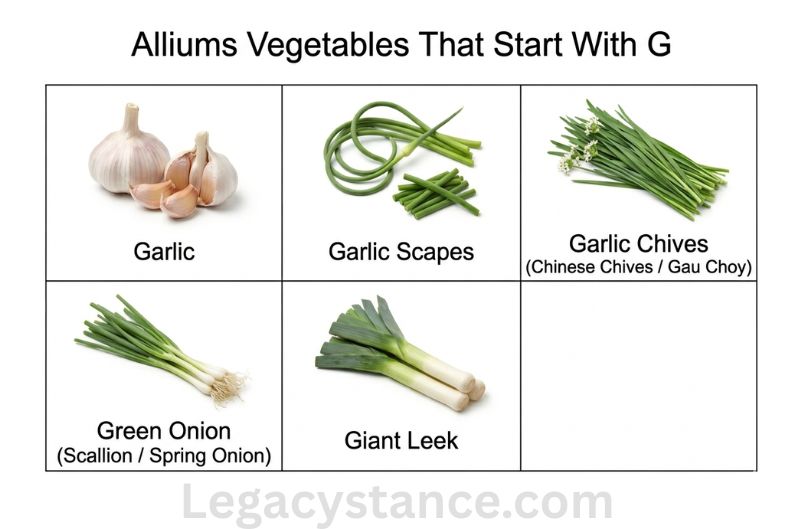
Garlic
- What it is: A bulb vegetable in the onion family, used in virtually every world cuisine
- Looks like: White or light purple outer skin, cream-colored cloves inside
- Taste: Sharp and pungent raw; buttery and mild when roasted
- Cook it: Minced into sauces, roasted whole, infused in oil, added to marinades and curries
- Storage tip: Keep in a cool, dark, dry spot — never the refrigerator. Cold triggers sprouting and bitterness
- Fact: Crushing or cutting garlic activates allicin, its key compound. Whole unbroken cloves produce almost none
Garlic Scapes
- What it is: The curling green flower stalks hardneck garlic sends up before harvest
- Looks like: Long, bright green, naturally curled spirals
- Taste: Milder than garlic cloves — fresh, grassy, with gentle heat
- Cook it: Grilled, blended into pesto, pickled, stir-fried, or used as a garlic substitute
- Storage tip: Refrigerate in a loose bag — stays fresh up to 3 weeks
- Fact: Farmers cut them off intentionally to grow larger bulbs. They used to be thrown away until farmers markets made them a seasonal item
Garlic Chives (Chinese Chives / Gau Choy)
- What it is: Flat-leafed chives with a distinct garlic flavor, staple in Chinese, Korean, and Japanese cooking
- Taste: Mild garlic flavor, softer than regular garlic
- Cook it: Dumplings, stir-fries, egg dishes, Korean pancakes (buchujeon)
- Fact: Yellow garlic chives exist too — they’re blanched in darkness, turning pale yellow with a sweeter, more delicate flavor
Green Onion (Scallion / Spring Onion)
- What it is: Young onion plants harvested before the bulb fully develops
- Looks like: Thin white stalks transitioning into hollow green tops
- Taste: White part is sharper; green tops are mild and grassy
- Cook it: Raw over soups and noodles, in fried rice, dumplings, salsas, scallion pancakes
- Storage tip: Stand root-end in a glass of water on the counter — stays fresh a week and keeps growing
- Fact: Spain’s La Calçotada festival is dedicated entirely to grilling a large spring onion variety called the calçot
Giant Leek
- What it is: A heritage variety of leek grown to oversized proportions in Northern England and Scotland
- Taste: Milder and sweeter than standard leeks
- Cook it: Slow-braised, added to soups and pies
- Fact: Competitive growing of giant leeks is a serious tradition in County Durham, UK
Roots & Rhizomes Vegetables That Start With G
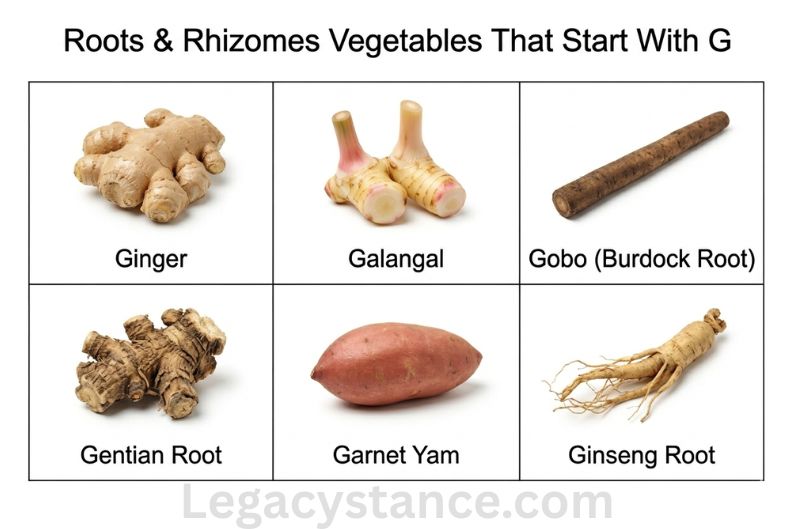
Ginger
- What it is: A rhizome (underground stem) native to Southeast Asia, used in cooking and traditional medicine for 3,000+ years
- Looks like: Knobby, tan-skinned, fibrous pale-yellow flesh inside
- Taste: Warming, spicy, slightly sweet — hits the back of the throat differently from chili heat
- Cook it: Grated into stir-fries, simmered into tea, minced into marinades, baked into cookies, pickled with sushi
- Storage tip: Freeze it. Grate directly from frozen — no peeling needed
- Fact: Clinical studies confirm ginger reduces nausea from motion sickness and morning sickness
Galangal
- What it is: A rhizome related to ginger but tasting completely different. Fundamental to Thai, Indonesian, and Malaysian cooking
- Looks like: Pale yellow to white, with pink-tinged rings at the joints. Harder and denser than ginger
- Taste: Sharp, piney, citrusy-peppery. You cannot substitute ginger for galangal and get the same result
- Cook it: Ground into Thai curry pastes, sliced into tom kha gai soup, Indonesian rendang, Malaysian laksa
- Storage tip: Freeze tightly wrapped. Slice directly from frozen
- Fact: Galangal was traded as a luxury spice in medieval Europe and used in both cooking and medicine
Gobo (Burdock Root)
- What it is: A long, thin root vegetable central to Japanese and Korean cooking
- Looks like: Up to 3 feet long, dark brown outside, cream-colored inside
- Taste: Earthy, slightly sweet, mildly bitter. Stays pleasantly firm after cooking
- Cook it: Braised in kinpira (soy sauce, mirin, sesame), added to miso soup, pickled as a side dish
- Storage tip: Submerge cut pieces in water with a splash of vinegar immediately — it browns extremely fast
- Fact: The inventor of Velcro got his idea from burdock burrs sticking to his dog’s fur
Gentian Root
- What it is: An Alpine European root used primarily as a bittering agent in traditional liqueurs (Aperol, Suze, Angostura)
- Taste: Among the bitterest plants used in food and drink — intensely so
- Cook it: Used in Alpine herbal preparations, digestive bitters, and mountain cuisine
- Fact: Even in tiny concentrations, gentian bitterness is immediately detectable
Garnet Yam
- What it is: A red-skinned sweet potato variety with deep orange flesh. Often mislabeled as a yam in US grocery stores
- Taste: Sweet, moist, rich when baked
- Cook it: Baked whole, mashed, roasted, added to soups
- Fact: True yams and sweet potatoes are botanically unrelated — the “yam” label in American stores is almost always a garnet sweet potato
Ginseng Root
- What it is: A slow-growing root used in Korean, Chinese, and traditional medicine for centuries
- Taste: Bitter and slightly sweet, with a medicinal earthiness
- Cook it: Brewed into tea, simmered into Korean samgyetang (ginseng chicken soup), sliced into broths
- Fact: Ginseng takes 4 to 6 years to mature for harvest. It’s one of the most labor-intensive roots to cultivate
Greater Plantain (Plantago Major)
- What it is: An edible broadleaf plant found worldwide, often dismissed as a weed
- Taste: Slightly bitter, earthy, with a mild herbal note
- Cook it: Young leaves eaten raw in salads, older leaves cooked in soups or blanched
- Fact: Used across European folk medicine traditions for wound healing and digestion
Groundnut / Bambara Groundnut
- What it is: A legume that grows underground like peanuts, drought-resistant, staple in sub-Saharan Africa
- Taste: Nutty and starchy — between a peanut and a chickpea
- Cook it: Boiled as a snack, ground into flour, added to stews
- Fact: Food security researchers are studying Bambara groundnuts because they grow in poor soils with minimal water
Giant Radish (Daikon)
- What it is: A large white root radish used heavily in Japanese, Korean, and Chinese cooking. “Giant radish” covers oversized varieties
- Taste: Mild, slightly peppery, crisp
- Cook it: Grated raw, pickled, added to soups, braised in soy
- Storage tip: Wrap in damp paper towels and refrigerate
Groundcherry (Ground Cherry)
- What it is: Small fruits inside papery husks related to tomatillos. Used as a vegetable in savory cooking
- Looks like: Small, round, yellow-orange inside a papery lantern-shaped husk
- Taste: Sweet and tart with tropical notes — pineapple meets tomato
- Cook it: Raw as snacks, made into jams, added to salsas, roasted in savory dishes
- Storage tip: Keep in husks at room temperature — lasts up to 3 weeks
- Fact: Native to North America, ground cherries were part of Indigenous food traditions long before European contact
Leafy Greens Vegetables That Start With G
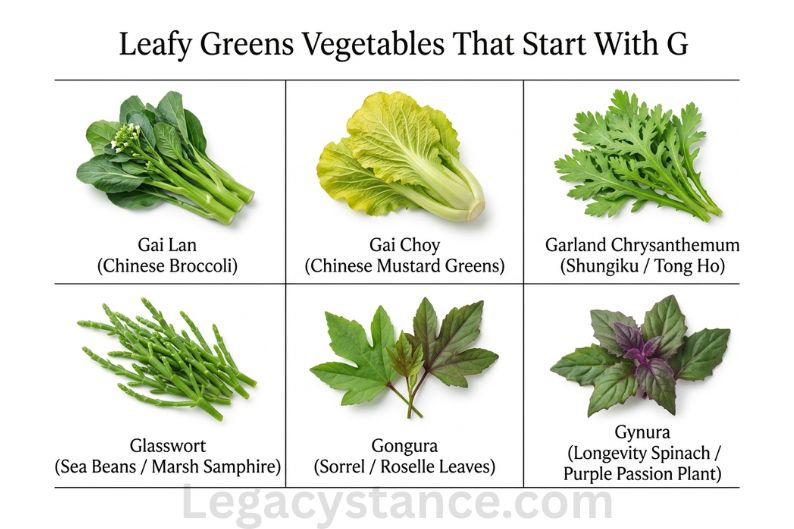
Gai Lan (Chinese Broccoli)
- What it is: A leafy brassica staple in Cantonese cooking
- Looks like: Thick green stems, dark blue-green leaves, small white flower buds
- Taste: Mildly bitter with a slight sweetness in the stems when properly cooked
- Cook it: Blanched with oyster sauce, stir-fried with garlic, added to noodle dishes
- Storage tip: Wrap in damp paper towels, refrigerate. Use within 3 to 4 days
- Fact: Traditional Chinese New Year banquets almost always include gai lan — the long stems symbolize longevity
Gai Choy (Chinese Mustard Greens)
- What it is: A pungent mustard green used across China, Vietnam, and Southeast Asia
- Looks like: Large crinkled yellow-green leaves with thick pale stems
- Taste: Distinctly mustard-like and sharp — more assertive than most leafy greens
- Cook it: Pickled into a sour condiment, added to soups, stir-fried, braised with meats
- Fact: Pickled gai choy (haam choy) is a foundational ingredient in Cantonese pork bone soups
Garland Chrysanthemum (Shungiku / Tong Ho)
- What it is: An edible chrysanthemum variety grown specifically for eating, popular in East and Southeast Asia
- Looks like: Bright green jagged leaves almost identical to decorative chrysanthemum plants
- Taste: Herbal, slightly bitter, with a distinctive floral undertone
- Cook it: Hot pot, shabu-shabu, Japanese New Year dishes, lightly stir-fried
- Storage tip: Wrap in a damp cloth, refrigerate. Use within 2 days — wilts quickly
- Fact: The same genus produces this edible plant and the chrysanthemums sold in flower shops
Glasswort (Sea Beans / Marsh Samphire)
- What it is: A coastal succulent growing in salt marshes, historically burned for soda ash used in glassmaking
- Looks like: Bright green jointed stems resembling tiny cacti or asparagus tips
- Taste: Intensely salty, fresh, pleasantly crisp. No additional salt needed in cooking
- Cook it: Eaten raw in salads, briefly blanched with fish, pickled, used as a seafood garnish
- Storage tip: Rinse well, refrigerate in a damp cloth, use within 3 days — loses crunch quickly
- Fact: In Tudor England, glasswort was collected from sea cliffs at genuine personal risk — it was considered a dangerous harvest
Gongura (Sorrel / Roselle Leaves)
- What it is: Intensely sour leafy green from the roselle plant, central to Andhra Pradesh cooking in India
- Looks like: Green to reddish-green lobed leaves
- Taste: Intensely tart and sour — the most aggressively flavored leafy green in South Indian cooking
- Cook it: Made into chutneys, cooked with lamb or chicken, mixed into dals and rice
- Fact: The same plant produces both gongura leaves and hibiscus flowers used for tea
Gynura (Longevity Spinach / Purple Passion Plant)
- What it is: A leafy plant from Southeast Asia and parts of Africa with a devoted following in health food communities
- Looks like: Green or deep purple-tinged leaves with a velvety texture
- Taste: Mild, slightly bitter — similar to spinach with an earthier note
- Cook it: Eaten raw in salads, lightly stir-fried, added to soups
- Fact: Sometimes grown as a houseplant in the West without people realizing it’s edible
Good King Henry
- What it is: An old European leafy vegetable once very widely eaten, now largely forgotten
- Taste: Earthy and green, with a slightly wild character — young shoots like asparagus, leaves like spinach
- Cook it: Young shoots cooked like asparagus, leaves cooked like spinach
- Fact: The rise of spinach as a common grocery item directly pushed Good King Henry out of people’s diets. Heritage seed growers still cultivate it
Green Amaranth
- What it is: The leafy green form of the amaranth plant, grown for its edible leaves across Africa, Asia, and the Americas
- Taste: Mild, slightly earthy — similar to spinach when cooked
- Cook it: Sautéed with garlic, added to soups, eaten raw when young
- Fact: Amaranth greens are called “callaloo” in Caribbean cooking — a completely different dish from Jamaican callaloo (taro leaves)
Grape Leaves
- What it is: The edible leaves of grapevines, best known for wrapping rice and meat fillings
- Taste: Tangy, slightly earthy, with a pleasant chewiness when brined or cooked
- Cook it: Dolma / dolmades (stuffed grape leaves), as wrappers for grilled dishes
- Fact: Young, tender leaves are far preferable to older ones — old leaves become tough and fibrous
Grelos (Turnip Greens)
- What it is: The leafy tops of turnip plants, beloved in Portuguese and Galician cooking
- Taste: Bitter and peppery — assertive against rich pork or sausage
- Cook it: Braised with chorizo and potatoes, sautéed with olive oil and garlic, added to broths
- Fact: Galicia, Spain holds an annual Festa do Grelo — an entire festival dedicated to this green every February
Garden Rocket (Arugula)
- What it is: A peppery leafy green used across Italian and Mediterranean cooking
- Taste: Distinctly peppery and slightly bitter — more intense than most salad greens
- Cook it: Raw in salads, on top of pizza, in pasta, as a bruschetta topping
- Fact: Arugula was considered an aphrodisiac in ancient Rome — it was grown in sacred gardens
Garden Cress
- What it is: A fast-growing edible sprout widely used in European cooking and increasingly popular as a microgreen
- Looks like: Tiny bright green shoots with round leaves
- Taste: Sharp, peppery, similar to mustard
- Cook it: Sprinkled raw over salads, soups, egg dishes, sandwiches
- Fact: Garden cress can be grown on a damp paper towel on a windowsill and is ready to eat in 5 to 7 days
Golden Samphire
- What it is: A coastal plant with edible young shoots, different from marsh samphire / glasswort
- Taste: Aromatic and slightly bitter
- Cook it: Used similarly to sea vegetables, in salads and pickles
- Fact: Golden samphire grows on rocky cliffs and shingle beaches across the British Isles
Goutweed (Ground Elder)
- What it is: A plant widely considered an invasive garden weed, but edible when young
- Taste: Mild and slightly herbal, similar to parsley or angelica
- Cook it: Young leaves used raw in salads or cooked in soups
- Fact: Introduced to Northern Europe by Romans as a food plant. It spread so aggressively it became one of the hardest garden weeds to remove
Green Purslane
- What it is: A succulent leafy plant with high nutritional density, used widely in Middle Eastern and Mediterranean cooking
- Taste: Slightly sour and mildly salty, with a refreshing crisp texture
- Cook it: Raw in salads (fattoush), lightly sautéed, added to yogurt dishes
- Fact: One of the highest plant sources of omega-3 fatty acids — more than most land vegetables
Golden Purslane
- What it is: A cultivated variety of purslane with broader, golden-green leaves
- Taste: Slightly lemony flavor compared to green purslane
- Cook it: Used the same way as green purslane, but considered more refined for culinary use
- Fact: Actively cultivated rather than foraged — grown intentionally in herb gardens
Gnetum Leaves (Melinjo Leaves)
- What it is: Edible leaves from the gnetum gnemon tree, used in Indonesian cooking
- Taste: Slightly bitter and savory
- Cook it: Added to soups like sayur lodeh, cooked with coconut milk
- Fact: The seeds of the same tree are ground into a chip called emping — a popular Indonesian snack
Gundruk
- What it is: A fermented leafy green from Nepal and the eastern Himalayas, made from mustard or radish leaves
- Taste: Sour, slightly pungent — a result of lacto-fermentation
- Cook it: Added to soups, cooked with potatoes, eaten as a side with rice
- Fact: Gundruk was developed as a preservation method for surplus leafy greens before winter in mountain regions
Brassicas / Cruciferous Vegetables That Start With G
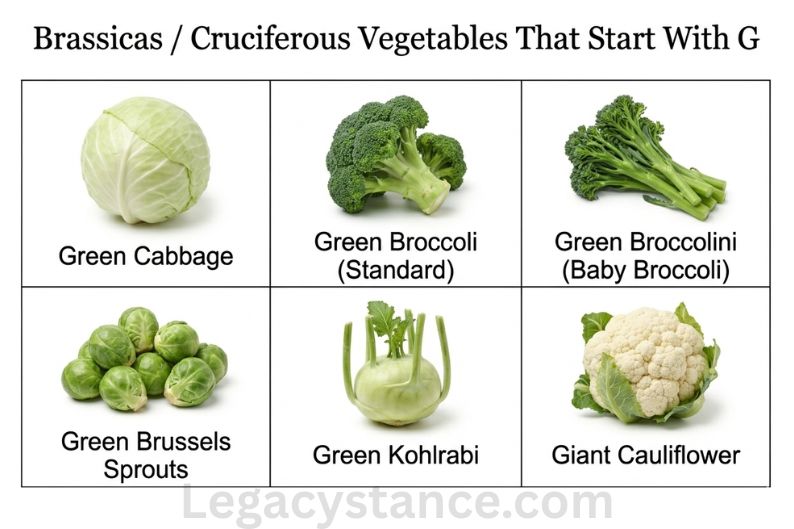
Green Cabbage
- What it is: One of the most widely grown brassicas on earth
- Looks like: Pale to medium green, tightly packed round head
- Taste: Mild and slightly peppery raw; sweeter when cooked or fermented
- Cook it: Coleslaw, sauerkraut, kimchi, stuffed cabbage rolls, braised with apples, added to soups
- Storage tip: Whole heads keep for weeks refrigerated. Once cut, wrap the cut side
- Fact: Dutch sailors ate fermented cabbage (sauerkraut) across month-long voyages to prevent scurvy
Green Broccoli (Standard)
- What it is: The most commonly consumed cruciferous vegetable globally
- Taste: Mildly grassy and slightly bitter, becomes nuttier when roasted
- Cook it: Roasted, steamed, stir-fried, added to pasta and soups
- Fact: Broccoli was largely unknown in the United States until the 1920s when Italian immigrants brought it over
Green Broccolini (Baby Broccoli)
- What it is: A hybrid between broccoli and Chinese broccoli (gai lan), developed in Japan in the 1990s
- Taste: More tender and sweeter than broccoli, with smaller florets and long thin stems
- Cook it: Roasted, grilled, stir-fried, steamed
- Fact: Broccolini is sometimes called “asparation” — a portmanteau of asparagus and broccoli
Green Brussels Sprouts
- What it is: Small compact brassica buds growing along a thick stalk
- Taste: Mild when properly cooked; bitter and sulfurous when overcooked
- Cook it: Roasted at high heat (the best method), shredded into slaws, pan-fried with bacon or pancetta
- Fact: They grow on stalks, not underground. Buying them on the stalk keeps them fresher longer
Green Kohlrabi
- What it is: A brassica with a swollen edible stem that grows above ground, looking like a flying saucer
- Looks like: Pale green, round, with protruding leaf stems
- Taste: Mild and sweet — like a cross between a broccoli stem and an apple
- Cook it: Eaten raw in slaws, roasted, added to stir-fries, steamed
- Fact: The name comes from German: “kohl” (cabbage) + “rübe” (turnip)
Giant Cauliflower
- What it is: An oversized cauliflower variety grown for size rather than flavor. Common in competition growing circles
- Taste: Milder than standard cauliflower
- Cook it: Same as regular cauliflower — roasted, riced, added to soups
Green Romanesco
- What it is: A striking lime-green cruciferous vegetable with a mathematically precise fractal pattern
- Taste: Milder and nuttier than broccoli, slightly crunchy
- Cook it: Roasted, steamed, pasta dishes
- Fact: The florets of romanesco follow a Fibonacci spiral — it’s one of the most mathematically precise patterns found in nature
Legumes & Pods Vegetables That Start With G
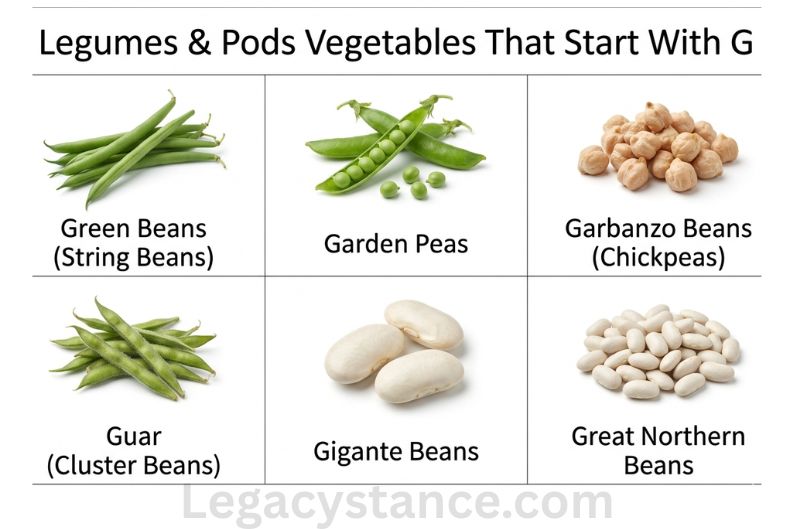
Green Beans (String Beans / French Beans / Snap Beans)
- What it is: The unripe pods of common bean plants, called different names across different countries
- Looks like: Long, slender, bright green pods that snap cleanly when fresh
- Taste: Mild and grassy raw; savory and tender cooked
- Cook it: Blanched cold in salads, sautéed with garlic, steamed, added to casseroles, stir-fried with sesame
- Storage tip: Store unwashed in a dry bag in the crisper. Use within 5 to 7 days
- Fact: Green and yellow wax beans are the same species — only the color differs
Garden Peas (Green Peas)
- What it is: Seeds from Pisum sativum pods, one of the oldest cultivated vegetables
- Looks like: Small, round, bright green, sold fresh in pods, canned, or frozen
- Taste: Sweet and mild — fresh peas have a natural sweetness canned peas can’t replicate
- Cook it: Rice dishes, pasta, pureed soups, salads, Indian curries, British mushy peas
- Storage tip: Frozen peas retain nutrition better than peas left in the fridge for several days
- Fact: Gregor Mendel used green peas for his landmark genetics experiments in the 1860s
Garbanzo Beans (Chickpeas)
- What it is: A legume from the family Fabaceae, staple across the Middle East, Mediterranean, and South Asia
- Taste: Nutty, slightly earthy, creamy when cooked
- Cook it: Hummus, falafel, chana masala, Moroccan chickpea soup, roasted as snacks
- Fact: Chickpeas count as both a protein and a vegetable in dietary guidelines — one of very few foods to do so
Guar (Cluster Beans)
- What it is: Long narrow pods grown in India and parts of Africa, called “gavar phali” in Indian cooking
- Looks like: Thin, dark green, slightly fuzzy pods growing in clusters
- Taste: Mild and slightly bitter with a starchy texture
- Cook it: Sautéed in Indian dry curries (sabzi), added to lentil dishes, cooked into vegetable stews
- Fact: Guar gum — found in ice cream, salad dressings, and countless processed foods — comes from the seeds of this plant
Gigante Beans
- What it is: Large white butter beans central to Greek cooking, particularly in the dish gigantes plaki
- Taste: Creamy, rich, and mild — absorb surrounding flavors beautifully
- Cook it: Baked in tomato sauce, added to soups, served as a main dish
- Fact: Gigante means “giant” in Greek — they’re among the largest bean varieties in the world
Great Northern Beans
- What it is: Medium-sized white beans with a mild flavor, popular in American and French cooking
- Taste: Mild, creamy, slightly nutty
- Cook it: Soups, stews, cassoulet, white bean dip, baked beans
- Fact: Great Northern beans hold their shape better in long cooking than navy beans — a useful distinction for slow cooker dishes
Green Soybeans (Edamame)
- What it is: Immature soybeans harvested before they harden, popular in Japanese cooking
- Taste: Sweet, nutty, with a slight grassy freshness
- Cook it: Boiled or steamed in pods with salt, shelled and added to rice or salads
- Fact: Edamame is one of the few plant foods containing all nine essential amino acids
Green Lentils
- What it is: A widely used lentil variety with a peppery flavor, holds its shape better than red lentils
- Taste: Peppery and earthy, with more texture than red or yellow lentils
- Cook it: Salads, soups, lentil stews (dal), French lentilles du Puy dishes
- Fact: French Puy lentils are a protected designation of origin — only lentils grown in the Puy region of France can legally use that name
Galega Bean (Goat’s Rue)
- What it is: A rare legume with a long history in European herbal traditions
- Taste: Mild and slightly bitter
- Cook it: Cooked similarly to other small beans
- Fact: Galega officinalis was used in folk medicine and is the botanical source from which metformin (a diabetes drug) was eventually developed
Green Black-Eyed Peas
- What it is: The fresh, green, unripe version of black-eyed peas before they dry
- Taste: Sweeter and more tender than dried black-eyed peas
- Cook it: Boiled, added to salads, cooked into Southern US hoppin’ john
- Fact: Black-eyed peas are not actually peas — they’re a variety of cowpea native to West Africa
Squash & Gourds Vegetables That Start With G
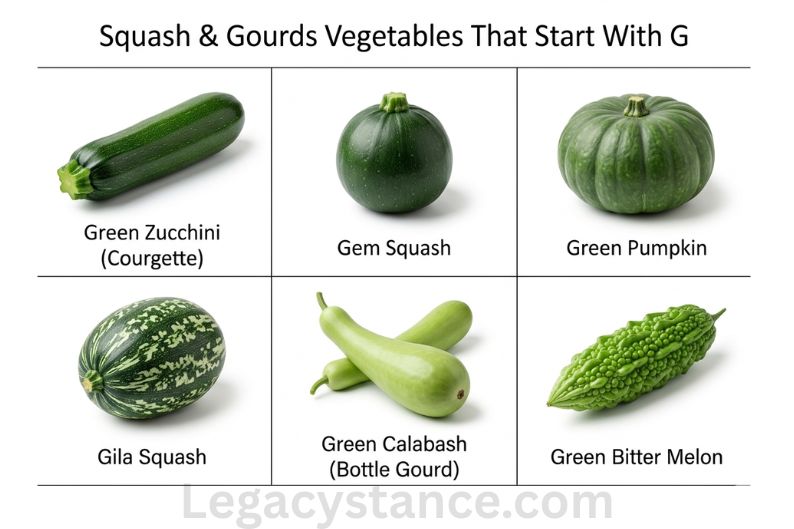
Green Zucchini (Courgette)
- What it is: A summer squash with Italian roots, one of the most productive garden vegetables
- Looks like: Long, cylindrical, dark to medium green with glossy smooth skin
- Taste: Mild and slightly watery raw; slightly sweet and tender when cooked
- Cook it: Grilled, spiralized into noodles, added to frittatas, baked into bread, stuffed and roasted
- Storage tip: Keep in the crisper — not the coldest part of your fridge. Gets mushy when too cold
- Fact: Zucchini grows so fast in summer that leaving a bag of them on a neighbor’s porch is a well-worn gardening joke
Gem Squash
- What it is: A small, round squash about the size of an orange, popular in South African cooking
- Looks like: Dark green, smooth, perfectly round — like a tiny pumpkin
- Taste: Mild and slightly sweet, with tender flesh
- Cook it: Halved and baked with butter, stuffed with cheese or minced meat
- Fact: Gem squash is one of South Africa’s most beloved home-cooked vegetables but is almost unknown outside that country
Green Pumpkin
- What it is: An unripe or green-skinned pumpkin variety used in cooking before it fully ripens
- Taste: Milder and less sweet than orange pumpkin
- Cook it: Curries, soups, stews, roasted
Gila Squash
- What it is: A heritage squash variety from the American Southwest, traditionally grown by Native American communities
- Taste: Sweet and dense — stores exceptionally well
- Cook it: Baked, added to soups and stews
Green Calabash (Bottle Gourd / Lauki / Doodhi)
- What it is: A long, pale green gourd widely used in South Asian, Middle Eastern, and African cooking
- Taste: Very mild and slightly sweet — absorbs surrounding flavors readily
- Cook it: Added to curries, cooked into soups, stuffed, used in Indian halwa (dessert)
- Fact: Archaeological evidence shows bottle gourds were used as water containers by ancient humans — some of the earliest cultivated plants
Green Bitter Melon (Bitter Gourd / Karela)
- What it is: A deeply bitter gourd used heavily in South and Southeast Asian cooking
- Looks like: Bumpy, warty, elongated, bright green exterior
- Taste: Intensely bitter — the most bitter commonly eaten vegetable. It takes getting used to
- Cook it: Stir-fried with eggs (a Chinese classic), stuffed and cooked in Indian cuisine, added to soups
- Fact: Bitter melon is used in traditional medicine across South Asia, China, and the Caribbean for blood sugar management. Clinical studies show modest evidence supporting this
Green Chayote (Chow-Chow / Vegetable Pear)
- What it is: A mild gourd native to Central America, now grown across tropical regions worldwide
- Looks like: Pear-shaped, pale to medium green, with a single large seed inside
- Taste: Very mild and slightly sweet — often compared to a cross between cucumber and zucchini
- Cook it: Stir-fried, added to soups and curries, stuffed, eaten raw in salads
- Fact: Chayote has a single seed that can sprout while still inside the fruit
Green Winter Squash (various)
- What it is: Multiple winter squash varieties with green skin — includes varieties like green Hubbard
- Taste: Dense, sweet, and nutty
- Cook it: Roasted, pureed into soups, baked
Green Acorn Squash
- What it is: An acorn-shaped winter squash with dark green ribbed skin
- Taste: Sweet, nutty, slightly peppery
- Cook it: Halved and roasted with brown sugar or butter, stuffed, pureed into soup
Gourds (General — Ash Gourd / Winter Melon)
- What it is: Large, pale green-white gourd used in South and East Asian cooking
- Taste: Very mild, almost flavorless alone — acts as a flavor absorber
- Cook it: Added to soups and curries, used in Chinese clay pot dishes, made into Indian petha candy
Peppers & Nightshades Vegetables That Start With G
Green Bell Pepper
- What it is: An unripe bell pepper — picked before it turns red, yellow, or orange
- Looks like: Glossy, blocky, thick-walled, bright green
- Taste: More bitter and less sweet than ripe bell peppers
- Cook it: Stuffed with rice and meat, added to stir-fries and fajitas, eaten raw with dips, diced into salsas
- Fact: Green bell peppers have significantly less Vitamin C than red ones — the ripening process dramatically increases it
Green Chili Pepper
- What it is: The unripe version of any chili pepper — covers hundreds of varieties globally
- Taste: Ranges from mild (Anaheim, Poblano) to intensely hot (Thai green chili, Serrano)
- Cook it: Roasted, added to salsas, stuffed, cooked into curries, dried and ground
- Fact: Green and red chilies of the same variety are the same plant at different stages. Green ones are generally less sweet but can be spicier or milder depending on the variety
Green Jalapeño
- What it is: The most widely consumed green chili in North America
- Taste: Moderately hot with a bright, vegetal flavor
- Cook it: Poppers, pickled, sliced over nachos, added to salsas and guacamole
Ghost Pepper (Bhut Jolokia)
- What it is: One of the world’s hottest chili peppers, native to Northeast India
- Taste: Extremely hot with a fruity, smoky note underneath the intense heat
- Cook it: Used sparingly in pickles and very hot chutneys. Handled with extreme caution
- Fact: Ghost pepper was briefly the hottest chili in the world by Guinness World Records (2007). It has since been surpassed by Carolina Reaper and Pepper X
Green Tomato
- What it is: An unripe tomato — and in some cases a variety specifically bred to stay green when ripe (Green Zebra, Aunt Ruby’s German Green)
- Looks like: Firm, slightly waxy, uniformly green or green-white
- Taste: Tart and acidic with minimal sweetness
- Cook it: Fried (a Southern US classic), pickled, made into chutneys, used in salsa verde
- Fact: The 1991 film “Fried Green Tomatoes” created a lasting spike in Southern restaurant menus
Green Tomatillo
- What it is: A small, husked fruit-vegetable fundamental to Mexican cooking
- Looks like: Small, round, bright green inside a papery husk — similar to ground cherry but more savory
- Taste: Tart, tangy, and bright — much more acidic than red tomatoes
- Cook it: Roasted or raw into salsa verde, cooked into enchilada sauce, added to guacamole
- Fact: Tomatillos are not unripe tomatoes — they’re a completely different plant in the nightshade family
Garden Egg (White / Green Eggplant)
- What it is: Small egg-shaped eggplant varieties, typically white or pale green, common across West Africa
- Taste: Milder and less bitter than large purple eggplant
- Cook it: Added to West African stews, grilled, stuffed
- Fact: The name “eggplant” comes directly from these small white varieties that look like eggs on the plant
Green Eggplant (Thai Eggplant)
- What it is: Small, round, green-and-white eggplants used in Thai green and red curries
- Taste: Slightly bitter, firm, holds its texture in curries
- Cook it: Added whole or halved to Thai curries, grilled, pickled
Stems & Shoots Vegetables That Start With G
Green Asparagus
- What it is: Young shoots of a perennial plant harvested in spring
- Looks like: Long thin green stalks with tightly closed purple-tinged tips
- Taste: Slightly grassy, earthy, and nutty. Thin stalks are more tender; thick ones meatier
- Cook it: Roasted with olive oil, grilled with parmesan, blanched cold, added to risotto, wrapped in prosciutto
- Storage tip: Treat like cut flowers — trim ends and stand in a glass of water in the fridge
- Fact: Asparagus makes urine smell different for most people due to asparagusic acid. Whether you detect the odor is genetic
Giant Corn (Corn on the Cob — large varieties)
- What it is: Oversized corn varieties like Peruvian choclo, with much larger kernels than standard sweet corn
- Taste: Starchier and less sweet than sweet corn — more like a grain
- Cook it: Boiled, roasted on the cob, added to Peruvian dishes
Green Bamboo Shoots
- What it is: The edible young shoots of bamboo plants, harvested before they harden
- Taste: Mild, slightly earthy, crisp when fresh
- Cook it: Added to stir-fries, soups, ramen, and Asian braised dishes
- Fact: Fresh bamboo shoots contain naturally occurring cyanogenic compounds that are neutralized by boiling — always cook them before eating
Green Celery
- What it is: The most commonly grown celery variety, with bright green stalks and leaves
- Taste: Crisp, mild, and slightly bitter with a distinctive herbal aroma
- Cook it: Raw in salads and as a snack, added to soups and stocks, braised as a vegetable
- Storage tip: Wrap stalks in aluminum foil in the refrigerator — keeps crisp far longer than a bag
Green Fennel
- What it is: A bulb vegetable with feathery fronds and a mild anise flavor
- Taste: Mildly sweet and anise-like when raw; mellows into something nutty and sweet when roasted
- Cook it: Shaved raw into salads, roasted, braised with fish, added to stocks
- Fact: Every part of fennel is edible — the bulb, stalks, fronds, and seeds
Garlic Mustard
- What it is: An edible wild plant with both garlic and mustard notes, technically edible though invasive in North America
- Taste: Garlicky with a distinct mustard peppery bite
- Cook it: Young leaves used in salads and pesto
- Fact: Garlic mustard is one of the most invasive plants in North American forests — foragers are actively encouraged to harvest it
ROOTS (ADDITIONAL)
German Butterball Potato
- What it is: A heritage potato variety with golden skin and buttery dense yellow flesh
- Taste: Naturally buttery and rich — needs minimal seasoning
- Cook it: Roasted, boiled, mashed
Green (Fingerling) Potato
- What it is: A general term for potatoes with naturally green-tinted or heritage varieties
- Note: A potato that has turned green from light exposure should be avoided — greening indicates solanine buildup, which causes stomach upset
Grasspea (Grass Pea / Khesari Dal)
- What it is: A drought-resistant legume grown in South Asia and East Africa
- Taste: Earthy and slightly nutty
- Cook it: Cooked into dal, added to soups
- Fact: Grasspea can cause a neurological disorder (lathyrism) when consumed in very large quantities over long periods with no dietary variety — historically documented during famines
Groundsel
- What it is: A wild edible plant in the daisy family — historically consumed in some European foraged food traditions
- Taste: Bitter and herbal
- Cook it: Rarely eaten now — primarily historical interest
Herbs Used As Vegetables That Start With G
Genovese Basil
- What it is: The classic Italian basil variety, the foundation of Genoese pesto
- Taste: Sweet, clove-like, intensely aromatic
- Cook it: Made into pesto, torn over pizza and pasta, used in Caprese salad
- Fact: True Genovese basil is a protected designation — certified pesto from Genoa can only use this specific variety
Garden Thyme
- What it is: A woody herb used extensively in European cooking
- Taste: Earthy, slightly floral, mildly peppery
- Cook it: Roasted meats, soups, stews, marinades
Garden Sage
- What it is: A silver-green herb with a strong, distinctive flavor
- Taste: Earthy, slightly camphor-like, intensely savory
- Cook it: Brown butter sage sauce, stuffings, pork dishes, added to gnocchi
Green Coriander (Cilantro)
- What it is: The fresh leafy form of the coriander plant — used as a vegetable herb in global cooking
- Taste: Bright, citrusy, herbal. A genetic trait makes some people perceive it as soapy
- Cook it: Raw garnish over tacos, curries, soups, dals, salsas
Green Dill
- What it is: A feathery green herb widely used in Scandinavian, Eastern European, and Middle Eastern cooking
- Taste: Fresh, slightly anise-like, distinctively aromatic
- Cook it: Pickles, salmon dishes, yogurt sauces, borscht
Green Parsley
- What it is: One of the most widely used culinary herbs, used as both a garnish and a substantive ingredient
- Taste: Fresh and slightly peppery — flat-leaf parsley has more flavor than curly
- Cook it: Tabbouleh (where it’s the main ingredient, not just a garnish), chimichurri, gremolata, soups
Green Chervil
- What it is: A delicate herb resembling parsley but with a subtle anise flavor — common in French cooking
- Taste: Mild, slightly sweet, anise-like
- Cook it: Omelettes, fine herbes blends, used raw over salads and soups
Green Marjoram
- What it is: A milder, sweeter relative of oregano
- Taste: Delicate and sweet — more floral than oregano
- Cook it: Italian and Greek dishes, sausages, tomato-based sauces
Green Oregano
- What it is: One of the most widely used herbs in Mediterranean cooking
- Taste: Peppery, slightly bitter, aromatic
- Cook it: Pizza, pasta sauces, Greek salads, marinades for grilled meats
Green Tarragon (French Tarragon)
- What it is: A delicate herb central to French cuisine — one of the four fine herbes
- Taste: Mild anise flavor — softer than basil or parsley
- Cook it: Béarnaise sauce, chicken dishes, vinaigrettes, egg preparations
Additional Vegetables That Start With G
Green Watercress
- What it is: A fast-growing aquatic plant with a sharp, peppery flavor
- Taste: Peppery and slightly bitter — more intense than most salad greens
- Cook it: Added raw to salads, blended into soups, used as a garnish for steak
- Fact: One of the oldest known leaf vegetables eaten by humans — cultivated since antiquity
Glasswort (Rock Samphire)
- What it is: A different samphire variety from marsh glasswort, growing on rocky coastal cliffs
- Taste: Aromatic, slightly carrot-like and salty
- Cook it: Pickled, used in coastal European fish dishes
- Fact: Shakespeare mentions samphire in King Lear — characters harvest it from dangerous cliff faces
Green Mizuna
- What it is: A Japanese mustard green with feathery, jagged leaves
- Taste: Mild and slightly peppery — more delicate than gai choy
- Cook it: Raw in salads, added to ramen, lightly wilted in stir-fries
Green Tatsoi
- What it is: A rosette-forming Asian green with thick, spoon-shaped leaves
- Taste: Mild and slightly sweet — gentler than most Asian mustard greens
- Cook it: Salads, stir-fries, soups
Green Pak Choi (Bok Choy)
- What it is: A leafy green in the brassica family, central to Chinese cooking
- Looks like: Thick white stems with dark green leaves
- Taste: Juicy crisp stems, tender leaves. Mild and slightly cabbage-like
- Cook it: Stir-fries, soups, noodle dishes, steamed as a side
- Fact: The white stems take a few minutes longer to cook than the leaves — start them first
Green Endive / Belgian Endive
- What it is: A type of chicory with tightly packed leaves, grown in darkness to keep them pale and mild
- Taste: Crisp and pleasantly bitter — bitterness mellows when cooked
- Cook it: Used as “boats” for salad fillings, braised in butter, grilled, added to mixed salads
- Storage tip: Wrap in paper towels and protect from light — light exposure increases bitterness
Green Oak Leaf Lettuce
- What it is: A looseleaf lettuce with deeply lobed oak-shaped leaves
- Taste: Mild, slightly buttery, very tender
- Cook it: Raw in salads — doesn’t hold up to heat
Green Butterhead Lettuce
- What it is: A soft, loosely folded lettuce with a buttery texture
- Taste: Very mild and slightly sweet
- Cook it: Wraps for meat or grain fillings, salads
Green Iceberg Lettuce
- What it is: The most commercially produced lettuce in North America — crisp and mild
- Taste: Mild, very crisp, and watery — carries dressings well
- Cook it: Wedge salad, sandwiches, burgers, shredded into tacos
- Fact: Iceberg lettuce dominated American salads in the 20th century because it survived long refrigerated transport — flavor was secondary to shelf life
Green Romaine Lettuce
- What it is: Upright, firm-leafed lettuce, the standard for Caesar salad
- Taste: Mild with a slight bitterness and a satisfying crunch
- Cook it: Caesar salad, grilled in halves (yes — grilling romaine is excellent), wraps
Green Sorrel
- What it is: A tart, lemony leafy green used widely in French and Eastern European cooking
- Taste: Intensely sour and lemony — wilts dramatically when cooked, losing much of its volume
- Cook it: Sorrel soup, mixed into cream sauces for fish, used in salads
- Fact: Sorrel is one of the few vegetables with oxalic acid high enough to affect the texture of cream — it thickens sauces without any starch
Green Swiss Chard
- What it is: A leafy green with broad leaves and thick stalks, related to beets
- Taste: Slightly earthy, milder than spinach, with tender leaves
- Cook it: Sautéed with garlic, added to soups and frittatas, used in Turkish börek
Green Kale
- What it is: A leafy brassica green with thick, crinkled or flat leaves
- Taste: Earthy and slightly bitter — mellows when massaged raw or cooked
- Cook it: Chips, sautéed, added to soups, massaged into salads
- Fact: Kale was one of the most commonly eaten vegetables in Europe during the Middle Ages — its comeback is relatively recent
Green Spinach
- What it is: A fast-growing leafy green, one of the most nutritionally dense common vegetables
- Taste: Mild and slightly earthy raw; collapses into a concentrated, slightly metallic-tasting mass when cooked
- Cook it: Salads, added to pasta and soups, sautéed, smoothies, Indian palak dishes
Gotu Kola
- What it is: A leafy herb-vegetable used in Sri Lankan, Indian, and Southeast Asian cooking and traditional medicine
- Taste: Mildly bitter and grassy
- Cook it: Sri Lankan mallung (chopped salad with coconut), added to sambol, used in juices
- Fact: Used in Ayurveda and traditional Chinese medicine for brain health and wound healing
Ginger Mint
- What it is: A mint variety with a subtle ginger-like warming note
- Taste: Cool mint with background warmth
- Cook it: Herbal teas, cocktails, dessert garnishes
Garden Lovage
- What it is: A large-leaved herb tasting strongly of celery, used in European traditional cooking
- Taste: Bold and celery-like, more intense than actual celery
- Cook it: Soups, stocks, potato dishes — use sparingly as it overpowers
- Fact: Popular in medieval European cooking — fell out of use when celery became widely available
Green Mustard Leaves
- What it is: The leafy greens of the mustard plant — different from mustard seeds
- Taste: Peppery and pungent, more so than spinach or kale
- Cook it: Sautéed, added to soups, braised with pork — popular in American Southern and Indian cooking
Grains of Paradise
- What it is: A spice seed from West Africa used as a vegetable-spice in traditional cooking
- Taste: Complex — peppery, floral, with hints of cardamom and citrus
- Cook it: West African stews, some craft beers, used in ras el hanout spice blend
- Fact: Grains of Paradise were the primary pepper substitute in medieval Europe before black pepper became affordable
Green Papaya
- What it is: Unripe papaya used as a vegetable rather than a fruit
- Taste: Mild, slightly vegetal, and crisp — none of the sweetness of ripe papaya
- Cook it: Som tum (Thai green papaya salad), pickled, cooked into curries
- Fact: Green papaya contains an enzyme called papain, used commercially as a meat tenderizer
Green Mango (as a vegetable)
- What it is: Unripe mango used as a sour, crisp vegetable in South and Southeast Asian cooking
- Taste: Sharply sour and tangy, crunchy
- Cook it: Chutneys, pickles (aam ka achar), Thai salads, added raw to salads
- Fact: Raw green mango is more nutritious per gram than ripe mango — higher in vitamin C
Green Jackfruit
- What it is: Unripe jackfruit used as a meat substitute because of its texture — meaty and fibrous when cooked
- Taste: Virtually flavorless raw — absorbs surrounding spices and sauces
- Cook it: Pulled “pork” style in sandwiches, Indian green jackfruit curry (kathal ki sabzi)
- Fact: Green jackfruit has become a globally popular plant-based meat alternative — its texture mimics pulled pork unusually well
Green Plantain
- What it is: Unripe plantain used as a starchy vegetable — completely different from ripe yellow plantain
- Taste: Starchy, not sweet, with a dense, almost potato-like texture
- Cook it: Fried into tostones (double-fried plantain chips), boiled, made into West African fufu
- Fact: Green and yellow plantain are the same fruit at different ripeness stages — but they function as completely different foods in the kitchen
Gari (Fermented Cassava)
- What it is: A processed fermented cassava product used as a staple starch across West Africa
- Taste: Slightly sour and starchy
- Cook it: Mixed with water into eba (a fufu-like starch), eaten with soups and stews
- Fact: Gari is one of the most important food staples across Nigeria, Ghana, and surrounding countries — more so than rice in many areas
Green Breadfruit
- What it is: Unripe breadfruit used as a starchy vegetable across the Pacific, Caribbean, and parts of Africa
- Taste: Starchy and potato-like — no sweetness until fully ripe
- Cook it: Roasted, boiled, added to soups, made into chips
- Fact: Breadfruit was introduced to the Caribbean by Captain Bligh — the same voyage that ended in the famous mutiny on the Bounty
Green Banana (as a vegetable)
- What it is: Unripe banana used as a cooking starch across South Asia, Southeast Asia, East Africa, and the Caribbean
- Taste: Starchy, slightly tannic, no sweetness
- Cook it: Boiled curries (kachkala in South Asian cooking), added to soups, fried into chips
- Fact: Green banana flour is gaining attention as a gluten-free, high-resistant-starch alternative
Grumichama
- What it is: A small tree fruit from Brazil used as a vegetable-fruit in South American cooking
- Taste: Sweet and slightly sour — similar to a grape
- Cook it: Made into jams, eaten fresh, used in chutneys
Geliche (Kafal)
- What it is: An edible berry-bearing tree from subtropical Himalayan regions, used locally as food
- Taste: Sweet-sour, aromatic
- Fact: Used in traditional Himalayan communities as both food and a natural preservative
Green Lotus Root
- What it is: The edible underwater stem of the lotus plant, used across Chinese, Japanese, Korean, and Indian cooking
- Looks like: Cream-colored, cylindrical, with distinctive holes running through it
- Taste: Mildly sweet and starchy, stays crisp even after cooking
- Cook it: Stir-fried, added to soups, deep-fried into chips, pickled
- Fact: The holes in lotus root are not seeds — they’re air channels that help the plant breathe underwater
Green Neem Leaves
- What it is: Extremely bitter leaves from the neem tree, used sparingly in South Indian cooking
- Taste: One of the bitterest edible leaves — used in tiny quantities
- Cook it: Fried briefly in oil and added to rice dishes in Tamil Nadu during festivals
- Fact: The same tree produces neem oil, used in pesticides and skincare products
Gai Choy (Yellow) / Golden Mustard Greens
- What it is: A yellow-green form of mustard greens with a slightly milder flavor
- Taste: Less sharp than dark green gai choy, slightly sweet
- Cook it: Pickled, stir-fried, added to soups
Most Popular Vegetables That Start With G
- Garlic — Used in nearly every world cuisine. The most searched G vegetable globally
- Ginger — One of the oldest traded spice-vegetables in history
- Green Beans — A universal side dish across Western, Asian, and Middle Eastern tables
- Garden Peas — One of the earliest cultivated vegetables on record
- Green Bell Pepper — The most affordable bell pepper variety, widely used in cooking worldwide
- Green Onion — The most commonly used fresh garnish vegetable globally
- Green Cabbage — Eaten raw, cooked, and fermented across nearly every food culture
Rare Vegetables That Start With G
| Vegetable | Where It’s From | Why It’s Rare |
| Galangal | Southeast Asia | Available in Asian stores only; ignored in Western supermarkets |
| Glasswort (Samphire) | Coastal Europe | Requires salt marsh conditions to grow |
| Gongura | South India | Only found near South Indian grocery stores elsewhere |
| Good King Henry | Old Europe | Displaced by spinach — now almost only in heritage seed gardens |
| Gobo (Burdock Root) | Japan / Korea | Available in Japanese grocery stores; rarely elsewhere |
| Garland Chrysanthemum | East Asia | Found in East Asian stores; invisible in mainstream retail |
| Gem Squash | South Africa | A South African staple unknown almost everywhere else |
| Gynura | Southeast Asia / Africa | Occasionally grown as a houseplant — edibility often unknown |
| Gila Squash | American Southwest | Heritage variety maintained by Native American seed keepers |
| Gundruk | Nepal / Himalayas | Only found in Himalayan or South Asian specialty stores |
How to Cook Vegetables That Start With G
Roast → Globe artichoke, green asparagus, green pepper, green zucchini, green romanesco, gem squash, green acorn squash High heat (200°C / 400°F) concentrates their natural sweetness.
Stir-fry → Gai lan, gai choy, garland chrysanthemum, green beans, garlic scapes, green pak choi, green amaranth Fast heat, constant movement. Keeps color and crunch.
Braise / Slow cook → Gobo, guar beans, green cabbage, gigante beans, green jackfruit They absorb surrounding flavors and transform completely.
Eat raw → Green onion, glasswort, ground cherry, garden rocket, green purslane, garden cress Raw is where these flavors are clearest.
Soup base → Garlic, ginger, galangal, gongura, grelos, green peas Either dissolve into broth or give it its backbone.
Pickle → Garlic scapes, gai choy, glasswort, green tomato, green papaya, ginger All hold up beautifully in vinegar or brine.
Nutrition Overview
| Vegetable | Fiber | Vitamin C | Notable Nutrient |
| Garlic | Low | Moderate | Manganese, B6, allicin |
| Ginger | Low | Low | Gingerols, magnesium |
| Green Beans | Moderate | Good | Vitamin K, folate |
| Garden Peas | High | Good | Protein, thiamine |
| Gai Lan | Moderate | Excellent | Calcium, Vitamin K |
| Globe Artichoke | Very high | Moderate | Folate, potassium |
| Green Asparagus | Moderate | Good | Folate, Vitamin K |
| Green Cabbage | Moderate | Excellent | Vitamin K, B6 |
| Green Purslane | Low | Moderate | Omega-3 fatty acids |
| Garbanzo Beans | High | Low | Protein, iron, folate |
| Green Kale | High | Excellent | Calcium, Vitamin K |
| Green Spinach | Moderate | Good | Iron, folate, Vitamin K |
Most G vegetables are strong in Vitamin K (bone health, blood clotting) and B vitamins. Globe artichoke is a standout fiber source. Green purslane is one of very few vegetables with meaningful omega-3 content.
Interesting Facts about Vegetables That Start With G
- Velcro was invented after burdock (gobo) burrs stuck to a dog’s fur
- Globe artichokes contain cynarin, which makes water taste sweeter after eating them — this is why wine and artichoke famously don’t pair well
- Garlic scapes were agricultural waste until farmers markets discovered them in the early 2000s
- Gongura leaves and hibiscus flowers come from the exact same plant
- Glasswort (samphire) was so valuable in Tudor England it was harvested from sea cliffs at personal risk
- Bamboo shoots must always be cooked — raw ones contain compounds neutralized by heat
- Gregor Mendel used garden peas to discover genetics — a vegetable literally changed how humans understand heredity
- Green jackfruit is now a globally traded meat substitute — its fibrous texture genuinely mimics pulled pork
- Garland chrysanthemum and the flowers in your florist’s shop are from the same genus
- Good King Henry was once as common as spinach — spinach’s commercial success quietly replaced it
Family Feud: Most Likely Survey Answers
If a Family Feud question asked “Name a vegetable that starts with G,” the top survey answers would likely be:
- Garlic
- Green beans
- Green peas
- Green pepper
- Ginger
- Green onion
- Green zucchini / courgette
More specific answers like globe artichoke or galangal would register fewer points — they’re accurate but less top-of-mind for most survey respondents.
Related Fruits That Start With G
| Fruits Starting With G | Vegetables Starting With G |
| Grapes | Garlic |
| Guava | Green Beans |
| Grapefruit | Ginger |
| Gooseberry | Globe Artichoke |
| Green Apple | Gai Lan |
| Greengage Plum | Galangal |
| Golden Kiwi | Guar |
| Groundcherry (fruit use) | Groundcherry (vegetable use) |
Note: Groundcherry sits in both columns — eaten raw as a sweet fruit but used in savory salsas as a vegetable.
Read more –
70+ Vegetables That Start With F: From Fennel to Fiddlehead Ferns
100+ Vegetables That Start With E: From Everyday Favorites to Rare
Frequently Asked Questions
What are the most common vegetables that start with G?
The most widely recognized G vegetables include garlic, ginger, green beans, green peas, green bell peppers, green onions, and green cabbage. These are commonly found in supermarkets and used in many cuisines worldwide.
Are ginger and garlic really vegetables?
Both are commonly grouped with vegetables in cooking. Garlic is a bulb vegetable from the onion family, while ginger is a rhizome, an underground stem. Although they are often used as flavoring ingredients, they are also eaten as food rather than just seasonings.
Which vegetables that start with G are good for beginners to cook?
Green beans, green peas, green cabbage, green zucchini, green bell peppers, and green onions are easy to prepare and work well in simple dishes like stir-fries, soups, salads, and roasted vegetable trays.
What are some rare vegetables that start with G?
Less common choices include galangal, gongura, glasswort, Good King Henry, gobo (burdock root), gem squash, gynura, and gundruk. These are often found in specialty markets or traditional regional cuisines.