

Looking for Vegetables That Start With E? You might know eggplant or edamame, but there are many more worth discovering. This list brings together common vegetables, heirloom varieties, leafy greens, roots, legumes, and regional foods from around the world. Whether you’re building vocabulary, planning meals, or exploring new produce, you’ll find simple descriptions and useful facts that make each vegetable easy to understand.
Quick Answer: Vegetables That Start With E
| Vegetable | Taste | Best Use |
| Eggplant | Smoky, mild | Roasting, grilling |
| Edamame | Buttery, mild | Boiling, snacking |
| Endive | Bitter, crisp | Salads, braising |
| Escarole | Mildly bitter | Soups, sautéing |
| Elephant Garlic | Sweet, mild | Roasting, raw |
| Eddoe | Starchy, nutty | Boiling, mashing |
| Epazote | Sharp, medicinal | Beans, soups |
| Ensete | Bland, starchy | Fermented dishes |
| Ethiopian Kale | Peppery, robust | Stews, stir fries |
| Earth Pea | Sweet, earthy | Soups, stews |
Leafy Greens Vegetables That Start With E
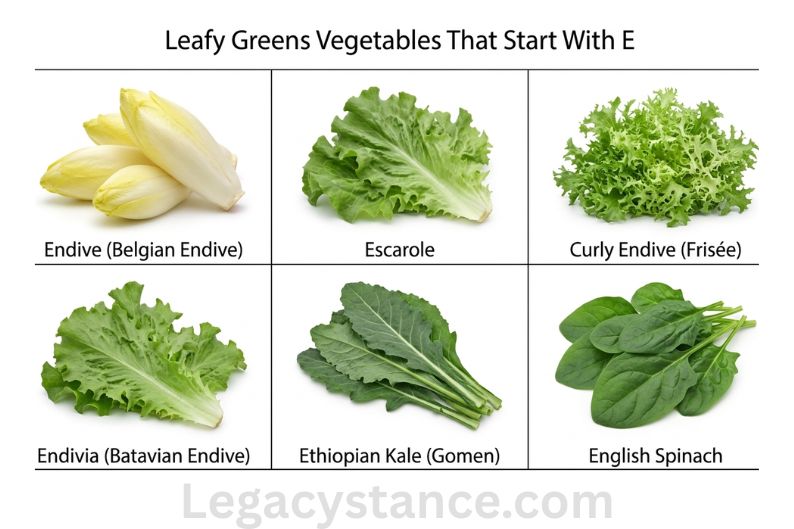
1. Endive (Belgian Endive) Pale yellow, tightly packed torpedo-shaped head. Crisp and pleasantly bitter. Grows in darkness — that is what keeps it mild. Eaten raw as a scoop for dips or braised in butter.
Storage: Away from light, wrapped in damp paper. Lasts 5–7 days.
Fact: Exposure to light turns it green and sharply bitter.
2. Escarole Broad wavy leaves. Dark green outside, pale yellow inside. Milder than other endives. Classic in Italian white bean soup. Good raw in salads too.
Storage: Damp paper towel in crisper. Use within 5 days.
Fact: Southern Italians stuff whole escarole heads with olives and anchovies as a Christmas dish.
3. Curly Endive (Frisée) Frizzy, lacy leaves. More bitter than Belgian endive. The pale inner leaves are milder. Classic in French bistro salads with bacon vinaigrette.
Storage: Loosely wrapped in fridge. 4–5 days.
Fact: Used as a digestive aid in traditional French herbal medicine.
4. Endivia (Batavian Endive) Broad, flat leaves with wavy edges. Mildest of the endive family. Used in Italian soups or wilted into pasta.
Storage: Same as escarole.
Fact: In some countries this is called escarole — the names overlap by region.
5. Ethiopian Kale (Gomen) Long, broad, dark green leaves. More fibrous than common kale. Central to Ethiopian cuisine — slow cooked in spiced butter with onions and garlic.
Storage: Damp bag in fridge. Use within 5 days.
Fact: Traditional fasting food in Ethiopian Orthodox Christianity.
6. English Spinach Smooth, tender, dark green leaves. Mild and slightly mineral. Wilts almost instantly. Good raw in salads or briefly sautéed with garlic.
Storage: Dry in fridge. Use within 3 days.
Fact: Loses roughly half its volume when cooked.
7. Egyptian Spinach (Molokhia) Dark green pointed leaves. Releases a thick, slightly mucilaginous texture when cooked — similar to okra. Central to Egyptian, Lebanese, and Jordanian cooking.
Storage: Use fresh within 2 days or freeze.
Fact: One of the oldest recorded vegetables in human history — found in ancient Egyptian tomb inscriptions.
8. European Sorrel Arrow-shaped smooth leaves. Intensely sour and lemony. Used in small amounts in salads or stirred into cream sauces for fish.
Storage: Damp towel, fridge. Use within 3 days.
Fact: The sourness comes from oxalic acid — the same compound found in rhubarb.
9. Epazote Jagged dark green leaves. Sharp, medicinal, slightly anise-like. Traditional in Mexican cooking — added to black beans to reduce gas and add flavor.
Storage: Damp paper towel in fridge. 3–4 days.
Fact: Used in Mesoamerican cooking for at least 3,000 years.
10. Early Jersey Wakefield Cabbage Heirloom cone-shaped cabbage with tightly packed pale green leaves. Sweeter and more tender than round cabbages. Good raw in coleslaw or braised whole.
Storage: Whole head in fridge for up to 2 weeks.
Fact: Developed in the 19th century in Jersey, England, and later popularized in New Jersey, USA.
11. Early Flat Dutch Cabbage Large flat round heirloom cabbage. Dense, mild, and slightly sweet. One of the oldest named cabbage varieties still in cultivation.
Storage: Whole in fridge for 2–3 weeks.
12. Early Summer Cabbage Smaller, looser heads than winter cabbage. Sweeter and more delicate. Harvested before full maturity for a milder flavor.
Storage: Use within 1 week of harvest.
13. Evergreen Bunching Onion (Tops) The hollow green tops of evergreen bunching onions. Mild onion flavor. Used like scallion greens in Asian cooking — over noodles, soups, and rice.
Storage: Stand in water in fridge or wrap and refrigerate. 5–7 days.
14. Emmer Wheat Greens Young shoots of emmer wheat. Tender and mildly grassy. Used in salads or juiced. Still common in parts of the Middle East and Ethiopia where emmer is grown. Storage: Refrigerate and use within 2–3 days.
15. Eruca (Arugula / Rocket) Deeply lobed dark green leaves. Peppery and slightly bitter. Eaten raw in salads, on pizza, or wilted quickly into pasta.
Storage: Dry in fridge. 3–4 days. Fact: Romans considered arugula an aphrodisiac and it was grown in monastery gardens across medieval Europe.
16. Endive Sprouts Sprouted endive seeds. Slightly bitter, crunchy. Used as a garnish or mixed into salads.
Storage: Refrigerate in a container. Use within 3–4 days.
17. Emerald Okra A green heirloom variety of okra with ridged pods. Slightly less mucilaginous than standard okra. Used in stews, fried, or pickled.
Storage: Unwashed in fridge. Use within 3–4 days.
18. Emu Apple Greens Young leaves of the emu apple plant used in Australian bush food traditions. Mildly tart.
Storage: Use fresh immediately.
19. English Mustard Greens Broad leaves with a sharp, peppery, wasabi-like heat. Good briefly sautéed or used raw in small amounts in salads.
Storage: Damp paper towel in fridge. 3–5 days.
20. Edamame Leaves The young leaves of soybean plants. Mild and slightly grassy. Used in Asian cooking as a stir fry green or salad leaf.
Storage: Use within 2 days.
Root Vegetables That Start With E
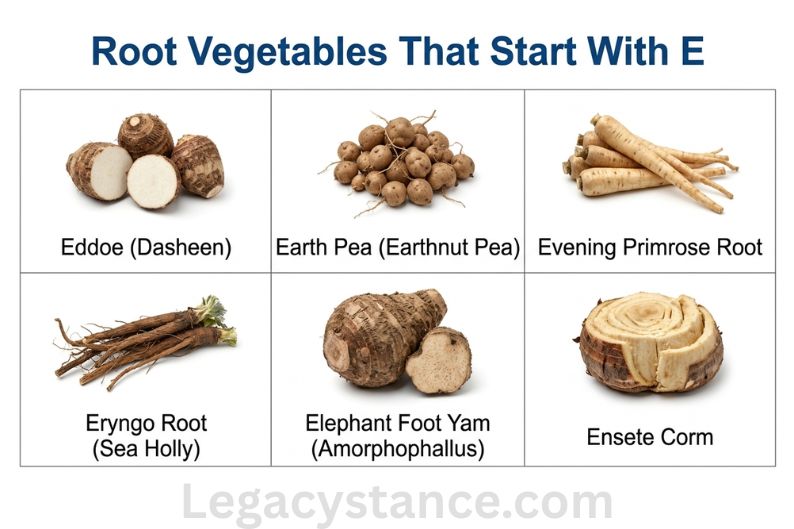
21. Eddoe (Dasheen) Small, rough, dark-skinned tropical root. White to pale lavender flesh. Starchy and mildly nutty. Boiled, mashed, or added to stews. A staple in West Africa and the Caribbean.
Storage: Dry, ventilated spot at room temperature. 1–2 weeks. Never refrigerate.
Fact: Contains calcium oxalate crystals — always wear gloves when peeling and never eat raw.
22. Earth Pea (Earthnut Pea) Tiny thumb-sized underground tubers from a climbing legume. Sweet and chestnut-like. Roasted as a snack or added to stews. Still foraged in rural Scotland and France.
Storage: In dry sand in a cool spot.
Fact: A survival food during the Scottish Highland Clearances.
23. Evening Primrose Root Cream to pale brown, carrot-like. Mild and slightly peppery — similar to parsnip when roasted. Eaten by Native Americans for centuries.
Storage: Crisper drawer in fridge. Use within 1 week.
Fact: The flowers only open at night and are pollinated by moths.
24. Eryngo Root (Sea Holly) Long, dark brown, fibrous coastal root. Slightly sweet with an unusual floral quality. Historically candied and sold at European market fairs.
Storage: Use within a few days of harvest.
Fact: Shakespeare mentions sea holly candy in The Merry Wives of Windsor.
25. Elephant Foot Yam (Amorphophallus) Large, heavy, rough-skinned tropical corm. Dense, starchy flesh. Used in Indian and Southeast Asian cooking — curried, fried into chips, or added to rice dishes.
Storage: Cool, dry, dark place. Lasts several weeks.
Fact: Can weigh up to 70 kg in the wild — one of the largest edible corms on earth.
26. Ensete Corm The underground base of the ensete plant. Starchy, dense, and bland. Scraped, fermented underground for months, then cooked into bread or porridge called kocho. A staple food in Ethiopia.
Storage: The fermented paste keeps refrigerated for 2 weeks.
Fact: Called the “tree against hunger” — one plant can feed a family for months.
27. Eddo Root (Colocasia) Closely related to taro. Small and rounded with rough dark skin. Starchy and mildly earthy. Boiled, roasted, or used to thicken soups.
Storage: Room temperature, dry and ventilated.
28. East Indian Arrowroot Starchy tropical root from the maranta plant. Very mild, almost tasteless. Mainly used as a thickener for sauces and gravies. Easily digestible.
Storage: Dried powder keeps indefinitely. Fresh root in a cool dry place.
29. Esculenta Taro (Colocasia esculenta) The standard taro plant. Large starchy corm with brown fibrous skin and white-purple flesh. Boiled, steamed, or pounded into poi (Hawaiian staple). Mild and slightly nutty.
Storage: Cool, dry, ventilated. 1–2 weeks. Fact: One of the oldest cultivated crops — grown for over 10,000 years.
30. Ensete Stem The thick inner stem of the ensete plant, separate from the corm. Scraped and fermented into kocho. Has a tangy, sour flavor from fermentation.
31. Ethiopian Cabbage Root The root base of Ethiopian cabbage plants. Starchy and mild. Used in root vegetable stews in East Africa.
32. Edible Burdock (Gobo) Long, slender, dark brown root — can grow over a meter long. Earthy, slightly sweet, and fibrous. A staple in Japanese cooking — used in kinpira gobo (sautéed strips) or simmered in broth.
Storage: Unwashed in a damp paper towel in fridge. Up to 2 weeks.
Fact: Japanese people eat far more burdock root than anyone else in the world.
33. Earth Chestnut Small rounded underground tubers from the pignut plant (Conopodium majus). Nutty and sweet — very similar to water chestnuts but grown in European soil. Foraged in meadows and woodland edges.
Storage: Use within a few days of harvest.
34. Enset Root Lower root portion of the enset plant. Starchy and used similarly to the corm in Ethiopian cuisine.
Legumes Vegetables That Start With E
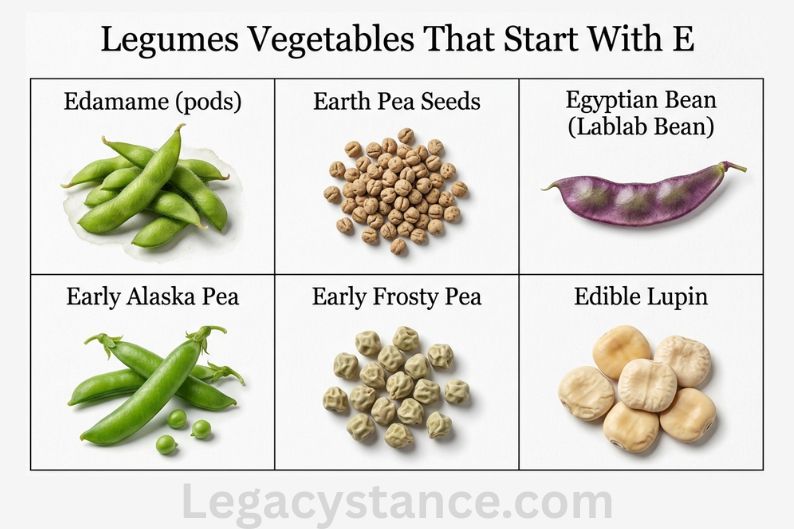
35. Edamame Young green soybeans in the pod. Buttery, slightly sweet, mildly nutty. Boiled in salted water and eaten straight from the pod. Also blended into dips or added to grain bowls.
Storage: Fresh pods last 2–3 days in fridge. Frozen keeps up to a year with no quality loss.
Fact: Edamame has been eaten in East Asia for over 2,000 years.
36. Earth Pea Seeds The pea-like seeds of the earthnut pea plant. Slightly bitter and starchy. Historically cooked into porridge and bread during times of scarcity.
Storage: Dried seeds in an airtight container.
37. Egyptian Bean (Lablab Bean) Also called hyacinth bean. Purple-podded, flat legume grown across Africa, Asia, and the Middle East. Young pods eaten like green beans. Seeds cooked into stews.
Storage: Fresh pods in fridge 3–4 days. Dried seeds indefinitely.
Fact: Also grown as an ornamental plant because of its vivid purple flowers.
38. Early Alaska Pea A heritage garden pea variety producing small, sweet, round peas. One of the earliest maturing peas — ready in about 56 days. Sweet, tender, and good eaten raw straight from the pod.
Storage: Refrigerate and use within 2–3 days. Freezes well.
39. Early Frosty Pea Sweet dwarf pea variety. Compact plant producing wrinkled peas with excellent flavor. Good fresh or lightly cooked.
40. Edible Lupin Large, flat, cream-colored bean. Slightly bitter raw but the bitterness is removed by soaking in salt water. High in protein. Common in Mediterranean countries — eaten pickled as a bar snack in Portugal, Spain, and Italy.
Storage: Dried beans in an airtight container.
Fact: Lupin beans are currently being studied as a wheat flour substitute for gluten-free baking.
41. Eye of the Goat Bean An heirloom dry bean variety with distinctive markings — creamy white with a dark eye-shaped spot. Used in traditional Mexican and Southwestern American cooking. Earthy, creamy flavor when cooked.
Storage: Dried in an airtight container. Lasts years.
42. Empress Pea A large, sweet garden pea variety. Produces long pods with up to 9 peas per pod. Popular in home gardens.
43. Early Perfection Pea Heirloom variety. Slightly curved pods with very sweet peas inside. One of the classic garden pea varieties.
44. Edible Soybean (Glycine max) The mature dried form of the same plant that produces edamame. Used to make tofu, tempeh, soy milk, and miso. Mild and very high in protein.
Storage: Dried beans indefinitely. Fresh beans 2–3 days.
Alliums Vegetables That Start With E
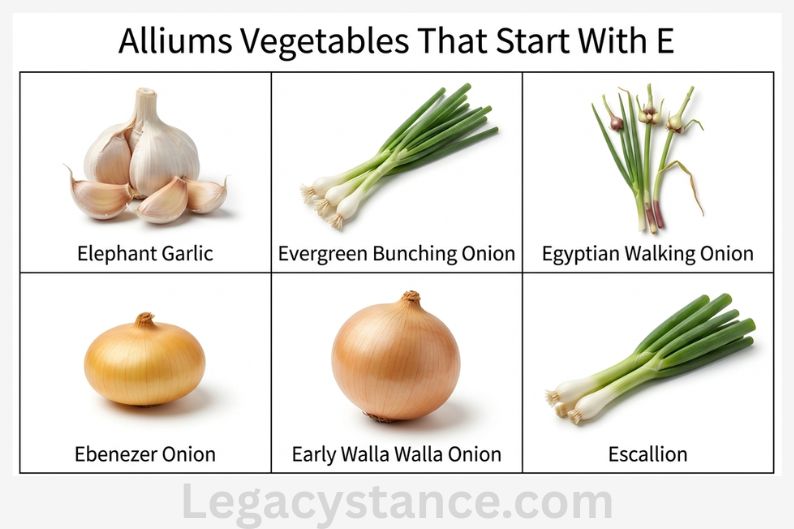
45. Elephant Garlic Technically a type of leek, not true garlic. Massive bulbs with 4–6 huge cloves. Much milder and sweeter than regular garlic. Roasted whole it becomes buttery and spreadable.
Storage: Cool, dry, dark place with airflow. Months.
Fact: Takes two full growing seasons to reach full size.
46. Evergreen Bunching Onion (Bulb) Slender white bulb with long green tops. Mild onion flavor, never forms a large round bulb. Used throughout East Asian cooking as a scallion substitute.
Storage: Fridge in a plastic bag. 1 week.
47. Egyptian Walking Onion (Tree Onion) Unique onion that produces small bulblets at the top of its stalks instead of seeds. The stalks fall over under the weight, “walk” to a new spot, and replant themselves.
Storage: Small top bulblets in a cool, dry place. Weeks.
Fact: One plant keeps multiplying and spreading indefinitely without replanting.
48. Ebenezer Onion An heirloom onion variety. Small to medium, flat, yellow-skinned. Mild flavor. Popular in home gardens in the early 20th century.
49. Early Walla Walla Onion Sweet onion with thin skin and very high sugar content. Mild enough to eat raw. Originally developed in Walla Walla, Washington.
Storage: Mesh bag in a cool dry spot. Weeks.
Fact: Sweet onions like Walla Walla have such high water content they don’t store as long as pungent onions.
50. Escallion (Caribbean Green Onion) The Caribbean term for a type of bunching onion. Widely used across Jamaica, Trinidad, and Haiti. Key ingredient in jerk seasoning blends and rice dishes.
Storage: Fridge wrapped. 5–7 days.
51. European Leek Long white stalk, broad flat blue-green leaves. Mild onion-like flavor. Sweeter and more delicate than onion. Braised, used in soups, or slow-cooked in cream.
Storage: Fridge unwashed. Up to 2 weeks.
Fact: The national symbol of Wales — worn on St. David’s Day.
Brassicas / Cruciferous Vegetables That Start With E
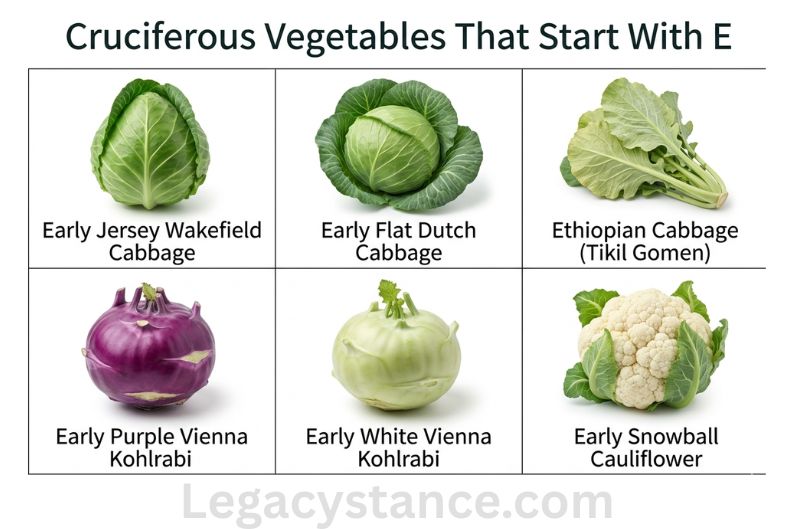
52. Early Jersey Wakefield Cabbage Cone-shaped heirloom cabbage. Sweet and tender. Developed in 19th century England.
Storage: Whole head in fridge. Up to 2 weeks.
53. Early Flat Dutch Cabbage Large, flat, round heirloom variety. Dense and mild. One of the oldest named cabbage varieties still grown.
54. Ethiopian Cabbage (Tikil Gomen) Not actually a cabbage — closer to a large leafy brassica. Pale green with thick stems. Used in Ethiopian cuisine with turmeric, onion, and potato for a dish also called tikil gomen.
Storage: Fridge in a bag. 5–7 days.
Fact: Tikil gomen is one of the most common vegetarian dishes on an Ethiopian plate.
55. Early Purple Vienna Kohlrabi Purple-skinned kohlrabi variety. Crisp, mild, and slightly sweet — like a cross between cabbage and broccoli stems. Eaten raw in slices with dip or lightly cooked.
Storage: Fridge without greens. Up to 2 weeks.
56. Early White Vienna Kohlrabi White-green skinned version of the above. Milder flavor. Popular in German and Central European cooking.
57. Early Snowball Cauliflower White, compact cauliflower heads that mature earlier than standard varieties. Mild and versatile.
Storage: Fridge in a bag. 5–7 days.
58. Early Purple Sprouting Broccoli Heritage variety producing small purple florets on branching stems before main-season broccoli. Slightly more intense flavor than standard broccoli.
Storage: Fridge. Use within 3–4 days.
Fact: Turns green when cooked — the purple is from anthocyanin pigments that break down with heat.
59. Escarole (classified also as a brassica-adjacent bitter green) Already covered above under leafy greens.
60. English Mustard Greens Covered above under leafy greens.
Gourds and Squash Vegetables That Start With E
61. Edible Gourd (Lauki / Bottle Gourd) Light green, smooth-skinned gourd. Mild, slightly sweet flesh. Very high water content. Cooked into curries, soups, and stews across South Asia and the Middle East.
Storage: Room temperature whole. Once cut, refrigerate and use within 2 days.
Fact: Ancient dried bottle gourds were used as water vessels — some of the oldest known human containers.
62. Egg Gourd Small, egg-shaped, white or yellow gourd. Used in Asian cooking as a young vegetable — cooked in stir fries and soups when small and tender.
Storage: Fridge. Use within 3–4 days.
63. Eastern Pumpkin Heritage variety of field pumpkin grown in Eastern Europe and Central Asia. Orange flesh, mildly sweet. Roasted, pureed into soup, or used in pastries.
Storage: Cool, dry, dark place. Months.
64. Ember Squash A smaller heirloom squash variety with dense, sweet flesh. Roasted whole or halved. Regional to parts of North America.
65. European Marrow Large pale green or striped elongated squash. Mild, watery flesh. Used in British cooking — stuffed and baked, or cooked into marrow jam.
Storage: Cool, dry place. Several weeks.
Fact: In the UK, growing prize-winning giant marrows is a serious competitive hobby.
66. Early Straightneck Squash Yellow summer squash with a straight neck. Mild and slightly sweet. Used the same way as zucchini — grilled, sautéed, or eaten raw.
Storage: Fridge. Use within 4–5 days.
67. Early Acorn Squash Small, dark green, ribbed winter squash. Sweet, nutty flesh. Halved and roasted with butter and maple syrup, or stuffed and baked.
Storage: Cool, dry place. 1–2 months.
68. Early Delicata Squash Cream-colored with green stripes. Sweet, rich flesh with a thin edible skin. Roasted in rings — no peeling needed.
Storage: Cool, dry place. 1–2 months.
Root and Tuberous Vegetables That Start With E (Additional)
69. Edible Canna (Queensland Arrowroot) A large tropical plant grown for its starchy underground rhizomes. Mild flavor, very starchy. Used as a potato substitute in parts of Australia, South America, and Africa.
Storage: Cool, dry place. Similar to potatoes.
Fact: The rhizomes can be processed into a fine arrowroot starch.
70. Edible Ginger (Young Ginger) Young, fresh ginger rhizome with thin pink skin and milder flavor than mature ginger. Used pickled (gari), in stir fries, juiced, or eaten raw. Storage: Fridge in a bag. Weeks.
71. Edible Lotus Root The underwater rhizome of the lotus plant. Pale beige, hollow inside with a beautiful lace-like cross-section. Crunchy and mildly sweet. Used in Asian cooking — stir fried, braised, or made into chips.
Storage: Submerged in water in fridge. Up to 1 week.
Fact: The distinctive holes in lotus root are air channels that help the plant breathe underwater.
72. Edible Turmeric Fresh turmeric rhizome. Bright orange inside, thin brown skin. Earthy, slightly bitter, peppery. Used fresh in curries, juiced, or grated into rice dishes.
Storage: Fridge in a bag or freeze whole. Months.
Fact: Fresh turmeric stains skin and surfaces intensely — handle with care.
73. Edible Galangal Related to ginger. Hard, knobby rhizome with a piney, citrusy, slightly medicinal flavor. Essential in Thai and Indonesian cooking — used in curries and soups. Not a substitute for ginger — distinctly different flavor.
Storage: Fridge in a bag. Weeks.
74. Edible Arrowhead (Sagittaria) Aquatic plant grown for its small underwater corms. Crisp and slightly sweet, similar to water chestnuts. Used in Chinese and Japanese cooking — stir fried or braised. Storage: Fridge. Use within 1 week.
75. Elephant Yam (Amorphophallus paeoniifolius) Slightly different from elephant foot yam. Large, starchy, purple-tinged flesh. Common in South and Southeast Asian cooking. Curried, fried, or boiled.
Storage: Cool, dry, dark place.
76. Edible Dahlia Tubers The tuberous roots of dahlia plants are edible. Crisp, slightly sweet, mildly flavored — somewhere between apple and water chestnut. Can be eaten raw or cooked.
Storage: Cool, dry place. Similar to other tubers.
Fact: Dahlias were originally brought to Europe from Mexico as a food crop — they just ended up more popular as ornamental flowers.
77. Earth Apple (Jerusalem Artichoke) Knobbly, thin-skinned tuber. Nutty and slightly sweet — somewhat like a cross between artichoke heart and potato. Roasted, pureed into soup, or eaten raw in thin slices.
Storage: Fridge. 1–2 weeks.
Fact: Has nothing to do with Jerusalem or artichokes — “Jerusalem” is likely a corruption of the Italian girasole (sunflower).
Stems, Shoots, and Stalks Vegetables That Start With E
78. Ensete Stem (Inner) The inner starchy stem of the ensete plant. Fermented and cooked into kocho. Already covered above.
79. Edible Bamboo Shoots (Early Season) The young emerging shoots of bamboo. Crisp, mild, slightly bitter when raw. Must be boiled before eating to remove cyanogenic compounds. Used in stir fries, soups, and curries across Asia.
Storage: Boiled shoots in fridge in water. Use within 1 week.
Fact: Bamboo is one of the fastest growing plants — some species grow 90 cm in a single day.
80. Edible Asparagus (Early Season) Tender young spears emerging in spring. One of the first vegetables of the season. Grassy, slightly sweet, slightly bitter. Roasted, grilled, steamed, or shaved raw over salads.
Storage: Stand upright in water in fridge. Use within 2–3 days.
Fact: Asparagus causes a distinctive smell in urine — about 40% of people can detect it.
81. Edible Fiddlehead Ferns Tightly curled young fronds of the ostrich fern. Bright green, crisp. Taste like a cross between asparagus and green beans. Must be cooked — never eat raw. Briefly boiled then sautéed in butter.
Storage: Fridge. Use within 2 days.
Fact: Available only for a few weeks in spring when fronds first emerge.
82. Edible Cattail Shoots Young shoots of the cattail plant (bulrush). Collected in spring before they emerge fully. Mild and slightly sweet — eaten like corn on the cob or cut and used in stir fries.
Storage: Use within 1–2 days of harvest.
83. Elderflower Buds The unopened flower buds of the elder plant. Mildly sweet and floral. Used in salads, fritters, or pickled. The ripe berries are used differently (as fruit).
Storage: Use fresh within 1 day.
84. Edible Chrysanthemum Stems (Tong Ho) The stems and leaves of the garland chrysanthemum. Mild, slightly herbal. Used in East Asian cooking — hot pot, soups, and stir fries.
Storage: Damp paper towel in fridge. 3–4 days.
Mushrooms Commonly Called E Vegetables
(Culinary convention treats mushrooms as vegetables in cooking)
85. Enoki Mushroom Long, thin, white stems with tiny caps. Delicate and slightly crunchy. Mild, barely-there flavor. Used in hot pot, ramen, soups, or eaten raw in salads.
Storage: Fridge in original packaging. 5–7 days.
Fact: Grow in complete darkness which keeps them white and long — wild enoki are short and brown.
86. Eryngii Mushroom (King Oyster) Thick white stems with small brown caps. Meaty, dense texture. Almost no flavor when raw — develops deep umami when grilled or roasted.
Storage: Fridge in paper bag. Up to 1 week.
Fact: The stem is the main edible part — opposite to most mushrooms.
87. Elm Oyster Mushroom Grows on elm trees. Pale yellow to cream caps. Mild flavor. Used in stir fries and soups. Less common than standard oyster mushrooms but similar in use.
Storage: Paper bag in fridge. 3–5 days.
Edible Flowers Used as Vegetables
88. Elderflower Flat clusters of tiny white flowers from the elder tree. Floral, sweet, slightly musty. Made into elderflower fritters, syrups, and cordials. The raw berries and leaves of the elder plant are toxic — only the flowers and ripe berries (cooked) are eaten.
Storage: Use same day. Wilts quickly.
89. Edible Nasturtium Flowers and Leaves Round, lily pad-like leaves and bright orange, red, and yellow flowers. Both taste peppery and slightly spicy. Used in salads, as garnish, or pickled for a caper-like condiment.
Storage: Fridge in a damp container. 2–3 days.
Fact: The entire plant is edible — flowers, leaves, and seeds.
90. Edible Borage Flowers Star-shaped bright blue flowers. Cool, fresh, cucumber-like taste. Used in salads, frozen into ice cubes, or as a cocktail garnish.
Storage: Use fresh. 1–2 days.
Global and Heritage Vegetables That Start With E
91. Ensete (False Banana) Already covered above. Worth noting here as one of the most significant food plants almost completely unknown outside East Africa.
92. Efo Riro Greens A leafy green used in Nigerian Yoruba cooking. Slightly bitter and robust. Cooked in a rich, spicy palm oil stew with crayfish, peppers, and meat or fish.
Storage: Fridge in a damp bag. 3–4 days.
Fact: Efo riro is considered one of the most important vegetable stews in Yoruba cuisine.
93. Edamame (Black) Black-podded soybean variety. Harvested young like standard edamame. Slightly nuttier and earthier than green varieties. Found at specialty markets.
94. Early Golden Bantam Corn Heritage sweet corn variety dating to 1902. Yellow kernels with sweet, rich flavor. Considered the gold standard of old-fashioned corn flavor before modern supersweet hybrids.
Storage: Fridge and use within 1–2 days. Sweetness fades fast.
95. Elote (Mexican Street Corn) Not a unique variety — refers to fresh whole corn prepared street food style: grilled, slathered in mayo or crema, dusted with chili and cotija cheese. Technically the same corn, culturally distinct.
96. Ethiopian Mustard (Abyssinian Mustard) Leafy brassica grown in East Africa. Broad leaves with a mild mustard-like flavor. Used cooked in stews or raw as a salad leaf.
Storage: Damp bag in fridge. 4–5 days.
97. Early Blood Turnip Heirloom red-fleshed turnip. Deep red skin and flesh. Earthy and slightly sweet. Roasted, boiled, or pickled.
Storage: Fridge. 1–2 weeks.
98. Edible Amaranth Greens (Efo) The leafy tops of certain amaranth plants. Used as a vegetable in West Africa, South Asia, and the Caribbean. Mild and slightly earthy. Cooked like spinach — sautéed, steamed, or added to soups.
Storage: Damp paper towel in fridge. 2–3 days.
Fact: Amaranth greens are nutritionally very similar to spinach but grow much better in hot, humid climates.
99. Edible Purslane (European) Thick, succulent, paddle-shaped leaves. Slightly sour and crunchy. One of the most nutritious leafy greens — extremely high in omega-3 fatty acids for a plant. Used in salads, braised, or added to soups.
Storage: Fridge. Use within 2 days.
Fact: Purslane is considered a weed in most North American gardens — yet it’s actively cultivated and sold in Mediterranean markets.
100. Edible Sea Purslane Coastal relative of purslane. Fleshy, salty, succulent leaves. Foraged from salt marshes. Eaten raw in salads or briefly blanched.
101. Elephant Ear (Edible Taro Leaf) The enormous leaves of taro and related plants. Must be thoroughly cooked — raw leaves are toxic. Used in Hawaiian laulau (wrapped around fish and pork, then steamed), West African soups, and Indian cuisine.
Storage: Use within 1–2 days.
102. Edible Cactus Pad (Nopal) The flat pads of the prickly pear cactus. Bright green, slightly mucilaginous, mildly tart. Used in Mexican cooking — grilled, in tacos, scrambled eggs, or salads.
Storage: Fridge. Use within 5 days.
Fact: Nopales are one of the most eaten vegetables in Mexico.
103. Edible Sea Vegetables — Ecklonia (Kelp) Brown kelp used as a sea vegetable in Japan and Korea. Dried, rehydrated, and used in dashi broth, salads, and soups. Earthy and deeply savory.
Storage: Dried — indefinitely. Rehydrated — use within 2 days.
104. Espelette Pepper A mildly spicy red pepper from the Basque region of France and Spain. Fruity and gentle heat — used fresh, dried, or ground. Has protected designation of origin (PDO) status.
Storage: Dried and ground — airtight container for months.
Fact: In the Basque village of Espelette, the peppers are strung across buildings to dry every autumn.
105. Early Jalapeno An early-maturing variety of jalapeño pepper. Medium heat. Green when picked young, red when fully ripe. Used fresh, pickled, smoked (chipotle), or stuffed.
Storage: Fridge. Up to 1 week fresh.
Vegetables That Start With E By Category — Summary
Leafy Greens: Endive, Escarole, Curly Endive, Endivia, Ethiopian Kale, English Spinach, Egyptian Spinach, European Sorrel, Epazote, Eruca, Evergreen Bunching Onion tops, Emmer Wheat Greens, English Mustard Greens, Edamame Leaves, Efo Riro, Ethiopian Mustard, Edible Amaranth, Edible Purslane, Sea Purslane, Elephant Ear Leaf
Root Vegetables: Eddoe, Earth Pea, Evening Primrose Root, Eryngo Root, Elephant Foot Yam, Ensete Corm, Eddo Root, East Indian Arrowroot, Esculenta Taro, Edible Canna, Edible Burdock, Earth Chestnut, Earth Apple, Edible Dahlia Tubers, Elephant Yam
Legumes: Edamame, Earth Pea Seeds, Egyptian Bean, Early Alaska Pea, Early Frosty Pea, Edible Lupin, Eye of the Goat Bean, Empress Pea, Early Perfection Pea, Edible Soybean
Alliums: Elephant Garlic, Evergreen Bunching Onion, Egyptian Walking Onion, Ebenezer Onion, Early Walla Walla Onion, Escallion, European Leek
Brassicas: Early Jersey Wakefield Cabbage, Early Flat Dutch Cabbage, Ethiopian Cabbage, Early Purple Vienna Kohlrabi, Early White Vienna Kohlrabi, Early Snowball Cauliflower, Early Purple Sprouting Broccoli
Gourds / Squash: Edible Gourd, Egg Gourd, Eastern Pumpkin, European Marrow, Early Straightneck Squash, Early Acorn Squash, Early Delicata Squash
Stems and Shoots: Edible Bamboo Shoots, Edible Asparagus, Edible Fiddlehead Ferns, Edible Cattail Shoots, Edible Chrysanthemum Stems, Ensete Stem
Mushrooms: Enoki, Eryngii (King Oyster), Elm Oyster
Edible Flowers: Elderflower, Edible Nasturtium, Edible Borage
Rhizomes / Spice Roots: Edible Ginger, Edible Turmeric, Edible Galangal, Edible Lotus Root, Edible Arrowhead
Peppers: Espelette, Early Jalapeño, Emerald Okra
Sea Vegetables: Edible Sea Purslane, Ecklonia Kelp, Eelgrass
Most Popular E Vegetables (Quick Rank)
- Eggplant — eaten on every continent, deeply versatile
- Edamame — went global in under two decades
- Endive — cornerstone of French and Belgian cooking
- Escarole — Italian cooking staple
- Elephant Garlic — rising popularity at farmers markets
Nutrition Snapshot
| Vegetable | Key Nutrients |
| Edamame | Complete plant protein, folate, Vitamin K |
| Eggplant | Fiber, nasunin antioxidant, Vitamin B1 |
| Endive | Folate, Vitamin K, very low calorie |
| Escarole | Vitamin A, Vitamin K, iron |
| Ethiopian Kale | Vitamin C, calcium, iron |
| Elephant Garlic | Vitamin C, selenium, prebiotic fiber |
| Edible Purslane | Omega-3 fatty acids, Vitamin E |
| Egyptian Spinach | Vitamins A and C, calcium |
Family Feud — Most Likely Answers
If the question were “Name a vegetable starting with E,” survey answers would most likely be:
- Eggplant
- Edamame
- Endive
- Escarole
Everything else on this list is bonus knowledge.
Related Fruits Starting With E
| Fruits | Vegetables |
| Elderberry | Eggplant |
| Emblica (Indian Gooseberry) | Edamame |
| Etrog | Endive |
| Entawak | Escarole |
| Emu Apple | Elephant Garlic |
| European Pear | Eddoe |
Read also:
125+ Vegetables That Start With D: From Daikon to Dulse
75+ Vegetables That Start With C: From Common to Rare Global Crops
FAQ’s
What are the most common vegetables that start with E?
The most widely recognized E vegetables are eggplant, edamame, endive, escarole, and elephant garlic. These are commonly found in grocery stores and used in many cuisines around the world.
Which E vegetables are best for beginners to cook?
Edamame, eggplant, escarole, and elephant garlic are easy starting points. They require simple preparation and work well in everyday dishes such as stir-fries, soups, roasted vegetables, and salads.
Are all vegetables on this list true vegetables?
Not always. Some foods, such as eggplant and peppers, are botanically fruits because they contain seeds. However, they are treated as vegetables in cooking, which is why they appear on vegetable lists.
Which E vegetables are the most nutritious?
Edamame is rich in plant protein, endive provides folate and vitamin K, purslane contains omega-3 fatty acids, and Egyptian spinach offers vitamins A and C. Each vegetable contributes different nutrients to a balanced diet.
Are there any rare vegetables that start with E?
Yes. Ensete, earth pea, eryngo root, edible dahlia tubers, and Ethiopian kale are examples of lesser-known vegetables that are important in specific regions and traditional cuisines.