

Looking for Vegetables That Start With F? You might know fennel, fava beans, or French beans, but there are many more worth discovering. From everyday vegetables found in supermarkets to unique regional plants and wild greens, this guide brings them together in one easy-to-browse list.
Whether you’re building a food vocabulary list, planning meals, teaching students, or simply curious about new foods, you’ll find useful information, cooking ideas, and interesting facts about vegetables that begin with the letter F.
Quick Answer: Vegetables That Start With F
| Vegetable | Taste | Best Use |
| Fennel | Sweet, anise | Roasting, raw salads |
| Fava Beans | Buttery, nutty | Stews, dips |
| Fiddlehead Ferns | Grassy, nutty | Sautéed, steamed |
| French Beans | Crisp, mild | Stir fry, salads |
| Fingerling Potato | Buttery, earthy | Roasting |
| Field Peas | Mild, starchy | Soups, stews |
| Flat-Leaf Parsley | Bright, peppery | Cooking, tabbouleh |
| Frisée | Bitter, nutty | Salads |
| Fuki | Earthy, mild | Simmered dishes |
| Fluted Pumpkin (Ugu) | Mild, earthy | Nigerian soups |
Bulb & Root Vegetables That Start With F
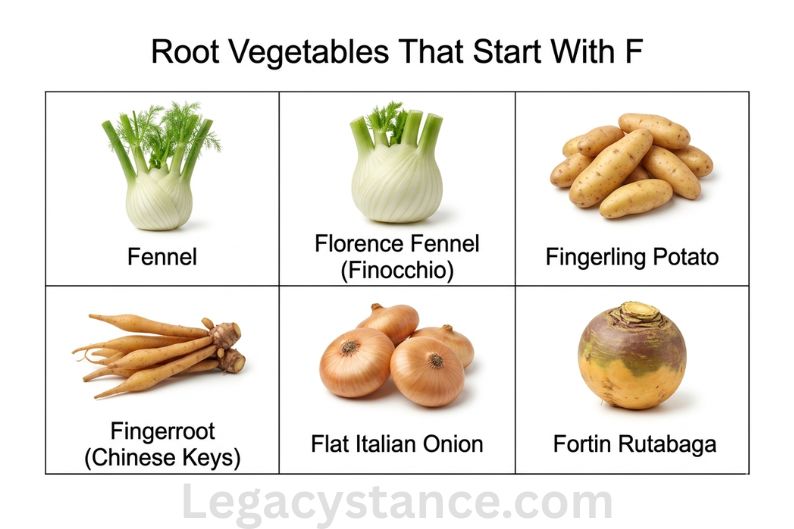
1. Fennel A white-green bulb with feathery fronds. Tastes strongly of anise when raw — sweet and caramelized once roasted. Every part is edible: the bulb, stalks, and fronds. Common in Italian, French, and Greek cooking.
- Best uses: roasted wedges, raw shaved salads, soups, braised dishes
- Storage: wrap in damp paper towel, fridge, 4–5 days
- Fact: Roasting removes almost all the anise sharpness. People who say they dislike licorice often love roasted fennel.
2. Florence Fennel (Finocchio) A cultivated form of fennel bred specifically for its thick, rounded bulb. Slightly sweeter and more compact than wild fennel. The name finocchio is used across Italian markets.
3. Fingerling Potato Small, elongated, finger-shaped potatoes. Waxy and dense — they hold their shape after cooking instead of turning fluffy. Varieties include Russian Banana, French Fingerling, and Purple Peruvian.
- Best uses: roasted whole, pan-fried with herbs, sheet pan dinners
- Storage: cool dark pantry only — never the fridge
- Fact: Purple fingerlings get their color from anthocyanins, the same pigment found in blueberries.
4. Fingerroot (Chinese Keys) A relative of ginger with thin finger-like roots spreading from a central rhizome. Used widely in Thai, Indonesian, and Cambodian cooking. Has a peppery, slightly bitter, aromatic flavor.
- Best uses: Thai curry pastes, fish dishes, herbal soups
- Fact: The Thai name is krachai. It’s almost unknown outside Southeast Asian cooking.
5. Flat Italian Onion A flattened, disc-shaped onion with a milder, sweeter flavor than round onions. The thin layers make them ideal for pickling and caramelizing.
6. Fortin Rutabaga A heritage variety of rutabaga with golden flesh and a denser texture than standard varieties. Grown in Canada and parts of Northern Europe. Sweeter after the first frost.
7. Field Garlic (Wild Garlic) A wild relative of garlic that grows in fields and woodland edges. Smaller and more pungent than cultivated garlic. The leaves, bulbs, and flowers are all edible.
- Best uses: pestos, butter, soups, salads
- Fact: Field garlic often grows as a weed in lawns — most people pull it out without knowing it’s edible.
Legumes Vegetables That Start With F
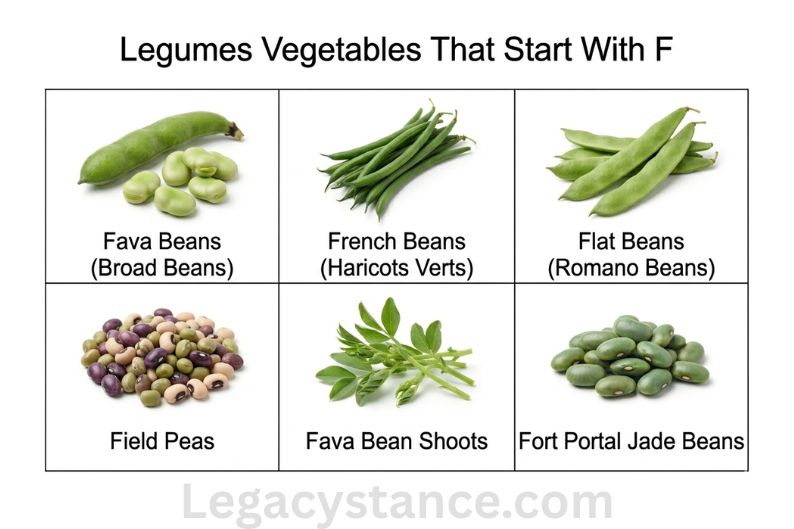
8. Fava Beans (Broad Beans) One of the oldest cultivated plants on earth. The beans grow in long, fuzzy green pods. Mature beans need double-peeling — first the pod, then the waxy skin around each bean.
- Best uses: mashed into dips, pasta with pecorino, Middle Eastern stews, raw when very young
- Storage: in pod, fridge, up to 5 days
- Fact: A condition called G6PD deficiency (favism) causes serious reactions to fava beans in some people, especially men of Mediterranean and African descent.
9. French Beans (Haricots Verts) Slender, refined green beans harvested young before the pods toughen. Thinner and more tender than standard green beans. The French variety is picked at a smaller size specifically for better texture.
- Best uses: blanched in Niçoise salad, stir-fried with garlic, steamed as a side
- Storage: paper bag, fridge, 3 days
- Fact: If left on the plant too long, French beans become shelling beans — the pods toughen and the seeds inside swell.
10. Flat Beans (Romano Beans) Wide, flat green bean pods — sometimes called Italian flat beans. Stringless when young. More robust and slightly sweeter than French beans. Hold up better in longer cooking.
- Best uses: braised in tomato sauce, slow-cooked stews, grilled
11. Field Peas A type of cowpea common in the American South and West Africa. Black-eyed peas are one variety. Others include crowder peas, cream peas, and purple hull peas.
- Best uses: slow-simmered with ham hock, mixed into rice dishes, pureed into soup
- Fact: Field pea plants fix nitrogen in soil — farmers plant them as cover crops between seasons to naturally improve the ground.
12. Fava Bean Shoots The tender young growing tips of the fava bean plant, harvested before maturity. Used as a delicate green vegetable.
- Best uses: quickly sautéed with garlic, raw in salads, spring garnishes
- Fact: Considered a prosperity symbol in Chinese New Year cooking across southern China.
13. Fort Portal Jade Beans A Ugandan heritage bean variety with a distinctive jade-green color. Grown in the Fort Portal region of Uganda. Used in stews and slow-cooked dishes. Rarely found outside East African markets.
Leafy Greens Vegetables That Start With F
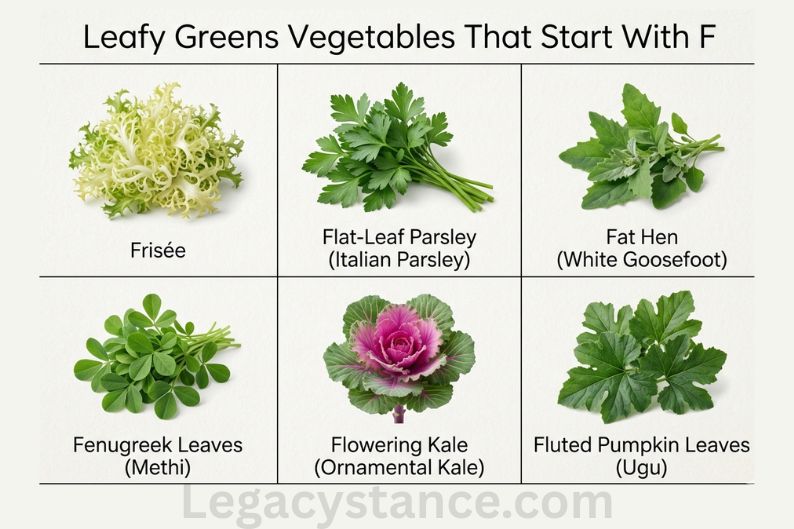
14. Frisée A pale, curly-leafed chicory with a genuinely bitter taste. The paler the inner leaves, the milder the bitterness. A French bistro staple — classic Lyonnaise salad uses it with bacon and a poached egg.
- Best uses: salads with bacon, blue cheese, walnuts, warm dressings
- Storage: dry paper towel, fridge, 4 days
- Fact: Farmers cover growing frisée heads to block sunlight — this keeps the leaves pale and less bitter. Uncovered frisée turns dark green and intensely bitter.
15. Flat-Leaf Parsley (Italian Parsley) Used as both herb and cooking vegetable. Far more flavorful than curly parsley. Central ingredient in tabbouleh, chimichurri, and fattoush. The stems carry as much flavor as the leaves.
- Best uses: tabbouleh, chimichurri, stirred into sauces and stews at the end
- Storage: trim stems and stand in a glass of water in fridge — lasts up to 2 weeks
- Fact: Curly parsley was historically used as a plate garnish, not for flavor. Many chefs refuse to cook with it.
16. Fat Hen (White Goosefoot / Wild Spinach) A wild edible plant — technically a weed — that grows across Europe, Asia, and North America. Before spinach became cultivated, this was one of the most commonly eaten leafy greens in Northern Europe.
- Best uses: cooked exactly like spinach, added to soups and egg dishes
- Fact: Seeds of fat hen were found in the stomach of Tollund Man, a 2,400-year-old preserved body found in Denmark.
17. Fenugreek Leaves (Methi) Small, three-lobed bitter leaves central to Indian, Nepali, and Ethiopian cooking. Sold fresh in bunches or dried as kasuri methi. The dried form has a deeper, more concentrated flavor.
- Best uses: dal, aloo methi (potato dish), methi paratha (flatbread), curries
- Storage: damp paper towel, fridge, 2 days; dried kasuri methi lasts months in a sealed jar
- Fact: Fenugreek seeds contain sotolone — the same compound that gives maple syrup its flavor. Artificial maple flavoring is often made from fenugreek extract.
18. Flowering Kale (Ornamental Kale) A cool-weather leafy brassica with dramatic ruffled leaves — deep green outer, colorful pink, white, or magenta center. Fully edible despite its ornamental reputation.
- Best uses: young inner leaves in salads, sautéed, decorative garnish
- Fact: Cold temperatures intensify the color rather than damage it. A frost makes flowering kale more vibrant.
19. Fluted Pumpkin Leaves (Ugu) Dark green, deeply lobed leaves from the fluted pumpkin vine. A cornerstone ingredient in Nigerian cooking. Texture is denser than spinach.
- Best uses: egusi soup, ofe onugbu, pepper soup, cooked with beans
- Fact: The entire fluted pumpkin plant is used — leaves as a vegetable, seeds pressed for oil, roots in traditional medicine.
20. Flame Lettuce A red looseleaf lettuce with deeply colored outer leaves shading to pale green at the center. Mild, slightly buttery flavor. Less bitter than red oak leaf lettuce.
- Best uses: fresh salads, sandwiches, wraps
21. Forellenschluss Lettuce (Flashy Trout’s Back) An Austrian heirloom lettuce with pale green leaves heavily spotted with dark red-brown. The name means “trout’s back” in German, describing the speckled pattern.
- Best uses: salads, where the visual pattern adds interest
- Fact: One of the most visually distinctive lettuces in the world. Popular with home gardeners who grow heritage varieties.
22. Four-Season Lettuce A loose-leaf lettuce variety bred to grow in multiple seasons without bolting quickly. Mild and slightly bitter. Reliable for home gardeners who want a year-round salad leaf.
23. Flashy Butter Gem Lettuce A compact, buttery-textured lettuce with green and red-speckled leaves. Tender and mild. Often sold as a “living lettuce” in grocery stores — roots still attached.
24. French Dandelion A cultivated, less bitter version of the common dandelion. Grown for its leaves rather than left to grow wild. Used in French country cooking as a bitter salad green.
- Best uses: warm salads with lardons and mustard vinaigrette
25. French Sorrel A perennial herb-vegetable with intensely sharp, lemony flavor. Chefs use it to add acidity without citrus. Turns brownish-green when cooked due to oxalic acid reacting with chlorophyll — the flavor is unaffected.
- Best uses: sorrel soup, sauces for fish, raw in salads, scrambled eggs
- Fact: The same oxalic acid that gives sorrel its sourness is also found in rhubarb and spinach.
26. French Purslane (Golden Purslane) A cultivated variety of purslane with golden-green succulent leaves and a slightly sour, salty taste. More tender than wild purslane. Rich in omega-3 fatty acids.
- Best uses: salads, soups, summer sandwiches
27. Frilled-Leaf Mustard A ruffled-leaf variety of mustard green with a peppery, slightly spicy bite. Used across Asian and Southern American cooking. More decorative in appearance than standard mustard greens.
28. Flying Spinach (Malabar Spinach) A climbing vine with thick, succulent leaves used as a spinach substitute in tropical regions. Grows abundantly in heat and humidity where regular spinach wilts.
- Best uses: stir-fried with garlic, added to soups, cooked into dals
29. False Daisy (Bhringraj) A leafy plant used as a vegetable in South and Southeast Asia. Slightly bitter taste. More commonly known in Ayurvedic medicine but the leaves are eaten as a cooked green in parts of India and Thailand.
Brassicas & Cruciferous Vegetables That Start With F
30. Fioretto (Flowering Cauliflower) A Japanese-developed hybrid between cauliflower and broccoli. Grows as loose flowing white stems topped with small florets instead of forming a tight head. Sweeter and more tender than standard cauliflower.
- Best uses: roasted whole at high heat, sautéed in butter, plated as a showpiece vegetable
- Fact: Developed for visual appeal as much as flavor. It reached restaurant kitchens before home cooks.
31. Flat Cabbage (Chinese Flat Cabbage / Tatsoi) A low-growing brassica with dark green, spoon-shaped leaves arranged in a flat rosette. Mild and slightly mustard-like. Handles cold very well — flavor actually improves after frost.
- Best uses: stir-fries, soups, braised dishes, raw in salads
32. Five Color Silverbeet A variety of Swiss chard with stems in five different colors — red, yellow, orange, white, and pink. Mild, earthy flavor. Grown as much for its visual impact as its taste.
- Best uses: sautéed, added to pasta, used as a colorful side dish
Squash & Gourds Vegetables That Start With F
33. Futsu Squash A Japanese heirloom winter squash with a deeply ribbed, dark green exterior that turns orange-brown at maturity. The flesh is sweet, dense, and dry — similar to kabocha but nuttier.
- Best uses: roasted, stuffed, pureed into soup
- Fact: Futsu squash keeps for up to 3 months after harvest, making it a traditional winter food in Japan.
34. Flat White Boer Pumpkin A flattened, disc-shaped white pumpkin with pale ivory skin and mild, sweet flesh. Common in South African cooking. Cooked the same way as butternut squash.
- Best uses: roasted, stuffed, baked into savory dishes
35. Fenugreek Root The root of the fenugreek plant is occasionally eaten as a vegetable in parts of South Asia. Milder than the leaves, with a slightly bitter, earthy flavor.
Wild & Foraged Vegetables That Start With F
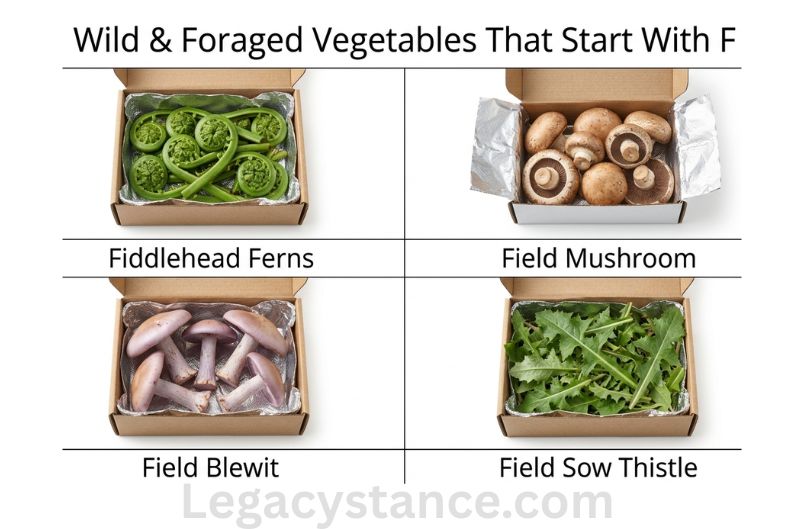
36. Fiddlehead Ferns The tightly coiled young shoots of the ostrich fern. Bright green spirals harvested in early spring before they uncurl. One of the most strictly seasonal foods in North America — available for only 2–3 weeks per year.
- Best uses: sautéed in butter with garlic, steamed with lemon, added to pasta, pickled
- Storage: fridge, dry, use within 1–2 days
- Warning: Never eat raw. Raw fiddleheads contain compounds that cause nausea and vomiting. Always cook for at least 5 minutes.
37. Field Mushroom (Wild Button Mushroom) A wild mushroom that grows in fields and meadows across North America and Europe. Looks nearly identical to cultivated button mushrooms but has a deeper, earthier, more complex flavor.
- Best uses: sautéed in butter, soups, omelets, grilled whole
38. Field Blewit A wild mushroom with a pale lilac cap and stem. Found in deciduous woodland and field edges in autumn across Europe and North America. Sweet smell and mild flavor.
- Best uses: sautéed, added to cream sauces, mixed mushroom dishes
- Fact: The name “blewit” comes from “blue hat” — a reference to the lavender coloring.
39. Field Sow Thistle A wild edible plant with toothed, slightly prickly leaves. Young leaves taste bitter — similar to dandelion. Used as a cooked green or raw salad leaf in foraging traditions across Europe and Asia.
40. Field Pennycress A mustard-family wild plant with small round seed pods. The young leaves have a peppery, radish-like flavor. Used as a foraged green in spring.
Asian Vegetables That Start With F
41. Fuki (Japanese Butterbur) The leaf stalk of the butterbur plant. One of Japan’s most traditional spring vegetables. Long, celery-like stalks with large round leaves. Must be blanched and peeled before eating to remove astringency.
- Best uses: simmered in dashi, soy sauce and mirin (nimono), spring rice dishes, pickled
- Storage: blanch immediately after purchase; keep refrigerated in water, use within 2 days
- Fact: The appearance of fuki at Japanese markets signals the start of spring cooking season.
42. Foxtail Millet Greens The young leaves of the foxtail millet plant. Eaten as a cooking green in parts of East Asia and East Africa. Mild and grassy in flavor.
- Best uses: stir-fried with garlic and sesame oil, added to soups
43. Flax Microgreens The sprouted seedlings of flax plants. Very small, thin, and mild with a slightly nutty flavor. Grown as microgreens rather than mature plants.
- Best uses: salad toppings, smoothies, garnishes
Peppers & Spicy Vegetables That Start With F
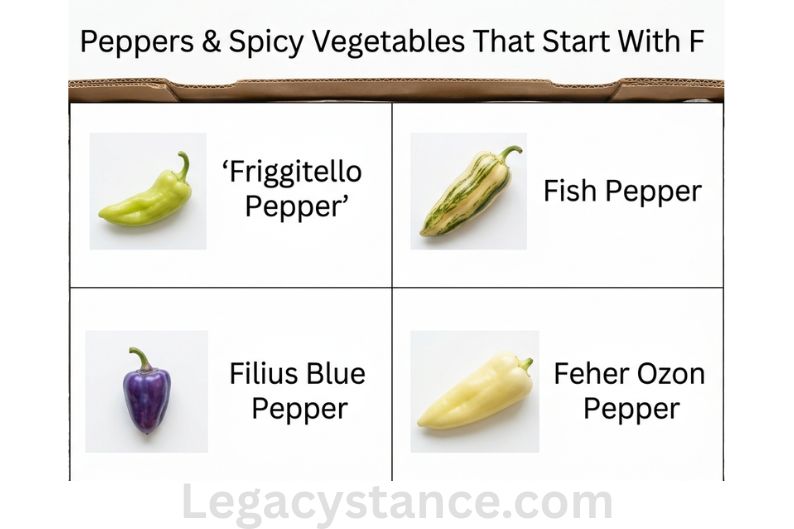
44. Friggitello Pepper A sweet Italian frying pepper, long and thin, with very mild heat. Pale green when unripe, turning red or yellow at maturity. A staple in Southern Italian cooking.
- Best uses: fried whole in olive oil, stuffed, pickled, added to antipasto
45. Fish Pepper An heirloom African-American pepper from the Chesapeake Bay region. Starts cream-colored with green stripes, turns red at maturity. Mild to medium heat with a fruity flavor. Historically used in seafood dishes.
- Best uses: crab cakes, fish stews, hot sauces
46. Filius Blue Pepper A small, ornamental but edible pepper. Starts bright purple-blue, ripens to red. Compact plant grown in containers. Mild to moderate heat.
- Best uses: fresh salsas, pickling, colorful garnish
47. Feher Ozon Pepper A Hungarian sweet pepper variety. Large, blocky, pale yellow-white when mature. Very sweet with almost no heat. Similar to a sweet bell pepper but more refined in flavor.
- Best uses: stuffed peppers, roasted, raw in salads
48. Fiero Radicchio An Italian chicory variety with deep red-burgundy leaves and white ribs. More elongated than round radicchio. Bitter, slightly peppery flavor that mellows when grilled or roasted.
- Best uses: grilled, added to risotto, pasta dishes, Italian salads
Root Vegetables (Additional)
49. French Breakfast Radish A small, elongated radish with a bright red upper half and white tip. Milder than round radishes. The classic French way to eat them: with good butter and sea salt on bread.
- Best uses: raw with butter and salt, sliced into salads, quick-pickled
- Storage: remove tops, store in fridge, use within 5 days
50. French Radish (General) Any radish variety with French origins or cultivated in the French style. Includes several heritage varieties beyond the breakfast radish.
51. Flint Corn A hard variety of corn with a small, dense kernel. The outer layer is hard, the starchy interior is soft. Used for grinding into cornmeal and polenta. Not eaten fresh off the cob like sweet corn.
- Best uses: ground into polenta, cornmeal, dried and stored
Specialty & Hybrid Vegetables That Start With F
52. Ficoides Glaciales (Ice Plant) A succulent ground cover with leaves covered in tiny translucent bladder cells that look like ice crystals. Mildly salty and juicy — the plant stores salt in its cells as an adaptation to coastal soils.
- Best uses: raw in salads, garnish for seafood dishes
- Fact: Used almost exclusively in high-end restaurants and specialty farmers markets. Genuinely unlike any other vegetable in texture.
53. Fiorentino Tomato (Florentine Tomato) A large, deeply ribbed Italian heirloom tomato. More hollow inside than standard tomatoes, making it perfect for stuffing. Meaty walls with fewer seeds.
- Best uses: stuffed with rice and herbs, roasted whole, baked dishes
54. Florentino Tomato A variant spelling and sometimes distinct variety of the Fiorentino. Grown across Tuscany. Very similar preparation and use.
Herbs Used as Vegetables
55. Fresh Herbs (as vegetables) Several herbs cross into vegetable territory when used in large quantities rather than as seasoning:
- Flat-leaf parsley — used as main ingredient in tabbouleh
- Fennel fronds — scattered over fish, stirred into salads
- Fenugreek leaves (methi) — used as a leafy cooking green
- French sorrel — pureed into soups and sauces
Additional F Vegetables That Start With F
56. Feijoa (Pineapple Guava) — Savory Use Botanically a fruit, but used in savory cooking in South America and New Zealand. The flesh is gritty and creamy white with a tropical, slightly minty flavor. Used in chutneys and salsas alongside pork and game meats.
57. Fennel Greens (Fennel Fronds) The feathery top growth of the fennel plant. Separate from the bulb — used as an herb and garnish. Taste is more intense than the bulb.
58. Fava Bean Greens The top leaves of the fava bean plant. Tender, mildly flavored. Eaten as a spring green in Italian and Chinese cooking.
59. Field Cabbage A hardy, open-headed cabbage variety grown in field conditions. Coarser leaves than cultivated cabbage. Used in slow-cooked country dishes.
60. Fermented Cabbage (Sauerkraut Base) While sauerkraut is a product, the vegetable foundation — raw shredded fermented green or white cabbage — is used as a cooking ingredient in its own right across Central and Eastern Europe.
61. French Thyme (as vegetable green) Used in larger quantities in Provençal cooking — branches added whole to braises and stews and removed before serving.
62. Fairy Ring Mushroom (Marasmius oreades) A small wild mushroom that grows in circular patterns — the “fairy rings” visible in grass. Sweet, nutty flavor, much more intense than cultivated mushrooms. Dried fairy ring mushrooms are especially potent.
- Best uses: soups, sauces, dried and powdered as a seasoning
63. Fennel Pollen Greens The flowering tops of mature fennel plants. Highly aromatic. Used in Tuscan cooking as a seasoning and edible garnish.
64. Field Cress A peppery wild cress related to watercress. Found growing in fields and disturbed ground. The leaves have a sharp, radish-like bite.
- Best uses: salads, sandwiches, garnish
65. French Lettuce (Butterhead Varieties) A category of soft, loose-headed lettuce associated with French cultivation — includes varieties like Merveille des Quatre Saisons. Buttery texture, mild flavor.
66. Fava Bean Pods (Young) When fava bean pods are harvested very young — no more than 3–4 inches long — the entire pod is edible, cooked like a green bean. Rarely seen outside kitchen gardens in Italy and France.
67. Fluted Gourd Distinct from fluted pumpkin. A smaller, ridged gourd variety used in parts of East Asia and South Asia in stir-fries and soups.
68. Field Endive A wild form of chicory/endive that grows in open fields across Europe. The leaves are bitter and used in salads or braised in olive oil in Italian country cooking.
69. Flowering Chives The flower heads of chive plants are fully edible and more mildly flavored than the leaves. Used as a vegetable garnish across French and Asian cooking.
70. French Globe Artichoke Grown and cultivated specifically in France, particularly in Brittany. Rounder and more tender than Italian or Spanish varieties. Eaten the same way — leaves pulled off and dipped, heart eaten whole.
71. Fiddlehead (Pacific Sword Fern variety) A West Coast American variety of fiddlehead, distinct from the ostrich fern of eastern North America. Same preparation required — always cook before eating.
72. Flat-Podded Peas (Snap Pea Variants) Snow peas and sugar snap peas with flat, wide pods. Eaten whole, pod and all, while still tender.
73. Flamingo Chard A specific variety of Swiss chard with vivid pink-red stems. Grown as an ornamental and edible vegetable. Flavor is mild and slightly earthy.
74. Field Leek (Wild Leek / Ramp) A wild leek that grows in North American woodlands in spring. Strong garlic-onion flavor. Extremely seasonal — foraged in April and May across Appalachia and the Northeast.
- Best uses: sautéed in butter, added to eggs, pickled
- Fact: Ramps have developed a cult following in the American food world. Restaurants list them on menus for only a few weeks each spring.
75. Florence Artichoke A variant cultivated in the Florence region of Tuscany. Smaller and more tender than the large globe artichokes sold in supermarkets. Eaten raw, shaved thin, in Florentine cuisine.
76. French Tarragon (as cooking green) Used in larger quantities in French cuisine — particularly in béarnaise sauce and fines herbes mixtures. When used as a primary flavor rather than a seasoning note, it functions as a vegetable green.
77. Fava Bean Husk In some traditional Italian cooking, the dried outer shells of fava bean pods are slow-cooked into soups and stocks, treated as a vegetable ingredient that adds body.
F Vegetables by Category — Master Reference
Root & Bulb Fennel, Florence Fennel, Fingerling Potato, Fingerroot, Flat Italian Onion, Fortin Rutabaga, Field Garlic, French Breakfast Radish, French Radish
Legumes Fava Beans, French Beans, Flat Beans, Field Peas, Fava Bean Shoots, Fort Portal Jade Beans, Flat-Podded Peas, Fava Bean Pods (young)
Leafy Greens Frisée, Flat-Leaf Parsley, Fat Hen, Fenugreek Leaves, Flowering Kale, Fluted Pumpkin Leaves, Flame Lettuce, Forellenschluss Lettuce, Four-Season Lettuce, Flashy Butter Gem Lettuce, French Dandelion, French Sorrel, French Purslane, Frilled-Leaf Mustard, Flying Spinach, False Daisy, Fennel Greens, Fava Bean Greens, French Lettuce, Field Endive, Flamingo Chard
Brassicas Fioretto, Flat Cabbage (Tatsoi), Five Color Silverbeet
Squash & Gourds Futsu Squash, Flat White Boer Pumpkin, Fluted Gourd
Wild & Foraged Fiddlehead Ferns, Field Mushroom, Field Blewit, Field Sow Thistle, Field Pennycress, Field Cress, Fairy Ring Mushroom, Field Leek (Ramp), Fiddlehead Pacific variety
Asian Vegetables Fuki, Foxtail Millet Greens, Flax Microgreens
Peppers Friggitello Pepper, Fish Pepper, Filius Blue Pepper, Feher Ozon Pepper
Chicory Family Fiero Radicchio, Frisée, Field Endive, French Dandelion
Specialty & Hybrid Ficoides Glaciales, Fiorentino Tomato, Florentino Tomato, Fioretto, Flint Corn
African & Tropical Fluted Pumpkin Leaves (Ugu), Feijoa
Herb-Vegetables Flat-Leaf Parsley, Fenugreek Leaves, French Sorrel, Fennel Fronds, Flowering Chives, French Tarragon, French Thyme, Fennel Pollen Greens
Heritage Varieties Forellenschluss Lettuce, Fort Portal Jade Beans, Fortin Rutabaga, Florence Artichoke, French Globe Artichoke
Most Popular F Vegetables
- French Beans — the most recognized F vegetable in everyday cooking worldwide
- Fennel — mainstream since Mediterranean diet coverage grew
- Fava Beans — thousands of years of cultivation across three continents
- Fingerling Potatoes — once a restaurant exclusive, now a supermarket regular
- Flat-Leaf Parsley — used in more dishes globally than almost any other F plant
How to Cook F Vegetables
Best for Roasting Fennel, Fingerling Potato, Fioretto, Futsu Squash, Fiorentino Tomato, Flat White Boer Pumpkin, Fiero Radicchio
Best for Stir Frying French Beans, Fenugreek Leaves, Fuki, Flat Cabbage, Foxtail Millet Greens, Flying Spinach, Fingerroot
Best for Soups & Stews Fava Beans, Field Peas, Fat Hen, Fluted Pumpkin Leaves, Fuki, Field Mushroom, Fairy Ring Mushroom, Futsu Squash
Best Raw Frisée, Flame Lettuce, Ficoides Glaciales, French Sorrel, Fennel (shaved thin), French Breakfast Radish, Forellenschluss Lettuce, Flat-Leaf Parsley (in tabbouleh)
Best Pickled Friggitello Pepper, Fuki, French Breakfast Radish, Field Leek (Ramp), Fava Beans, Fennel Fronds
Nutrition Overview
| Vegetable | Fiber | Vitamin C | Iron | Standout Nutrient |
| Fava Beans | Very High | Moderate | High | Protein, Manganese |
| Fiddlehead Ferns | Moderate | High | High | Omega-3 fatty acids |
| Flat-Leaf Parsley | Moderate | Very High | High | Vitamin K |
| Fenugreek Leaves | High | Moderate | High | Calcium |
| French Beans | Moderate | Good | Low | Vitamin K |
| Field Peas | High | Moderate | Moderate | Plant protein |
| Fennel | High | Good | Moderate | Folate |
| Frisée | Low | Good | Low | Vitamin A |
| Fat Hen | High | High | High | Calcium, Vitamin K |
| Fluted Pumpkin Leaves | High | High | High | Vitamins A & C |
Fava beans are among the most protein-dense vegetables available. Fiddlehead ferns are unusual in containing omega-3 fatty acids — rare for a green vegetable. Flat-leaf parsley has more vitamin C per gram than most citrus.
Interesting Facts about Vegetables That Start With F
- Fennel fronds are edible and excellent — most people throw them away. Use them exactly like dill.
- Fava bean plants fix nitrogen in cold weather — Mediterranean farmers use them as winter cover crops.
- The word “fennel” traces to Latin foeniculum, meaning “little hay.” Roman athletes ate fennel seeds believing it increased strength.
- Fat hen was likely the most commonly eaten leafy green in Northern Europe for thousands of years before spinach arrived — now nearly forgotten.
- Frisée and Belgian endive are the same plant species. The difference is how they’re grown: endive in the dark, frisée in open air.
- Fish pepper was nearly extinct before food historian Michael Twitty helped bring it back to prominence by connecting it to African-American culinary history.
- Ramps (field leeks) festivals happen across Appalachia every spring — entire communities celebrate the arrival of the first foraged greens.
- Fenugreek seeds are used to make artificial maple syrup flavor. The compound responsible — sotolone — is identical in both plants.
Family Feud — Vegetables Starting With F
If this category appeared on Family Feud, the top answers would almost certainly be:
- French Beans — most recognized F vegetable in everyday cooking
- Fennel — the most visually distinctive
- Fava Beans — widely known across multiple cuisines
- Fingerling Potatoes — now a supermarket standard
- Fiddlehead Ferns — less common but instantly memorable
Read more related:
75+ Vegetables That Start With C: From Common to Rare Global Crops
Frequently Asked Questions
What are the most common vegetables that start with F?
The most widely recognized F vegetables are fennel, fava beans, French beans, fingerling potatoes, flat-leaf parsley, and frisée. These are commonly available in supermarkets and used in many cuisines around the world.
Which F vegetables are easiest to cook for beginners?
French beans, fingerling potatoes, fennel, and flat-leaf parsley are great beginner-friendly choices. They require minimal preparation and work well in simple roasted, steamed, or sautéed dishes.
Are all vegetables on this list easy to find?
No. Some, such as fennel and French beans, are widely available, while others like fuki, fiddlehead ferns, field cress, and Fort Portal jade beans are seasonal, regional, or found mainly in specialty markets.
Which vegetables that start with F are the most nutritious?
Fava beans, fenugreek leaves, flat-leaf parsley, fluted pumpkin leaves, fat hen, and fiddlehead ferns are especially nutrient-rich. They provide fiber, vitamins, minerals, and plant-based nutrients that support a balanced diet.