WGAF means “Who Gives A F***?” It’s used in texts, comment sections, and chats to say “Who cares?” or “This doesn’t matter to me.” Not a real question. Just a very fast way to dismiss something entirely.
Picture your friend texting you: “People are saying your outfit was too much.”
You reply: “WGAF.”
Done. Conversation closed. That’s exactly how it works in real life — no explanation needed, no follow-up required. It’s one of those acronyms where the tone does more work than the letters.
The Letters, and What They Actually Mean
W — Who
G — Gives
A — A
F — F***
There’s also a cleaner version: “Who Gives A Flip” — same acronym, same dismissive energy, just without the strong language. Some people use it when they want the attitude but not the word. Both versions exist, but in most real online conversations, the stronger one is what people actually mean.
Here’s what most articles miss though: WGAF isn’t really a question. Nobody’s expecting an answer. It’s rhetorical. It’s saying — this topic? Not worth anyone’s attention, including mine.
WGAF Tone Is the Whole Point
The letters are easy. The tone is where it gets interesting.
WGAF can sound like three different things depending on what’s happening around it:
- Confidence — “WGAF what they think, I posted it anyway.”
- Mild irritation — “WGAF about that drama, move on.”
- Playful indifference — “WGAF lol, I’m still buying it.”
Same four letters. Completely different feelings. That’s why context matters so much with this one. Strip it from the conversation and you lose half the meaning.
WGAF Real Examples — Different Situations, Same Energy
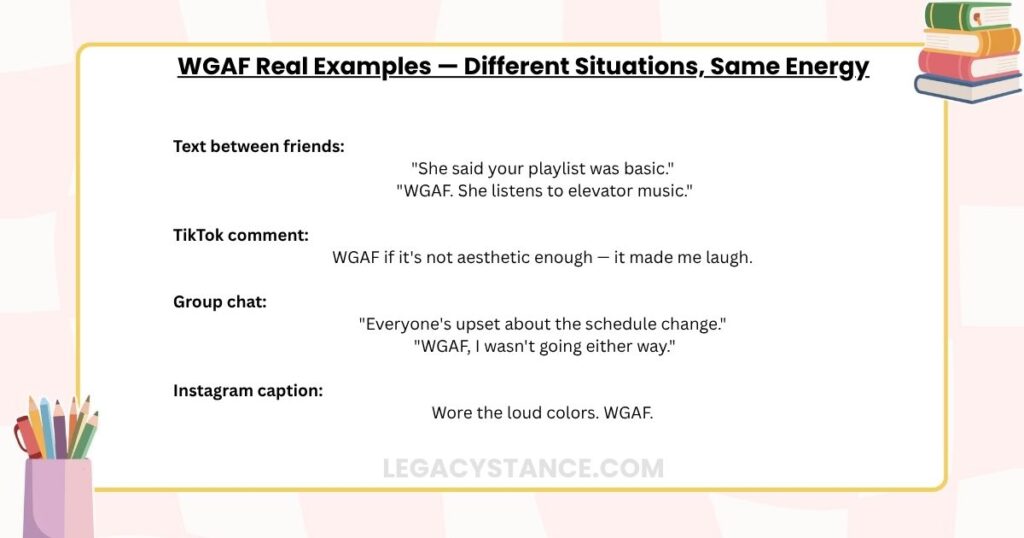
Text between friends:
“She said your playlist was basic.”
“WGAF. She listens to elevator music.”
TikTok comment:
WGAF if it’s not aesthetic enough — it made me laugh.
Group chat:
“Everyone’s upset about the schedule change.”
“WGAF, I wasn’t going either way.”
Instagram caption:
Wore the loud colors. WGAF.
The situations are different. The delivery shifts. But the core message never changes — I’m not giving this any energy.
WGAF vs. IDGAF — A Small Difference That Actually Matters
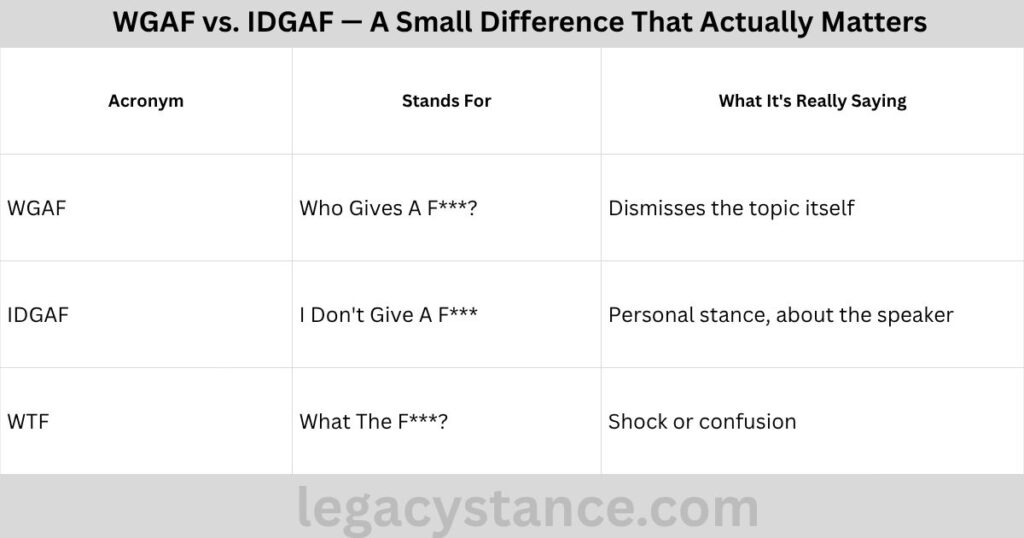
People mix these up constantly, and it’s worth clearing up.
| Acronym | Stands For | What It’s Really Saying |
| WGAF | Who Gives A F***? | Dismisses the topic itself |
| IDGAF | I Don’t Give A F*** | Personal stance, about the speaker |
| WTF | What The F***? | Shock or confusion |
IDGAF is personal — it’s about you not caring.
WGAF is broader — it’s almost challenging the room: does this even deserve anyone’s attention?
That subtle shift changes the weight of what you’re communicating. IDGAF hits emotionally. WGAF sounds more like a dismissal of the entire subject.
Where WGAF Fits — and Where It Completely Backfires
WGAF works naturally in:
- Casual texts with friends
- Social media comments and captions
- Group chats where everyone already talks this way
It falls apart in:
- Work messages or professional emails
- Conversations with someone who’s already upset
- Any setting where tone is being monitored or judged
Because WGAF implies strong language even when you don’t spell it out, people read the attitude immediately. In the wrong setting, it doesn’t just sound casual — it sounds dismissive in a way that damages the conversation. Worth thinking about before hitting send.
If Someone Sends You WGAF
They’re done. They’re not asking you to keep explaining or share more thoughts. WGAF is almost always the end of a thread, not an invitation to go deeper.
Best responses:
- “Fair enough”
- “Got it, no worries”
- “Same honestly”
Short, easy, no friction. Matching the energy works better than over-explaining yourself back to them.
How WGAF Acronym Came to Exist
Nobody invented WGAF on a specific day. The phrase “who gives a f***” has been part of casual spoken English for decades. When texting culture kicked in and everyone started compressing phrases into letter codes, it followed naturally.
Full phrase → strip to initials → use everywhere.
It joined a long list of acronyms — WTF, NGL, IDK, IDGAF — that people started typing without even thinking about what the letters stood for. The phrase was already there. The shortcut just made it faster.
Read also:
IGU Meaning in Text — What Those Three Letters Actually Mean
WTB Meaning: What It Means in Texts, Chats, and Online Posts
FAQ’s
Is WGAF always offensive?
Not between close friends — it often lands as casual or even funny. But to someone you don’t know well, or in a tense situation, it can come across as cold or dismissive. The relationship and the setting decide how it reads.
Can “Who Gives A Flip” actually replace it?
Yes. Same acronym, softer meaning. If you want the indifferent tone without the strong language, the flip version works. It’s less common but totally understood.
Is this only a TikTok thing?
No. WGAF shows up in texts, WhatsApp groups, Instagram captions, Twitter, Snapchat — basically anywhere people type casually. TikTok just made it more visible because comment culture there rewards that energy.
Why does it feel stronger than just saying “who cares?”
Because “who cares” is mild. WGAF carries attitude. It’s not just saying something doesn’t matter — it’s saying it doesn’t even deserve to matter. That extra edge is exactly why people reach for it instead of the softer version.
From what actually shows up in real comment sections and group chats, WGAF gets used fast and without much thought. It’s one of those expressions people type on instinct when something isn’t worth their energy. Now you know what it means, what’s behind the tone, and exactly when it helps versus when it creates more problems than it solves.