You got a text. Just three letters: mmk. No explanation, no emoji, no follow-up. And now you’re wondering if everything’s fine or if something shifted.
MMK means “mmm, okay” — a written version of that half-humming sound people make when they’ve heard something but haven’t fully decided how they feel about it yet. Simple on the surface. Loaded underneath.
Why MMK Is Harder to Read Than It Looks
“Okay” is clean. “Okay!” is warm. But mmk sits in the uncomfortable middle — where someone accepted what you said without actually endorsing it.
That “mmm” part is doing most of the work. In real speech, you hum mmm when you’re thinking, doubting, or processing. Mmk captures that exact sound in typed form. It’s not agreement. It’s not disagreement. It’s somewhere between I heard you and I’m not fully sold.
Here’s the catch — the same three letters can mean completely different things depending on what came before them.
Four Ways Mmk Actually Shows Up in Real Conversations
1. Straight acknowledgment — no emotion attached
“Class starts at 10, not 9.”
“mmk”
Nothing hidden here. Just received the info, moved on. Low energy, not cold.
2. Quiet skepticism
“I swear I didn’t see your message.”
“mmk”
No argument. No accusation. But that mmk is raising an eyebrow internally. The person isn’t convinced, and they’re letting you know without making it a thing.
3. Thin patience after repeated disappointment
“Forgot your charger again, sorry.”
“mmk”
By the third time someone makes the same mistake, this isn’t forgiveness anymore. It’s tolerance — and barely that. The lack of anything else added says everything.
4. Warm and reassuring
“I’ve been anxious about tomorrow all day.”
“You’ve got this, you’ve prepared well — mmk?”
This one surprises people. With a question mark and a caring message before it, mmk becomes gentle. Almost like “okay, sweetheart?” It’s a soft nudge, not a cold shoulder.
That question mark matters more than most people realize. “mmk?” reads completely differently from “mmk” with nothing after it.
What Changes Based on Who Sent MMK
From a girl: When a girl replies with just mmk — especially if she’d normally write more — that gap is the message. She got the information, she’s not thrilled, but she’s choosing not to get into it. It usually signals she’s cautious, thinking, or keeping her reaction private. The shorter the reply relative to her usual style, the more intentional it probably is.
From a guy: Guys often use mmk as low-effort acknowledgment. It doesn’t always mean something is wrong — sometimes it genuinely is just lazy typing. But if the conversation was going well and suddenly drops to a single mmk, that contrast is worth noticing. It lands as a shrug more than a statement.
The real read comes from comparing the reply to their normal texting patterns, not from the word alone.
Mmk vs. Similar Short Replies
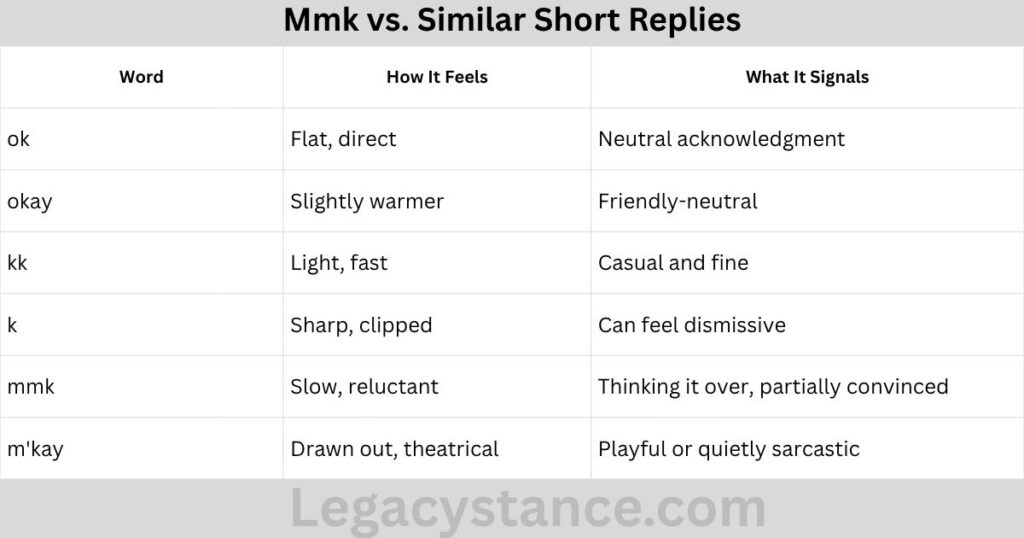
People mix these up constantly. They’re not the same.
| Word | How It Feels | What It Signals |
| ok | Flat, direct | Neutral acknowledgment |
| okay | Slightly warmer | Friendly-neutral |
| kk | Light, fast | Casual and fine |
| k | Sharp, clipped | Can feel dismissive |
| mmk | Slow, reluctant | Thinking it over, partially convinced |
| m’kay | Drawn out, theatrical | Playful or quietly sarcastic |
“k” can feel like a door closing. Mmk feels more like someone leaning back in their chair and exhaling. Less hostile, more undecided.
Mmk in Comments and Social Media
On Instagram, TikTok, or in any comment section, mmk works as a one-word response to an opinion someone doesn’t agree with — but doesn’t feel like debating.
“She was completely in the right here.”
“mmk”
That’s not agreement. It’s an eyebrow raise typed out. The person sees it differently and opted out of the conversation without starting one.
In DMs on any platform, it functions exactly like texting. No special social media meaning — the slang travels across apps without changing.
When MMK Means Something Completely Different
In all caps, MMK shows up in totally separate contexts:
- Fashion — Michael Michael Kors, a sub-line of the MK brand. Used in style posts and tags.
- Philippines — MMK stands for Maalaala Mo Kaya, a long-running Filipino drama anthology. Common reference in that culture, rare outside of it.
- Gaming chats — Still usually just “mmm, okay.” A teammate reluctantly agreeing to a strategy they’re not confident in but will follow anyway.
- Medical/technical — Appears in clinical notes and codes. Completely unrelated to texting.
Lowercase in a text conversation? Almost certainly the “mmm, okay” slang. That’s the only version that matters in casual messaging.
How to Read MMK Without Overthinking It
Three things to check before drawing conclusions:
What came before it. An apology, an excuse, a plan, a fact — context changes everything. The mmk is always reacting to something specific.
What’s missing. No emoji when they usually add one. Shorter than their normal reply. No “haha” or “lol.” Those absences tell you more than the word itself.
Is this normal for them? Some people just text in short bursts. If mmk is their usual style, don’t read into it. If they’ve suddenly gone quiet compared to how they normally talk to you, that shift is the signal.
One more thing — don’t manufacture a problem that isn’t there. If the rest of the chat is normal and only this one reply feels odd, it probably isn’t odd. It’s probably just a lazy okay.
Mistakes People Keep Making With Mmk
Reading it as rude by default. It isn’t always. Neutral exists, and mmk lives there a lot.
Responding with “are you okay?” immediately. If the person was just being casual, this creates awkwardness that didn’t need to exist.
Missing actual passive-aggression when it’s there. The tell is contrast — shorter than usual, colder than usual, delayed more than usual. When all three happen together, mmk is carrying something.
Assuming it means the same thing every time. It doesn’t. Same word, different conversations, genuinely different meanings.
Read more:
What Does BTA Mean? (And Why the Same Letters Confuse So Many People)
YN Meaning Slang: What It Means (And Why Context Changes Everything)
FAQs
If someone sends mmk after an apology, what’s the right move?
Don’t ask if they’re upset — that can feel like putting the emotional labor on them. Instead, acknowledge what you did more directly. “I know I keep doing that, I’ll actually fix it” does more than “are you mad?” It shows you understood without forcing a conversation they may not want to have right now.
Can mmk be sarcastic?
Yes, and it’s pretty cutting when it is. If someone just explained something obviously off, and they get back a flat mmk after a pause — that’s barely concealed sarcasm. The delay and the dryness together make it clear. Without those signals, it’s usually not sarcastic.
Why do some people write it as “mm okay” or “mhm k” instead?
People type how they talk. Some stretch the hum longer, some compress it. Mmk is just the most compact form. The meaning stays the same across all variations — it’s a typing style, not a different word.
Does the number of m’s change the meaning?
Slightly, yeah. “mmk” is standard. “mmmk” with extra m’s tends to be more drawn out — either more skeptical or more playful, depending on context. The longer the hum, the more the person is sitting with their response before giving it.
The Short Version
Mmk = “mmm, okay.” But that okay is never quite neutral — it’s thinking, doubting, shrugging, or occasionally being soft and reassuring. Which one it is depends entirely on the conversation around it, not the word itself.
Read the context. Check the contrast. Don’t invent a problem from three letters alone.