You saw “unk” somewhere and it stopped you. Maybe in a text. Maybe on a form. Maybe in a TikTok comment. The word is short, but figuring out what it actually means takes a second — because the answer genuinely depends on where you saw it.
Short answer: unk means either unknown, uncle/older person, or unknown unknown — and those three meanings have nothing to do with each other.
Unk Started as a Simple Abbreviation
Long before it ever touched social media, “unk” lived quietly in paperwork.
Hospitals, police reports, database fields — anywhere information might be missing, someone wrote unk to mean unknown. Fast, clean, no confusion.
- “Next of kin: unk” — nobody listed
- “Cause of injury: unk” — not determined yet
- “Allergies: unk” — not on record
That’s all it is in formal settings. A placeholder. No tone, no attitude, just a quick note that something wasn’t filled in. If you saw “unk” on any kind of official document, this is your answer and you can stop reading here.
Then Slang Took Unk Somewhere Else Entirely
In casual Black American speech, unc became a warm shorthand for uncle — or really any older male figure you’re familiar with. Not necessarily blood-related. Just an older guy in your circle.
Unk is simply how some people type that same word. Faster. Less precious about spelling.
“My unk came through with food, we’re good.”
That’s the neutral, friendly version. But then the word picked up a second edge online.
In Gen Z internet culture, calling someone “unk” carries a specific kind of teasing energy. It means: you’re acting old. You’re out of touch. You just used a dead meme and thought it was fresh.
It’s not always harsh. Between friends, it’s usually just ribbing. But the implication is clear — you don’t know what’s going on culturally right now, and someone noticed.
“He said ‘on fleek’ in the group chat. Full unk behavior.”
“Why does he dress like an unk at every cookout 💀”
The key difference between the uncle meaning and the Gen Z meaning is tone. One is affectionate. The other is playful mockery. Context — and a few emojis — usually makes it obvious which one you’re looking at.
Unk in Real Examples Across Different Situations
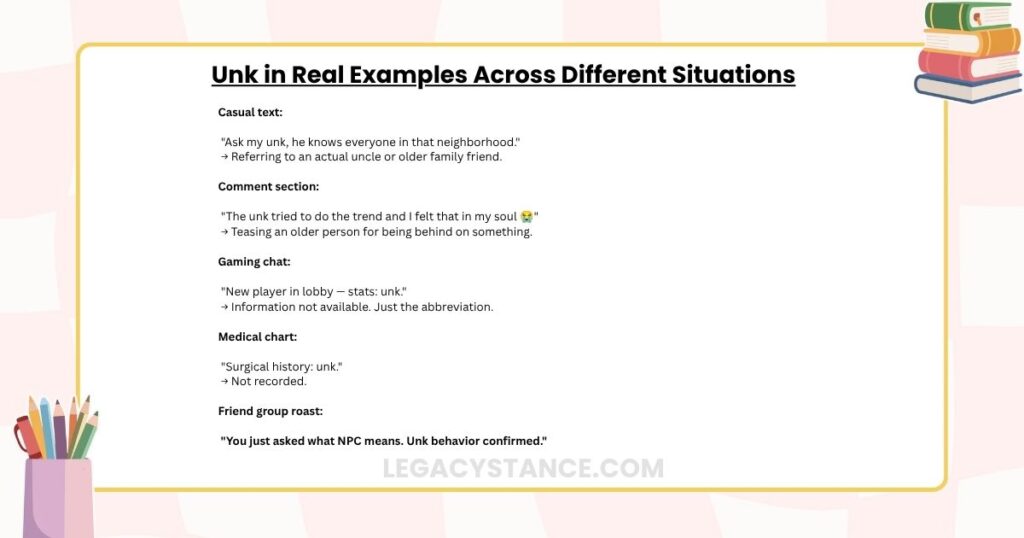
Casual text:
“Ask my unk, he knows everyone in that neighborhood.”
→ Referring to an actual uncle or older family friend.
Comment section:
“The unk tried to do the trend and I felt that in my soul 😭”
→ Teasing an older person for being behind on something.
Gaming chat:
“New player in lobby — stats: unk.”
→ Information not available. Just the abbreviation.
Medical chart:
“Surgical history: unk.”
→ Not recorded.
Friend group roast:
“You just asked what NPC means. Unk behavior confirmed.”
Each one reads completely differently. Same four letters, totally different weight behind them.
Unk on TikTok
On TikTok, the slang version dominates. It shows up in comments, captions, and stitches — almost always pointing at someone acting like they’re from a different era of the internet.
The unk on TikTok is a type, almost a character. Well-meaning. Tries hard. But keeps getting it slightly wrong. Sometimes the comments say it with genuine affection. Other times it’s just clowning. The video itself usually tells you which.
There’s no locked definition here — the platform uses it loosely — but the out-of-touch older energy is almost always the core of it.
Unk The Engineering Version Nobody Expects
Here’s the one that surprises people: in aerospace, military planning, and risk management, unk-unk is a real technical term. It means unknown unknown.
The logic behind it:
- Things you know and understand → known knowns
- Things you know you haven’t figured out yet → known unknowns
- Things you couldn’t have imagined would be a problem → unknown unknowns, or unk-unks
“The failure was an unk-unk. Nothing in our models accounted for it.”
This usage stays inside professional technical fields. You won’t hear it in a TikTok comment or a group chat. But if you work in engineering, defense, or project risk, it’s a real term with a specific meaning.
How to Identify the Right Unk Meaning in Three Seconds
Where did you see it? Official document → unknown. Social media or text → uncle/out-of-touch slang. Engineering report → unk-unk.
Who used it? Medical or admin professional → abbreviation. Young person online → Gen Z slang. Risk manager or engineer → unk-unk.
What is the sentence doing? “Cause: unk” → not recorded. “You’re acting like an unk” → you seem out of touch. “This was an unk-unk” → no one saw it coming.
Three questions. That’s all it takes.
What People Usually Get Wrong about Unk
Assuming it’s always an insult. In paperwork, it’s neutral. In a text about your actual uncle, it’s warm. Only in the teasing Gen Z context does it carry any edge.
Thinking unk and unc are different words. They’re not. Same meaning, same origin — just different typing habits. Some people write unc, some write unk. Neither is more correct.
Treating it as a typo. In formal writing, “unk” is intentional shorthand. In slang, it’s intentional too. It’s almost never a mistake.
Unk Quick Reference
| Where You Saw It | What It Means | Tone |
| Medical form / report | Unknown | Neutral, factual |
| Casual text / conversation | Uncle or older male figure | Warm, familiar |
| TikTok / memes / comments | Out-of-touch older person | Playful, teasing |
| Gaming or tech chat | Unknown (abbreviation) | Neutral |
| Engineering / risk document | Unknown unknown (unk-unk) | Technical, serious |
Read also:
FTM Meaning: What It Means in Texts and Everyday Conversations
WBU Meaning: The Real Answer Behind Those Three Letters
FAQs
Does “unk” mean the same thing as “unc”?
Yes. They come from the same word — uncle — and carry the same meaning in slang. The spelling varies by person and habit, not by definition.
Can calling someone “unk” be rude?
It depends on delivery and relationship. Among friends, it’s almost always just teasing. Said to a stranger with a harsh tone, it can feel dismissive. The surrounding context usually makes it clear.
Why does a slang word also appear on medical forms?
The two uses developed completely independently. The medical abbreviation existed long before the slang did. It’s a coincidence of letters, not a connection of meaning.
Is “unk-unk” actually used by real professionals?
Yes. Engineers, military planners, and risk managers use it as a legitimate term for risks that couldn’t have been anticipated. It’s not casual language — it belongs to a specific professional context.
From what shows up across comment sections, chats, and online searches, most confusion around “unk” comes from one simple thing: people see it in an unexpected place and assume there’s only one meaning. There isn’t. But now you know all of them — and the next time it shows up, the context will do the work for you.