YWA means “You’re Welcome Anyway.” It’s a short, casual reply you send when someone thanks you — especially when your help didn’t fully work out, or when they apologize for bothering you.
Picture this: you spent 10 minutes helping your friend troubleshoot their phone, and it still didn’t fix. They text back: “Thanks for trying though.” And you reply: “YWA 😊”
That’s exactly where this term lives. Not in big dramatic moments. Just in the everyday, slightly imperfect ones.
So Where Did You Probably See YWA?
Most people first spot YWA on Snapchat, in Instagram DMs, or in a regular text thread. It pops up in those quick back-and-forth exchanges where nobody wants to type a full sentence but still wants to sound polite.
Here’s what makes YWA interesting: it has a built-in tone of “no hard feelings.” When someone says thanks even though things didn’t go perfectly, YWA is the soft landing — it says I heard you, no big deal, we’re cool.
YWA in Real Conversations Where it Shows Up
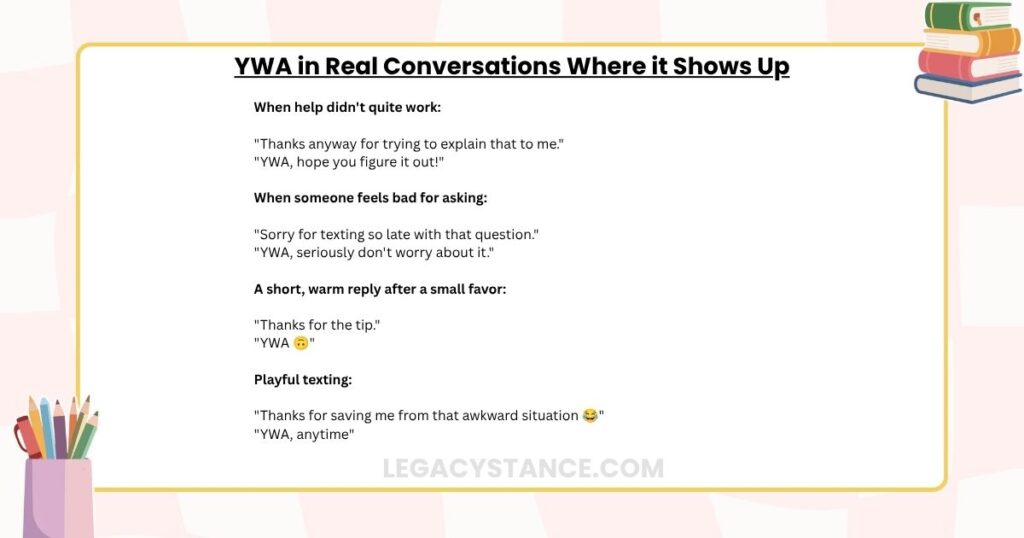
Not every “thanks” situation calls for the same reply. YWA fits some perfectly, and feels off in others. Here’s how it actually looks in real chats:
When help didn’t quite work:
“Thanks anyway for trying to explain that to me.”
“YWA, hope you figure it out!”
When someone feels bad for asking:
“Sorry for texting so late with that question.”
“YWA, seriously don’t worry about it.”
A short, warm reply after a small favor:
“Thanks for the tip.”
“YWA 🙃”
Playful texting:
“Thanks for saving me from that awkward situation 😂”
“YWA, anytime”
Notice how in each of these, the tone shifts slightly. Sometimes YWA sounds warm and reassuring. Sometimes it sounds just a tiny bit teasing — like saying “oh yeah, sure, you’re welcome… for that.”
That small shift in feeling? It mostly comes from the emoji you pair it with, and how well you know the person.
The Tone Is Everything Here
This is the part most people miss.
YWA doesn’t have one fixed emotion behind it. It can land as:
- Warm and kind — “Of course, no need to apologize.”
- Lightly teasing — “You’re thanking me? Okay, sure, YWA.”
- Gently sarcastic — Said when someone overly thanks you for something tiny.
The words stay the same. The tone changes based on what happened before it, who said it, and what you add after.
If someone texts you YWA with a 🙃, they’re probably being a little playful. If it comes with a 😊, it’s just friendly. No emoji and one word only? Probably neutral — quick and casual, nothing deeper.
YWA on Snap, TikTok, and Instagram — Does It Change?
Not really, no.
On Snapchat, YWA shows up after someone snaps “thx” or “sorry for bothering you.” Same energy — short, informal, no big deal.
On TikTok, you’ll see it in comment replies. Someone might comment “Thanks for explaining, even though I’m still confused lol” and the creator replies “YWA 😂.” It fits the low-effort, high-friendliness vibe of TikTok comments.
On Instagram DMs, it’s used the same way as texting. Someone thanks you, maybe apologizes a little, and YWA is the chill way to wave it off.
The platform doesn’t change the meaning. What changes is how fast the conversation moves and how many people might see it.
YWA from a Guy vs. from a Girl — Is There a Difference?
Nope.
The meaning stays the same regardless of who sends it. Both guys and girls use YWA as a quick, friendly acknowledgment. The only thing that shifts the tone is the relationship and context — not the gender of whoever typed it.
If a guy texts YWA after helping you, it’s the same casual “no big deal” as when a girl sends it. Read the situation, not the sender.
When YWA Doesn’t Fit
Here’s the catch — and it matters.
YWA works beautifully in casual, low-stakes moments. But it can feel really off if you use it in the wrong situation.
Skip YWA when:
- Someone is deeply thanking you for something that meant a lot to them
- You’re in a work chat, group project message thread, or texting a teacher or boss
- The conversation is emotional — like someone just told you something hard and said “thanks for listening”
- The person doesn’t use slang at all and might genuinely not know what it means
In those cases, just type it out. “You’re welcome” or “Of course, happy to help” hits differently when the moment actually calls for it.
Using YWA in a serious situation accidentally signals that you’re not taking it seriously. That’s not a good look.
YWA Other “Meanings” People List Online
A quick note on this, because you’ll find other definitions if you search around.
Some sites list things like “You’re Welcome Anytime” or “You Wanna Ask” as meanings for YWA. Technically possible? Sure. Actually used that way in real texting? Barely.
The one meaning that shows up everywhere — across slang dictionaries, chat examples, and actual conversations — is You’re Welcome Anyway. That’s the one worth knowing. The others are so rare that if someone sent you YWA expecting you to read it as something else, they’d probably just explain it.
How to Reply When Someone Sends You YWA
If you get a YWA back, you don’t need to analyze it. Just match their energy.
- If the conversation was casual: “Haha okay, thanks anyway!”
- If they were reassuring you: “Appreciate it, for real.”
- If it felt slightly teasing: “Okay okay, I’ll stop thanking you 😅”
- If the chat’s naturally winding down: a simple “💙” or no reply is totally fine.
You don’t need to respond with a full paragraph. YWA is a wrap-up kind of message — it closes the loop softly.
From What I’ve Seen in Real Chats
YWA gets used most between people who already have a comfortable, familiar dynamic. It’s not the kind of thing you’d send to someone you’re texting for the first time. It works because both people already understand the shorthand.
The funniest uses are honestly when someone overdramatically thanks you for something tiny — like passing them the aux cord — and you just reply “YWA 😌” like you just completed a life mission. That little bit of irony is baked into how people use it.
Frequently Asked Questions
If I don’t know what YWA means in the middle of a conversation, should I ask?
Yes, and it’s fine to ask. Just say “wait what does YWA mean?” — nobody’s going to judge you for it. Slang moves fast, and not everyone keeps up with every abbreviation.
Can YWA come across as rude?
It can, if the situation is serious and the other person feels like you’re brushing off their thanks. In casual conversations it reads as friendly. In heavier moments, it can feel dismissive — so pay attention to the context before you hit send.
Is YWA an old term or is it still being used in 2025?
Still in use, especially on Snapchat and in direct messages. It hasn’t exploded into mainstream use the way LOL or NGL did, but people who know it use it regularly. It’s one of those abbreviations that stays quietly useful.
What’s the difference between YW and YWA?
YW is “you’re welcome” — clean, simple, and used when help went smoothly. YWA adds the “anyway,” which carries a little extra meaning: the help might not have been perfect, or the thanks wasn’t totally necessary, but you’re still accepting it with good vibes. Small difference in letters, slightly different feeling.
YWA is one of those terms that’s simple once you get it, but easy to misread before you do. Now you’ve got the full picture — the meaning, the tone, the right moments to use it, and the ones to avoid.