You saw “TWT” in a message and now you’re second-guessing the whole conversation. Fair enough — let’s clear it up fast.
TWT means “Time Will Tell.” It’s used when someone doesn’t know how something will turn out yet, and they’re okay waiting to find out. That’s it. Simple on the surface, but the way people actually use it is worth understanding.
The Emotion Hiding Inside Three Letters
Most explanations stop at the definition. Here’s what they miss.
When someone types TWT, they’re not just saying “I don’t know.” They’re saying I have a feeling, but I’m not ready to say it out loud. There’s a difference. It carries patience, quiet confidence, or sometimes a little suspense.
“I don’t know” feels empty. TWT feels like someone’s watching and waiting.
That shift in tone is exactly why it shows up so much in conversations about relationships, results, predictions, and outcomes — situations where something is about to happen, and everyone’s waiting to see what it is.
What TWT Actually Looks Like in Real Chats
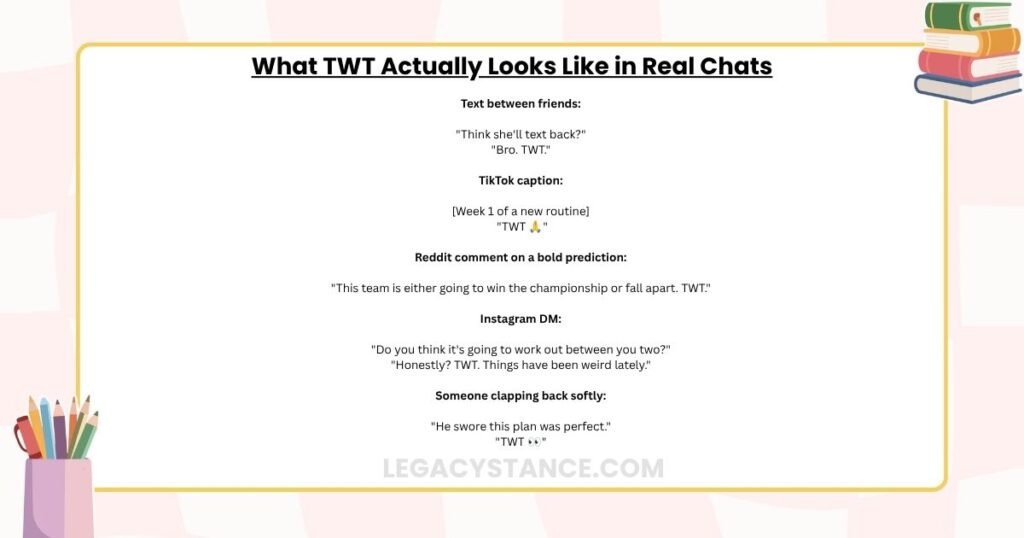
Text between friends:
“Think she’ll text back?”
“Bro. TWT.”
TikTok caption:
[Week 1 of a new routine]
“TWT 🙏”
Reddit comment on a bold prediction:
“This team is either going to win the championship or fall apart. TWT.”
Instagram DM:
“Do you think it’s going to work out between you two?”
“Honestly? TWT. Things have been weird lately.”
Someone clapping back softly:
“He swore this plan was perfect.”
“TWT 👀”
Notice the pattern — TWT always appears when something is pending. A reply, a result, a relationship shift. It’s the pause before the answer arrives.
TWT vs TwT — The Mix-Up That Changes Everything
This is where people get genuinely confused, and it’s worth paying attention to.
TWT = Time Will Tell. An abbreviation. All letters treated equally.
TwT = A crying face emoticon. Tilt your head — the T’s are eyes, the lowercase w is a trembling mouth. It’s an expression of emotion, not a prediction.
So if you tell someone something sad and they reply “TwT,” they’re not commenting on the future. They’re showing you they feel bad about it.
Getting these two wrong completely changes how a message reads. Especially on Instagram and Reddit where both versions pop up in comments regularly.
TWT Platform Breakdown — Same Word, Different Energy
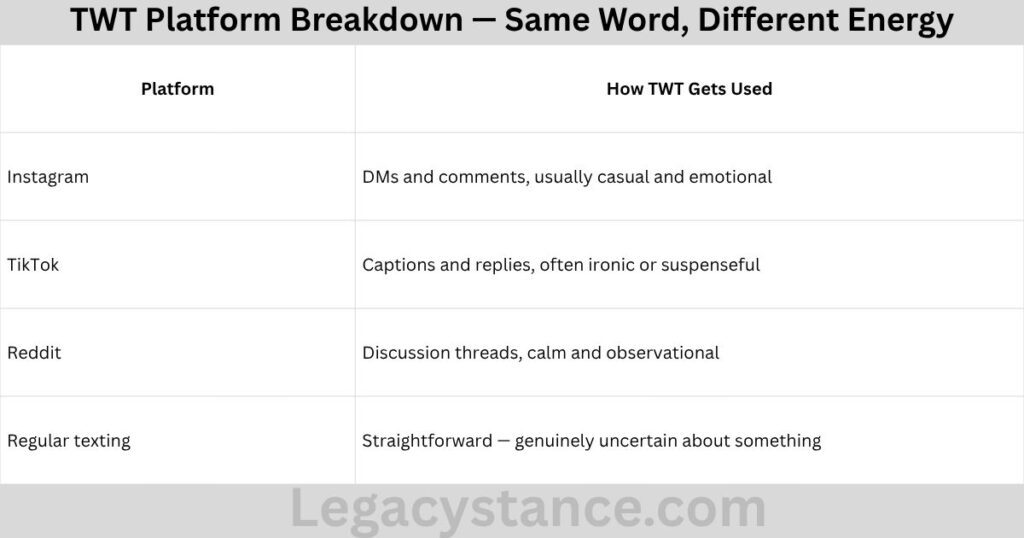
The meaning doesn’t change across platforms, but the tone shifts depending on where you see it.
| Platform | How TWT Gets Used |
| DMs and comments, usually casual and emotional | |
| TikTok | Captions and replies, often ironic or suspenseful |
| Discussion threads, calm and observational | |
| Regular texting | Straightforward — genuinely uncertain about something |
On TikTok especially, TWT gets used with a sarcastic edge. Someone posts an overconfident take, and the comments fill up with “TWT 👀” — which is a soft way of saying we’ll see about that.
The Crypto Meaning — Completely Different World
If TWT shows up in a finance thread, a crypto Discord, or a trading conversation, it likely means Trust Wallet Token — a cryptocurrency tied to the Trust Wallet app.
Zero connection to texting slang. Context makes it obvious which one applies. Coins and wallets mentioned? Crypto. Relationships and outcomes? Time Will Tell.
When Someone Sends You TWT — What Do You Actually Say Back?
Most people just stare at it. Here’s what fits naturally:
- “Ugh, the waiting is the worst part”
- “Fair. Let me know when you find out”
- “Yeah, I guess we’ll see 😅”
- “That’s not the answer I was hoping for lol”
You don’t need to match it with another abbreviation. Just respond to what they’re actually saying, which is: the answer isn’t here yet, and I’m sitting with that.
TWT From a Girl — Does the Meaning Change?
People search this a lot. Short answer: the word means the same thing.
What changes is the weight of the conversation around it. If someone you like sends “TWT” after you ask where things are going between you two, that hits differently than a friend saying it about a game result. Same three letters, completely different stakes.
Read the conversation, not just the word.
When to Use TWT and When to Skip It
TWT lands well when there’s genuinely something pending — a result coming, an outcome unclear, a situation unfolding. Drop it into a conversation that has no upcoming payoff and it just confuses people.
Use it when:
- You’re uncertain but expecting an answer soon
- You’re making a soft prediction without committing to it
- You want to signal patience without typing a full response
Skip it when:
- Someone needs a direct answer right now
- The other person is already anxious about the outcome
- You’re in a work or school setting where abbreviations feel out of place
Read more:
WGAF Meaning — Blunt Acronym That Says Everything Without Saying Much
YWA Meaning — What It Means When Someone Texts You This
Unk Meaning: One Word, Three Completely Different Lives
FAQs
Is TWT passive-aggressive?
Not inherently. But if someone’s waiting on something serious and you reply with just “TWT,” it can feel like a dodge. Tone of the whole conversation matters more than the word itself.
Can TWT be sarcastic?
Yes, and it’s pretty common. Especially under TikTok posts where someone made a big claim. “TWT” in the comments is a quiet way of raising an eyebrow without starting an argument.
Is it okay to use in school or work messages?
No. Keep it in personal chats. If you want to use the phrase in a professional context, just write “time will tell” — it reads completely differently.
Does lowercase “twt” mean the same thing?
Usually yes. Most people type it lowercase out of habit or autocorrect. Just watch that the w isn’t styled smaller than the T’s, or it starts reading as the crying emoticon instead.
TWT is one of those terms that looks simple but carries real emotional weight in the right conversation. People reach for it when they’re hopeful but cautious, uncertain but still paying attention.
It’s not about not having an answer. It’s about trusting that one is coming.