

Finding Vegetables That Start With D is easier than most people think. Beyond familiar choices like daikon, dill, and dandelion greens, there are many lesser-known vegetables enjoyed across Asia, Europe, Africa, and the Americas.
This guide brings together common, rare, leafy, root, sea, and heirloom vegetables that start with D. You’ll discover what they are, how they’re used in everyday cooking, and interesting facts that make each one worth knowing.
Common Vegetables That Start With D
| Vegetable | Flavor | Best Use |
| Daikon | Mild, peppery | Pickling, stir-fry |
| Dandelion Greens | Bitter | Sauté, salads |
| Dasheen | Starchy, nutty | Boiling, curries |
| Dill | Bright, anise-like | Pickling, sauces |
| Drumstick Pod | Earthy, mild | Curries, soups |
| Dulse | Salty, smoky | Snacks, soups |
| Dragon Tongue Bean | Sweet, tender | Sauté, roasting |
| Dolichos Bean | Earthy, dense | Stews, curries |
| Daylily Bud | Sweet, grassy | Stir-fry, soups |
| Delicata Squash | Sweet, buttery | Roasting |
| Dinosaur Kale | Earthy, robust | Soups, sauté |
| Dutch White Cabbage | Mild, crisp | Slaws, braising |
| Desert Truffle | Nutty, earthy | Sauté, stews |
| Dwarf Bean | Sweet | Steaming, stir-fry |
Root Vegetables That Start With D
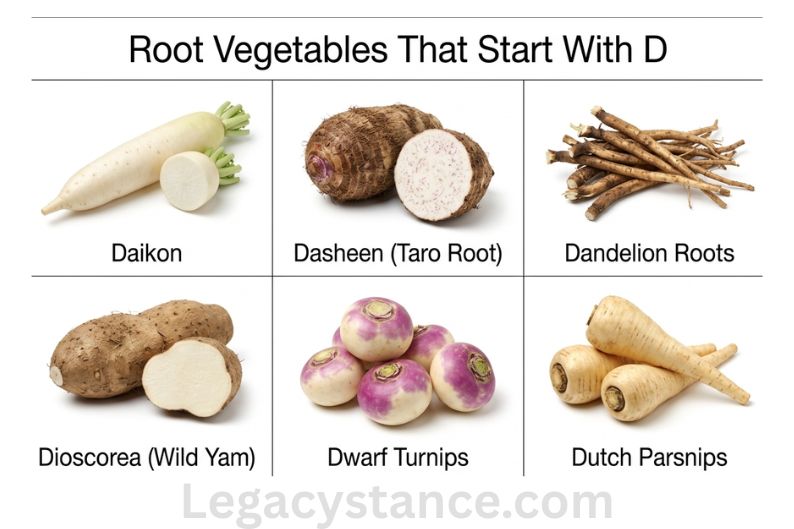
1. Daikon
A long white radish essential to East and South Asian cooking. Can grow over a foot long with smooth white skin and crisp white flesh.
Taste: Mild, clean, faintly peppery raw — sweet and soft when cooked
Cooking uses:
- Pickled into Japanese takuan (bright yellow pickle)
- Grated raw beside tempura or sushi as oroshi
- Simmered in miso soup or oden stew
- Shredded into cold salads
- Stir-fried with pork or tofu
Storage: Wrap in a damp paper towel, refrigerate. Dries out quickly without moisture.
Fact: Grated daikon placed beside fried food in Japanese cooking is not decoration — it genuinely aids digestion of oily food.
2. Dasheen (Taro Root)
The Caribbean and West African name for taro. A rough, hairy-skinned corm with white or purple-flecked flesh inside. Must always be cooked — raw dasheen contains compounds that irritate the throat.
Taste: Starchy, mildly nutty, faintly sweet
Cooking uses:
- Boiled and mashed like potato
- Cooked in Trinidadian callaloo stew
- Fried into taro chips
- Simmered in coconut curries
Storage: Keep unpeeled at room temperature in a cool, dry place. Do not refrigerate unwashed.
Fact: Dasheen leaves are eaten across the Caribbean as a separate vegetable — in some regions more widely than the root.
3. Dandelion Root
The root of the same dandelion plant whose greens are eaten in salads. Brown-skinned, white-fleshed, and pencil-thin when young — thicker and more fibrous when mature.
Taste: Bitter, earthy, slightly sweet when roasted
Cooking uses:
- Roasted and brewed as a caffeine-free coffee substitute
- Chopped and added to root vegetable soups
- Cooked in stews in traditional European food
Storage: Refrigerate in a bag for up to one week.
Fact: Roasted dandelion root coffee became popular in Europe during World War II when real coffee was scarce.
4. Dioscorea (Wild Yam)
A climbing vine that produces edible tubers across tropical Africa, Asia, and the Caribbean. Not the same as sweet potato — true yams belong to the Dioscorea genus.
Taste: Starchy, dry, mildly earthy — less sweet than sweet potato
Cooking uses:
- Boiled and pounded into fufu across West Africa
- Fried in slices
- Added to soups and stews
- Roasted in embers whole
Storage: Keep uncut at room temperature in a cool, dry area for several weeks.
Fact: Nigeria produces over 65% of the world’s yam supply, making it the most yam-dependent country on earth.
5. Dwarf Turnip
A smaller, rounder variety of standard turnip. White and purple skin, crisp white flesh, milder than full-sized turnips.
Taste: Mild, slightly peppery, sweetens considerably when roasted
Cooking uses:
- Roasted whole
- Added to root vegetable braises
- Sliced raw into winter salads
- Pickled in Middle Eastern cuisine
Storage: Refrigerate in a bag for up to two weeks.
Fact: Young dwarf turnip leaves are entirely edible and used as greens in Southern US cooking.
6. Dutch Parsnip
A heritage variety of parsnip with a slightly shorter, stubbier root and a sweeter, nuttier flavor than standard parsnips.
Taste: Sweet, nutty, earthy — intensifies with roasting
Cooking uses:
- Roasted alongside root vegetables
- Pureed into soup
- Glazed with honey or maple syrup
- Added to winter stews
Storage: Refrigerate in a loose bag for up to three weeks.
Fact: Parsnips develop more sweetness after a frost because the cold converts their starches into sugars.
7. Desert Truffle (Terfez)
A subterranean fungus found in arid regions of the Middle East and North Africa. Not a true truffle but cooked as a vegetable across Saudi Arabia, Iraq, Libya, and Morocco.
Taste: Nutty, earthy, milder and less intense than European black truffle
Cooking uses:
- Sautéed in butter
- Added to lamb stews
- Cooked in scrambled eggs
- Grilled whole over open fire
Storage: Use within two to three days of harvest. Does not preserve well.
Fact: Desert truffles are mentioned in ancient Arabic texts and are considered a delicacy at Bedouin feasts.
8. Dahlia Tuber
The tuber of the ornamental dahlia plant. Grown for flowers in most gardens but the tuber is edible — it was cultivated as a food crop by Aztecs in Mexico long before Europeans arrived.
Taste: Crunchy, mildly sweet, similar to water chestnuts or jicama
Cooking uses:
- Sliced raw into salads
- Roasted in oil
- Added to stir-fries as a water chestnut substitute
Storage: Keep cool and dry. Use fresh.
Fact: The dahlia was introduced to Europe as a food crop, not a flower — its decorative potential was discovered later.
9. Dolichos Root
The root portion of the dolichos/hyacinth bean plant. Less common than the bean itself but used in parts of South Asia as a food source.
Taste: Starchy, mild, similar to cassava
Cooking uses:
- Boiled in water
- Added to thick soups
Storage: Use fresh within a few days.
Fact: Most parts of the dolichos plant are edible — leaves, young pods, seeds, and roots.
10. Drumstick Root (Moringa Root)
The root of the moringa tree, sharper and more pungent than the pods. Used in traditional South Asian cooking as a condiment in small amounts.
Taste: Pungent, hot, similar to horseradish
Cooking uses:
- Grated as a condiment
- Used in small amounts in regional South Indian chutneys
Storage: Refrigerate wrapped. Use within several days.
Fact: Moringa root contains high concentrations of the same compounds found in horseradish — which explains the similarity in heat.
Leafy Greens That Start With D
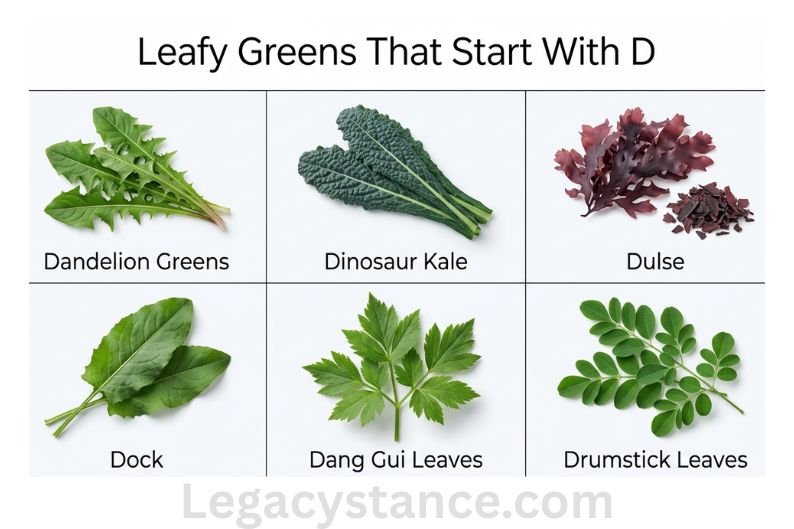
11. Dandelion Greens
Deeply toothed leaves from the common dandelion plant. A staple in Italian, Greek, and Southern American cooking.
Taste: Distinctly bitter — young spring leaves are significantly milder
Cooking uses:
- Sautéed with garlic and olive oil
- Tossed in sharp vinaigrette
- Braised with pancetta or bacon
- Added to bean and lentil soups
Storage: Unwashed in a loose bag, refrigerated. Use within two to three days.
Fact: Dandelion greens have more iron per gram than spinach.
12. Dinosaur Kale (Lacinato / Tuscan Kale)
Long dark blue-green leaves with a pebbled, leathery surface. The traditional variety used in Tuscan ribollita soup.
Taste: Earthier and more complex than curly kale, noticeably less bitter
Cooking uses:
- Tuscan ribollita and minestrone
- Sautéed with garlic and chili
- Massaged raw in salads with lemon and olive oil
- Added to grain bowls
Storage: Refrigerate unwashed in a bag. Lasts up to a week.
Fact: Lacinato kale has been grown in Tuscany since the 18th century.
13. Dulse (Sea Vegetable)
A reddish-purple seaweed from North Atlantic and North Pacific coastlines. Eaten as a snack for centuries in Ireland, Iceland, and Atlantic Canada.
Taste: Salty, smoky, strongly umami
Cooking uses:
- Eaten dried straight from the bag
- Fried in a dry pan as a bacon substitute
- Added to chowders and seafood soups
- Blended into seasoning salts
Storage: Sealed container away from light and moisture. Lasts months.
Fact: Fried dulse smells and tastes like bacon — documented and confirmed by food researchers at Oregon State University.
14. Dock (Sorrel Dock / Rumex)
A broad-leaved wild plant found across Europe, North America, and Asia. Closely related to sorrel. Used as a pot herb in traditional cooking across many cultures.
Taste: Sour, tangy, lemony
Cooking uses:
- Cooked into sour soups in Eastern Europe
- Wilted as a side green
- Added to fish dishes in Russia and Ukraine
- Blended into sorrel sauce
Storage: Refrigerate loose in a bag. Use within two days.
Fact: Dock leaves have been used for centuries to soothe nettle stings — the same fields where nettles grow almost always contain dock.
15. Dang Gui Leaves (Angelica Leaves)
Leaves of the angelica plant, which is more famous for its root in traditional Chinese medicine. Young leaves are used as a cooked vegetable in parts of East Asia.
Taste: Mildly bitter, aromatic, herbal
Cooking uses:
- Blanched and eaten as a side vegetable
- Added to mountain vegetable dishes in Korea and Japan
Storage: Use fresh. Refrigerate for no more than two days.
Fact: Angelica stems are candied in sugar and used as a cake decoration in European confectionery.
16. Drumstick Leaves (Moringa Leaves)
The small, round leaves of the moringa tree. Widely eaten as a vegetable across South Asia, East Africa, and the Philippines.
Taste: Mildly bitter, grassy, slightly peppery
Cooking uses:
- Stirred into dal at the last minute
- Added to soups and stews
- Cooked with eggs
- Eaten fresh in salads in the Philippines
Storage: Refrigerate in a bag. Use within three days.
Fact: Moringa leaves contain more calcium per gram than milk, more potassium than bananas, and more vitamin C than oranges.
17. Dill (Leafy Use)
While dill appears in the herb section of most grocery stores, in Eastern European cooking it is used in amounts large enough to classify as a leafy vegetable.
Taste: Bright, grassy, faintly anise-like
Cooking uses:
- Folded generously into potato salad
- Stirred into borscht and cold soups
- Scattered over cucumbers with sour cream
- Mixed into soft cheese spreads
Storage: Stand in a glass of water, cover loosely with a bag, refrigerate. Lasts up to a week.
Fact: In Russian cooking, dill is used more as a vegetable than a seasoning — entire recipes call for cups of it, not teaspoons.
18. Deltoid-Leaved Dewflower (Deinanthe)
A shade-loving leafy plant from mountain forests of China and Japan. Young leaves are eaten as a foraged vegetable in traditional mountain cooking.
Taste: Mild, slightly grassy
Cooking uses:
- Blanched and dressed with soy and sesame
- Added to mixed wild vegetable dishes
Storage: Use fresh within a day of harvesting.
Fact: Largely unknown outside its native range — rarely appears in any vegetable list.
19. Dolmeh Leaves (Grape Leaves / Vine Leaves)
The leaves of grapevines. Widely used as a cooking vegetable across the Middle East, Greece, and Turkey. The leaf itself is the edible wrapping.
Taste: Slightly tart, grassy, briny when preserved
Cooking uses:
- Stuffed with rice, herbs, and meat (dolmeh, dolmades)
- Used as wrapping for grilled fish
- Blanched and layered in casseroles
Storage: Fresh leaves refrigerate for several days. Jarred leaves last months.
Fact: Grape leaves have been stuffed and cooked across the Eastern Mediterranean for over 2,000 years.
20. Dwarf Bok Choy (Shanghai Bok Choy)
A smaller, more tender version of standard bok choy with pale green stems rather than the classic white. A staple in Chinese home cooking.
Taste: Mild, clean, very slightly sweet
Cooking uses:
- Stir-fried whole in oyster sauce
- Steamed alongside dumplings
- Added to ramen and noodle soups
- Braised in broth
Storage: Unwashed in a perforated bag in the fridge. Use within three to four days.
Fact: The smaller the bok choy, the more tender and sweet it tends to be.
Cruciferous Vegetables That Start With D
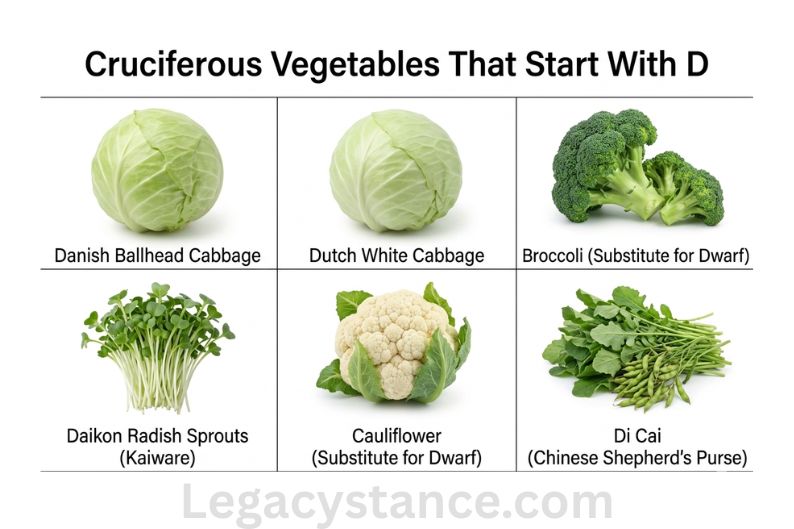
21. Dutch White Cabbage
A smooth, pale-headed cabbage variety from the Netherlands. Tighter and denser than loose-leaf cabbages with a mild, sweet flavor.
Taste: Mild, crisp, slightly sweet when raw — sweeter and softer when cooked
Cooking uses:
- Dutch coleslaw (koolsla)
- Braised slowly in butter or fat
- Added to hutspot (Dutch stew)
- Fermented into sauerkraut
Storage: Refrigerate whole, unwrapped. Lasts up to two weeks.
Fact: Dutch white cabbage is the standard variety used to make the original European sauerkraut.
22. Danish Ballhead Cabbage
A round, dense cabbage variety bred in Denmark. Heavy, firm head with tightly packed pale green leaves.
Taste: Crisp and mild raw — develops a slightly sweet, savory depth when braised or fermented
Cooking uses:
- Fermented into sauerkraut
- Braised with apples and caraway seeds
- Used in stuffed cabbage rolls
- Sliced for winter salads
Storage: Refrigerate or keep in a cool root cellar for up to three weeks.
Fact: Danish ballhead is prized by fermenters because its dense, high-water content produces excellent sauerkraut.
23. Di Cai (Chinese Shepherd’s Purse)
A leafy green in the mustard family. Eaten widely in Chinese cooking, especially in Shanghai, where it is a traditional filling for wontons and spring rolls.
Taste: Mildly bitter with a fresh, slightly nutty edge
Cooking uses:
- Mixed into wonton and dumpling fillings
- Stir-fried with garlic
- Cooked in rice congee
- Added to spring rolls
Storage: Refrigerate unwashed. Use within two days.
Fact: Shepherd’s purse takes its English name from the shape of its seed pods, which resemble old-fashioned coin purses.
24. Dwarf Cauliflower
A compact cauliflower variety bred for smaller spaces and faster maturity. Grows in a more manageable size than standard cauliflower heads.
Taste: Identical to standard cauliflower — mild, nutty, earthy
Cooking uses:
- Roasted whole
- Mashed as a potato substitute
- Steamed and served with cheese sauce
- Added to curries
Storage: Refrigerate unwrapped. Use within five days.
Fact: Dwarf cauliflower was developed partly to suit home garden growers with limited space.
25. Dwarf Broccoli
A compact broccoli variety producing smaller heads. Flavor and use are identical to standard broccoli.
Taste: Mild, slightly nutty, faintly bitter
Cooking uses:
- Roasted at high heat until edges crisp
- Steamed
- Stir-fried
- Added to pasta and grain dishes
Storage: Refrigerate unwashed. Use within four days.
Fact: Broccoli has been cultivated in Italy since ancient Roman times.
26. Daikon Radish Sprouts (Kaiware)
The young sprouts of daikon seeds. Common in Japanese cuisine as a garnish and fresh topping.
Taste: Sharp, peppery, more intense than mature daikon
Cooking uses:
- Laid across sushi rolls
- Added to salads
- Used as a garnish for soups and rice dishes
Storage: Refrigerate in the tray they come in. Use within three days.
Fact: Kaiware sprouts are considered one of Japan’s most common microgreens.
Legumes Vegetables That Start With D
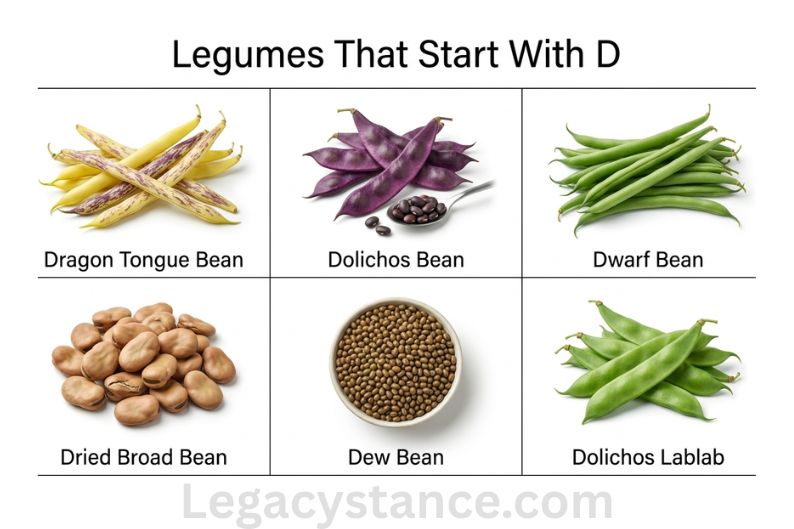
27. Dragon Tongue Bean
Yellow wax beans with distinctive purple streaks that vanish entirely when cooked.
Taste: Sweet, tender, more delicate than standard green beans
Cooking uses:
- Lightly sautéed in butter with herbs
- Roasted at high heat
- Blanched and added to salads
- Pickled whole
Storage: Unwashed in a produce bag, refrigerated. Use within four to five days.
Fact: Dragon tongue beans originated in the Netherlands and are also called Dutch yellow wax beans.
28. Dolichos Bean (Hyacinth Bean / Lablab Bean)
A vine-growing legume with beautiful purple flowers and pods ranging from green to deep purple. Cultivated across South Asia and sub-Saharan Africa for thousands of years.
Taste: Dense, earthy, similar to black-eyed peas
Cooking uses:
- South Asian curries and dal
- East African stews
- Rice dishes
- Thick vegetable soups
Storage: Dried seeds keep up to a year in an airtight container.
Fact: Hyacinth bean doubles as an ornamental garden vine — one of very few vegetables also grown purely for decoration.
29. Dwarf Bean (Bush Bean)
A compact, bushy bean plant that does not need staking. Widely grown in home gardens across Europe and North America.
Taste: Sweet, fresh, tender
Cooking uses:
- Steamed as a simple side
- Stir-fried with garlic
- Blanched and tossed in salads
- Added to minestrone soup
Storage: Refrigerate unwashed in a bag. Use within three to four days.
Fact: Dwarf beans are the most commonly grown home garden bean in the United Kingdom.
30. Dried Broad Bean (Fava Bean Dried)
The dried, shelf-stable form of fresh broad beans. A staple across the Middle East, North Africa, and the Mediterranean.
Taste: Nutty, creamy, more intense than fresh fava
Cooking uses:
- Cooked into Egyptian ful medames
- Pureed into dips
- Added to thick stews
- Made into falafel in some regions
Storage: Airtight container in a cool, dark place for up to a year.
Fact: Ful medames, made from dried fava beans, is the national dish of Egypt and has been eaten there since ancient times.
31. Dew Bean (Moth Bean)
A drought-resistant legume native to India. One of the hardiest crops in arid conditions — grown across Rajasthan where few other crops survive.
Taste: Earthy, slightly nutty, firmer texture than other small beans
Cooking uses:
- Sprouted and eaten raw in salads
- Cooked into Indian dal
- Added to dry-spiced vegetable dishes (sabzi)
- Mixed into street food preparations
Storage: Dried beans store for up to a year in a sealed container.
Fact: Moth bean is one of the few legumes that can be sprouted and eaten raw — commonly sold as fresh sprouts in Indian markets.
32. Dolichos Lablab (Fresh Green Pods)
The young, flat green pods of the hyacinth bean plant before the seeds mature. Cooked as a fresh vegetable the same way snap beans are.
Taste: Mild, slightly sweet, earthy
Cooking uses:
- Stir-fried with spices
- Added to South Indian sambar
- Cooked into dry sabzi dishes
Storage: Refrigerate and use within three days.
Fact: Young lablab pods must be fully cooked — even the green pods contain low levels of compounds that are neutralized by heat.
33. Dark Red Kidney Bean (Fresh)
Fresh, unshelled kidney beans before drying. Rare outside of home gardens but used fresh in some traditional recipes.
Taste: Earthy, hearty, creamy when cooked
Cooking uses:
- Fresh: shelled and simmered in soups
- Added to stews and braises
Storage: Refrigerate shelled beans and use within two days.
Fact: Never eat raw kidney beans — they contain high concentrations of a toxin called phytohaemagglutinin that causes intense illness. Boiling for at least ten minutes destroys it.
34. Dun Pea
An older variety of field pea with a dull brown-grey seed coat. Grown across Northern Europe and used in traditional English and Scandinavian cooking.
Taste: Earthy, mild, slightly starchy
Cooking uses:
- Cooked into traditional English pease pudding
- Simmered in soups
- Added to stews
Storage: Dried peas store for a year in an airtight container.
Fact: Pease pudding (made from dun peas) was a working-class staple in northern England for centuries and is still sold in chip shops in northeast England today.
Gourds and Squash Vegetables That Start With D
35. Delicata Squash
An oblong winter squash with cream skin and distinctive green and orange stripes. Its key advantage: the skin is thin and entirely edible after roasting.
Taste: Sweet, buttery — often described as sweet potato crossed with corn
Cooking uses:
- Roasted in rings with seeds left in
- Stuffed with grains and cheese, baked whole
- Cubed into grain and farro bowls
- Pureed into soup
Storage: Whole, uncut — two to three months in a cool, dry place. Cut — refrigerate and use within five days.
Fact: Despite being a winter squash, delicata has a shorter shelf life than butternut and does not keep all winter.
36. Duda Farm Bitter Melon (Bitter Gourd)
The bitter gourd or bitter melon is a warty, ridged green gourd used across South and Southeast Asian cooking. It has one of the strongest bitter flavors of any vegetable.
Taste: Intensely bitter, slightly astringent
Cooking uses:
- Stir-fried with eggs and garlic in Chinese cooking
- Stuffed with pork and steamed
- Added to soups in Filipino and Vietnamese cooking
- Salted and squeezed to reduce bitterness before cooking
Storage: Refrigerate in a bag and use within four to five days.
Fact: Bitter melon has been studied extensively for its potential role in blood sugar regulation in traditional medicine.
37. Dudhi (Bottle Gourd / Lauki)
A pale green, smooth-skinned gourd shaped like a bottle or a large club. One of the oldest cultivated gourds in human history.
Taste: Mild, slightly sweet, absorbs surrounding flavors — similar to zucchini
Cooking uses:
- Cooked in South Asian dal and curries
- Made into halwa (sweet dessert)
- Stewed in Middle Eastern dishes
- Added to soups and stir-fries
Storage: Refrigerate whole for up to a week. Cut pieces refrigerate for three days.
Fact: Dried bottle gourds were used as water containers and musical instruments across ancient Africa and Asia — archaeologists have found them at sites over 10,000 years old.
38. Delicata-Type Winter Squash Variants
Several heirloom squash varieties closely related to delicata share the same thin edible skin, including:
- Honey Boat Squash — longer, deeper orange flesh
- Sugar Loaf Squash — slightly rounder, very sweet
- Zeppelin Squash — elongated, dense flesh
All are roasted the same way as standard delicata.
39. Drum Gourd (Round Bottle Gourd)
A round, drumlike variety of bottle gourd grown across India and West Africa.
Taste: Mild, watery, similar to zucchini
Cooking uses:
- Curried with spices
- Added to dal
- Fried with mustard seeds and turmeric
Storage: Refrigerate and use within five days of cutting.
Fact: In parts of West Africa, the dried shell of drum gourds is used as a percussion instrument.
40. Dwarf Summer Squash
Compact summer squash varieties bred for smaller garden spaces. Includes dwarf versions of zucchini, pattypan, and yellow squash.
Taste: Mild, tender, slightly sweet when young
Cooking uses:
- Sautéed in butter
- Grilled
- Added to ratatouille
- Sliced raw into summer salads
Storage: Refrigerate and use within four days.
Fact: Summer squash harvested small and young is consistently more tender and flavorful than oversized ones.
Pod and Stem Vegetables That Start With D
41. Drumstick Pod (Moringa Oleifera)
The long ridged green pod of the moringa tree. Not eaten whole — cooked and the interior flesh and seeds are scraped out.
Taste: Subtly earthy, mildly bitter, faintly like grassy asparagus
Cooking uses:
- South Indian sambar soup
- Coconut-based curries
- Dal
- Sri Lankan meat gravies
Storage: Refrigerate in a perforated bag. Use within three to four days.
Fact: Drumstick pods are sometimes called the “miracle tree” pods — every part of the moringa tree is edible or medicinally useful.
42. Dolichos Pods (Young Lablab Pods)
The young flat pods of the lablab/hyacinth bean, harvested before seeds mature.
Taste: Mild, slightly sweet, earthy
Cooking uses:
- Stir-fried with spices
- Added to South Indian sambar
- Cooked in dry-spiced dishes
Storage: Refrigerate and use within three days.
Fact: Must be cooked — even young pods contain low levels of compounds that heat neutralizes.
43. Dang Myun Vegetable Stem (Korean Glass Noodle Plant)
The stems of plants used in Korean mountain vegetable (namul) cooking. Various stems from native Korean plants are blanched and seasoned as banchan side dishes.
Taste: Varies — mostly mild with slight bitterness
Cooking uses:
- Blanched, dressed with sesame oil and soy
- Stir-fried as banchan
Storage: Use fresh.
Fact: Korean mountain vegetable cuisine (sanchae) features dozens of stems and shoots that do not appear in any other culinary tradition.
Edible Flowers and Buds Vegetables That Start With D
44. Daylily Bud
Unopened buds of the daylily plant. Used in Chinese cooking for over a thousand years. Sold dried and called golden needles or gum jum.
Taste: Fresh: grassy and mildly sweet. Dried: earthy, funky, like dried mushrooms
Cooking uses:
- Hot and sour soup
- Mu shu pork and mu shu vegetables
- Braised vegetarian dishes
- Stir-fried with wood ear mushrooms
Storage: Dried buds in a sealed bag last up to a year.
Fact: Fresh daylily buds are edible, but some people have sensitivities to them — dried is generally considered safer.
45. Daylily Flower (Open Bloom)
The open orange flower of the daylily, used fresh as a vegetable in Chinese and Appalachian cooking.
Taste: Mildly sweet, slightly crunchy if the base is used
Cooking uses:
- Stuffed with cream cheese and fried
- Tossed fresh into salads
- Battered and fried as tempura-style fritters
Storage: Use the same day. Flowers wilt within hours.
Fact: Daylilies are different from true lilies — only daylily flowers and buds are safe to eat.
46. Dahlia Flower Petals
The petals of dahlia flowers are edible and used as garnishes and salad additions.
Taste: Mildly bitter to faintly sweet depending on variety
Cooking uses:
- Scattered over salads as an edible garnish
- Candied for cake decoration
Storage: Use same day.
Fact: Dahlia petals range in taste by color and variety — some are mildly bitter, others have a faint watermelon edge.
47. Dandelion Flower
The bright yellow flower head of the dandelion. Used in wines, fritters, and as a salad addition.
Taste: Mildly sweet and slightly bitter
Cooking uses:
- Battered and fried as flower fritters
- Made into dandelion wine
- Scattered raw over salads
- Infused into honey
Storage: Use within hours of picking.
Fact: Dandelion flowers open and close with daylight — they close at night and on overcast days.
Alliums, Herbs Used as Vegetables, and Aromatics That Start With D
48. Dill (Anethum Graveolens)
Both the feathery green fronds and the flat seed heads are used. In Eastern Europe, this is a vegetable, not just a seasoning.
Taste: Bright, grassy, faintly anise-like
Cooking uses:
- Pickling cucumbers, green beans, and carrots
- Folded into potato, beet, and egg salads
- Stirred into cold soups and borscht
- Mixed into labneh and yogurt sauces
- Scattered over smoked salmon
Storage: Stand trimmed stems in a glass of water, cover loosely, refrigerate. Keeps up to a week.
Fact: The word dill comes from the old Norse dilla — meaning “to lull.” It was given to babies to ease stomach aches.
49. Dang Gui (Chinese Angelica)
A plant root used medicinally in traditional Chinese medicine and occasionally as a vegetable flavoring in soups and broths.
Taste: Strongly aromatic, slightly sweet, herbal
Cooking uses:
- Simmered in medicinal chicken soups
- Added to tonic broths
- Used as a flavoring in slow-cooked stews
Storage: Dried root keeps indefinitely. Fresh keeps refrigerated for up to a week.
Fact: Dang gui is one of the most commonly used plants in traditional Chinese medicine, used for over 2,000 years.
50. Dabberlocks (Alaria Esculenta)
An edible seaweed from the kelp family found along North Atlantic coasts. Consumed in Ireland, Iceland, and Scotland.
Taste: Salty, mildly oceanic, slightly chewy
Cooking uses:
- Added to soups and stews
- Eaten raw in small amounts
- Dried and powdered as a seasoning
Storage: Fresh: use within two days. Dried: months in a sealed container.
Fact: Dabberlocks has a long rib down the center of each frond — the rib is tougher and usually removed before eating.
Sea Vegetables That Start With D
51. Dulse (Palmaria Palmata)
Already described in Section 2. One of the most important edible seaweeds in the North Atlantic.
52. Dabberlocks / Winged Kelp (Alaria Esculenta)
A brown seaweed common in cold North Atlantic waters. One of the more palatable kelp-family seaweeds.
Taste: Mildly salty, slightly nutty when dried
Cooking uses:
- Kombu-style use in broths
- Dried and crumbled into soups
- Added to seaweed salads
Storage: Dried: sealed container, months. Fresh: use within two days.
Fact: Dabberlocks is sometimes called “Atlantic wakame” because its flavor and texture resemble Japanese wakame seaweed.
53. Dilsk
An older Irish and Scottish spelling/variant name for dulse. Same plant, different regional name.
54. Deep-Sea Kelp Fronds
Various kelp species harvested from cold ocean floors. Used as a vegetable in Japanese, Korean, and Icelandic cuisines.
Taste: Salty, umami-rich, oceanic
Cooking uses:
- Japanese dashi broth base
- Korean miyeok soup (seaweed soup)
- Simmered with soy and mirin as a side dish
Storage: Dried keeps months. Fresh refrigerate and use within three days.
Fact: Kombu (a type of deep-sea kelp) is the base of dashi, the fundamental broth of Japanese cooking.
Tropical and Rare Vegetables That Start With D
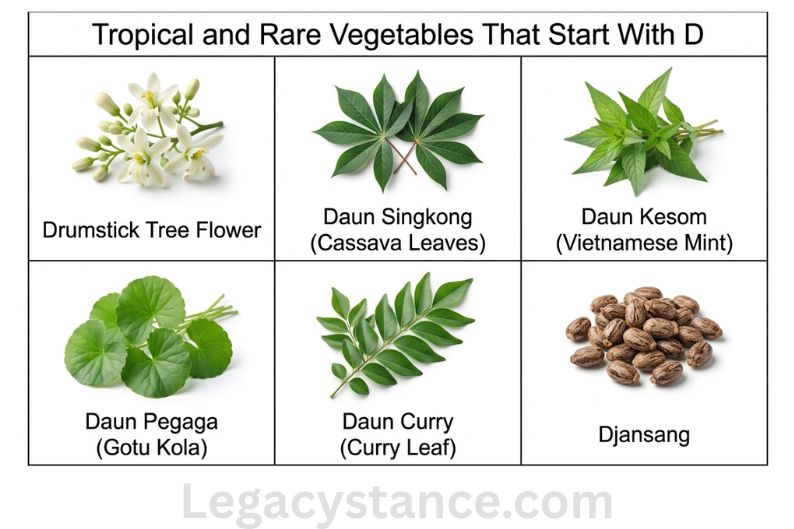
55. Drumstick Tree Flower
The small white flowers of the moringa tree — edible and used as a vegetable in South and Southeast Asia.
Taste: Mildly bitter, slightly sweet, mushroom-like when cooked
Cooking uses:
- Stir-fried with eggs
- Added to soups and curries
- Cooked in coconut milk dishes
Storage: Use fresh. Delicate and wilts quickly.
Fact: Moringa flowers are sometimes used to brew a mildly sweet herbal tea.
56. Daun Singkong (Cassava Leaves)
The leaves of the cassava plant, eaten widely across sub-Saharan Africa and Southeast Asia. Cannot be eaten raw — must be cooked thoroughly.
Taste: Earthy, bitter raw — mellow and spinach-like after prolonged cooking
Cooking uses:
- Simmered into Congolese pondu stew
- Cooked into Indonesian sayur daun singkong
- Pounded and cooked with coconut milk
- Added to peanut-based stews in West Africa
Storage: Refrigerate and use within two days. Leaves deteriorate quickly.
Fact: Cassava leaves must be boiled for at least 20 minutes — they contain cyanogenic compounds that cooking breaks down.
57. Daun Kesom (Vietnamese Mint)
A pungent herb-vegetable from Southeast Asia. Despite the name, it is not mint — it has a sharp, lemony, peppery flavor.
Taste: Intensely aromatic, citrusy, peppery, slightly spicy
Cooking uses:
- Scattered over Vietnamese laksa soup
- Added to Malay and Singaporean rice salads
- Used fresh as a garnish in Southeast Asian cooking
Storage: Stand in water or refrigerate wrapped. Use within two to three days.
Fact: Daun kesom is sometimes called laksa leaf because it is one of the defining flavors of laksa soup.
58. Daun Pegaga (Centella Asiatica / Gotu Kola)
A small, fan-shaped leaf used as a vegetable and medicinal herb across Sri Lanka, Malaysia, and Indonesia.
Taste: Mildly bitter, grassy, herbal
Cooking uses:
- Eaten raw in Sri Lankan gotu kola sambol salad
- Blended into herbal juices
- Added to Malaysian ulam (raw vegetable salads)
- Cooked briefly in coconut milk
Storage: Refrigerate in a damp cloth. Use within two days.
Fact: Gotu kola is one of the most studied plants in Ayurvedic and traditional Sri Lankan medicine and is eaten fresh as a daily vegetable by many Sri Lankans.
59. Daun Curry (Curry Leaf)
The leaves of the curry leaf tree — a standard flavoring vegetable in South Indian and Sri Lankan cooking. Fried in hot oil to release flavor.
Taste: Aromatic, citrusy, slightly nutty — very different from curry powder
Cooking uses:
- Fried in hot oil at the start of a dish to flavor the base
- Added to chutneys
- Scattered over rice dishes
- Used in South Indian tempering (tadka)
Storage: Refrigerate on the stem for up to a week. Freeze for longer storage.
Fact: Curry leaves and curry powder have no relationship — curry powder does not contain curry leaves.
60. Djansang (Ricinodendron Heudelotii Seeds)
Seeds from a West African tree used as a vegetable flavoring and seasoning. A common ingredient in Cameroonian and Central African cooking.
Taste: Smoky, nutty, pungent
Cooking uses:
- Ground into a paste for stews
- Added to Cameroonian ndole dish
- Used as a base seasoning for West African soups
Storage: Dried seeds keep for months in a sealed container.
Fact: Djansang is almost completely unknown outside Central and West Africa — one of the most underrepresented African ingredients globally.
61. Doum Palm Fruit
The fruit of the doum palm tree, native to Egypt and the Sahel. Used as both a sweet and a savory vegetable.
Taste: Sweet, woody, mildly gingerbread-like when dried
Cooking uses:
- Dried fruit eaten as a sweet snack
- Brewed into a drink
- Ground into flour for porridges
Storage: Dried fruit lasts months at room temperature.
Fact: Doum palm fruits have been found in ancient Egyptian tombs — they were placed as offerings for the afterlife.
62. Dichelostemma (Ookow / Wild Hyacinth Bulb)
A wild-harvested edible bulb native to the western United States. Eaten for centuries by indigenous peoples of California and the Pacific Northwest.
Taste: Sweet, mild, similar to cooked onion
Cooking uses:
- Roasted in earth ovens
- Boiled and eaten plain
- Dried and ground into meal
Storage: Use fresh or dry for storage.
Fact: Wild hyacinth bulbs were a critical food source for California indigenous communities before European settlement.
63. Dawadawa (African Locust Bean)
Fermented seeds of the African locust bean tree. Used as a seasoning vegetable and umami-adding ingredient across West Africa.
Taste: Strongly pungent, smoky, intensely savory — similar to fermented soybeans
Cooking uses:
- Added to West African soups and stews as a seasoning
- Used in Nigerian egusi soup
- Ground into paste as a base flavoring
Storage: Fermented and dried keeps for months.
Fact: Dawadawa is sometimes called African MSG because of its powerful umami flavor.
Heritage and Heirloom Vegetables That Start With D
64. Dragon Carrot
A deep purple, almost black heirloom carrot variety with bright orange flesh inside.
Taste: Earthy, sweet, slightly spicy — similar to standard carrot
Cooking uses:
- Roasted whole to preserve the color contrast
- Sliced raw into salads for visual effect
- Glazed with honey and thyme
Storage: Refrigerate in a bag for up to three weeks.
Fact: The purple color of dragon carrots comes from anthocyanins — the same pigments in blueberries and red cabbage.
65. Dwarf Cavendish Banana Blossom
The large purple flower of the dwarf Cavendish banana plant. The inner petals and florets are edible as a vegetable.
Taste: Mildly bitter, slightly astringent — similar to artichoke heart
Cooking uses:
- Cooked in South and Southeast Asian curries
- Used as a pulled pork substitute in vegan cooking
- Added to salads in Thai and Filipino cooking
- Fried in fritters
Storage: Refrigerate wrapped tightly. Use within two days of cutting.
Fact: Banana blossom can be shredded to resemble flaked fish or pulled meat — it is one of the most convincing plant-based meat substitutes.
66. Donskoy Tomato (Heritage)
A cold-tolerant Russian heirloom tomato variety developed in the Don River region of Russia.
Taste: Sweet-tart, balanced, classic tomato flavor
Cooking uses:
- Fresh in salads
- Slow-roasted
- Made into sauces and soups
Storage: Never refrigerate uncut tomatoes — room temperature, use within a week.
Fact: Donskoy tomatoes were bred specifically for Russia’s short growing season and cold springs.
67. De Cicco Broccoli
One of the oldest Italian heirloom broccoli varieties, originating in Broccolo De Cicco near Bari in the 1890s.
Taste: Sweeter and more complex than modern hybrid broccoli
Cooking uses:
- Sautéed in olive oil with garlic and chili
- Steamed and dressed with lemon
- Added to pasta with anchovies in the southern Italian style
Storage: Refrigerate unwashed. Use within three to four days.
Fact: De Cicco produces side shoots after the main head is harvested, giving multiple harvests from a single plant.
68. Detroit Dark Red Beet
The most widely grown beet variety in the United States — a heritage variety from the 1890s with deep red flesh and a clean, sweet flavor.
Taste: Sweet, earthy, rich
Cooking uses:
- Roasted whole in foil
- Boiled and pickled
- Sliced raw into salads
- Blended into borscht
Storage: Remove greens, refrigerate in a bag for two to three weeks.
Fact: Detroit Dark Red beet is named after Detroit because it was commercially developed and distributed by a Detroit seed company in the 1890s.
69. Di Napoli Pepper (Italian Heirloom)
A long, thin, sweet Italian heirloom pepper variety from Naples.
Taste: Sweet, mild, fruity — very low heat
Cooking uses:
- Roasted whole in the oven
- Griddled and dressed with olive oil and garlic
- Added to Neapolitan pizza
- Preserved in olive oil
Storage: Refrigerate and use within a week.
Fact: Neapolitan sweet peppers are fried whole in olive oil as a street food in Naples, sold in paper cones.
Regional and Cultural Vegetables That Start With D
70. Dabberlocks (Ireland/Scotland)
See Section 9. A culturally important seaweed in Irish and Scottish coastal communities.
71. Djeka Leaves (Cameroon)
Aromatic leaves from Central Africa used as a flavoring vegetable in Central African stews and soups.
Taste: Pungent, aromatic, similar to bay leaf but more intense
Cooking uses:
- Added to Cameroonian stews
- Used to flavor grilled meats
- Infused into sauces
Storage: Dry and store like bay leaves.
Fact: Djeka is untranslatable in most Western culinary references and absent from nearly all global vegetable databases.
72. Daikon Kimchi (Kkakdugi Radish)
While kimchi is a preparation, the cubed daikon used specifically for kkakdugi in Korean cooking is treated as its own distinct ingredient.
Taste: Sour, spicy, crunchy, pungent
Cooking uses:
- Eaten as a banchan side dish with Korean meals
- Added to noodle soups
- Served alongside Korean BBQ
Storage: Refrigerate in a sealed container. Improves with age over weeks.
Fact: Kkakdugi is considered one of the easiest kimchis to make at home because the radish ferments predictably and quickly.
73. Dhal (Split Lentil — Vegetable Use)
Various split lentils used as a vegetable base across South Asia, including:
- Chana dal (split chickpea)
- Urad dal (black lentil)
- Masoor dal (red lentil)
- Moong dal (split mung bean)
- Toor dal (pigeon pea)
Each is cooked as a thick vegetable stew across India, Pakistan, Bangladesh, and Nepal.
Storage: Dried split lentils keep for up to a year.
Fact: Dal is eaten by more people every day than almost any other vegetable dish on earth.
74. Dried Mushrooms (Vegetable Use — Various D Varieties)
Several mushrooms starting with D are used as vegetables in cooking:
- Dried Shiitake — used across East Asia in broths and stir-fries
- Dried Chanterelle — European soups and sauces
- Dried Morel — French and Italian cooking
- Dried Porcini — Italian risotto and pasta
Storage: Sealed containers, months to years.
Fact: Dried mushrooms often have a more intense flavor than fresh because drying concentrates their umami compounds.
Additional D Vegetables (Complete Coverage)
75. Daikon Radish (Korean Mu)
The Korean variety of daikon — shorter, rounder, denser than the Japanese version, with a slightly sweeter flavor.
Uses: Cubed in Korean soups (mu guk), cut into kkakdugi kimchi, used in braised short rib dishes.
76. Dandelion Chicory (Taraxacum officinale cultivated)
Cultivated dandelion varieties grown for milder, larger leaves.
Uses: Salads, braised greens, sautéed as a side vegetable.
77. Dasheen Leaves (Callaloo Leaf)
The large leaves of the dasheen/taro plant.
Uses: Trinidadian callaloo soup, West African soups, coconut milk stews.
78. Datil Pepper
A small, extremely hot pepper from St. Augustine, Florida — fruity heat similar to a habanero.
Uses: Hot sauces, salsas, pickled condiments.
79. Diplazium (Vegetable Fern / Paco)
An edible fern eaten across Southeast Asia, the Pacific Islands, and tropical Africa.
Taste: Mild, slightly mucilaginous, reminiscent of young spinach
Uses: Raw in Filipino salads, stir-fried, added to soups.
80. Dragon Fruit Flower
The flower of the dragon fruit cactus — edible before the fruit develops.
Taste: Mildly sweet, delicate
Uses: Stir-fried, added to soups, used in herbal teas.
81. Dolichos Biflorus (Horse Gram)
A small, dark legume grown across South India and used in traditional cooking.
Taste: Nutty, slightly bitter, very dense
Uses: South Indian kollu rasam (pepper soup), sprouted and eaten raw, added to curries.
Fact: Horse gram is one of the most heat- and drought-tolerant legumes in the world.
82. Dambala (White-Flowered Gourd, Sinhalese)
The Sri Lankan name for snake gourd or a white-fleshed gourd variety used in Sri Lankan cooking.
Uses: Curried with coconut milk, added to lentil dishes.
83. Duku (Lansium Domesticum)
A Southeast Asian fruit-vegetable used in savory preparations in Indonesian and Malaysian cooking.
Taste: Sweet-sour, slightly bitter seeds
Uses: Eaten fresh, seeds cooked in fish dishes, leaves used in herbal medicine.
84. Dense-Leaved Elodea Greens
Wild aquatic greens occasionally harvested and eaten in traditional Asian waterway farming communities.
Uses: Stir-fried as a water vegetable side dish.
85. Dente di Leone (Italian Dandelion)
The Italian cultivated dandelion variety — more tender and less bitter than wild dandelion.
Uses: Raw in Italian spring salads, sautéed with olive oil and garlic.
86. Dew Plant (Mesembryanthemum)
A succulent-like coastal plant with edible leaves eaten in South Africa.
Taste: Salty, slightly sour
Uses: Raw in salads, cooked as a side green.
87. Dal Methi (Fenugreek Lentil Preparation)
A combination vegetable preparation using fenugreek leaves cooked with lentils — treated as its own dish category across India.
Uses: Eaten over rice, served with roti.
88. Dun Pea Shoots
The young tender shoots of dun pea plants — eaten like other pea shoots.
Uses: Stir-fried, added raw to salads.
89. Dwarf Celery
A compact variety of celery with thinner stalks and a more intense flavor than standard celery.
Uses: Cooked into soups, used as a mirepoix base, eaten raw with dips.
90. Dwarf Pea
Compact bush varieties of garden peas — same flavor, smaller plant.
Uses: Steamed, added to rice dishes, eaten raw fresh from the pod.
91. Dobra Cabbage (Eastern European Heritage)
Heritage cabbage varieties from Eastern Europe used for fermentation and braising.
Uses: Sauerkraut, stuffed cabbage rolls, braised dishes.
92. Dominican Oregano (Lippia Graveolens)
A highly aromatic herb-vegetable used across Mexico and Central America — more intense than Mediterranean oregano.
Uses: Used fresh and dried in Mexican salsas, soups, and stews.
93. Dolichos Uniflorus Sprouts
Sprouted horse gram seeds — a common fresh vegetable sold in South Indian markets.
Uses: Raw salads, lightly stir-fried, mixed with coconut and spices.
94. Dulse Flakes (Seasoning Vegetable)
Dried dulse ground into flakes — used as a direct salt-and-umami vegetable seasoning.
Uses: Sprinkled over popcorn, pasta, rice, salads.
95. Daikon Microgreens
Young daikon sprouts harvested at the microgreen stage — sharper and spicier than mature daikon.
Uses: Garnishing sushi, salads, noodle bowls.
96. Dutch Carrots (Baby Carrots — Heritage)
Small, slender heritage carrots originating from Dutch agricultural development in the 17th century.
Uses: Roasted whole, glazed, added to braises, eaten raw.
Fact: The orange carrot we know today was selectively bred in the Netherlands — before Dutch intervention, most carrots were purple, yellow, or white.
97. Dragon Roll Cucumber (Japanese Cucumber)
A thin-skinned, nearly seedless cucumber variety used in Japanese cooking.
Taste: Crisp, mildly sweet, very refreshing
Uses: Sushi rolls, sunomono cucumber salad, pickled in rice vinegar.
98. Dried Chili (De Arbol, Dried)
Dried chili peppers starting with D — including:
- De Arbol — thin, fiery Mexican chili
- Dried Ancho — ripe dried poblano, rich and smoky
- Dried Degi Mirch — Indian Kashmiri-style dried red chili, mild heat, deep color
Uses: Mexican salsas, mole sauces, Indian curries and dals.
99. Drumhead Cabbage
A large, flat-headed cabbage variety — older than most modern round cabbages.
Uses: Sauerkraut, colcannon, braised dishes.
100. Doce de Abobora (Pumpkin/Squash Preserve Vegetable)
A Portuguese squash variety used both as a savory vegetable and in sweet preparations.
Uses: Savory squash soups, sweet preserves and jams.
101. Dikgobe (Bambara Groundnut)
A legume widely consumed in southern and eastern Africa. Grown underground like peanuts but used as a vegetable and protein source.
Taste: Nutty, dense, similar to chickpea
Uses: Boiled and eaten plain, added to thick porridges, cooked in groundnut soups.
Fact: Bambara groundnut is one of the most nutritionally complete foods in African traditional agriculture.
102. Dulse Powder
Powdered form of dried dulse used as a direct vegetable seasoning.
Uses: Added to bread dough, mixed into butter, stirred into soups.
103. Dang Myeon Greens
Various greens harvested alongside glass noodle cultivation in Korea.
Uses: Blanched and dressed as banchan.
104. Dry-Farmed Tomato (Various D-Varieties)
Heritage dry-farmed tomato varieties with concentrated flavor due to minimal irrigation:
- Druzba — Bulgarian heirloom, meaty and sweet
- Dr. Wyche’s Yellow — large golden heirloom, fruity
Uses: Fresh eating, slow-roasting, sauce.
105. Dabberlocks Powder
Dried and powdered dabberlocks seaweed used as a mineral seasoning.
Uses: Added to soups, sprinkled over fish dishes.
106. Dry-Roasted Corn (Dried Maize — Dehydrated)
Dehydrated corn kernels used as a vegetable in Andean cooking.
Uses: Rehydrated in soups, ground into masa, fried into cancha (crispy corn snack in Peru).
107. Dark Opal Basil (Vegetable Use)
A purple-leafed basil variety used both as an herb and as a fresh vegetable addition.
Uses: Scattered over salads, used in Southeast Asian cooking, added to fresh summer rolls.
108. Dalmatian Sage Leaves
Leaves from the Dalmatian coast sage variety — used as a vegetable flavoring across Croatian and Italian cooking.
Uses: Fried in butter as a sauce for pasta, added to roasted meats, infused into olive oil.
109. Dried Fava (Dried Broad Bean)
Already listed as #30 — the dried form of broad beans.
110. Dried Pea (Various)
Dried field and garden peas used as vegetables in soups and stews:
- Split yellow peas
- Split green peas
- Whole dried marrowfat peas
Uses: British mushy peas, pea soup, dal-style preparations.
111. Dun Lentil
A brownish-grey heritage lentil variety used in traditional European peasant cooking.
Uses: French lentil soups, German lentil stews.
112. Dried Chickpea (Desi Variety)
Smaller, darker chickpea variety common in South Asia — distinct from the larger kabuli chickpea.
Uses: Dal, curries, roasted into chana chur snack mix.
113. Desem Wheat Greens
Young wheat grass harvested at the green stage and used as a vegetable in health-focused cooking.
Uses: Blended into green juices, added to smoothies, eaten raw.
114. Dry-Cured Olive (Vegetable/Condiment)
Olives preserved through dry salt curing — used as a flavoring vegetable across North Africa and the Middle East.
Uses: Scattered over tagines, added to Moroccan salads, eaten with bread.
115. Dried Tomato (Various D Heirloom Varieties)
Sun-dried forms of heirloom D tomatoes — including Druzba and Dr. Wyche’s:
Uses: Pasta, antipasto platters, blended into sauces.
116. De Cayenne Pepper
The standard cayenne pepper used as a vegetable and spice across cooking globally.
Uses: Fresh in salsas and pickles, dried and powdered as a universal spice.
117. Delicious Pepper (Sweet Lipstick Variety)
A thick-walled, very sweet red pepper variety.
Uses: Roasted, stuffed and baked, eaten raw.
118. Drumstick Squash
A long, club-shaped squash variety grown in South and Southeast Asia.
Uses: Curried with coconut milk, added to dal, fried with spices.
119. Dwarf Gray Sugar Pea
A heritage snow pea variety with edible pods and a sweet flavor.
Uses: Stir-fried whole, eaten raw, added to Asian noodle dishes.
120. Dried Winter Melon Strip (Dong Gua Gan)
Sun-dried winter melon strips used as a preserved vegetable in Chinese cooking.
Uses: Rehydrated and added to soups, stir-fried with pork.
121. Dwarf Sage (Rock Sage)
A compact sage variety with more intense oils than standard sage.
Uses: Fried in butter, added to bean soups, used in stuffings.
122. Dika Nut Paste (Ogbono)
Fermented and dried wild mango seeds from West Africa, used as a vegetable thickener.
Uses: Nigerian ogbono soup, Central African stews.
Fact: Ogbono soup is one of Nigeria’s most consumed everyday soups — the dika nut creates a distinctive slimy, thick texture that Nigerians call draw soup.
123. Deep Purple Kohlrabi
A purple-skinned kohlrabi variety — same as standard kohlrabi in flavor and use.
Uses: Sliced raw into salads, roasted, shaved into slaws.
124. Dew Drop Tomato
A tiny heirloom cherry tomato variety producing very small, sweet yellow-orange fruit.
Uses: Eaten whole, added to salads, roasted and folded into pasta.
125. Desert Gourd (Citrullus Colocynthis)
A drought-tolerant wild gourd from North Africa and the Middle East. Seeds are extracted and used as food — the flesh itself is bitter and used medicinally.
Uses: Seeds roasted and eaten, ground into oil, used in traditional cooking in arid regions.
Fact: Desert gourd was used as a bitter medicine in ancient Egypt — seeds were found in the tomb of Tutankhamun.
Vegetables That Start With D by Category
Root Vegetables Daikon, Dasheen, Dandelion Root, Dioscorea, Dwarf Turnip, Dutch Parsnip, Dahlia Tuber, Detroit Dark Red Beet, Dragon Carrot, Dutch Carrot
Leafy Greens Dandelion Greens, Dinosaur Kale, Dock, Dang Gui Leaves, Drumstick Leaves, Dwarf Bok Choy, Daun Singkong, Daun Pegaga, Diplazium Fern, Dente di Leone, Di Cai
Cruciferous Dutch White Cabbage, Danish Ballhead Cabbage, Dwarf Cauliflower, Dwarf Broccoli, De Cicco Broccoli, Daikon Sprouts, Drumhead Cabbage, Dobra Cabbage
Legumes Dragon Tongue Bean, Dolichos Bean, Dwarf Bean, Dried Broad Bean, Dew Bean, Dun Pea, Dark Red Kidney Bean, Dolichos Pods, Dolichos Biflorus, Dikgobe, Desi Chickpea, Dun Lentil
Gourds and Squash Delicata Squash, Dudhi (Bottle Gourd), Bitter Gourd, Drum Gourd, Dwarf Summer Squash, Drumstick Squash, Desert Gourd
Pods and Stems Drumstick Pod, Dolichos Pods, Dwarf Gray Sugar Pea, Dragon Roll Cucumber
Edible Flowers and Buds Daylily Bud, Daylily Flower, Dandelion Flower, Dahlia Petals, Drumstick Flower, Dragon Fruit Flower
Sea Vegetables Dulse, Dabberlocks, Dilsk, Deep-Sea Kelp
Tropical and Regional Daun Kesom, Daun Curry, Daun Singkong, Djansang, Dawadawa, Djeka Leaves, Dambala, Duka, Doum Palm, Dichelostemma
Heritage and Heirloom Detroit Dark Red Beet, De Cicco Broccoli, Donskoy Tomato, Di Napoli Pepper, Druzba Tomato, Dr. Wyche’s Yellow Tomato, Dragon Carrot, Dutch Carrot, Dwarf Gray Sugar Pea
Most Popular Vegetables That Start With D
1. Daikon — The most consumed D vegetable globally. Central to Japanese, Korean, Chinese, Indian, and Vietnamese cooking. Pickled, fresh, cooked, grated — used in nearly every form.
2. Dill — Appears in more cuisines than almost any other D vegetable. Essential in Eastern European, Middle Eastern, Scandinavian, and American cooking.
3. Dandelion Greens — Growing fast in popularity outside traditional cuisines. Available at most farmers markets. One of the most nutritious greens on the list.
4. Dinosaur Kale — The kale variety preferred by chefs over curly kale for its deeper flavor and more forgiving texture.
5. Drumstick Pod — Essential across South India and Sri Lanka. The most widely consumed D vegetable in the Indian subcontinent.
Rare Vegetables That Start With D
These rarely appear on any list:
Desert Truffle (Terfez) — Harvested only in arid Middle Eastern and North African deserts after seasonal rains. Cannot be farmed.
Dichelostemma (Wild Hyacinth Bulb) — A wild-harvested indigenous food of California. Almost never sold commercially.
Djansang — Used only in Cameroonian and Central African cooking. Unknown outside its origin region.
Dawadawa (African Locust Bean) — West Africa’s most important fermented flavoring vegetable. Absent from most Western culinary databases.
Daun Pegaga (Gotu Kola) — A daily vegetable in Sri Lanka. Virtually invisible in Western cooking despite being available in Asian grocery stores.
Dabberlocks — A North Atlantic seaweed eaten in Ireland for centuries. Rarely available outside coastal communities.
Daylily Bud (Fresh) — The dried version is common in Chinese cooking. Fresh buds are almost never sold commercially anywhere.
How to Cook Vegetables That Start With D
Best for Roasting
- Delicata squash — Roast at 200°C/400°F in rings. Skin is edible, no peeling needed.
- Detroit Dark Red Beet — Wrap whole in foil and roast at 190°C/375°F for 45–60 minutes.
- Dinosaur kale — Drizzle with olive oil, roast at 180°C/350°F for 10–12 minutes into chips.
- Dutch carrot — Roast whole with honey and thyme.
- Daikon — Slice thick, roast with miso glaze.
Best for Stir-Frying
- Dwarf bok choy — Whole in hot wok with garlic and oyster sauce, two to three minutes.
- Daylily buds — Soak dried buds first, then stir-fry with wood ear mushrooms.
- Dragon tongue beans — High heat, minimal oil, two to three minutes.
- Drumstick leaves — Quick stir-fry with garlic and chili.
- Daikon — Matchstick cut, high heat with soy and sesame.
Best for Soups and Braises
- Drumstick pods — Need fifteen to twenty minutes to become tender in sambar or curry.
- Dudhi (bottle gourd) — Absorbs broth flavors beautifully. Twenty minutes in dal or curry.
- Dried dolichos beans — Soak overnight, cook for sixty to ninety minutes in stews.
- Dinosaur kale — Slow braise in ribollita for at least thirty minutes.
- Daikon — Simmers in oden or miso for thirty to forty-five minutes.
Best Raw
- Dandelion greens — Young spring leaves directly into salad.
- Daikon sprouts — Over sushi or in salads.
- Dragon tongue beans — Young and very fresh, raw in salads.
- Dwarf gray sugar pea — Eat pods whole raw.
Best for Pickling
- Daikon — Classic Japanese and Korean pickles.
- Dutch white cabbage — Fermented into sauerkraut.
- Dandelion greens stems — Quick-pickled in vinegar.
- De Arbol chili — Pickled whole in vinegar brine.
Buying Guide for D Vegetables
Daikon: Choose firm, heavy roots with no soft spots or cracks. Skin should be smooth and white. Avoid any with a hollow sound when tapped.
Dandelion greens: Look for deep green, unwilted leaves. Avoid yellow or limp bunches. Smaller leaves are less bitter.
Dinosaur kale: Deep blue-green color, firm ribs, no yellowing or holes. Smaller leaves are more tender.
Delicata squash: Firm with no soft spots. Skin should be cream-colored with clear green stripes. Avoid any with large brown patches.
Drumstick pods: Bright green, firm but slightly flexible. Avoid cracked or yellowing pods.
Dudhi (bottle gourd): Smooth, pale green skin. Press lightly — it should feel firm. Soft spots mean over-maturity.
Daylily buds (dried): Golden-yellow to light brown color. Avoid very dark or black buds.
Dulse: Buy from reputable suppliers. Should smell oceanic, not fishy or rotten.
Dragon tongue beans: Bright yellow with clear purple streaks. Avoid limp or spotted pods.
Dolichos beans (dried): Check the packaging date. Beans older than two years take much longer to cook and may never fully soften.
Nutrition Overview
| Vegetable | Notable Nutrients | Particularly Good For |
| Daikon | Vitamin C, folate, fiber | Digestive support |
| Dandelion Greens | Iron, calcium, vitamin K, vitamin A | Bone and blood health |
| Dinosaur Kale | Vitamin K, vitamin C, calcium, iron | Overall nutrition density |
| Drumstick Leaves | Calcium, potassium, vitamin C, iron | One of the most nutrient-dense leaves available |
| Dulse | Iodine, iron, magnesium, B vitamins | Thyroid and mineral support |
| Dasheen | Potassium, fiber, magnesium | Sustained energy |
| Detroit Dark Red Beet | Folate, manganese, nitrates | Cardiovascular and exercise performance |
| Dolichos Bean | Protein, iron, fiber | Plant protein source |
| Delicata Squash | Beta-carotene, vitamin C, fiber | Immune and eye health |
| Dill | Vitamin A, vitamin C, manganese | Antioxidant support |
Note: Nutritional values vary by growing conditions, preparation method, and serving size. This table reflects general nutritional strengths, not medical claims.
Interesting Facts About Vegetables That Start With D
- Daikon can grow over 18 inches long and weigh more than 2 pounds.
- Dandelion greens contain more iron per gram than spinach.
- Dulse fried in a dry pan smells and tastes like bacon — confirmed by food scientists.
- Drumstick leaves contain more calcium per gram than milk.
- The dahlia was introduced to Europe as a food crop — its flowers were an afterthought.
- Bottle gourd (dudhi) dried shells are over 10,000 years old at some archaeological sites.
- Dutch orange carrots were selectively bred in the Netherlands — most historical carrots were purple, yellow, or white.
- Daylily buds have been eaten in China for over 1,000 years.
- Dragon tongue beans lose their purple streaks entirely when cooked.
- Desert truffle cannot be farmed — it only grows wild after rare desert rains.
- Cassava leaves (daun singkong) must be boiled for at least 20 minutes to neutralize natural toxins.
- Dawadawa (African locust bean) is sometimes called African MSG for its intense umami.
- Doum palm fruits were found in the tomb of Tutankhamun.
- The word dill comes from old Norse and means “to lull.”
- De Cicco broccoli has been grown in southern Italy since the 1890s.
Family Feud Answers — Vegetables That Start With D
If this category came up on Family Feud, the most likely survey answers would be:
- Daikon — Most recognized D vegetable globally
- Dill — The herb-vegetable most people know by name
- Dandelion Greens — Increasingly recognized in North American markets
- Drumstick — Top answer across South Asian audiences
- Dulse — Known in coastal communities and health food stores
These reflect general name recognition, not personal preference.
Related Fruits That Start With D
| Fruit | Notes |
| Durian | Southeast Asian fruit, intensely fragrant |
| Dragon Fruit | Cactus fruit, mild flavor |
| Date | Dried or fresh, very sweet |
| Damson Plum | Small, tart European plum |
| Dewberry | Wild berry, similar to blackberry |
| Darling Plum | Small Caribbean wild fruit |
| Desert Lime | Australian native citrus |
Read more –
70+ Vegetables That Start With B: From Broccoli to Burdock Root
Frequently Asked Questions
What is the most popular vegetable that starts with D?
Daikon is one of the most widely eaten D vegetables in the world. It is used in Japanese, Korean, Chinese, Indian, and Southeast Asian cooking. People enjoy it raw, pickled, roasted, and simmered in soups.
Are dandelion greens really edible?
Yes. Dandelion greens have been eaten for centuries in many cultures. Young leaves are often used in salads, while mature leaves are commonly sautéed, braised, or added to soups.
Which D vegetables are easiest to grow at home?
Daikon radishes, dwarf beans, dill, and dandelion greens are beginner-friendly options. They grow quickly, need minimal care, and can produce a harvest in a relatively short time.
Are there any rare vegetables that start with D?
Yes. Examples include desert truffle, dabberlocks seaweed, djansang, dawadawa, and daylily buds. Many of these are important regional foods but remain largely unknown outside their native areas.
Can D vegetables be part of a healthy diet?
Absolutely. Many D vegetables provide fiber, vitamins, minerals, and plant compounds that support overall health. Choices such as dandelion greens, dinosaur kale, drumstick leaves, daikon, and dulse are especially nutrient-rich.