Learning Math Words That Start With K can make math easier to understand and discuss. From everyday measurement terms like kilogram and kilometer to advanced ideas such as kernel, kurtosis, and Kruskal’s Algorithm, these words appear across many areas of mathematics.
This collection is designed for students, teachers, and curious learners who want clear definitions and practical examples. Whether you’re studying geometry, statistics, algebra, or computer science, knowing these terms helps build stronger math vocabulary and confidence.
Quick List: All Math Words That Start With K
Here is the complete alphabetical list:
- Kappa
- Kappa Coefficient
- Kappa Statistic
- K-Ary Tree
- Kendall’s Tau
- Kernel
- Kernel Density Estimation
- Kernel Function
- Kernel Method
- Kilobit
- Kilobyte
- Kilohertz
- Kilogram
- Kiloliter
- Kilometer
- Kilopascal
- Kilovolt
- Kilowatt
- Kilowatt-Hour
- Kite
- Klein Bottle
- Klein Geometry
- K-Coloring
- K-Map (Karnaugh Map)
- K-Means Clustering
- K-Nearest Neighbor
- Knapsack Problem
- Knot
- Knot Theory
- Koch Curve
- Koch Snowflake
- Kolmogorov Axioms
- Kolmogorov Complexity
- Kolmogorov–Smirnov Test
- K-Regular Graph
- Krein Space
- Kronecker Delta
- Kronecker Product
- Kronecker Symbol
- K-Space
- K-Theory
- Kurtosis
- Killing Vector
- Koszul Complex
- Kuratowski’s Theorem
- K-Factor
- K-Function
- K-Group
- K-Partite Graph
- Kummer’s Theorem
- K-Type Distribution
- Klein Four-Group
- Knuth’s Arrow Notation
- K-Dimensional Space
- K-Linear Map
- K-Module
- Kuhn-Tucker Conditions
- K-Algebra
- Kronecker’s Theorem
- K-Sigma
- K-Step Method
- Krichever–Novikov Algebra
- K-Spread
- K-Torus
- K-Metric Space
- K-Pseudorandom
- K-Semisimple
- K-Stable
- K-Subgroup
- K-Ultrafilter
- K-Vector Space
- K-Vertex
- Killing Form
- Kähler Manifold
- Kähler Metric
- Kac–Moody Algebra
- Kan Extension
- Kantorovich Distance
- Kaplan–Meier Estimator
- Karush–Kuhn–Tucker (KKT) Conditions
- Kasteleyn Matrix
- Kelvin (unit in thermodynamic math)
- Kendall’s W
- Kernel Regression
- Kernel Trick
- Kirchhoff’s Laws (graph theory)
- Klein Model
- K-Nearest Centroid
- K-NNS (K-Nearest Neighbor Search)
- K-Norm
- Knudsen Number
- Kobayashi Metric
- Kodaira Dimension
- Kolmogorov Extension Theorem
- Kolmogorov Zero-One Law
- Kronecker Delta Function
- Kruskal’s Algorithm
- Kruskal–Wallis Test
- Künneth Formula
- Kuratowski Closure Axioms
Math K Words Vocabulary
| Word | Math Field | Difficulty |
| Kilogram | Measurement | Easy |
| Kilometer | Measurement | Easy |
| Kite | Geometry | Easy |
| Knot | Measurement | Easy |
| Koch Snowflake | Fractal Geometry | Medium |
| Kernel | Linear Algebra | Medium |
| Kappa | Statistics | Medium |
| Kurtosis | Statistics | Advanced |
| Kronecker Delta | Higher Math | Advanced |
| Klein Bottle | Topology | Advanced |
| Knapsack Problem | Combinatorics | Advanced |
| K-Means Clustering | Data Science | Advanced |
| Kolmogorov Complexity | Computation Theory | Advanced |
| KKT Conditions | Optimization | Advanced |
| Kruskal’s Algorithm | Graph Theory | Advanced |
Common Math Words that Start With K
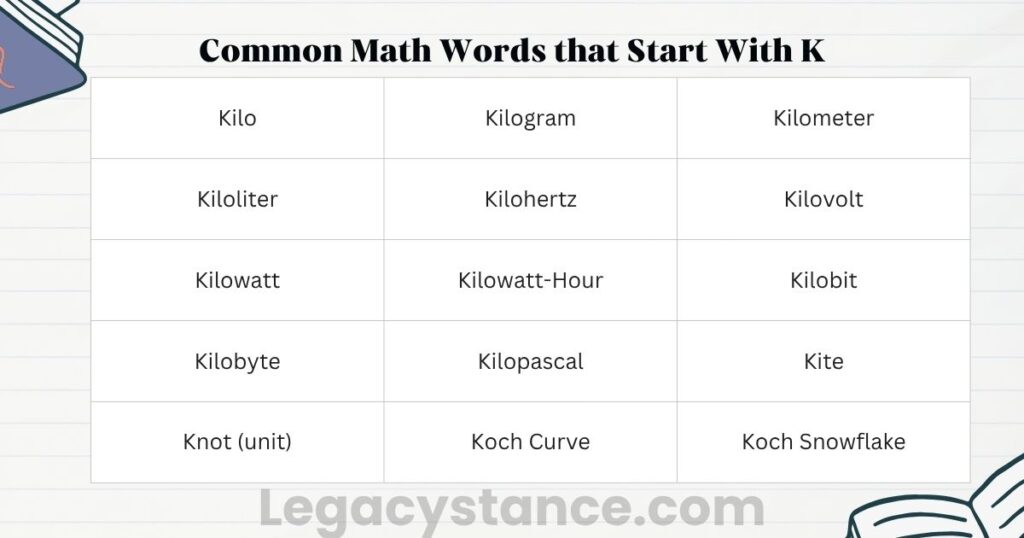
Kilo
A prefix meaning 1,000. Found in almost every metric unit — kilogram, kilometer, kiloliter, kilowatt, and more. Learn this prefix once and all the “kilo” words become easy.
Kilogram
A unit of mass equal to 1,000 grams. It is the base unit of mass in the International System of Units (SI).
- Example: A bag of rice weighs 2 kilograms.
- Used in: weight, mass, and conversion problems.
Kilometer
A unit of distance equal to 1,000 meters (about 0.62 miles).
- Example: A marathon is approximately 42 kilometers.
- Used in: distance and map-scale problems.
Kiloliter
A volume unit equal to 1,000 liters.
- Example: A large water tank holds 10 kiloliters.
- Used in: large-volume calculations in applied math.
Kilohertz
A unit of frequency equal to 1,000 hertz.
- Example: AM radio signals operate in the kilohertz range.
- Used in: physics-math problems about waves and signals.
Kilovolt
A unit of electrical voltage equal to 1,000 volts.
- Example: Power transmission lines carry hundreds of kilovolts.
- Used in: electrical engineering math.
Kilowatt
A unit of power equal to 1,000 watts.
- Example: A home oven uses about 2 kilowatts.
- Used in: energy and power calculation problems.
Kilowatt-Hour
The amount of energy used when one kilowatt of power runs for one hour.
- Example: Your monthly electricity bill is measured in kilowatt-hours.
- Used in: real-world energy math.
Kilobit
One thousand bits of digital data.
- Used in: computing and data rate math.
Kilobyte
1,024 bytes of digital data (or approximately 1,000 bytes in decimal).
- Used in: computing, file size calculations.
Kilopascal
A unit of pressure equal to 1,000 pascals.
- Example: Tire pressure is often measured in kilopascals.
- Used in: applied math and physics problems.
Kite
A quadrilateral with two pairs of consecutive equal sides. The diagonals of a kite are perpendicular to each other, and one diagonal bisects the other.
- Example: A diamond-shaped figure where two pairs of touching sides are equal.
- Used in: geometry proofs, area calculations.
Knot (unit)
A unit of speed equal to one nautical mile per hour (1.852 km/h).
- Example: A ship traveling at 20 knots covers about 37 kilometers per hour.
- Used in: navigation math, speed conversion problems.
Koch Curve
A fractal curve created by repeatedly replacing the middle third of each line segment with two sides of an equilateral triangle. Each step makes the curve longer.
- Used in: fractal geometry, exploring infinite length.
Koch Snowflake
A closed fractal shape built by applying the Koch Curve process to all three sides of a triangle. The result has infinite perimeter but finite area.
- Example: After infinite steps, the perimeter grows without bound while the enclosed area converges to 8/5 times the original triangle.
- Used in: fractal geometry, limits, area vs. perimeter concepts.
Kelvin
The base unit of temperature in the SI system, used in thermodynamic calculations.
- Example: 0°C equals 273.15 K.
- Used in: scientific and applied math involving temperature.
Geometry Math Words that Start With K
Klein Bottle
A surface with no distinct inside or outside. It is non-orientable, meaning it has no boundary and loops back through itself. A true Klein bottle requires four dimensions.
- Used in: topology.
Klein Geometry
A framework that classifies different types of geometry based on which transformation groups leave certain properties unchanged. Proposed by Felix Klein in his Erlangen Program.
- Used in: abstract geometry, group theory.
Klein Four-Group
The smallest non-cyclic group, containing four elements where every element is its own inverse.
- Written as: V₄ or Z₂ × Z₂.
- Used in: abstract algebra.
Klein Model
A model of hyperbolic geometry where straight lines are represented as chords inside a disk.
- Used in: non-Euclidean geometry.
K-Dimensional Space
A mathematical space with exactly K dimensions. When K = 3, it is ordinary three-dimensional space.
- Used in: linear algebra, geometry, machine learning.
K-Torus
A generalization of a torus (donut shape) to K dimensions.
- Used in: topology, differential geometry.
Statistics Math Words that Start With K
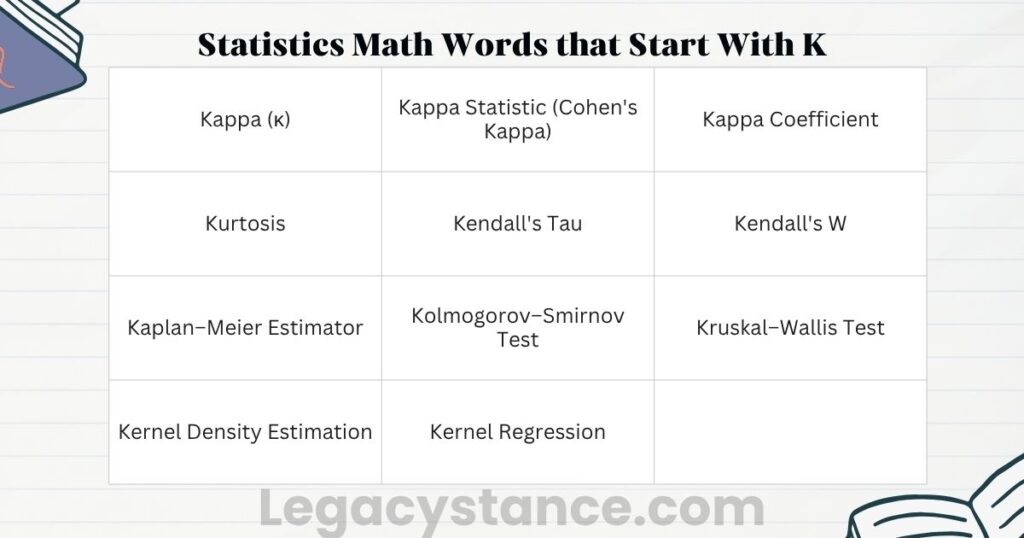
Kappa (κ)
The 10th Greek letter, used in math and statistics as a symbol for constants, curvature, and agreement measures.
Kappa Statistic (Cohen’s Kappa)
A measure of agreement between two raters or classifiers that corrects for how much agreement would happen by pure chance.
- Example: Two doctors examining the same patients might agree 85% of the time — Cohen’s Kappa adjusts that figure for random chance.
- Used in: medical research, AI model evaluation, survey testing.
Kappa Coefficient
A version of Cohen’s Kappa applied to categorical data agreement problems.
Kurtosis
A measure of how heavy or light the tails of a data distribution are compared to a normal distribution.
- High kurtosis = more extreme values, heavier tails.
- Low kurtosis = fewer extreme values, lighter tails.
- Used in: risk analysis, financial modeling, data science.
Kendall’s Tau
A nonparametric measure of correlation between two ranked variables.
- Example: Measuring how consistently two judges rank a set of competitors.
- Used in: ranked data analysis.
Kendall’s W
A measure of agreement among multiple raters who each rank the same set of subjects.
- Used in: reliability testing, survey analysis.
Kaplan–Meier Estimator
A statistical method for estimating survival functions from time-to-event data.
- Used in: medical research, reliability engineering.
Kolmogorov–Smirnov Test
A statistical test that compares a sample to a reference distribution, or compares two samples, to determine if they come from the same distribution.
- Used in: hypothesis testing, data analysis.
Kruskal–Wallis Test
A nonparametric test that determines whether three or more groups come from the same distribution.
- Used in: comparing multiple independent samples when data is not normally distributed.
Kernel Density Estimation
A method of estimating the probability density function of a variable using a smooth curve fitted to data points.
- Used in: data visualization, statistics.
Kernel Regression
A nonparametric method that estimates the relationship between variables using weighted local averages.
- Used in: data science, machine learning.
Algebra and Higher Math Words that Start With K

Kernel
The set of all input vectors that a linear transformation maps to zero. Also called the null space in matrix algebra.
- Example: If T(x) = Ax, the kernel contains all x where Ax = 0.
- Used in: linear algebra, abstract algebra.
Kernel Function
A function that computes similarity between two data points, often in a high-dimensional space, without directly computing the transformation.
- Used in: machine learning, functional analysis.
Kernel Method
An algorithm class that uses kernel functions to solve problems in high-dimensional spaces efficiently.
- Used in: support vector machines, pattern recognition.
Kernel Trick
A technique that allows algorithms to operate in high-dimensional spaces by computing kernel functions rather than explicit coordinates.
- Used in: machine learning.
Kronecker Delta (δᵢⱼ)
A function of two integer variables that equals 1 when i = j and 0 when i ≠ j.
- Example: δ₃₃ = 1, δ₂₅ = 0.
- Used in: matrix algebra, quantum mechanics, tensor calculations.
Kronecker Product (⊗)
A matrix operation that produces a larger block matrix from two matrices. If A is m×n and B is p×q, then A⊗B is (mp)×(nq).
- Used in: quantum computing, signal processing.
Kronecker Symbol
A generalization of the Legendre symbol used in number theory.
- Used in: quadratic reciprocity, number theory.
Kronecker’s Theorem
A result in algebra and number theory about the existence of field extensions containing roots of polynomials.
- Used in: abstract algebra, field theory.
K-Linear Map
A function between two K-vector spaces that preserves addition and scalar multiplication.
- Used in: linear algebra, abstract algebra.
K-Vector Space
A vector space over a field K, where K defines the scalars used in the space.
- Used in: linear algebra.
K-Algebra
An algebra over a field K — a vector space equipped with a bilinear multiplication operation.
- Used in: abstract algebra.
K-Module
A module over a ring K, generalizing the concept of a vector space.
- Used in: abstract algebra, commutative algebra.
Kuhn-Tucker Conditions (also written KKT)
See Karush–Kuhn–Tucker Conditions.
Karush–Kuhn–Tucker (KKT) Conditions
A set of first-order necessary conditions for a solution in nonlinear programming to be optimal, extending the method of Lagrange multipliers to include inequality constraints.
- Used in: constrained optimization, operations research.
K-Norm
A norm on a vector space that satisfies specific K-related properties, used in functional analysis.
K-Semisimple
A ring or module property describing a structure that decomposes into simple components over a field K.
- Used in: abstract algebra.
Kac–Moody Algebra
An infinite-dimensional Lie algebra that generalizes finite-dimensional semisimple Lie algebras.
- Used in: theoretical physics, string theory, representation theory.
Killing Form
A symmetric bilinear form on a Lie algebra used to classify semisimple Lie algebras.
- Used in: Lie algebra theory, mathematical physics.
Killing Vector
A vector field on a Riemannian or pseudo-Riemannian manifold that represents a direction of symmetry.
- Used in: differential geometry, general relativity.
Koszul Complex
A construction in homological algebra used to study depth and regularity in commutative ring theory.
- Used in: algebraic geometry, commutative algebra.
Krein Space
A generalization of Hilbert space where the inner product can take negative values.
- Used in: functional analysis, quantum field theory.
Krichever–Novikov Algebra
An infinite-dimensional Lie algebra generalizing the Virasoro algebra to higher-genus Riemann surfaces.
- Used in: mathematical physics, conformal field theory.
Discrete Math and Computer Science Terms Starting With K
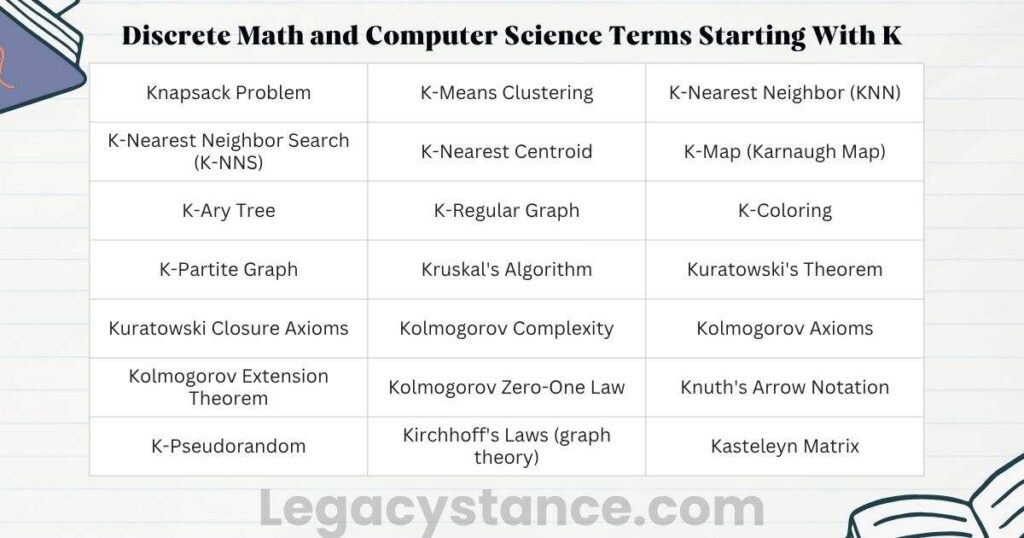
Knapsack Problem
An optimization problem: given items with different weights and values, choose which to include to maximize value without exceeding a weight limit.
- Example: Packing a bag for maximum usefulness while staying under 10 kg.
- Used in: combinatorics, resource allocation, cryptography.
K-Means Clustering
An algorithm that divides data into K groups by minimizing the distance from each point to its cluster’s center.
- Used in: data science, customer segmentation, image compression.
K-Nearest Neighbor (KNN)
A classification algorithm that assigns a label to a new data point based on the K most similar existing points.
- Used in: machine learning, pattern recognition, medical diagnosis.
K-Nearest Neighbor Search (K-NNS)
The computational problem of finding the K data points closest to a given query point.
- Used in: databases, computer vision.
K-Nearest Centroid
A variant of KNN that classifies points based on distance to the nearest cluster centroid rather than individual neighbors.
- Used in: machine learning.
K-Map (Karnaugh Map)
A visual method for simplifying Boolean algebra expressions by grouping adjacent cells in a grid.
- Used in: digital logic design, computer engineering math.
K-Ary Tree
A tree data structure where each node has at most K children.
- K = 2 is a binary tree; K = 3 is a ternary tree.
- Used in: computer science, database indexing.
K-Regular Graph
A graph where every vertex has exactly K edges connected to it.
- Used in: graph theory, network design.
K-Coloring
Assigning K colors to graph vertices so no two adjacent vertices share the same color.
- Used in: graph theory, scheduling, map coloring.
K-Partite Graph
A graph whose vertices can be divided into K independent sets, with edges only between sets.
- Used in: combinatorics, matching theory.
Kruskal’s Algorithm
An algorithm that finds the minimum spanning tree of a weighted graph by adding edges in order of increasing weight.
- Used in: graph theory, network optimization.
Kuratowski’s Theorem
States that a graph is planar (drawable without edge crossings) if and only if it contains no subdivision of K₅ (complete graph on 5 vertices) or K₃,₃ (complete bipartite graph).
- Used in: graph theory.
Kuratowski Closure Axioms
A set of axioms defining a topological space through a closure operator on sets.
- Used in: topology, set theory.
Kolmogorov Complexity
The length of the shortest computer program that can produce a given string of data.
- Low complexity = data has a short description (like a repeating pattern).
- High complexity = data is essentially random.
- Used in: information theory, data compression, cryptography.
Kolmogorov Axioms
The three foundational rules of probability theory proposed by Andrey Kolmogorov:
- Probability of any event is ≥ 0.
- Probability of the entire sample space = 1.
- For mutually exclusive events, probabilities add.
- Used in: all areas of probability and statistics.
Kolmogorov Extension Theorem
A theorem that guarantees the existence of a stochastic process consistent with a given family of finite-dimensional probability distributions.
- Used in: probability theory.
Kolmogorov Zero-One Law
States that any event in the tail σ-algebra of a sequence of independent random variables has probability either 0 or 1.
- Used in: probability theory.
Knuth’s Arrow Notation
A notation system for expressing very large numbers through iterated exponentiation.
- Example: 3↑↑3 = 3^(3^3) = 3^27.
- Used in: combinatorics, theoretical computer science.
K-Pseudorandom
A sequence or object that passes K statistical tests for randomness, even if it is not truly random.
- Used in: cryptography, computational complexity.
Kirchhoff’s Laws (graph theory)
A set of results about spanning trees and electrical networks in graphs, including the Matrix-Tree Theorem.
- Used in: graph theory, electrical network analysis.
Kasteleyn Matrix
A signed adjacency matrix used to count perfect matchings in planar graphs.
- Used in: combinatorics, statistical mechanics.
Topology and Geometry Math Words that Start With K
Knot Theory
The mathematical study of knots — closed loops in three-dimensional space that cannot be untangled without cutting.
- Example: A trefoil knot has three crossings and is the simplest non-trivial knot.
- Used in: topology, DNA research, polymer science.
K-Theory
A branch of algebraic topology that classifies vector bundles over topological spaces.
- Used in: algebraic topology, mathematical physics.
Kähler Manifold
A complex manifold equipped with a Kähler metric — a metric that satisfies specific compatibility conditions between complex and symplectic structures.
- Used in: differential geometry, algebraic geometry.
Kähler Metric
A specific type of Riemannian metric on a complex manifold that is simultaneously a Hermitian and a symplectic metric.
- Used in: complex geometry, string theory.
K-Space
In physics and engineering, the Fourier transform domain of physical space. Used to represent wave vectors.
- Used in: MRI mathematics, signal processing.
Kobayashi Metric
A metric on complex manifolds that measures holomorphic distances.
- Used in: complex analysis, several complex variables.
Kodaira Dimension
A numerical invariant that classifies complex algebraic varieties by their growth rate of global holomorphic forms.
- Used in: algebraic geometry.
K-Metric Space
A generalized metric space where the triangle inequality is relaxed or modified by a constant K.
- Used in: functional analysis, fixed-point theory.
Künneth Formula
A theorem in algebraic topology relating the homology of a product space to the homologies of its factors.
- Used in: algebraic topology, homological algebra.
Kan Extension
A universal construction in category theory that extends a functor along another functor.
- Used in: category theory, homotopy theory.
Kantorovich Distance
A metric on probability distributions measuring the cost of transforming one distribution into another.
- Also called the Wasserstein distance or Earth Mover’s distance.
- Used in: optimal transport, machine learning.
Kaplan–Meier (moved above to Statistics section — see there)
Number Theory Math Words that Start With K
Kummer’s Theorem
A result giving the largest power of a prime p that divides a binomial coefficient C(m+n, m).
- Used in: number theory, combinatorics.
Knudsen Number
A dimensionless number comparing the molecular mean free path to a characteristic length. Used in fluid dynamics math.
- Used in: applied mathematics, physics.
K-Factor
A multiplier used in Elo rating systems (chess, sports rankings) that controls how much a single result changes a player’s rating.
- Used in: statistics, sports mathematics.
Optimization Math Words Start that With K
KKT Conditions (Karush–Kuhn–Tucker)
First-order conditions required for a point to be an optimal solution in constrained nonlinear optimization.
- Used in: mathematical programming, economics, engineering.
Kuhn-Tucker Conditions
Another name for KKT Conditions (named after Harold Kuhn and A.W. Tucker, though William Karush derived them earlier).
Subject-Wise Category K Math words Summary
Measurement: Kilo, Kilogram, Kilometer, Kiloliter, Kilohertz, Kilovolt, Kilowatt, Kilowatt-Hour, Kilobit, Kilobyte, Kilopascal, Kelvin, Knot
Geometry: Kite, Koch Curve, Koch Snowflake, Klein Bottle, Klein Four-Group, Klein Geometry, Klein Model, K-Dimensional Space, K-Torus
Statistics and Probability: Kappa, Kappa Statistic, Kurtosis, Kendall’s Tau, Kendall’s W, Kaplan–Meier, Kolmogorov–Smirnov Test, Kruskal–Wallis Test, Kernel Density Estimation, Kernel Regression, Kolmogorov Axioms
Algebra and Higher Math: Kernel, Kernel Function, Kernel Method, Kernel Trick, Kronecker Delta, Kronecker Product, Kronecker Symbol, Kronecker’s Theorem, K-Linear Map, K-Vector Space, K-Algebra, K-Module, Killing Form, Killing Vector, Koszul Complex, Krein Space, Kac–Moody Algebra
Discrete Math and CS: Knapsack Problem, K-Means, KNN, K-NNS, K-Map, K-Ary Tree, K-Regular Graph, K-Coloring, K-Partite Graph, Kruskal’s Algorithm, Kuratowski’s Theorem, Kolmogorov Complexity, Knuth’s Arrow Notation, Kasteleyn Matrix, Kirchhoff’s Laws
Topology and Advanced Geometry: Knot Theory, K-Theory, Kähler Manifold, Kähler Metric, K-Space, Kobayashi Metric, Kodaira Dimension, Künneth Formula, Kan Extension, Kantorovich Distance, Kuratowski Closure Axioms
Optimization: KKT Conditions, K-Factor
Number Theory: Kummer’s Theorem, Kronecker Delta Function, Knudsen Number
Real-World K Math Words Uses
Everyday life: Kilogram, kilometer, and kilowatt appear on grocery labels, road signs, and electricity bills. Once you learn the kilo prefix, the whole family of measurement words becomes easy.
Data science and AI: K-Means and KNN power recommendation engines, image classifiers, and medical diagnosis tools. Kernel methods run inside the support vector machines used in spam filters.
Finance and risk: Kurtosis tells risk analysts how likely extreme outcomes are. A high-kurtosis investment has heavier tails — meaning big gains and big crashes are more likely than a normal distribution would predict.
Medical research: Cohen’s Kappa measures how much two doctors genuinely agree beyond chance. The Kaplan–Meier estimator tracks survival rates in clinical trials.
Engineering: Kirchhoff’s Laws apply to both electrical circuits and graph networks. KKT conditions appear in structural optimization problems.
Cryptography and computing: Kolmogorov Complexity underpins data compression theory. The Knapsack Problem is the basis of certain early cryptographic systems.
DNA biology and physics: Knot Theory is used by biologists to understand how DNA strands tangle during replication and by physicists in quantum field models.
Tips for Remembering K Math Words
Group by prefix first. All “kilo” words mean 1,000 of something. Master the prefix and you’ve handled a dozen words at once.
Anchor kurtosis visually. High kurtosis = sharp peak, heavy tails, like a needle stuck in the ground. Low kurtosis = flat, wide, spread-out hill. Draw it once and you won’t forget it.
Kronecker Delta is a diagonal rule. δᵢⱼ = 1 only when both subscripts match. Think of the identity matrix — 1s only on the diagonal.
For KNN vs. K-Means: KNN uses existing labels to classify new points. K-Means finds new groups when you have no labels. One classifies, one discovers.
Koch Snowflake = infinite edge, finite inside. The perimeter grows forever, but the area does not. Write this down and the concept clicks.
Commonly Confused K Math Words
Kilo vs. Kilogram “Kilo” is a prefix. “Kilogram” is a complete unit. You can say “five kilos” in conversation, but in written math you write “5 kilograms.” A kilo of what — grams, meters, watts? The prefix alone doesn’t answer that.
Kernel vs. Null Space These are the same thing with different names. “Null space” is the matrix-specific term used in most linear algebra textbooks. “Kernel” is the abstract algebraic term used in broader mathematics and computer science. Both mean: the set of inputs a transformation sends to zero.
Kurtosis vs. Skewness Skewness measures symmetry — is the distribution lopsided left or right? Kurtosis measures tail weight — are extreme values more or less common than a normal distribution? A distribution can be perfectly symmetric and still have very heavy or very light tails.
Koch Curve vs. Koch Snowflake The Koch Curve is one open fractal edge. The Koch Snowflake applies the same construction to all three sides of a triangle, making a closed shape. The snowflake is built from three Koch Curves.
Knot (speed) vs. Knot (topology) A nautical knot measures speed (one nautical mile per hour). A mathematical knot is a closed loop in 3D space. The only thing they share is the word. Sailors got the term because they counted physical knots on a rope to measure speed — the math usage is entirely separate.
Read More Posts:
110+ Vegetables That Start With H: From Horseradish to Huauzontle
115+ Vegetables That Start With G: From Garlic to Gai Lan
Frequently Asked Questions
1. Why should students learn math vocabulary like K-words?
Math vocabulary helps students understand instructions, solve problems more accurately, and communicate ideas clearly. Knowing the meaning of important terms reduces confusion and makes learning new concepts much easier.
2. What are the most common math words that start with K?
Some of the most common K math words include kilogram, kilometer, kiloliter, kite, kernel, kurtosis, and K-means clustering. These terms appear in school math, science, statistics, and technology.
3. Are all K math words difficult to learn?
No. Many K words are beginner-friendly, especially measurement terms such as kilogram and kilometer. More advanced terms like Kolmogorov Complexity or Kähler Manifold are typically studied at the university level.
4. What is the easiest way to remember K math terms?
Group similar words together. For example, all kilo- words relate to 1,000 units of something. Learning terms by category—such as geometry, statistics, or algebra—also makes them easier to remember.
5. Where are K math words used in real life?
K math terms appear in daily activities, technology, science, medicine, engineering, and data analysis. For example, kilowatt-hours are used on electricity bills, while KNN and K-Means help power modern machine-learning systems.
Conclusion
Math words starting with K cover a wide range — from the simple measurement terms students use every day to the deep abstract concepts that shape modern mathematics and computer science. The common words like kilogram and kite appear in middle school classrooms.
The advanced terms like Kolmogorov Complexity and Kähler Manifold appear in university research. Knowing where each word belongs helps you use it confidently. Start with the prefix rule for the kilo family, work through geometry, then push into statistics and algebra — and the full list becomes much easier to navigate.