Learning Math Words That Start With A can make math easier to understand and less intimidating. From basic terms like addition and angle to advanced concepts such as abelian group and algebraic topology, these words help students read problems, follow lessons, and explain their thinking clearly.
This collection is designed for students, parents, and teachers who want a simple reference they can use anytime. Each term connects to a real math idea, making it easier to build vocabulary while strengthening problem-solving skills.
Quick List: All Math Words That Start With A
- Abscissa
- Abelian Group
- Absolute Error
- Absolute Maximum
- Absolute Minimum
- Absolute Value
- Abstract Algebra
- Abundant Number
- Acceleration
- Accuracy
- Acute Angle
- Acute Triangle
- Addend
- Addition
- Additive Identity
- Additive Inverse
- Adjacent Angles
- Adjacent Side
- Affine Space
- Affine Transformation
- Aleph (ℵ)
- Algebra
- Algebraic Closure
- Algebraic Expression
- Algebraic Fraction
- Algebraic Geometry
- Algebraic Multiplicity
- Algebraic Number
- Algebraic Topology
- Algebraic Variety
- Algorithm
- Altitude
- Amplitude
- Analytic Continuation
- Analytic Function
- Analytic Geometry
- Angle
- Angle Bisector
- Angle of Depression
- Angle of Elevation
- Annihilator
- Annulus
- Antiderivative
- Antisymmetric Relation
- Apex
- Apothem
- Approximation
- Approximation Theory
- Arc
- Arc Length
- Arccos
- Arcsin
- Arctan
- Area
- Argument (Complex Number)
- Archimedes’ Axiom
- Arithmetic
- Arithmetic Mean
- Arithmetic Progression
- Arithmetic Series
- Arithmetic Sequence
- Array
- Ascending Order
- Associative Property
- Asymmetric
- Asymmetric Distribution
- Asymptote
- Asymptotic Expansion
- Automorphism
- Average
- Axes
- Axiom
- Axiom of Choice
Complete Reference: Math Words That Start With A
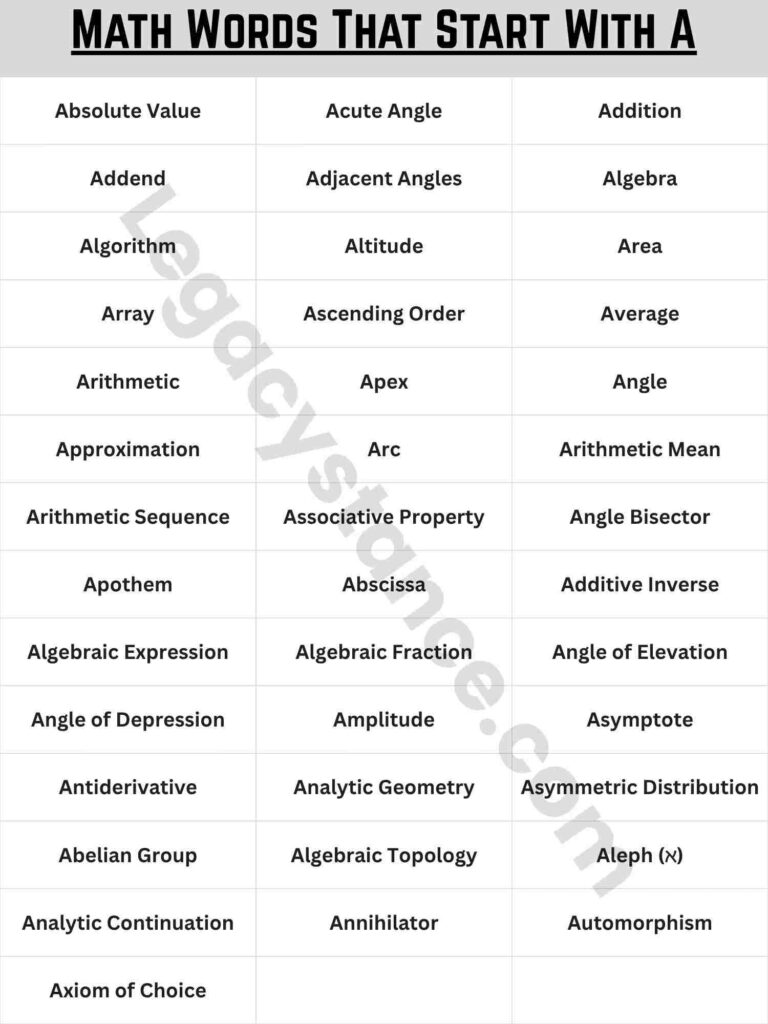
| Word | Math Branch | Difficulty |
| Absolute Value | General Math | Easy |
| Acute Angle | Geometry | Easy |
| Addition | Arithmetic | Easy |
| Addend | Arithmetic | Easy |
| Adjacent Angles | Geometry | Easy |
| Algebra | General | Easy |
| Algorithm | General / CS | Easy |
| Altitude | Geometry | Easy |
| Area | Geometry | Easy |
| Array | Arithmetic | Easy |
| Ascending Order | General | Easy |
| Average | Statistics | Easy |
| Arithmetic | General | Easy |
| Apex | Geometry | Easy |
| Angle | Geometry | Easy |
| Approximation | General | Medium |
| Arc | Geometry | Medium |
| Arithmetic Mean | Statistics | Medium |
| Arithmetic Sequence | Algebra | Medium |
| Associative Property | Algebra | Medium |
| Angle Bisector | Geometry | Medium |
| Apothem | Geometry | Medium |
| Abscissa | Coordinate Geometry | Medium |
| Additive Inverse | Algebra | Medium |
| Algebraic Expression | Algebra | Medium |
| Algebraic Fraction | Algebra | Medium |
| Angle of Elevation | Trigonometry | Medium |
| Angle of Depression | Trigonometry | Medium |
| Amplitude | Trigonometry | Advanced |
| Asymptote | Algebra/Calculus | Advanced |
| Antiderivative | Calculus | Advanced |
| Analytic Geometry | Calculus | Advanced |
| Asymmetric Distribution | Statistics | Advanced |
| Abelian Group | Abstract Algebra | Advanced |
| Algebraic Topology | Higher Math | Advanced |
| Aleph (ℵ) | Set Theory | Advanced |
| Analytic Continuation | Complex Analysis | Advanced |
| Annihilator | Linear Algebra | Advanced |
| Automorphism | Abstract Algebra | Advanced |
| Axiom of Choice | Set Theory | Advanced |
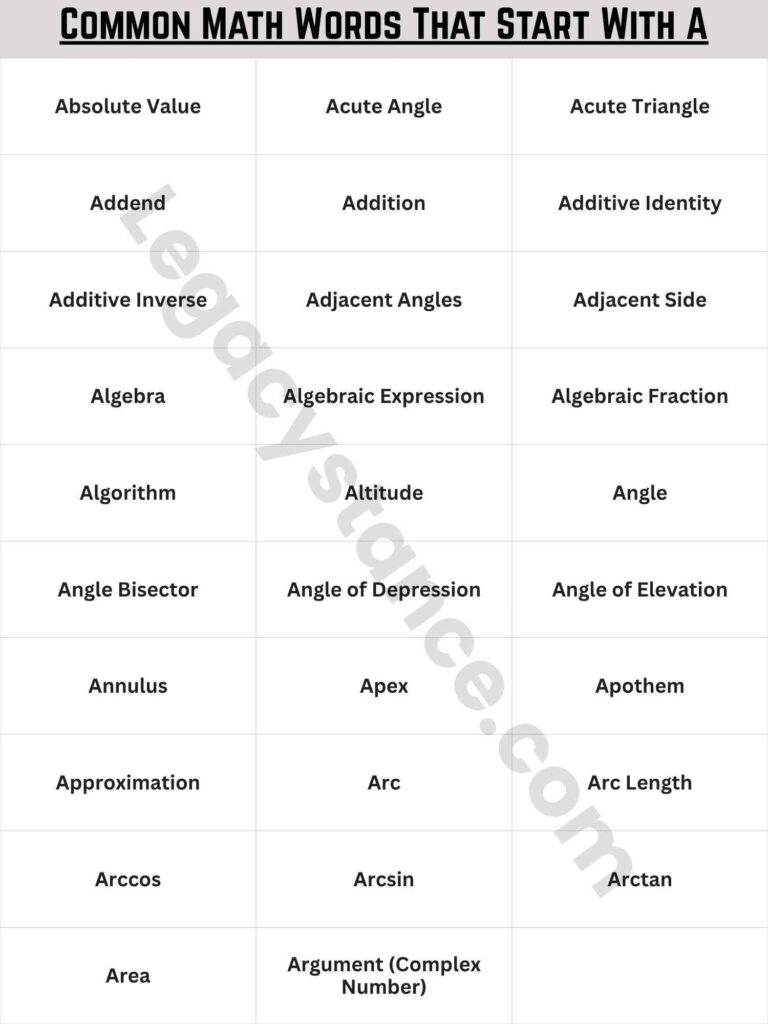
Common Math Words That Start With A
Absolute Value
Meaning: The distance of a number from zero on a number line. Always positive or zero.
Example: |−8| = 8
Why it matters: Used in equations, inequalities, and distance-based problems.
Acute Angle
Meaning: An angle that measures between 0° and 90°.
Example: A 60° angle inside an equilateral triangle.
Why it matters: Angle classification is the first step in geometry.
Acute Triangle
Meaning: A triangle where all three angles are less than 90°.
Example: A triangle with angles 50°, 60°, and 70°.
Why it matters: Triangle type determines which formulas and rules apply.
Addend
Meaning: Any number being added in an addition problem.
Example: In 6 + 9 = 15, both 6 and 9 are addends.
Why it matters: Correct vocabulary helps students follow instructions precisely.
Addition
Meaning: Combining two or more numbers to get a total sum.
Example: 34 + 58 = 92
Why it matters: One of the four core arithmetic operations everything else builds on.
Additive Identity
Meaning: The number 0. Adding 0 to any number leaves it unchanged.
Example: 47 + 0 = 47
Why it matters: Foundational property in algebra and number theory.
Additive Inverse
Meaning: The number that, when added to the original, gives zero.
Example: The additive inverse of 9 is −9, because 9 + (−9) = 0.
Why it matters: Used when solving equations and working with negative numbers.
Adjacent Angles
Meaning: Two angles that share a common vertex and one side, but do not overlap.
Example: When two lines cross, neighboring angles at the intersection are adjacent.
Why it matters: Key to understanding supplementary and complementary angle pairs.
Adjacent Side
Meaning: In a right triangle, the side next to a given angle that is not the hypotenuse.
Example: In trigonometry, cos(angle) = adjacent ÷ hypotenuse.
Why it matters: Essential for setting up trigonometric ratios.
Algebra
Meaning: The branch of math using letters and symbols to represent unknown values and relationships.
Example: Solving 2x + 4 = 10 gives x = 3.
Why it matters: Gateway to all advanced mathematics, science, and engineering.
Algebraic Expression
Meaning: A combination of numbers, variables, and operations — with no equals sign.
Example: 5x² − 3y + 8
Why it matters: Building and reading expressions is core to algebra.
Algebraic Fraction
Meaning: A fraction where the numerator, denominator, or both contain variables.
Example: (x + 3) / (x − 2)
Why it matters: Used extensively in simplifying and solving rational equations.
Algorithm
Meaning: A fixed, step-by-step procedure used to solve a problem or complete a calculation.
Example: The long division process is an algorithm.
Why it matters: Every calculation method in math — and every process in computing — is an algorithm.
Altitude
Meaning: The perpendicular distance from a vertex of a shape to its opposite base.
Example: The height of a triangle drawn straight down to its base.
Why it matters: Required in area formulas for triangles, parallelograms, and 3D shapes.
Angle
Meaning: The figure formed by two rays meeting at a common point called the vertex. Measured in degrees or radians.
Example: A corner of a square is a 90° angle.
Why it matters: Fundamental to geometry, trigonometry, and navigation.
Angle Bisector
Meaning: A ray that cuts an angle into two equal parts.
Example: Bisecting a 100° angle produces two 50° angles.
Why it matters: Used in geometric constructions and triangle congruence proofs.
Angle of Depression
Meaning: The downward angle from a horizontal line to a point below.
Example: A pilot looking down at a runway uses angle of depression to calculate descent.
Why it matters: Used in navigation, surveying, and physics problems.
Angle of Elevation
Meaning: The upward angle from a horizontal line to a point above.
Example: Looking up at the top of a tower from the ground.
Why it matters: Used to calculate the heights of buildings, trees, and mountains indirectly.
Annulus
Meaning: The ring-shaped region between two concentric circles.
Example: A washer or a circular track has the shape of an annulus.
Why it matters: Area of an annulus = π(R² − r²), where R is the outer radius and r is the inner radius.
Apex
Meaning: The highest point or topmost vertex of a triangle, pyramid, or cone.
Example: The pointed top of an Egyptian pyramid is its apex.
Why it matters: Identifies the reference point for height in many geometry problems.
Apothem
Meaning: The perpendicular distance from the center of a regular polygon to the midpoint of one of its sides.
Example: In a regular hexagon, the apothem runs from the center to the middle of any edge.
Why it matters: Used in the area formula for regular polygons: Area = ½ × perimeter × apothem.
Approximation
Meaning: A value close to the true value, found through rounding or estimation.
Example: π ≈ 3.14159
Why it matters: Real-world calculations rarely require exact values. Knowing how to approximate — and when it’s acceptable — is a critical skill.
Arc
Meaning: A curved section of a circle’s circumference.
Example: The curved crust of a pizza slice is an arc of the full circle.
Why it matters: Arc length and arc measure are essential in circle geometry and engineering.
Arc Length
Meaning: The actual measured distance along an arc of a circle.
Example: Arc length = (θ/360) × 2πr, where θ is the central angle.
Why it matters: Used when calculating distances along curved paths.
Arccos
Meaning: The inverse cosine function. Returns the angle whose cosine equals a given value.
Example: arccos(0.5) = 60°
Why it matters: Used to find angles when the cosine ratio is known.
Arcsin
Meaning: The inverse sine function. Returns the angle whose sine equals a given value.
Example: arcsin(0.5) = 30°
Why it matters: Used to reverse sine calculations and find unknown angles.
Arctan
Meaning: The inverse tangent function. Returns the angle whose tangent equals a given value.
Example: arctan(1) = 45°
Why it matters: Commonly used in physics and engineering to find direction angles.
Area
Meaning: The amount of flat space enclosed within a 2D shape. Measured in square units.
Example: Area of a rectangle = length × width. A 6 m × 4 m room has an area of 24 m².
Why it matters: One of the most practical math skills — used in construction, farming, design, and everyday measurement.
Argument (Complex Number)
Meaning: The angle a complex number makes with the positive real axis on the complex plane.
Example: The complex number 1 + i has an argument of 45°.
Why it matters: Used in polar form of complex numbers and in signal processing.
Arithmetic
Meaning: The most fundamental branch of math: addition, subtraction, multiplication, and division.
Example: Calculating the total cost of groceries is arithmetic.
Why it matters: Every area of mathematics builds on arithmetic skills.
Arithmetic Mean
Meaning: The sum of all values divided by the number of values.
Example: Mean of 10, 20, 30 = (10 + 20 + 30) ÷ 3 = 20
Why it matters: The most commonly used measure of central tendency in data and statistics.
Arithmetic Progression
Meaning: Another name for arithmetic sequence — a list of numbers with a constant difference between consecutive terms.
Example: 5, 10, 15, 20 — common difference is 5.
Why it matters: Models steady, predictable patterns in real-world situations.
Arithmetic Sequence
Meaning: A sequence where each term is found by adding a fixed number (common difference) to the previous term.
Example: 3, 7, 11, 15 — common difference is 4.
Why it matters: Used to model linear growth patterns and calculate future terms.
Arithmetic Series
Meaning: The sum of all terms in an arithmetic sequence.
Example: The sum of 1 + 2 + 3 + … + 100 = 5050.
Why it matters: The formula Sₙ = n/2 × (first + last) simplifies large sums significantly.
Array
Meaning: Numbers or objects arranged in equal rows and columns to represent multiplication.
Example: A 4 × 3 array shows 4 rows of 3, meaning 4 × 3 = 12.
Why it matters: Gives students a visual model of multiplication before they memorize tables.
Ascending Order
Meaning: Arranging numbers from smallest to largest.
Example: 3, 7, 12, 19, 25 is in ascending order.
Why it matters: Used in data sorting, statistics, and number comparison.
Associative Property
Meaning: When adding or multiplying, the grouping of numbers does not change the result.
Example: (3 + 4) + 5 = 3 + (4 + 5) = 12
Why it matters: Allows flexible regrouping in mental math and algebraic simplification.
Asymmetric
Meaning: A shape or figure with no line of symmetry — the two halves do not match.
Example: A scalene triangle is asymmetric.
Why it matters: Symmetry analysis is used in geometry, art, and engineering design.
Asymmetric Distribution
Meaning: A data set where values are not evenly spread around the center — skewed to one side.
Example: Income data in most countries is asymmetrically distributed, skewed toward lower incomes.
Why it matters: Recognizing skew helps statisticians choose the right measure of central tendency.
Asymptote
Meaning: A line that a curve approaches indefinitely but never actually reaches.
Example: The graph of y = 1/x approaches the x-axis but never touches it.
Why it matters: Describes the boundary behavior of functions in pre-calculus and calculus.
Asymptotic Expansion
Meaning: An approximation of a function using a series that may not converge but grows more accurate under specific conditions.
Branch: Numerical Analysis
Why it matters: Engineers use asymptotic expansions when exact solutions are impossible to compute.
Average
Meaning: A general term for the central or typical value of a data set. Usually refers to the arithmetic mean.
Example: Five quiz scores of 70, 75, 80, 85, 90 give an average of 80.
Why it matters: Used in grades, finance, sports, and almost every field of data analysis.
Axes
Meaning: The reference lines on a coordinate plane — the horizontal x-axis and the vertical y-axis.
Example: To plot (4, 6), move 4 units along the x-axis and 6 units up the y-axis.
Why it matters: Every graph in algebra, statistics, and science is built on axes.
Axiom
Meaning: A statement accepted as true without proof — a foundational rule that all other math builds from.
Example: “A straight line can be drawn between any two points” is Euclid’s first axiom.
Why it matters: Axioms are the starting rules of every mathematical system.
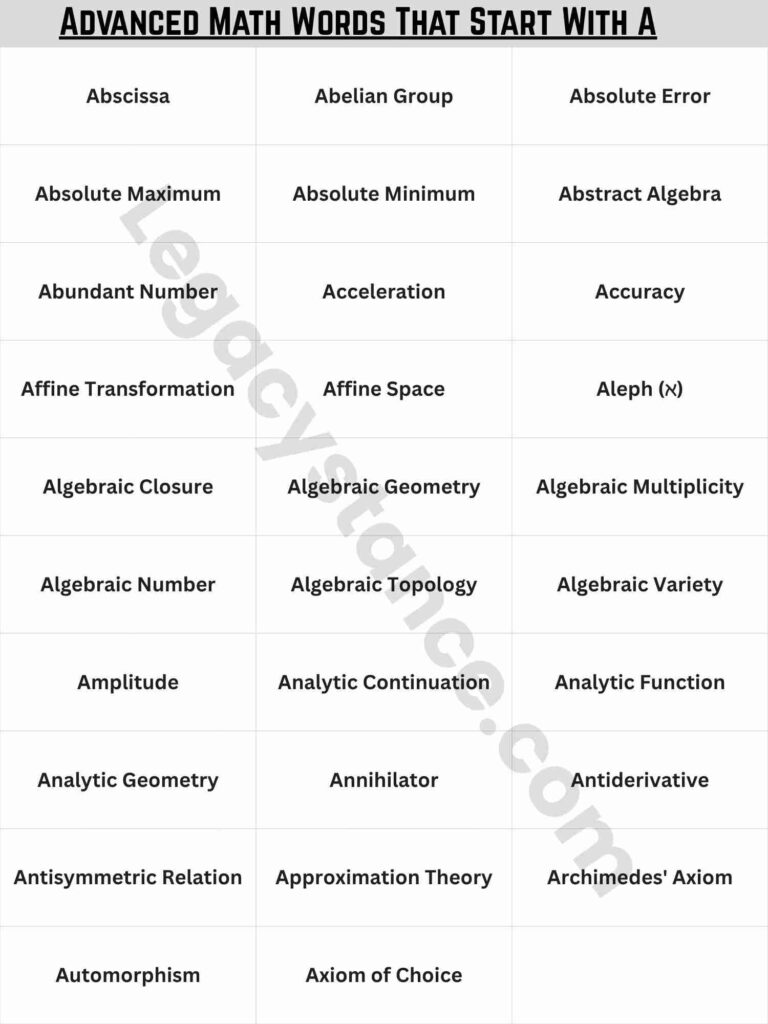
Advanced Math Words That Start With A
Abscissa
Meaning: The x-coordinate of a point on a coordinate plane.
Example: In the point (5, 3), the abscissa is 5.
Branch: Coordinate Geometry
Abelian Group
Meaning: A group where the operation is commutative — order of elements does not affect the result.
Example: Integers under addition: 3 + 5 = 5 + 3. Always.
Branch: Abstract Algebra
Absolute Error
Meaning: The positive difference between a measured or estimated value and the true value.
Example: If the true length is 10 cm but measured as 10.3 cm, absolute error = 0.3 cm.
Branch: Measurement / Statistics
Absolute Maximum
Meaning: The highest output value a function reaches over its entire domain.
Example: On a closed interval, the absolute maximum is the largest y-value the graph hits.
Branch: Calculus
Absolute Minimum
Meaning: The lowest output value a function reaches over its entire domain.
Example: The function f(x) = x² has an absolute minimum of 0 at x = 0.
Branch: Calculus
Abstract Algebra
Meaning: The study of algebraic structures like groups, rings, and fields, rather than specific numbers.
Branch: Higher Mathematics
Why it matters: Underpins cryptography, coding theory, and theoretical physics.
Abundant Number
Meaning: A number whose proper divisors add up to more than the number itself.
Example: Divisors of 12: 1, 2, 3, 4, 6. Sum = 16 > 12. So 12 is abundant.
Branch: Number Theory
Acceleration
Meaning: In mathematics, the rate of change of velocity — the second derivative of position with respect to time.
Example: A = d²s/dt² Branch: Calculus / Physics
Accuracy
Meaning: How close a calculated or measured result is to the true value. Example: A measurement of 9.99 is more accurate than 9.5 when the true value is 10. Branch: Measurement / Statistics
Affine Transformation
Meaning: A geometric transformation — including translation, rotation, scaling, and shearing — that preserves straight lines and parallel lines.
Branch: Linear Algebra / Geometry
Why it matters: Powers computer graphics, robotics, and machine learning transformations.
Affine Space
Meaning: A geometric structure like Euclidean space but without a fixed origin point.
Branch: Geometry / Linear Algebra
Aleph (ℵ)
Meaning: A symbol representing the sizes of infinite sets. ℵ₀ is the cardinality of the natural numbers. Branch: Set Theory
Why it matters: Allows mathematicians to measure and compare different sizes of infinity.
Algebraic Closure
Meaning: A field is algebraically closed if every non-constant polynomial over it has a root within it. The complex numbers are algebraically closed.
Branch: Abstract Algebra
Algebraic Geometry
Meaning: The study of geometric shapes defined by polynomial equations.
Branch: Higher Mathematics
Why it matters: Used in cryptography, theoretical physics, and advanced computing.
Algebraic Multiplicity
Meaning: The number of times an eigenvalue appears as a root of the characteristic polynomial of a matrix.
Branch: Linear Algebra
Algebraic Number
Meaning: Any number that is a solution to a polynomial equation with rational coefficients.
Example: √2 is algebraic because it solves x² − 2 = 0. But π is not algebraic — it is transcendental. Branch: Number Theory
Algebraic Topology
Meaning: A branch using algebraic tools to study and classify shapes and spaces.
Branch: Higher Mathematics
Why it matters: Applied in data science, physics, and the study of multi-dimensional spaces.
Algebraic Variety
Meaning: The set of all solutions to a system of polynomial equations.
Branch: Algebraic Geometry
Amplitude
Meaning: In a trigonometric graph, the maximum distance from the center line to the peak of the wave.
Example: In y = 4sin(x), the amplitude is 4. Branch: Trigonometry
Analytic Continuation
Meaning: A method for extending the domain of a complex function beyond its original region.
Branch: Complex Analysis
Analytic Function
Meaning: A function that can be represented by a convergent power series near every point in its domain. Branch: Complex Analysis / Calculus
Analytic Geometry
Meaning: The study of geometry using coordinates and algebraic equations to represent shapes and relationships. Branch: Coordinate Geometry
Why it matters: Bridges the gap between algebra and geometry — used in virtually every applied science.
Annihilator
Meaning: The set of all linear functionals that map every vector in a given subspace to zero.
Branch: Linear Algebra
Antiderivative
Meaning: A function whose derivative equals a given function. The reverse of differentiation.
Example: The antiderivative of 2x is x². Branch: Calculus
Why it matters: Core to integration, which calculates areas, volumes, and accumulated quantities.
Antisymmetric Relation
Meaning: A relation where if a relates to b and b relates to a, then a and b must be the same element.
Example: “Less than or equal to” (≤) is antisymmetric. Branch: Discrete Math / Set Theory
Approximation Theory
Meaning: The study of how complex functions can be closely represented by simpler ones like polynomials.
Branch: Numerical Analysis
Why it matters: Used in engineering, computer science, and scientific modeling.
Archimedes’ Axiom
Meaning: States that for any two positive magnitudes, a multiple of the smaller will eventually exceed the larger.
Branch: Mathematical Foundations
Automorphism
Meaning: A structure-preserving mapping from a mathematical object to itself.
Branch: Abstract Algebra
Why it matters: Used in group theory, graph theory, and the study of symmetry.
Axiom of Choice
Meaning: A foundational principle in set theory stating that from any collection of non-empty sets, one element can always be selected from each.
Branch: Set Theory
Why it matters: One of the most discussed and debated axioms in all of mathematics.
Geometry Math Words That Start With A
- Acute Angle
- Acute Triangle
- Adjacent Angles
- Affine Space
- Affine Transformation
- Altitude
- Angle
- Angle Bisector
- Annulus
- Apex
- Apothem
- Arc
- Arc Length
- Area
- Asymmetric
- Axes
Algebra Math Words That Start With A
- Addend
- Additive Identity
- Additive Inverse
- Algebra
- Algebraic Expression
- Algebraic Fraction
- Algebraic Number
- Algorithm
- Arithmetic Sequence
- Arithmetic Series
- Ascending Order
- Associative Property
- Asymptote
Statistics and Data Math Words That Start With A
- Absolute Error
- Accuracy
- Arithmetic Mean
- Array
- Ascending Order
- Asymmetric Distribution
- Average
Trigonometry Math Words That Start With A
- Adjacent Side
- Amplitude
- Angle of Depression
- Angle of Elevation
- Arccos
- Arcsin
- Arctan
Calculus Math Words That Start With A
- Absolute Maximum
- Absolute Minimum
- Acceleration
- Analytic Function
- Antiderivative
- Approximation Theory
- Arc Length
- Asymptote
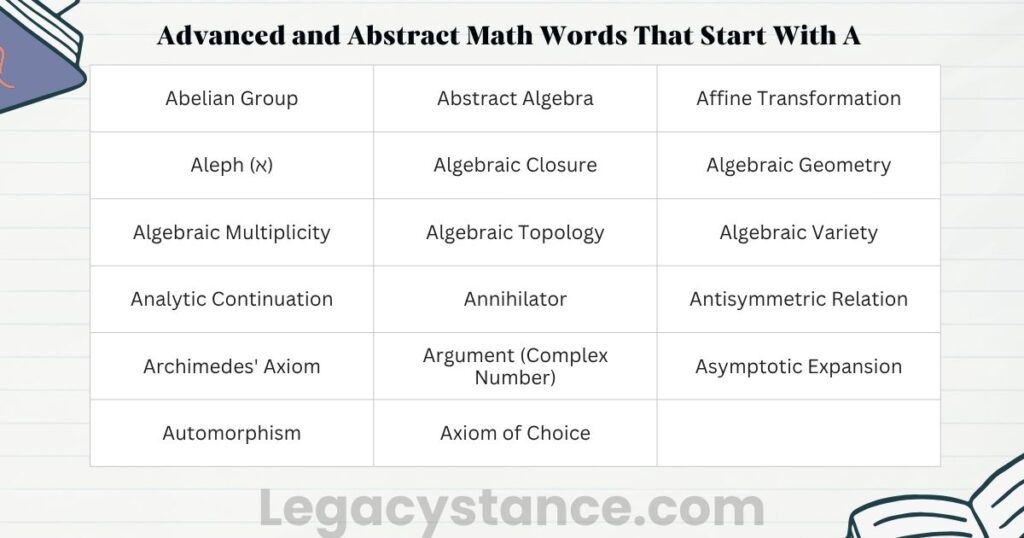
Advanced and Abstract Math Words That Start With A
- Abelian Group
- Abstract Algebra
- Affine Transformation
- Aleph (ℵ)
- Algebraic Closure
- Algebraic Geometry
- Algebraic Multiplicity
- Algebraic Topology
- Algebraic Variety
- Analytic Continuation
- Annihilator
- Antisymmetric Relation
- Archimedes’ Axiom
- Argument (Complex Number)
- Asymptotic Expansion
- Automorphism
- Axiom of Choice
Math Words That Start With A Real-World Applications
Construction and design: Area, altitude, apothem, and arc length are used by architects and engineers every day.
Technology: Algorithms run every app, search engine, and navigation system. Affine transformations power animations in games and films.
Finance: Arithmetic mean and average are standard tools for analyzing market data and investment returns.
Navigation and surveying: Angle of elevation and angle of depression let professionals calculate heights and distances without physically measuring them.
Data science: Asymmetric distributions and accuracy measurements tell researchers whether their data is reliable.
Physics and engineering: Amplitude, antiderivative, and analytic functions are the language of waves, signals, and force calculations.
Commonly Confused K Math Words
Average vs. Arithmetic Mean Average is a broad word — it can mean mean, median, or mode depending on context. Arithmetic mean is always specific: sum ÷ count. When a teacher says “class average,” they mean arithmetic mean. When a statistician says “average,” ask which one.
Approximation vs. Estimation An approximation follows a method to get close to the true value (rounding π to 3.14). An estimation is a rough judgment without formal calculation. Both are useful — but they’re not interchangeable.
Altitude vs. Height In everyday use these feel identical. In geometry, altitude specifically means the perpendicular distance from a vertex to the opposite side — and it must form a right angle with the base. A triangle’s altitude sometimes falls outside the triangle itself (in obtuse triangles).
Arcsin vs. Sin Sin(angle) gives you a ratio. Arcsin(ratio) gives you the angle. They work in reverse directions. Students mix these up when working backwards from a value to find an unknown angle.
Arithmetic Sequence vs. Arithmetic Series A sequence is the list: 2, 4, 6, 8. A series is the sum of that list: 2 + 4 + 6 + 8 = 20. Same numbers, different operation.
Read also:
100+ Math Words That Start With K | With Meanings and Examples
Vegetables That Start With I: 130+ Names, Facts, and Uses
FAQs about Math Words That Start With A
What is the best way to learn math vocabulary?
Focus on a few words at a time and use them while solving problems. Seeing a word in action helps you remember it much better than memorizing definitions alone.
Which Math Words That Start With A are most important for beginners?
Students should start with terms such as addition, angle, area, average, addend, and algebra. These appear frequently in school math and create a strong foundation for future learning.
Why do math words matter if I already know how to calculate?
Understanding vocabulary helps you know what a question is asking. Many mistakes happen because students misunderstand terms, not because they cannot do the calculation.
Are advanced terms like Abelian Group and Axiom useful for school students?
Most younger students will not use them right away, but learning their basic meanings can make higher-level math easier when those topics appear later in high school or college.
How can parents help children learn math terms?
Use everyday examples. Talk about angles in buildings, averages in sports scores, or areas when measuring a room. Real-life connections make new words easier to understand and remember.
Conclusion
Math words starting with A span every level — from addition and area in elementary school to abelian groups and algebraic topology in university-level study. The common terms give students the language for daily problem-solving. The intermediate terms open up geometry, algebra, and statistics. The advanced terms unlock entirely new branches of mathematics.
Learning these words one category at a time, connecting them to real examples, and understanding where they’re actually used — that is how mathematical vocabulary becomes genuinely useful, not just something memorized for a test.