Learning math becomes much easier when you understand the words behind the numbers. This guide to Math Words That Start With G explains important terms in clear, simple language, from basic measurement words like gram and gallon to advanced ideas such as graph theory and gradient descent.
Whether you’re a student building vocabulary, a parent helping with homework, or a teacher looking for quick references, these math terms can help you understand problems faster and use mathematical ideas with more confidence.
Quick List: Math Words That Start With G
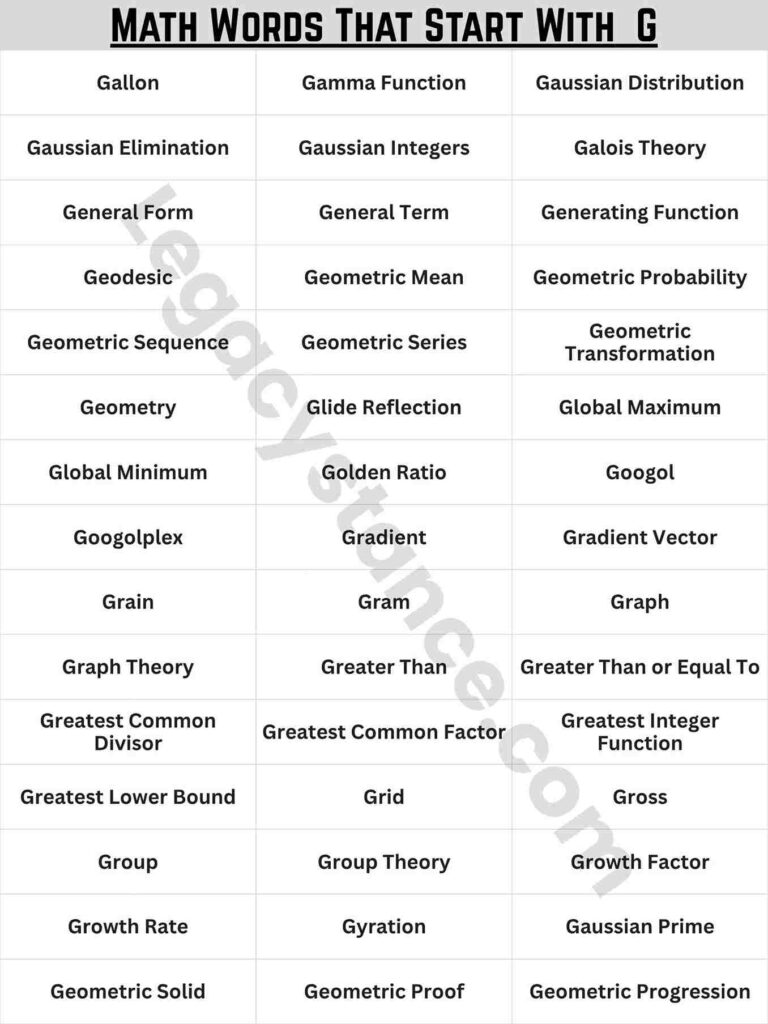
- Gallon
- Gamma Function
- Gaussian Distribution
- Gaussian Elimination
- Gaussian Integers
- Galois Theory
- General Form
- General Term
- Generating Function
- Geodesic
- Geometric Mean
- Geometric Probability
- Geometric Sequence
- Geometric Series
- Geometric Transformation
- Geometry
- Glide Reflection
- Global Maximum
- Global Minimum
- Golden Ratio
- Googol
- Googolplex
- Gradient
- Gradient Vector
- Grain
- Gram
- Graph
- Graph Theory
- Greater Than
- Greater Than or Equal To
- Greatest Common Divisor
- Greatest Common Factor
- Greatest Integer Function
- Greatest Lower Bound
- Grid
- Gross
- Group
- Group Theory
- Growth Factor
- Growth Rate
- Gyration
- Gaussian Prime
- Geometric Solid
- Geometric Proof
- Geometric Progression
- Geometric Angle
- Gradient Descent
- Graph of a Function
- Graphical Solution
- Greater Than Inequality
- Greatest Upper Bound
- Grouped Data
- Grouping Symbols
- Geometry Net
- Geometric Dilation
- Geometric Rotation
- Geometric Reflection
- Geometric Translation
- Googol Power
- Gamma Distribution
- Gaussian Curve
- Grid Point
- General Solution
- Geometric Construction
Common Math Words That Start With G
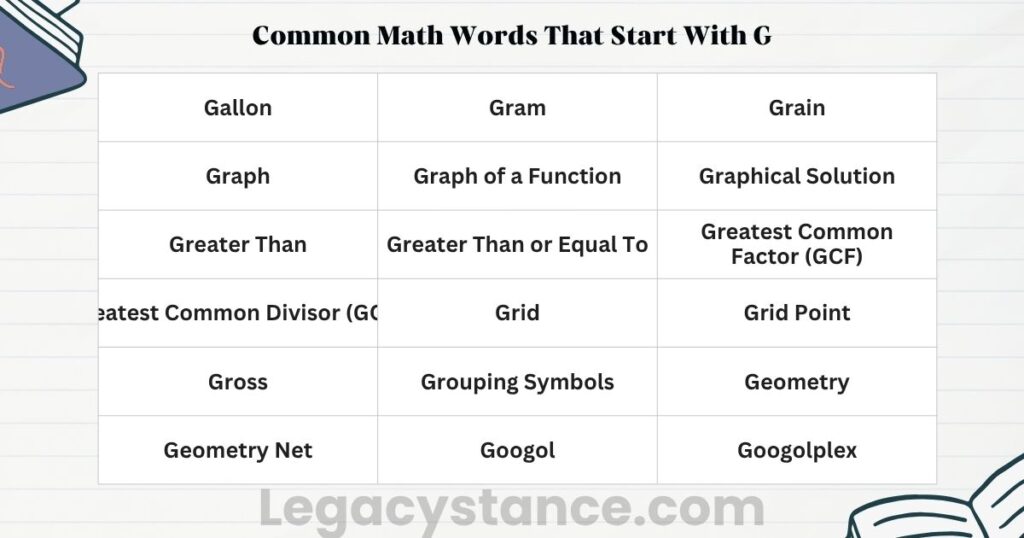
Gallon
Meaning: A unit of liquid volume in the US customary system. One gallon equals 4 quarts or 128 fluid ounces.
Example: A large milk jug holds about 1 gallon.
Why it matters: Used in volume measurement, unit conversion, and word problems.
Gram
Meaning: A metric unit of mass. One kilogram equals 1,000 grams.
Example: A standard paperclip weighs about 1 gram.
Why it matters: Core to metric measurement and science lab problems.
Grain
Meaning: A very small unit of weight in the Imperial system. One pound equals 7,000 grains.
Example: Used in pharmacy and historical measurement problems.
Why it matters: Appears in measurement conversion and applied math contexts.
Graph
Meaning: A visual display showing how two quantities relate using points, lines, bars, or curves.
Example: A line graph showing weekly rainfall makes trends easy to read.
Why it matters: Used across every branch of math, from elementary data charts to university-level calculus.
Graph of a Function
Meaning: The set of all points (x, y) that satisfy a function, plotted on a coordinate plane.
Example: The graph of f(x) = x² is a U-shaped parabola opening upward.
Why it matters: Visualizing functions is essential for understanding algebra, calculus, and beyond.
Graphical Solution
Meaning: Solving an equation or system by drawing graphs and finding where they intersect.
Example: To solve y = 2x + 1 and y = -x + 4, graph both lines and find their intersection point (1, 3).
Why it matters: Gives students a visual method for solving problems that complements algebraic approaches.
Greater Than
Meaning: Shows one number is larger than another. Symbol: >
Example: 9 > 4
Why it matters: Foundation for inequalities and number comparison at every level.
Greater Than or Equal To
Meaning: A comparison including both larger than and equal cases. Symbol: ≥
Example: x ≥ 5 means x can be 5 or any number above 5.
Why it matters: Changes the solution set of any inequality. Distinct from strict “greater than.”
Greatest Common Factor (GCF)
Meaning: The largest number that divides evenly into two or more numbers.
Example: GCF of 12 and 18 = 6.
Why it matters: Used to simplify fractions, factor expressions, and solve ratio problems.
Greatest Common Divisor (GCD)
Meaning: Same calculation as GCF. Preferred term in higher mathematics and computer science.
Example: GCD(24, 36) = 12.
Why it matters: The Euclidean algorithm — one of history’s oldest algorithms — is built entirely on GCD.
Grid
Meaning: Evenly spaced horizontal and vertical lines forming squares, used for plotting and measurement.
Example: Point (3, 4) on a coordinate grid is 3 units right and 4 units up.
Why it matters: Every coordinate plane, graph, and geometric diagram relies on grid structure.
Grid Point
Meaning: Any point where two grid lines cross, having exact integer coordinates.
Example: (2, 5) is a grid point. (2.3, 4.7) is not.
Why it matters: Grid points are used in coordinate geometry, graphing, and lattice problems.
Gross
Meaning: A quantity equal to 144, or 12 dozen.
Example: A supply order of one gross of pens means 144 pens.
Why it matters: A real mathematical quantity in commerce, multiplication, and grouping problems.
Grouping Symbols
Meaning: Symbols that indicate which operations to perform first — parentheses ( ), brackets [ ], and braces { }.
Example: In 3 × (4 + 2), the parentheses tell you to add 4 + 2 before multiplying.
Why it matters: Directly tied to order of operations. Missing or misreading grouping symbols changes the entire answer.
Geometry
Meaning: The branch of math that studies shapes, sizes, angles, and spatial relationships in both 2D and 3D.
Example: Calculating the area of a triangle, volume of a sphere, or interior angles of a polygon.
Why it matters: Used daily in architecture, engineering, design, navigation, and construction.
Geometry Net
Meaning: A flat, unfolded version of a 3D shape. When folded, it forms the solid.
Example: A cross-shaped net of six squares folds into a cube.
Why it matters: Helps students connect 2D and 3D thinking. Used in surface area problems.
Googol
Meaning: The number 1 followed by 100 zeros, written as 10¹⁰⁰.
Example: A googol is larger than the estimated number of atoms in the observable universe.
Why it matters: Teaches exponential notation and extremely large number concepts. The company Google is named after this word.
Googolplex
Meaning: 10 raised to the power of a googol.
Example: Writing a googolplex digit by digit is physically impossible — the universe lacks enough space.
Why it matters: Illustrates how notation handles numbers that can never be fully written out.
Algebra and Sequences Math Words That Start With G
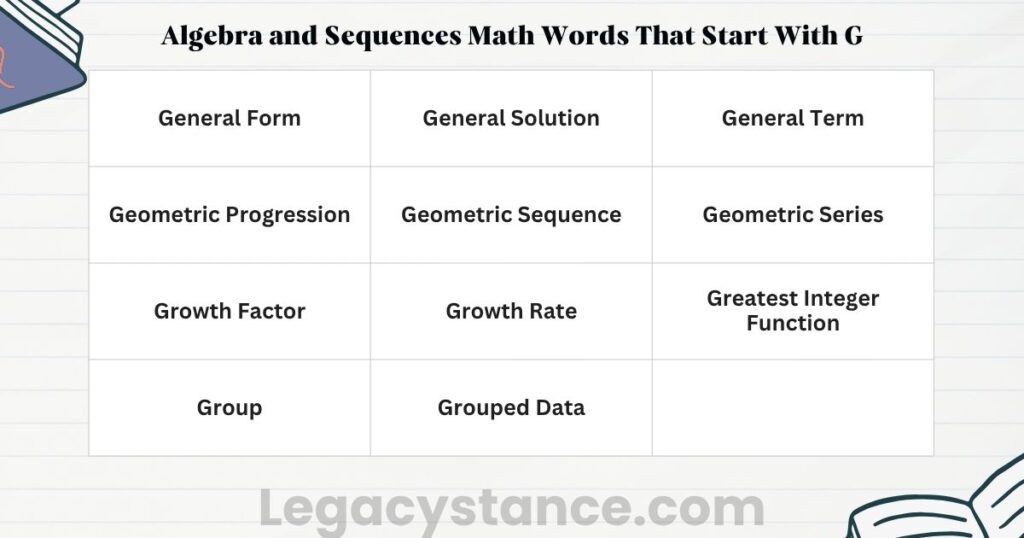
General Form
Meaning: A standard way of writing an equation that shows all terms. For a line: Ax + By = C.
Example: 2x + 3y = 6 is the general form of a linear equation.
Why it matters: Allows easy identification of intercepts and comparison between equations.
General Solution
Meaning: A solution to a differential equation or system that includes all possible answers, typically with constants.
Example: The general solution to dy/dx = y is y = Ce^x, where C is any constant.
Why it matters: Captures every possible solution at once, not just one specific case.
General Term
Meaning: A formula using position number n to find any term in a sequence, written as aₙ.
Example: For 3, 6, 9, 12…, aₙ = 3n. Plug in n = 5 to get 15.
Why it matters: Eliminates the need to list every term. First step toward understanding functions formally.
Geometric Progression
Meaning: Another name for a geometric sequence — a list where each term is multiplied by a constant ratio.
Example: 5, 10, 20, 40, 80 — each term multiplied by 2.
Why it matters: The term “progression” is used in older textbooks and many standardized tests. Knowing both names prevents confusion.
Geometric Sequence
Meaning: A sequence where each term is found by multiplying the previous term by a fixed common ratio.
Example: 2, 6, 18, 54 — common ratio is 3.
Why it matters: Models compound interest, population growth, and exponential decay.
Geometric Series
Meaning: The sum of terms in a geometric sequence.
Example: 2 + 6 + 18 + 54 = 80.
Why it matters: Used to calculate totals in finance, engineering, and physics when values change at a constant rate.
Growth Factor
Meaning: The number you multiply by in an exponential growth situation. A 20% increase gives a growth factor of 1.20.
Example: $1,000 at 5% annual interest: 1000 × (1.05)³ ≈ $1,157.63.
Why it matters: Essential for compound interest, population models, and exponential functions.
Growth Rate
Meaning: The percentage by which a quantity increases over a period.
Example: A city growing from 50,000 to 55,000 in one year has a 10% growth rate.
Why it matters: Connects algebra directly to real-world economics and science problems.
Greatest Integer Function
Meaning: Written as ⌊x⌋, it rounds any real number down to the nearest whole number. Also called the floor function.
Example: ⌊4.9⌋ = 4.
Why it matters: Used in programming, scheduling, and problems where partial units do not count.
Group
Meaning: A set combined with one operation that satisfies four rules: closure, associativity, identity, and inverses.
Example: Integers under addition form a group. Zero is the identity element. Every integer has a negative (its inverse).
Why it matters: The fundamental structure behind symmetry in mathematics.
Grouped Data
Meaning: Data organized into intervals or classes rather than listed as individual values.
Example: Instead of listing 30 individual test scores, grouped data might show 10 students scored 70–79, 12 scored 80–89, and 8 scored 90–99.
Why it matters: Makes large datasets manageable. Used to create frequency tables and histograms.
Geometry Math Words That Start With G
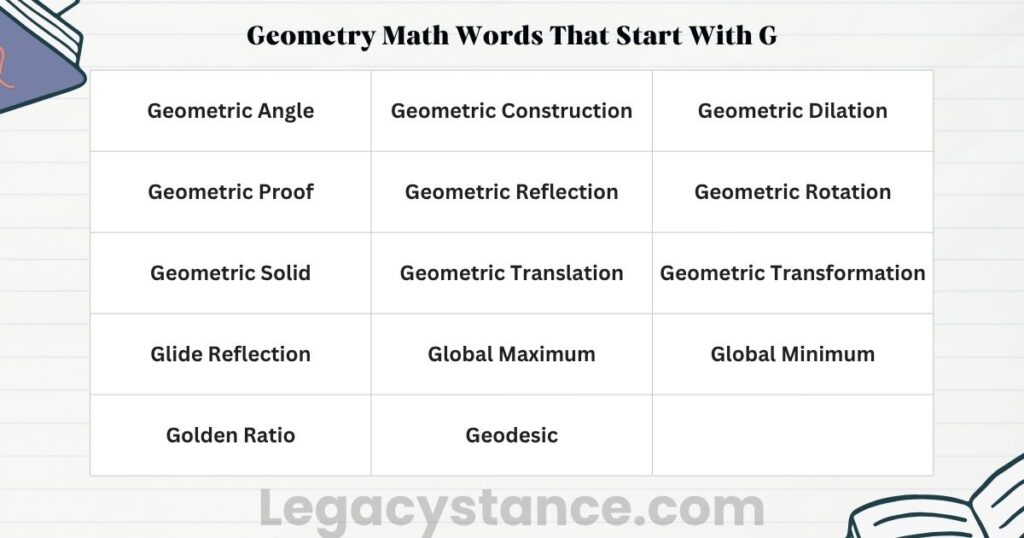
Geometric Angle
Meaning: The figure formed by two rays sharing a common endpoint (the vertex), measured in degrees.
Example: A 90° angle is a right angle. A 180° angle forms a straight line.
Why it matters: Angles are the building blocks of all geometric figures and proofs.
Geometric Construction
Meaning: Drawing precise geometric figures using only a compass and straightedge — no measurements allowed.
Example: Constructing a perpendicular bisector of a line segment using a compass.
Why it matters: Develops logical thinking and deepens understanding of geometric properties.
Geometric Dilation
Meaning: A transformation that resizes a shape by a scale factor from a center point, without changing its shape.
Example: Scaling a triangle by factor 2 makes every side twice as long while keeping all angles the same.
Why it matters: Foundation of similarity in geometry. Used in maps, blueprints, and photography.
Geometric Proof
Meaning: A logical argument using definitions, postulates, and theorems to show a geometric statement is true.
Example: Proving that the base angles of an isosceles triangle are equal using the properties of congruent triangles.
Why it matters: Teaches deductive reasoning — the ability to move from known facts to new conclusions.
Geometric Reflection
Meaning: A transformation that flips a shape over a line (called the line of reflection), creating a mirror image.
Example: Reflecting point (3, 4) over the y-axis gives (−3, 4).
Why it matters: One of the four basic rigid motions. Used in symmetry, art, and coordinate geometry.
Geometric Rotation
Meaning: A transformation that turns a shape around a fixed point (center of rotation) by a given angle.
Example: Rotating a square 90° clockwise around its center produces the same square in a new orientation.
Why it matters: Fundamental in geometry, physics, computer graphics, and engineering design.
Geometric Solid
Meaning: A three-dimensional shape with length, width, and height. Examples include cubes, spheres, cones, and pyramids.
Example: A soup can is a real-life geometric solid — a cylinder with circular bases.
Why it matters: Surface area and volume calculations all involve geometric solids.
Geometric Translation
Meaning: A transformation that slides every point of a shape the same distance in the same direction.
Example: Moving triangle ABC four units right and two units up without rotating or flipping it.
Why it matters: The simplest rigid motion. Introduces students to coordinate transformations.
Geometric Transformation
Meaning: Any operation that changes the position, size, or orientation of a shape — includes translation, reflection, rotation, and dilation.
Example: Reflecting a shape and then translating it combines two geometric transformations.
Why it matters: Core topic in middle and high school geometry, and essential in computer graphics.
Glide Reflection
Meaning: A combination of a reflection across a line followed by a translation along that same line.
Example: Walking footprints form a glide reflection — each footprint is a flipped and shifted version of the previous one.
Why it matters: One of four rigid motions in geometry. Appears in symmetry patterns and tiling designs.
Global Maximum
Meaning: The highest output value of a function across its entire domain.
Example: For f(x) = −x² + 4, global maximum = 4 at x = 0.
Why it matters: The mathematical basis for optimization — finding the best possible outcome in a situation.
Global Minimum
Meaning: The lowest output value of a function across its entire domain.
Example: For f(x) = x² + 2, global minimum = 2 at x = 0.
Why it matters: Used in minimizing cost, error, time, and material usage in applied math.
Golden Ratio
Meaning: A special number approximately equal to 1.618, written as φ (phi). Occurs when the ratio of two quantities equals the ratio of their sum to the larger quantity.
Example: A rectangle with sides in ratio 1 : 1.618 is a golden rectangle — considered the most naturally pleasing proportion.
Why it matters: Appears in spiral galaxies, flower petal counts, classical architecture, and human anatomy proportions.
Geodesic
Meaning: The shortest path between two points on a curved surface — the curved equivalent of a straight line.
Example: A plane flying from New York to Tokyo follows a geodesic arc along Earth’s surface, not a straight line on a flat map.
Why it matters: Used in navigation, general relativity, and structural engineering such as geodesic dome design.
Statistics and Probability Math Words That Start With G
Gaussian Curve
Meaning: The specific bell-shaped curve produced by plotting a Gaussian (normal) distribution. Symmetric around the mean.
Example: Plotting the heights of 10,000 adults produces a Gaussian curve centered around average height.
Why it matters: The visual form of the normal distribution. Recognizing it is fundamental in data analysis.
Gaussian Distribution
Meaning: A probability distribution where data clusters symmetrically around a mean, forming a bell curve. Also called normal distribution.
Example: Standardized test scores in a large population follow a Gaussian distribution.
Why it matters: Foundation of statistical inference in medicine, psychology, economics, and engineering.
Gamma Distribution
Meaning: A probability distribution used to model waiting times or the time until a certain number of events occur.
Example: Modeling how long until a call center receives its 10th call uses a gamma distribution.
Why it matters: Used in reliability engineering, queuing theory, and Bayesian statistics.
Geometric Mean
Meaning: An average found by multiplying all values and taking the nth root, where n is the number of values.
Example: Geometric mean of 4 and 9 = √(4 × 9) = 6.
Why it matters: More accurate than arithmetic mean for growth rates, ratios, and financial returns over multiple periods.
Geometric Probability
Meaning: Finding probability using areas, lengths, or volumes rather than counting outcomes.
Example: If a dart lands randomly on a square board containing a circle, the probability of hitting the circle = area of circle ÷ area of square.
Why it matters: Bridges geometry and statistics. Used in simulations and continuous probability models.
Grouped Data
Already defined in Algebra section — skip repeat.
Advanced Math Words That Start With G
Gradient
Meaning: In algebra, gradient means slope — how steep a line is. In calculus, the gradient of a function is a vector pointing in the direction of steepest increase.
Example (algebra): A road rising 4 meters over 100 meters horizontal has a gradient of 4%.
Example (calculus): For f(x, y) = x² + y², the gradient is the vector (2x, 2y).
Why it matters: Gradient is the core concept behind gradient descent — the algorithm that trains modern AI systems.
Gradient Descent
Meaning: An optimization algorithm that repeatedly moves in the direction of the negative gradient to find a function’s minimum value.
Example: Training a neural network uses gradient descent to minimize prediction error by adjusting weights step by step.
Why it matters: The engine behind machine learning and deep learning. Possibly the most applied mathematical algorithm of the 21st century.
Gradient Vector
Meaning: A vector containing all partial derivatives of a multivariable function, pointing in the direction of greatest increase.
Example: On a temperature map, the gradient vector at any point shows which direction heats up fastest.
Why it matters: Essential in multivariable calculus, physics, and machine learning.
Gaussian Elimination
Meaning: A method for solving systems of linear equations by applying row operations to reduce a matrix step by step.
Example: A system of 3 equations with 3 unknowns is reduced to upper triangular form, then solved by back-substitution.
Why it matters: One of the most widely used algorithms in computational math, engineering, and physics.
Gamma Function
Meaning: A function Γ(n) extending factorial to all real numbers.
Example: Γ(5) = 4! = 24. Also handles Γ(1/2) = √π, which standard factorial cannot.
Why it matters: Appears in probability distributions, quantum mechanics, and complex analysis.
Galois Theory
Meaning: A branch of abstract algebra linking field theory and group theory to determine which polynomial equations can be solved using radicals.
Example: Galois theory proves no general formula using roots and basic operations can solve every degree-5 polynomial.
Why it matters: Resolved a 19th-century open problem and laid foundations for modern algebra and cryptography.
Generating Function
Meaning: A formal power series encoding a sequence — each coefficient represents one term.
Example: Generating function for 1, 1, 1, 1… is 1/(1−x), since 1 + x + x² + x³ + … expands from it.
Why it matters: A powerful combinatorics tool for finding formulas for complex sequences.
Gaussian Integers
Meaning: Complex numbers a + bi where both a and b are integers.
Example: 3 + 4i is a Gaussian integer. They have their own prime numbers called Gaussian primes.
Why it matters: Used in number theory and signal processing. Extends integer concepts into the complex plane.
Gaussian Prime
Meaning: A Gaussian integer that cannot be factored into smaller Gaussian integers (other than units).
Example: 3 is a regular prime but is also a Gaussian prime. However, 5 = (2 + i)(2 − i) is not a Gaussian prime.
Why it matters: Extends the concept of prime numbers into complex number systems. Used in advanced number theory.
Greatest Lower Bound (Infimum)
Meaning: The largest value that is less than or equal to every element in a set, even if that value is not in the set.
Example: For the open interval (0, 1), the greatest lower bound is 0 — not in the set, but no number larger than 0 is a lower bound.
Why it matters: Foundational in real analysis. Formalizes how sequences approach limits without reaching them.
Greatest Upper Bound (Supremum)
Meaning: The smallest value that is greater than or equal to every element in a set, even if not in the set.
Example: For the open interval (0, 1), the greatest upper bound is 1, even though 1 is not in the set.
Why it matters: Pairs with greatest lower bound in real analysis. Together they define the completeness of the real number line.
Graph Theory
Meaning: The mathematical study of networks made of vertices (nodes) and edges (connections).
Example: A map of airports connected by flight routes is a graph. Finding the shortest route is a graph theory problem.
Why it matters: Powers GPS navigation, social networks, internet routing, and biological network research.
Group Theory
Meaning: The formal study of groups — their structure, properties, and relationships.
Example: The eight symmetries of a square (four rotations, four reflections) form a group called the dihedral group D₄.
Why it matters: The mathematical language of symmetry. Drives cryptography, particle physics, and crystallography.
Gyration (Radius of Gyration)
Meaning: The distance from a rotation axis at which all of a body’s mass could be concentrated without changing its rotational inertia.
Example: Engineers calculate the radius of gyration for structural columns to determine resistance to buckling.
Why it matters: Used in structural engineering, mechanics, and physics-based applied mathematics.
Math Words That Start With G Real-World Applications
Measurement: Gram, gallon, and grain appear in cooking, laboratory science, medical dosing, and manufacturing. Converting between these systems is a practical daily skill.
Finance: Geometric mean and growth factor are the correct tools for calculating investment returns across multiple time periods. Using arithmetic mean instead overstates returns.
Data Science: Gaussian distribution underlies standardized tests, quality control inspections, and medical research trials. Gradient descent trains every major AI model in use today.
Navigation and Engineering: Geodesic paths guide flight routes and GPS systems. Geometry nets help engineers visualize and cut materials for 3D structures. Radius of gyration determines how structural beams handle stress.
Architecture and Design: The golden ratio appears in classical buildings, product proportions, and natural patterns. Geometric constructions form the basis of technical drawing and precision design.
Commonly Confused G Math Terms
GCF vs. GCD
Same calculation, different names. GCF is standard in elementary and middle school. GCD is preferred in higher math and computer science. Neither is wrong — know both.
Greater Than (>) vs. Greater Than or Equal To (≥)
The > symbol strictly excludes the equal case. The ≥ symbol includes it. This single difference changes an entire inequality solution set.
Geometric Sequence vs. Geometric Series
A sequence is the list: 2, 6, 18, 54. A series is the sum: 2 + 6 + 18 + 54 = 80. Both share the same multiplication pattern. The difference is list versus total.
Geometric Mean vs. Arithmetic Mean
Arithmetic mean adds and divides. Geometric mean multiplies and takes roots. For test scores, use arithmetic. For growth rates and ratios, geometric mean gives the accurate picture.
Geometric Progression vs. Geometric Sequence
These are the same thing. “Progression” appears in older textbooks and many standardized tests. Knowing both names prevents unnecessary confusion.
Global Maximum vs. Local Maximum
A local maximum is the highest point in a small region — a function can have many. A global maximum is the single highest point across the entire domain. Every global maximum is a local maximum. The reverse is not always true.
Gradient (Slope) vs. Gradient (Vector)
In algebra, gradient means slope. In multivariable calculus, it becomes a vector. Same word — meaning grows with the level of math.
Greatest Lower Bound vs. Minimum
A minimum must be inside the set. A greatest lower bound may not be. For (0, 1), the minimum does not exist, but the greatest lower bound is 0.
Tips for Learning Math Words That Start With G
- Use the root “geo.” It comes from the Greek word for Earth. Geometry, geodesic, and geographic share this root. Recognizing roots connects unfamiliar words to ones you already know.
- Sort by category. Keep measurement words in one group, algebra words in another, statistics in a third. Organized information is easier to retrieve under pressure.
- Explain it without notes. If you can define geometric mean to someone else from memory, you own it. If you stumble, that is exactly where to review.
- Find them outside the classroom. Growth rate in a news headline. Gaussian distribution behind a grading curve. Gradient on a hiking trail rating. Real encounters make vocabulary permanent.
Read also:
130+ Math Words That Start With C | With Meanings and Examples
90+ Math Words That Start With E — Meanings, Examples, and Uses
FAQ’s about Math Words That Start With G
Which G math words are most important for everyday life?
Words like graph, greater than, gram, gallon, growth rate, and greatest common factor appear regularly in school, shopping, cooking, science, finance, and data interpretation. These are practical terms worth learning first.
What is the easiest way to remember new math terms?
Group related words together. For example, keep geometry words in one list and statistics words in another. Using the words in examples, drawings, or real situations helps them stick much better than simple memorization.
Are advanced terms like Galois Theory and Group Theory useful for beginners?
Not immediately, but they help show how large and connected mathematics really is. Beginners do not need to master these topics, but becoming familiar with the names can make future learning less intimidating.
What’s the difference between a graph and graph theory?
A graph is a visual representation of data or relationships. Graph theory is an advanced branch of mathematics that studies networks made of points and connections. The two are related but used in different ways.
Conclusion
These 60+ math words starting with G stretch from basic measurement terms like gram and gallon all the way to advanced structures like group theory, Galois theory, and Gaussian elimination. Every word here does real mathematical work — nothing is included just to fill a list.
Start with the terms you already recognize. Build outward into medium-level vocabulary. Let curiosity lead you toward the advanced ones. Vocabulary grows the same way understanding does — one connected idea at a time.