Learning math becomes much easier when you understand the words behind the concepts. Many students struggle with a problem not because the math is difficult, but because the vocabulary is unfamiliar. This collection of Math Words That Start With E explains important terms in clear, simple language so you can learn with confidence.
From everyday words like equal, equation, and even number to advanced ideas such as eigenvalue and Euler’s number, this guide helps students, parents, and teachers build a stronger math vocabulary. Whether you’re studying for class, creating a word wall, or looking up a quick definition, you’ll find useful explanations and examples here.
Quick Scan List — All Math Words That Start With E
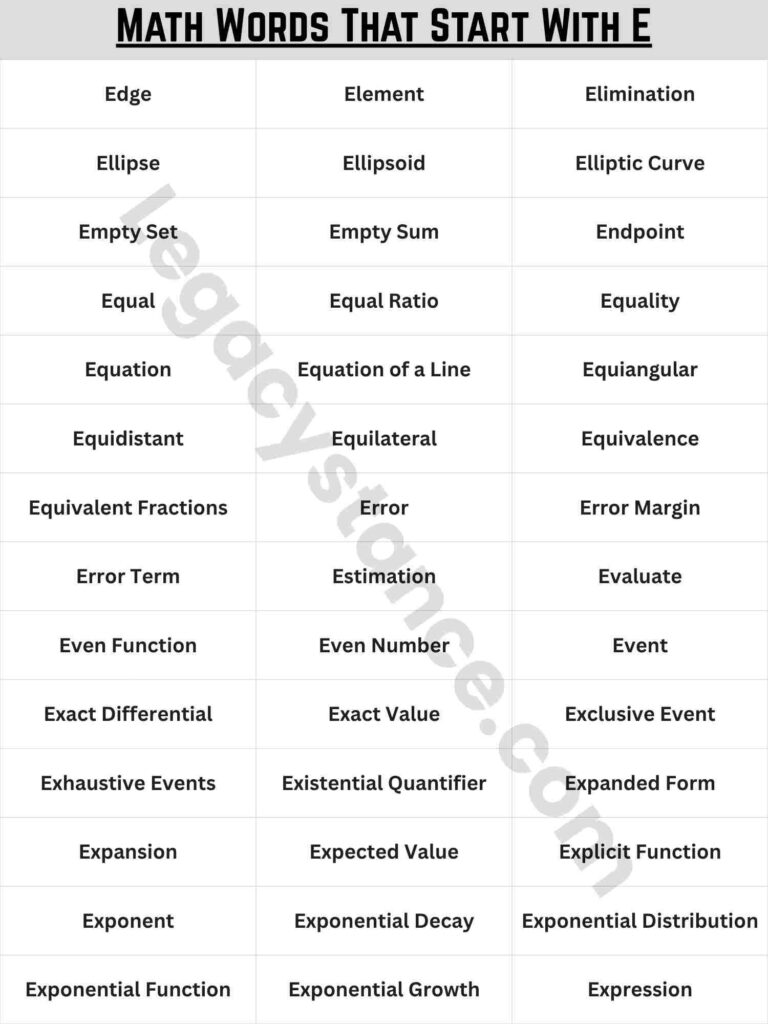
No definitions here. Find your word fast, then jump to the section you need.
- Edge
- Element
- Elimination
- Ellipse
- Ellipsoid
- Elliptic Curve
- Empty Set
- Empty Sum
- Endpoint
- Equal
- Equal Ratio
- Equality
- Equation
- Equation of a Line
- Equiangular
- Equidistant
- Equilateral
- Equivalence
- Equivalent Fractions
- Error
- Error Margin
- Error Term
- Estimation
- Evaluate
- Even Function
- Even Number
- Event
- Exact Differential
- Exact Value
- Exclusive Event
- Exhaustive Events
- Existential Quantifier
- Expanded Form
- Expansion
- Expected Value
- Explicit Function
- Exponent
- Exponential Decay
- Exponential Distribution
- Exponential Function
- Exponential Growth
- Expression
- Extended Euclidean Algorithm
- Exterior Angle
- Exterior Angle Theorem
- Extrapolation
- Extrema
- Euclidean Algorithm
- Euclidean Distance
- Euclidean Domain
- Euclidean Geometry
- Euclidean Space
- Euler’s Formula
- Euler’s Number (e)
- Eigenvalue
- Eigenvector
- Empirical Probability
- Empirical Rule
- Enumeration
- Epsilon (ε)
- Equinumerosity
- Escribed Circle
- Exact Sequence
- Excircle
- Exradius
- Face Value (place value context)
- Field Extension
- Floor vs Ceiling (E for estimation context: see estimation)
Wait — staying strictly on E. Continuing:
- E (Euler’s constant)
- E (expected value notation)
- Eccentricity
- Edge (graph theory)
- Edge (geometry)
- Elongation
- Embedded Graph
- Empirical Data
- Endpoint (interval)
- Endpoint (ray/segment)
- Equilateral Polygon
- Equiprobable
- Equivalent Equations
- Equivalent Expressions
- Ergodic
- Error Bound
- Euclidean Norm
- Euler’s Totient Function
- Even Permutation
- Event Space
- Exact Form
- Existence Theorem
- Existential Statement
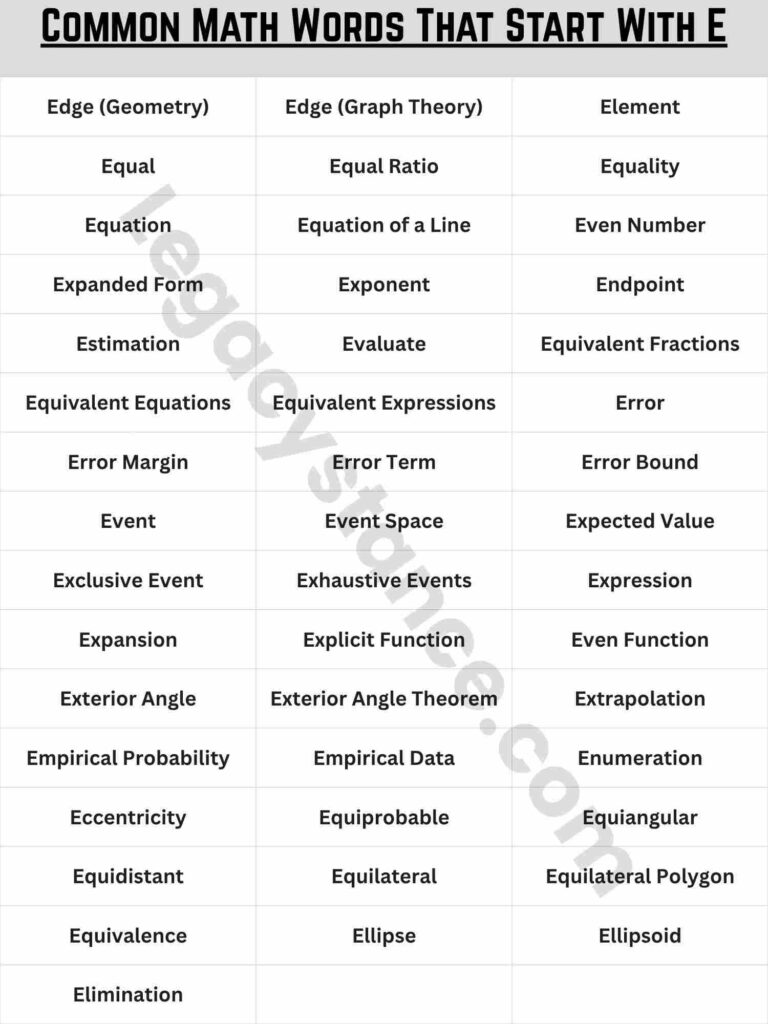
Common Math Words That Start With E
Edge (Geometry)
Meaning: A straight line segment where two flat faces of a 3D solid meet.
Example: A triangular prism has 9 edges.
Why It Matters: Counting edges is required for surface area problems and for applying Euler’s polyhedron formula: Vertices − Edges + Faces = 2.
Edge (Graph Theory)
Meaning: A connection between two vertices (nodes) in a graph or network.
Example: In a map showing cities connected by roads, each road is an edge.
Why It Matters: Graphs model real networks — social connections, road systems, computer networks. Edges define those connections.
Element
Meaning: A single object that belongs to a set.
Example: In the set {2, 4, 6, 8}, the number 4 is one element.
Why It Matters: Set theory is the language of modern mathematics. Every branch — probability, algebra, analysis — uses the idea of elements and sets.
Equal
Meaning: Two values or expressions that have exactly the same amount.
Example: 6 + 9 = 15 means both sides are equal.
Why It Matters: Equality is the foundation every equation is built on. Understanding it precisely prevents errors when solving and balancing equations.
Equal Ratio
Meaning: Two ratios that simplify to the same value.
Example: 2:4 and 3:6 are equal ratios — both simplify to 1:2.
Why It Matters: Equal ratios are the basis of proportion problems, scaling, and unit rate comparisons.
Equality
Meaning: The formal mathematical relationship where two expressions have the same value, written with =.
Example: 3² + 4² = 5² is an equality.
Why It Matters: Equality is a logical statement, not just a symbol. In proofs and formal math, understanding what equality means precisely is essential.
Equation
Meaning: A statement showing that two expressions are equal, always containing an equals sign.
Example: 2x + 5 = 13 is an equation. Solving it means finding x = 4.
Why It Matters: Equations are the core tool of algebra. Every real-world math problem eventually becomes an equation to solve.
Equation of a Line
Meaning: A formula describing every point that lies on a straight line. Standard form is y = mx + b.
Example: y = 3x − 2 describes a line with slope 3 crossing the y-axis at −2.
Why It Matters: Students use this to graph lines, find intercepts, and solve systems of equations in algebra.
Even Number
Meaning: Any whole number divisible by 2 with no remainder.
Example: 2, 4, 6, 8, 10, 100 are even. The number 7 is not.
Why It Matters: Even and odd numbers form the base of divisibility, number theory, and many algebraic proofs.
Expanded Form
Meaning: Writing a number by showing the value of each individual digit.
Example: 4,736 in expanded form = 4,000 + 700 + 30 + 6.
Why It Matters: Expanded form builds deep place value understanding, which is necessary for multi-digit operations and later for polynomial expressions.
Exponent
Meaning: A small number written above and to the right of a base, showing how many times the base multiplies itself.
Example: 3⁴ = 3 × 3 × 3 × 3 = 81. The 4 is the exponent.
Why It Matters: Exponents appear in scientific notation, algebra, compound interest, and almost every advanced topic in math and science.
Endpoint
Meaning: Either end point of a line segment, or the starting point of a ray.
Example: A segment from A(1, 2) to B(5, 6) has A and B as its endpoints.
Why It Matters: Endpoints define the boundaries of segments and intervals. In calculus, interval endpoints determine the domain of integration.
Estimation
Meaning: Reaching a close but not exact answer, usually by rounding to make calculation easier.
Example: Estimating 497 × 4 as 500 × 4 = 2,000 gives a quick, close answer.
Why It Matters: Estimation is a daily life skill and a check on exact answers. If you estimate 2,000 but calculate 20,000, you know something went wrong.
Evaluate
Meaning: To substitute numbers for variables in an expression and calculate its value.
Example: Evaluate 5x − 3 when x = 4: 5(4) − 3 = 17.
Why It Matters: Evaluating expressions is one of the most tested algebra skills and is the bridge between abstract symbols and actual numbers.
Equivalent Fractions
Meaning: Fractions with different numerators and denominators that represent the same value.
Example: 1/3, 2/6, 4/12, and 5/15 are all equivalent.
Why It Matters: You cannot add or subtract fractions with unlike denominators without first finding equivalent fractions.
Equivalent Equations
Meaning: Two equations that have exactly the same solution set, even if they look different.
Example: 2x = 10 and x = 5 are equivalent equations — they have the same solution.
Why It Matters: When you solve an equation by performing operations on both sides, each step produces an equivalent equation. Understanding this justifies every algebraic step.
Equivalent Expressions
Meaning: Two expressions that produce the same value for every possible input.
Example: 3(x + 2) and 3x + 6 are equivalent expressions.
Why It Matters: Simplifying and factoring algebra depends entirely on replacing expressions with equivalent ones.
Error
Meaning: The difference between a measured or estimated value and the actual correct value.
Example: If the true answer is 80 and you got 75, the error is 5.
Why It Matters: Error analysis teaches students to evaluate accuracy. In science and statistics, it is essential for evaluating the reliability of results.
Error Margin
Meaning: The maximum amount by which a result could differ from the true value.
Example: A poll result of 55% with a ±3% error margin means the true figure is likely between 52% and 58%.
Why It Matters: Error margins appear in polls, surveys, and scientific research. Knowing how to read them prevents misreading data.
Error Term
Meaning: In statistics and analysis, the part of a value that cannot be explained by the model — the leftover difference.
Example: In a regression model, the error term is the gap between what the model predicted and what actually happened.
Why It Matters: Error terms measure how well a model fits reality. Smaller error terms mean better predictions.
Error Bound
Meaning: A guaranteed upper limit on how large an error can be in a numerical calculation or approximation.
Example: In numerical integration, the error bound tells you the worst-case gap between your approximation and the true value.
Why It Matters: Error bounds are used in numerical methods and analysis to guarantee that approximations are close enough to be useful.
Event
Meaning: Any result or group of results from a probability experiment.
Example: When rolling a die, getting an odd number is an event — it includes outcomes 1, 3, and 5.
Why It Matters: Probability is always calculated for an event. You cannot find probability without first defining what event you are measuring.
Event Space
Meaning: The set of all possible events in a probability experiment, also called the sample space.
Example: For rolling a single die, the event space is {1, 2, 3, 4, 5, 6}.
Why It Matters: Defining the event space is always the first step in solving any probability problem.
Expected Value
Meaning: The long-run average outcome of a probability experiment if repeated many times.
Example: Rolling a fair die many times, the expected value = (1+2+3+4+5+6) ÷ 6 = 3.5.
Why It Matters: Expected value is used in insurance, finance, and game theory to make decisions when outcomes are uncertain.
Exclusive Event
Meaning: Two events that cannot both occur in the same trial. Also called mutually exclusive.
Example: When tossing a coin, getting heads and tails at the same time is impossible — exclusive events.
Why It Matters: For exclusive events: P(A or B) = P(A) + P(B). This rule only works when events cannot overlap.
Exhaustive Events
Meaning: A collection of events that together cover every possible outcome.
Example: For any coin toss, heads and tails are exhaustive — one must occur.
Why It Matters: Exhaustive events guarantee that probabilities sum to exactly 1, which helps students check their work.
Expression
Meaning: A combination of numbers, variables, and operations with no equals sign.
Example: 7x² − 3x + 5 is an expression. Add = and another value and it becomes an equation.
Why It Matters: You simplify expressions. You solve equations. Confusing the two is one of the most common algebra mistakes students make.
Expansion
Meaning: Multiplying out brackets to write an expression in full without parentheses.
Example: Expanding (x + 4)(x + 3) gives x² + 7x + 12.
Why It Matters: Expansion is foundational for factoring, solving quadratics, and working with polynomials throughout algebra.
Explicit Function
Meaning: A function where one variable is written directly in terms of another — typically y = f(x).
Example: y = 2x + 7 is explicit. Compare to x² + y² = 25, which is implicit.
Why It Matters: Explicit functions are straightforward to differentiate and evaluate. Recognizing implicit functions matters in calculus.
Even Function
Meaning: A function where f(−x) = f(x) for all x, making its graph symmetric about the y-axis.
Example: f(x) = x² is even: f(−3) = 9 = f(3). The graph mirrors itself.
Why It Matters: Even functions simplify integration on symmetric intervals. They appear throughout calculus and signal processing.
Exterior Angle
Meaning: An angle formed outside a polygon by extending one of its sides past the vertex.
Example: Extending one side of a triangle beyond its vertex creates an exterior angle.
Why It Matters: Exterior angles are tested in geometry proofs and used to find missing angle measures inside polygons.
Exterior Angle Theorem
Meaning: A theorem stating that an exterior angle of a triangle equals the sum of the two non-adjacent interior angles.
Example: If two interior angles are 45° and 65°, the opposite exterior angle is 110°.
Why It Matters: This is one of the most frequently used theorems in triangle geometry, especially for finding unknown angles efficiently.
Extrapolation
Meaning: Estimating a value that lies beyond the range of known data by extending a trend or pattern.
Example: If a plant grows 3 cm per week for 4 weeks, extrapolating predicts it will reach 21 cm by week 7.
Why It Matters: Extrapolation is used in forecasting and science but becomes less reliable the further you go from actual data.
Empirical Probability
Meaning: Probability calculated from actual observed data rather than theory.
Example: Flipping a coin 200 times and getting heads 96 times gives an empirical probability of 96/200 = 0.48.
Why It Matters: Empirical probability reflects what actually happens, which sometimes differs from theoretical probability.
Empirical Data
Meaning: Data collected from real observations, experiments, or measurements rather than assumptions.
Example: Recording the heights of 50 students is collecting empirical data.
Why It Matters: All of statistics rests on empirical data. The quality of data directly determines the reliability of conclusions.
Enumeration
Meaning: Systematically counting or listing all elements or outcomes in a set.
Example: Listing all 36 possible outcomes when rolling two dice is enumeration.
Why It Matters: Enumeration is a core skill in combinatorics and probability. Without systematic counting, outcomes get missed.
Eccentricity
Meaning: A number that describes how much a conic section (ellipse, parabola, hyperbola) deviates from being a perfect circle.
Example: A circle has eccentricity 0. An ellipse has eccentricity between 0 and 1. A parabola has eccentricity exactly 1.
Why It Matters: Eccentricity classifies conic sections and appears in astronomy — Earth’s orbit has an eccentricity of about 0.017.
Equiprobable
Meaning: Two or more outcomes that each have the same probability of occurring.
Example: On a fair die, all six outcomes are equiprobable — each has probability 1/6.
Why It Matters: When outcomes are equiprobable, probability = favorable outcomes ÷ total outcomes. This simple formula only applies when outcomes are equally likely.
Equiangular
Meaning: A polygon where every interior angle measures the same.
Example: A regular hexagon is equiangular — all six interior angles are 120°.
Why It Matters: Regular polygons are both equilateral and equiangular. Knowing one property often confirms the other for regular shapes.
Equidistant
Meaning: At the same distance from two or more reference points or lines.
Example: Every point on a circle is equidistant from the center.
Why It Matters: Equidistance defines circles, perpendicular bisectors, angle bisectors, and many geometric constructions.
Equilateral
Meaning: A shape where all sides have equal length.
Example: A triangle with all sides 7 cm is equilateral. All interior angles are 60°.
Why It Matters: Equilateral triangles are central to trigonometry, tessellations, and geometry proofs at every level.
Equilateral Polygon
Meaning: A polygon where all sides are equal in length but angles do not need to be equal.
Example: A rhombus is equilateral — all four sides equal — but its angles are not always 90°.
Why It Matters: Distinguishing equilateral polygons from regular polygons (equal sides AND angles) prevents a very common geometry confusion.
Equivalence
Meaning: A relationship between two things that are equal in value, logic, or mathematical behavior.
Example: In modular arithmetic, 13 ≡ 1 (mod 4) — they are equivalent under mod 4.
Why It Matters: Equivalence is used in logic, set theory, and abstract algebra. It is more general than equality.
Ellipse
Meaning: A closed oval curve where the sum of distances from any point on it to two fixed points (foci) is constant.
Example: Earth’s orbit around the Sun is an ellipse with the Sun at one focus.
Why It Matters: Ellipses are studied as conic sections in algebra 2. They appear in astronomy, architecture, and optics.
Ellipsoid
Meaning: A 3D surface where every cross-section is an ellipse. A sphere is a special case.
Example: A rugby ball or an American football is shaped like an ellipsoid.
Why It Matters: Earth itself is modeled as an oblate ellipsoid — slightly flattened at the poles — which matters for GPS accuracy.
Elimination
Meaning: A method for solving a system of equations by adding or subtracting equations to cancel one variable.
Example: From x + y = 10 and x − y = 4, add them: 2x = 14, so x = 7, then y = 3.
Why It Matters: Elimination is one of three key methods for systems of equations. It is most efficient when substitution would create messy fractions.
Elongation
Meaning: A stretching transformation that extends a shape in one direction while keeping its width the same.
Example: Multiplying all y-values of a circle by 2 elongates it into an ellipse.
Why It Matters: Elongation appears in transformation geometry and in applied settings like engineering and computer graphics.
Exact Value
Meaning: A value expressed precisely with no rounding or approximation.
Example: sin 45° = √2/2 is exact. Writing 0.707 is a decimal approximation.
Why It Matters: In trigonometry and calculus, exact values eliminate rounding errors. Answers like π, √3, and e are exact; their decimals are not.
Existence Theorem
Meaning: A theorem that guarantees a solution exists without necessarily telling you how to find it.
Example: The Intermediate Value Theorem guarantees a root exists between two points — it does not tell you where.
Why It Matters: Existence theorems are foundational in analysis and calculus. Knowing a solution exists is separate from knowing how to find it.
Existential Statement
Meaning: A mathematical statement claiming that at least one object satisfies a condition.
Example: “There exists a prime number greater than 100” is an existential statement. (True — 101 is prime.)
Why It Matters: Existential statements appear in proofs and logic. Proving one requires finding just one example; disproving one requires showing no example can exist.
Advanced Math Words That Start With E
Euler’s Number (e)
Meaning: A mathematical constant ≈ 2.71828, the base of natural logarithms and the foundation of continuous growth models.
Example: Continuous compound interest: A = Pe^(rt). If P = 1,000, r = 5%, t = 10 years, then A = 1,000 × e^0.5 ≈ $1,649.
Math Branch: Calculus, Analysis
Real-World Use: Population growth, radioactive decay, compound interest, thermodynamics, and probability all use e.
E (Expected Value Notation)
Meaning: In statistics, E(X) denotes the expected value of a random variable X.
Example: If X is the outcome of rolling a fair die, E(X) = 3.5.
Math Branch: Probability/Statistics
Real-World Use: Insurance companies use E(X) to price policies. Investors use it to weigh uncertain returns.
Euler’s Formula
Meaning: The equation e^(iθ) = cos θ + i sin θ, connecting exponential and trigonometric functions through complex numbers.
Example: The famous special case: e^(iπ) + 1 = 0, linking e, i, π, 1, and 0.
Math Branch: Complex Analysis
Real-World Use: Electrical engineering, signal processing, and quantum mechanics all rely on Euler’s formula to work with oscillating quantities.
Euler’s Totient Function (φ)
Meaning: A function φ(n) that counts how many integers from 1 to n share no common factor with n.
Example: φ(8) = 4, because 1, 3, 5, 7 share no factors with 8.
Math Branch: Number Theory
Real-World Use: RSA encryption — which secures most internet communication — depends directly on Euler’s totient function.
Eigenvalue
Meaning: A scalar λ associated with a square matrix A such that Av = λv for some non-zero vector v.
Example: A matrix that doubles vectors along the x-axis has eigenvalue 2 in that direction.
Math Branch: Linear Algebra
Real-World Use: Eigenvalues drive Google’s PageRank, face recognition software, structural engineering analysis, and quantum mechanics.
Eigenvector
Meaning: A non-zero vector v that does not change direction under a matrix transformation — it only scales by the eigenvalue.
Example: If a matrix stretches space along one axis, vectors along that axis are eigenvectors.
Math Branch: Linear Algebra
Real-World Use: Used in data compression (JPEG), machine learning (PCA — Principal Component Analysis), and physics simulations.
Elliptic Curve
Meaning: A smooth curve defined by the equation y² = x³ + ax + b, studied for its rich algebraic structure.
Example: Despite the name, elliptic curves do not look like ellipses — they form smooth looped shapes.
Math Branch: Number Theory / Algebraic Geometry
Real-World Use: Elliptic curve cryptography secures HTTPS connections, banking apps, and encrypted messaging. It protects billions of transactions daily.
Empirical Rule
Meaning: In a normal distribution: 68% of data falls within 1 standard deviation of the mean, 95% within 2, and 99.7% within 3.
Example: Test scores with mean 70 and standard deviation 10: about 95% of scores fall between 50 and 90.
Math Branch: Statistics
Real-World Use: Used in quality control, medical research, and any field analyzing normally distributed data.
Epsilon (ε)
Meaning: A Greek letter representing a small positive quantity — used formally in limit and continuity definitions.
Example: In the epsilon-delta definition: for every ε > 0, there exists δ > 0 such that if |x − c| < δ then |f(x) − L| < ε.
Math Branch: Real Analysis
Real-World Use: The rigorous foundation of all of calculus. Every limit, derivative, and integral rests on this definition.
Equinumerosity
Meaning: Two sets are equinumerous if a one-to-one correspondence exists between them — even if both are infinite.
Example: The natural numbers and even numbers are equinumerous, despite even numbers seeming smaller.
Math Branch: Set Theory
Real-World Use: The foundation for understanding different sizes of infinity — a result that surprises most people when they first meet it.
Escribed Circle / Excircle
Meaning: A circle tangent to one side of a triangle and to the extensions of the other two sides. Every triangle has exactly three excircles.
Example: For a triangle with sides a, b, c and area A and semi-perimeter s, the exradius opposite to side a is rₐ = A/(s − a).
Math Branch: Advanced Geometry
Real-World Use: Appears in competition mathematics and in classical geometry constructions involving triangle centers.
Exradius
Meaning: The radius of an excircle of a triangle.
Example: If a triangle has area 24 and semi-perimeter 12, one exradius is r = 24/(12 − side length).
Math Branch: Geometry
Real-World Use: Used in competition geometry and classical triangle analysis.
Euclidean Algorithm
Meaning: A method to find the Greatest Common Divisor (GCD) of two numbers using repeated division with remainder.
Example: GCD(48, 18): 48 = 2×18 + 12 → 18 = 1×12 + 6 → 12 = 2×6 + 0 → GCD = 6.
Math Branch: Number Theory
Real-World Use: One of the oldest algorithms still in daily use — inside computers for simplifying fractions and in cryptography.
Euclidean Domain
Meaning: An algebraic structure where a version of the Euclidean algorithm can be applied — integers and polynomials are both examples.
Math Branch: Abstract Algebra
Real-World Use: Provides the algebraic foundation for factoring and division in settings beyond ordinary integers.
Euclidean Distance
Meaning: The straight-line distance between two points, found using the Pythagorean theorem.
Example: Distance from (0, 0) to (3, 4) = √(3² + 4²) = √25 = 5.
Math Branch: Geometry / Data Science
Real-World Use: GPS navigation, machine learning clustering, computer graphics, and robotics all use Euclidean distance.
Euclidean Geometry
Meaning: The geometry of flat space, built on Euclid’s five postulates about points, lines, and planes.
Example: The angles of a triangle add to 180° — this is a theorem of Euclidean geometry.
Math Branch: Geometry
Real-World Use: The foundation for most engineering, surveying, and architecture calculations.
Euclidean Norm
Meaning: The length of a vector, calculated as the square root of the sum of its squared components.
Example: The Euclidean norm of vector (3, 4) = √(3² + 4²) = 5.
Math Branch: Linear Algebra
Real-World Use: Used in machine learning to measure the size of weight vectors, and in physics to measure the magnitude of force and velocity vectors.
Euclidean Space
Meaning: A mathematical space of any number of dimensions where the usual rules of geometry apply — flat, with standard distance measurement.
Example: The coordinate plane is 2D Euclidean space. Everyday physical space is approximately 3D Euclidean space.
Math Branch: Geometry / Analysis
Real-World Use: The setting for classical physics, engineering design, and most computer-aided design software.
Extended Euclidean Algorithm
Meaning: An extension of the Euclidean algorithm that also finds integers x and y satisfying ax + by = GCD(a, b).
Example: For 48 and 18: finds GCD = 6 and the specific x, y where 48x + 18y = 6.
Math Branch: Number Theory
Real-World Use: Central to RSA encryption — used to compute modular inverses which are essential in cryptographic key generation.
Exact Differential
Meaning: A differential expression that equals the total derivative of some function — meaning it has no path dependence.
Example: dF = 2x dx + 2y dy is exact because it is the total derivative of F = x² + y².
Math Branch: Multivariable Calculus
Real-World Use: In thermodynamics, exact differentials identify state functions like internal energy, distinguishing them from path-dependent quantities like heat.
Exact Form
Meaning: In differential geometry, a differential form that is the exterior derivative of another form.
Example: If ω = df for some function f, then ω is an exact form.
Math Branch: Differential Geometry
Real-World Use: Exact forms appear in advanced physics — particularly in electromagnetism and general relativity.
Exact Sequence
Meaning: A sequence of algebraic objects and maps between them where the image of each map equals the kernel of the next.
Example: In homology theory: 0 → A → B → C → 0 is a short exact sequence.
Math Branch: Abstract Algebra / Algebraic Topology
Real-World Use: Used in algebraic topology to study the structure of spaces and in homological algebra in advanced mathematics.
Existential Quantifier (∃)
Meaning: A logical symbol meaning “there exists at least one,” used to state that a condition is satisfied by at least one element.
Example: ∃x ∈ ℝ such that x² = 4 means “there exists a real number x where x² = 4.” (x = 2 or x = −2.)
Math Branch: Mathematical Logic
Real-World Use: Existential quantifiers appear in every formal proof. Without them, mathematical language cannot express existence claims rigorously.
Exponential Distribution
Meaning: A probability distribution modeling the time between successive independent events occurring at a constant rate.
Example: Time between calls arriving at a customer service center follows an exponential distribution.
Math Branch: Statistics / Probability
Real-World Use: Used in reliability engineering, queuing theory, and telecommunications to model waiting times and failure rates.
Exponential Function
Meaning: A function of the form f(x) = aˣ where the variable is the exponent.
Example: f(x) = 2ˣ gives values 1, 2, 4, 8, 16, 32 as x increases by 1 each step.
Math Branch: Algebra / Calculus
Real-World Use: Models compound interest, population growth, radioactive decay, and learning curves.
Exponential Growth
Meaning: Growth by a fixed percentage per time period, causing the total to multiply rapidly.
Example: A population starting at 500 that doubles every year reaches 8,000 in just 4 years.
Math Branch: Applied Mathematics
Real-World Use: Describes bacterial growth, viral spread, compound interest, and early-stage technology adoption.
Exponential Decay
Meaning: Decrease by a fixed percentage per time period, causing the total to shrink toward zero.
Example: A substance with a 2-hour half-life shrinks from 100g to 50g to 25g to 12.5g every two hours.
Math Branch: Applied Mathematics
Real-World Use: Models radioactive decay, medication clearance from the body, and cooling of a hot object.
Extrema
Meaning: The maximum and minimum values of a function — locally (within a region) or globally (over the entire domain).
Example: For f(x) = −x² + 9, the global maximum is 9 at x = 0. There is no minimum.
Math Branch: Calculus
Real-World Use: Finding extrema powers all optimization — minimizing manufacturing cost, maximizing structural strength, training machine learning models.
Even Permutation
Meaning: A permutation that can be expressed as an even number of two-element swaps (transpositions).
Example: The permutation (1 2 3) → (2 3 1) is an even permutation — achievable in two swaps.
Math Branch: Abstract Algebra / Group Theory
Real-World Use: Even permutations form the alternating group, central to Galois theory — which explains why there is no general formula for quintic equations.
Ergodic
Meaning: A system is ergodic if its time average equals its space average — meaning the system explores all states given enough time.
Example: A gas molecule in a closed container is ergodic — over time it visits all available positions.
Math Branch: Advanced Probability / Dynamical Systems
Real-World Use: Ergodic theory underpins statistical mechanics, thermodynamics, and modern chaos theory.
Empty Sum
Meaning: A sum with no terms at all. By mathematical convention, its value is zero.
Example: The sum of zero numbers = 0. This is not a coincidence — it is a formal definition needed to make algebraic rules work consistently.
Math Branch: Formal Mathematics / Combinatorics
Real-World Use: Empty sums appear in combinatorics, formal proofs, and computer science where edge cases must be handled without breaking the rules.
Embedded Graph
Meaning: A graph drawn on a surface (like a plane or sphere) in such a way that edges do not cross.
Example: A planar graph is an embedded graph — it can be drawn on a flat plane with no crossing edges.
Math Branch: Graph Theory / Topology
Real-World Use: Circuit board design requires embedded graphs — crossing wires on a board cause short circuits.
Field Extension
Meaning: A larger field that contains a smaller field as a subset, adding new elements not in the original.
Example: The real numbers are a field extension of the rational numbers. The complex numbers extend the reals.
Math Branch: Abstract Algebra
Real-World Use: Field extensions are the foundation of Galois theory, which determines which polynomial equations can be solved by formulas.
Geometry Math Words That Start With E
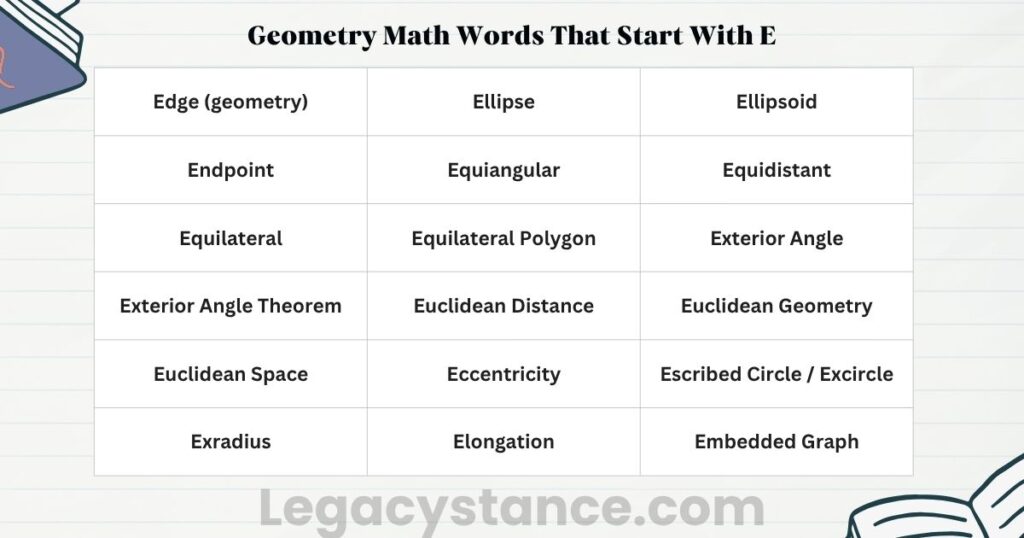
- Edge (geometry)
- Ellipse
- Ellipsoid
- Endpoint
- Equiangular
- Equidistant
- Equilateral
- Equilateral Polygon
- Exterior Angle
- Exterior Angle Theorem
- Euclidean Distance
- Euclidean Geometry
- Euclidean Space
- Eccentricity
- Escribed Circle / Excircle
- Exradius
- Elongation
- Embedded Graph
Algebra Math Words That Start With E
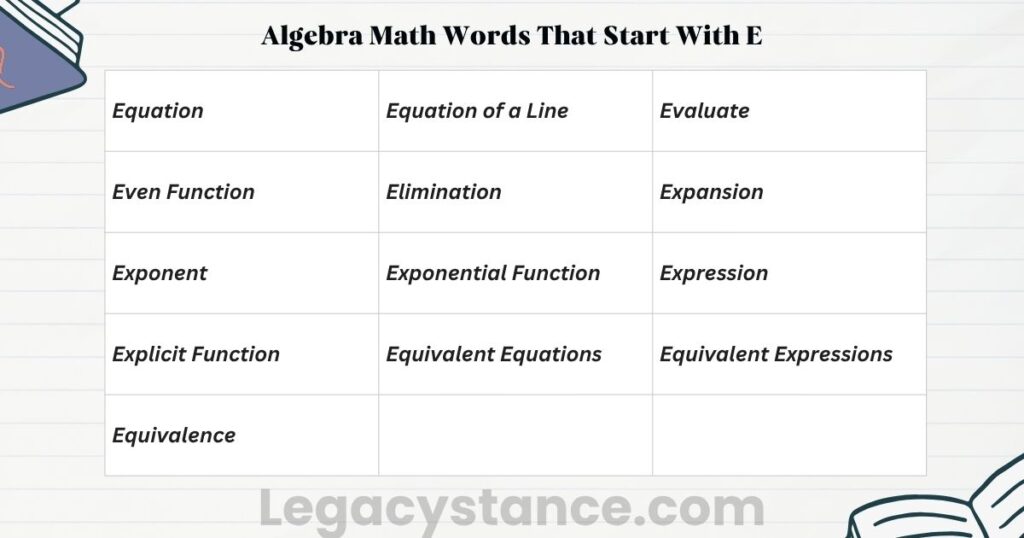
- Equation
- Equation of a Line
- Evaluate
- Even Function
- Elimination
- Expansion
- Exponent
- Exponential Function
- Expression
- Explicit Function
- Equivalent Equations
- Equivalent Expressions
- Equivalence
Arithmetic and Number Sense Math Words That Start With E
- Equal
- Equality
- Equal Ratio
- Even Number
- Expanded Form
- Equivalent Fractions
- Estimation
- Exact Value
Statistics and Probability Math Words That Start With E
- Event
- Event Space
- Expected Value (E(X))
- Exclusive Event
- Exhaustive Events
- Extrapolation
- Empirical Probability
- Empirical Data
- Empirical Rule
- Enumeration
- Equiprobable
- Error
- Error Margin
- Error Term
- Error Bound
- Exponential Distribution
- Exponential Growth
- Exponential Decay
Calculus and Analysis Math Words That Start With E
- Euler’s Number (e)
- Epsilon (ε)
- Exact Differential
- Exact Form
- Extrema
- Existence Theorem
- Even Function
Number Theory and Abstract Algebra
- Euclidean Algorithm
- Extended Euclidean Algorithm
- Euclidean Domain
- Euclidean Norm
- Elliptic Curve
- Euler’s Totient Function (φ)
- Even Permutation
- Field Extension
- Empty Sum
Linear Algebra Math Words That Start With E
- Eigenvalue
- Eigenvector
- Euclidean Norm
Logic and Formal Math
- Existential Quantifier (∃)
- Existential Statement
- Exact Sequence
- Equinumerosity
- Empty Sum
Advanced Probability
- Ergodic
- Exponential Distribution
Terms Students Commonly Mix Up E Math Terms
Expression vs. Equation
An expression has no equals sign — 4x + 3. An equation does — 4x + 3 = 19. You simplify expressions. You solve equations. Using the wrong word leads to the wrong method.
Even Function vs. Even Number
Completely different ideas. An even number divides by 2 with no remainder. An even function satisfies f(−x) = f(x) — a symmetry property with nothing to do with divisibility.
Empirical Probability vs. Theoretical Probability
Theoretical probability comes from calculation assuming equally likely outcomes. Empirical probability comes from actual observed experiments. They often differ — and that gap is what makes statistics necessary.
Extrapolation vs. Interpolation
Interpolation estimates within your data range. Extrapolation goes beyond it. Extrapolation becomes less reliable the further it goes from real observations.
Exponent vs. Power vs. Base
In 5³: 5 is the base, 3 is the exponent, and 125 is the power (the result). Many people use “exponent” and “power” interchangeably — they are technically different.
Equality vs. Equivalence
Equality (=) means two specific things have the same value. Equivalence (≡) is broader — two things behave the same under a defined set of rules, like in modular arithmetic.
Exclusive vs. Exhaustive Events
Exclusive events cannot happen at the same time. Exhaustive events together cover every possible outcome. Events can be both, one, or neither — they describe different properties.
Eigenvalue vs. Eigenvector
An eigenvector is a direction. An eigenvalue is the scale factor along that direction. You cannot have one without the other — they always come as a pair.
4 Learning Tips That Work
Pair words that travel together. Learn equation alongside expression and equality. Learn eigenvalue alongside eigenvector. Words learned in context stick much better than words learned alone.
Connect the word to what it does. Exponent comes from Latin exponere — to put out or explain. Equilateral comes from “equal” + “latus” (Latin for side). Etymology is not just interesting — it is a memory tool.
Use the difficulty column in the table. If you are in grades 6–8, master the Easy column completely. Then work through Medium. The Advanced column rewards curiosity — read it even if you do not need it yet.
Teach one word per day to someone else. Explaining a definition forces you to understand it. If you cannot explain “equivalent fractions” to a friend in one sentence, you do not know it well enough yet.
Read more:
100+ Math Words That Start With B | With Meanings and Examples
130+ Math Words That Start With C | With Meanings and Examples
FAQs about Math Words That Start With E
1. Why is math vocabulary important?
Math vocabulary helps you understand instructions, solve problems correctly, and explain your thinking. When you know what terms like equivalent fractions or expected value mean, the math itself becomes much easier to follow.
2. What is the difference between an expression and an equation?
An expression is a math phrase without an equals sign, such as 5x + 2. An equation includes an equals sign, such as 5x + 2 = 12. You simplify expressions, but you solve equations.
3. Are all E math words used in school?
No. Some terms, such as equal, evaluate, and equilateral, are common in school math. Others, like ergodic, exact sequence, and field extension, are usually studied in advanced university-level mathematics.
4. How can I remember math words more easily?
Try learning words in related groups. For example, study equation, expression, and equality together. Use each word in a simple example, make flashcards, and explain the term to someone else. Teaching a concept is one of the best ways to remember it.
Conclusion
Math words starting with E cover the entire range of the subject — from equal and even number in early arithmetic, through equation, expression, and exponent in algebra, into ellipse, exterior angle, and eccentricity in geometry, and all the way to eigenvalue, Euler’s number, and ergodic theory at the frontier of advanced math.
Ninety-three terms are listed here. All of them verified. All of them real.
The most important to master first: equal, equation, expression, exponent, evaluate, equivalent fractions, and expected value. These seven carry a student through years of math. Everything else connects back to them.
Know the words. Understand the math.