Learning math becomes easier when you understand the words behind the concepts. This collection of Math Words That Start With C brings together important terms used in arithmetic, algebra, geometry, statistics, calculus, and other areas of mathematics.
Whether you’re a student, parent, or teacher, these definitions and examples can help build confidence with mathematical language. From common words like circle and coefficient to advanced terms like Cauchy sequence and Central Limit Theorem, this guide makes math vocabulary easier to understand and use.
Quick List: Math Words That Start With C
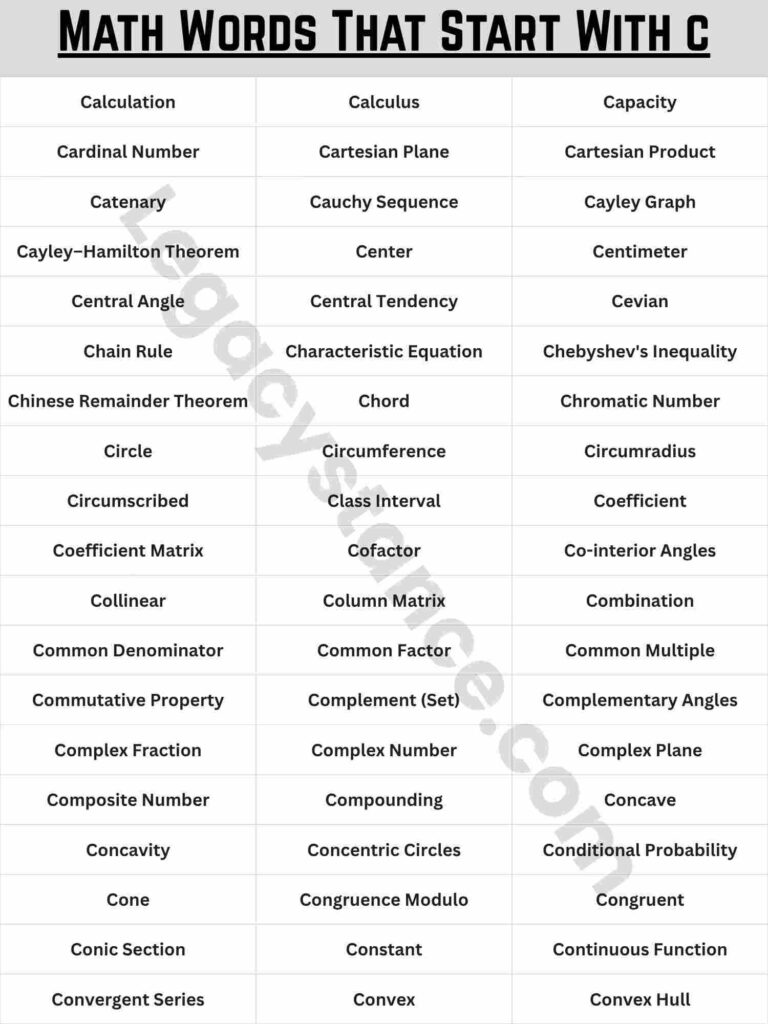
- Calculation
- Calculus
- Capacity
- Cardinal Number
- Cartesian Plane
- Cartesian Product
- Catenary
- Cauchy Sequence
- Cayley Graph
- Cayley–Hamilton Theorem
- Center
- Centimeter
- Central Angle
- Central Tendency
- Cevian
- Chain Rule
- Characteristic Equation
- Chebyshev’s Inequality
- Chinese Remainder Theorem
- Chord
- Chromatic Number
- Circle
- Circumference
- Circumradius
- Circumscribed
- Class Interval
- Coefficient
- Coefficient Matrix
- Cofactor
- Co-interior Angles
- Collinear
- Column Matrix
- Combination
- Common Denominator
- Common Factor
- Common Multiple
- Commutative Property
- Complement (Set)
- Complementary Angles
- Complex Fraction
- Complex Number
- Complex Plane
- Composite Number
- Compounding
- Concave
- Concavity
- Concentric Circles
- Conditional Probability
- Cone
- Congruence Modulo
- Congruent
- Conic Section
- Constant
- Continuous Function
- Convergent Series
- Convex
- Convex Hull
- Coordinate
- Coordinate Geometry
- Coplanar
- Corollary
- Correlation
- Corresponding Angles
- Cosecant
- Cosine
- Cotangent
- Counting Number
- Covariance
- Cross Product
- Cube
- Cube Root
- Cubic Equation
- Cubic Function
- Cumulative Frequency
- Curl
- Cyclic Quadrilateral
- Cycloid
- Cylinder
- Cayley Table
- Centroid
- Circumcenter
- Class Width
- Closed Set
- Closed Interval
- Codomain
- Collinear Points
- Column Vector
- Concave Polygon
- Conditional Statement
- Conjugate
- Consecutive Integers
- Constant Function
- Continuous Data
- Contrapositive
- Convergence
- Convex Polygon
- Coordinate Plane
- Corollary of Pythagoras
- Counting Principle
- Critical Point
- Cross-Multiplication
- Cumulative Distribution Function
- Cyclic Group
- Cylindrical Coordinates
- Cartesian Coordinates
- Central Limit Theorem
- Chebyshev Polynomial
- Closed Form Expression
- Coefficient of Variation
- Complementary Events
- Complete Graph
- Composite Function
- Compound Interest
- Compound Inequality
- Conditional Equation
- Converse
- Convex Set
- Coprime Numbers
- Counterexample
- Cramer’s Rule
- Critical Value
- Cubic Root Function
- Cumulative Relative Frequency
- Cyclic Notation
- Cylindrical Surface
- Carry (in arithmetic)
- Celsius Scale
- Centesimal Angle
- Chord Length
- Closed Curve
- Coefficient of Determination
- Column Space
- Complementary Function
- Compound Event
- Concave Up / Concave Down
Common Math Words That Start With C
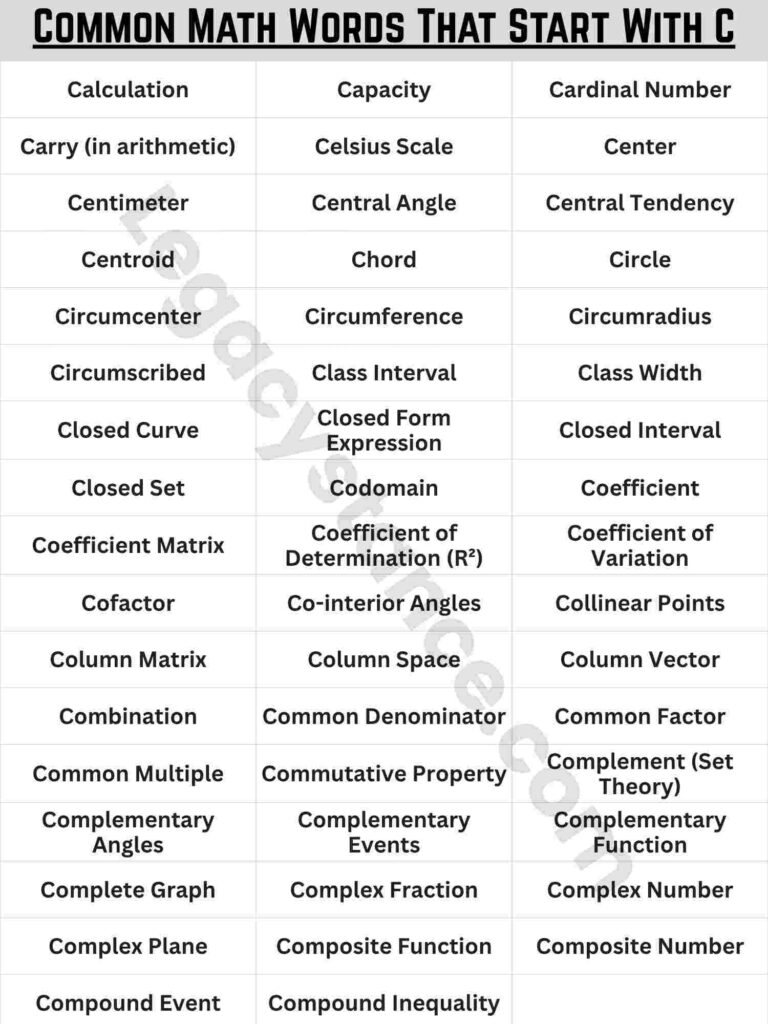
Calculation
Meaning: Using math operations to reach an answer.
Example: The cashier’s calculation showed a total of Rs. 650.
Why it matters: It is the most basic action in all of mathematics.
Capacity
Meaning: The maximum amount a container can hold, measured in liters or milliliters.
Example: The bottle has a capacity of 2 liters.
Why it matters: Appears constantly in measurement and real-life word problems.
Cardinal Number
Meaning: A number that shows how many items are in a group
Example: There are 9 students — the cardinal number is 9.
Why it matters: The foundation of counting and set theory.
Carry (in arithmetic)
Meaning: When the sum of digits in a column exceeds 9, the extra value is carried to the next column.
Example: Adding 7 + 8 = 15, so you write 5 and carry 1.
Why it matters: Essential for multi-digit addition and multiplication.
Celsius Scale
Meaning: A temperature measurement scale where water freezes at 0° and boils at 100°.
Example: 37°C is normal human body temperature.
Why it matters: Used in measurement problems involving temperature conversion.
Center
Meaning: The exact middle point of a circle or sphere.
Example: All radii of a circle begin at the center.
Why it matters: Central to area, circumference, and arc length calculations.
Centimeter
Meaning: A unit of length equal to one-hundredth of a meter.
Example: A standard pencil is about 19 centimeters long.
Why it matters: Used in nearly every measurement and perimeter problem.
Central Angle
Meaning: An angle with its vertex at the center of a circle, with both arms reaching the circumference.
Example: A 90° central angle cuts out one quarter of a circle.
Why it matters: Directly connected to arc length and sector area.
Central Tendency
Meaning: A single value summarizing a data set — mean, median, or mode.
Example: For {4, 6, 8, 10}, the mean is 7.
Why it matters: Without it, statistics cannot summarize large data sets.
Centroid
Meaning: The point where all three medians of a triangle meet — its geometric center of gravity.
Example: If you balanced a triangle on a pin, the pin would sit at the centroid.
Why it matters: Used in geometry proofs and engineering design.
Chord
Meaning: A line segment connecting two points on a circle’s circumference.
Example: A diameter is the longest possible chord.
Why it matters: Core to circle theorem problems.
Circle
Meaning: A flat round shape where every edge point is the same distance from the center.
Example: A coin, wheel, and clock face are all circles.
Why it matters: Foundation for circumference, area, arc, and trigonometry.
Circumcenter
Meaning: The point equidistant from all three vertices of a triangle — the center of its circumscribed circle.
Example: The circumcenter can fall inside, outside, or on the triangle depending on its angles.
Why it matters: Used in triangle geometry and circle theorems.
Circumference
Meaning: The total distance around a circle. Formula: C = 2πr.
Example: A circle with radius 7 cm has circumference ≈ 44 cm.
Why it matters: Used in design, engineering, and every circle problem in school math.
Circumradius
Meaning: The radius of the circle that passes through all vertices of a polygon.
Example: For a triangle with sides a, b, c and area A: R = abc / 4A.
Why it matters: Appears in advanced triangle geometry.
Circumscribed
Meaning: A shape drawn around another shape, touching all its outer vertices.
Example: A circle circumscribed around a triangle touches all three corners.
Why it matters: Used in geometric constructions and proofs.
Class Interval
Meaning: A range used to group data in a frequency table.
Example: 0–10, 11–20, 21–30 are class intervals.
Why it matters: Makes large data sets manageable in statistics.
Class Width
Meaning: The size of each class interval in a frequency table.
Example: In the interval 10–20, the class width is 10.
Why it matters: Needed to draw histograms accurately.
Closed Curve
Meaning: A curve that begins and ends at the same point, with no openings.
Example: A circle and an ellipse are both closed curves.
Why it matters: Used in topology and shape classification.
Closed Form Expression
Meaning: A mathematical expression that gives an exact answer using standard operations — no infinite series or approximation.
Example: The sum of the first n natural numbers has the closed form: n(n+1)/2.
Why it matters: Closed forms make calculations fast and exact.
Closed Interval
Meaning: A set of numbers including both endpoints, written as [a, b].
Example: [2, 7] includes 2, 7, and every number between them.
Why it matters: Used in calculus and real analysis to define domains.
Closed Set
Meaning: A set that contains all its limit points.
Example: The set [0, 1] is closed because it includes both boundary points.
Why it matters: Fundamental in real analysis and topology.
Codomain
Meaning: The set of all possible output values a function could produce.
Example: For f(x) = x², the codomain might be all real numbers, even though only non-negatives are actually produced.
Why it matters: Helps distinguish range from codomain in function theory.
Coefficient
Meaning: The number placed directly in front of a variable.
Example: In 7x + 3, the coefficient of x is 7.
Why it matters: Misreading coefficients causes consistent errors in algebra.
Coefficient Matrix
Meaning: A matrix formed from the coefficients of variables in a system of equations.
Example: For 2x + 3y = 5 and x − y = 1, the coefficient matrix is [[2,3],[1,−1]].
Why it matters: Central to solving systems of equations using matrices.
Coefficient of Determination (R²)
Meaning: A value between 0 and 1 showing how well a regression model fits the data.
Example: R² = 0.95 means the model explains 95% of the variation in data.
Why it matters: Used in statistics to evaluate prediction models.
Coefficient of Variation
Meaning: The ratio of standard deviation to the mean, expressed as a percentage.
Example: A CV of 10% means data is relatively consistent around the mean.
Why it matters: Allows comparison of variability between data sets with different units.
Cofactor
Meaning: The signed minor of an element in a matrix, used in determinant calculations.
Example: Cofactors are used in matrix inversion and Cramer’s rule.
Why it matters: Essential in linear algebra.
Co-interior Angles
Meaning: Angles on the same side of a transversal between two parallel lines. They add up to 180°.
Example: If one co-interior angle is 110°, the other is 70°.
Why it matters: Tested in parallel line geometry problems.
Collinear Points
Meaning: Three or more points that all lie on the same straight line.
Example: A(1,2), B(2,4), C(3,6) are collinear — they share the same line.
Why it matters: Used to verify geometric alignments in coordinate problems.
Column Matrix
Meaning: A matrix with only one column and multiple rows.
Example: [[3],[5],[7]] is a column matrix.
Why it matters: Used in matrix multiplication and linear transformations.
Column Space
Meaning: The set of all possible outputs of a matrix when multiplied by a vector.
Example: The column space tells you which vectors a linear transformation can reach.
Why it matters: Core concept in linear algebra and systems of equations.
Column Vector
Meaning: A vector written vertically as a single column of numbers.
Example: The vector (3, 4) written vertically is a column vector.
Why it matters: Standard notation in matrix algebra.
Combination
Meaning: A selection of items where order does not matter.
Example: Choosing 2 players from 5 gives 10 combinations.
Why it matters: Used in probability, statistics, and real planning problems.
Common Denominator
Meaning: A shared multiple of the denominators of two or more fractions.
Example: For 1/3 and 1/4, the common denominator is 12.
Why it matters: Required to add or subtract fractions.
Common Factor
Meaning: A number that divides two or more numbers exactly.
Example: Common factors of 12 and 18 are 1, 2, 3, 6.
Why it matters: Used to simplify fractions and find HCF.
Common Multiple
Meaning: A number that is a multiple of two or more numbers.
Example: 12 is a common multiple of 3 and 4.
Why it matters: Foundation of LCM problems.
Commutative Property
Meaning: Swapping the order of numbers in addition or multiplication does not change the result.
Example: 5 + 9 = 9 + 5 and 4 × 7 = 7 × 4.
Why it matters: Simplifies mental math and builds algebraic reasoning.
Complement (Set Theory)
Meaning: All elements in the universal set that are not in the given set.
Example: If A = {1,2,3} and U = {1,2,3,4,5}, the complement of A is {4,5}.
Why it matters: Used in probability and logic.
Complementary Angles
Meaning: Two angles that add up to exactly 90°.
Example: 35° and 55° are complementary.
Why it matters: Found in right triangle problems and geometric proofs.
Complementary Events
Meaning: Two events where one must happen — their probabilities add up to 1.
Example: Rolling an even number and rolling an odd number are complementary events on a die.
Why it matters: Simplifies probability calculations.
Complementary Function
Meaning: The solution to a homogeneous differential equation, forming part of the general solution.
Example: For y” + y = cos(x), the complementary function solves y” + y = 0.
Why it matters: Used in solving differential equations.
Complete Graph
Meaning: A graph where every vertex is connected to every other vertex.
Example: A complete graph with 4 vertices has 6 edges.
Why it matters: Used in graph theory and network analysis.
Complex Fraction
Meaning: A fraction where the numerator, denominator, or both also contain fractions.
Example: (1/2) ÷ (3/4) is a complex fraction.
Why it matters: Appears in algebra and rational expressions.
Complex Number
Meaning: A number written as a + bi, where a is real and b is the imaginary component.
Example: 3 + 4i is a complex number.
Why it matters: Used in electrical engineering, quantum physics, and advanced algebra.
Complex Plane
Meaning: A 2D plane for plotting complex numbers. Real part on x-axis, imaginary part on y-axis.
Example: The number 3 + 4i sits at point (3, 4) on the complex plane.
Why it matters: Visualizes complex number operations geometrically.
Composite Function
Meaning: A function built by applying one function to the output of another. Written as f(g(x)).
Example: If f(x) = x² and g(x) = x + 1, then f(g(x)) = (x+1)².
Why it matters: Core to calculus and function analysis.
Composite Number
Meaning: A whole number greater than 1 with more than two factors.
Example: 12 is composite — divisible by 1, 2, 3, 4, 6, 12.
Why it matters: Central to prime factorization and number theory.
Compound Event
Meaning: A probability event made of two or more simple events.
Example: Rolling a 3 and flipping heads is a compound event.
Why it matters: Used in multi-step probability problems.
Compound Inequality
Meaning: Two inequalities joined by “and” or “or.”
Example: 3 < x ≤ 10 is a compound inequality.
Why it matters: Used to define ranges and solve interval problems.
Compound Interest
Meaning: Interest calculated on both the original amount and previously earned interest.
Example: Rs. 1,000 at 10% annual compound interest becomes Rs. 1,100 after year 1 and Rs. 1,210 after year 2.
Why it matters: Essential in financial mathematics and real-world banking.
Compounding
Meaning: The process of repeatedly applying a percentage growth to a growing total.
Example: Compounding monthly gives higher returns than compounding annually.
Why it matters: Explains exponential growth in finance.
Concave
Meaning: A shape that curves inward, like a cave.
Example: A crescent moon is concave on one side.
Why it matters: Tested in shape classification and polygon problems.
Concave Polygon
Meaning: A polygon with at least one interior angle greater than 180°.
Example: A star shape is a concave polygon.
Why it matters: Contrasted with convex polygons in geometry.
Concave Up / Concave Down
Meaning: Describes the direction a curve bends. Concave up opens like a bowl. Concave down opens like an arch.
Example: y = x² is concave up. y = −x² is concave down.
Why it matters: Used in calculus to identify maximum and minimum points.
Concavity
Meaning: The property of a curve describing whether it bends upward or downward.
Example: At a minimum point, concavity switches from concave down to concave up.
Why it matters: Used to classify turning points in calculus.
Concentric Circles
Meaning: Circles sharing the same center but with different radii.
Example: A dartboard has concentric circles.
Why it matters: Appear in annular area problems.
Conditional Equation
Meaning: An equation that is true only for specific values of the variable.
Example: 2x + 3 = 7 is conditional — it’s only true when x = 2.
Why it matters: Distinguishes from identities, which are always true.
Conditional Probability
Meaning: The probability of one event occurring given that another has already occurred.
Example: P(A|B) means the probability of A given B already happened.
Why it matters: Used in risk analysis, medical testing, and statistics.
Conditional Statement
Meaning: A logical statement in the form “if P, then Q.”
Example: “If a shape is a square, then it has four equal sides.”
Why it matters: Foundation of mathematical proof and logic.
Cone
Meaning: A 3D shape with a circular base narrowing to a single apex point.
Example: An ice cream cone is the most familiar example.
Why it matters: Volume and surface area of cones appear in every mensuration unit.
Congruence Modulo
Meaning: Two numbers are congruent modulo n if they leave the same remainder when divided by n.
Example: 17 ≡ 5 (mod 6) because both leave remainder 5 when divided by 6.
Why it matters: Used in number theory and cryptography.
Congruent
Meaning: Two shapes are congruent if they are identical in size and shape.
Example: Two triangles with equal sides and angles are congruent.
Why it matters: Core to geometric proofs.
Conic Section
Meaning: A curve produced by slicing a cone — circle, ellipse, parabola, or hyperbola.
Example: A satellite dish follows a parabolic conic section.
Why it matters: Used in astronomy, optics, and advanced geometry.
Conjugate
Meaning: For a complex number a + bi, the conjugate is a − bi. For surds, the conjugate of (a + √b) is (a − √b).
Example: The conjugate of 3 + 4i is 3 − 4i.
Why it matters: Used to simplify expressions with surds and complex numbers.
Consecutive Integers
Meaning: Integers that follow each other with no gaps.
Example: 5, 6, 7, 8 are consecutive integers.
Why it matters: Used in algebraic word problems involving sums of sequences.
Constant
Meaning: A value in an expression that does not change.
Example: In y = 5x + 9, the number 9 is the constant.
Why it matters: Separating constants from variables is the first step in solving equations.
Constant Function
Meaning: A function whose output is the same for every input.
Example: f(x) = 7 produces 7 no matter what x is.
Why it matters: Represents horizontal lines on a graph.
Continuous Data
Meaning: Data that can take any value within a range, including decimals.
Example: Height, weight, and temperature are continuous data.
Why it matters: Determines which statistical methods and graphs are appropriate.
Continuous Function
Meaning: A function with no breaks, jumps, or holes in its graph.
Example: f(x) = x² is continuous — you can draw it without lifting your pen.
Why it matters: Continuity is a requirement for applying many calculus theorems.
Contrapositive
Meaning: The logical equivalent of a conditional statement, formed by negating and reversing both parts.
Example: Contrapositive of “If it rains, the ground is wet” is “If the ground is not wet, it did not rain.”
Why it matters: Used in mathematical proof writing.
Convergence
Meaning: A sequence or series converges when its terms approach a fixed value.
Example: 1, 1/2, 1/4, 1/8… converges toward 0.
Why it matters: Central concept in calculus and analysis.
Convergent Series
Meaning: An infinite series whose total sum approaches a finite number.
Example: 1 + 1/2 + 1/4 + 1/8 + … converges to 2.
Why it matters: Used in physics, signal processing, and calculus.
Converse
Meaning: The reverse of a conditional statement — swapping “if” and “then.”
Example: Converse of “If x = 3, then x² = 9” is “If x² = 9, then x = 3.”
Why it matters: Not every converse is true — understanding this prevents logic errors.
Convex
Meaning: A shape that bulges outward with all interior angles less than 180°.
Example: A regular hexagon is convex.
Why it matters: Contrasted with concave in polygon classification.
Convex Hull
Meaning: The smallest convex shape that contains a given set of points.
Example: Imagine stretching a rubber band around scattered pins — the shape it forms is the convex hull.
Why it matters: Used in computational geometry and data science.
Convex Polygon
Meaning: A polygon where all interior angles are less than 180° and no sides push inward.
Example: A regular pentagon is a convex polygon.
Why it matters: Standard shape classification in geometry.
Convex Set
Meaning: A set where the line segment between any two points in the set stays entirely within the set.
Example: A filled circle is a convex set.
Why it matters: Used in optimization and linear programming.
Coordinate
Meaning: An ordered pair (x, y) that identifies a point’s exact location on a plane.
Example: (4, −3) is 4 units right and 3 units below the origin.
Why it matters: The language of every graph, map, and geometric proof in coordinate geometry.
Coordinate Geometry
Meaning: The branch of math combining algebra and geometry using a coordinate plane.
Example: Finding the distance between two points using their coordinates.
Why it matters: Connects algebraic equations to geometric shapes visually.
Coordinate Plane
Meaning: A flat surface defined by two perpendicular number lines — the x-axis and y-axis.
Example: All graphs in school mathematics are drawn on the coordinate plane.
Why it matters: The visual foundation of algebra and geometry combined.
Coprime Numbers
Meaning: Two numbers whose only common factor is 1.
Example: 8 and 15 are coprime — they share no common factors.
Why it matters: Used in fractions, number theory, and the Chinese Remainder Theorem.
Coplanar
Meaning: Points or lines that all lie on the same flat plane.
Example: Three points always form a plane, but a fourth may not be coplanar with them.
Why it matters: Important in 3D geometry and vector problems.
Corollary
Meaning: A result that follows directly and easily from a proven theorem.
Example: From the theorem that all angles in a triangle sum to 180°, a corollary is that a triangle can have at most one obtuse angle.
Why it matters: Corollaries extend theorems without needing separate proofs.
Correlation
Meaning: A statistical measure showing the direction and strength of a relationship between two variables.
Example: Hours studied and exam scores tend to have a strong positive correlation.
Why it matters: Used in research, economics, and data science.
Corresponding Angles
Meaning: Angles in the same position when a transversal crosses parallel lines. They are always equal.
Example: Both angles sitting above-left of each intersection are corresponding.
Why it matters: Used to prove lines are parallel and solve geometric problems.
Cosecant
Meaning: The reciprocal of sine. cosec(θ) = 1/sin(θ).
Example: cosec(30°) = 1 ÷ 0.5 = 2.
Why it matters: One of the six core trigonometric ratios.
Cosine
Meaning: In a right triangle, the ratio of the adjacent side to the hypotenuse.
Example: cos(60°) = 0.5.
Why it matters: Used in navigation, engineering, and wave analysis.
Cotangent
Meaning: The reciprocal of tangent. cot(θ) = cos(θ) / sin(θ).
Example: cot(45°) = 1.
Why it matters: One of the six core trigonometric ratios.
Counting Number
Meaning: Positive whole numbers starting from 1, used for counting: 1, 2, 3, 4…
Example: You use counting numbers every time you count objects.
Why it matters: The most basic form of number in mathematics.
Counting Principle (Fundamental)
Meaning: If one event has m outcomes and a second has n outcomes, together they have m × n outcomes.
Example: 3 shirt colors × 4 pant colors = 12 outfit combinations.
Why it matters: The backbone of combinatorics and probability counting.
Covariance
Meaning: A measure of how two variables change together — positive, negative, or zero.
Example: Study time and test scores have positive covariance.
Why it matters: Used in finance and statistics to measure joint variability.
Cramer’s Rule
Meaning: A method using determinants to solve systems of linear equations.
Example: For a 2×2 system, each variable is solved using a ratio of two determinants.
Why it matters: Provides a formula-based alternative to elimination methods.
Critical Point
Meaning: A point on a graph where the derivative equals zero or does not exist — often a maximum, minimum, or saddle point.
Example: For f(x) = x², the critical point is at x = 0.
Why it matters: Central to optimization problems in calculus.
Critical Value
Meaning: A threshold value in statistics used to decide whether to reject a hypothesis.
Example: In a z-test at 95% confidence, the critical value is ±1.96.
Why it matters: Used in hypothesis testing and confidence intervals.
Cross-Multiplication
Meaning: A method to solve proportions by multiplying diagonally across an equality.
Example: To solve x/3 = 4/6, cross-multiply: 6x = 12, so x = 2.
Why it matters: Quick and reliable method for solving ratio and proportion problems.
Cross Product
Meaning: A vector operation on two 3D vectors that produces a third vector perpendicular to both.
Example: If A = (1,0,0) and B = (0,1,0), the cross product is (0,0,1).
Why it matters: Used in physics for torque and in graphics for surface normals.
Cube
Meaning: In geometry, a 3D solid with six equal square faces. In algebra, raising a number to the power of 3.
Example (shape): A dice is a cube.
Example (algebra): 5³ = 125.
Why it matters: Cube calculations appear in volume and algebraic expressions.
Cube Root
Meaning: The value that, when multiplied by itself three times, gives the original number.
Example: ∛64 = 4, because 4 × 4 × 4 = 64.
Why it matters: Used in volume problems and higher-level algebra.
Cubic Equation
Meaning: An equation where the highest power of the variable is 3.
Example: x³ − 6x² + 11x − 6 = 0.
Why it matters: Models real-world phenomena including profit curves and physics problems.
Cubic Function
Meaning: A function of the form f(x) = ax³ + bx² + cx + d.
Example: f(x) = 2x³ − x + 5.
Why it matters: Produces characteristic S-shaped curves on a graph.
Cubic Root Function
Meaning: A function that outputs the cube root of the input: f(x) = ∛x.
Example: f(8) = 2.
Why it matters: Inverse of the cubic function; used in algebra and graphing.
Cumulative Distribution Function (CDF)
Meaning: A function that gives the probability that a variable takes a value less than or equal to a specific number.
Example: CDF at x = 5 gives the probability that the outcome is 5 or less.
Why it matters: Foundation of probability distributions in statistics.
Cumulative Frequency
Meaning: A running total of frequencies across class intervals in a data table.
Example: If 5 students scored 0–10 and 8 scored 11–20, cumulative frequency at 11–20 is 13.
Why it matters: Used to draw ogive curves and find medians from grouped data.
Cumulative Relative Frequency
Meaning: The cumulative frequency expressed as a proportion of the total.
Example: If 13 out of 40 students fall in the first two classes, cumulative relative frequency is 0.325.
Why it matters: Used in percentile and distribution analysis.
Curl
Meaning: A vector operator measuring the rotation of a vector field at a point.
Example: Curl describes how fast a tiny paddle wheel would spin if placed in a flowing fluid.
Why it matters: Used in fluid dynamics and electromagnetic theory.
Cyclic Group
Meaning: A group in abstract algebra generated by a single element, where repeated application of the operation cycles through all elements.
Example: The integers modulo 5 under addition form a cyclic group.
Why it matters: One of the most fundamental structures in group theory.
Cyclic Notation
Meaning: A shorthand for writing permutations by showing which elements cycle into each other.
Example: (1 2 3) means 1→2, 2→3, 3→1.
Why it matters: Used in abstract algebra and permutation groups.
Cyclic Quadrilateral
Meaning: A four-sided polygon where all four vertices lie on a single circle.
Example: The opposite angles of a cyclic quadrilateral always add up to 180°.
Why it matters: A frequently tested result in circle theorem problems.
Cycloid
Meaning: The curve traced by a point on the rim of a rolling circle.
Example: Mark a dot on a bicycle tire — the path it traces as the wheel rolls is a cycloid.
Why it matters: Used in advanced geometry and calculus of variations.
Cylinder
Meaning: A 3D shape with two identical circular ends connected by a curved surface.
Example: A tin can is a cylinder.
Why it matters: Volume and surface area of cylinders appear in every mensuration chapter.
Cylindrical Coordinates
Meaning: A 3D coordinate system using radius, angle, and height instead of x, y, z.
Example: A point at radius 3, angle 90°, height 5 is written as (3, 90°, 5).
Why it matters: Simplifies equations involving cylindrical or rotational symmetry.
Cylindrical Surface
Meaning: The curved outer surface of a cylinder, excluding the circular ends.
Example: The label on a tin can wraps around the cylindrical surface.
Why it matters: Calculated separately from the full surface area in some problems.
Advanced Terms
Calculus
Meaning: The branch studying continuous change through differentiation (rates) and integration (accumulation).
Example: Calculus calculates a car’s exact speed at any instant, not just average speed.
Real-World Use: Physics, engineering, economics, medicine.
Cartesian Coordinates
Meaning: The system of locating points using ordered pairs (x, y) or triples (x, y, z).
Example: (2, 3) is 2 units right and 3 units up from the origin.
Why it matters: The standard system for all coordinate geometry.
Cartesian Product
Meaning: For two sets A and B, the set of all ordered pairs (a, b).
Example: If A = {1, 2} and B = {x, y}, then A × B = {(1,x), (1,y), (2,x), (2,y)}.
Why it matters: Foundation of relations and functions in set theory.
Catenary
Meaning: The curve a hanging chain or cable naturally forms under gravity. Mathematically: y = cosh(x).
Example: Power lines and the Gateway Arch in St. Louis follow a catenary shape.
Why it matters: Appears in structural engineering and advanced geometry.
Cauchy Sequence
Meaning: A sequence where terms become arbitrarily close to each other as the sequence progresses.
Example: 1, 1.4, 1.41, 1.414, 1.4142… is a Cauchy sequence approaching √2.
Why it matters: Used to prove the existence of limits in real analysis.
Cayley Graph
Meaning: A diagram representing a mathematical group using its elements and generators as a directed graph.
Example: The cyclic group Z₄ produces a square-shaped Cayley graph.
Why it matters: Used in abstract algebra and group theory.
Cayley–Hamilton Theorem
Meaning: Every square matrix satisfies its own characteristic equation.
Example: If the characteristic equation of matrix A is λ² − 5λ + 6 = 0, then A² − 5A + 6I = 0.
Why it matters: Used to compute matrix powers efficiently in linear algebra.
Central Limit Theorem
Meaning: As sample size grows, the distribution of sample means approaches a normal distribution, regardless of the original population’s distribution.
Example: Even if individual exam scores are skewed, the average of many samples follows a bell curve.
Why it matters: One of the most important theorems in all of statistics.
Centesimal Angle
Meaning: An angle measured in gradians, where a right angle equals 100 gradians and a full circle equals 400 gradians.
Example: 90° = 100 gradians in centesimal measure.
Why it matters: Used in surveying and some European engineering systems.
Cevian
Meaning: A line segment from a vertex of a triangle to any point on the opposite side.
Example: Medians, altitudes, and angle bisectors are all special types of cevians.
Why it matters: Ceva’s Theorem uses cevians to prove concurrence of lines in triangles.
Chain Rule
Meaning: A calculus rule for differentiating composite functions: d/dx[f(g(x))] = f'(g(x)) × g'(x).
Example: Differentiating sin(x²) gives cos(x²) × 2x.
Why it matters: One of the most-used differentiation techniques in calculus.
Characteristic Equation
Meaning: An equation derived from a matrix to find its eigenvalues: det(A − λI) = 0.
Example: Used to find eigenvalues that describe transformation directions in linear algebra.
Why it matters: Central to matrix analysis and differential equations.
Chebyshev Polynomial
Meaning: A sequence of orthogonal polynomials with applications in approximation theory.
Example: Chebyshev polynomials minimize the maximum error in polynomial approximations.
Why it matters: Used in numerical analysis and signal processing.
Chebyshev’s Inequality
Meaning: A rule stating that for any data set, no more than 1/k² of values lie more than k standard deviations from the mean.
Example: At least 75% of data lies within 2 standard deviations of the mean.
Why it matters: Works for any distribution — no assumption of normality needed.
Chinese Remainder Theorem
Meaning: A theorem that guarantees a unique solution when solving simultaneous congruences with coprime moduli.
Example: Find x such that x ≡ 2 (mod 3) and x ≡ 3 (mod 5) — the theorem gives x = 8.
Why it matters: Used in cryptography and computer science.
Chord Length
Meaning: The straight-line distance between two points on a circle’s circumference.
Example: Chord length = 2r × sin(θ/2), where θ is the central angle.
Why it matters: Used in circle geometry and engineering design.
Chromatic Number
Meaning: The minimum number of colors needed to color a graph’s vertices so no two connected vertices share a color.
Example: A triangle graph needs 3 colors — its chromatic number is 3.
Why it matters: Used in scheduling, map coloring, and graph theory.
Rarely Taught But Genuinely Math Words That Start With C
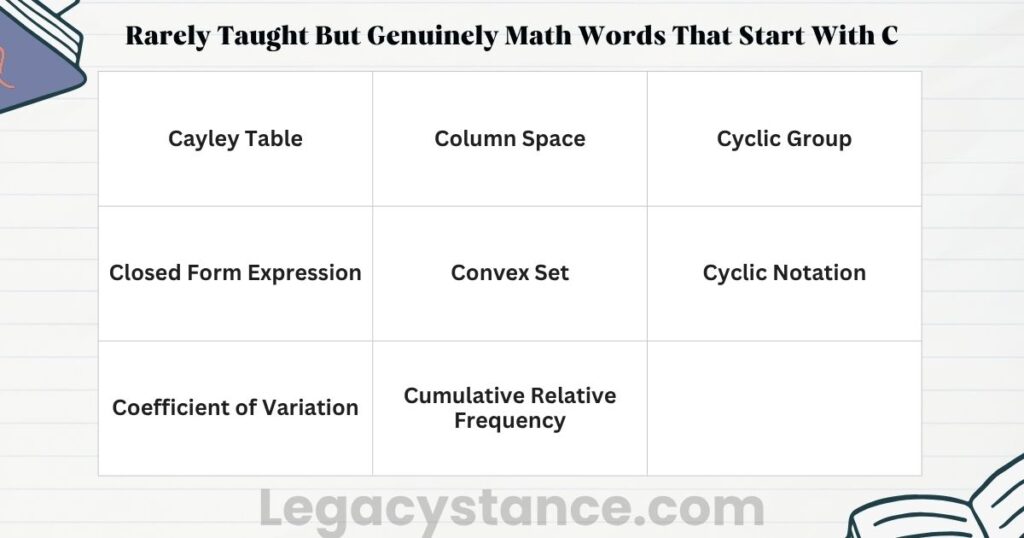
Cayley Table — A multiplication table showing the results of all combinations of group elements. Used in abstract algebra to analyze group structure.
Closed Form Expression — A mathematical expression giving an exact answer without approximation. For example, the sum of the first n integers has the closed form n(n+1)/2.
Coefficient of Variation — Standard deviation divided by the mean, expressed as a percentage. Useful when comparing variability between different data sets.
Column Space — The set of all possible outputs (column vectors) of a matrix. Used in linear algebra to understand the reach of a linear transformation.
Convex Set — A set where the line connecting any two points in the set stays entirely within the set. A filled circle is a convex set; a crescent shape is not.
Cumulative Relative Frequency — Cumulative frequency expressed as a fraction or percentage of total data. Used in percentile calculations.
Cyclic Group — A group in abstract algebra generated entirely by one element through repeated operation. Integers mod n form cyclic groups.
Cyclic Notation — Shorthand for writing permutations by listing the cycle of elements. (1 2 3) means 1 maps to 2, 2 maps to 3, and 3 maps back to 1.
Subject-by-Subject Reference Math Words That Start With C
Geometry: Center, Centroid, Circumcenter, Chord, Circle, Circumference, Circumradius, Circumscribed, Closed Curve, Co-interior Angles, Collinear, Concave, Concave Polygon, Concentric Circles, Cone, Congruent, Conic Section, Convex, Convex Polygon, Coplanar, Corresponding Angles, Cyclic Quadrilateral, Cylinder, Cevian, Cycloid
Algebra: Coefficient, Coefficient Matrix, Cofactor, Composite Function, Complex Number, Complex Plane, Conjugate, Constant, Constant Function, Cubic Equation, Cubic Function, Cubic Root Function, Characteristic Equation
Statistics & Probability: Central Tendency, Chebyshev’s Inequality, Chebyshev Polynomial, Class Interval, Class Width, Coefficient of Determination, Coefficient of Variation, Complementary Events, Compound Event, Conditional Probability, Correlation, Covariance, Critical Value, Cumulative Distribution Function, Cumulative Frequency, Cumulative Relative Frequency, Central Limit Theorem
Trigonometry: Cosecant, Cosine, Cotangent, Chord Length, Centesimal Angle
Calculus: Calculus, Chain Rule, Concavity, Concave Up / Concave Down, Continuous Function, Convergence, Convergent Series, Critical Point, Cross Product, Curl, Composite Function
Number Theory: Cardinal Number, Chinese Remainder Theorem, Common Factor, Common Multiple, Composite Number, Congruence Modulo, Coprime Numbers, Counting Number, Counting Principle
Linear Algebra: Coefficient Matrix, Cofactor, Column Matrix, Column Space, Column Vector, Cramer’s Rule, Cayley–Hamilton Theorem, Characteristic Equation
Set Theory & Logic: Cartesian Product, Closed Set, Closed Interval, Codomain, Complement, Conditional Statement, Contrapositive, Converse, Convex Set
Graph Theory: Cayley Graph, Chromatic Number, Complete Graph, Cyclic Group, Cyclic Notation
Financial Math: Compounding, Compound Interest, Compound Inequality
Commonly Confused C-Terms
Circumference vs. Perimeter
Both measure total boundary length. Circumference applies only to circles. Perimeter applies to polygons. Same concept, different shapes.
Combination vs. Permutation
A combination selects items when order doesn’t matter. A permutation selects items when order does matter. Choosing 3 people for a committee is a combination. Ranking those 3 people first, second, third is a permutation.
Complementary vs. Supplementary Angles
Complementary angles sum to 90°. Supplementary angles sum to 180°. Memory tip: “C” comes before “S,” and 90 comes before 180.
Congruent vs. Similar
Congruent shapes are equal in size and shape — identical. Similar shapes match in shape but not size. Two A4 papers are congruent. An A4 and an A5 are similar.
Concave vs. Convex
Concave caves inward. Convex bulges outward. A bowl is concave. A ball is convex.
Continuous vs. Discrete Data
Continuous data takes any value in a range (height, temperature). Discrete data takes only specific separate values (number of students, number of goals).
Convergent vs. Divergent Series
A convergent series approaches a finite sum. A divergent series grows without bound or oscillates forever. 1 + 1/2 + 1/4 +… converges to 2. 1 + 2 + 3 +… diverges.
Read also:
100+ Math Words That Start With A | With Meanings and Examples
100+ Math Words That Start With B | With Meanings and Examples
Frequently Asked Questions about Math Words That Start With C
What are the most common Math Words That Start With C?
Some of the most frequently used terms are calculation, capacity, cardinal number, coefficient, circle, circumference, coordinate, cosine, cube, and compound interest. These appear regularly in school math and everyday problem-solving.
Why is learning math vocabulary important?
Math vocabulary helps you understand instructions, solve problems correctly, and communicate mathematical ideas clearly. Knowing the meaning of key terms often makes difficult topics easier to learn.
Which Math Words That Start With C are used in geometry?
Geometry includes many C-words such as circle, chord, circumference, circumcenter, centroid, concentric circles, cone, convex polygon, concave polygon, and cyclic quadrilateral.
What are some advanced Math Words That Start With C?
Higher-level mathematics uses terms like Cauchy Sequence, Cayley Graph, Cayley–Hamilton Theorem, Central Limit Theorem, Chain Rule, Chebyshev’s Inequality, Chinese Remainder Theorem, and Curl.
How can students remember math terms more easily?
The best approach is to learn each word with a simple definition and a real example. Using the term while solving problems helps reinforce its meaning and makes it easier to remember long term.
Conclusion
Math words starting with “C” cover more ground than almost any other letter in the subject. From counting numbers that every first-grader uses, to curl and Cauchy sequences that advanced students meet in university, this list spans the full range of mathematical learning.
The common terms show up every week in class. The advanced terms become essential in higher studies. The rare terms show that mathematics keeps growing beyond any single textbook.
Knowing the language of math does not just help you answer questions — it helps you understand what questions are actually asking. That is the real value of vocabulary.