Learning Math Words That Start With F can make math easier to understand and use. From basic terms like factor and fraction to advanced ideas like Fourier transform and Fubini’s theorem, these words appear across many areas of mathematics.
This guide explains each term in clear language with practical examples and real-world connections. Whether you’re a student, parent, or teacher, you’ll find helpful definitions that make math vocabulary easier to remember and apply.
Quick List — All Math Words That Start With F
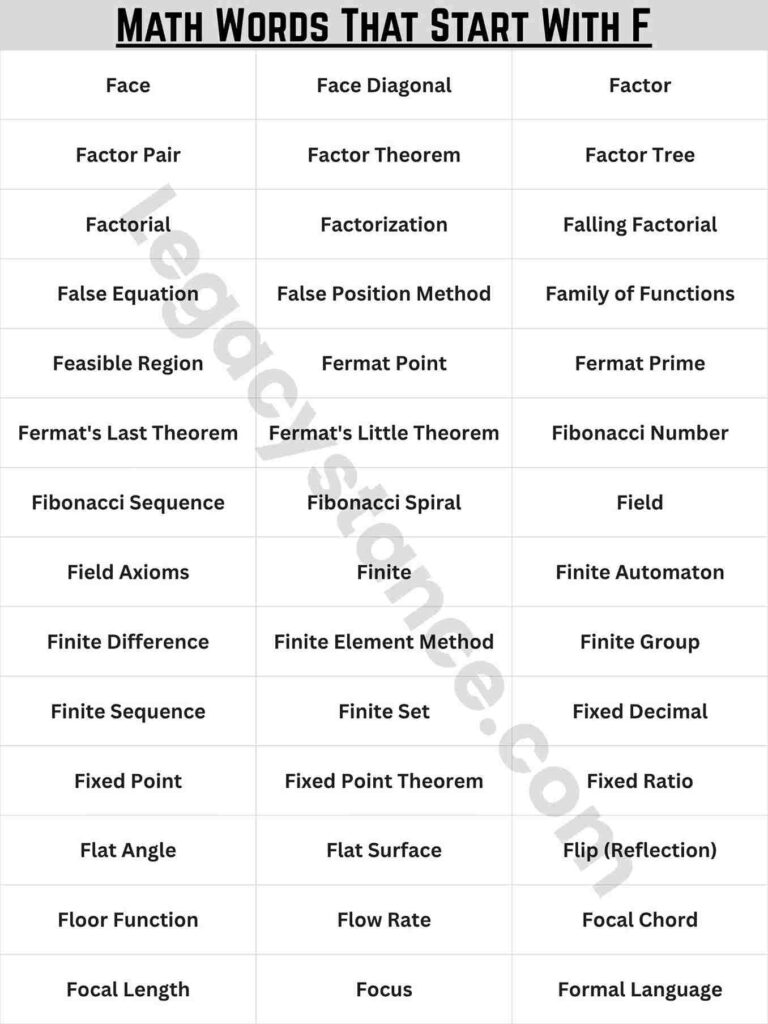
- Face
- Face Diagonal
- Factor
- Factor Pair
- Factor Theorem
- Factor Tree
- Factorial
- Factorization
- Falling Factorial
- False Equation
- False Position Method
- Family of Functions
- Feasible Region
- Fermat Point
- Fermat Prime
- Fermat’s Last Theorem
- Fermat’s Little Theorem
- Fibonacci Number
- Fibonacci Sequence
- Fibonacci Spiral
- Field
- Field Axioms
- Finite
- Finite Automaton
- Finite Difference
- Finite Element Method
- Finite Group
- Finite Sequence
- Finite Set
- Fixed Decimal
- Fixed Point
- Fixed Point Theorem
- Fixed Ratio
- Flat Angle
- Flat Surface
- Flip (Reflection)
- Floor Function
- Flow Rate
- Focal Chord
- Focal Length
- Focus
- Formal Language
- Formal Proof
- Formula
- Forward Difference
- Fourier Coefficient
- Fourier Series
- Fourier Transform
- Fractal
- Fraction
- Fraction Bar
- Fraction Simplification
- Fractional Exponent
- Fractional Part
- Fractions on a Number Line
- Free Variable
- Frequency
- Frequency Class
- Frequency Distribution
- Frequency Polygon
- Frequency Table
- Frenet Frame
- Frustum
- F-Distribution
- F-Test
- Fubini’s Theorem
- Full Angle
- Full Rotation
- Function
- Function Composition
- Function Domain
- Function Inverse
- Function Notation
- Function Range
- Fundamental Counting Principle
- Fundamental Theorem of Algebra
- Fundamental Theorem of Calculus
- Fuzzy Logic
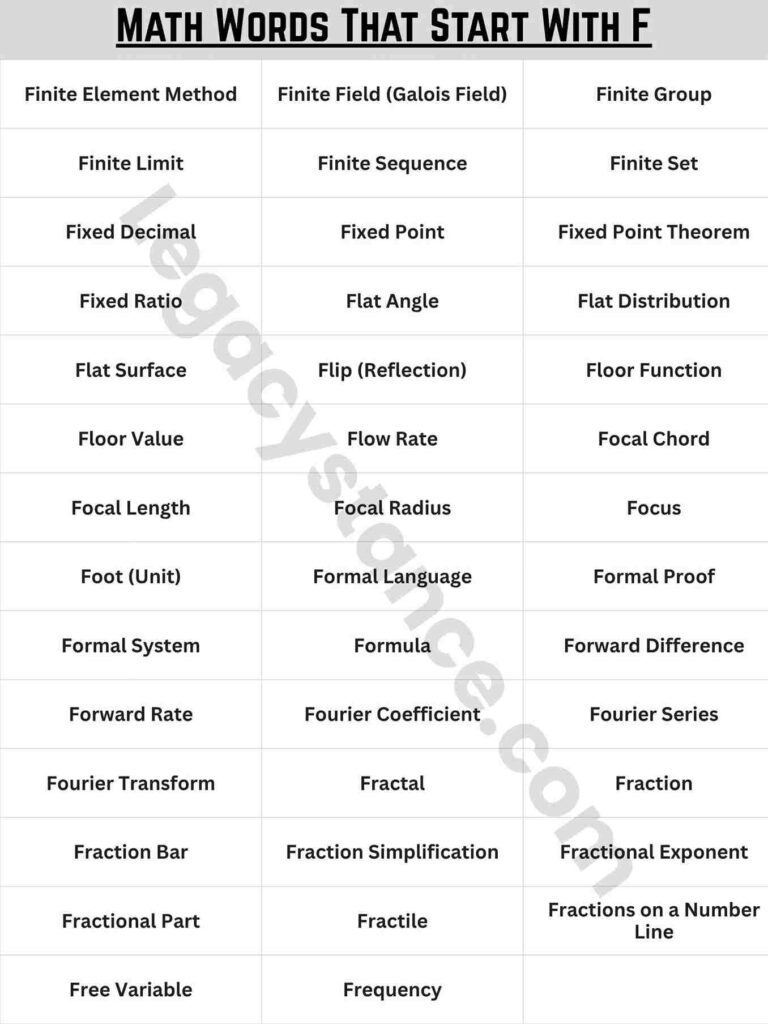
- Finite Limit
- Focal Radius
- Frequency Density
- Foot (unit)
- Frustum Volume Formula
- Forward Rate
- Frobenius Norm
- Frobenius Method
- Functional Equation
- Fibonacci Coding
- Finite Field (Galois Field)
- Floor Value
- Full Binary Tree
- Flat Distribution
- Frequency Ratio
- Force (vector quantity)
- Fractile
- Fundamental Domain
- Fundamental Matrix
- Fundamental Period
- Fuzzy Set
- Fixed-Point Iteration
- Frequency Histogram
- Face Value (place value context)
- Formal System
Common Math Words That Start With F
Face
Meaning: A flat surface forming part of the boundary of a 3D solid.
Example: A cube has 6 faces. A triangular prism has 5.
Why it matters: Face count connects directly to Euler’s formula — Faces + Vertices − Edges = 2.
Face Diagonal
Meaning: A diagonal drawn across one face of a 3D solid — not passing through the interior.
Example: On a box with a 3×4 face, the face diagonal = 5 (Pythagorean triple 3-4-5).
Why it matters: Used in surface area problems and 3D distance calculations.
Face Value
Meaning: The actual value of a digit in its own right, regardless of its position in a number.
Example: In 457, the face value of 5 is simply 5.
Why it matters: Distinguishes from place value — an important early arithmetic concept.
Factor
Meaning: A whole number that divides evenly into another number, leaving no remainder.
Example: Factors of 18 → 1, 2, 3, 6, 9, 18
Why it matters: Factoring underpins fractions, divisibility, and algebra.
Factor Pair
Meaning: Two numbers that multiply together to produce a given product.
Example: Factor pairs of 24 → (1, 24), (2, 12), (3, 8), (4, 6)
Why it matters: Builds multiplication fluency and leads directly into GCF and LCM work.
Factor Tree
Meaning: A diagram that breaks a number into its prime factors through branching steps.
Example: 36 → 6 × 6 → 2 × 3 × 2 × 3 → so 36 = 2² × 3²
Why it matters: Makes prime factorization visual and structured.
Factor Theorem
Meaning: (x − a) is a factor of polynomial f(x) if and only if f(a) = 0.
Example: f(x) = x² − 5x + 6. Test x = 2: f(2) = 4 − 10 + 6 = 0. So (x − 2) is a factor.
Why it matters: Connects polynomial zeros to factors — essential for solving higher-degree equations.
Factorial
Meaning: The product of all positive integers from 1 up to n, written n!
Example: 5! = 5 × 4 × 3 × 2 × 1 = 120. Note: 0! = 1 by definition.
Why it matters: Core to probability, permutations, and combinations.
Factorization
Meaning: Rewriting a number or algebraic expression as a product of its factors.
Example: x² − 9 = (x + 3)(x − 3)
Why it matters: Solving polynomial equations requires factorization as a primary technique.
Falling Factorial
Meaning: The product x(x−1)(x−2)···(x−n+1) for a positive integer n.
Example: 6^(3) = 6 × 5 × 4 = 120
Why it matters: Used in combinatorics when counting ordered selections and in calculus for polynomial approximations.
False Equation
Meaning: A mathematical statement claiming two unequal values are equal.
Example: 4 + 5 = 10 is a false equation.
Why it matters: Identifying false equations builds number sense and helps verify solutions.
False Position Method
Meaning: A numerical technique that estimates the root of an equation using linear interpolation between two boundary values with opposite signs.
Example: To solve f(x) = 0, choose x₁ and x₂ where f(x₁) and f(x₂) have opposite signs, then interpolate.
Why it matters: One of the oldest root-finding algorithms, still used in numerical computing.
Family of Functions
Meaning: A collection of functions sharing the same algebraic form but differing in their parameter values.
Example: f(x) = ax² defines a family — different values of a give different parabolas.
Why it matters: Helps students recognize how changing parameters transforms graphs.
Feasible Region
Meaning: The set of all points that simultaneously satisfy every constraint in a linear programming problem.
Example: With constraints x ≥ 0, y ≥ 0, and x + y ≤ 8, the feasible region is the triangle bounded by those lines.
Why it matters: Optimal solutions in linear programming always occur at vertices of the feasible region.
Fermat Point
Meaning: The point inside a triangle (all angles less than 120°) that minimizes the total distance to all three vertices.
Why it matters: Applied in facility location problems — finding the best single location to serve three destinations.
Fermat Prime
Meaning: A prime number of the form 2^(2ⁿ) + 1.
Example: Known Fermat primes → 3, 5, 17, 257, 65537
Why it matters: Connected to whether regular polygons can be constructed with compass and straightedge alone.
Fermat’s Last Theorem
Meaning: No three positive integers a, b, c satisfy aⁿ + bⁿ = cⁿ for any integer n greater than 2.
Example: While 3² + 4² = 5² works, no whole-number solution exists for a³ + b³ = c³.
Why it matters: Proposed in 1637 by Fermat, proven only in 1995 by Andrew Wiles after 358 years.
Fermat’s Little Theorem
Meaning: If p is prime and a is not divisible by p, then aᵖ⁻¹ ≡ 1 (mod p).
Example: 3⁴ mod 5 = 81 mod 5 = 1 ✓
Why it matters: Foundation of RSA encryption that protects internet data.
Fibonacci Coding
Meaning: A system of representing integers using Fibonacci numbers, where each number is expressed as a sum of non-consecutive Fibonacci numbers.
Example: 11 = 8 + 3 = F₆ + F₄, coded as 010011 in binary Fibonacci representation.
Why it matters: Used in data compression and error detection algorithms.
Fibonacci Number
Meaning: Any individual term in the Fibonacci sequence.
Example: 0, 1, 1, 2, 3, 5, 8, 13, 21, 34 — each is a Fibonacci number.
Fibonacci Sequence
Meaning: A sequence where each term equals the sum of the two preceding terms.
Rule: F(n) = F(n−1) + F(n−2), starting with F(0) = 0, F(1) = 1.
Why it matters: Appears in nature (sunflower seeds, shell spirals) and connects to the golden ratio φ ≈ 1.618.
Fibonacci Spiral
Meaning: A spiral built from quarter-circle arcs drawn inside squares whose side lengths follow the Fibonacci sequence.
Why it matters: Approximates the golden spiral. Found in nautilus shells, hurricanes, and pine cones.
Field
Meaning: A set with two operations — addition and multiplication — satisfying commutativity, associativity, distributivity, identity elements, and inverses for both operations.
Example: Real numbers ℝ and rational numbers ℚ are fields. Integers ℤ are not (no multiplicative inverse for most elements).
Why it matters: Fields are the formal algebraic structure underlying most of school mathematics.
Field Axioms
Meaning: The precise rules a set must satisfy to qualify as a field — closure, commutativity, associativity, identity, inverse, and distributivity.
Why it matters: Defines what mathematical structures behave like ordinary arithmetic.
Finite
Meaning: Having a definite end or a countable, limited number of elements.
Example: The set {2, 4, 6, 8} is finite. The set of all even numbers is not.
Why it matters: Distinguishing finite from infinite is fundamental in set theory, sequences, and calculus.
Finite Automaton
Meaning: A computational model with a finite number of states, processing inputs through defined transitions.
Why it matters: Theoretical basis for regular expressions, compilers, and pattern matching.
Finite Difference
Meaning: The discrete approximation of a derivative: Δf(x) = f(x+h) − f(x).
Example: If f(x) = x², then Δf(1) = f(2) − f(1) = 4 − 1 = 3.
Why it matters: Used in numerical analysis when continuous calculus is computationally impractical.
Finite Element Method
Meaning: A numerical technique that divides a region into small elements and solves differential equations over each piece.
Why it matters: Used to simulate stress in bridges, heat in engines, and airflow around aircraft before physical prototypes are built.
Finite Field (Galois Field)
Meaning: A field containing a finite number of elements, denoted GF(q) where q is a prime power.
Example: GF(2) = {0, 1} with addition and multiplication mod 2.
Why it matters: Foundation of error-correcting codes, cryptography, and digital communications.
Finite Group
Meaning: A group — a set with an associative operation, identity element, and inverses — containing a finite number of elements.
Example: The symmetries of a square form a finite group with 8 elements.
Why it matters: Finite group theory underlies crystallography, particle physics, and coding theory.
Finite Limit
Meaning: A limit whose value is a specific finite real number, not infinity.
Example: lim(x→2) (x² − 4)/(x − 2) = 4 — a finite limit.
Why it matters: Distinguishes well-defined limits from those that diverge — foundational in calculus.
Finite Sequence
Meaning: An ordered list of numbers that has a definite last term.
Example: 3, 6, 9, 12, 15 is a finite sequence with 5 terms.
Why it matters: Contrasts with infinite sequences in series and calculus.
Finite Set
Meaning: A set containing a limited, countable number of members.
Example: {Monday, Tuesday, Wednesday, Thursday, Friday} — 5 elements, finite.
Why it matters: Used when counting outcomes in probability and defining problem scope.
Fixed Decimal
Meaning: A decimal with a set number of digits after the decimal point.
Example: 3.14 is a fixed decimal with 2 decimal places.
Why it matters: Central to rounding, measurement precision, and financial arithmetic.
Fixed Point
Meaning: A value x where a function maps x to itself — where f(x) = x.
Example: For f(x) = x², the fixed points are x = 0 and x = 1.
Why it matters: Fixed points represent equilibrium states in dynamic systems.
Fixed Point Theorem
Meaning: Under certain conditions, a continuous function mapping a set to itself must have at least one fixed point.
Example: Brouwer’s theorem — stir coffee; when it settles, at least one molecule is exactly where it started.
Why it matters: Proves solution existence in economics, game theory, and differential equations.
Fixed Ratio
Meaning: A constant multiplier between consecutive terms of a geometric sequence.
Example: In 3, 6, 12, 24 — the fixed ratio is 2.
Why it matters: Defines geometric sequences and underpins compound interest and exponential growth.
Flat Angle
Meaning: An angle measuring exactly 180°, forming a perfectly straight line.
Example: The angle on one side of a straight road = 180°.
Why it matters: Base of supplementary angle relationships and linear pair theorems.
Flat Distribution
Meaning: A probability distribution where every outcome has an equal probability — also called a uniform distribution.
Example: Rolling a fair die gives a flat distribution across 1, 2, 3, 4, 5, 6.
Why it matters: The simplest theoretical distribution; the benchmark for randomness.
Flat Surface
Meaning: A surface with no curvature — lying entirely in one plane.
Example: The face of a cube is a flat surface. A sphere has no flat surfaces.
Why it matters: Distinguishes plane geometry objects from curved ones like cylinders and spheres.
Flip (Reflection)
Meaning: A geometric transformation that mirrors a shape across a line.
Example: Reflecting point (3, 2) across the y-axis gives (−3, 2).
Why it matters: One of the four fundamental geometric transformations alongside rotation, translation, and dilation.
Floor Function
Meaning: Rounds any real number down to the nearest integer, always — regardless of how close it is to the next whole number.
Example: ⌊4.9⌋ = 4 | ⌊−2.1⌋ = −3
Why it matters: Used in programming, number theory, and any context where only complete units matter.
Floor Value
Meaning: The result produced by applying the floor function to a specific number.
Example: The floor value of 7.85 is 7.
Why it matters: Clarifies what “rounding down” actually means in applied contexts.
Flow Rate
Meaning: The quantity of a substance passing a point per unit of time.
Example: A pipe delivering 30 liters per minute has a flow rate of 30 L/min.
Why it matters: Appears in calculus-based related rates problems and applied physics.
Focal Chord
Meaning: A chord of a conic section that passes through one of its foci.
Example: The latus rectum of a parabola is the focal chord perpendicular to the axis of symmetry.
Why it matters: Defines key geometric measurements within conic sections.
Focal Length
Meaning: The distance from the center of a curved mirror or lens to its focal point.
Example: A telescope mirror with a 2-meter focal length brings parallel light to a point 2 meters away.
Why it matters: Connects conic geometry directly to optics, cameras, and telescope design.
Focal Radius
Meaning: The distance from a point on a conic section to one of its foci.
Example: For an ellipse, the sum of the two focal radii from any point equals the major axis length.
Why it matters: Defines the geometric property that distinguishes ellipses from other curves.
Focus
Meaning: A fixed reference point that defines the shape of a conic section.
- Parabola → 1 focus
- Ellipse → 2 foci (sum of distances to both foci is constant for any point on the curve)
- Hyperbola → 2 foci (difference of distances is constant)
Example: A satellite dish is parabolic — signals hit the dish and converge at the focus, where the receiver sits.
Why it matters: Behind telescopes, antennas, headlights, and solar collectors.
Foot (Unit)
Meaning: A unit of length in the imperial system equal to 12 inches or approximately 0.305 meters.
Example: A standard door is about 7 feet tall.
Why it matters: Used in measurement, geometry, and unit conversion problems.
Formal Language
Meaning: A set of strings defined by a precise mathematical alphabet and grammar.
Why it matters: Foundation of theoretical computer science — compilers and programming languages are built on formal language theory.
Formal Proof
Meaning: A mathematical argument where every step follows logically from definitions, axioms, or previously proven results.
Example: Euclid’s proof that infinitely many primes exist is a formal proof.
Why it matters: Every theorem in mathematics rests on a chain of formal proofs.
Formal System
Meaning: A mathematical structure consisting of a set of symbols, a grammar for combining them, axioms, and inference rules.
Why it matters: Gödel’s incompleteness theorems — among the most profound results in logic — apply to formal systems. They show every sufficiently powerful formal system contains true statements it cannot prove.
Formula
Meaning: An equation expressing a mathematical relationship between defined quantities.
Example: Area of a triangle: A = ½ × base × height
Why it matters: Formulas translate word problems into computable expressions across every math branch.
Forward Difference
Meaning: The operation Δf(x) = f(x+1) − f(x), a discrete analog of the derivative.
Example: If f(x) = x², then Δf(3) = f(4) − f(3) = 16 − 9 = 7.
Why it matters: Used in numerical computing and financial modeling when data is discrete rather than continuous.
Forward Rate
Meaning: An interest rate agreed upon today for a loan or investment that begins at a future date.
Example: A 6-month forward rate starting in 1 year locks in borrowing costs before the loan begins.
Why it matters: Used in financial mathematics for pricing bonds, derivatives, and hedging instruments.
Fourier Coefficient
Meaning: A scalar value in a Fourier series that determines how much of a particular frequency is present in a function.
Example: A large coefficient at low frequency means the signal changes slowly; large at high frequency means rapid oscillation.
Why it matters: Fourier coefficients encode the complete frequency content of any periodic signal.
Fourier Series
Meaning: A representation of a periodic function as an infinite sum of sine and cosine terms.
Example: A square wave = (4/π)[sin(x) + sin(3x)/3 + sin(5x)/5 + ···]
Why it matters: Used in signal processing, audio compression, image compression, and solving partial differential equations.
Fourier Transform
Meaning: A mathematical operation that converts a function from the time domain into the frequency domain — applicable to any function, not just periodic ones.
Why it matters: Powers MRI scanners, radar, audio engineering, and data compression. One of the most impactful mathematical tools in applied science.
Fractal
Meaning: A geometric object displaying self-similar structure at every scale of magnification.
Example: Mandelbrot Set, Sierpinski Triangle, Koch Snowflake
Why it matters: Models natural irregular structures — coastlines, blood vessels, mountain ranges — that Euclidean geometry cannot describe.
Fraction
Meaning: A number written as one integer over another, representing a part of a whole or a ratio.
Example: ¾ means 3 equal parts out of 4.
Why it matters: Fractions appear in measurement, probability, algebra, and calculus.
Fraction Bar
Meaning: The horizontal line separating numerator from denominator in a fraction. It means division.
Example: ⁵⁄₈ means 5 ÷ 8 = 0.625.
Why it matters: Students who don’t recognize the bar as a division sign consistently misread fractions.
Fraction Simplification
Meaning: Reducing a fraction to its lowest terms by dividing numerator and denominator by their greatest common factor.
Example: 12/18 → GCF = 6 → simplified to 2/3.
Why it matters: Required before comparing, adding, or interpreting fractions meaningfully.
Fractional Exponent
Meaning: An exponent written as a fraction, representing a root.
Example: 27^(1/3) = ∛27 = 3
Why it matters: Bridges exponent rules and radical notation — used constantly in algebra and calculus.
Fractional Part
Meaning: The portion of a number remaining after the integer part is removed.
Example: The fractional part of 5.73 is 0.73.
Why it matters: Used in floor function definitions, rounding analysis, and number theory.
Fractile
Meaning: A value below which a specified fraction of a data set falls — a generalization of percentiles and quartiles.
Example: The 0.25 fractile = the 25th percentile = the first quartile Q1.
Why it matters: Fractiles give precise language for describing data distribution positions.
Fractions on a Number Line
Meaning: The placement of fractions as points between integers on a scaled line.
Example: ½ sits exactly midway between 0 and 1.
Why it matters: Builds understanding of fraction size and order before arithmetic operations begin.
Free Variable
Meaning: A variable in a system that is unconstrained — it can take any value, creating infinitely many solutions.
Example: In x + y = 10, solving for x gives x = 10 − y, where y is the free variable.
Why it matters: One free variable signals infinitely many solutions in a linear system.
Frequency
Meaning: The count of how many times a specific value appears in a data set.
Example: In {3, 5, 3, 7, 3, 9}, the frequency of 3 is 3.
Why it matters: Starting point for all data analysis and probability work.
Frequency Class
Meaning: A defined interval grouping values together in a frequency distribution.
Example: The class 70–79 groups all test scores between 70 and 79.
Why it matters: Grouping raw data into classes makes large data sets readable.
Frequency Density
Meaning: Frequency divided by class width — used as the vertical axis in a histogram when class widths are unequal.
Example: A class of width 5 with frequency 20 has a frequency density of 4.
Why it matters: Without frequency density, histograms with unequal class widths give visually misleading area comparisons.
Frequency Distribution
Meaning: A structured display showing how often each value or class occurs in a data set.
Example: 5 students scored 70–79, 12 scored 80–89, 3 scored 90–99.
Why it matters: Foundation for histograms, statistical summaries, and probability calculations.
Frequency Histogram
Meaning: A bar chart where bars represent frequency counts for each class interval, with no gaps between bars.
Example: A histogram of exam scores with classes 60–69, 70–79, 80–89.
Why it matters: Visualizes the shape of a distribution — symmetric, skewed, or uniform.
Frequency Polygon
Meaning: A line graph formed by connecting the midpoints of each class interval at their corresponding frequencies.
Example: Plot midpoints of histogram bars at their heights, then connect with straight lines.
Why it matters: Allows two or more data distributions to be compared on the same graph.
Frequency Ratio
Meaning: The ratio of the frequency of one value or event to another, or to the total.
Example: If 15 out of 60 items are defective, the frequency ratio is 15:60 = 1:4.
Why it matters: Connects raw frequency data to probability and proportional reasoning.
Frequency Table
Meaning: A table listing each value or class alongside its frequency count.
| Score | Frequency |
| 70–79 | 5 |
| 80–89 | 12 |
| 90–99 | 3 |
Why it matters: The first step in any statistical analysis — organizes raw data before any calculation begins.
Frenet Frame
Meaning: A moving coordinate system along a 3D curve, defined by three orthogonal unit vectors: Tangent (T), Normal (N), and Binormal (B).
Why it matters: Describes how a curve bends and twists through 3D space. Used in robotics, computer animation, and aerospace trajectory design.
Frobenius Method
Meaning: A technique for finding power series solutions to second-order linear ordinary differential equations near a regular singular point.
Example: Used to solve Bessel’s equation, which models wave behavior in cylindrical systems.
Why it matters: Essential in mathematical physics and engineering for solving equations classical methods cannot handle.
Frobenius Norm
Meaning: A matrix norm defined as the square root of the sum of the squares of all matrix entries.
Example: For a 2×2 matrix with entries 1, 2, 3, 4 → Frobenius norm = √(1+4+9+16) = √30.
Why it matters: Used in machine learning, data science, and numerical linear algebra to measure matrix size and compute matrix approximations.
Frustum
Meaning: The solid formed when a cone or pyramid is cut by a plane parallel to its base, removing the top.
Example: A bucket or a truncated traffic cone is a frustum.
Why it matters: Frustum volume and surface area calculations appear in engineering, architecture, and manufacturing.
Frustum Volume Formula
Meaning: V = (h/3)(A₁ + A₂ + √(A₁·A₂)), where h is height and A₁, A₂ are the areas of the two parallel bases.
Example: Used to calculate the volume of a tapered storage tank.
Why it matters: Applied directly in civil engineering, construction, and container design.
F-Distribution
Meaning: A right-skewed probability distribution formed by the ratio of two chi-squared distributions divided by their degrees of freedom.
Why it matters: Core to ANOVA tests and regression validation across scientific research and quality control.
F-Test
Meaning: A hypothesis test using the F-distribution to compare two variances or to validate overall regression model significance.
Example: An F-test on a regression output answers: “Does this model explain data better than random chance?”
Why it matters: Every regression analysis includes an F-statistic — it determines whether the model has any predictive value.
Fubini’s Theorem
Meaning: A double integral of a well-behaved function can be evaluated as two successive single integrals, computed in either order.
Example: ∬f(x,y) dA = ∫[∫f(x,y) dy] dx
Why it matters: Makes 2D integration tractable. Used in physics, probability, and engineering to compute mass, volume, and expectations.
Full Binary Tree
Meaning: A tree structure in which every node has either 0 or exactly 2 children.
Example: A tournament bracket where every match produces one winner and one eliminated player is a full binary tree.
Why it matters: Fundamental in computer science and discrete mathematics — underlies search algorithms and data structures.
Full Angle
Meaning: An angle measuring exactly 360°, representing one complete rotation.
Example: A figure skater completing one full spin rotates through a full angle.
Why it matters: Connects to circle geometry, periodic functions, and angular velocity.
Full Rotation
Meaning: One complete turn of 360° around a fixed point.
Example: A clock’s minute hand completes a full rotation every 60 minutes.
Why it matters: Foundational in rotational symmetry and understanding trigonometric periodicity.
Function
Meaning: A rule that assigns exactly one output to every valid input.
Example: f(x) = x² + 3 → f(4) = 16 + 3 = 19
Why it matters: The central object of algebra and calculus — nearly all mathematical modeling uses functions.
Function Composition
Meaning: Applying one function to the output of another — (f ∘ g)(x) = f(g(x)).
Example: f(x) = x + 2, g(x) = 3x → (f ∘ g)(x) = 3x + 2
Why it matters: Appears in the chain rule, transformations, and any multi-step mathematical operation.
Function Domain
Meaning: The complete set of valid input values for a function.
Example: f(x) = √x → domain is x ≥ 0
Why it matters: Knowing the domain prevents undefined outputs and is required for accurate graphing.
Function Inverse
Meaning: A function that reverses the original — if f maps x to y, then f⁻¹ maps y back to x.
Example: f(x) = 2x → f⁻¹(x) = x/2
Why it matters: Inverse functions define logarithms, solve equations, and appear across advanced mathematics.
Function Notation
Meaning: The f(x) format for writing and evaluating functions.
Example: f(x) = 3x − 1 means multiply input by 3, then subtract 1.
Why it matters: Clarifies which variable is the input and allows evaluation at specific values without ambiguity.
Function Range
Meaning: The complete set of possible output values a function can produce.
Example: f(x) = x² → range is all y ≥ 0
Why it matters: Determines what outputs are actually achievable — critical for modeling real-world constraints.
Functional Equation
Meaning: An equation where the unknown is a function itself, not a variable.
Example: Cauchy’s functional equation: f(x + y) = f(x) + f(y) — solved by f(x) = cx.
Why it matters: Functional equations characterize functions by their behavior rather than their formula, appearing in analysis, number theory, and mathematical physics.
Fundamental Counting Principle
Meaning: If event A can occur in m ways and event B in n ways, both together can occur in m × n ways.
Example: 4 shirt colors × 3 pants options = 12 outfit combinations.
Why it matters: Foundation of combinatorics — the fastest way to count possibilities without listing every case.
Fundamental Domain
Meaning: A region in a mathematical space that contains exactly one representative from each equivalence class under a group action.
Example: The unit square [0,1) × [0,1) is a fundamental domain for translations of the integer lattice.
Why it matters: Used in crystallography, tilings, and the study of symmetry groups.
Fundamental Matrix
Meaning: A matrix whose columns are linearly independent solutions to a system of linear differential equations.
Why it matters: Used to express the general solution of a linear ODE system compactly, essential in control theory and dynamical systems.
Fundamental Period
Meaning: The smallest positive value T for which a periodic function satisfies f(x + T) = f(x) for all x.
Example: sin(x) has a fundamental period of 2π.
Why it matters: Determines how often a wave pattern repeats — central in trigonometry, signal analysis, and physics.
Fundamental Theorem of Algebra
Meaning: Every non-constant polynomial of degree n has exactly n roots in the complex numbers, counting multiplicity.
Example: x³ − 6x² + 11x − 6 = 0 has exactly 3 roots: x = 1, 2, 3.
Why it matters: Guarantees that polynomial equations are always solvable — the formal reason complex numbers were developed.
Fundamental Theorem of Calculus
Meaning: The theorem establishing that differentiation and integration are inverse operations.
- Part 1: d/dx ∫ₐˣ f(t) dt = f(x)
- Part 2: ∫ₐᵇ f(x) dx = F(b) − F(a), where F is any antiderivative of f
Why it matters: The central result of all of calculus. It made computing areas, distances, and accumulated quantities systematically possible.
Fuzzy Logic
Meaning: A logic system where truth values range continuously from 0 to 1, rather than only true or false.
Example: “The temperature is hot” might carry a truth value of 0.7, not strictly true or false.
Why it matters: Built into washing machines, camera autofocus, air conditioners, and AI systems handling imprecise information.
Fuzzy Set
Meaning: A set in which each element has a degree of membership between 0 and 1, rather than simply being in or out.
Example: In the fuzzy set “tall people,” a person 6’2″ might have membership 0.9, while someone 5’8″ might have 0.5.
Why it matters: Extends classical set theory to handle vagueness and uncertainty — the mathematical backbone of fuzzy logic systems.
Fixed-Point Iteration
Meaning: A numerical method that solves f(x) = 0 by rewriting it as x = g(x) and iterating: xₙ₊₁ = g(xₙ).
Example: To solve x² − 2 = 0, rewrite as x = 2/x + x/2 and iterate from an initial guess.
Why it matters: One of the most widely used root-finding techniques in computational mathematics and engineering simulations.
Geometry Math Words That Start With F
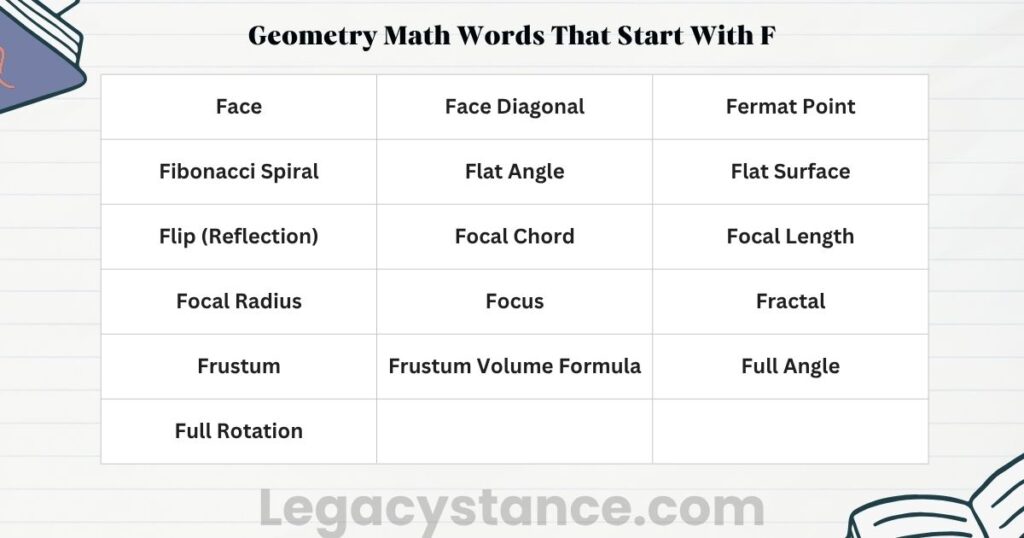
- Face
- Face Diagonal
- Fermat Point
- Fibonacci Spiral
- Flat Angle
- Flat Surface
- Flip (Reflection)
- Focal Chord
- Focal Length
- Focal Radius
- Focus
- Fractal
- Frustum
- Frustum Volume Formula
- Full Angle
- Full Rotation
Statistics Math Words That Start With F
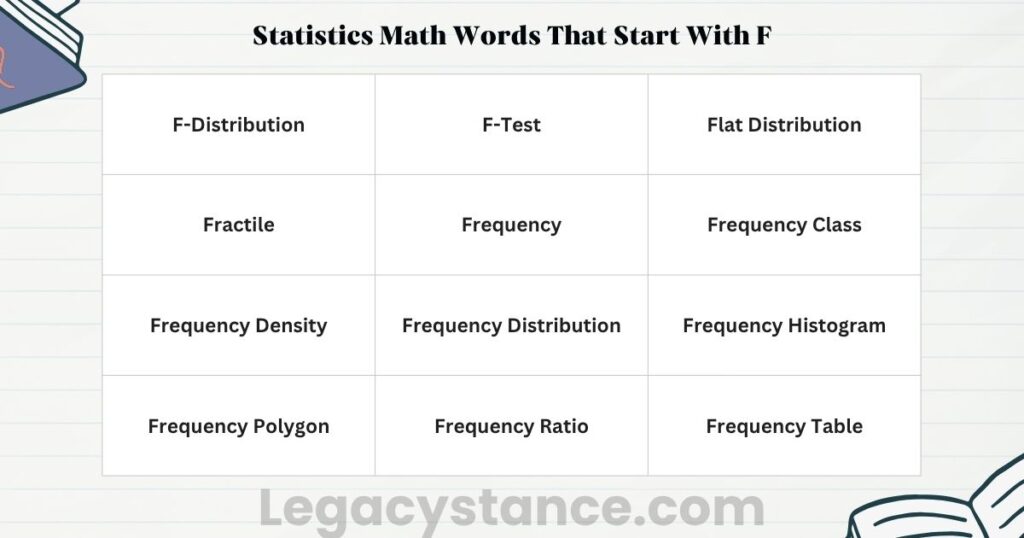
- F-Distribution
- F-Test
- Flat Distribution
- Fractile
- Frequency
- Frequency Class
- Frequency Density
- Frequency Distribution
- Frequency Histogram
- Frequency Polygon
- Frequency Ratio
- Frequency Table
Algebra Math Words That Start With F
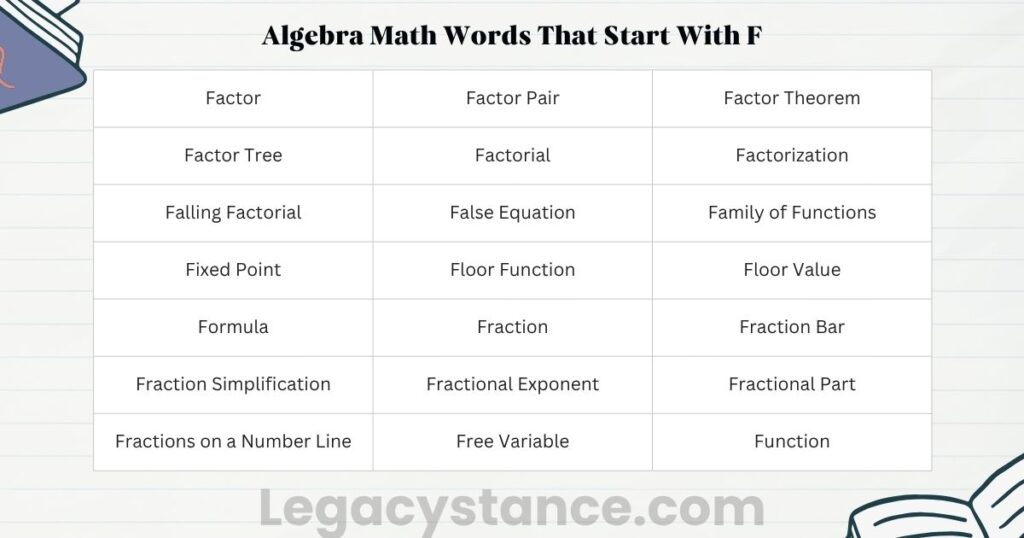
- Factor
- Factor Pair
- Factor Theorem
- Factor Tree
- Factorial
- Factorization
- Falling Factorial
- False Equation
- Family of Functions
- Fixed Point
- Floor Function
- Floor Value
- Formula
- Fraction
- Fraction Bar
- Fraction Simplification
- Fractional Exponent
- Fractional Part
- Fractions on a Number Line
- Free Variable
- Function
- Function Composition
- Function Domain
- Function Inverse
- Function Notation
- Function Range
- Fundamental Counting Principle
- Fundamental Theorem of Algebra
- Functional Equation
Number Theory Math Words That Start With F
- Factor
- Fermat Prime
- Fermat’s Last Theorem
- Fermat’s Little Theorem
- Fibonacci Coding
- Fibonacci Number
- Fibonacci Sequence
- Finite Field
- Fixed Ratio
- Fractile
Calculus Math Words That Start With F
- Finite Limit
- Flow Rate
- Forward Difference
- Fourier Coefficient
- Fourier Series
- Fourier Transform
- Fubini’s Theorem
- Fundamental Period
- Fundamental Theorem of Calculus
Abstract Algebra and Logic Math Words That Start With F
- Field
- Field Axioms
- Finite Group
- Formal Language
- Formal Proof
- Formal System
- Fundamental Domain
- Fuzzy Logic
- Fuzzy Set
Applied and Computational Math Words That Start With F
- False Position Method
- Fibonacci Coding
- Finite Automaton
- Finite Difference
- Finite Element Method
- Fixed-Point Iteration
- Forward Rate
- Frobenius Method
- Frobenius Norm
- Frenet Frame
- Fundamental Matrix
- Full Binary Tree
Real-World Applications of Math Words That Start With F
Engineering and Architecture
Frustum calculations appear in tapered columns, cooling towers, and storage tanks. Finite element method lets engineers simulate structural stress before a single beam is placed. Fourier series solves heat distribution equations in material science.
Medicine and Imaging
Fourier transforms power MRI and CT scanners — they convert raw signal data into readable images. Frequency distributions help epidemiologists map how diseases spread across populations.
Technology and Computing
Floor functions appear in integer division and grid-positioning algorithms. Finite automata drive regular expressions and text search engines. Frobenius norm is used in machine learning for matrix approximations. Fuzzy logic controls autofocus in cameras and temperature regulation in smart appliances.
Finance
Forward rates underpin bond pricing and derivatives. F-tests validate whether pricing models capture real market behavior. Fractals describe market price movements — Benoit Mandelbrot argued financial markets are fractal in structure.
Nature and Art
Fibonacci sequence and spiral appear in sunflower seed arrangements, nautilus shells, pine cones, and galaxy arms. The golden ratio derived from it has been used in art and architecture for thousands of years.
Navigation, Physics, and Optics
Focus geometry defines how telescopes, satellite dishes, headlights, and solar collectors are shaped. Frenet frames describe how spacecraft trajectories bend through 3D space. Frobenius method solves wave equations in cylindrical and spherical physical systems.
Commonly Confused Terms
Frequency vs. Relative Frequency
Frequency is the raw count of occurrences. Relative frequency divides that count by the total — expressing it as a fraction or percentage. If 8 out of 40 students scored above 90, frequency is 8, relative frequency is 20%.
Factor vs. Multiple
A factor divides a number. A multiple is produced by multiplying. 6 is a factor of 24. 24 is a multiple of 6. The direction matters — students reverse these on tests more than almost any other pair.
Function Domain vs. Function Range
Domain is the set of valid inputs. Range is the set of possible outputs. Domain goes in, range comes out.
Floor Function vs. Rounding
Floor always goes down — no exceptions. Rounding goes to the nearest integer, which sometimes means going up. ⌊3.9⌋ = 3, but 3.9 rounded = 4.
Fourier Series vs. Fourier Transform
A Fourier series breaks a periodic function into sinusoidal components. A Fourier transform applies to any function — periodic or not — and converts it into the frequency domain. The series is a special case of the transform.
Fractal vs. Polygon
A polygon has a finite number of straight sides and a definite, measurable perimeter. A fractal has infinite self-similar detail at every zoom level — its perimeter can be infinite even when it encloses a finite area (the Koch Snowflake is the classic example).
Fuzzy Set vs. Fuzzy Logic
A fuzzy set assigns each element a membership degree between 0 and 1. Fuzzy logic is the reasoning system built on top of fuzzy sets — it uses those membership values to make decisions and draw conclusions.
Read more:
130+ Math Words That Start With C
90+ Math Words That Start With E
60+ Math Words That Start With G
FAQs about Math Words That Start With F
1. Which Math Words That Start With F are most important for students?
The most useful terms for most students include factor, fraction, factorial, formula, function, frequency, and face. These appear regularly in school math and provide a foundation for more advanced topics later.
2. Why should I learn math vocabulary instead of only solving problems?
Math vocabulary helps you understand instructions, word problems, textbooks, and exams. When you know what terms mean, solving problems becomes faster because you spend less time figuring out what the question is asking.
3. What is the difference between a factor and a fraction?
A factor is a number that divides another number exactly. For example, 3 is a factor of 12. A fraction represents part of a whole, such as 3/4. Although the words sound similar, they describe completely different mathematical ideas.
4. Where are advanced F math terms used in real life?
Terms like Fourier transform, finite element method, and fuzzy logic are used in medical imaging, engineering, artificial intelligence, computer software, telecommunications, and scientific research. Many modern technologies depend on these mathematical concepts.
Conclusion
Math words starting with F span every level of mathematics — from fraction and factor in early arithmetic all the way to Fourier transforms, Fubini’s theorem, and the Fundamental Theorem of Calculus in university-level courses.
The everyday terms build the problem-solving skills you use constantly. The advanced ones drive modern science, engineering, technology, and financial analysis.
Understanding these words in context — what they do and where they appear — is what builds genuine mathematical fluency. Not memorizing definitions, but recognizing the concept when it shows up in a real problem.