Mhm means yes, I agree, or I’m listening. It’s the written form of the sound people make in real conversation — “mm-hmm” — typed out in texts, DMs, and online chats instead of saying a full word.
Simple enough. But here’s what most people don’t realize: mhm is one of those replies where the word stays the same and the feeling behind it changes completely depending on how it’s used.
The Core Meaning of Mhm
The most reliable definition comes straight from dictionary sources. Oxford lists mhm as an exclamation used to say yes or show you are listening. Dictionary.com describes it as a written form of “mm-hmm,” used to express agreement or acknowledgment in informal writing.
In real texting, it works like a nod. Someone asks a question, you say mhm, and that means yes or got it — without typing anything longer.
What makes mhm interesting is that it carries tone without carrying content. The letters don’t change but the feeling behind them can shift from warm and easy to flat and reluctant depending on what surrounds them.
How Punctuation Changes Everything
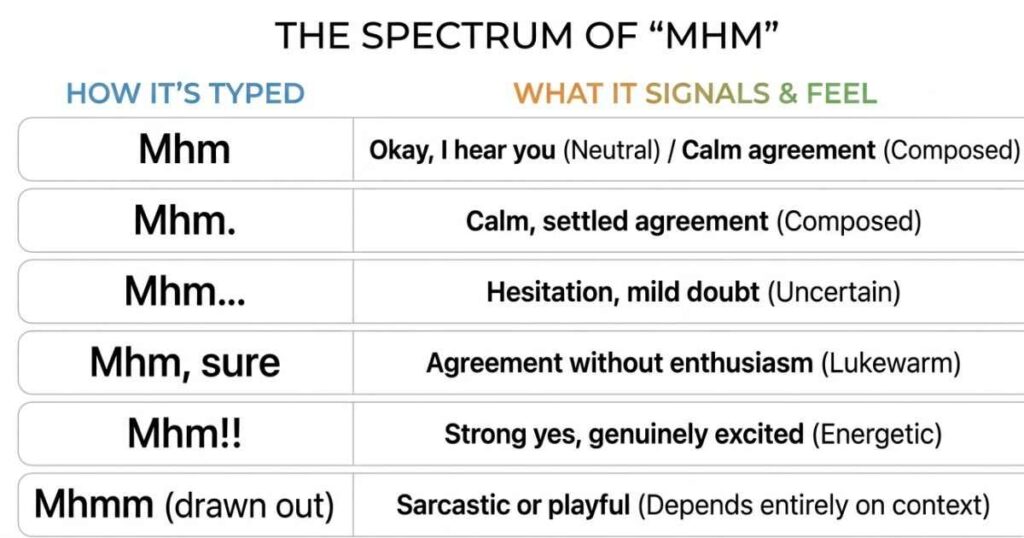
This is the part most articles skip over, and it matters a lot.
| How It’s Typed | What It Signals | Feel |
| Mhm | Yes, okay, I hear you | Neutral |
| Mhm. | Calm, settled agreement | Composed |
| Mhm… | Hesitation, mild doubt | Uncertain |
| Mhm, sure | Agreement without enthusiasm | Lukewarm |
| Mhm!! | Strong yes, genuinely excited | Energetic |
| Mhmm (drawn out) | Sarcastic or playful | Depends entirely on context |
A period makes it feel final. An ellipsis makes it feel unsure. Exclamation points push it toward enthusiasm. Reading mhm without noticing what comes with it is how misunderstandings start.
What Mhm Means in Texting
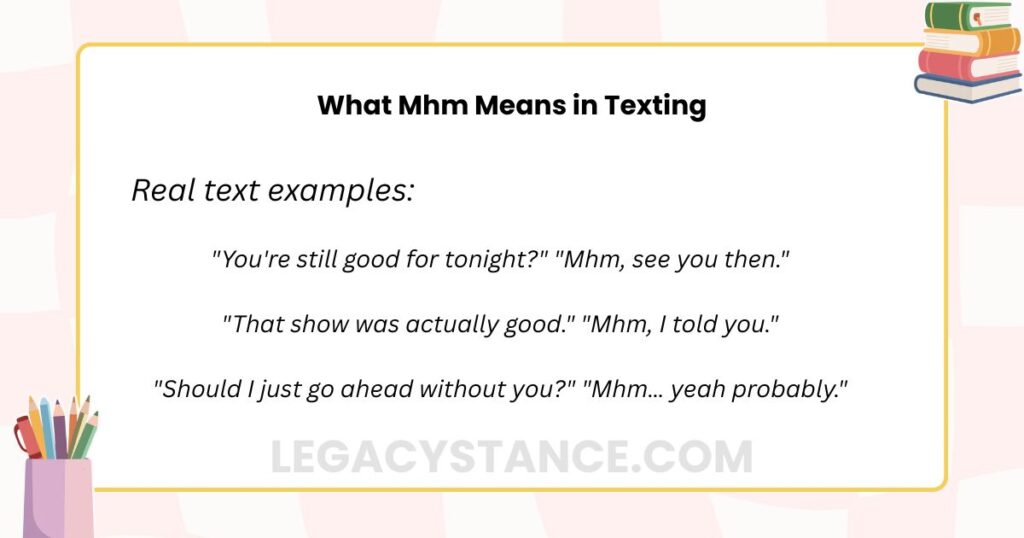
In everyday texting, mhm is one of the most common quick replies people send. It shows up when someone wants to confirm something without opening a longer conversation. It fits naturally into fast back-and-forth exchanges where typing full sentences would feel stiff.
Real text examples:
“You’re still good for tonight?” “Mhm, see you then.”
“That show was actually good.” “Mhm, I told you.”
“Should I just go ahead without you?” “Mhm… yeah probably.”
Notice how the third example already sounds different from the first two. Same word, different energy.
People also send mhm when they’re multitasking — half in a conversation, half doing something else. It keeps the chat alive without requiring focus. That’s not rudeness; that’s just how texting works in real life.
What Mhm Means From a Girl to a Guy (and Vice Versa)
This gets searched constantly, and the answer is genuinely straightforward: the gender of the sender does not change what mhm means.
A girl texting mhm to a guy is saying yes, okay, or I hear you — the same thing anyone else would mean. People sometimes interpret a short reply as cold, flirty, or passive-aggressive based on who sent it, but that’s projection, not reading.
The real question is always what the conversation looked like before that message arrived. A warm, relaxed chat makes mhm feel light and natural. A tense or one-sided exchange makes the same word feel distant. The word is neutral — the situation gives it color.
Same logic applies when a guy sends it to a girl. It’s acknowledgment. That’s it.
Mhm on Snapchat and Instagram
On Snapchat and Instagram DMs, mhm behaves the same as in regular texting. Both platforms run on fast, casual messaging, so short replies fit naturally. Someone might send mhm after seeing a Story reply, responding to a photo, or confirming something quickly in a DM thread.
There’s no platform-specific meaning here. Mhm on Snapchat means the same thing it means in iMessage or WhatsApp. The only difference is the platform moves faster, so short replies feel even more normal.
Mhm on TikTok
On TikTok, mhm lives mostly in comment sections and live chats. Viewers type it to agree with something a creator said, validate a comment they relate to, or signal they already knew what was being discussed.
You’ll sometimes see comment chains where multiple people reply “mhm” or “mhm fr” to a popular comment. In that case it works like a group “exactly” or “same” — a wave of agreement without anyone typing much.
Mhm in Gaming and on Discord
In Discord DMs, group chats, and in-game text channels, mhm works as a fast confirmation. Players use it to acknowledge a callout, agree to a plan, or respond to a teammate mid-session without breaking focus.
Gaming communication is built around speed, so a full “yes, that sounds good” rarely happens. Mhm fits that pace. It’s clean, quick, and everyone understands it.
Does Mhm Mean Yes or No?
Almost always yes — or at minimum, “I acknowledge this.” It’s not a no. Even a reluctant mhm is technically agreement, just without the enthusiasm.
The only gray area is sarcasm. A slow, drawn-out “mhmmm” typed in an obviously sarcastic conversation can flip the meaning. But that’s a specific situation and context makes it clear. In a normal exchange, mhm points toward yes every single time.
Common Misreadings of Mhm
“They’re mad at me.” Short replies don’t equal anger. Many people text briefly out of habit, not emotion.
“They’re not interested.” Low energy in a reply can mean tired, busy, or just a brief-texter by nature. Mhm by itself doesn’t confirm disinterest.
“It’s flirting.” It’s not. Mhm is one of the most neutral replies in texting. Flirting comes from the whole conversation, not from one word.
“It’s rude.” It’s informal and short — but not rude. In an ongoing conversation where context is already established, mhm is a completely normal reply.
Mhm vs Similar Responses
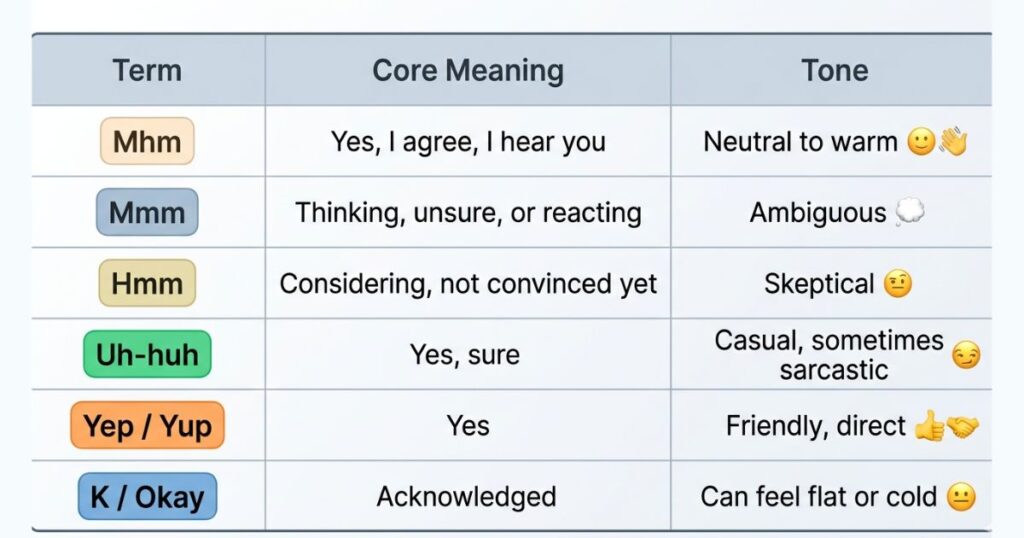
People often mix up mhm with similar-looking replies. Here’s how they actually differ:
| Term | Core Meaning | Tone |
| Mhm | Yes, I agree, I hear you | Neutral to warm |
| Mmm | Thinking, unsure, or reacting | Ambiguous |
| Hmm | Considering, not convinced yet | Skeptical |
| Uh-huh | Yes, sure | Casual, sometimes sarcastic |
| Yep / Yup | Yes | Friendly, direct |
| K / Okay | Acknowledged | Can feel flat or cold |
Mhm sits closest to “yes” while still feeling conversational. “Hmm” leans toward doubt. “Mmm” can mean almost anything depending on the situation. Knowing the difference helps you read replies more accurately.
Where Mhm Comes From
Mhm is the written version of “mm-hmm,” a nasal two-syllable sound people make in spoken conversation to signal agreement or active listening. It’s not a word in the traditional sense — it’s a phonetic shortcut that migrated from speech into text as messaging culture grew.
Dictionary.com traces “mm-hmm” in recorded English back to at least 1934. The texting version became common as chat platforms made short phonetic replies a normal part of written conversation. Oxford includes it as a real exclamation, defined as a sound used to say yes or to show that you are listening.
That origin explains why mhm looks a little odd written out. It was never designed to be spelled — it was designed to be heard.
Read also:
What Does SML Mean? Texting, TikTok, YouTube, Size & More
MB Meaning in Text: What It Actually Means and When It Changes
FAQs
Is “mhm” a positive reply?
Usually, yes. Most people use “mhm” to show agreement, understanding, or acknowledgment. It is generally softer and more casual than typing “yes.”
Why does “mhm” sometimes feel cold?
Short replies can feel distant when the conversation already feels tense or one-sided. The word itself is neutral, but the mood of the chat changes how it sounds.
What is the difference between “mhm” and “hmm”?
“Mhm” normally means agreement or confirmation. “Hmm” usually means someone is thinking, unsure, confused, or questioning something.
Can “mhm” be rude?
Not by itself. Many people naturally text in short replies, especially when busy or multitasking. Tone depends on the full conversation, not one word alone.
Why do people type “mhm” instead of “yes”?
Because it feels more natural and conversational. It copies real speech and sounds less formal than typing a complete “yes” every time.
Final Thought
Mhm is a small word doing a quiet job: agreeing, acknowledging, confirming — without making a big deal of any of it. It’s not cold, not warm, not flirty, not rude on its own. The conversation around it is what turns it into something specific.
When you get a mhm and you’re not sure how to read it, don’t focus on the word. Focus on everything that came before it.