OTW = On The Way Used in texts, DMs, Snapchat, Instagram, WhatsApp, and group chats. It tells the other person that the sender has left or is currently heading toward a destination. In rare cases it can mean “Off The Wall,” but in everyday texting, on the way is the meaning you can count on.
What Does OTW Mean in Texting?
Someone sends “OTW” and the conversation is already wrapping up — because they are on the move. That is exactly what makes this abbreviation useful. It replaces a full sentence with three letters without losing the message.
Typing “I am on my way” while walking out the door, grabbing your keys, or sitting in a moving car is not always practical. OTW handles all of that instantly.
Real examples from everyday texting:
- “OTW, give me 10.”
- “Just locked up, OTW.”
- “OTW — traffic is rough but moving.”
- “Sorry for the delay, OTW now.”
Each of these carries the same core information: movement has started. The tone shifts based on what surrounds OTW, not the abbreviation itself.
OTW in Relationship Conversations
In couple or close-friend conversations, OTW does something beyond sharing location updates. It removes uncertainty. When someone is waiting and feeling impatient or anxious, a quick “OTW” from the other person settles that immediately.
It is not romantic slang. It carries no secret code. But in the right relationship context, it can feel caring simply because it is prompt and communicative.
Examples that come up naturally in relationship chats:
- “OTW to you, hold on.”
- “Had a long day, OTW home.”
- “OTW to pick you up — be outside in 5.”
The emotional weight here comes from the relationship, not from the abbreviation. OTW stays practical even when the conversation around it is personal.
OTW on Snapchat, Instagram, and WhatsApp
Across these three platforms, OTW behaves the same way — it is a quick movement update before an in-person meetup.
On Snapchat, it usually appears in chat right before two people are about to see each other. The digital conversation is closing, and real life is about to begin.
On Instagram, it shows up in DMs or story replies. Someone heading to an event, party, or place might drop “OTW” as a low-effort status update for people who are already there.
On WhatsApp, especially in group chats, OTW is a standard reply when someone asks “where are you?” It is short enough to send while still physically on the move.
No platform changes the meaning. The delivery style is slightly different across each app, but OTW always signals the same thing.
OTW in Group Chats
Group chats before a meetup often turn into a chain of OTW messages. One person asks if everyone is close, and the replies come in fast — “OTW,” “Almost there,” “OTW, parking now.”
It works well in this setting because it gives the whole group a clear update without anyone needing to write a full explanation. One word, everyone informed.
Where OTW shines most in group settings:
- Confirming you are on your way when the group is already gathered
- Letting people know not to wait at the door
- Buying time when you are running a few minutes behind
It is efficient without being dismissive, which is why it fits group chat culture so naturally.
OTW Meaning in Tagalog and Bilingual Conversations
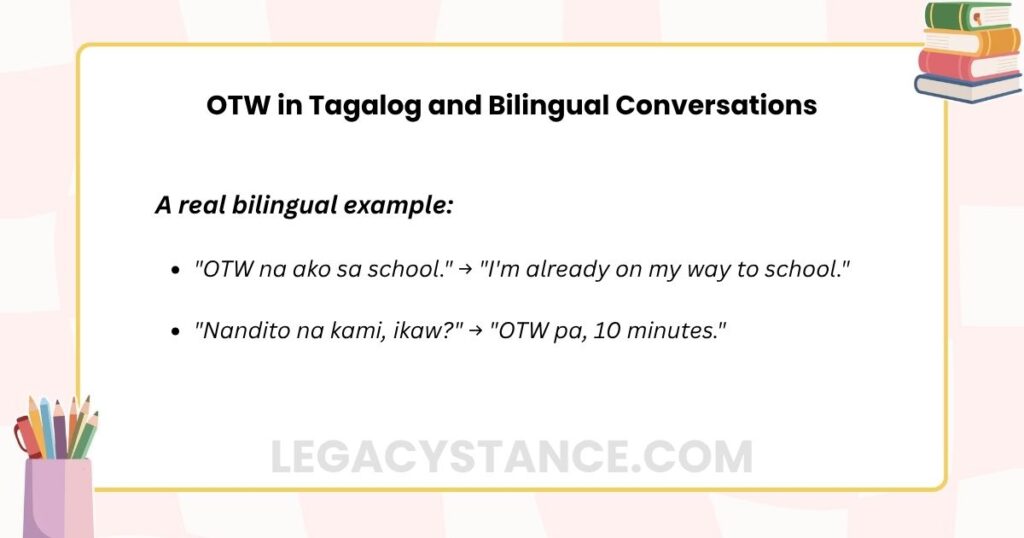
In Filipino texting culture, OTW is completely standard. It blends into conversations that switch between English and Tagalog without any friction.
The direct Tagalog translation is papunta na or paparating na — both mean “already on the way.”
A real bilingual example:
- “OTW na ako sa school.” → “I’m already on my way to school.”
- “Nandito na kami, ikaw?” → “OTW pa, 10 minutes.”
This is not a different meaning — it is the same OTW used inside a bilingual conversation style that is natural across Filipino communities both online and in person.
OTW on TikTok and Discord
On TikTok, OTW appears in video captions and comments. Someone posting about heading to a concert, a game, or a meetup might write “OTW to this event” — meaning they are literally going. It functions as a casual real-time announcement rather than a reply to someone.
On Discord, OTW shows up in gaming servers and friend group channels. If a group is waiting on someone to join a session or meet in a game lobby, “OTW” is the standard heads-up that they are logging in or navigating over.
Neither platform adds new meaning. The abbreviation stays consistent.
Does OTW Ever Mean Something Else?
Yes, technically — but the alternate meaning almost never appears in standard conversations.
“Off The Wall” is occasionally listed as another expansion of OTW. You might see this in very specific creative or music discussions, but it is rare enough that most people have never encountered it in that context. If you see OTW in a text thread, group chat, or DM, it means on the way.
There is no hidden meaning. No platform-specific alternate definition. No generational shift in how it is used. On the way covers it in almost every case.
OTW Meaning vs OMW and Other Similar Abbreviations
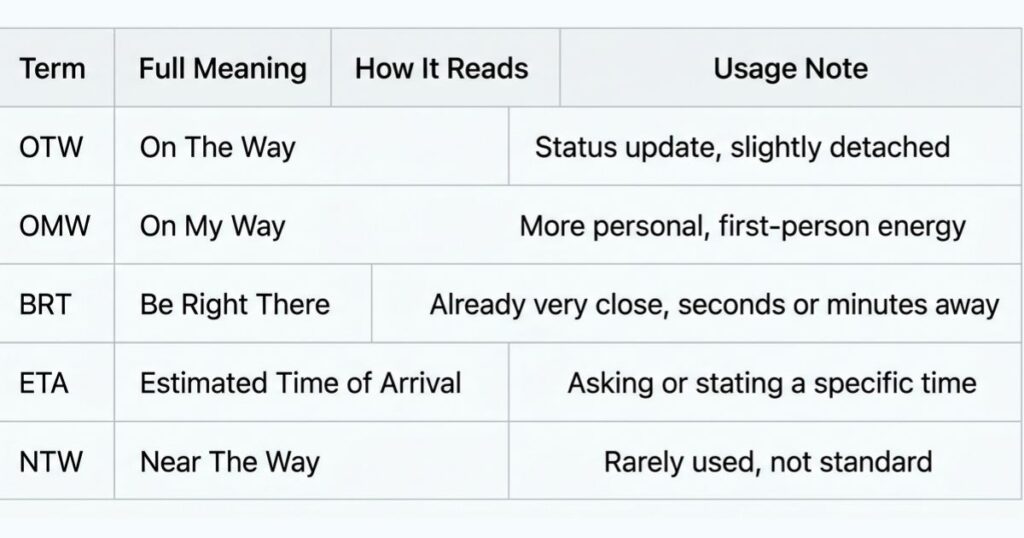
These abbreviations all overlap in meaning, but they are not identical in feel.
| Term | Full Meaning | How It Reads |
| OTW | On The Way | Status update, slightly detached |
| OMW | On My Way | More personal, first-person energy |
| BRT | Be Right There | Already very close, seconds or minutes away |
| ETA | Estimated Time of Arrival | Asking or stating a specific time |
| NTW | Near The Way | Rarely used, not standard |
The most common mix-up is OTW vs OMW. Both mean the same thing in practice. OTW reads like a general status — something happened, movement started. OMW feels slightly more personal, like a direct statement to the other person. In real texting, people swap them without thinking about the difference.
BRT is worth knowing separately — it means the person is not just on the way, they are nearly there. Using BRT when you are 20 minutes out would feel misleading.
When OTW Can Feel Rude (Even Though It Is Not)
OTW is a neutral abbreviation. It does not carry attitude by default. But how it lands depends heavily on the situation surrounding it.
If someone has been waiting a long time, sent multiple messages, and finally receives just “OTW” — that brevity can feel cold. Not because OTW is rude, but because the context makes it feel like the bare minimum.
A simple breakdown:
| Situation | How OTW Lands |
| Quick casual reply to “you close?” | Completely fine, efficient |
| After being unreachable for 30 minutes | Can feel dismissive |
| Paired with an apology or context | Warm and considerate |
| Sent in a group chat as a heads-up | Natural and expected |
Adding one more line changes everything. “OTW, sorry for the wait” hits differently than just “OTW” in a tense situation. The abbreviation is not the problem — it is what you leave out.
OTW in Real Conversation Examples
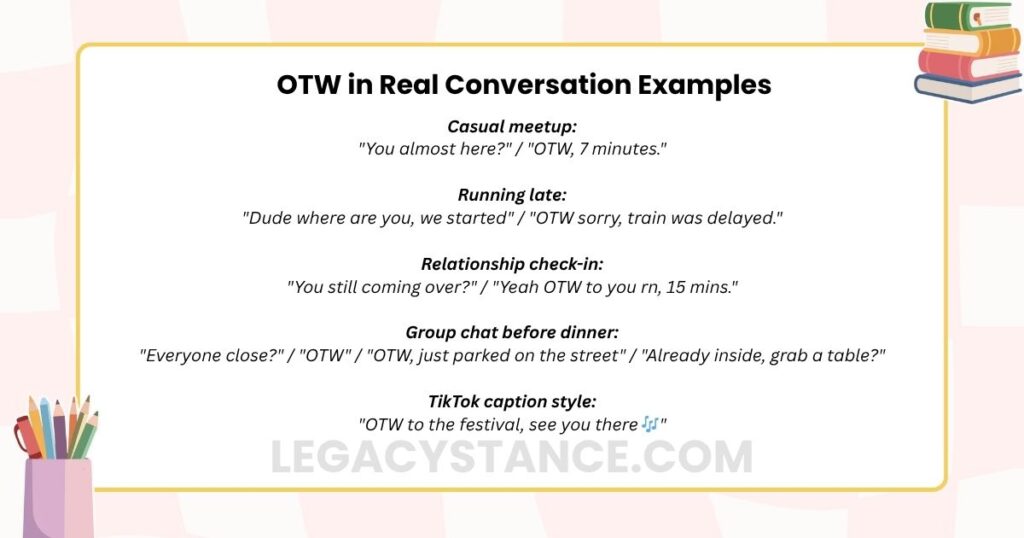
These are realistic, natural exchanges showing OTW in different situations:
Casual meetup:
“You almost here?” / “OTW, 7 minutes.”
Running late:
“Dude where are you, we started” / “OTW sorry, train was delayed.”
Relationship check-in:
“You still coming over?” / “Yeah OTW to you rn, 15 mins.”
Group chat before dinner:
“Everyone close?” / “OTW” / “OTW, just parked on the street” / “Already inside, grab a table?”
TikTok caption style:
“OTW to the festival, see you there 🎶”
Bilingual chat:
“Nandito na kami, ikaw?” / “OTW pa, traffic eh.”
Each example uses OTW the same way — movement confirmed, arrival coming — but the register and setting shift naturally.
Common Misunderstandings Worth Clearing Up
“Does OTW mean they are almost there?” Not exactly. It means they have started moving. They could be 3 minutes away or 25 minutes out. If you need a time estimate, ask for an ETA separately.
“Is OTW only used by younger people?” No. It is common across age groups in casual texting. Anyone familiar with basic texting shorthand will recognize and use it.
“Does OTW mean something different on TikTok or Snapchat?” No. The meaning does not change by platform. On the way is on the way everywhere.
“Can I use OTW in a professional message?” Skip it in formal or workplace communication. Write “I am on my way” or “I will arrive shortly” instead. OTW belongs in casual, personal conversations.
Read also –
What Does SML Mean? Texting, TikTok, YouTube, Size & More
What Do Mhm Mean in Text? Full Meaning, Examples & Context
FAQs
Does OTW always mean the person has already left?
Usually yes — OTW implies movement has started. But sometimes people send it right as they are leaving, meaning departure is seconds away rather than already in progress. Either way, arrival is confirmed.
What is the difference between OTW and OMW in texting?
Both mean the same thing. OMW (On My Way) sounds slightly more personal and direct. OTW (On The Way) reads a bit more like a general status update. In real conversations, people use both interchangeably and the distinction rarely matters.
Is OTW used the same way across different countries?
Yes, with small cultural flavors. In the Philippines, it mixes naturally with Tagalog. In the US and UK, it is pure casual English texting shorthand. The core meaning — movement toward a destination — stays the same globally.
Can OTW mean something romantic?
OTW has no romantic meaning on its own. In a relationship context, it can feel warm or reassuring depending on the situation, but that emotional layer comes from the relationship itself, not from the abbreviation.
Conclusion
OTW means on the way — full stop. It works in texts, group chats, DMs, Snapchat, Instagram, Discord, TikTok, and bilingual conversations without changing its meaning. The only thing that shifts is how it feels based on what surrounds it.
If you received OTW and wondered what it meant, now you know. If you are sending it, pair it with a small bit of context when the situation calls for it. Three letters do a lot of work, but a little warmth goes a long way.