

Looking for Vegetables That Start With C? You’ll find much more than just carrots and cabbage. This guide brings together common kitchen staples, regional favorites, and lesser-known vegetables enjoyed around the world.
Each vegetable includes practical details about flavor, cooking uses, storage, and interesting facts. Whether you’re building a food list, teaching vocabulary, planning meals, or simply exploring new foods, this collection makes it easy to discover vegetables that begin with the letter C.
Quick Reference: Vegetables That Start With C
| Vegetable | Type | Taste | Best Use |
| Cabbage | Cruciferous | Mild, earthy | Braising, slaws |
| Carrot | Root | Sweet | Roasting, soups |
| Cauliflower | Cruciferous | Nutty | Roasting, rice substitute |
| Celery | Stalk | Bitter, fresh | Soups, snacking |
| Cucumber | Gourd | Cool, watery | Salads, pickling |
| Capsicum | Fruit-veg | Sweet to fiery | Stir-fry, stuffing |
| Celeriac | Root | Earthy | Mashing, soups |
| Chickpeas | Legume | Nutty, buttery | Curries, salads |
| Collard Greens | Leafy Green | Slightly bitter | Braising |
| Corn | Grain-veg | Sweet | Grilling, boiling |
| Courgette | Gourd | Mild | Grilling, baking |
| Cowpeas | Legume | Earthy | Stews |
| Cress | Leafy Green | Peppery | Salads, garnish |
| Chicory | Leafy Green | Bitter | Salads, grilling |
Cruciferous Vegetables That Start With C
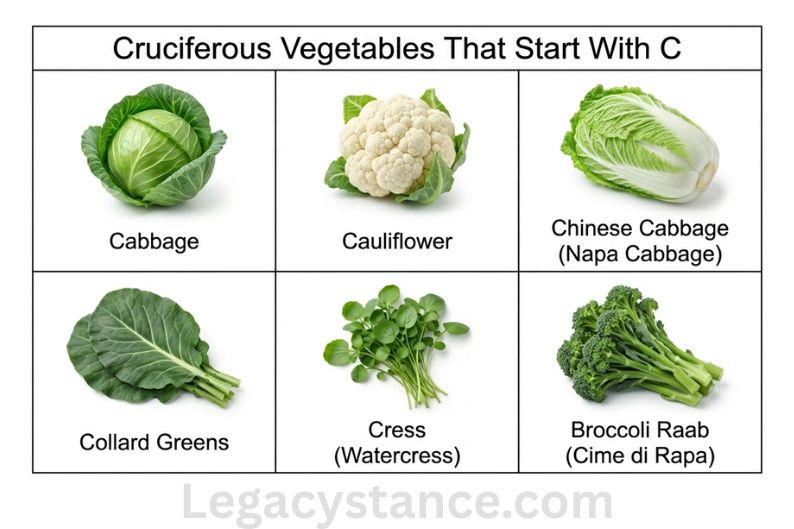
1. Cabbage
Round, dense head with tightly packed pale green or purple leaves. Raw cabbage is crunchy and faintly peppery. Cooked, it turns soft and sweet.
- Uses: Coleslaw, braised dishes, stuffed rolls, sauerkraut, kimchi
- Storage: Whole head lasts 2 weeks in fridge. Wrap cut face tightly.
- Fact: Roman soldiers ate cabbage before drinking to slow alcohol absorption.
2. Cauliflower
A compact white curd of tightly bunched flower buds. Also comes in orange, green, and purple. Roasting brings out a nutty, slightly caramelized flavor that boiling completely destroys.
- Uses: Roasted florets, cauliflower rice, pizza crust, mash, curries
- Storage: Store stem-side down in fridge, up to 1 week.
- Fact: Romanesco cauliflower grows in a perfect natural fractal pattern.
3. Chinese Cabbage (Napa Cabbage)
Long oval shape, pale yellow-green leaves, white crinkled midribs. Far more tender than regular cabbage. Wilts down significantly when cooked.
- Uses: Kimchi, hot pot, dumplings, soups, stir-fries
- Storage: Whole head lasts 2 weeks. Wrap cut face once sliced.
- Fact: Over 200 kimchi varieties use napa cabbage as the base.
4. Collard Greens
Large, flat, dark green leaves with thick stems. A Southern American and pan-African staple. Bitterness softens beautifully with long, slow braising.
- Uses: Braised with smoked meat, stir-fried, soups, used as wraps
- Storage: Damp paper towel, plastic bag, fridge. Use within 5 days.
- Fact: In Brazil, collard greens are shredded fine and served alongside rice and black beans daily.
5. Cress (Watercress / Garden Cress)
Small, delicate leaves with a peppery punch that seems impossible for such a tiny plant. Watercress grows near streams. Garden cress grows on a windowsill in days.
- Uses: Salads, sandwiches, soup garnish, blended into sauces
- Storage: Stand in cold water like flowers. Refrigerate. Use within 2 days.
- Fact: In England, watercress was called “poor man’s bread” — gathered wild from streams for free.
6. Broccoli Raab (Cime di Rapa)
Thin stalks, small broccoli-like florets, and leafy greens all in one plant. Bitter and sharp — a staple of Southern Italian cooking.
- Uses: Sautéed with garlic and chili, pasta dishes, pizza topping
- Storage: Refrigerate in a damp paper towel. Use within 3 days.
- Fact: In Puglia, it’s traditionally paired with orecchiette pasta as a regional classic.
Root Vegetables That Start With C
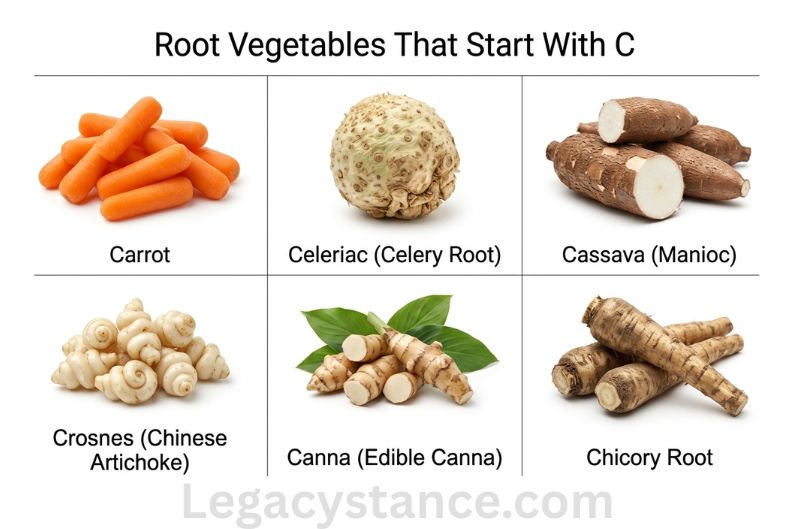
7. Carrot
Long, tapered orange root — though originally purple and white before Dutch farmers bred the orange variety in the 1600s.
- Uses: Soups, stews, roasting, raw snacking, juicing, carrot cake
- Storage: Remove green tops first — they pull moisture from the root. Sealed bag in fridge, up to 3 weeks.
- Fact: “Baby carrots” in bags are regular carrots shaped by machines, not actually young ones.
8. Celeriac (Celery Root)
Rough, knobby brown ball on the outside. Firm, creamy white inside. Smells like celery but tastes richer and more complex.
- Uses: Mashed celeriac, French remoulade, soups, roasted chunks, gratin
- Storage: Leave skin on until use. Fridge for 2–3 weeks.
- Fact: French and German cooks have used celeriac as a winter staple for centuries. It was almost unknown in American kitchens until recently.
9. Cassava (Manioc)
Thick woody root with rough brown skin and dense white starchy flesh. One of the most important food crops on earth — over 800 million people eat it daily.
- Uses: Boiled plain, fried chips, tapioca, stews, flour
- Storage: Unpeeled roots last 1 week at room temperature. Once peeled, cook immediately or freeze.
- Fact: Raw cassava contains compounds that produce cyanide. Traditional preparation — soaking, fermenting, cooking — removes them completely. Always cook thoroughly.
10. Crosnes (Chinese Artichoke)
Tiny, coiled ivory-white tubers about thumb-sized. Look unusual but taste excellent — crunchy, slightly sweet, nutty, similar to water chestnuts.
- Uses: Stir-fried, pickled, sautéed in butter, raw in salads
- Storage: Very perishable. Use within 2–3 days.
- Fact: Brought from Japan to France in the 1880s, named after a French village, briefly fashionable in Paris, then almost forgotten.
11. Canna (Edible Canna)
Grown as a food crop in the Andes for centuries. Most people only know it as a garden flower, but the rhizomes of edible varieties are starchy and nutritious.
- Uses: Boiled, baked, ground into starch, used as a cooking thickener
- Storage: Store like a potato — cool, dry place. Use within 2 weeks.
- Fact: Canna starch called “purple arrowroot” is sold in Vietnamese markets and makes an unusually smooth, glossy sauce.
12. Chicory Root
The root of the chicory plant — different from the leafy chicory used in salads. Thick, earthy, and starchy when cooked fresh.
- Uses: Roasted and ground into caffeine-free coffee, cooked as a root vegetable, added to stews
- Storage: Store in a cool dark place, like a parsnip. Use within 1 week.
- Fact: Chicory coffee has been popular in New Orleans and France for over 200 years.
13. Camote (Sweet Potato — regional name)
Called camote across Latin America and the Philippines. Same vegetable as sweet potato but with regional varieties that differ in sweetness and texture.
- Uses: Boiled, roasted, mashed, street food snack
- Storage: Cool, dry, dark place. Never refrigerate uncooked — cold damages the flesh.
- Fact: In the Philippines, camote tops — the young leaves — are eaten as a leafy green vegetable.
14. Chinese Yam (Nagaimo)
A long, cylindrical, white-fleshed root that becomes slippery and mucilaginous when grated raw. Sounds strange. Tastes mild and slightly sweet.
- Uses: Grated raw into Japanese dishes (tororo), sliced into stir-fries, added to soups
- Storage: Keep unpeeled at room temperature for up to 2 weeks.
- Fact: Grated Chinese yam is poured over rice in Japan — the sticky texture is considered a delicacy, not a flaw.
Leafy Greens Vegetables That Start With C
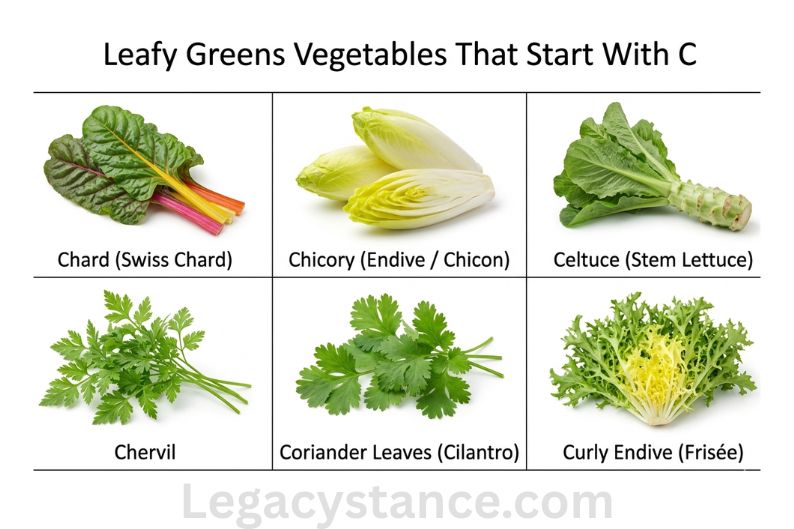
15. Chard (Swiss Chard)
Wide flat leaves with thick colorful stems — red, yellow, white, or pink. Related to beets, not spinach, though many people mix them up.
- Uses: Sautéed with garlic, soups, pasta fillings, savory pies
- Storage: Damp paper towel, refrigerate. Use within 3 days.
- Fact: The stems need 2–3 extra minutes of cooking compared to the leaves. Add stems first, leaves later.
16. Chicory (Endive / Chicon)
Pale yellow-green leaves in a tight oval shape. Distinctly bitter raw. Softens and sweetens when grilled or braised.
- Uses: Raw salads with citrus dressing, grilled halves, braised in butter, paired with blue cheese
- Storage: Wrap in damp cloth, away from light. Light increases bitterness. Use within 4 days.
- Fact: Chicory root is roasted and ground into a caffeine-free coffee substitute.
17. Celtuce (Stem Lettuce)
A type of lettuce grown for its thick crunchy stem, not its leaves. Almost unknown outside China but a common vegetable there.
- Uses: Raw in salads, stir-fried, pickled, cut into matchsticks with sesame oil
- Storage: Store unwashed in fridge. Lasts about 1 week.
- Fact: The stem contains a milky sap that tastes slightly bitter raw but disappears completely when cooked.
18. Chervil
Feathery delicate leaves that look like a cross between parsley and ferns. Used heavily in French cooking, barely known elsewhere.
- Uses: Mixed into salads, stirred into eggs, used in French fines herbes, added to cream sauces at the very end
- Storage: Stand in cold water in fridge. Use within 2 days.
- Fact: Chervil was a traditional Easter herb in Europe, symbolizing new life. Heat destroys its flavor — always add raw or last.
19. Coriander Leaves (Cilantro)
Flat, feathery bright green leaves with a citrusy, herby scent that roughly 10–15% of people experience as soapy due to a specific gene variant.
- Uses: Mexican salsas, Indian curries, Thai soups, Vietnamese pho, added raw before serving
- Storage: Trim stems, stand in water in fridge, cover loosely. Lasts 10 days vs 2 days in a bag.
- Fact: The soap-taste reaction is caused by a gene near olfactory receptor OR6A2. It’s a real genetic difference.
20. Curly Endive (Frisée)
Pale yellow center with spiky, curly outer leaves. Part of the chicory family. Used mostly in French bistro salads.
- Uses: Salads with warm bacon dressing, poached egg on top, mixed green salads
- Storage: Refrigerate in a loose bag. Use within 4 days.
- Fact: The pale yellow center is blanched by tying the leaves together to block sunlight — reducing bitterness intentionally.
21. Ceylon Spinach (Malabar Spinach)
Not related to regular spinach. A climbing vine with thick, glossy, dark green leaves. Popular in South Asia and tropical Africa.
- Uses: Stir-fried, added to soups, used as a spinach substitute
- Storage: Refrigerate in a damp bag. Use within 3 days.
- Fact: Unlike regular spinach, Malabar spinach thrives in hot weather — it’s the spinach substitute for tropical climates.
22. Chrysanthemum Greens (Tong Ho)
Bright green, slightly serrated leaves with a distinctive floral-herby aroma. Common in East Asian cooking.
- Uses: Hot pot, Japanese shabu-shabu, stir-fries, soups
- Storage: Refrigerate in a damp paper towel. Use within 2 days.
- Fact: The same plant produces both edible greens and ornamental flowers — the edible variety is selected for leaf flavor, not flower size.
23. Cutting Celery (Leaf Celery)
Looks like flat-leaf parsley but smells intensely of celery. Grown for its leaves, not its stalks. Far more flavorful per leaf than regular celery.
- Uses: Soups, stews, stocks, herb blends, added to salads
- Storage: Stand in cold water or wrap in a damp towel. Use within 3 days.
- Fact: Cutting celery is the celery variety closest to wild celery — more pungent and less watery than modern stalk celery.
Gourds and Squash Vegetables That Start With C
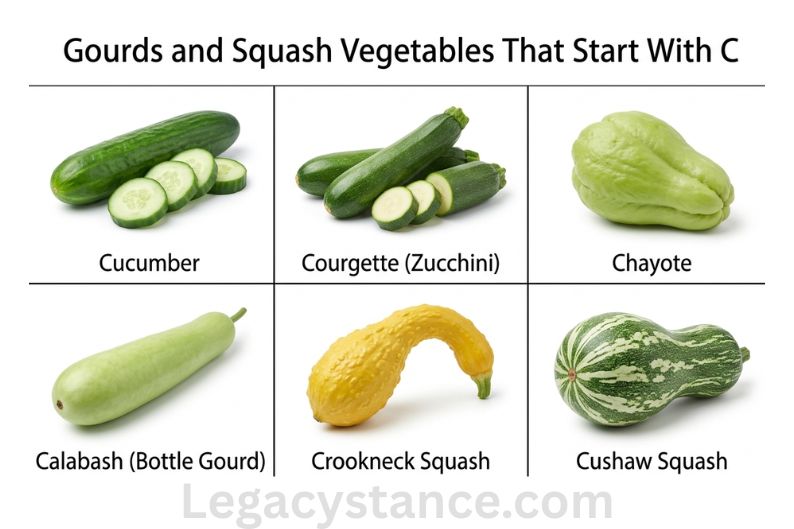
24. Cucumber
Long, cylindrical, and green with a pale watery interior. One of the most widely eaten vegetables on earth. Belongs to the gourd family.
- Uses: Raw salads, tzatziki, pickling, cold soups, sandwiches
- Storage: Counter for up to 2 days. Fridge makes them mushy faster than expected.
- Fact: Cucumbers are 96% water — among the highest water content of any solid food.
25. Courgette (Zucchini)
Long, smooth, dark green cylinder with soft pale flesh and small seeds. Same vegetable — courgette in the UK, zucchini in the US.
- Uses: Grilled slices, roasted, zucchini bread, spiralized noodles, stuffed and baked, soups
- Storage: Keep loose in fridge, not in plastic bags. Use within 5 days.
- Fact: Left on the plant too long, a courgette grows into a marrow — the size of a small watermelon.
26. Chayote
Pale green, pear-shaped, with a slightly wrinkled surface and one large flat seed. Part of the gourd family. Widely eaten across Latin America, Asia, and the Caribbean.
- Uses: Stir-fried, pickled, soups and stews, stuffed and baked, raw in Mexican salads
- Storage: Thick skin protects it — lasts up to 1 month in the fridge.
- Fact: Every part of the chayote plant is edible — fruit, seed, young shoots, and the starchy root.
27. Calabash (Bottle Gourd / Opo Squash)
Long, pale green vegetable in a bottle or club shape. One of the earliest cultivated plants in human history.
- Uses: Indian lauki curries, soups, stir-fried with spices, stuffed and baked, South Asian desserts
- Storage: Room temperature for a few days, fridge for up to 2 weeks.
- Fact: Dried calabash shells were used as water containers and musical instruments for thousands of years before pottery existed.
28. Crookneck Squash
Yellow squash with a curved neck and bumpy skin. A summer squash common in American gardens and farmers markets.
- Uses: Roasted, sautéed, added to casseroles, grilled
- Storage: Refrigerate and use within 5 days.
- Fact: Crookneck squash was one of the “Three Sisters” crops grown by Native American tribes alongside corn and beans.
29. Cushaws (Cushaw Squash)
Large, crookneck-shaped winter squash with green and white stripes. A heirloom variety that’s been grown in the American South for centuries.
- Uses: Pies, soups, roasted, mashed
- Storage: Cool, dry place. Lasts up to 3 months as a whole squash.
- Fact: Cushaw squash was a staple food of the Cherokee and other Southeastern Native American tribes.
30. Cucamelon (Mouse Melon)
Looks exactly like a tiny watermelon the size of a grape. Tastes like a cucumber with a squeeze of lime. Technically a fruit but used as a vegetable.
- Uses: Pickled, eaten raw as a snack, added to salads
- Storage: Refrigerate in a bag. Use within 1 week.
- Fact: Cucamelon has been eaten in Mexico and Central America for centuries but only became popular in Western specialty markets in the 2010s.
Legumes Vegetables That Start With C
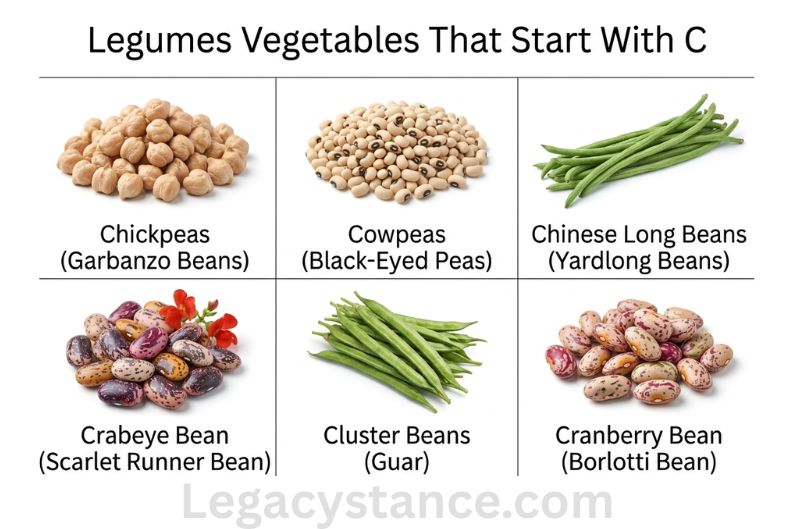
31. Chickpeas (Garbanzo Beans)
Round, beige, slightly bumpy legumes. Grown in the Middle East for over 7,000 years. Now eaten on every continent.
- Uses: Hummus, curries, stews, roasted snacks, salads, falafel
- Storage: Dried chickpeas last up to 2 years sealed. Canned, use within 3 days of opening.
- Fact: Chickpea liquid (aquafaba) whips into stiff peaks like egg whites — discovered by bakers by accident around 2014.
32. Cowpeas (Black-Eyed Peas)
Small cream-colored beans with a black spot. Originated in West Africa. A foundational crop across tropical regions worldwide.
- Uses: Stews, rice dishes, hoppin’ john, soups, paired with greens
- Storage: Dried cowpeas last 1 year in a sealed jar. No overnight soaking needed — they cook faster than most legumes.
- Fact: Eating cowpeas on New Year’s Day is a Southern American tradition for good luck, practiced since the 1800s.
33. Chinese Long Beans (Yardlong Beans)
Grow up to three feet long. Similar to green beans but chewier and with a more intense beany flavor. Don’t go mushy in stir-fries.
- Uses: Stir-fried with garlic and chili, Thai salads, curried, braised
- Storage: Plastic bag in fridge. Use within 3 days before they wrinkle.
- Fact: In Chinese New Year tradition, cutting long beans short before cooking is considered bad luck.
34. Crabeye Bean (Scarlet Runner Bean)
Dramatic red and black patterned seeds on a climbing vine with bright red flowers. Often grown as ornamental but completely edible.
- Uses: Stews, soups, paired with ham, slow-cooked dishes
- Storage: Dried beans last 2 years sealed. Soak at least 8 hours before cooking.
- Fact: Native American tribes used the colorful seeds as both food and decorative trade beads.
35. Cluster Beans (Guar)
Thin, ridged pods that grow in tight clusters on the plant. Common in Indian cooking. The pods are eaten young when tender.
- Uses: Dry-spiced Indian sabzi, curries, stir-fried
- Storage: Refrigerate in a paper bag. Use within 3 days.
- Fact: Mature guar beans are processed into guar gum — used as a thickener in ice cream, sauces, and even oil drilling fluids.
36. Cranberry Bean (Borlotti Bean)
Cream-colored pods with red speckles. The beans inside are pale pink with red streaks — beautiful before cooking. The color fades to plain brown once cooked.
- Uses: Italian pasta e fagioli, soups, stews, salads
- Storage: Fresh pods in fridge for up to 1 week. Dried beans last 2 years.
- Fact: The Italian name “borlotti” comes from the word for “blister” — referring to the speckled pod markings.
37. Catjang Bean
A small, cylindrical black or brown bean from the cowpea family. Grown across South Asia and Africa. More drought-resistant than most legumes.
- Uses: Curries, stews, porridges, ground into flour
- Storage: Dried, sealed container. Lasts 1–2 years.
- Fact: Catjang beans can fix nitrogen in poor soils, making them a vital rotation crop in regions where the soil is depleted.
38. Carob Bean
Long brown pods from the carob tree. The pulp inside the pod is sweet and edible as a vegetable when young. Dried and ground into carob powder when mature.
- Uses: Young pods eaten raw or cooked, mature pods ground as chocolate substitute
- Storage: Fresh pods in fridge for up to 2 weeks.
- Fact: Carob was used as a natural unit of weight measurement in ancient times — the word “carat” for gold and gemstones comes from carob seeds.
Alliums (Onion Family) Vegetables That Start With C
39. Chive
Thin, hollow, dark green stalks with a mild onion flavor. The most delicate member of the allium family. Often used as a finishing herb rather than a cooked vegetable.
- Uses: Potato dishes, eggs, soups, sour cream dips, garnish
- Storage: Stand in water in fridge or wrap in a damp towel. Use within 1 week.
- Fact: Chive flowers are edible and have a slightly stronger onion flavor than the stalks.
40. Cipollini Onion
Small, flat, disc-shaped onions with thin papery skin. Sweeter than regular onions. Popular in Italian and French cooking.
- Uses: Roasted whole, pickled, glazed in balsamic vinegar, added to stews
- Storage: Cool, dark, dry place. Lasts several weeks.
- Fact: The flat shape comes from the way cipollini grow — as a wide, shallow bulb rather than a tall rounded one.
41. Chinese Garlic (Elephant Garlic)
Technically closer to a leek than true garlic, despite its name and appearance. The cloves are enormous — a single clove can be the size of a small regular garlic head.
- Uses: Roasted whole, used raw in milder dishes where regular garlic is too strong
- Storage: Cool, dark, dry place. Lasts several weeks.
- Fact: Because the flavor is milder than regular garlic, elephant garlic is preferred by people who want garlic flavor without the intensity.
Stem and Stalk Vegetables That Start With C
42. Celery
Long ribbed stalks, pale green, hollow, and extremely watery. One of the most hydrating vegetables available.
- Uses: Soups, stocks, raw with dips, Bloody Mary drinks, mirepoix base
- Storage: Wrap in aluminum foil — keeps crisp 2–3 weeks vs 3 days in a bag.
- Fact: Celery burns slightly more calories to digest than it contains — one of very few foods where this is true.
43. Cardoon
Looks like a wild, oversized version of celery — thick silvery-green stalks with jagged edges. Closely related to artichokes. Grows mainly in Mediterranean regions.
- Uses: Braised in cream, baked in gratins, fried in batter, Italian Christmas dishes
- Storage: Wrap in damp newspaper. Use within 2 days.
- Fact: Cardoon was more popular than artichoke in Renaissance Europe. It’s been making a quiet comeback in Italian cooking.
44. Caigua (Slipper Gourd)
A hollow, cucumber-like vegetable from the Andes. Looks like a deflated green pepper. Popular in Peru and Bolivia.
- Uses: Stuffed with meat or vegetables, stir-fried, raw in salads
- Storage: Refrigerate and use within 5 days.
- Fact: Caigua has been used in Andean traditional medicine for digestive health for centuries — modern research is beginning to investigate these claims.
45. Cattail Shoots
The young shoots and inner stems of cattail plants are edible and have been eaten by indigenous peoples across North America for thousands of years.
- Uses: Eaten raw like cucumber, boiled, steamed, used as a vegetable side dish
- Storage: Best eaten immediately after harvesting.
- Fact: Different parts of the cattail are edible at different seasons — shoots in spring, pollen in summer, roots in winter.
Flower Vegetables That Start With C
46. Capers
The pickled flower buds of the caper bush — harvested before they open, then cured in salt or vinegar brine.
- Uses: Pasta puttanesca, chicken piccata, smoked salmon, tartar sauce, salads
- Storage: Store in brine in fridge after opening. Without brine they lose flavor within days.
- Fact: Caperberries are the fruit formed after the flower opens — larger, milder, used as a cocktail garnish.
47. Cauliflower (Purple / Orange / Green)
All the same species as white cauliflower but with different pigments. Orange cauliflower has more beta-carotene. Green (Romanesco) forms a fractal pattern.
- Uses: Same as white cauliflower — roasting, steaming, rice, mash
- Storage: Same as white cauliflower — stem-side down in fridge, up to 1 week.
- Fact: The colors are caused by different plant pigments, not different species. They’re color variants of one plant.
48. Chive Blossoms
The purple ball-shaped flowers that grow on chive plants. Fully edible with a stronger onion flavor than the stalks.
- Uses: Salad garnish, infused into vinegar, mixed into butter, scattered over soups
- Storage: Use immediately after picking. Don’t refrigerate — they wilt fast.
- Fact: Chive blossom vinegar turns bright pink within 24 hours — a stunning natural color reaction.
Fruit-Vegetables That Start With C
49. Capsicum / Bell Pepper
Green, yellow, orange, and red bell peppers are all the same vegetable at different ripeness stages. Red is fully ripe — which is why it’s sweeter.
- Uses: Stir-fries, stuffed peppers, roasted sauces, raw in salads, fajitas
- Storage: Unwashed in fridge. Green lasts longer — red ripens faster and ages quickly.
- Fact: Red bell peppers have almost 3 times more vitamin C than green ones — simply from extra ripening time.
50. Chili Pepper
The spicy members of the capsicum family. Heat comes from capsaicin, concentrated in the white pith and seeds.
- Uses: Curries, salsas, hot sauces, chili con carne, pickling, dried into spice powders
- Storage: Fresh, 1 week in fridge. Freeze whole for up to 6 months — no blanching needed.
- Fact: Chili peppers evolved to be spicy specifically to deter mammals while allowing birds (who spread seeds) to eat them. Birds can’t detect capsaicin.
51. Cherry Tomato
Small, round tomatoes eaten as a vegetable. Sweeter and more flavorful per bite than large tomatoes due to a higher ratio of skin and seeds to flesh.
- Uses: Raw in salads, roasted whole, pasta sauces, skewers
- Storage: Counter until ripe, then fridge for 2–3 days. Cold dulls the flavor.
- Fact: Cherry tomatoes originated in South America. The tiny wild tomato ancestors still grow there.
52. Cape Gooseberry
Small, golden-orange berries inside papery lantern-shaped husks. Sweet-tart with tropical notes — classified as both fruit and vegetable depending on the country.
- Uses: Salads, jams, meat sauces, eaten raw, South African desserts
- Storage: Keep in the husk until eating — the husk extends shelf life significantly.
- Fact: Cape gooseberry is a national food of South Africa and is often served dipped in chocolate at formal meals.
53. Cucamelon
Tiny grape-sized fruit that looks like a miniature watermelon. Tastes like cucumber with a lime twist.
- Uses: Pickled, raw snacking, salads, cocktail garnish
- Storage: Fridge in a bag. Use within 1 week.
- Fact: Indigenous peoples in Mexico and Central America have eaten cucamelon for centuries — Western discovery happened only recently.
54. Corn (Maize)
Grain classified as a vegetable when eaten fresh. Kernels arranged in rows on a central cob — always in an even number of rows.
- Uses: Grilled on the cob, boiled, creamed corn, polenta, chowder, salsa
- Storage: Leave husk on and refrigerate. Cook same day as buying — sweetness drops within hours of picking.
- Fact: A single ear of corn always has an even number of kernel rows — always even, never odd.
Asian and Tropical Vegetables That Start With C
55. Chinese Broccoli (Gai Lan)
Dark green leafy vegetable with thick stems, small white flowers, and flat leaves. A staple of Cantonese cooking. More bitter and more flavorful than regular broccoli.
- Uses: Blanched with oyster sauce, stir-fried with garlic, noodle dishes
- Storage: Damp paper towel in fridge. Use within 3 days.
- Fact: The small yellow-white flowers on gai lan are edible and slightly more tender than the stems.
56. Chinese Spinach (Amaranth Greens / Yin Choi)
Bright green or red-and-green leaves that cook down quickly like spinach. The red variety turns cooking liquid deep magenta.
- Uses: Stir-fried with garlic, soups, added to noodles
- Storage: Refrigerate in a damp towel. Use within 2 days.
- Fact: The red variety of Chinese spinach turns cooking water a vivid magenta color — harmless and natural.
57. Chinese Mustard Greens (Gai Choy)
Large, crinkled, pale green leaves with thick stems. A sharp, peppery, mustard-like bite that softens with cooking.
- Uses: Stir-fried, pickled (preserved mustard greens are a pantry staple in China), soups
- Storage: Refrigerate. Use within 3–4 days.
- Fact: Preserved, pickled Chinese mustard greens are used as a flavoring ingredient across East and Southeast Asia.
58. Chinese Water Spinach (Kangkong)
Hollow-stemmed, dark green leaves that grow near water. One of the most commonly eaten leafy vegetables in Southeast Asia.
- Uses: Stir-fried with garlic and chili (a beloved dish across Malaysia, Singapore, and Indonesia), soups
- Storage: Refrigerate. Very perishable — use within 2 days.
- Fact: Kangkong grows so readily in tropical climates that it’s sometimes considered invasive in water systems outside its native range.
59. Curry Leaf (as a vegetable green)
Small, glossy, aromatic leaves used as a vegetable-herb in South Indian and Sri Lankan cooking. Not the same as curry powder.
- Uses: Fried in oil as a flavor base, added to dals, chutneys, rice dishes
- Storage: Refrigerate in a bag up to 1 week. Freeze for up to 3 months.
- Fact: Curry leaves lose most of their flavor when dried — fresh or frozen leaves are the only forms that deliver the real taste.
60. Colocasia (Taro)
A large root vegetable with rough, brown, bark-like skin and purple-flecked white or grey flesh. Starchy and dense — a staple across tropical Asia, Africa, and the Pacific.
- Uses: Boiled, mashed, made into taro chips, Hawaiian poi, added to soups
- Storage: Cool, dry, dark place — like a potato. Use within 1 week.
- Fact: Raw taro contains calcium oxalate crystals that cause intense itching and irritation. Cooking destroys them completely.
61. Chinese Okra (Luffa / Ridge Gourd)
Long, ridged, dark green gourd that looks like a cucumber with sharp ridges running along its length. Related to the loofah sponge.
- Uses: Stir-fried, soups, curries, picked young and tender
- Storage: Refrigerate and use within 4 days. Toughens fast once mature.
- Fact: Left to fully mature, luffa becomes completely fibrous and is dried to make the loofah bath sponges sold worldwide.
62. Coccinia (Ivy Gourd / Kovakkai)
Small, oval, red and green gourd about the size of a thumb. Common in Indian and Southeast Asian cooking.
- Uses: Stir-fried with spices, added to dals, pickled
- Storage: Refrigerate. Use within 4 days.
- Fact: Ivy gourd grows wild along roadsides and fences in tropical countries and is freely foraged for cooking.
63. Capsella (Shepherd’s Purse)
A wild plant with small heart-shaped seed pods, foraged and eaten as a vegetable in East Asia — especially China and Korea.
- Uses: Stir-fried, added to soups, used as a spring vegetable in Chinese dumplings
- Storage: Very perishable. Use within 1–2 days.
- Fact: Shepherd’s purse is one of the filling vegetables in traditional Chinese spring dumplings eaten during the Qingming festival.
Mediterranean and European Vegetables That Start With C
64. Cardoon
Already covered above — but worth noting its place as a Mediterranean regional treasure, eaten at Christmas in northern Italy for centuries.
65. Cicoria (Wild Chicory / Dandelion Greens)
Foraged wild greens — the same plant as common chicory, but picked from roadsides and fields in Italy, Greece, and Turkey. More bitter than cultivated chicory.
- Uses: Blanched and dressed with olive oil and lemon, added to pasta, sautéed with garlic
- Storage: Use immediately after foraging or purchase. Very perishable.
- Fact: Wild cicoria is a central part of Roman cucina povera — the cooking of the poor — eaten by Romans for thousands of years.
66. Catalogna Chicory (Puntarelle)
A special variety of chicory grown in Rome. The thick inner stalks are sliced thin, soaked in ice water to curl, then dressed with anchovy and garlic dressing.
- Uses: Puntarelle salad, bitter addition to mixed salads, braised
- Storage: Refrigerate. Use within 3–4 days.
- Fact: Preparing puntarelle is a skill in Rome. Vendors sell pre-cut puntarelle at Roman markets — the curling is done by soaking in cold water for 30 minutes.
67. Claytonia (Miner’s Lettuce)
Small, round, pale green leaves that form a circle around the stem — unique appearance. Mild and slightly succulent. Foraged or grown as a cool-weather salad green.
- Uses: Raw salads, garnish, mixed into mesclun
- Storage: Refrigerate in a damp bag. Use within 3 days.
- Fact: California Gold Rush miners ate claytonia to prevent scurvy — giving it the common name “miner’s lettuce.”
68. Caper Leaf
The young leaves of the caper bush — pickled and eaten as a vegetable in Mediterranean countries. Rarely seen outside Greece, Italy, and the Middle East.
- Uses: Pickled in brine, added to salads, used as a garnish
- Storage: Keep in brine in fridge after opening.
- Fact: Caper leaves are less widely known than caper buds but have been eaten in Mediterranean cooking since ancient Greek times.
African and South American Vegetables That Start With C
69. Cowpeas Leaves (Southern Pea Leaves)
The young leaves of the cowpea plant — eaten as a leafy vegetable across sub-Saharan Africa.
- Uses: Stir-fried, boiled as a side, added to stews
- Storage: Refrigerate. Very perishable — use within 2 days.
- Fact: Cowpea leaves are eaten alongside the beans themselves — the whole plant serves as food across multiple African cuisines.
70. Chaya (Tree Spinach)
A large leafy plant native to Mexico and Central America. The leaves are rich in nutrients but must always be cooked — raw leaves are toxic.
- Uses: Boiled, stir-fried, added to soups and tamales
- Storage: Refrigerate. Use within 3 days.
- Fact: Chaya leaves cannot be eaten raw — they must be cooked for at least 5 minutes to neutralize the toxic compounds inside.
71. Callaloo
A term used across the Caribbean for leafy greens from taro (colocasia) or amaranth plants. The dish made from them is also called callaloo.
- Uses: Callaloo soup, stewed with coconut milk and scotch bonnet pepper, served as a side
- Storage: Refrigerate. Use within 2–3 days.
- Fact: Callaloo is the national dish of Trinidad and Tobago — a point of serious cultural pride.
72. Cocoyam (Malanga)
A starchy root vegetable closely related to taro but with slightly different flavor. Used across West Africa, the Caribbean, and South America.
- Uses: Boiled, fried, mashed, made into fufu
- Storage: Cool, dry, dark place. Lasts 1–2 weeks.
- Fact: Malanga is tolerated by people with starch allergies who can’t eat regular potatoes — it’s used in allergy-friendly diets.
73. Chiltepín (Wild Chili)
A tiny, wild chili pepper — one of the oldest chili varieties on earth. Smaller than a pea, incredibly hot, and found growing wild across Mexico and the American Southwest.
- Uses: Dried and crushed into salsa, used in Mexican regional cooking
- Storage: Dried, in a sealed jar. Lasts up to 1 year.
- Fact: Chiltepín is considered the wild ancestor of many cultivated chili peppers. It grows wild along riverbeds and is harvested by hand each autumn.
74. Cuban Oregano (Broad Leaf Thyme)
A thick, fleshy-leaved plant with an intense oregano-thyme scent. Used as a vegetable-herb in Caribbean and West African cooking.
- Uses: Stews, soups, jerked meats, tea
- Storage: Refrigerate in a bag. Use within 1 week.
- Fact: Despite the name, Cuban oregano is not related to regular oregano — it’s a succulent from the same family as mint.
75. Cassava Leaves
The leaves of the cassava plant — widely eaten across Central and West Africa. Like cassava root, they must be cooked to remove toxic compounds.
- Uses: Stewed with peanuts and palm oil (a dish called pondu in the Democratic Republic of Congo), cooked into rice dishes
- Storage: Refrigerate and use within 2 days.
- Fact: Cassava leaves are boiled, pounded, and cooked for several hours — the long preparation is essential, not optional.
76. Coriander Root
The root of the coriander plant — used as a vegetable-spice in Thai cooking. Far more pungent than the leaves.
- Uses: Pounded into Thai curry pastes, added to soups and marinades
- Storage: Keep in the fridge. Use within 1 week.
- Fact: Thai cooks prize the root above the leaves — buying coriander with roots still attached is considered better quality in Thai markets.
77. Carrot Greens
The feathery tops of carrot plants — edible and nutritious though slightly bitter. Often discarded but completely usable.
- Uses: Pesto, added to soups, used as a parsley substitute, blended into sauces
- Storage: Separate from roots and refrigerate. Use within 2 days.
- Fact: Most people throw carrot greens away. In Italy and France, they’re used in stocks and herb blends without hesitation.
Most Popular Vegetables That Start With C
| Rank | Vegetable | Why It’s Popular |
| 1 | Carrot | Eaten in every country. Versatile, affordable, loved by kids and chefs equally |
| 2 | Cabbage | One of the most consumed vegetables globally by weight. Ferments, braises, and crunches |
| 3 | Cucumber | Universal salad ingredient. Base of pickles in almost every food culture |
| 4 | Cauliflower | Popularity exploded with low-carb cooking trends — rice, pizza, mash |
| 5 | Corn | Technically a grain but treated as a vegetable. More uses than any other C vegetable |
| 6 | Capsicum | Colorful, sweet, sold year-round. Used from Mexico to China to Hungary |
| 7 | Chickpeas | Most widely eaten legume after soybeans. Base of hummus, falafel, chana masala |
Buying Guide
Carrot: Firm, smooth, no bending. Smaller carrots tend to taste sweeter.
Cauliflower: Heavy, tightly packed. Avoid yellowing, black spots, or loose florets.
Cabbage: Dense and heavy for its size. Wilted outer leaves are fine — the inside is usually perfect.
Cucumber: Press the ends. Soft ends mean age. Skin should feel taut.
Chickpeas (dried): No cracks or breaks. Old dried chickpeas never fully soften — buy from stores with high turnover.
Capsicum: Shiny skin, fresh green cap. Wrinkled skin means moisture loss.
Celeriac: Medium-sized, minimal root hair. Very large ones tend to be woody in the center.
Nutrition Overview
| Vegetable | Fiber | Vitamin C | Vitamin K | Standout Nutrient |
| Carrot | Medium | Good | Medium | Beta-carotene |
| Cauliflower | Medium | High | Medium | Folate |
| Cabbage | Medium | High | High | Antioxidants |
| Chickpeas | Very High | Low | Low | Plant protein |
| Collard Greens | High | High | Very High | Calcium |
| Chard | Medium | Good | Very High | Magnesium |
| Cress | Low | Very High | Very High | Iron |
| Corn | Medium | Medium | Low | Lutein |
| Cassava | High | Low | Low | Carbohydrates |
| Chinese Broccoli | Medium | High | High | Folate |
How to Cook Vegetables That Start With C
Best for Roasting Carrot, cauliflower, capsicum, chicory, celeriac, corn. Toss in oil and salt, roast at 200°C / 400°F. High heat brings out natural sweetness.
Best for Stir-Frying Chinese cabbage, chard, Chinese long beans, courgette, kangkong, Chinese broccoli. High heat, short time, constant movement.
Best for Soups and Stews Cassava, cowpeas, calabash, chickpeas, collard greens, cocoyam, carrot. Long slow cooking lets them absorb flavor and build the base of the dish.
Best Eaten Raw Cucumber, capsicum, cress, celeriac remoulade, carrot sticks, claytonia, cucamelon.
Best for Fermenting and Pickling Cabbage, cucumber, capers, chili peppers, Chinese long beans, Chinese mustard greens.
Interesting Facts about C Vegetables
- Carrots were purple and white before Dutch farmers bred the orange variety in the 1600s.
- Corn always grows an even number of kernel rows on every ear. Always.
- Chickpea liquid (aquafaba) whips into egg-white-like peaks — discovered accidentally by bakers around 2014.
- Cassava is the third-largest source of carbohydrates globally, after rice and wheat.
- The calabash gourd was used as a container before pottery was invented.
- Chili peppers evolved to be spicy to deter mammals while allowing birds to eat and spread their seeds — birds cannot detect capsaicin at all.
- Coriander is mentioned in ancient Sanskrit texts and in the Bible — one of the oldest spice plants in recorded history.
- A loofah sponge is a fully matured Chinese okra (luffa) left to dry completely.
- Crosnes were brought from Japan to France in the 1880s, became briefly fashionable, then nearly vanished from culinary memory.
- Chaya leaves are toxic raw — they must be cooked for at least 5 minutes before eating.
Family Feud Answers — Vegetables That Start With C
If this category came up on Family Feud, the most likely survey answers would be:
| Rank | Answer | Why It Would Score |
| 1 | Carrot | First vegetable most people name starting with C |
| 2 | Cucumber | Universal recognition |
| 3 | Cauliflower | Common household vegetable |
| 4 | Celery | Classic pantry answer |
| 5 | Corn | Most people say vegetable, not grain |
| 6 | Cabbage | Strong recognition across cultures |
These are likely answers — surveys vary by region and audience. Carrot is almost certainly the top answer regardless of where the survey runs.
Related Fruits That Start With C
| Fruit | Related C Vegetable | Connection |
| Cherry | Capsicum | Both grow on flowering plants |
| Cantaloupe | Cucumber | Both belong to the gourd family |
| Coconut | Cassava | Both are tropical staple crops |
| Clementine | Carrot | Both orange, both high in vitamin C |
| Cherimoya | Chayote | Both tropical, both Central American in origin |
| Cranberry | Cowpeas | Both small, red, and tart or earthy |
Read also –
70+ Vegetables That Start With B: From Broccoli to Burdock Root
125+ Vegetables That Start With D: From Daikon to Dulse
FAQ’s on Vegetables That Start With C
What are the most common vegetables that start with C?
The most widely recognized vegetables that start with C include carrot, cabbage, cauliflower, cucumber, celery, corn, capsicum, and chickpeas. These are popular because they are affordable, easy to cook, and used in many cuisines around the world.
Which C vegetables are best for beginners to cook?
Carrots, cauliflower, cabbage, cucumber, and bell peppers are great choices for beginners. They require little preparation, work in many recipes, and are easy to find in most grocery stores and markets.
Are all vegetables that start with C healthy?
Most provide valuable nutrients such as fiber, vitamins, minerals, and antioxidants. However, each offers different benefits. For example, carrots are rich in beta-carotene, chickpeas provide protein and fiber, while collard greens are packed with vitamin K and calcium.
Are there any C vegetables that must be cooked before eating?
Yes. Cassava, taro (colocasia), chaya leaves, and cassava leaves should be properly prepared and cooked before consumption. Cooking removes naturally occurring compounds that can cause irritation or make them unsafe to eat raw.