Verbs shape how we speak, write, and think. In this guide to Verbs That Start With F, you’ll find simple, useful words that bring your sentences to life. From basic actions like fall and fix to stronger choices like forge and foster, these verbs help you say more with fewer words.
Whether you’re a student, writer, or just building your vocabulary, this list is made to be easy to scan and easy to use. You don’t need fancy language—just the right verb at the right time.
Top 10 Most Useful Verbs That Start With F
| # | Verb | Why It’s Useful |
| 1 | Focus | Works in writing, resumes, and daily speech |
| 2 | Form | Great for academic and professional writing |
| 3 | Facilitate | Strong resume verb |
| 4 | Fight | Powerful in storytelling |
| 5 | Feel | Universal emotional verb |
| 6 | Follow | Common in instructions and leadership |
| 7 | Fix | Simple, clear, widely used |
| 8 | Forge | Strong and vivid for creative writing |
| 9 | Foster | Top-tier positive verb |
| 10 | Frame | Useful in writing and business both |
What Are Verbs That Start With F?
Verbs starting with F describe actions, states, and processes across almost every situation imaginable. They can be physical (flip, flee), emotional (fear, falter), communicative (field, fib), or professional (facilitate, finalize). The letter F gives many verbs a soft, flowing quality — but some hit hard too. Think of the difference between flutter and force. Same letter, completely different energy.
Here’s the catch — most people only use 10 to 15 F verbs regularly. This guide will change that.
Physical Action Verbs That Start With F
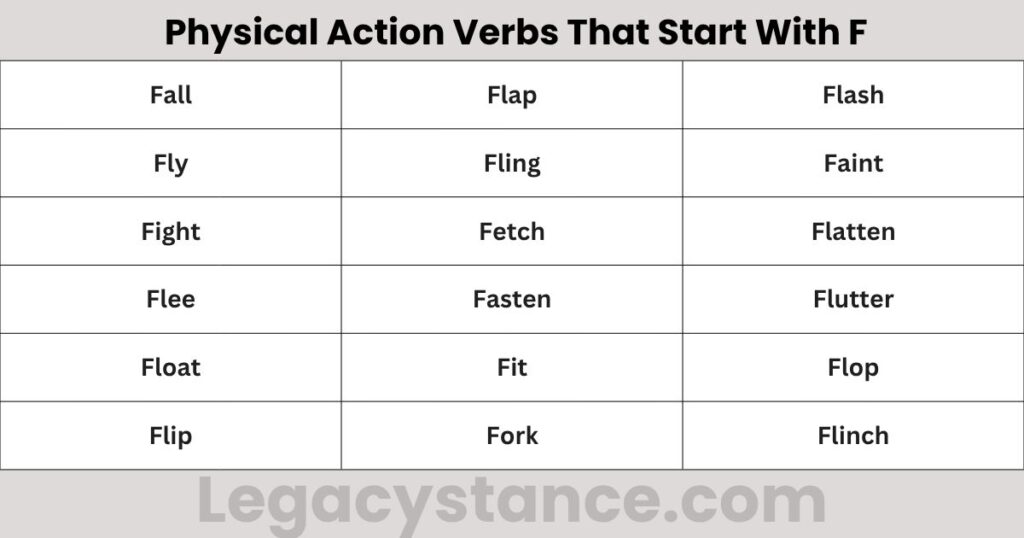
These are verbs you can see happening — movement, body, and physical effort:
- Fall
- Fly
- Fight
- Flee
- Float
- Flip
- Flap
- Fling
- Fetch
- Fasten
- Fit
- Fork
- Flash
- Faint
- Flatten
- Flutter
- Flop
- Flinch
- Frolic
- Flex
- Flick
- Furl
- Fumble
- Flail
- Forage
- Fracture
- Fragment
- Fray
- Fatten
- Froth
- Frost
- Flunk
- Flog
- Foam
- Flounce
- Flounder
- Flicker
- Fizz
Quick tip: These verbs work best in action-heavy storytelling or sports writing. If you want a reader to see something happening, grab one of these.
Communication Verbs That Start With F
These describe how people speak, share, question, or express:
- Field (questions)
- Fib
- Flatter
- Foreshadow
- Fill in (someone verbally)
- Foreshadow
- Fabricate (a story)
- Fudge (the truth)
- Fluster (someone mid-conversation)
Most people miss this — field is one of the most underused communication verbs in English. “She fielded every question without hesitation” is so much stronger than “she answered.”
Emotional and Abstract Verbs That Start With F
These are the verbs that live in your chest, not your hands:
- Feel
- Fear
- Forgive
- Fantasize
- Fester
- Frustrate
- Fascinate
- Fawn
- Fret
- Fade
- Fixate
- Flow
- Forget
- Falter
- Flare (up)
- Flinch (emotional context — hesitate internally)
- Fail
- Faze
Writer’s Tip: Swap feel for more specific verbs whenever you can. Instead of “he felt scared,” try “he flinched at every shadow.” One word does the work of five.
Academic and Professional Verbs That Start With F
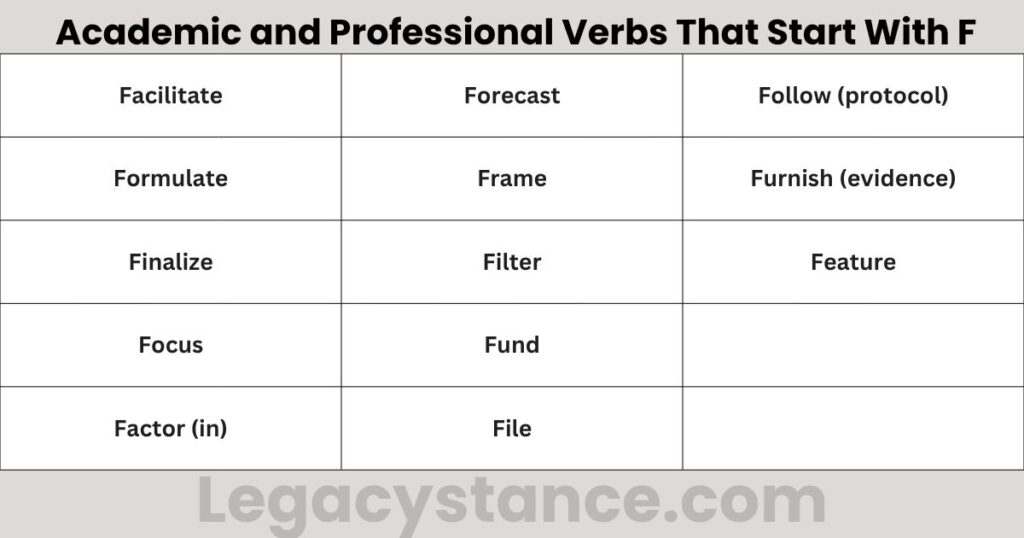
These shine in essays, research papers, reports, and business writing:
- Facilitate
- Formulate
- Finalize
- Focus
- Factor (in)
- Forecast
- Frame
- Filter
- Fund
- File
- Follow (protocol)
- Furnish (evidence)
- Feature
- Function
- Found (establish)
- Familiarize
- Fluctuate
- Forward
Positive Verbs That Start With F
Looking for positive verbs that start with F? These carry uplifting, growth-oriented energy:
- Foster
- Flourish
- Fulfill
- Free
- Forge
- Find
- Fuel
- Fix
- Favor
- Fortify
- Flow (positive sense)
- Fructify
- Flower
- Fan (the flames of hope)
- Follow through
- Freshen
Personal insight: I used to overlook fortify completely. Then I used it in a piece about resilience — “she fortified her routines after the setback” — and it landed perfectly. It suggests active strength-building, not just surviving.
😄 Funny Verbs That Start With F
Some of these are just fun to say out loud:
- Flabbergast
- Fart
- Finagle
- Fuss
- Freak (out)
- Flip out
- Flounce (already in physical — remove here)
Wait — catching that overlap right now. Flounce stays in Physical. Here the clean funny-only list:
- Flabbergast
- Fart
- Finagle
- Fuss
- Freak (out)
- Fidget (nervous comedy)
- Fumble (social awkwardness)
- Fawn (overdone flattery)
Note this: Flabbergast is criminally underused. “His excuse completely flabbergasted the room.” Try it once. You will use it again.
Verbs That Start With F to Describe a Person
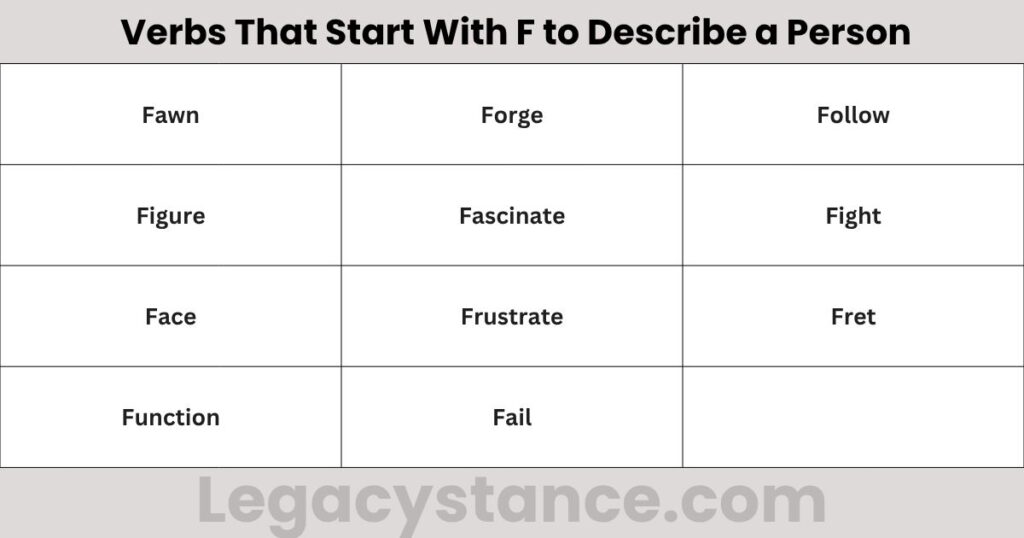
These capture how someone acts, behaves, or carries themselves:
- Fawn (over people)
- Figure (things out)
- Face (challenges head-on)
- Function (well under pressure)
- Forge (connections)
- Fascinate (a room)
- Frustrate (those around them)
- Fail (to communicate)
- Follow (rules rigidly)
- Fight (for others)
- Fret (constantly)
- Free (those around them)
- Flatter (everyone they meet)
- Fabricate (constantly)
Phrasal Verbs That Start With F
Two-word and three-word verbs used in everyday natural English:
- Fall apart — to break down emotionally or physically
- Fall behind — to not keep pace with something
- Fall for — to be tricked, or to fall in love
- Fall through — when a plan fails to happen
- Feel up to — to feel ready or capable
- Figure out — to understand or solve something
- Fill out — to complete a form
- Find out — to discover information
- Fix up — to repair or arrange something
- Follow up — to check back on something
- Follow through — to complete what you started
- Fade out — to gradually disappear
- Face up to — to accept a difficult truth
- Fire up — to excite or start something
- Fend off — to defend against something
- Fork over — to reluctantly pay or hand something over
- Free up — to make time or space available
- Factor in — to include something in your thinking
- Fan out — to spread in different directions
- Flesh out — to add more detail to an idea
- Float around — to exist without clear direction
- Fly by — to pass very quickly
- Fool around — to waste time or act silly
- Force out — to make someone leave
- Freeze out — to deliberately exclude someone
- Front for — to act as a cover for something else
- Freshen up — to clean or refresh yourself
- Flip out — to react wildly or angrily
- Fly off — to leave suddenly in anger
- Fork out — to pay reluctantly (British variant of fork over)
- Fall back on — to rely on something when other options fail
Modern and Tech Verbs Starting With F
Language keeps evolving. These F verbs are used heavily in tech and digital spaces right now:
- Fetch — retrieve data from an API
- Fire — trigger an event in code (“fire a function”)
- Fork — duplicate a code repository for your own use
- Fuzz — send random data inputs to find software bugs
- Flag — mark a post, bug, or content item for review
- Feed — push content into a stream or data pipeline
Verbs That Start With F for Kids and Beginners
Simple, one-syllable F verbs young learners can start using right away:
- Fly — to move through the air
- Fall — to drop down
- Find — to look for and get something
- Feed — to give food to someone or something
- Fill — to put something into a container
- Fold — to bend paper or cloth
- Follow — to go behind someone
- Fish — to try to catch fish
- Frown — to make an unhappy face
- Freeze — to become very cold and still
- Flap — to wave up and down like bird wings
- Fix — to make something work again
Hard F vs. Soft F: In English, F almost always makes the same sound — like in fish, fall, and fix. The one exception? The word of, where F makes a “V” sound. Tricky, right?
Verbs Starting With “Fo” — Special Focus
These deserve their own spotlight since “verbs that start with fo” is one of the most searched F-verb phrases:
- Follow — to go after or obey
- Force — to make something happen through pressure
- Form — to create or shape something
- Forget — to fail to remember
- Forgive — to stop being angry at someone
- Found — to establish or start an organization
- Focus — to concentrate on something
- Forbid — to say something is not allowed
- Forecast — to predict what will happen
- Fortify — to make something stronger
- Foretell — to predict future events
- Foreshadow — to hint at what is coming
- Forsake — to abandon or give up on someone
- Forge — to create with effort, or to fake something
- Foil — to prevent someone’s plan from working
- Fondle — to touch gently
- Fool — to trick someone
- Forbear — to hold back from doing something
- Forage — to search for food in the wild
- Foster — to encourage something to grow gradually
- Forward — to send something along to another person
Common Confusion Pairs — F Edition
Flaunt vs. Flout
- Flaunt = to show off proudly (“She flaunted her new ring.”)
- Flout = to break rules deliberately (“He flouted the dress code.”)
These two get swapped constantly. The quick fix: if someone is showing something, it is flaunt. If they are breaking a rule, it is flout.
Feel vs. Fell
- Feel = present tense (“I feel tired.”)
- Fell = past tense of fall, OR to cut down a tree (“He felled the old oak.”)
Forgo vs. Forego
- Forgo = to give something up willingly (“I will forgo dessert.”)
- Forego = to come before or precede (“The foregoing evidence suggests…”)
Most people write forego when they mean forgo. It is a small mistake editors always catch.
Resume and Business Verbs That Start With F
Strong past-tense F verbs for professional resumes — each shown in a real bullet-point format:
- Facilitated — Facilitated weekly cross-team meetings for 40+ staff
- Finalized — Finalized vendor contracts worth $250,000
- Forecasted — Forecasted quarterly revenue within 3% accuracy
- Formulated — Formulated a new onboarding process that cut training time by 30%
- Founded — Founded the company’s first remote work task force
- Filed — Filed and organized over 500 compliance documents
- Flagged — Flagged critical system vulnerabilities before product launch
- Filtered — Filtered 300+ job applications to identify top 10 candidates
- Fostered — Fostered a collaborative team culture across three departments
- Fulfilled — Fulfilled all client deliverables ahead of schedule
Quick tip: Always use past tense on a resume. Pair every verb with a number when you can — it turns vague claims into evidence.
Creative Writing — Weak vs. Strong F Verbs
| Weak Verb | Strong F Verb | Why It Works Better |
| Walked away quickly | Fled | Adds urgency and fear instantly |
| Looked briefly | Flickered | Shows nervous, fleeting attention |
| Made something | Forged | Implies effort and determination |
| Moved smoothly | Floated | Shows how — not just that |
| Got angry suddenly | Flared up | More vivid and physical |
| Held very tightly | Fisted | Shows tension in the grip |
| Spoke nervously | Faltered | Puts emotion directly into action |
| Got worse slowly | Festered | Adds creeping, quiet tension |
Verbs That Start With F by Word Length
3-Letter F Verbs
- Fly
- Fix
- Fib
- Fan
- Fit
- Fry
- Fog (to make unclear)
4-Letter F Verbs
- Fade
- Fail
- Fake
- Farm
- Fast (to go without food)
- Fawn
- Faze
- Fend
- Fine (to penalize)
- Fire
- Flag
- Flaw (to damage)
- Flee
- Flex
- Flit
- Foam
- Flog
- Fold
- Fool
- Fork
- Foul
- Fret
- Fuel
- Fume
- Fund
- Fuss
5-Letter F Verbs
- Fancy
- Flare
- Flame
- Flesh (out)
- Fight
- Flood
- Floor (to shock someone)
- Flirt
- Fling
- Flush
- Foray
- Found
- Forge (listed again for length reference only — detailed entry above)
- Frame
- Freak
- Frost
- Frown
- Froth
6-Letter F Verbs
- Falter
- Fasten
- Fester
- Fidget
- Figure
- Filter (six letters — kept here only)
- Finish
- Flaunt
- Forbid
- Freeze
Long F Verbs (8+ Letters)
- Fabricate
- Facilitate
- Familiarize
- Fantasize
- Fascinate
- Finalize
- Flabbergast
- Fluctuate
- Foreshadow
- Formulate
- Frustrate
Impact of Word Choice — Side by Side
Weak: She got through the hard time. Strong: She forged through the hardship.
Forged tells you how she got through — with pressure, effort, and resistance. “Got through” is passive and says nothing about her.
Weak: He looked at the door nervously. Strong: He flickered his eyes toward the door.
Flickered shows the quickness and anxiety of the glance. “Looked” is flat. There is no tension in it.
Weak: The problem got worse over time. Strong: The problem festered.
Festered adds time, quiet danger, and a sense of things rotting beneath the surface. “Got worse” makes readers feel absolutely nothing.
Mini Quiz — Which Verb Wins?
Question 1:
A) She moved through the crowd. B) She forged through the crowd.
Answer: B — Forged tells us she had to push against resistance. “Moved” gives no information at all.
Question 2:
A) He felt scared in the dark room. B) He froze in the doorway of the dark room.
Answer: B — Froze shows fear through physical action rather than stating it directly. Show — never just tell.
Quick Reference: Verbs That Start With F
| Verb | Past Tense | Synonym | Best Use Case |
| Focus | Focused | Concentrate | Academic and professional writing |
| Forge | Forged | Create | Storytelling and creative writing |
| Foster | Fostered | Nurture | Positive and growth contexts |
| Fabricate | Fabricated | Invent | Negative or manufacturing contexts |
| Falter | Faltered | Hesitate | Character emotion in fiction |
| Facilitate | Facilitated | Coordinate | Business and resume writing |
| Flinch | Flinched | Recoil | Action scenes and emotional moments |
| Fester | Festered | Worsen | Slow-growing problems in fiction |
| Finalize | Finalized | Complete | Business, contracts, and deadlines |
| Flourish | Flourished | Thrive | Positive and growth narratives |
| Flatter | Flattered | Compliment | Social dynamics and character behavior |
| Forecast | Forecasted | Predict | Business, planning, and weather |
You may like:
115+ Science Words That Start With S | Full List With Meanings
185+ Verbs That Start With E (Simple, Strong, and Ready to Use)
FAQs on Verbs That Start With F
What are the most common verbs that start with F?
The most common in everyday English are fall, feel, find, fix, follow, fight, form, and fly. These show up constantly in speech, reading, and writing.
What are positive verbs that start with F?
Strong positive F verbs include foster, flourish, fulfill, fortify, forgive, free, fuel, facilitate, and focus. All carry energy, growth, or warmth.
What are verbs that start with F to describe a person?
To describe how someone behaves: fascinate, fawn, fight, flourish, foster, fidget, fabricate, follow, and face their problems. Context shapes every one of these.
What is the easiest F verb for kids?
Fly, fix, fall, fill, and fold — all one syllable, clear meaning, and easy to picture immediately.
What are funny verbs that start with F?
Flabbergast, flail, flounder, flop, frolic, and fib all make sentences more alive and memorable.
Are there F verbs used in tech?
Yes — fetch, flag, fork, fire, fuzz, and feed are all standard in technology and digital media today.
Final Thoughts
F verbs are not just a list to scroll through and forget. They are a writing toolkit.
The difference between a dull sentence and a gripping one often comes down to a single verb. “She walked away” versus “she fled.” “He made it work” versus “he forged a solution.” Same idea — completely different weight.
Most people stick to the same handful of verbs their whole life. That is exactly why their writing sounds like everyone else’s. When you reach for falter, fester, forge, or flabbergast, your sentences start sounding specific — alive — and unmistakably yours.
Whether you are building a resume, writing a story, studying for a test, or just trying to win at word games — this guide has what you need. Come back to it. Keep adding to your vocabulary. One better verb at a time.