
If you’ve ever come across a tricky science term and felt lost. Learning Science Words That Start With F can feel overwhelming at first, especially when the same words show up in physics, biology, and chemistry.
This guide keeps things simple. It breaks down meanings in plain language and shows how these words connect to real life — from how your body works to how the universe moves. Whether you’re studying for a test or just curious, this is built to help you understand, not just memorize.
20 Most-Used Science Words That Start With F
These show up constantly — in textbooks, on exams, in lab reports. Start here.
- Force — A push or pull that changes motion
- Friction — Resistance when two surfaces rub together
- Frequency — How many wave cycles happen per second
- Fusion — Combining nuclei to release energy
- Fission — Splitting a nucleus to release energy
- Fossil — Preserved remains of ancient organisms
- Fermentation — Breaking down sugars without oxygen
- Fluid — A substance that flows — liquid or gas
- Filament — A thin thread-like structure or wire
- Flora — All plant life in a specific region
- Fauna — All animal life in a specific region
- Focal Point — Where light rays meet after reflection
- Food Chain — Transfer of energy from one organism to the next
- Free Fall — Motion under gravity only, no other force
- Filtration — Separating solids from liquids using a filter
- Formula — Symbolic representation of a chemical compound
- Fungus — Organism that absorbs nutrients from its environment
- Fiber — Thin, thread-like material in plants or synthetics
- Fault — A crack in Earth’s crust where movement occurs
- Flux — Rate of flow of energy, particles, or fluid
Physics Science Words That Start With F
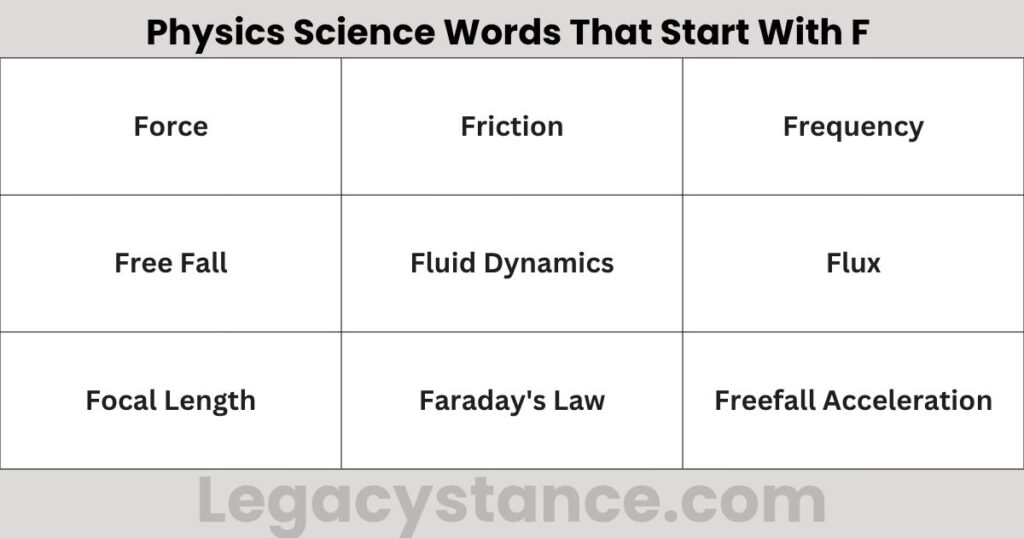
Force — Every time you kick a ball or hold a book up, you’re applying force. Measured in Newtons. Without force, nothing in the universe changes its motion.
Friction — Rub your hands together. That warmth is friction — resistance between two surfaces in contact. Cars brake because of it. Floors stay safe because of it.
Frequency — Sound, light, and radio all travel in waves. Frequency counts how many complete waves pass a point in one second, measured in Hertz (Hz). Higher frequency means higher pitch in sound, or more energetic light.
Free Fall — When something falls with only gravity acting on it — no air resistance, no support. Astronauts in orbit are technically in constant free fall. It just looks like floating.
Fluid Dynamics — The science of how liquids and gases move. Airplane wings, blood flow, ocean currents — all governed by this.
Flux — Describes how much of something (energy, magnetic field, particles) passes through an area. Used in everything from solar panels to MRI machines.
Focal Length — The distance from a lens or mirror to where light focuses. Cameras, telescopes, and human eyes all depend on focal length.
Faraday’s Law — A changing magnetic field creates an electric current. Every electric generator on Earth operates because of this single rule.
Freefall Acceleration — On Earth, all objects in free fall accelerate at 9.8 m/s² regardless of mass. A feather and a hammer fall identically in a vacuum — something that surprises nearly everyone the first time they see it.
Chemistry Science Words That Start With F
Formula — A chemical formula tells you exactly what atoms are in a compound. H₂O means two hydrogen atoms, one oxygen atom. Chemistry’s shorthand.
Filtration — Pour a mixture through filter paper — the solid stays behind, the liquid passes through. Used daily in water treatment plants worldwide.
Fermentation — Yeast and bacteria break down sugars without oxygen, producing alcohol, carbon dioxide, or lactic acid. Bread rising, beer brewing, yogurt forming — all fermentation at work.
Fluorine — The most reactive element on the periodic table. Found in toothpaste (as fluoride), non-stick pans (Teflon), and certain medications.
Flame Test — Hold a metal compound in a flame and watch the color appear. Sodium burns orange-yellow. Copper burns green. Potassium burns violet. One of the most visually satisfying experiments in chemistry.
Free Radical — An atom with an unpaired electron, making it highly reactive. Linked to aging and cell damage. Antioxidants in food work by neutralizing them.
Freezing Point — The temperature at which a liquid becomes solid. Water freezes at 0°C. Adding salt lowers this point — exactly why salt goes on icy roads.
Fractional Distillation — Separates liquid mixtures by their different boiling points. Crude oil gets separated into petrol, diesel, and kerosene through this process.
Biology Science Words That Start With F
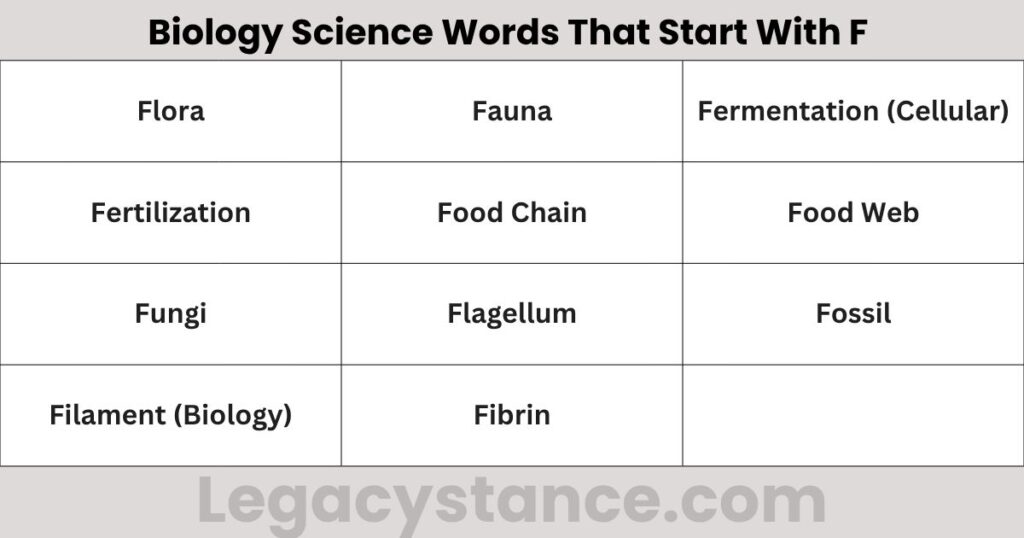
Flora — Every plant species in a region — not just flowers, but every moss, tree, fern, and grass.
Fauna — Every animal species in a region. Flora and fauna together paint the full living picture of an ecosystem.
Fermentation (Cellular) — In biology, this is how cells produce energy without oxygen. Sprint hard enough and your muscles switch to fermentation when oxygen can’t arrive fast enough. That burning sensation is lactic acid building up.
Fertilization — When a sperm cell joins an egg cell, creating the starting point of a new organism. Happens in humans, animals, and flowering plants (using pollen rather than sperm).
Food Chain — Shows who eats whom. Grass → Rabbit → Fox. Only about 10% of energy passes from one level to the next — which is why large predators are always rare.
Food Web — A food chain is one straight path. A food web shows every feeding connection together. Real ecosystems are webs, not chains.
Fungi — Not plants, not animals — their own kingdom entirely. They decompose dead material, help plants absorb nutrients through mycorrhizae, and gave us bread, beer, and penicillin.
Flagellum — A whip-like tail some cells use to move. Sperm cells have one. So do certain bacteria. One of the most ancient movement structures in all of biology.
Fossil — When an organism dies and gets buried, minerals slowly replace its organic material over millions of years, leaving stone shaped exactly like the original creature.
Filament (Biology) — In flowers, the stalk that holds the anther — the pollen-producing part. Easy to overlook, essential for reproduction.
Fibrin — A protein your body produces during clotting. When you cut yourself, fibrin forms a mesh that traps blood cells and seals the wound.
Earth Science Words That Start With F
Fault — A fracture in Earth’s crust where two blocks of rock have moved relative to each other. Earthquakes happen along faults. The San Andreas Fault in California is one of the most studied on Earth.
Fold — Rock layers bent or buckled by pressure from inside Earth. The Himalayas formed partly because tectonic plates pushed rocks into massive folds over millions of years.
Floodplain — Flat land alongside a river that floods when the river overflows. Rich agricultural soil forms here because floods deposit nutrients.
Fossil Fuel — Coal, oil, and natural gas — formed from ancient organic matter compressed over millions of years. They store enormous energy but release carbon dioxide when burned.
Fjord — A long, narrow inlet carved by glaciers, with steep walls on either side. When the glacier retreats, the sea fills the carved valley. Norway is famous for them.
Frost — Ice crystals that form when water vapor in the air freezes directly onto cold surfaces — delicate and feathery, unlike ice which forms from liquid water.
Weather Fronts — A boundary between two air masses with different temperatures. Cold fronts bring sharp temperature drops and storms. Warm fronts bring gradual warming and steady rain.
Fluvial — Relating to rivers and their processes. Fluvial erosion is how rivers carve canyons over thousands of years. The Grand Canyon is the most famous example.
Geological Formation — A body of rock with consistent characteristics — same type, age, and origin — that can be mapped. Scientists read Earth’s history through formations the way others read book pages.
Space & Astronomy Science Words That Start With F
Fusion (Stellar) — In the sun’s core, hydrogen nuclei fuse into helium at 15 million degrees Celsius. The energy released warms Earth from 150 million kilometers away.
Flyby — A spacecraft passing close to a planet or moon without orbiting or landing. NASA’s Voyager probes completed flybys of Jupiter, Saturn, Uranus, and Neptune — gathering data at a fraction of the cost of full missions.
Fireball — A meteor brighter than Venus in the night sky. Some explode in the atmosphere (called bolides). The 2013 Chelyabinsk fireball injured over 1,000 people from its shockwave alone.
Full Moon — When Earth sits between the sun and the moon, the entire lit face becomes visible from Earth. Repeats roughly every 29.5 days.
Flux (Radiation) — Measures how much energy from a star or galaxy reaches a detector. Helps astronomers calculate distances to objects billions of light-years away.
Faint Object — Any star, galaxy, or body too dim for the naked eye but detectable by telescope. Most of the universe is made of faint objects.
Fragmentation (Asteroid) — When asteroids collide, they break into smaller fragments. This is how asteroid families form — and how meteoroids that eventually fall to Earth originate.
Medical & Health Science Words That Start With F
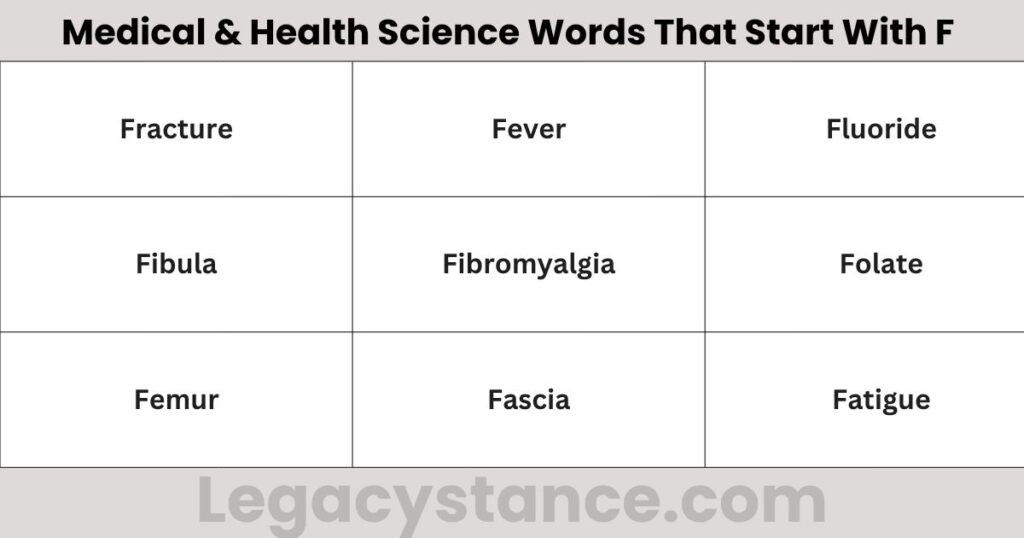
Fracture — A break or crack in a bone. A stress fracture is a tiny crack from repeated pressure, common in runners and athletes — no dramatic snap required.
Fibula — The thinner bone in the lower leg, running alongside the tibia. Slender but critical for ankle stability.
Femur — The thigh bone — the longest, heaviest bone in the human body. Connects the hip to the knee and carries full body weight when standing.
Fever — Body temperature rising above 37°C as an immune response. A mild fever makes the body less hospitable to bacteria and viruses — often a sign the immune system is working.
Fibromyalgia — A chronic condition causing widespread muscle pain and fatigue. Causes aren’t fully understood. More common in women and frequently misdiagnosed.
Fascia — Connective tissue surrounding muscles, organs, and nerves throughout the body. When it tightens or scars, pain and limited movement follow.
Fluoride — Strengthens tooth enamel and prevents cavities. Added to most municipal water and toothpaste. Recommended by dentists for decades.
Folate (Folic Acid) — A B vitamin essential for DNA production and cell growth. Pregnant women need extra because it prevents serious brain and spine defects in the developing fetus.
Fatigue — Not just tiredness. Medical fatigue is persistent exhaustion that doesn’t improve with rest — a symptom found in anemia, autoimmune disease, sleep disorders, and dozens of other conditions.
Technology & Applied Science Words That Start With F
Fiber Optics — Thin glass or plastic strands carrying light signals. Internet data travels through fiber optic cables because light moves information faster and more cleanly than electricity through metal wires.
Frequency Modulation (FM) — Encoding information in radio waves by varying the frequency. FM radio sounds clearer than AM because it resists electrical interference.
Field Effect Transistor (FET) — A transistor type used in nearly all modern electronics. Smartphones and computers run on billions of FETs etched onto tiny chips.
Fuel Cell — Generates electricity through a hydrogen-oxygen reaction, producing only water as a byproduct. Powers some buses, forklifts, and experimental vehicles.
Firmware — Software permanently stored inside hardware. Routers, keyboards, and printers all run firmware — it’s what makes hardware functional straight from the factory.
Firewall — A system that monitors and filters network traffic. Named after the physical firewall — a barrier designed to stop fire spreading through a building.
Force Sensor — Measures applied force. Found in robotics, medical devices, industrial machinery, and touchscreens.
Easy Science Words That Start With F (Grades 4–6)
| Word | Simple Meaning |
| Float | Staying on water because density is lower than water |
| Freeze | A liquid cooling until it becomes solid |
| Fall | Movement toward Earth pulled by gravity |
| Food | Substance an organism consumes for energy and nutrients |
| Fin | Flat limb fish use to steer and move |
| Feather | Lightweight bird structure for flight and warmth |
| Fire | Chemical reaction releasing heat and light as something burns |
| Fog | A cloud that forms at ground level |
| Fiber | Thread-like material in plants or man-made materials |
| Fern | A simple plant that reproduces with spores, not seeds |
Advanced Science Words That Start With F
Fourier Transform — A mathematical method for breaking complex signals into their component frequencies. Used in signal processing, JPEG image compression, and quantum mechanics.
Fluorescence — A substance absorbs light at one wavelength and re-emits it at a longer one. Highlighter pens glow under UV light because of this. Biologists use fluorescent markers to track individual cells.
Fractals — Geometric patterns that repeat at every scale. Zoom in and the same shape appears again infinitely. Coastlines, snowflakes, and certain plant structures display natural fractal geometry.
Fermion — A fundamental particle with half-integer spin — electrons, protons, and neutrons are all fermions. No two fermions can occupy the same quantum state simultaneously (the Pauli Exclusion Principle).
Feynman Diagram — A visual tool representing particle interactions, where every line and vertex carries precise mathematical meaning. Invented by Richard Feynman in the 1940s, still used in cutting-edge physics today.
Feedback Loop — When a system’s output circles back and becomes its own input. Positive feedback amplifies change (microphone screeching near a speaker). Negative feedback stabilizes systems (a thermostat turning off when the room reaches target temperature).
Ferrimagnetism — A type of magnetism where atoms align in opposing directions but unevenly, leaving a net magnetic force. Magnetite is a naturally occurring ferrimagnetic mineral.
Fission-Fusion Dynamics — In social biology, groups that split apart and reform flexibly. Chimpanzees and dolphins both use this strategy — no fixed permanent group, just fluid social reshaping.
Complete Reference List — 100+ Science Words That Start With F
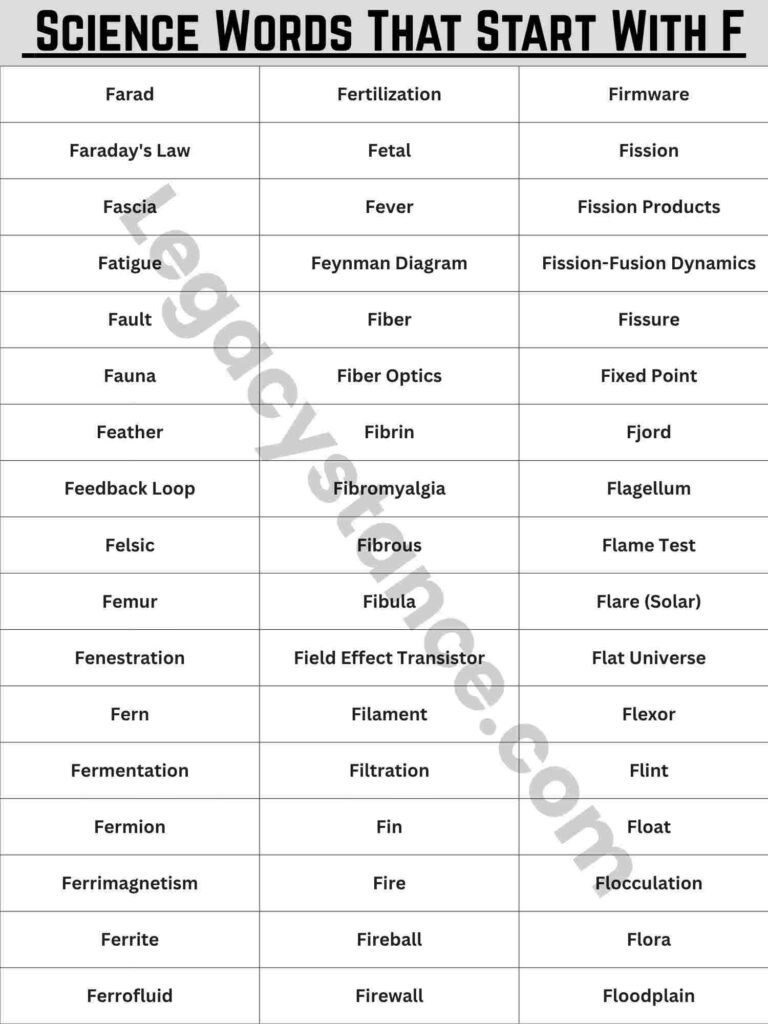
Farad — Unit of electrical capacitance
Faraday’s Law — Changing magnetic fields create electric current
Fascia — Connective tissue surrounding muscles and organs
Fatigue — Persistent exhaustion unrelieved by rest
Fault — Crack in Earth’s crust where movement has occurred
Fauna — All animal life in a specific area
Feather — Bird structure for flight and insulation
Feedback Loop — Output that cycles back as input
Felsic — Light-colored rock with high silica content
Femur — Longest bone in the human body
Fenestration — Openings or pores in membranes or bones
Fern — Spore-reproducing vascular plant
Fermentation — Sugar breakdown without oxygen
Fermion — Fundamental particle with half-integer spin
Ferrimagnetism — Unequal opposing magnetic alignment in materials
Ferrite — Magnetic iron compound used in electronics
Ferrofluid — Magnetic liquid responding to magnetic fields
Fertilization — Union of sperm and egg cells
Fetal — Relating to the fetus stage of development
Fever — Elevated body temperature as immune response
Feynman Diagram — Visual map of particle interactions
Fiber — Thread-like structure in plants or materials
Fiber Optics — Light-carrying glass strands for data transmission
Fibrin — Blood clotting protein mesh
Fibromyalgia — Chronic widespread pain condition
Fibrous — Having a thread-like or stringy texture
Fibula — Thin lower leg bone
Field Effect Transistor — Electronic component controlling current with voltage
Filament — Thin thread structure in cells or devices
Filtration — Separating solids from liquids via filter
Fin — Limb for steering in water
Fire — Rapid oxidation releasing heat and light
Fireball — Extremely bright atmospheric meteor
Firewall — Network security barrier
Firmware — Permanent software inside hardware devices
Fission — Splitting atomic nucleus to release energy
Fission Products — Smaller nuclei formed after nuclear fission
Fission-Fusion Dynamics — Flexible animal group splitting and reforming
Fissure — Narrow crack in rock or body tissue
Fixed Point — Stable value in mathematical iteration
Fjord — Glacier-carved narrow coastal inlet
Flagellum — Whip-like cell structure for movement
Flame Test — Color-based metal identification using flame
Flare (Solar) — Sudden energy burst from the sun’s surface
Flat Universe — Cosmological model with zero spatial curvature
Flexor — Muscle that bends a joint
Flint — Hard sedimentary rock used historically for tools
Float — Staying on water’s surface via buoyancy
Flocculation — Clumping of particles in suspension
Flora — All plant life in a specific area
Floodplain — Flat land beside rivers prone to flooding
Flow Rate — Volume of fluid passing a point per unit time
Fluid — Substance that flows — liquid or gas
Fluid Dynamics — Science of liquid and gas movement
Fluorescence — Light absorbed and re-emitted at longer wavelength
Fluorescent — Emitting visible light after absorbing radiation
Fluoride — Mineral strengthening tooth enamel
Fluorine — Most reactive element on the periodic table
Fluvial — Related to river processes
Flyby — Spacecraft passing near a celestial body
Focal Length — Distance from lens to focus point
Focal Point — Where light rays converge
Fog — Low-lying cloud at ground level
Folate — B vitamin essential for DNA and cell growth
Fold (Geological) — Bent or buckled rock layers
Folic Acid — Synthetic form of folate used in supplements
Follicle — Small sac in skin or ovary
Food Chain — Linear energy transfer sequence in ecosystems
Food Web — Interconnected feeding relationships in an ecosystem
Foramen — Natural opening in a bone
Force — Push or pull causing change in motion
Force Sensor — Device measuring applied force
Formic Acid — Simplest carboxylic acid, found in ant stings
Formation (Geological) — Mappable rock body with consistent properties
Formula (Chemical) — Symbolic representation of compound composition
Fossil — Preserved remains of ancient organisms
Fossil Fuel — Energy-rich material from ancient organic matter
Fossil Record — Accumulated collection of all known fossils
Fourier Transform — Mathematical signal decomposition technique
Fractal — Self-repeating geometric pattern
Fractional Distillation — Separating liquids by boiling point differences
Fracture — Break or crack in bone or rock
Fracture Zone — Region of faulted ocean floor
Free Energy — Energy available to do work in a thermodynamic system
Free Fall — Motion under gravity alone
Free Radical — Highly reactive atom with unpaired electron
Freeze — Transition from liquid to solid state
Freezing Point — Temperature at which a liquid becomes solid
Frequency — Number of wave cycles per second
Frequency Band — Range of frequencies within a spectrum
Frequency Modulation — Radio encoding via frequency variation
Friction — Resistance force between surfaces in contact
Front (Weather) — Boundary between differing air masses
Frontal Lobe — Front section of the brain’s cerebral cortex
Frost — Ice crystals forming from water vapor on cold surfaces
Frostbite — Tissue damage from freezing temperatures
Fructose — Simple sugar found naturally in fruits
Fuel Cell — Electricity from hydrogen-oxygen chemical reaction
Full Moon — Moon fully illuminated as seen from Earth
Full Spectrum — Entire range of a particular type of radiation
Fundamental Force — One of four basic forces governing the universe
Fungi — Kingdom including molds, yeasts, and mushrooms
Fusion — Combining atomic nuclei to release energy
Fusion Reactor — Device replicating stellar fusion for energy production
Flywheel — Rotating mechanical device storing rotational energy
Common Confusions — Words People Mix Up
Fission vs. Fusion Both involve atomic nuclei and release enormous energy — that’s where the similarity ends. Fission splits heavy atoms (nuclear power plants). Fusion joins light atoms (the sun). One tears apart. One brings together.
Flora vs. Fauna Flora = plants. Fauna = animals. Memory trick: Flora sounds like flower. Fauna sounds like fawn (a baby deer). One word, one kingdom, locked in.
Frequency vs. Wavelength Frequency counts how many waves pass per second. Wavelength measures how long each wave is. Higher frequency always means shorter wavelength — they move in opposite directions.
Food Chain vs. Food Web A food chain is a single straight path: plant → insect → bird → hawk. A food web shows all paths together. Real ecosystems are webs. Food chains are simplified models used for teaching.
Fracture vs. Fault A fracture is any break — in bone or rock. A fault is a specific fracture in Earth’s crust where movement has already occurred. All faults are fractures, but most fractures aren’t faults.
Fungus vs. Flora Fungi look plant-like but belong to their own separate kingdom. Calling fungi “flora” is a common mistake — even among adults. They’re fundamentally different organisms.
Fermentation vs. Filtration Both start with F and appear in chemistry class — that’s where the similarity stops. Fermentation is a biological chemical process (sugars breaking down). Filtration is a physical separation technique (particles removed from liquid). Different mechanisms, different purposes.
Real-Life Places These Words Appear
Science vocabulary doesn’t live only in textbooks.
Hospitals — Fracture, femur, fibula, fever, fascia, fibrin, fluoride, fatigue, folate
Weather forecasts — Front, fog, frost, floodplain, fluvial
Physics labs and engineering — Force, friction, frequency, flux, feedback loop, fluid dynamics
Kitchens and food production — Fermentation, fructose, fiber, filtration, freeze
Power generation — Fission, fusion, fossil fuel, fuel cell, flow rate
Space centers — Flyby, fireball, full moon, fusion (stellar), flux density
Electronics and computing — Fiber optics, firmware, firewall, FET, FM, frequency band
You may like to read:
90+ Science Words That Start With G | Full List with Meanings
140+ Science Words That Start With C (Meanings for Students & Beginners)
FAQs on Science Words That Start With F
1. How can I remember science words without forgetting them later?
Focus on understanding, not memorizing. Link each word to something real. For example, think of friction when you rub your hands together. The brain keeps what it connects to daily life.
2. Why do some science words have more than one meaning?
Because science fields overlap. A word like flux appears in physics, biology, and earth science, but the core idea—flow or change—stays the same. Context changes the details.
3. What’s the easiest way to study a long list like this?
Break it into small groups. Study 10–15 words at a time, then test yourself. Mixing categories (like biology + physics) actually improves memory more than cramming one topic.
4. Are these words useful outside school?
Yes. Words like fiber, fuel, fracture, and frequency show up in health, technology, and everyday conversations. Understanding them makes real-world topics easier.
Final Words
Learning Science Words That Start With F isn’t about memorizing definitions for a test and forgetting them later. It’s about building a base that helps you understand how things actually work — from your body to the world around you.
Come back to this list when you need clarity, not just answers. The more you connect these words to real situations, the more they’ll stick. Science gets easier when the words start making sense — and that’s exactly where this guide helps.