Verbs that start with E are some of the most powerful action words in English. They cover physical movement, deep emotion, sharp professional language, and everyday conversation. Common examples include earn, explain, explore, express, and engage.
This guide organizes 185+ E verbs by category — whether you’re a student building vocabulary, a writer sharpening sentences, or someone crushing a word game, you’ll find exactly what you need here.
Quick List: Top 10 Most Useful Verbs That Start With E
- Earn — great for resumes and real-life context
- Explain — essential for academic and everyday writing
- Explore — perfect for creative and travel writing
- Express — strong in emotional and personal writing
- Engage — professional favorite in business writing
- Establish — powerful in formal and academic work
- Evaluate — key verb in research and reports
- Evolve — ideal for long-term growth and change
- Encounter — vivid and unexpected in storytelling
- Execute — sharp and decisive in business or action writing.
Action Verbs That Start With E (Physical Movement)
These describe doing something with your body — concrete, direct, easy to visualize.
- Edge
- Eject
- Elbow
- Embark
- Erase
- Erect
- Erupt
- Evade
- Excavate
- Exercise
- Exhale
- Exert
- Exit
- Extract
Quick tip: When writing an action scene, swap move for edge or evade. The tension shift is immediate.
Communication Verbs That Start With E
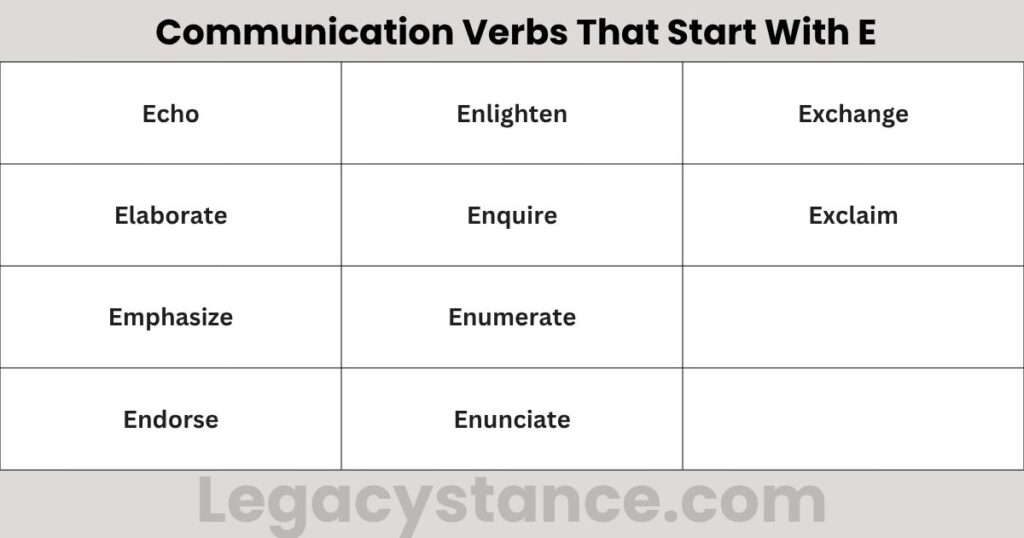
These describe how we talk, share, or connect with others — useful in essays, dialogue, and business writing.
- Echo
- Elaborate
- Emphasize
- Endorse
- Enlighten
- Enquire
- Enumerate
- Enunciate
- Exchange
- Exclaim
Here’s the catch — many writers use said or told in dialogue when a verb like exclaimed or elaborated would do so much more work.
Emotional and Abstract Verbs That Start With E
These describe feelings, mental states, or inner experiences — perfect for journaling, poetry, and personal essays.
- Ease
- Ebb
- Empathize
- Endure
- Enrich
- Enshrine
- Enthrall
- Envy
- Estrange
- Exalt
- Excite
- Exhilarate
Most people miss this: emotional verbs aren’t weak. Endure hits harder than deal with. Enthrall is more alive than interest.
Academic and Professional Verbs That Start With E
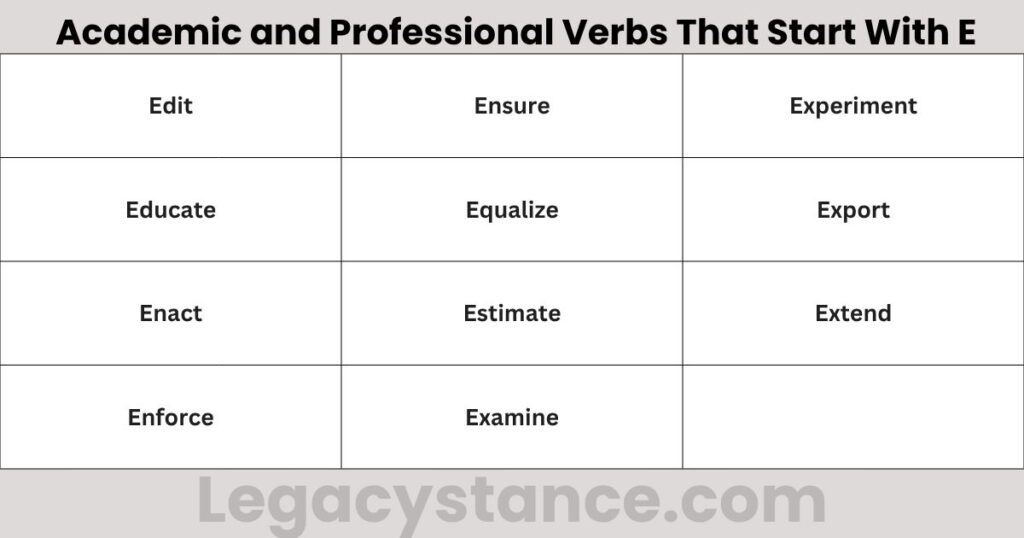
These belong on your resume, inside a research paper, or in a business report.
- Edit
- Educate
- Enact
- Enforce
- Ensure
- Equalize
- Estimate
- Examine
- Experiment
- Export
- Extend
Positive and Growth Verbs That Start With E
These carry forward motion — progress, learning, building something worthwhile.
- Elevate
- Empower
- Energize
- Envision
- Equip
- Excel
- Exceed
- Embrace
- Encourage
These are the verbs that start with E to describe a person growing — excelling, embracing challenge, empowering others — the kind of language that makes character descriptions feel alive.
Phrasal Verbs That Start With E
Phrasal verbs carry a different meaning than the base word alone. Here are the most useful E-based ones:
- Ease into — to start something gradually (She eased into the new routine.)
- Ease off — to reduce pressure (The rain eased off by noon.)
- Eat up — to consume completely (The project ate up all our time.)
- Edge out — to barely beat someone (He edged out the competition.)
- Egg on — to encourage bad behavior (His friends egged him on.)
- Empty out — to remove everything (She emptied out the closet.)
- End up — to finally reach a result (They ended up working together.)
- Enter into — to begin formally (Both parties entered into an agreement.)
- Even out — to become equal (The scores evened out by halftime.)
Resume and Business Verbs That Start With E
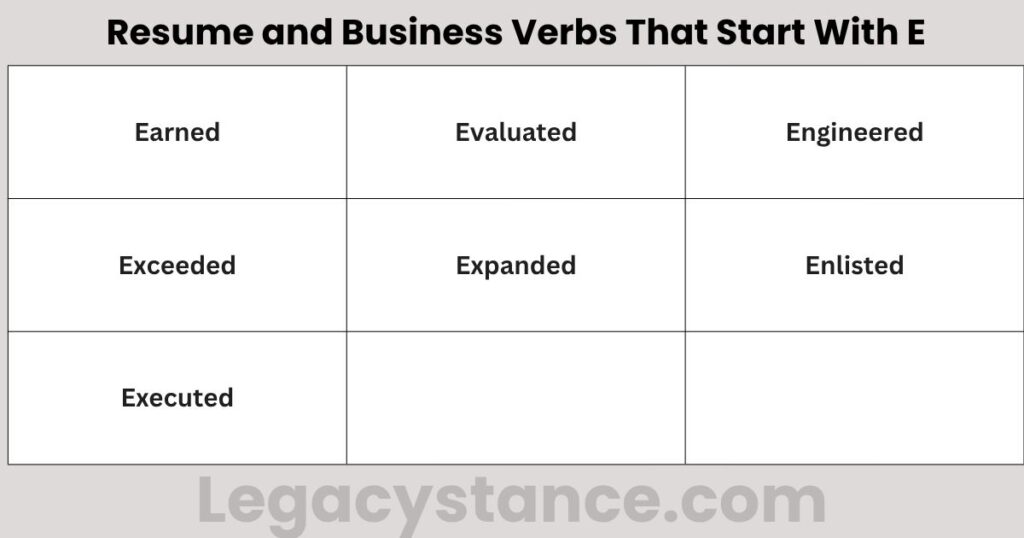
These verbs signal action, ownership, and results — exactly what hiring managers want to see.
- Earned — Earned a top-performer award two years running
- Exceeded — Exceeded quarterly targets by 22%
- Executed — Executed a full product launch within budget
- Evaluated — Evaluated vendor contracts to reduce operating costs
- Expanded — Expanded client base from 12 to 47 accounts
- Engineered — Engineered a reporting system that saved 8 hours weekly
- Enlisted — Enlisted cross-functional teams to deliver on time
Note this: Always use past tense on resumes. Present tense belongs in job descriptions — past tense is for accomplishments.
✍️ Creative Writing — Weak vs. Strong Verbs That Start With E
The difference between a boring scene and a gripping one is often a single verb swap.
| Weak Verb | Strong E-Verb | Why It Works Better |
| Walk slowly | Edge forward | Builds suspense one step at a time |
| Look at | Examine | Shows focus and deliberate care |
| Show | Expose | Adds vulnerability and real stakes |
| Use up | Exhaust | Implies total, complete depletion |
| Move away | Escape | Adds urgency and clear intent |
| Avoid | Evade | Implies cleverness, not just absence |
| Hug | Envelop | More physical, more intimate |
| Meet | Encounter | More unexpected, more vivid |
Kids and Beginner Verbs That Start With E
Simple, short, and easy to remember — great for early readers and ESL learners.
- Eat — I eat breakfast every morning.
- End — The story ended well.
- Enter — Enter your name here.
- Enjoy — They enjoy playing outside.
Hard E vs. Soft E — Quick Explanation: The letter E makes two sounds:
- Long E (says its name): eat, enter, equal
- Short E (quick sound): end, effort, egg
Kids learning to read benefit from knowing this early.
Modern and Tech Verbs That Start With E (2026)
These verbs appear constantly in digital workplaces and tech writing today.
- E-sign — Please e-sign the contract before Friday.
- Encrypt — Always encrypt sensitive user data.
- Embed — Embed the video directly into the landing page.
- Enable — Enable two-factor authentication immediately.
Contextual Meaning Differences
The same verb can shift meaning completely depending on where you use it. Most lists never show you this.
Expose — Three Contexts
- Journalism: The report exposed a years-long cover-up.
- Photography: Expose the film to light carefully and briefly.
- Cybersecurity: The vulnerability exposed private user data to outside access.
Execute — Three Contexts
- Business: Execute the plan before the quarterly deadline.
- Legal/Historical: The court ordered the sentence to be executed.
- Coding: Execute the command directly in the terminal.
Common Confusions — E Verbs That Trip People Up
Evoke vs. Invoke
- Evoke = bring up a feeling or memory (The song evoked her childhood.)
- Invoke = call upon something for authority (He invoked his right to remain silent.)
Both are powerful. They are not interchangeable.
Ensure vs. Insure vs. Assure
- Ensure = make certain something happens (Ensure the data is backed up.)
- Insure = protect financially (Insure the vehicle before driving.)
- Assure = tell someone with confidence (I assure you, it’s handled.)
Extend vs. Expand
- Extend = make longer or reach further (Extend the deadline by two days.)
- Expand = grow wider or larger (Expand the business into new markets.)
Most writers use these interchangeably. They carry different meanings — and careful readers notice.
Word Length Lists (For Word Games and Scrabble)
3-Letter E Verbs
- Err
- Eye
4-Letter E Verbs
- Emit
- Etch
- Even
5-Letter E Verbs
- Elect
- Emote
- Enrol
- Erode
- Evoke
- Expel
Long E Verbs (8+ Letters)
- Electrify
- Eliminate
- Encapsulate
- Enumerate
- Exaggerate
- Exemplify
- Exhilarate
- Expatriate
- Extinguish
Extension Master List of Verbs That Start With E
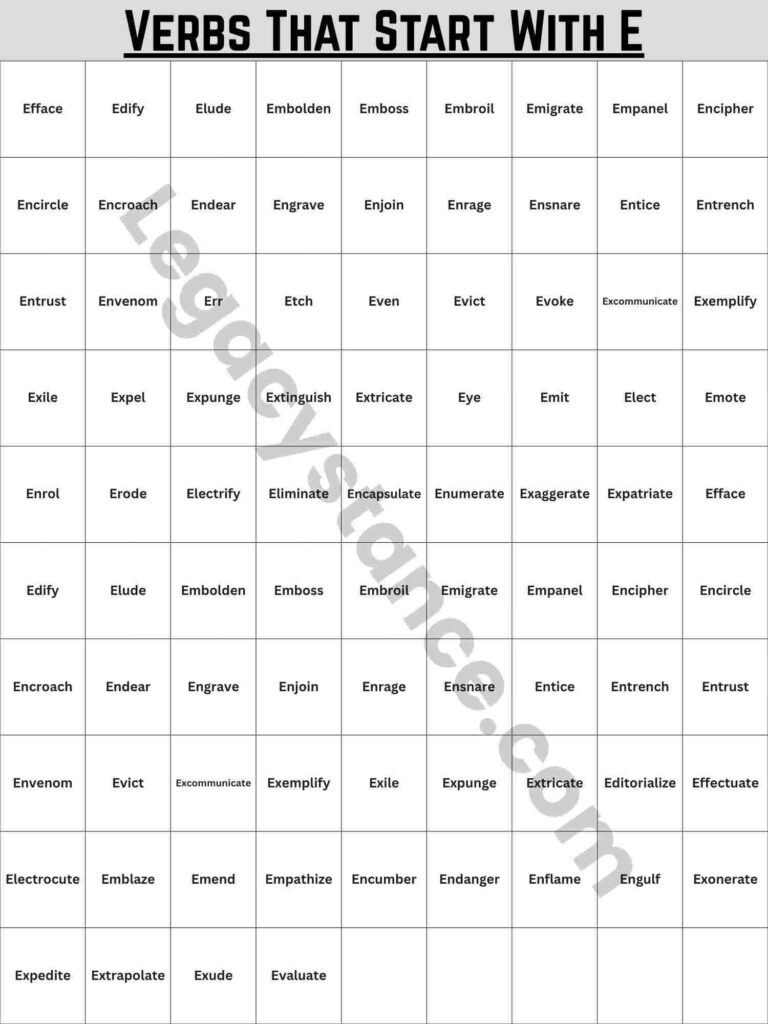
- Efface, Edify, Elude, Embolden, Emboss, Embroil, Emigrate, Empanel, Encipher, Encircle
- Encroach, Endear, Engrave, Enjoin, Enrage, Ensnare, Entice, Entrench, Entrust, Envenom
- Err, Etch, Even, Evict, Evoke, Excommunicate, Exemplify, Exile, Expel, Expunge
- Extinguish, Extricate, Eye, Emit, Elect, Emote, Enrol, Erode, Electrify, Eliminate
- Encapsulate, Enumerate, Exaggerate, Expatriate, Efface, Edify, Elude, Embolden, Emboss, Embroil
- Emigrate, Empanel, Encipher, Encircle, Encroach, Endear, Engrave, Enjoin, Enrage, Ensnare
- Entice, Entrench, Entrust, Envenom, Evict, Excommunicate, Exemplify, Exile, Expunge, Extricate
- Editorialize, Effectuate, Electrocute, Emblaze, Emend, Empathize, Encumber, Endanger, Enflame, Engulf
- Exonerate, Expedite, Extrapolate, Exude, Evaluate
Writing Insight + Word Choice Impact (Merged)
Here is something worth paying attention to across all writing levels — the verb you choose doesn’t just describe an action. It tells the reader how to feel about that action.
Take experience as a verb. Writers almost always use it as a noun: “It was a great experience.” But as a verb — “She experienced genuine fear for the first time” — it pulls the reader inside the moment rather than leaving them watching from outside.
The same principle applies to every swap below:
Weak: He showed his feelings. Strong: He expressed every unspoken thought in a single look.
Expressed is precise. It tells us the feelings were intentional — they came through meaning, not just behavior.
Weak: The fire went through the building. Strong: The fire engulfed the building in under four minutes.
Engulfed creates a visual. It is total, fast, and alarming. Went through is geography. Engulfed is a story.
Mini Quiz — Which Verb Is Stronger?
Round 1:
A. She walked out of the room. B. She exited the room without a word.
✅ Answer: B
Exited carries finality. Combined with “without a word,” it creates silence and tension. Walked out is neutral — it tells us nothing beyond movement.
Round 2:
A. He avoided the question. B. He evaded every question with a smile.
✅ Answer: B
Evaded signals intelligence and intent. The smile adds character. Avoided is flat by comparison.
You may like to read:
150+ Science Words That Start With D | Definitions & Real Use
115+ Science Words That Start With S | Full List With Meanings
FAQ’s about Verbs That Start With E
Q: What are the most common verbs that start with E?
The most common ones are eat, end, enter, earn, explain, express, and enjoy. These appear in everyday speech, school writing, and professional content regularly.
Q: What are positive verbs that start with E?
Strong positive E verbs include encourage, empower, enrich, elevate, evolve, excel, embrace, and energize. All suggest growth or something good moving forward.
Q: What are negative verbs that start with E?
Negative E verbs include exploit, exclude, evade, estrange, exhaust, exaggerate, and enrage. These describe actions that damage, deceive, or drain.
Q: What is the easiest E verb for kids?
Eat is the easiest — one syllable, clear meaning, used every single day. End, enter, and enjoy are also excellent beginner choices.
Q: What are verbs that start with E to describe a person?
Consider empathizes (understands others), endures (pushes through difficulty), excels (performs above average), encourages (lifts others up), and evolves (keeps growing). These show character through what someone does, not how they look.
Final Thoughts
This collection of 185+ verbs that start with E is built for actual use — not memorization. Every verb here has a home: a résumé bullet, a story sentence, a school essay, a word-game board.
The real skill is not knowing that evade and avoid both mean “to stay away from something.” It is knowing that evade implies cleverness, urgency, and intent — while avoid carries none of that weight. That gap between two similar words is exactly where strong writing lives.
Pick five verbs from this article you have never used before. Put them in real sentences today. That is how vocabulary grows — through use, not through lists.