
If you’re searching for Science Words That Start With D, you’re likely trying to make sense of terms that show up again and again in class, exams, or homework. This guide keeps things simple. You’ll find clear meanings, real-life examples, and words grouped in a way that actually helps you remember them.
Instead of long, confusing explanations, everything here is written in plain language. Whether you’re a student, parent, or teacher, this list helps you quickly understand what each word means and where it fits in science.
20 Most-Used Science Words That Start With D
Density — Mass packed into a given space
DNA — Molecule carrying genetic instructions in living things
Diffusion — Particles moving from crowded to less crowded areas
Decomposition — Dead matter breaking down via bacteria or fungi
Displacement — Liquid volume pushed aside by a submerged object
Dominant — Gene that shows its trait with just one copy
Drought — Long period of very little or no rainfall
Delta — Landform built where a river meets the sea
Dwarf planet — Round solar-orbiting body smaller than a true planet
Doppler effect — Frequency change when source and observer move relative to each other
Dialysis — Machine-based blood filtering when kidneys fail
Ductility — Metal’s ability to stretch into wire without snapping
Diploid — Cell with two full chromosome sets
Divergent — Moving apart — plates, species, or evolutionary paths
Dark matter — Invisible mass detected only through its gravity
Disinfectant — Chemical that kills surface germs
Dormancy — Organism’s resting state during harsh conditions
Differentiation — How identical cells become specialized (muscle, nerve, skin)
Diastole — Heart’s relaxation phase — the lower blood pressure number
Deceleration — Rate of slowing down; negative acceleration
Physics Science Words That Start With D
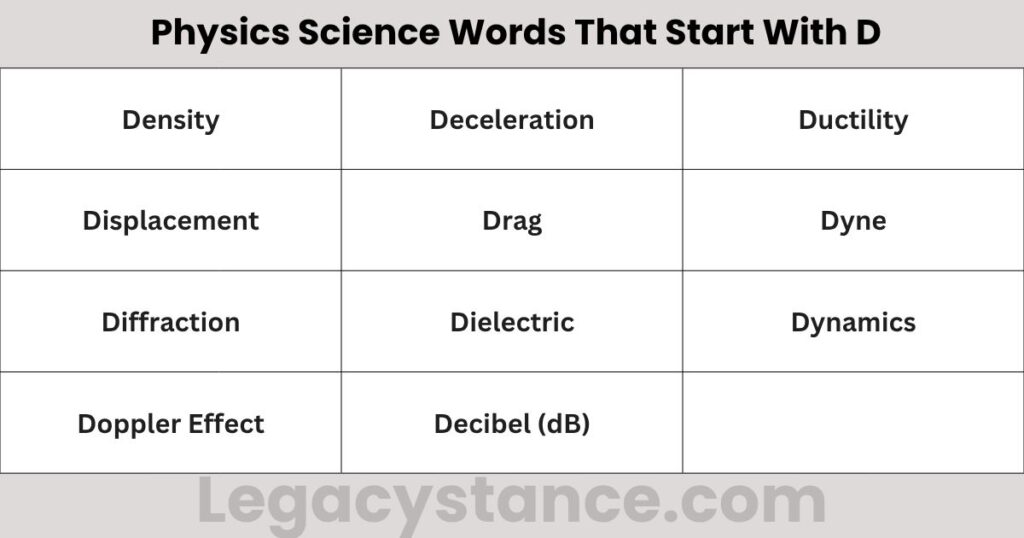
Physics asks how and why things move, interact, and exist. These terms are foundational.
Density — Mass divided by volume. Ice floats on water because it’s less dense. Ships float despite being steel because their overall density stays low.
Displacement — The volume of liquid an object pushes aside when submerged. Drop a rock in a full glass — the overflow equals the rock’s volume.
Diffraction — Waves bending around edges or through narrow gaps. The rainbow shimmer on a CD surface is diffraction in action.
Doppler Effect — An ambulance siren sounds higher as it approaches, lower as it leaves. That pitch change is the Doppler effect — waves compressing toward you, stretching away.
Deceleration — Slowing down. Technically negative acceleration. Braking a car produces deceleration.
Drag — Resistance force from moving through air or water. Streamlined car designs minimize drag to save fuel.
Dielectric — A poor conductor that stores electrical energy. Capacitors inside phones and laptops rely on dielectrics.
Decibel (dB) — Unit of sound intensity. Conversation ≈ 60 dB. Jet engine ≈ 140 dB.
Ductility — A metal’s ability to be drawn into wire. Copper wiring exists because copper is highly ductile.
Dyne — A very small unit of force from the CGS measurement system. Roughly the weight of a mosquito.
Dynamics — The branch of physics studying forces and the motion they produce.
Chemistry Science Words That Start With D
Decomposition Reaction — One compound splits into simpler substances. Heating limestone releases carbon dioxide — that’s decomposition.
Dilution — Adding solvent to weaken a solution. Mixing water into concentrated juice is dilution.
Distillation — Separating mixtures by heating. Substances with different boiling points separate as vapors and recollect. Used to produce pure water and alcohol.
Dissolution — A solute disappearing into a solvent to form a solution. Salt vanishing into water is dissolution.
Dipole — A molecule with one slightly positive end and one slightly negative end. Water is a dipole — which is why it dissolves so many substances.
Denaturing — Heat or chemicals destroying a protein’s shape, stopping it from functioning. Frying an egg denatures the white’s proteins.
Deuterium — A heavier hydrogen isotope carrying one extra neutron. Used in nuclear fusion research.
Desiccant — A moisture-absorbing substance. The tiny silica gel packets in packaging are desiccants.
Dispersion — White light splitting into its color spectrum through a prism.
Double Bond — Two atoms sharing two pairs of electrons. Carbon dioxide contains double bonds between carbon and oxygen.
Dalton (Da) — Unit of atomic mass. One dalton ≈ mass of one proton or neutron.
Delocalized Electrons — Electrons not fixed to one atom, free to move across a structure. They make metals and graphite electrically conductive.
Biology Science Words That Start With D
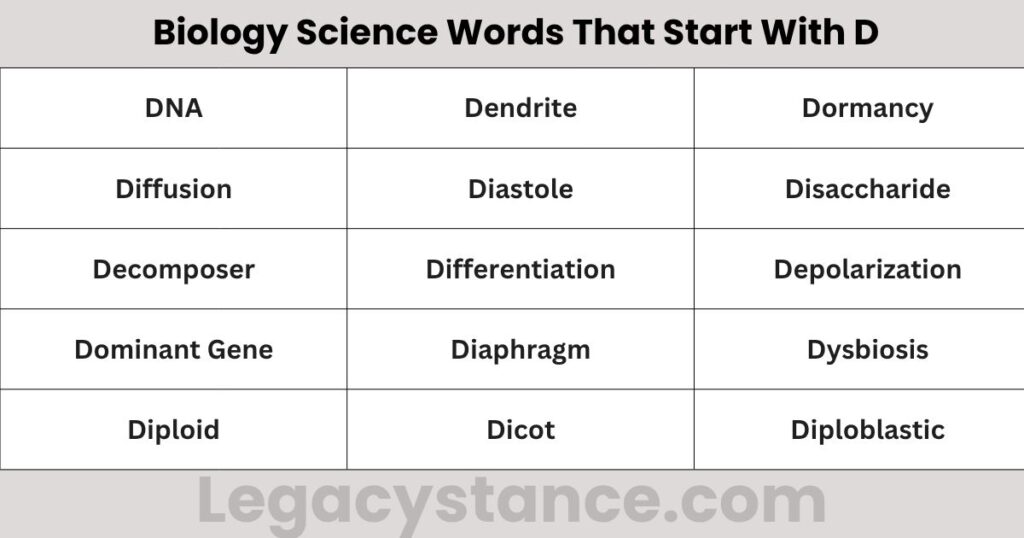
DNA (Deoxyribonucleic Acid) — The twisted-ladder molecule inside every cell holding the complete instructions for building and running an organism.
Diffusion — Molecules drift naturally from high concentration to low. Oxygen enters your bloodstream from your lungs this way — no active pumping needed.
Decomposer — Fungi and bacteria that break down dead material. Without them, dead matter would accumulate indefinitely. They’re the ecosystem’s cleanup crew.
Dominant Gene — Shows its effect even with just one copy. Brown eye color dominates blue — which is why brown eyes are more common worldwide.
Diploid — A cell carrying two complete chromosome sets. Human body cells are diploid, containing 46 chromosomes total.
Dendrite — Branch-like extensions on a neuron that receive incoming signals from other nerve cells.
Diastole — The heart’s filling phase. The lower number in your blood pressure reading reflects diastolic pressure.
Differentiation — One fertilized egg eventually becoming trillions of specialized cells — muscle, bone, neuron. Differentiation is what makes that possible.
Diaphragm — The dome-shaped muscle beneath your lungs. It contracts to inhale, relaxes to exhale.
Dicot — A plant producing two seed leaves at germination. Beans, roses, and sunflowers are all dicots.
Dormancy — A biological pause. Seeds wait through winter. Bears reduce metabolism in hibernation. Both are dormancy strategies.
Disaccharide — Two sugar molecules bonded together. Table sugar (sucrose) = glucose + fructose bonded as a disaccharide.
Depolarization — When a nerve cell’s interior becomes briefly positive, triggering a signal to fire. The basis of every thought, sensation, and movement.
Dysbiosis — An imbalance in gut bacteria. Linked to digestion problems, weakened immunity, and some mental health conditions.
Diploblastic — An animal body built from only two developmental layers. Jellyfish and sea anemones are diploblastic.
Earth Science Words That Start With D
Delta — When a river slows at the sea, it drops its sediment load. Accumulated over millennia, that becomes a fan-shaped delta. The Nile Delta is a classic example.
Deposition — Wind, water, or ice dropping the sediment they carry into a new location.
Divergent Boundary — Two tectonic plates pulling apart. The Mid-Atlantic Ridge is a divergent boundary. Iceland sits directly on it.
Drought — Prolonged, significantly below-average rainfall affecting water supply, agriculture, and ecosystems.
Dune — A wind-sculpted sand hill. Dunes migrate slowly as wind shifts sand from one side to the other.
Drainage Basin — All land that drains into a single river system. Rain falling anywhere inside a drainage basin eventually reaches the same river.
Desertification — Productive land permanently degrading into desert. Caused by overfarming, deforestation, and climate shifts — often all three together.
Dyke (geological) — A sheet of hardened magma that cut across existing rock layers as it forced through cracks.
Dip — The angle at which a rock layer tilts from horizontal. Geologists measure dip to map underground structure.
Deciduous — Trees that shed leaves each autumn and regrow them each spring. Oak, maple, and birch are deciduous.
Space & Astronomy Science Words That Start With D
Dark Matter — Can’t be seen or detected directly. Known to exist because of the gravitational effects it produces. Makes up roughly 27% of the universe.
Dwarf Planet — Orbits the sun, is roughly spherical, but hasn’t cleared its orbital neighborhood. Pluto and Ceres are dwarf planets.
Doppler Shift — Stars moving away show redshifted light; stars moving toward us show blueshifted light. Astronomers use this to measure stellar and galactic motion.
Dark Energy — The unknown force behind the universe’s accelerating expansion. Estimated to make up about 68% of everything in existence.
Declination — The celestial coordinate equivalent of latitude. Tells astronomers how far north or south of the celestial equator a star sits.
Dust Disk — The ring of gas and debris surrounding a young star. Planets form from these disks over millions of years.
Dwarf Star — A small, lower-luminosity star. Our sun is a yellow dwarf. White dwarfs are cooling remnants of dead stars.
Double Star — Two stars appearing close in the sky. Binary stars are genuinely gravitationally linked. Some “double stars” just look close from Earth but are actually far apart in space.
Medical & Health Science Words That Start With D
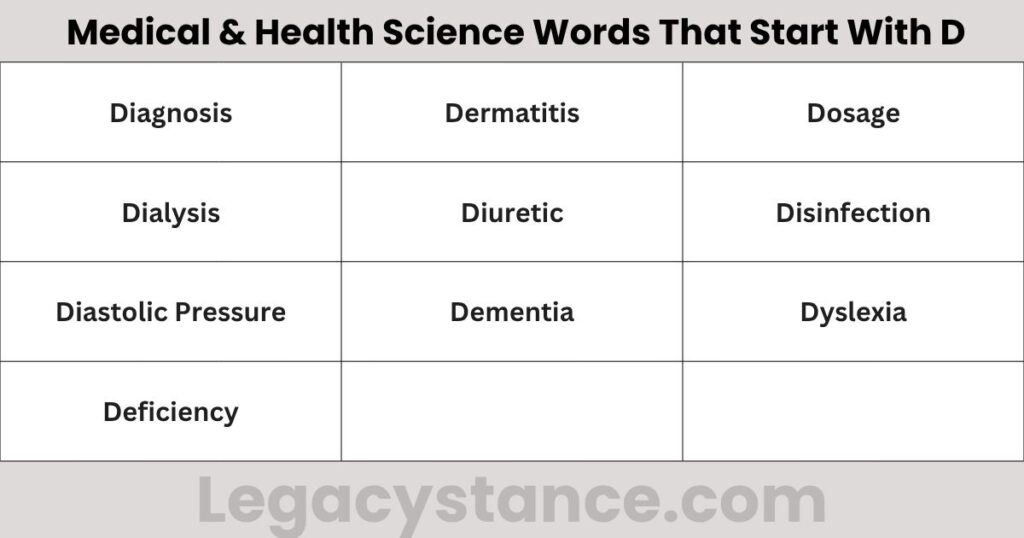
Diagnosis — Identifying a condition based on symptoms, history, and test results. Evidence-based, not guesswork.
Dialysis — Artificially filtering waste from blood when kidneys can no longer do it. Life-sustaining for patients with kidney failure.
Diastolic Pressure — The resting pressure in arteries between heartbeats. The bottom number in any blood pressure reading.
Deficiency — A body lacking something it needs. Vitamin D deficiency weakens bones. Iron deficiency causes fatigue and anemia.
Dermatitis — Skin inflammation from allergens, irritants, or immune reactions.
Diuretic — Increases urination to flush excess fluid. Caffeine is a mild diuretic. Doctors prescribe stronger versions for high blood pressure.
Dementia — Progressive decline in memory and cognitive function severe enough to disrupt daily life. Alzheimer’s is its most common form.
Dosage — Exact amount of medication given at one time. Precision matters — underdosing fails; overdosing harms.
Disinfection — Eliminating or inactivating harmful microorganisms on surfaces. Standard practice in every clinical environment.
Dyslexia — A neurological difference affecting reading and letter processing. Unrelated to intelligence — many dyslexic individuals excel in visual and creative thinking.
Technology & Applied Science Words That Start With D
Data — Raw collected facts. Meaningless alone. Organized and analyzed, it drives every modern decision from medicine to marketing.
Digital — Information encoded as binary (0s and 1s). More accurate and stable than analog signals.
Drone — An unmanned aerial vehicle operated remotely or autonomously. Used in agriculture, delivery, mapping, and defense.
Diode — An electronic component allowing current flow in one direction only. LEDs (light-emitting diodes) are the most visible example.
Debugging — Locating and fixing code errors. A core part of every programmer’s daily work.
Data Compression — Shrinking file size without losing critical information. MP3 audio and JPEG images both use compression.
Decoding — Converting encoded signals back into usable information. Every text message, image, and video call involves decoding.
Dynamic System — Any system that evolves over time according to rules. Weather, ecosystems, and financial markets are all dynamic systems.
Beginner Science Words That Start With D (Grades 3–5)
Short, clear, no jargon.
- Dew — Water droplets forming on cool surfaces when moist air cools overnight
- Dry ice — Solid carbon dioxide; turns directly to gas without melting
- Desert — Region receiving very little rainfall; not always hot (Antarctica qualifies)
- Dinosaur — Prehistoric reptiles that dominated Earth for ~165 million years; extinct ~66 million years ago
- Disease — When a body system stops working correctly due to infection, genetics, or environment
- Dew point — The temperature at which air moisture begins condensing into droplets
- Downstream — Direction a river flows toward
- Daylight — Natural sunlight during daytime hours
Advanced Science Words That Start With D (High School & Beyond)
- Diastereomers — Molecules with identical formulas and bonding but different 3D arrangements — not mirror images. Key in organic chemistry
- Delocalized electrons — Electrons flowing freely across multiple atoms, enabling electrical conductivity in metals
- Deuterium oxide (D₂O) — Heavy water; used as a neutron moderator in nuclear reactors
- Diffraction grating — A surface with thousands of microscopic lines that splits light into its full spectrum; used in spectroscopes
- Disequilibrium — A system out of balance, actively shifting toward a new state; applies in chemistry, ecology, and economics
- Diploblastic — Animal development from only two embryonic layers (ectoderm and endoderm)
- Dysbiosis — Gut microbiome imbalance linked to immune dysfunction and chronic illness
Complete Reference List — 150+ Science Words That Start With D
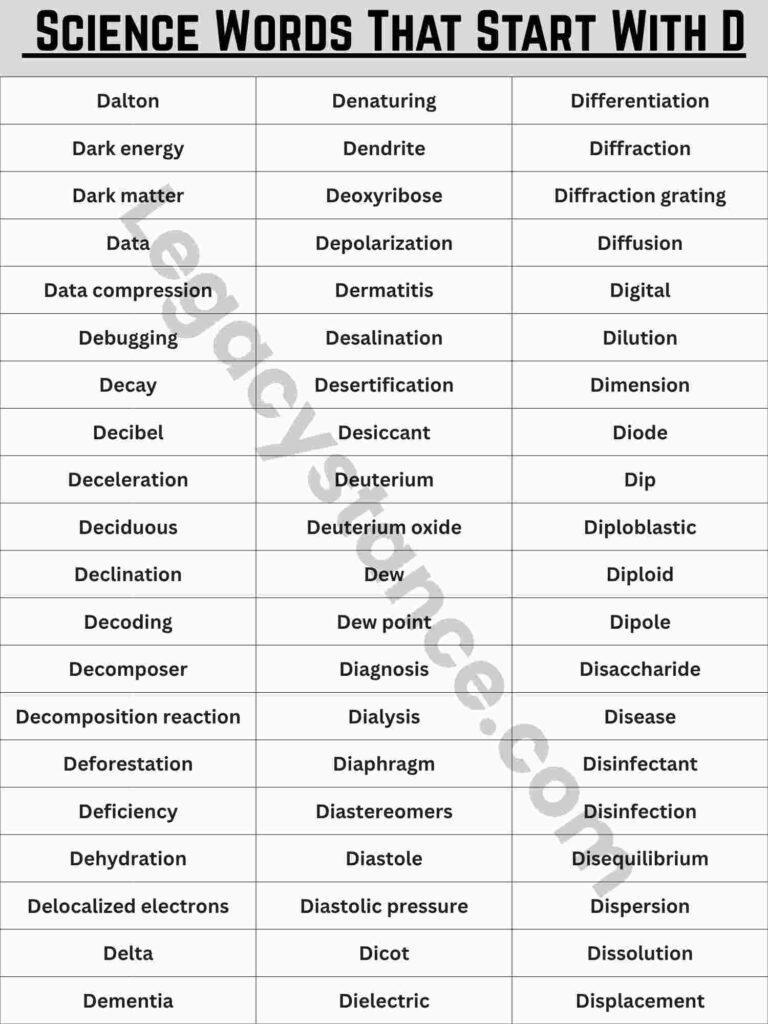
Alphabetical. One-line definitions. Use this to scan quickly before a test.
Dalton — Unit of atomic mass
Dark energy — Force driving the universe’s accelerating expansion
Dark matter — Invisible mass known only through gravity
Data — Raw collected facts
Data compression — Reducing file size without losing key information
Debugging — Fixing errors in computer code
Decay — Gradual breakdown of material or organisms
Decibel — Unit measuring sound intensity
Deceleration — Rate of slowing; negative acceleration
Deciduous — Seasonally leaf-shedding trees
Declination — Celestial north-south coordinate
Decoding — Converting encoded data into readable form
Decomposer — Organism breaking down dead material
Decomposition reaction — One compound splitting into simpler substances
Deforestation — Large-scale removal of forest cover
Deficiency — Body lacking a needed nutrient or substance
Dehydration — Loss of water from body or substance
Delocalized electrons — Electrons moving freely across multiple atoms
Delta — Sediment deposit at a river’s mouth
Dementia — Progressive cognitive decline
Denaturing — Protein structure destruction by heat or chemicals
Dendrite — Neuron’s signal-receiving branch
Deoxyribose — Sugar backbone of DNA
Depolarization — Nerve cell charge reversal triggering a signal
Dermatitis — Skin inflammation
Desalination — Removing salt from seawater
Desertification — Land degradation into permanent desert
Desiccant — Moisture-absorbing substance
Deuterium — Hydrogen isotope with one extra neutron
Deuterium oxide — Heavy water (D₂O) used in nuclear reactors
Dew — Condensed moisture on cool surfaces
Dew point — Temperature at which air moisture condenses
Diagnosis — Identifying a medical condition
Dialysis — Artificial blood filtering process
Diaphragm — Breathing muscle beneath the lungs
Diastereomers — Non-mirror-image structural isomers
Diastole — Heart’s relaxation and filling phase
Diastolic pressure — Blood pressure during heart’s rest phase
Dicot — Plant with two seed leaves at sprouting
Dielectric — Non-conductive material storing electrical energy
Differentiation — Specialization of cells into distinct types
Diffraction — Waves bending around obstacles or through gaps
Diffraction grating — Multi-line surface splitting light into spectrum
Diffusion — Particle movement from high to low concentration
Digital — Binary-encoded information
Dilution — Weakening a solution by adding solvent
Dimension — Measurable extent of space
Diode — One-directional current electronic component
Dip — Rock layer angle relative to horizontal
Diploblastic — Animal with two developmental tissue layers
Diploid — Cell with two full chromosome sets
Dipole — Molecule with opposite charge ends
Disaccharide — Two bonded sugar molecules
Disease — Disruption of normal body function
Disinfectant — Surface germ-killing chemical
Disinfection — Process of eliminating surface microorganisms
Disequilibrium — System actively shifting toward new balance
Dispersion — Light splitting into its color components
Dissolution — Solute dissolving completely into a solvent
Displacement — Volume of liquid moved by submerged object
Distillation — Separating mixtures by boiling point differences
Diuretic — Substance increasing urine output
Divergent boundary — Tectonic plates pulling apart
Divergent evolution — Species developing different traits from common ancestor
DNA — Genetic instruction molecule
Dominant — Gene showing its effect with one copy
Doppler effect — Frequency shift from relative motion
Doppler shift — Light frequency change revealing stellar motion
Dormancy — Biological rest during harsh conditions
Dosage — Precise medication amount
Double bond — Two shared electron pairs between atoms
Double helix — DNA’s twisted-ladder structure
Double star — Two stars appearing close in sky
Downstream — Direction of river flow
Drag — Fluid resistance against motion
Drainage basin — Land area draining into one river system
Drone — Unmanned remotely controlled aircraft
Drought — Extended period of severely low rainfall
Dry ice — Solid carbon dioxide
Ductility — Metal’s ability to stretch into wire
Dune — Wind-formed sand mound
Dust disk — Gas and debris ring around young star
Dwarf planet — Sub-planetary solar-orbiting body
Dwarf star — Small, low-luminosity star
Dynamic equilibrium — Equal rates of opposing reactions or changes
Dynamic system — System evolving over time by defined rules
Dynamics — Physics branch studying forces and motion
Dyke — Hardened magma sheet cutting across rock layers
Dysbiosis — Gut microbiome imbalance
Dyslexia — Neurological reading processing difference
Dyne — Very small CGS unit of force
Common Confusions — D-Words People Mix Up
DNA vs. RNA DNA stores genetic instructions permanently in the cell nucleus. RNA copies and carries those instructions out to build proteins. DNA stays; RNA travels.
Diffusion vs. Osmosis Diffusion = any molecules moving from high to low concentration. Osmosis = specifically water crossing a semipermeable membrane. Osmosis is one type of diffusion — the terms aren’t interchangeable.
Dominant vs. Recessive Dominant shows with one copy. Recessive needs two copies — one from each parent — to appear. You can carry a recessive gene your entire life without ever showing it.
Decomposition (biology) vs. Decomposition Reaction (chemistry) Biology: a dead organism breaking down naturally. Chemistry: a single compound splitting into simpler substances in a lab or industrial reaction. Same word, entirely different contexts.
Diastole vs. Systole Diastole = heart relaxing and filling (lower blood pressure number). Systole = heart contracting and pushing blood out (higher number). Together they make one complete heartbeat cycle.
Drought vs. Desertification Drought is temporary — it ends when rain returns. Desertification is long-term land degradation that may be permanent. Repeated droughts can trigger desertification, but they’re not the same event.
You may also like:
100+ Science Words That Start With F (Meanings + Examples)
123+ Science Words That Start With E: Simple Meanings With Explanations
FAQ’s
1. What are the most important D-words I should learn first?
Start with words you’ll see often: density, diffusion, DNA, decomposition, and dominant. These appear across many topics, so understanding them gives you a strong base for science overall.
2. How can I remember science vocabulary without memorizing everything?
Connect each word to a real example. For example, think of diffusion as perfume spreading in a room. When a word links to something you’ve seen, it sticks much better.
3. Are these words useful for exams or just general learning?
Both. Many of these terms show up in school tests, especially in biology, chemistry, and physics. Learning them also makes it easier to understand lessons instead of just memorizing answers.
4. What’s the easiest way to tell if a word is basic or advanced?
Basic words describe things you can see or feel, like dew or desert. Advanced words explain hidden processes, like depolarization or diastereomers. If it sounds abstract, it’s likely advanced.
What You’ve Got
From dew to deuterium oxide. From grade 3 to advanced biology. Every major D-word in science — defined once, organized clearly, with zero repetition.
Science vocabulary isn’t about memorizing a list. It’s about building a mental map where words connect to real things happening in real systems. These D-words are nodes on that map. The more you recognize them, the more of science starts making sense on its own.