If you’re searching for Science Words That Start With A, you probably don’t want a messy list—you want words that actually make sense. This guide keeps things simple.
Each term is explained in plain language, with real-life meaning you can understand and remember. Whether you’re studying for a test, teaching, or building vocabulary, this page helps you learn faster without confusion.
Quick Answer: 20 Most-Used Science Words That Start With A
- Atom — Smallest unit of matter
- Acid — Substance with pH below 7
- Adaptation — Trait that helps survival
- Atmosphere — Layers of gas around Earth
- Amplitude — Height of a wave
- Artery — Blood vessel carrying blood from heart
- Alloy — Metal mixed with another element
- Antibiotic — Medicine that kills bacteria
- Asteroid — Rocky body orbiting the sun
- Acceleration — Rate of change in speed
- Antibody — Protein fighting infection
- Aquifer — Underground water storage layer
- Aurora — Light display near Earth’s poles
- Axon — Nerve fiber carrying signals
- Asexual — Reproduction without two parents
- Absolute zero — Coldest possible temperature
- Anesthesia — Medical loss of sensation
- Alkaline — Substance with pH above 7
- Allele — Version of a gene
- Algae — Simple water-based organisms
Physics Science Words That Start With A
Physics is about energy, motion, and forces. These words show up in every chapter.
Acceleration — When an object speeds up, slows down, or changes direction. A car pressing the gas pedal is accelerating. So is a ball rolling downhill.
Amplitude — The height of a wave from its flat rest position. Loud sounds have high amplitude. Quiet ones have low amplitude.
Absolute Zero — The temperature where all particle movement stops: −273.15°C. Nothing in nature gets colder than this.
Absorption — When light hits a black shirt and doesn’t bounce back, the fabric absorbed it. That energy turns into heat — why dark clothes feel warmer in sunlight.
Angular Momentum — A spinning object resists stopping. The more mass spinning at greater speed, the higher the angular momentum. Ice skaters use this when they pull their arms in to spin faster.
Acoustics — The science of sound behavior. When a concert hall sounds amazing or a room echoes badly, acoustics explains why.
Arc — A curved path. In electricity, an arc is the visible spark jumping between two conductors. Lightning is a natural electrical arc.
Chemistry Science Words That Start With A
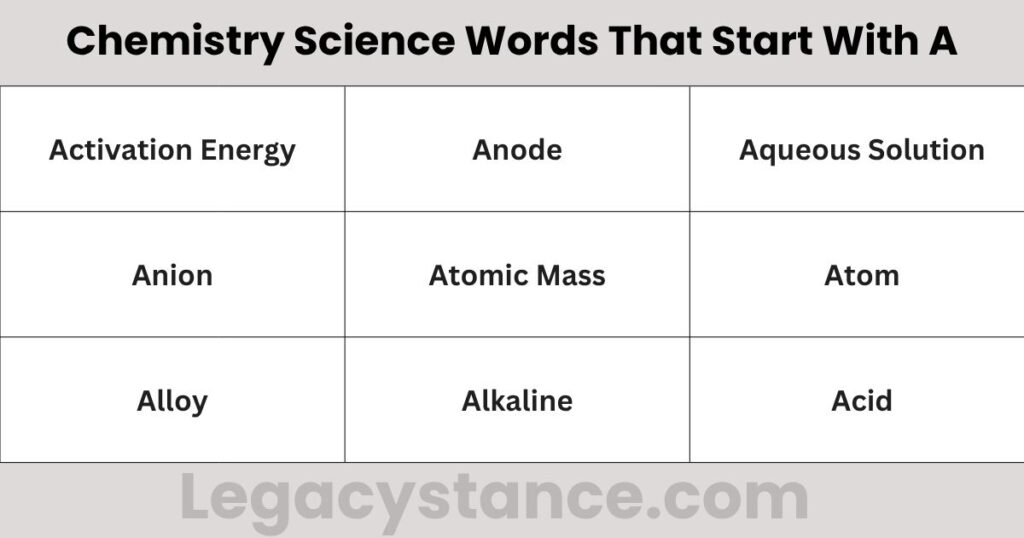
Acid — Acids have a pH below 7. They react with metals and turn litmus paper red. Lemon juice, vinegar, and stomach fluid are all acidic.
Alkaline — The opposite of acid. pH above 7. Baking soda and soap are alkaline. They can neutralize acids.
Alloy — Pure metals are often too soft for real use. Mix copper and tin and you get bronze. Steel is iron mixed with carbon. Both are alloys — stronger than the original metals alone.
Atom — The base unit of every chemical element. Each element’s atom is unique. Hydrogen and oxygen atoms bond to form water.
Atomic Number — The count of protons inside one atom’s nucleus. Every element has a unique atomic number. Carbon’s is 6. Gold’s is 79.
Atomic Mass — The total weight of protons and neutrons in a nucleus. Measured in atomic mass units (amu).
Anion — An atom with extra electrons, giving it a negative charge. In salt water, chloride is an anion.
Aqueous Solution — Any substance dissolved in water. Most chemical reactions in the body happen this way.
Anode — In a battery or electrolysis setup, the anode is the positive electrode where oxidation happens.
Activation Energy — The push a chemical reaction needs to get started. Striking a match gives the wood enough activation energy to ignite.
Biology Science Words That Start With A
Adaptation — A giraffe’s long neck reaches tall trees. A polar bear’s white fur hides it in snow. These traits developed over generations because they helped survival.
Algae — Simple, plant-like organisms living in water. No roots or leaves, but they produce oxygen through photosynthesis. Seaweed is a type of algae.
Artery — Carries oxygen-rich blood away from your heart. Thick-walled because blood moves through at high pressure.
Antibody — When a germ enters your body, your immune system produces these proteins to recognize and destroy it. Vaccines train your body to make them faster.
Axon — The long thread extending from a nerve cell. Carries electrical signals from one neuron to the next — like a wire in your body’s communication system.
Asexual Reproduction — One parent produces offspring alone. Bacteria split in two. Some plants grow new plants from a single cutting.
Allele — Your genes come in pairs. Each version is called an allele. One allele might give you brown eyes, another blue.
Anaerobic — Processes happening without oxygen. Your muscles go anaerobic during intense exercise — that’s the burning feeling.
Aorta — The largest artery in the human body. It leaves the heart and branches to carry blood everywhere.
Apoptosis — Programmed cell death. The body uses this to remove damaged or unnecessary cells. Disruptions in apoptosis can lead to cancer.
Earth Science Words That Start With A
Atmosphere — Five layers of gas wrap around Earth. The layer you breathe is the troposphere. The UV-blocking layer is the stratosphere.
Aquifer — Underground layers of rock that hold water like a sponge. Billions of people drink from aquifers through wells every day.
Alluvial — When a river slows, it drops the sediment it was carrying. That deposited material is alluvial. River deltas form this way.
Arid — Extremely dry land. Less than 250mm of rain per year. Deserts are arid.
Abrasion — Rock and particles scraping surfaces. Wind carrying sand abrades rock into smooth shapes. Glaciers abrade land beneath them, carving valleys.
Anticyclone — A high-pressure system in the atmosphere. Brings calm, dry weather. Rotates clockwise in the Northern Hemisphere.
Ash (Volcanic) — Fine particles of pulverized rock released during eruptions. Can travel thousands of miles and temporarily cool the planet.
Space & Astronomy Science Words That Start With A
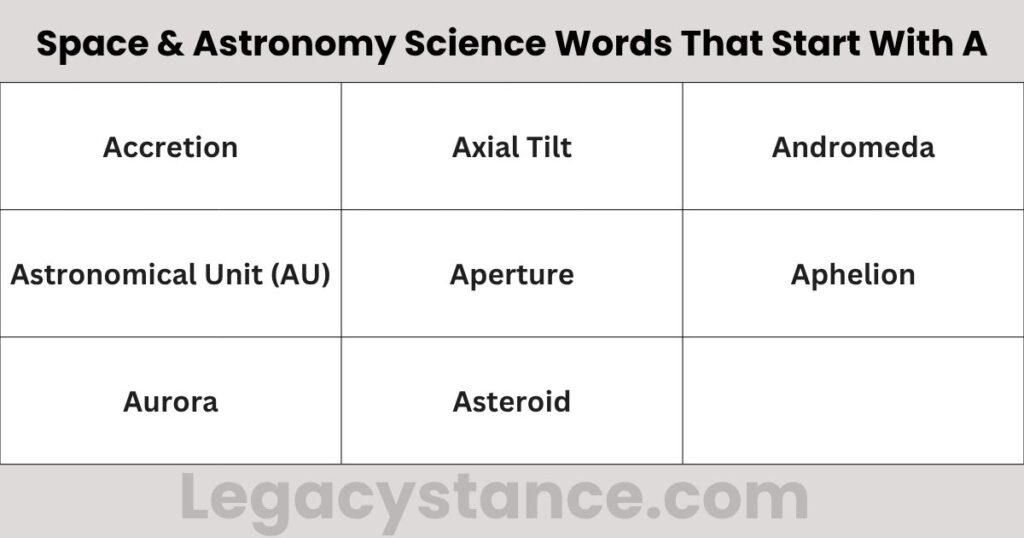
Asteroid — Rocky objects orbiting the sun, mostly between Mars and Jupiter. Some are pebble-sized. Ceres, the largest, is nearly 1,000 km wide.
Aurora — Near the poles, charged particles from the sun hit Earth’s magnetic field and create glowing curtains of light. The Northern Lights are aurora borealis.
Aphelion — The point in a planet’s orbit farthest from the sun. Earth reaches aphelion every July.
Aperture — The opening in a telescope that collects light. Bigger aperture = clearer, brighter images of distant objects.
Astronomical Unit (AU) — The average Earth-sun distance — about 150 million kilometers. Used to measure distances inside the solar system.
Andromeda — The nearest large galaxy to the Milky Way. About 2.5 million light-years away and slowly heading toward us.
Axial Tilt — Earth tilts 23.5 degrees on its axis. That tilt creates seasons. Without it, every day would feel the same.
Accretion — Planets form when particles of dust and rock slowly clump under gravity over millions of years.
Medical & Health Science Words That Start With A
Antibiotic — Kills or stops bacterial growth. Penicillin was the first. Overusing antibiotics creates resistant bacteria — a growing global problem.
Anesthesia — Before surgery, doctors remove sensation so patients feel no pain. General anesthesia = full sleep. Local = numbness in one area only.
Arrhythmia — Irregular heartbeat. Some are harmless. Others signal serious problems. An ECG detects them.
Anemia — Blood doesn’t carry enough oxygen, usually from low red blood cells or iron deficiency. Main symptoms: tiredness and pale skin.
Aneurysm — A dangerous bulge in a blood vessel wall. If it bursts, it can be life-threatening.
Antigen — Any substance that triggers an immune response. Germs carry antigens. So do allergens like pollen.
Asthma — Airways narrow and swell, making breathing difficult. Triggers include dust, smoke, cold air, and exercise.
Anticoagulant — Prevents blood clots. Patients with certain heart conditions take these daily.
Technology & Applied Science Words That Start With A
Algorithm — A step-by-step instruction set that solves a problem. Every app, search engine, and computer program runs on algorithms.
Automation — Machines working without human involvement. Factory robots, autopilot systems, and self-checkout machines are all forms of automation.
Antenna — Sends or receives electromagnetic signals. Your phone, radio, and Wi-Fi router all use antennas.
Analog — A signal that varies continuously, like sound waves in air. Vinyl records are analog.
Artificial Intelligence (AI) — Software performing tasks that typically require human thinking — recognizing faces, translating language, playing chess.
Easy Science Words That Start With A (Grade 4–6)
These are entry-level words. Good starting point for younger students or ESL learners.
Air — The mix of gases we breathe, mostly nitrogen and oxygen.
Animal — A living thing that eats food for energy and can usually move.
Acid rain — Rain containing pollution, making it more acidic than normal.
Attract — When two objects pull toward each other. Magnets attract metal.
Aquatic — Living or found in water.
Axis — The imaginary line a planet spins around.
Advanced Science Words That Start With A
These terms appear in high school, college courses, and research papers.
Anaerobic Respiration — Energy production in cells without oxygen. Produces lactic acid as a byproduct.
Anthropocene — The proposed geological epoch defined by human impact — climate change, mass extinction, microplastic pollution.
Autoimmune — When the immune system attacks the body’s own healthy tissue. Rheumatoid arthritis and lupus are autoimmune conditions.
Adiabatic — A process with no heat exchange with the environment. When rising air cools without transferring heat to its surroundings, that’s adiabatic cooling.
Allotrope — Different structural forms of the same element. Diamond and graphite are both pure carbon, arranged differently.
Action Potential — The electrical signal traveling along a nerve cell when a neuron fires.
Accretion Disk — The rotating ring of gas and dust surrounding a black hole or forming star as material spirals inward.
Complete Reference List: 110+ Science Words That Start With A
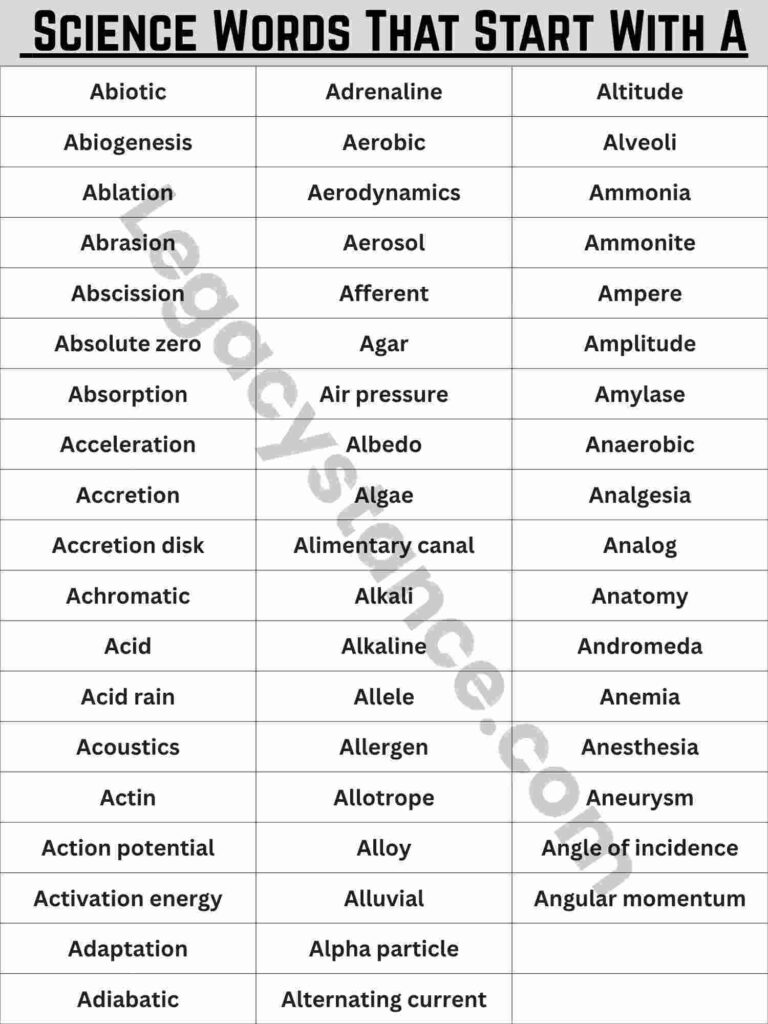
- Abiotic — Non-living parts of an ecosystem
- Abiogenesis — Life arising from non-living matter
- Ablation — Material removal by erosion or surgery
- Abrasion — Wearing away by friction or scraping
- Abscission — Plant shedding leaves or fruit
- Absolute zero — Coldest possible temperature (−273.15°C)
- Absorption — Taking in light, heat, or sound
- Acceleration — Change in speed or direction over time
- Accretion — Building up by gradual addition
- Accretion disk — Rotating matter ring around a black hole
- Achromatic — Free from color distortion in optics
- Acid — Substance with pH below 7
- Acid rain — Pollution-contaminated rain with low pH
- Acoustics — Study of sound behavior
- Actin — Protein involved in muscle contraction
- Action potential — Electrical nerve signal
- Activation energy — Energy needed to start a reaction
- Adaptation — Survival trait developed over generations
- Adiabatic — No heat exchange with surroundings
- Adrenaline — Hormone triggering fight-or-flight response
- Aerobic — Process requiring oxygen
- Aerodynamics — Study of air movement around objects
- Aerosol — Tiny particles suspended in gas
- Afferent — Nerve signals moving toward the brain
- Agar — Gel used in labs for bacterial cultures
- Air pressure — Weight of atmosphere pushing on surfaces
- Albedo — Reflectivity of a surface
- Algae — Simple aquatic photosynthetic organisms
- Alimentary canal — The full digestive tract
- Alkali — Base that dissolves in water
- Alkaline — Having pH above 7
- Allele — Variant form of a gene
- Allergen — Substance triggering allergic response
- Allotrope — Different forms of the same element
- Alloy — Mixture of metals
- Alluvial — Sediment deposited by flowing water
- Alpha particle — Helium nucleus from radioactive decay
- Alternating current — Electrical current reversing direction
- Altitude — Height above sea level
- Alveoli — Tiny air sacs in the lungs
- Ammonia — Compound of nitrogen and hydrogen (NH₃)
- Ammonite — Extinct spiral-shelled sea creature
- Ampere — Unit of electric current
- Amplitude — Wave height from rest position
- Amylase — Enzyme breaking down starch
- Anaerobic — Process without oxygen
- Analgesia — Pain relief without loss of consciousness
- Analog — Continuous signal type
- Anatomy — Study of body structure
- Andromeda — Galaxy nearest to the Milky Way
- Anemia — Low red blood cell or iron condition
- Anesthesia — Medical loss of feeling
- Aneurysm — Bulge in a blood vessel wall
- Angle of incidence — Angle at which light hits a surface
- Angular momentum — Rotational inertia of a spinning object
- Anion — Negatively charged ion
- Anode — Positive electrode in electrolysis
- Anoxic — Lacking dissolved oxygen
- Antenna — Device sending or receiving signals
- Anther — Pollen-producing part of a flower
- Anthropocene — Era defined by human impact on Earth
- Antibiotic — Drug destroying bacteria
- Antibody — Immune protein targeting pathogens
- Anticoagulant — Blood-clot-preventing medication
- Antigen — Substance triggering immune response
- Antifreeze — Substance lowering liquid’s freezing point
- Antinode — Point of maximum wave amplitude
- Anticyclone — High-pressure weather system
- Aphelion — Farthest orbital point from the sun
- Aperture — Light-collecting opening in a telescope
- Apnea — Temporary stop in breathing
- Apogee — Farthest point in orbit around Earth
- Apoptosis — Programmed cell death
- Aqueous — Relating to or dissolved in water
- Aquifer — Underground water-bearing rock layer
- Arc — Curved path or electrical spark
- Archimedes’ principle — Buoyancy equals displaced fluid weight
- Arid — Extremely dry climate or land
- Arrhythmia — Irregular heartbeat
- Artery — Vessel carrying blood from heart
- Arteriole — Small branch of an artery
- Artificial intelligence — Machine-based problem-solving software
- Asexual — Reproduction by single parent
- Asphyxiation — Oxygen deprivation in the body
- Asteroid — Rocky solar system body
- Asthma — Airway inflammation condition
- Astigmatism — Irregular eye curvature affecting vision
- Astronomical unit — Earth-sun distance (~150 million km)
- Atmosphere — Gas envelope around a planet
- Atom — Smallest unit of an element
- Atomic mass — Weight of protons and neutrons in nucleus
- Atomic number — Number of protons in one atom
- ATP — Energy currency molecule of cells
- Atrium — Heart chamber that receives blood
- Atrophy — Wasting away of tissue or organ
- Auditory — Relating to hearing
- Aurora — Polar light display from solar particles
- Autoimmune — Immune system attacking own body
- Automation — Machine-controlled processes
- Autotroph — Organism making its own food
- Avogadro’s number — 6.022 × 10²³ particles per mole
- Axial tilt — Angle of a planet’s rotational axis
- Axis — Imaginary spin line through a body
- Axon — Nerve fiber carrying electrical signals
- Azimuth — Horizontal angle in navigation or astronomy
- Acetone — Common organic solvent compound
- Aorta — Largest artery in the human body
- Anaerobic respiration — Energy production in cells without oxygen
- Adiabatic cooling — Cooling without heat loss to surroundings
You may like to read:
75+ Science Words That Start With I — List with Meanings
95+ Science Words That Start With U | List with Meanings
Common Confusions
Atom vs Molecule An atom is one unit of a single element. A molecule is two or more atoms bonded together. O is one oxygen atom. O₂ is a molecule.
Artery vs Vein Arteries carry blood away from the heart. Veins bring it back. Memory trick: Artery = Away.
Aerobic vs Anaerobic Aerobic needs oxygen — like jogging steadily. Anaerobic doesn’t — like a full sprint. Both produce energy, through different chemical paths.
Acid vs Alkaline Both sit on the pH scale. Acid = below 7. Alkaline = above 7. Pure water = exactly 7 (neutral).
Adaptation vs Evolution Adaptation is one specific survival trait. Evolution is the broader process of species changing across generations. Adaptations are products of evolution.
Asteroid vs Meteorite An asteroid orbits the sun. If it enters Earth’s atmosphere and burns up, it’s a meteor. If a piece survives and hits the ground — that’s a meteorite.
FAQs on Science Words That Start With A
1. What are the most important science words that start with A?
Start with the basics: atom, acid, adaptation, atmosphere, and artery. These show up often in school and help you understand bigger topics later.
2. How can I remember science terms easily?
Break words into parts. For example, “anti” means against, so antibiotic, antibody, and antigen become easier to understand. Learning roots saves time.
3. Are these words suitable for beginners?
Yes. The list includes easy, medium, and advanced words. Beginners can focus on simple terms like air, animal, and axis before moving up.
4. How many words should I learn in one day?
Keep it small—about 5 to 10 words daily. Focus on meaning and examples instead of memorizing long lists all at once.
Conclusion
You now have 110+ science words starting with A — organized by subject, leveled by difficulty, and cleaned of overlap. From atom and acid at the basics, to apoptosis and adiabatic at the advanced end, these terms cover physics, chemistry, biology, earth science, space, medicine, and technology.
Don’t memorize the full list in one sitting. Pick the section that matches your class. Learn five words a day with their real-world meaning. Within two weeks, most of this vocabulary will feel familiar — not forced.
Science vocabulary is a shared language. It lets you understand what’s actually happening in your blood, in the sky, in the ground, and out in space.

Hi, I’m the creator of Legacystance.com, dedicated to making English learning simple and enjoyable. I write clear, practical guides on adjectives, verbs, idioms, pronunciation, spelling, and more. Every article is carefully researched to give accurate, easy-to-understand information. My goal is to help readers improve their English skills confidently, one step at a time, with content that is trustworthy, useful, and beginner-friendly.