Learning Science Words That Start With C becomes much easier when the meanings are simple and connected to real life. This guide is built for students, parents, and beginners who want clear explanations without confusion. Instead of long textbook definitions, you’ll find short, practical meanings you can actually remember.
From basic ideas like cells and circuits to more advanced terms, this list helps you build strong science vocabulary step by step. Whether you’re preparing for exams or just improving your understanding, these words will start to feel familiar quickly.
Quick Answer — 20 Most-Used Science C Words
- Cell — Basic unit of all living things
- Carbon — Element essential to all life on Earth
- Catalyst — Speeds up a chemical reaction without being consumed
- Circuit — Complete path through which electricity flows
- Chlorophyll — Green pigment in plants that captures sunlight
- Chromosome — Thread-like structure in cells carrying genetic information
- Climate — Long-term weather pattern of a region
- Compound — Two or more elements chemically bonded together
- Condensation — Water vapor cooling and turning into liquid
- Conduction — Heat transfer through direct physical contact
- Conservation — Protecting and preserving natural resources
- Corrosion — Metal breaking down through chemical reaction
- Crust — Earth’s outermost rocky layer
- Current — Flow of electric charge or moving water
- Cytoplasm — Jelly-like fluid filling the inside of a cell
- Combustion — Burning reaction releasing heat and light
- Comet — Icy space object that grows a tail near the Sun
- Cornea — Transparent front layer of the human eye
- Capillary — Tiniest blood vessel connecting arteries to veins
- Convection — Heat transfer through moving fluid or gas
Physics Science Words That Start With C
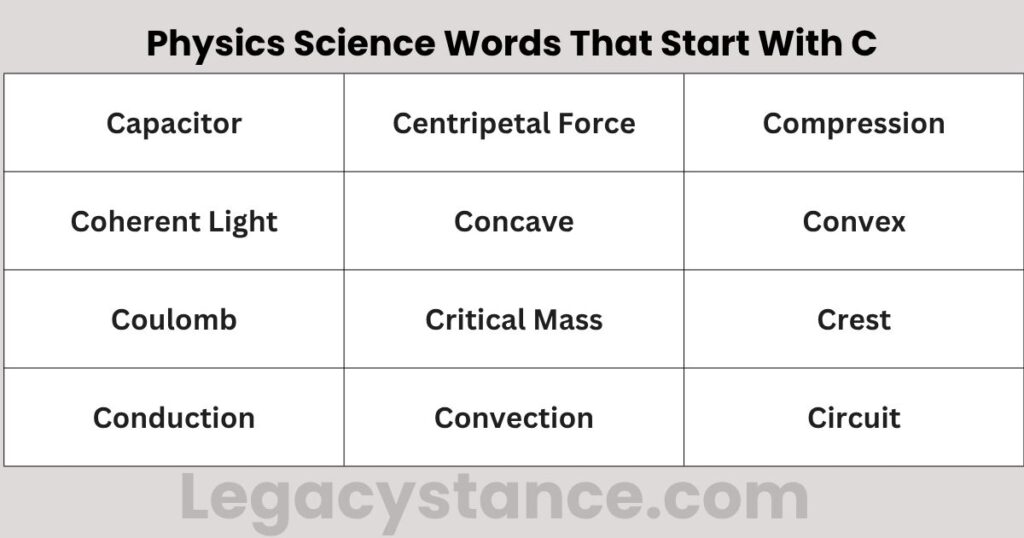
Physics explains how energy, force, and matter behave. These words are central to that.
Capacitor — Stores electrical energy temporarily. Think of the flash in a camera — it charges up, then releases all at once.
Centripetal Force — Pulls a moving object toward the center of a circular path. Spin a ball on a string — the tension pulling your hand inward is centripetal force.
Compression — A force that squeezes something, reducing its volume. Springs compress when you press them.
Coherent Light — Light waves perfectly in sync, same wavelength. Laser beams are coherent light.
Concave — Surface curved inward, like the inside of a spoon. Focuses light toward a point.
Convex — Surface curved outward. Spreads light apart — used in car side mirrors for wider vision.
Coulomb — Unit of electric charge, named after physicist Charles-Augustin de Coulomb.
Critical Mass — Minimum amount of fissile material needed to sustain a nuclear chain reaction.
Crest — The highest point of a wave. Its opposite is the trough.
Conduction — Heat moving through a solid by direct contact. A metal spoon in hot soup heats up this way.
Convection — Heat moving through fluids via circulation. Hot liquid rises, cool liquid sinks, creating a loop.
Circuit — The complete path electricity travels. Break it anywhere and the current stops.
Chemistry Science Words That Start With C
Carbon — Element #6. Every living thing is carbon-based. It forms more compounds than any other element.
Catalyst — Speeds up a reaction without being used up. Enzymes in your body are biological catalysts.
Compound — Two or more elements chemically joined. Water (H₂O) is hydrogen and oxygen bonded together.
Concentration — How much solute is dissolved in a solution. Strong coffee = high caffeine concentration.
Combustion — Fuel reacts with oxygen, releasing heat and light. Every fire is combustion.
Corrosion — A material (usually metal) breaks down through environmental chemical reactions. Rust on iron is corrosion.
Covalent Bond — Two atoms share electrons to bond. Water molecules are held together this way.
Crystal — A solid where atoms arrange in a repeating geometric pattern. Salt and diamonds are crystals.
Crystallization — Process where a structured solid forms from a liquid or solution.
Chlorine — Element Cl, yellow-green gas. Disinfects drinking water and swimming pools.
Chemical Change — A reaction that produces an entirely new substance. Burning wood is a chemical change — you cannot get the wood back.
Chemical Equation — A written representation of a reaction using symbols and formulas. Example: H₂ + O₂ → H₂O.
Colloid — Tiny particles spread through a substance without settling. Milk is a colloid.
Chelation — A molecule binds to a metal ion. Used medically to treat heavy metal poisoning.
Biology Science Words That Start With C
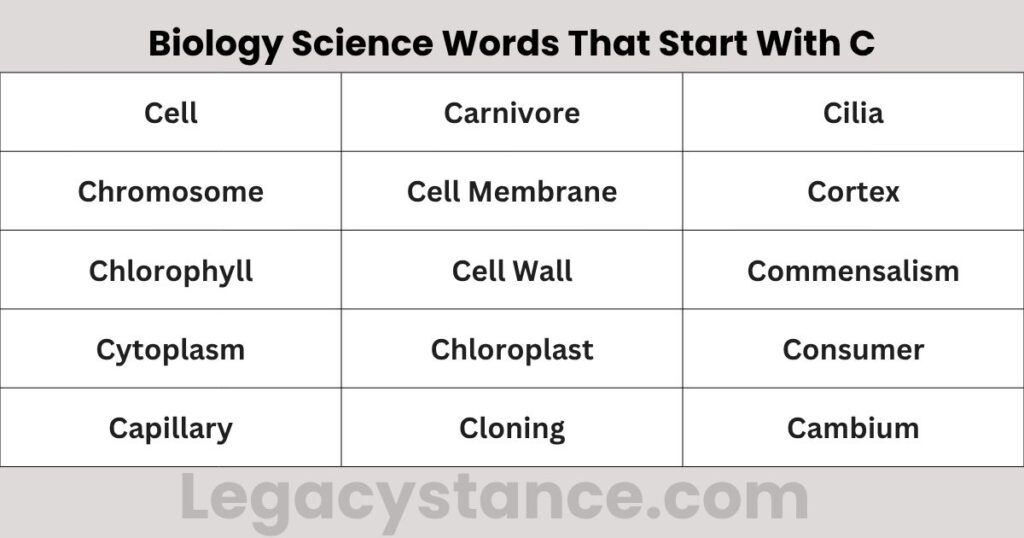
Cell — Every living thing is made of cells. Bacteria are single-celled. Your body contains about 37 trillion cells.
Chromosome — Found in the cell nucleus, carrying DNA. Humans have 46 — in 23 pairs.
Chlorophyll — Green pigment in leaves. Absorbs sunlight to power photosynthesis.
Cytoplasm — Gel-like fluid inside a cell, surrounding all organelles. Keeps everything suspended and moving.
Capillary — The body’s smallest blood vessels. Oxygen and nutrients pass through capillary walls into tissues.
Carnivore — An animal that eats only other animals. Lions, sharks, eagles.
Cell Membrane — Thin, flexible layer around every cell. Controls what enters and exits — like a security checkpoint.
Cell Wall — Rigid outer layer in plant cells only. Gives plants their structural shape.
Chloroplast — Organelle in plant cells where photosynthesis occurs. Contains chlorophyll.
Cloning — Producing a genetically identical copy of an organism. Dolly the sheep (1996) was the first cloned mammal.
Cilia — Tiny hair-like projections on certain cells. In airways, they sweep out dust and mucus.
Cortex — The outer layer of an organ. The brain’s cortex controls thinking, memory, and movement.
Commensalism — One organism benefits; the other is unaffected.
Consumer — Any organism that gets energy by eating other organisms.
Cambium — A layer of dividing cells in plant stems and roots that allows growth in thickness.
Earth Science Words That Start With C
Crust — Earth’s outermost solid shell. Oceanic crust is about 7 km thick; continental crust reaches up to 70 km.
Climate — Average weather conditions over decades. Climate is what you expect; weather is what you get today.
Canyon — A deep, narrow valley carved by a river over millions of years. The Grand Canyon took around 5–6 million years to form.
Core — Earth’s center. The inner core is solid iron; the outer core is liquid iron and nickel.
Convection Currents — Circular movement of magma inside Earth driven by heat. These currents slowly move tectonic plates.
Continental Drift — Continents move slowly across Earth’s surface over millions of years. All continents were once joined as Pangaea.
Cave — A natural underground hollow, mostly formed when acidic water dissolves limestone over thousands of years.
Coral Reef — Underwater ecosystem built from coral skeletons. Called the rainforests of the sea — nearly 25% of all marine species live there.
Conglomerate — A sedimentary rock made of rounded rock fragments cemented together.
Cyclone — A large rotating storm system. In the Northern Hemisphere, it spins counterclockwise.
Creep — Extremely slow downhill movement of soil and rock. Invisible daily but measurable over years.
Space & Astronomy Science Words That Start With C
Comet — An icy body orbiting the Sun. When it gets close, ice vaporizes and forms a glowing tail stretching millions of kilometers.
Constellation — A group of stars forming a recognizable sky pattern. Orion, Ursa Major, and Cassiopeia are well-known examples.
Cosmic Ray — High-energy particles traveling through space near the speed of light. They hit Earth constantly.
Crater — A bowl-shaped depression from a meteorite impact or volcanic eruption.
Celestial Body — Any natural object in space — stars, planets, moons, comets, asteroids.
Corona — The Sun’s outermost atmospheric layer. Only visible during a total solar eclipse — and millions of degrees hot.
Cosmology — The study of the universe’s origin, structure, and fate.
Cepheid Variable — A star that pulses in brightness at predictable intervals. Astronomers use it as a cosmic measuring stick for distance.
Cassini Division — The prominent dark gap in Saturn’s ring system, named after Giovanni Cassini.
Circumpolar Stars — Stars that never dip below the horizon from a given location. They circle the pole star all night.
Cosmic Background Radiation — Faint microwave energy spread across the universe — a leftover signal from the Big Bang.
Medical & Health Science Words That Start With C
Carcinogen — Any substance capable of causing cancer. Tobacco smoke contains dozens of confirmed carcinogens.
Cardiac — Relating to the heart. A cardiac arrest means the heart has stopped pumping blood.
Cartilage — Firm but flexible tissue in joints, ears, and the nose. Unlike bone, it has no blood supply of its own.
Cornea — Clear front surface of the eye, focusing incoming light. The most commonly transplanted human tissue in the world.
Cerebellum — Brain region controlling balance and coordination. Every smooth, steady movement you make involves it.
Cerebrum — The brain’s largest region. Responsible for thinking, memory, language, and voluntary movement.
Chemotherapy — Drug-based treatment that targets and kills rapidly dividing cancer cells.
Cortisol — Hormone released under stress. Nicknamed the stress hormone — it raises blood sugar and suppresses non-urgent body functions.
CT Scan — Medical imaging using rotating X-rays to build detailed cross-sectional pictures of internal organs.
Cataract — Clouding of the eye’s lens causing blurred vision. Globally, one of the top causes of blindness — but fully correctable with surgery.
Technology & Applied Science Words That Start With C
Circuit Board — A flat board holding electronic components connected by conductive pathways. Found in virtually every electronic device.
Code — Instructions written in a programming language telling a computer exactly what to do.
Conductor — A material that allows electricity or heat to pass through freely. Copper is one of the best.
Cybersecurity — Protecting computer systems and data from unauthorized access or damage.
CPU (Central Processing Unit) — The primary processor in a computer, executing all program instructions.
Calibration — Adjusting a measuring instrument to ensure its readings are accurate.
Carbon Fiber — A strong, extremely lightweight engineered material used in aircraft, racing cars, and prosthetics.
Compression (data) — Reducing a digital file’s size without losing essential information. ZIP files use compression.
Connectivity — The ability of devices or networks to communicate and exchange data with each other.
Easy Science Words That Start With C — Grade 3 to 5
| Word | What It Means |
| Cloud | Water droplets floating high in the atmosphere |
| Calcium | Mineral your body needs for strong bones and teeth |
| Camouflage | Animal blending into surroundings to hide |
| Caterpillar | Larval stage of a butterfly or moth |
| Cocoon | Protective case a caterpillar builds around itself |
| Colony | Group of the same organism living together |
| Coral | Tiny ocean animal that builds reefs |
| Compost | Decomposed plant material that enriches soil |
| Creek | A small, narrow freshwater stream |
| Crop | A plant grown by humans for food or materials |
| Cub | Young offspring of bears, lions, or wolves |
| Cactus | Plant adapted to survive in hot, dry desert conditions |
Advanced Science Words That Start With C — High School & Beyond
Cytogenetics — The study of chromosomes and their role in inherited conditions and diseases.
Chemiosmosis — Movement of ions across a membrane to generate ATP energy inside cells — a key step in respiration.
Coriolis Effect — The deflection of winds and ocean currents caused by Earth’s rotation. This is why hurricanes spin in opposite directions in each hemisphere.
Cladistics — A biological classification method based on shared evolutionary ancestry.
Carcinogenesis — The step-by-step process by which normal cells transform into cancerous ones.
Chromatin — The loose, uncoiled form of DNA in a resting cell nucleus. It condenses into visible chromosomes just before cell division.
Chemosynthesis — Energy production using chemicals instead of sunlight. Organisms near deep-sea hydrothermal vents rely on this.
Centrifugation — A lab technique spinning samples at high speed to separate components by density differences.
Cryptobiosis — A suspended life state where an organism shows no measurable metabolic activity — triggered by extreme conditions. Tardigrades (water bears) are the famous example.
Grade 7 Science Words That Start With C
These appear consistently in middle school science curricula.
| Word | Core Meaning |
| Cell Division | One cell splits into two (mitosis or meiosis) |
| Chemical Bond | Force that holds atoms together in a molecule |
| Conduction / Convection / Radiation | The three methods of heat transfer |
| Conservation of Energy | Energy changes form but is never created or destroyed |
| Circulatory System | Heart, blood vessels, and blood working together |
| Continental Plate | Large sections of Earth’s crust that drift slowly |
| Compound | Two or more elements chemically bonded |
| Camouflage | Animal adaptation for blending into environment |
Complete Reference List — 140+ Science Words That Start With C
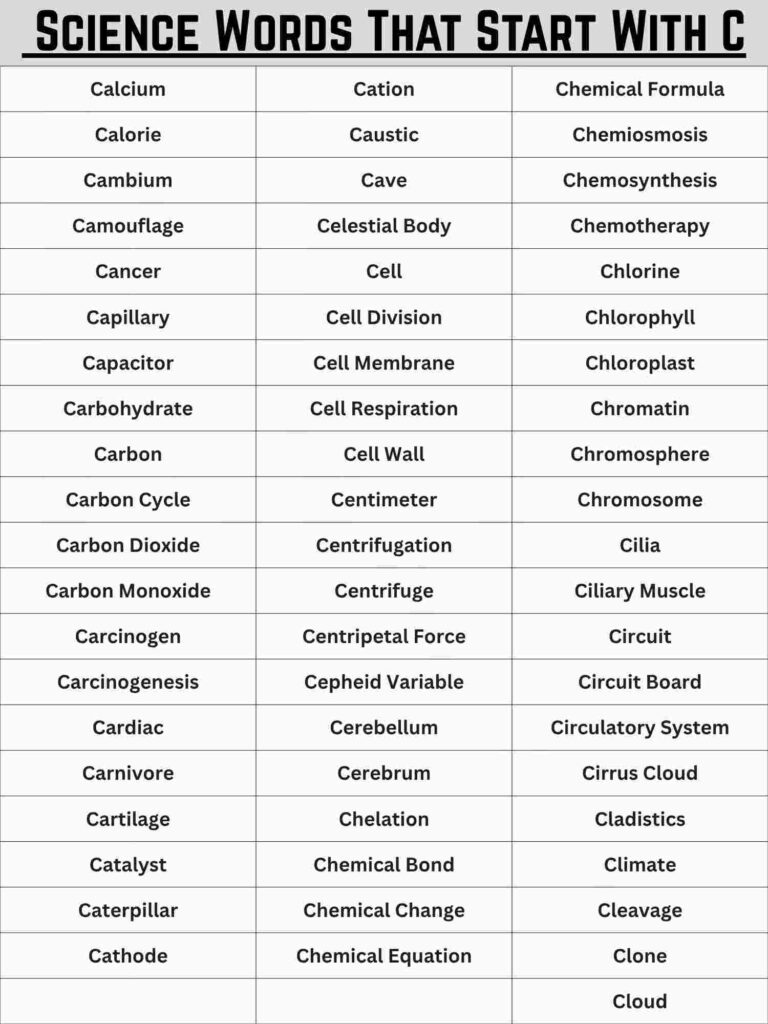
Calcium — Mineral for bones and muscles
Calorie — Unit of food energy
Cambium — Plant tissue enabling width growth
Camouflage — Blending into surroundings
Cancer — Uncontrolled abnormal cell growth
Capillary — Smallest blood vessel
Capacitor — Stores electrical charge
Carbohydrate — Sugar/starch energy molecule
Carbon — Building block of all life
Carbon Cycle — Movement of carbon through ecosystems
Carbon Dioxide — Gas CO₂ released during respiration
Carbon Monoxide — Toxic gas CO from incomplete combustion
Carcinogen — Cancer-causing substance
Carcinogenesis — Process of normal cells becoming cancerous
Cardiac — Relating to the heart
Carnivore — Meat-eating organism
Cartilage — Flexible connective tissue
Catalyst — Speeds up a reaction without being consumed
Caterpillar — Larva of butterfly or moth
Cathode — Negative electrode in a circuit
Cation — Positively charged ion
Caustic — Capable of burning or chemically corroding
Cave — Natural underground hollow in rock
Celestial Body — Any natural object in space
Cell — Basic structural unit of life
Cell Division — Process of one cell becoming two
Cell Membrane — Flexible outer boundary of every cell
Cell Respiration — Process cells use to extract energy
Cell Wall — Rigid layer surrounding plant cells
Centimeter — Length unit (one hundredth of a meter)
Centrifugation — Spinning to separate by density
Centrifuge — Machine that performs centrifugation
Centripetal Force — Force directed toward center of rotation
Cepheid Variable — Star with regular brightness cycles
Cerebellum — Brain region for balance and coordination
Cerebrum — Largest brain region; controls thinking
Chelation — Molecule binding to a metal ion
Chemical Bond — Force linking atoms together
Chemical Change — Reaction that creates a new substance
Chemical Equation — Symbolic representation of a reaction
Chemical Formula — Symbols showing a compound’s composition
Chemiosmosis — Ion movement to generate cellular energy
Chemosynthesis — Energy from chemicals, not sunlight
Chemotherapy — Drug treatment targeting cancer cells
Chlorine — Element Cl; used in disinfection
Chlorophyll — Green pigment powering photosynthesis
Chloroplast — Organelle where photosynthesis occurs
Chromatin — Loose DNA-protein complex in nucleus
Chromosphere — Sun’s layer above the photosphere
Chromosome — Condensed DNA structure in cell nucleus
Cilia — Hair-like projections on cell surfaces
Ciliary Muscle — Eye muscle adjusting lens curvature
Circuit — Closed path for electricity
Circuit Board — Base holding connected electronic parts
Circulatory System — Heart, blood, and vessels
Cirrus Cloud — Thin wispy cloud at high altitude
Cladistics — Classification by evolutionary ancestry
Climate — Long-term regional weather pattern
Cleavage — Mineral splitting along flat planes
Clone — Genetically identical copy of organism
Cloud — Water droplets suspended in atmosphere
Cobalt — Metallic element (symbol Co)
Cocoon — Protective larval casing
Code — Computer programming instructions
Coherent Light — In-phase light of same wavelength
Cohesion — Water molecules attracting each other
Cold Front — Advancing mass of cold air
Colloid — Mixture with particles that don’t settle
Colony — Same-species organisms living together
Comet — Icy orbiting body with a glowing tail
Commensalism — One benefits; other unaffected
Compound — Chemically bonded elements
Compound Eye — Multi-lens eye found in insects
Compression — Force reducing an object’s volume
Compost — Decomposed material enriching soil
Concentration — Amount of solute per solution volume
Condensation — Vapor converting to liquid
Condensation Nucleus — Particle triggering droplet formation
Conduction — Heat transfer through direct contact
Conductor — Material allowing energy flow
Conglomerate — Sedimentary rock of cemented fragments
Conifer — Cone-bearing tree (pine, spruce)
Conservation — Protecting natural resources
Conservation of Energy — Energy cannot be created or destroyed
Constellation — Star pattern in the night sky
Consumer — Organism that eats other organisms
Contact Force — Force requiring physical touch
Continental Drift — Movement of Earth’s tectonic plates
Continental Plate — Large section of Earth’s crust
Convection — Heat transfer through moving fluid
Convection Currents — Circular flow from temperature differences
Convex — Outward-curving surface
Convex Lens — Lens that converges light rays
Copper — Metallic element (symbol Cu)
Coral — Marine organism building reefs
Coral Reef — Biodiverse underwater ecosystem
Core — Earth’s innermost layer
Coriolis Effect — Wind deflection due to Earth’s rotation
Cornea — Clear front surface of the eye
Corona — Sun’s outer atmosphere
Cortex — Outer layer of an organ
Cortisol — Stress hormone from adrenal glands
Cosmic Background Radiation — Leftover energy from Big Bang
Cosmic Ray — High-energy particle from space
Cosmology — Study of universe’s origin and structure
Cotyledon — Seed leaf in a plant embryo
Coulomb — Unit of electric charge
Covalent Bond — Bond formed by shared electrons
Covalent Compound — Compound with shared electron bonds
Crater — Bowl-shaped depression from impact
Creek — Small freshwater stream
Creep — Slow downhill soil movement
Crepuscular — Active at dawn and dusk
Crest — Highest point of a wave
Critical Mass — Minimum mass for nuclear reaction
Crop — Food plant grown by humans
Crust — Earth’s outer rocky shell
Cryptobiosis — Suspended life state in extreme conditions
Crystal — Solid with repeating atomic pattern
Crystallization — Formation of crystals from a solution
CT Scan — X-ray imaging of body cross-sections
Cub — Young of bear, lion, or wolf
Cumulus Cloud — Puffy white fair-weather cloud
Current (electric) — Flow of electric charge
Current (water) — Flow in rivers or oceans
Cuticle — Waxy coating on plant leaves
Cybersecurity — Protection of digital systems
Cyclone — Large rotating storm system
Cytogenetics — Study of chromosomes and disorders
Cytology — Study of cells
Cytoplasm — Fluid inside a cell
Cytoskeleton — Internal protein framework of cells
Cytosol — Liquid part of cytoplasm
Calyx — Outer part of a flower
Canyon — Deep valley formed by erosion
Carbon Fiber — Strong lightweight material
Carbonation — CO₂ dissolved in liquid
Cassini Division — Gap in Saturn’s rings
Cataract — Clouding of the eye lens
Calibration — Adjusting measurement accuracy
Circumpolar Stars — Stars that never set
CPU — Computer’s main processor
Concave — Surface curving inward
Cobalt — Metal used in batteries and alloys
Common Confusions — C Words Students Mix Up
Conduction vs Convection vs Radiation All three transfer heat — but through different means. Conduction needs direct touch (metal spoon in hot soup). Convection uses a moving fluid (boiling water circulating). Radiation needs no medium at all — sunlight crosses empty space this way.
Cell Wall vs Cell Membrane The membrane is in every cell — flexible, controls entry and exit. The wall is only in plant cells — rigid, provides shape and structural support.
Climate vs Weather Weather is what’s happening outside right now. Climate is the 30-year average pattern of that region.
Compound vs Mixture A compound is chemically bonded — you cannot separate it by physical means. A mixture is physically combined — you can separate it (pick raisins out of cereal, for example).
Chromosome vs Chromatin Chromatin is DNA in its loose, uncoiled state inside a resting cell. When the cell prepares to divide, chromatin tightens and becomes chromosomes.
Crest vs Trough In any wave, the crest is the highest point. The trough is the lowest. They are always opposite each other.
Carnivore vs Omnivore vs Herbivore Carnivores eat only animals. Herbivores eat only plants. Omnivores eat both — humans included.
Real-Life Places These Words Show Up
Science vocabulary is not just for exams. Here’s where these words actually live:
- Hospital → Cardiac, CT Scan, Cornea, Cortisol, Chemotherapy, Cataract
- Your kitchen → Combustion (gas flame), Condensation (cold glass), Calcium (milk), Carbonation (fizzy drink)
- Outdoors → Canyon, Cyclone, Coral Reef, Camouflage, Continental Drift
- Space research → Comet, Corona, Cosmic Ray, Cosmology, Cepheid Variable
- School lab → Catalyst, Circuit, Crystal, Concentration, Centrifugation
- Your own body → Cerebrum, Cerebellum, Cytoplasm, Chromosome, Capillary, Cilia
You may like to read:
120+ Science Words That Start With B | Full List with Meanings
110+ Science Words That Start With A | Full List with Meanings
FAQs
Q1: How can I remember science words more easily?
Focus on meaning, not memorization. Link each word to a real example. For instance, condensation is the water on a cold bottle. That connection helps your brain store it longer.
Q2: Which C words should I learn first for exams?
Start with commonly tested ones like cell, circuit, catalyst, combustion, and chromosome. These appear often in school science and build a strong base.
Q3: What’s the fastest way to understand difficult terms?
Break the word into parts. Many science words come from Greek or Latin roots. For example, “cyto” means cell. Knowing roots helps you decode new words quickly.
Q4: Are these words useful outside school?
Yes. You’ll see them in daily life—carbon in the air, calories in food, circuits in devices, and climate in weather discussions. Science vocabulary is everywhere.
What You Learned Here
This guide covered 140+ science words starting with C — sorted by subject, by grade level, and by real-world use. The complete reference table gives you everything in one place. The confusions section clears up the pairs that trip students up most. The real-life section turns vocabulary into something you actually recognize.
Science vocabulary compounds over time. A student who understands cell and chromosome in Grade 6 is already halfway to understanding cytogenetics in Grade 11. Start with the words you need now. The harder ones follow naturally.