Science words can feel overwhelming—until they’re explained in a way that actually makes sense. This guide to Science Words That Start With B is built for real learners: students, parents, and anyone curious about how things work. Instead of hard definitions, you’ll find clear meanings you can quickly understand and remember.
From everyday ideas like blood and boiling point to bigger concepts like biodiversity and black holes, these words show up in school, health, nature, and technology. Learn them once, and you’ll start noticing science everywhere around you.
Quick Answer: 20 Most-Used Science Words That Start With B
- Bacteria — Single-celled microorganisms found almost everywhere
- Base — Substance that neutralizes acid; pH above 7
- Biodegradable — Material that breaks down naturally
- Biome — Large ecological region with similar climate and life
- Blood — Fluid carrying oxygen through the body
- Boiling point — Temperature at which liquid turns to gas
- Bond (chemical) — Force holding atoms together
- Brain — Central organ controlling the nervous system
- Buoyancy — Upward force a fluid exerts on an object
- Binary — System using only two values: 0 and 1
- Biomass — Total mass of living organisms in an area
- Black hole — Space region where gravity traps even light
- Botany — Study of plants
- Bronchi — Airways branching into the lungs
- Buffer — Solution resisting changes in pH
- Bedrock — Solid rock beneath soil and loose material
- Bioluminescence — Light produced by living organisms
- Bohr model — Atomic model showing electrons in fixed orbits
- Barometer — Instrument measuring air pressure
- Beta particle — Electron released during radioactive decay
Physics Science Words That Start With B
Buoyancy — The upward push a liquid or gas gives an object. When you float in a pool, this force is keeping you up. Archimedes discovered it while sitting in a bathtub.
Boiling point — The exact temperature where a liquid becomes a gas. Water reaches it at 100°C at sea level. Higher altitude means lower air pressure — so it boils earlier on a mountain.
Beta particle — A fast-moving electron or positron released from a radioactive atom. Used in some cancer treatments and industrial thickness gauges.
Black body — An object that absorbs all incoming light and emits radiation based purely on its temperature. Stars behave almost like black bodies.
Brownian motion — The random, jittery movement of tiny particles suspended in a fluid. Einstein mathematically explained it in 1905. Visible under a microscope with dust in water.
Brake force — The opposing force that slows a moving object. Friction between brake pads and wheels creates it.
Birefringence — Some crystals split light into two separate rays. Calcite does this — place it on text and the letters appear doubled.
Brillouin scattering — Light scattering caused by sound waves inside a material. Used in fiber optic sensors and temperature measurement.
Chemistry Science Words That Start With B
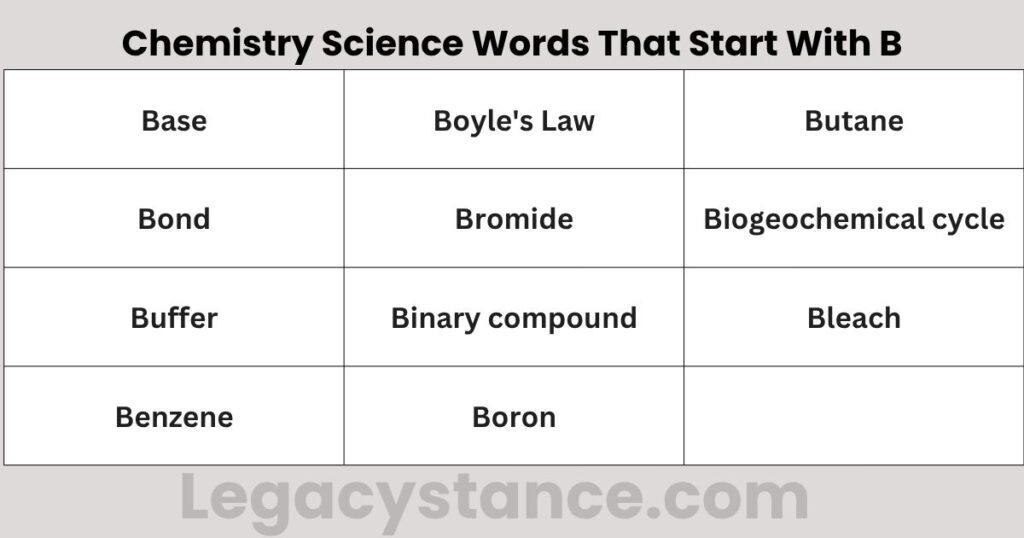
Base — A substance with pH above 7 that accepts protons or donates electrons. Baking soda is a base. Bases feel slippery and neutralize acids.
Bond — The force holding atoms together in a molecule. Covalent bonds share electrons; ionic bonds transfer them. Every compound you know exists because of bonds.
Buffer — A solution resisting sudden pH changes. Your blood is buffered — without it, small dietary shifts would be dangerous.
Benzene — A ring-shaped organic molecule with six carbon atoms. Used in making plastics, dyes, and medicines — but also a known carcinogen.
Boyle’s Law — At constant temperature, pressure and volume of a gas move inversely. Squeeze a balloon and pressure inside rises.
Bromide — A compound containing bromine. Used in photography, medicine, and as a flame retardant.
Binary compound — A chemical made from exactly two elements. Table salt (sodium chloride) is a classic example.
Boron — Element number 5. Found in glass, cleaning products, and nuclear reactors.
Butane — A flammable hydrocarbon used in lighters and camping stoves. The gas inside a Bic lighter.
Biogeochemical cycle — The movement of chemical elements like carbon and nitrogen through both living organisms and the physical environment.
Bleach — Usually sodium hypochlorite. Removes color and kills bacteria through oxidation.
Biology Science Words That Start With B
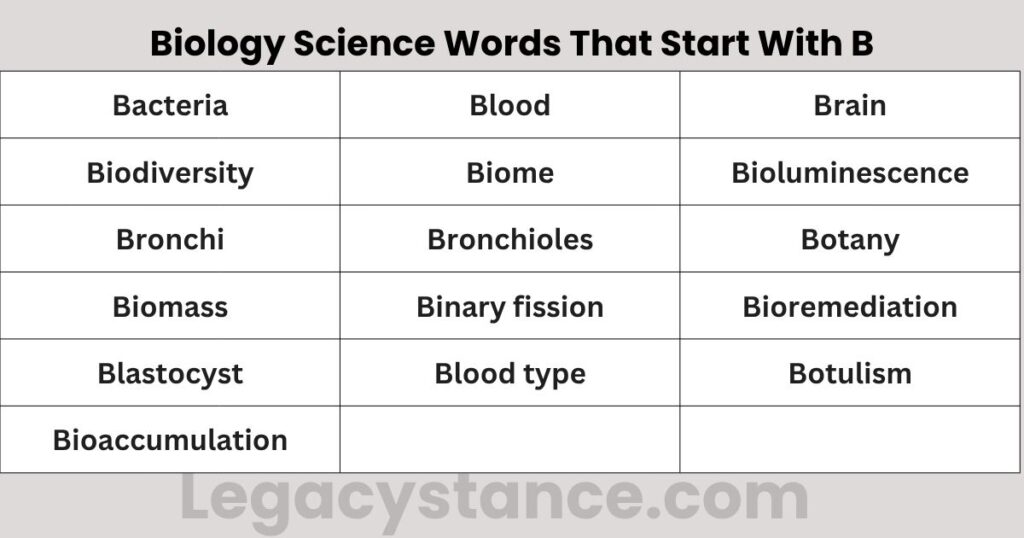
Bacteria — Single-celled organisms without a nucleus. Found in soil, water, your gut, and your skin. Most are harmless or genuinely helpful.
Blood — The fluid moving through your circulatory system, carrying oxygen, nutrients, waste, and immune cells.
Brain — The control center of the nervous system. About 86 billion neurons fire constantly here to manage thought, movement, and body function.
Biodiversity — The variety of life in a place. A rainforest scores high. A parking lot scores almost zero.
Biome — A large zone on Earth defined by climate, plants, and animals. Deserts, rainforests, and tundra are all biomes.
Bioluminescence — When living things produce their own light through a chemical reaction involving a molecule called luciferin. Fireflies do it. Deep-sea fish do it. Some fungi glow in the dark.
Bronchi — The two main branches from your trachea into your lungs. Inflammation of these tubes is called bronchitis.
Bronchioles — Tiny tubes branching off the bronchi inside your lungs, leading to the air sacs.
Botany — The science of plants — from root systems to flower reproduction.
Biomass — The total weight of living material in an area. Scientists measure it to understand how productive an ecosystem is.
Binary fission — How bacteria reproduce. One cell splits into two identical cells. Two become four. Four become eight — fast.
Bioremediation — Using bacteria or other organisms to clean up polluted soil or water. A real solution to oil spills.
Blastocyst — An early fertilized egg a few days after conception, before it implants in the uterus.
Blood type — Classification of human blood as A, B, AB, or O based on proteins on red blood cell surfaces.
Botulism — A serious illness caused by a toxin from Clostridium botulinum bacteria. The toxin is among the most potent known.
Bioaccumulation — When a substance like mercury builds up inside an organism faster than the body removes it. Concentration increases higher up the food chain.
Earth Science Words That Start With B
Bedrock — Solid rock sitting below soil, gravel, and loose surface material. Buildings and bridges are often anchored directly into it.
Basin — A low-lying area of land or a bowl-shaped depression on the ocean floor. River basins collect water draining from surrounding high ground.
Biosphere — The zone of Earth where life exists — from deep ocean trenches to the upper atmosphere.
Barometer — Measures atmospheric pressure. A quick pressure drop usually means rain is coming.
Bog — A waterlogged, acidic area full of partially decayed plant material called peat. Bogs preserve things for centuries — including ancient humans.
Bathymetry — Measuring and mapping ocean floor depth. Scientists use sonar to do it.
Bedding plane — The flat surface separating layers of sedimentary rock. Geologists read these layers like pages in a history book.
Breccia — Rock made of sharp, angular fragments cemented together. Different from conglomerate, which has rounded pieces.
Boulder — A rock fragment technically larger than 256mm. Glaciers can move boulders hundreds of miles.
Brackish water — Saltier than fresh water but less salty than the ocean. Found where rivers meet the sea.
Basalt — Dark volcanic rock that forms ocean floors. Dense, fine-grained, and incredibly common beneath the sea.
Butte — A flat-topped hill with steep sides. Common in the American Southwest — a smaller, isolated version of a mesa.
Space & Astronomy Science Words That Start With B
Black hole — A region of space where gravity is so strong that not even light escapes. Formed when massive stars collapse inward.
Big Bang — The leading explanation for the universe’s origin. About 13.8 billion years ago, everything expanded outward from an unimaginably hot, dense point.
Binary star — Two stars orbiting each other. More than half of all stars in the Milky Way are part of binary or multiple systems.
Blue shift — When an object in space moves toward us, light waves compress and shift toward blue. The opposite of red shift.
Brown dwarf — A “failed star” — too big to be a planet, too small to sustain nuclear fusion. Glows faintly in infrared.
Bolide — A very large meteor that explodes in the atmosphere. The 2013 Chelyabinsk event in Russia was one.
Baryons — Particles made of quarks. Protons and neutrons are baryons — they make up most visible matter in the universe.
Blazar — An extremely energetic galaxy with a jet of radiation pointed almost directly at Earth. Some are billions of light-years away.
Baryon asymmetry — The fact that the universe contains more matter than antimatter. Scientists still don’t fully understand why.
Medical & Health Science Words That Start With B
Blood pressure — The force blood pushes against artery walls. Measured as two numbers: systolic over diastolic. Sustained high readings strain the heart.
BMI (Body Mass Index) — A weight-to-height ratio used to screen for weight-related health conditions. Useful but not a complete picture of health.
Biopsy — Removing a small piece of tissue to test for disease. Commonly done when checking for cancer.
Bronchitis — Inflammation of the bronchi — the main air passages to the lungs. Causes coughing and mucus buildup.
Blood glucose — The amount of sugar in the blood at any given moment. People with diabetes monitor this carefully throughout the day.
Benign — A tumor or growth that is not cancerous and does not spread. Opposite of malignant.
Bladder — The organ that stores urine before it leaves the body.
Blood clot — A gel-like plug of blood cells that forms to stop bleeding. Clots inside blood vessels can cause strokes or heart attacks.
Biologic drug — A medication made from living cells — like insulin, engineered antibodies, or vaccines.
Bilirubin — A yellow pigment produced when red blood cells break down. High levels cause jaundice.
Bone marrow — Soft tissue inside bones that produces red blood cells, white blood cells, and platelets.
Basophil — A type of white blood cell involved in allergic reactions and inflammation.
Technology & Applied Science Words That Start With B
Binary — The number system using only 0 and 1. Every computer file, image, and operation is ultimately expressed in binary.
Bandwidth — How much data a network carries per second. Higher bandwidth means faster video, downloads, and calls.
Battery — Stores chemical energy and converts it to electrical energy on demand. The same basic chemistry runs a AA battery and an electric vehicle pack.
Bit — The smallest unit of computer data. Eight bits make one byte.
Byte — Eight bits. A single photo is typically a few megabytes — millions of bytes.
Bioengineering — Applying engineering methods to biological problems. Artificial joints, lab-grown tissue, and prosthetic limbs come from this field.
Boolean — A logic system built on true/false values. Every decision a computer makes runs on Boolean logic. Named after mathematician George Boole.
Bluetooth — Short-range wireless communication using radio waves. Named after a 10th-century Viking king who united tribes — the technology unites devices.
Biomechanics — How physical forces affect living bodies. Used in sports science, physical therapy, and robotics design.
Easy Science Words That Start With B (Beginners & Kids)
Bone — Hard material making up your skeleton. You have 206 of them. They store calcium and produce blood cells inside the marrow.
Bud — The small growth on a plant that becomes a leaf or flower.
Burrow — A tunnel dug by an animal for shelter. Rabbits, moles, and prairie dogs all build them.
Bark — The outer protective layer of a tree trunk and branches. It’s the tree’s skin.
Bulb — An underground plant storage organ — like an onion or tulip — holding energy for the next growing season.
Beak — The hard mouth structure of birds. Shape matches diet: curved for tearing meat, long and thin for probing flowers, short and strong for cracking seeds.
Berry — Botanically, a fruit from a single flower with one ovary. Bananas and avocados qualify. Strawberries, surprisingly, don’t.
Bug — Informally used for insects and small crawling creatures. In strict science, “true bugs” are a specific group with piercing mouthparts — like aphids.
Advanced Science Words That Start With B
Basal metabolic rate (BMR) — Energy your body burns at complete rest — just to keep breathing, heart beating, and cells functioning.
Bohr model — Niels Bohr’s 1913 atomic model showing electrons traveling in fixed circular orbits around the nucleus. It was later refined but remains the standard teaching model.
Bioinformatics — Using computers and statistics to analyze biological data, especially DNA sequences and protein structures.
Binomial nomenclature — The two-part naming system for species. Humans are Homo sapiens. Created by Carl Linnaeus in the 18th century.
Biotope — A specific habitat with uniform environmental conditions supporting a particular community of organisms.
Bioavailability — What fraction of a drug or nutrient actually reaches the bloodstream after being consumed. A drug can be effective on paper but poorly bioavailable in practice.
Biofilm — A thin layer of microorganisms clinging to a surface and producing a protective coating. Dental plaque is a biofilm.
Brachiation — Moving through trees by swinging arm-over-arm. Gibbons are the most skilled brachiators alive.
Bryophyte — Non-vascular plants like mosses and liverworts. They absorb water directly through their surfaces — no roots, no tubes.
Benthic zone — The bottom region of any body of water. A unique and often extreme ecosystem with specialized organisms.
Complete Reference List: 120+ Science Words That Start With B
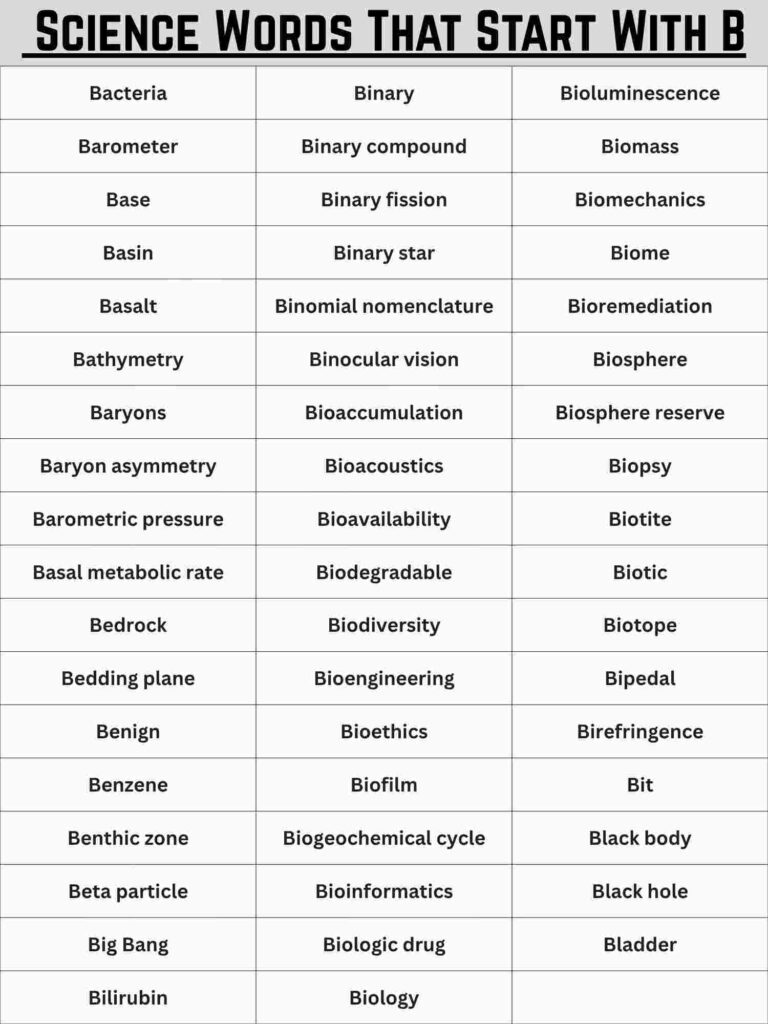
Bacteria — Single-celled organisms without a nucleus
Barometer — Measures atmospheric pressure
Base — pH above 7; neutralizes acids
Basin — Bowl-shaped landform or ocean depression
Basalt — Dark volcanic rock forming ocean floors
Bathymetry — Mapping and measuring ocean floor depth
Baryons — Subatomic particles made of quarks
Baryon asymmetry — More matter than antimatter in the universe
Barometric pressure — Atmospheric pressure read by a barometer
Basal metabolic rate — Energy used by body at complete rest
Bedrock — Solid rock beneath surface soil
Bedding plane — Flat surface separating rock layers
Benign — Non-cancerous; does not spread
Benzene — Six-carbon ring organic molecule
Benthic zone — Bottom region of a body of water
Beta particle — Electron released in radioactive decay
Big Bang — Universe origin event ~13.8 billion years ago
Bilirubin — Yellow pigment from red blood cell breakdown
Binary — Number system using only 0 and 1
Binary compound — Chemical made from two elements only
Binary fission — Cell reproduction by splitting into two
Binary star — Two stars orbiting each other
Binomial nomenclature — Two-part scientific naming for species
Binocular vision — Depth perception using two eyes
Bioaccumulation — Build-up of substances in organisms over time
Bioacoustics — Study of sound in living organisms
Bioavailability — Fraction of drug reaching the bloodstream
Biodegradable — Breaks down naturally through biology
Biodiversity — Variety of life in an ecosystem
Bioengineering — Engineering applied to biological systems
Bioethics — Ethics applied to biology and medicine
Biofilm — Microorganism layer on surfaces
Biogeochemical cycle — Elements cycling through living and non-living systems
Bioinformatics — Computing used to analyze biological data
Biologic drug — Medicine made from living cells
Biology — Study of living things
Bioluminescence — Light produced by living organisms
Biomass — Total mass of living organisms in an area
Biomechanics — Physics applied to living body movement
Biome — Large climate-defined ecological zone
Bioremediation — Organisms used to clean up pollution
Biosphere — Earth’s zone where life exists
Biosphere reserve — Protected area for biodiversity
Biopsy — Tissue sample taken for disease testing
Biotite — Dark mica mineral in granite
Biotic — Living components of an ecosystem
Biotope — Uniform habitat for specific organisms
Bipedal — Moving on two legs
Birefringence — Crystal splits light into two rays
Bit — Smallest unit of computer data
Black body — Object absorbing all incoming radiation
Black hole — Space region trapping all matter and light
Bladder — Organ storing urine before excretion
Blastocyst — Early-stage embryo before uterine implantation
Blazar — Energetic galaxy with jet aimed at Earth
Bleach — Oxidizing agent; disinfects and removes color
Blood — Circulatory fluid carrying oxygen and nutrients
Blood clot — Solidified blood blocking a vessel
Blood glucose — Sugar concentration in the blood
Blood pressure — Force of blood against artery walls
Blood serum — Liquid part of blood without clotting factors
Blood type — ABO classification based on red cell proteins
Blood vessel — Tube carrying blood through the body
Blue shift — Light compression when source moves toward observer
BMI — Weight-to-height health screening ratio
Bog — Acidic waterlogged wetland rich in peat
Bohr model — Atomic model with electrons in fixed orbits
Boiling point — Temperature where liquid becomes gas
Bolide — Large meteor exploding in the atmosphere
Bond (chemical) — Force holding atoms together
Bone — Hard connective tissue forming the skeleton
Bone marrow — Tissue inside bones producing blood cells
Boolean — True/false logic used in computing
Boreal forest — Cold northern forest of cone-bearing trees
Boron — Element 5; used in glass and nuclear reactors
Botany — Scientific study of plants
Botulism — Disease from C. botulinum toxin
Boulder — Rock fragment larger than 256mm
Bowen’s reaction series — Order minerals crystallize from cooling magma
Boyle’s Law — Pressure-volume relationship in gases
Brachiation — Tree locomotion by arm swinging
Brachycephalic — Short, wide skull shape
Brackish water — Salinity between fresh water and ocean water
Brainstem — Lower brain region connecting to spinal cord
Brake force — Force decelerating a moving object
Breccia — Rock of angular fragments cemented together
Brillouin scattering — Light scattered by sound waves in material
Brine — Water heavily saturated with salt
Bromide — Bromine-containing compound
Bronchi — Main air passages from trachea to lungs
Bronchioles — Tiny tubes branching inside the lungs
Bronchitis — Inflammation of the bronchi
Bronchodilator — Drug widening the lung airways
Brown dwarf — Object too small to sustain nuclear fusion
Brownian motion — Random particle movement in fluid
Brush border — Projections on intestinal cells aiding absorption
Bryophyte — Non-vascular plants like mosses
Bud — Plant growth becoming leaf or flower
Buffer — Solution resisting pH change
Bulb — Underground plant organ storing energy
Bulimia — Eating disorder with binge-purge cycles
Burrow — Animal-dug tunnel for shelter
Butane — Flammable hydrocarbon used in lighters
Butte — Flat-topped steep-sided hill
Buoyancy — Upward fluid force on submerged object
Byte — 8 bits; basic unit of digital storage
Bark — Outer protective layer of a tree
Basophil — White blood cell in allergic responses
Bacteriophage — Virus that infects and kills bacteria
Beach — Shoreline formed by wave erosion and sediment
Beak — Hard mouth structure of birds
Berry — Botanical fruit from a single-ovary flower
Biofilm — Microorganism layer clinging to surfaces
Bismuth — Element 83; used in medicines and cosmetics
Bluetooth — Short-range wireless radio communication
Bandwidth — Data capacity of a network or signal
Battery — Device converting chemical to electrical energy
Bioethics — Ethical study of biological and medical issues
Biosphere reserve — Protected ecological preservation zone
Baryon number — Count of quarks minus antiquarks in a system
Boreal — Relating to cold northern climates
Bacteriophage — Virus targeting and destroying bacteria
Binary planet — Two planets sharing a common orbital center
Common Confusions
Bacteria vs. Virus Both cause illness — but they are entirely different. Bacteria are living cells. Antibiotics kill them. Viruses are not cells at all. Antibiotics do nothing against them. This is why a doctor won’t prescribe antibiotics for a cold.
Benign vs. Malignant A benign tumor stays put and doesn’t invade other tissue. A malignant one spreads. That single word difference is one of the most important distinctions in all of medicine.
Boiling point vs. Melting point Boiling = liquid to gas. Melting = solid to liquid. Water melts at 0°C, boils at 100°C. Two different phase changes, often mixed up on exams.
Biodegradable vs. Compostable Biodegradable means something breaks down eventually — even if it takes centuries. Compostable means it breaks down quickly into useful material under the right conditions. Not the same thing.
Biotic vs. Abiotic Biotic = living parts of an ecosystem: plants, animals, fungi, bacteria. Abiotic = non-living: sunlight, water temperature, soil minerals. Both shape every ecosystem on Earth.
Binary fission vs. Mitosis Both produce two identical daughter cells. Binary fission happens in bacteria — organisms without a nucleus. Mitosis happens in cells that have a nucleus, like plant and animal cells.
Bromide vs. Bromine Bromine is the pure element — a reddish-brown toxic liquid. Bromide is a compound containing bromine — often safe, used in medicine and photography.
Where These Words Actually Show Up
These aren’t just test words. They appear in real situations constantly.
At the doctor’s office — Blood pressure, biopsy, benign, bronchitis, blood glucose, biologic drugs
In your kitchen — Boiling point, bacteria (food safety), biodegradable (packaging), brine (pickling), bleach (cleaning)
Outside in nature — Biome, biodiversity, bioluminescence, basalt, bedrock, bog
On every device you own — Binary, bandwidth, battery, Bluetooth, bit, byte, Boolean
In space news — Black holes, Big Bang, binary stars, brown dwarfs, bolides
Related Posts:
95+ Science Words That Start With U | List with Meanings
110+ Science Words That Start With A | Full List with Meanings
FAQs
1. Why are there so many science words starting with B?
A lot of science terms come from Latin and Greek. Prefixes like “bio-” (life) and “bi-” (two) are very common. That’s why you see words like biology, biodiversity, and binary so often.
2. What are the most important B science words to learn first?
Start with everyday terms like bacteria, biome, boiling point, buoyancy, and blood. These show up often in school and real life, so they give you the best foundation.
3. How can I remember these words easily?
Don’t try to memorize everything at once. Group words by meaning. For example, “bio-” words relate to life. Also, connect words to real experiences—like remembering buoyancy when you float in water.
4. Do these words matter outside school?
Yes, more than you think. You’ll hear them at the doctor’s office (blood pressure), in the kitchen (boiling point, bacteria), and even in tech (binary, battery). They help you understand everyday situations.
5. What’s the difference between similar B words like biodegradable and compostable?
Biodegradable means something will break down eventually. Compostable means it breaks down quickly and safely into useful material. The difference matters, especially for the environment.
What You’ve Got Now
You came here needing science words that start with B. You’re leaving with 120+ — sorted by field, connected to real situations, and explained without padding.
These words appear in science classes, doctor’s visits, nature documentaries, and everyday conversations. Learning them doesn’t only help on tests. It helps you understand how the world actually works.
Start with the section closest to your grade or interest. Let the harder words pull you in from there. That’s how vocabulary grows — not from staring at a list, but from understanding why each word exists.