Science words can feel confusing when they show up in homework or exams without clear explanations. This guide to Science Words That Start With W keeps things simple, practical, and easy to remember. Instead of long textbook definitions, you’ll find short meanings you can actually understand and use.
Whether you’re a student, parent, or just curious, this list helps you connect words like wave, weathering, and white blood cell to real-life ideas. Learn faster, remember longer, and feel more confident using science vocabulary every day.
⚡ 20 Most-Used Science Words That Start With W
Learn these first. They appear on tests, in textbooks, and in real conversations most often.
Wave — Energy moving through space or matter
Wavelength — Distance between two wave peaks
Weight — Gravitational force on an object
Water cycle — Earth’s continuous movement of water
Weathering — Breakdown of rocks by natural forces
Work — Force applied over a distance
White blood cell — Immune cell that fights infection
Watt — Unit of power
Wind — Moving air caused by pressure differences
Warm-blooded — Maintains constant internal body temperature
Water vapor — Water in its gaseous form
Weed — Plant growing where it is not wanted
Wound — Injury to body tissue
Wormhole — Hypothetical tunnel through space-time
Wildlife — Animals living in natural environments
White dwarf — Small, dense remnant of a dying star
Wood — Plant tissue giving trees their structure
Watershed — Land area draining into a river or lake
Wireless — Transmits data without physical cables
Wavefunction — Quantum description of a particle’s probable state
Physics Science Words That Start With W
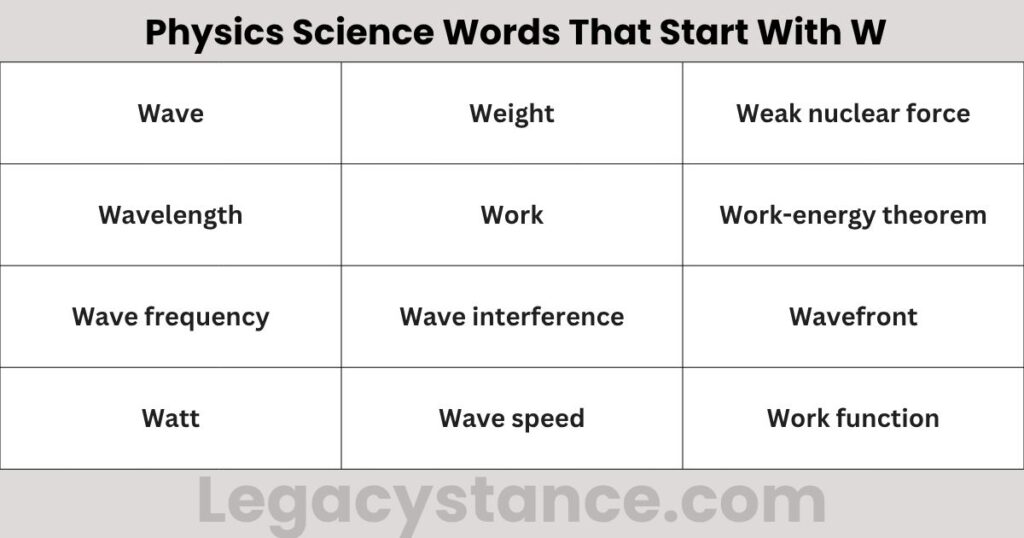
Physics cannot be discussed without W-words. Sound, light, motion, energy — all of it connects here.
Wave — A disturbance carrying energy from one place to another without permanently moving matter. Sound, light, and water ripples are all waves.
Wavelength — Distance from one wave peak to the next. Short wavelength means high energy — that’s why X-rays penetrate tissue but radio waves don’t.
Wave frequency — How many wave cycles pass a point per second, measured in hertz (Hz). Higher frequency produces higher-pitched sound.
Watt — The unit of power. One watt equals one joule of energy used per second. Every lightbulb, phone charger, and microwave is rated in watts.
Weight — The force gravity pulls on an object’s mass. On the Moon, your weight drops because gravity is weaker — but your mass stays identical.
Work — Force applied over a distance. Pushing a wall that doesn’t move does zero work in physics. Lifting a book does.
Wave interference — What happens when two waves collide. They either build each other up (constructive) or cancel out (destructive). Noise-canceling headphones use destructive interference.
Wave speed — How fast a wave travels through a medium. Sound moves slower through air than through steel. Light moves fastest through a vacuum.
Weak nuclear force — One of four fundamental forces in nature. It triggers radioactive decay. Tiny in range, enormous in consequence.
Work-energy theorem — Net work done on an object equals its change in kinetic energy.
Wavefront — The leading surface of a wave where all points vibrate in the same phase. Imagine the outer edge of a ripple spreading across a pond.
Work function — Minimum energy required to release an electron from a metal surface. Central to understanding the photoelectric effect.
Chemistry Science Words That Start With W
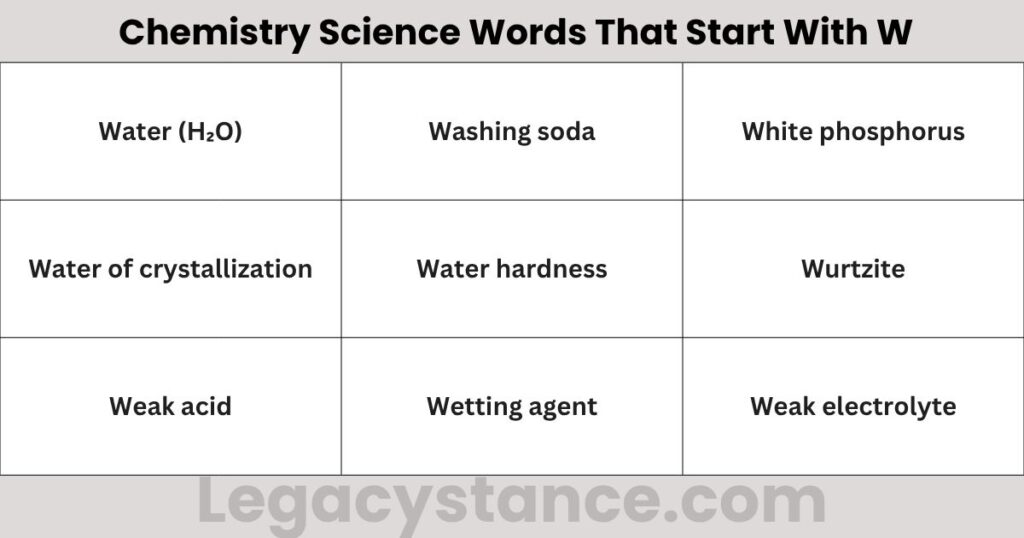
Water (H₂O) — Two hydrogen atoms bonded to one oxygen atom. It dissolves more substances than almost any other liquid — scientists call it the “universal solvent.”
Water of crystallization — Water molecules locked inside a crystal structure. Remove them and the crystal transforms. Blue copper sulfate turns white when this water is driven off by heat.
Weak acid — An acid that only partially breaks apart in water. Vinegar is a weak acid — sour enough to taste, harmless enough to eat.
Weak base — A base that only partially ionizes in solution. Ammonia is a weak base found in most household cleaners.
Washing soda — Sodium carbonate. Softens water and cuts through grease in laundry applications.
Water hardness — A measure of dissolved minerals, mainly calcium and magnesium, in water. Hard water leaves chalky deposits on kettles and inside pipes.
Wetting agent — Reduces surface tension so liquid spreads more easily across a surface. Soap functions as a wetting agent.
White phosphorus — A highly reactive, waxy solid form of phosphorus that ignites on contact with air. Stored and handled under water in laboratories.
Wurtzite — A hexagonal crystal structure found in zinc sulfide and gallium nitride. Relevant in semiconductor and LED research.
Weak electrolyte — A compound that only partially ionizes in solution, conducting electricity poorly compared to strong electrolytes.
Biology Science Words That Start With W
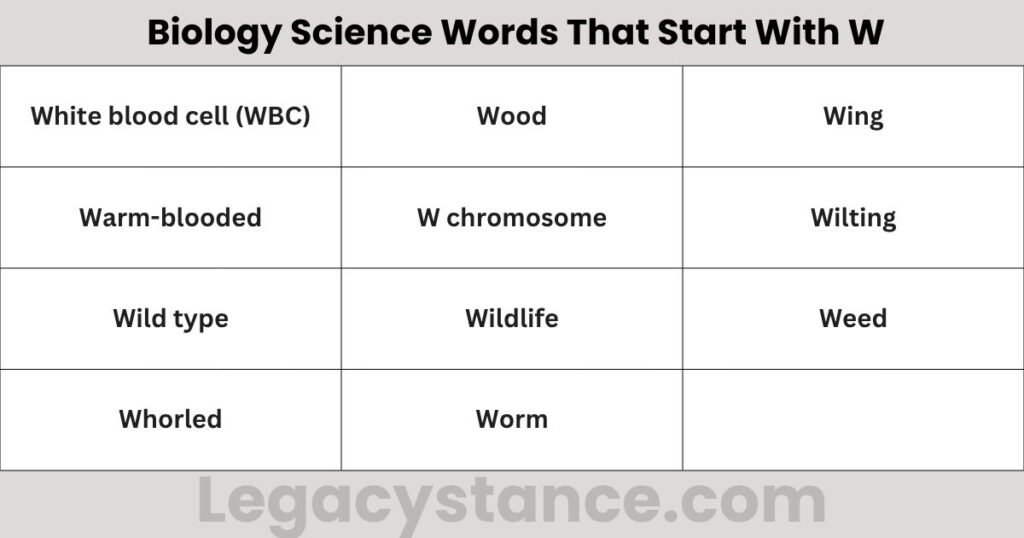
White blood cell (WBC) — Your immune system’s defense force. Roughly 4,000–11,000 WBCs exist per microliter of healthy blood. Elevated counts signal infection; low counts suggest immune suppression.
Warm-blooded — Animals that regulate body temperature internally, regardless of external conditions. Mammals and birds qualify. A dog holds roughly 38°C whether it’s in a snowstorm or a desert.
Wild type — The standard, naturally occurring form of a gene or organism. Genetics uses this as a baseline when studying mutations.
Whorled — A leaf arrangement where three or more leaves emerge from the same node on a stem. One of three primary leaf patterns in botany.
Wood — Secondary xylem tissue that hardens over time, giving trees structural support. Each growth ring represents one year — scientists use this to estimate a tree’s age.
W chromosome — A sex chromosome found in birds and some reptiles. Female birds are ZW; males are ZZ — the reverse of the human XX/XY system.
Wildlife — All organisms living in natural, undomesticated states. Wildlife ecology examines how these organisms interact with their habitats.
Worm — A soft-bodied, legless invertebrate. Earthworms aerate soil and break down organic matter, making them essential to agriculture.
Wing — A limb structure adapted for flight. Bird wings evolved from forelimbs — structurally, a bird’s wing shares the same bone arrangement as a human arm.
Wilting — Plant drooping caused by water loss. Happens when a plant loses water faster than its roots can absorb it.
Weed — Any plant growing where it isn’t wanted. Ecologically, invasive weeds outcompete native plants and destabilize ecosystems.
Earth Science Words That Start With W
Weathering — Physical and chemical breakdown of rock at Earth’s surface. Physical weathering cracks rock apart; chemical weathering changes its mineral composition. Both are constant and slow.
Water cycle — The continuous movement of water through evaporation, condensation, precipitation, and collection. No new water is created on Earth — what you drink has cycled through the planet for billions of years.
Water table — The underground depth below which soil is fully saturated with water. Drilling a well means reaching below this line.
Watershed — A land area that channels all rainfall and snowmelt toward a single river, lake, or stream. Entire regions depend on healthy watersheds for clean water supply.
Wind erosion — Removal and transport of soil and rock by wind. It carves desert landscapes and strips fertile topsoil from exposed farmland.
Wave erosion — Repeated wave impact breaking down coastal rock. Sea cliffs form through this process over thousands of years.
Wetlands — Land saturated with water for most of the year — swamps, marshes, bogs. They filter pollutants, absorb floodwater, and host enormous biodiversity.
Wadi — A dry desert riverbed that floods temporarily after heavy rain. Common across the Middle East and North Africa.
Water vapor — Water in gaseous form within the atmosphere. It’s the most abundant greenhouse gas and plays a major role in regulating Earth’s temperature.
Warm front — An advancing boundary of warm air displacing cooler air. Brings gradual temperature rises and steady precipitation.
Waterspout — A rotating column of air forming over open water. Essentially a tornado over a lake or ocean.
Wind shear — A sudden change in wind speed or direction at different altitudes. Dangerous for aircraft; critical in storm development.
Space & Astronomy Science Words That Start With W
White dwarf — What most stars become after exhausting nuclear fuel. Earth’s Sun will eventually become one — a cooling remnant roughly Earth-sized but with the Sun’s full mass.
Wormhole — A theoretical tunnel through space-time predicted by Einstein’s equations. No confirmed observation exists, but the mathematics permits them.
Wolf-Rayet star — An extremely massive, hot star actively shedding its outer layers through powerful stellar winds. These stars die as supernovae.
Winter solstice — The day one hemisphere receives the least sunlight annually. In the Northern Hemisphere, this falls around December 21st.
Wobble method — A technique for detecting exoplanets. An orbiting planet causes its host star to wobble slightly — that movement is measurable from Earth.
White hole — The theoretical opposite of a black hole. Matter and energy are ejected outward; nothing can enter. Exists only in equations so far.
Webb Space Telescope — Launched in 2021, this infrared observatory has captured galaxies that formed less than 300 million years after the Big Bang.
Wide-field telescope — Designed to image large sky areas at once. Used for asteroid detection and large-scale sky surveys.
Waveband — A specific range of frequencies within the electromagnetic spectrum. Radio astronomy, for instance, studies the universe through the radio waveband.
Medical & Health Science Words That Start With W
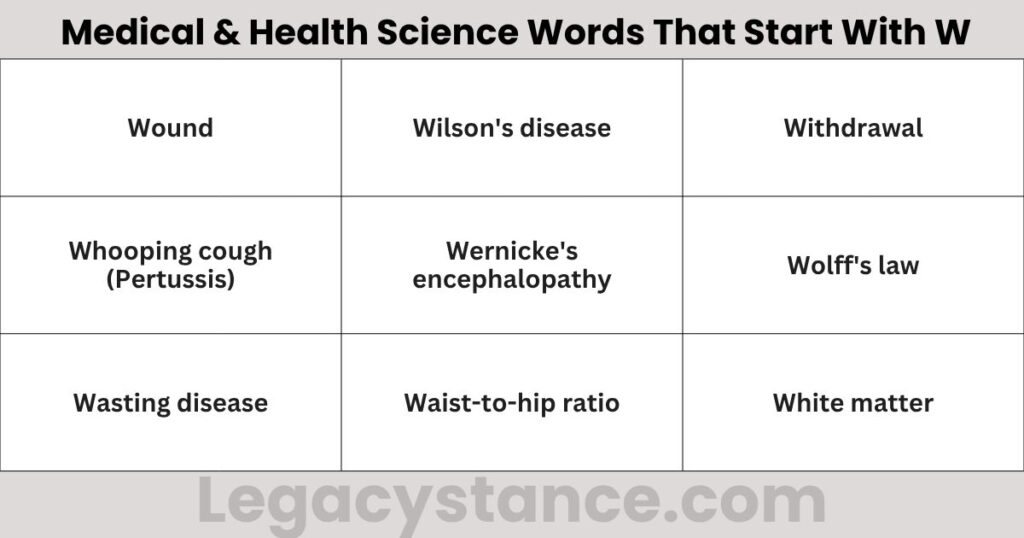
Wound — Classified as open (cuts, punctures, lacerations) or closed (bruises, internal bleeding). Healing passes through four overlapping stages: hemostasis, inflammation, proliferation, and remodeling.
Whooping cough (Pertussis) — A highly contagious bacterial infection causing intense coughing episodes. The name comes from the “whoop” sound when trying to inhale after coughing. Preventable by vaccine.
Wasting disease — Progressive, involuntary loss of muscle mass and body weight. Seen in chronic infections, certain cancers, and some neurological conditions.
Wilson’s disease — A genetic disorder preventing normal copper elimination. Copper accumulates in the liver, brain, and other organs, causing serious damage if untreated.
Wernicke’s encephalopathy — A brain disorder triggered by severe Vitamin B1 (thiamine) deficiency. Affects memory, coordination, and eye movement.
Waist-to-hip ratio — A body measurement used to assess fat distribution. A higher ratio correlates with increased cardiovascular risk.
Withdrawal — Physical and psychological symptoms appearing when a person stops using a substance their body has become dependent on.
Wolff’s law — Bone tissue adapts to mechanical stress placed on it. Athletes develop denser bones in high-load areas because of this principle.
White matter — Brain tissue composed of myelinated nerve fibers. It connects different brain regions and speeds up signal transmission.
Working memory — The cognitive system that holds and processes small amounts of information for short-term use. Central to learning, reasoning, and decision-making.
Technology & Applied Science Words That Start With W
Wireless — Data transmission using radio waves, infrared, or microwaves instead of physical cables. Wi-Fi and Bluetooth are both wireless systems.
Wi-Fi — A wireless networking technology operating at 2.4 GHz and 5 GHz radio frequencies to connect devices to the internet.
Wafer — A thin silicon disc used as the base for manufacturing microchips. One wafer can yield hundreds of individual chips.
Waveguide — A physical structure directing electromagnetic or sound waves along a defined path. Found in radar systems, microwave ovens, and fiber optic cables.
Wind turbine — Converts kinetic wind energy into electricity through rotating blades. Modern turbines can power hundreds of homes from a single unit.
Wearable biosensor — A skin-worn device that continuously monitors biological signals — glucose, body temperature, sweat composition — in real time.
Web server — A system that stores, processes, and delivers web content to browsers on request.
Work hardening — A process where metal becomes stronger and harder through repeated plastic deformation. Used intentionally in manufacturing.
Wet scrubber — An industrial device that removes pollutants from gas streams using liquid. Used in factories to reduce emissions before they reach the atmosphere.
Advanced Science Words That Start With W
These appear in higher-level study — grade 9 and above, or for genuinely curious readers.
Wavefunction — In quantum mechanics, a mathematical expression describing the probable quantum state of a particle. It doesn’t say where a particle is — only where it’s likely to be found.
Weak interaction — One of four forces in the Standard Model of particle physics. Causes radioactive beta decay and operates only at subatomic distances.
Wiedemann-Franz law — States that for metals, the ratio of thermal conductivity to electrical conductivity is proportional to temperature.
Winding number — A topological concept describing how many times a curve wraps around a given point. Used in advanced mathematics and theoretical physics.
Wollaston prism — A crystal optical device that splits incoming light into two beams of different polarizations. Used in spectroscopy and optical instruments.
Wurm glaciation — The last major ice age affecting the Alps, occurring roughly 115,000 to 11,700 years ago. Shaped much of Central European geography.
Wobble (genetic) — Flexibility in how a transfer RNA anticodon pairs with a messenger RNA codon. Allows fewer tRNA molecules to service the full genetic code.
Complete Reference List: 150+ Science Words That Start With W
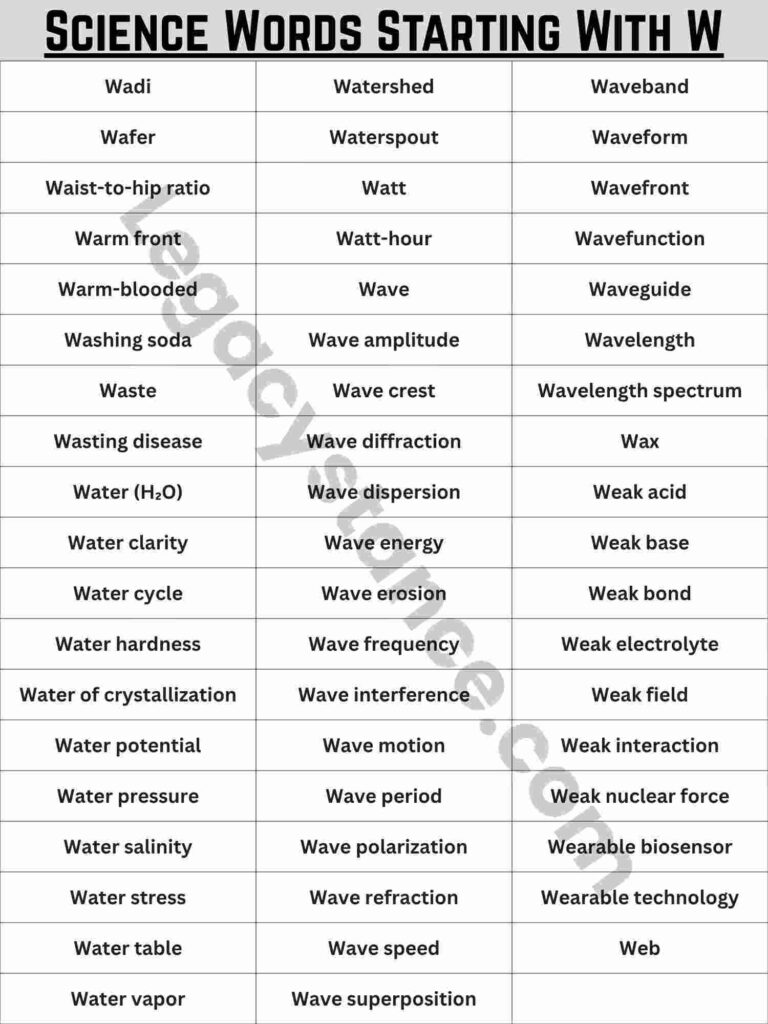
Wadi — Dry desert riverbed that floods after rain
Wafer — Thin silicon disc used to make computer chips
Waist-to-hip ratio — Measure of body fat distribution
Warm front — Warm air mass replacing cooler air
Warm-blooded — Maintains constant body temperature
Washing soda — Chemical used for cleaning and softening water
Waste — Unwanted or discarded material
Wasting disease — Illness causing severe body weight and muscle loss
Water (H₂O) — Essential liquid for all life
Water clarity — How clear or transparent water is
Water cycle — Movement of water through evaporation, rain, and collection
Water hardness — Amount of dissolved minerals in water
Water of crystallization — Water trapped inside crystals
Water potential — Tendency of water to move across membranes
Water pressure — Force water exerts on surfaces
Water salinity — Amount of salt in water
Water stress — Lack of enough water supply
Water table — Underground level where soil is fully wet
Water vapor — Water in gas form
Waterfall — Water flowing over a steep drop
Watershed — Land area draining into a river or lake
Waterspout — Rotating column of air over water
Watt — Unit of power
Watt-hour — Unit of energy
Wave — Energy moving through a medium
Wave amplitude — Height of a wave
Wave crest — Highest point of a wave
Wave diffraction — Bending of waves around obstacles
Wave dispersion — Separation of waves by frequency
Wave energy — Energy carried by waves
Wave erosion — Rock breaking by waves
Wave frequency — Number of waves per second
Wave interference — When waves combine
Wave motion — Movement of energy through waves
Wave period — Time for one wave cycle
Wave polarization — Direction of wave vibration
Wave refraction — Bending of waves in different media
Wave speed — How fast a wave moves
Wave superposition — Overlapping of waves
Wave trough — Lowest point of a wave
Waveband — Range of frequencies
Waveform — Shape of a wave
Wavefront — Line of equal wave phase
Wavefunction — Quantum state description of a particle
Waveguide — Structure that directs waves
Wavelength — Distance between wave peaks
Wavelength spectrum — Full range of wavelengths
Wax — Solid fatty substance
Weak acid — Acid that partially breaks in water
Weak base — Base that partially ionizes in water
Weak bond — Low-strength chemical attraction
Weak electrolyte — Substance that partially conducts electricity
Weak field — Low-strength force field
Weak interaction — Force causing radioactive decay
Weak nuclear force — Subatomic force involved in beta decay
Wearable biosensor — Device worn to monitor health signals
Wearable technology — Electronics worn on the body
Web — Spider net or interconnected system
Webb Space Telescope — Space telescope for deep space observation
Web server — System that delivers websites
Weber — Unit of magnetic flux
Wedge — Simple machine with slanted surfaces
Weed — Unwanted plant
Welding — Joining metals using heat
Wernicke’s encephalopathy — Brain disorder due to vitamin B1 deficiency
Wet deposition — Pollutants removed by rain or snow
Wet scrubber — Device removing air pollution
Wetland ecosystem — Water-saturated land ecosystem
Wetlands — Swamps and marshes
Wetting agent — Substance that helps liquids spread
Whiplash injury — Neck injury from sudden movement
White blood cell — Cell that fights infection
White dwarf — Small dense dead star
White hole — Theoretical object expelling matter
White light — Combination of all colors
White matter — Brain tissue that carries signals
White phosphorus — Highly reactive chemical form of phosphorus
Whooping cough — Contagious respiratory disease
Whorled — Leaf pattern with multiple leaves per node
Wide-field telescope — Telescope with large sky view
Wide-angle lens — Camera lens with wide view
Wiedemann-Franz law — Relation between heat and electricity in metals
Wild type — Normal form of a gene
Wildlife — Animals living in nature
Wilson’s disease — Disorder causing copper buildup in body
Wilting — Drooping of plants due to water loss
Wind — Moving air
Wind chill — Feeling colder due to wind
Wind direction — Direction wind comes from
Wind erosion — Soil removal by wind
Wind farm — Area with wind turbines
Wind power — Electricity from wind
Wind shear — Change in wind speed or direction
Wind turbine — Machine generating electricity from wind
Wind vane — Device showing wind direction
Winding number — Mathematical rotation measure
Wing — Flight structure in animals
Winter biology — Study of life in cold seasons
Winter solstice — Shortest day of the year
Wireless — Communication without cables
Wireless sensor — Device sending data without wires
Wi-Fi — Wireless internet technology
Withdrawal — Symptoms after stopping a substance
Wobble method — Detecting planets by star movement
Wobble (genetic) — Flexible genetic coding rule
Wolf-Rayet star — Very hot massive star losing mass
Wolff’s law — Bones grow stronger under stress
Wollaston prism — Optical device splitting light
Wollaston wire — Fine metal wire used in instruments
Wood — Hard plant tissue in trees
Wood anatomy — Study of wood structure
Wood density — Mass per volume of wood
Wood fiber — Structural plant cell material
Wood pulp — Material used to make paper
Wool — Natural fiber from sheep
Work — Force causing movement
Work function — Energy needed to remove an electron
Work hardening — Strengthening metal by deformation
Work output — Useful energy produced
Work-energy theorem — Work equals change in energy
Working memory — Short-term thinking storage
World ocean — All oceans connected together
Worm — Soft-bodied invertebrate
Wormhole — Theoretical space-time tunnel
Wound — Injury in body tissue
Wound healing — Body repair process
Wound infection — Infection in injured tissue
Wrasse — Colorful reef fish
Wrinkle ridges — Planet surface folds
Wrist — Joint connecting hand and arm
Wrist bones — Small bones in the wrist
Wurm glaciation — Last major ice age period
Wurtzite — Crystal structure type
W chromosome — Female sex chromosome in birds
Warm-blooded metabolism — Energy use to maintain body heat
Water absorption — Uptake of water
Water evaporation — Liquid water turning into gas
Water filtration — Cleaning water
Water infiltration — Water moving into soil
Water retention — Ability to hold water
Watershed management — Protecting water resources
Wave energy converter — Device turning waves into power
Wear resistance — Ability to resist damage
Weather front — Boundary between air masses
Weather system — Large atmospheric pattern
Weathervane — Wind direction indicator
Weed control — Removing unwanted plants
Wire resistance — Opposition to electric current
Wood grain — Pattern in wood rings
Weak field approximation — Simplified gravity model
Wavelength-division multiplexing — Sending data using multiple wavelengths
Water table fluctuation — Change in underground water level
Common Confusions: W Words People Mix Up
Weight vs. Mass Mass measures how much matter an object contains. Weight is the gravitational force acting on that mass. Same mass, different planet — completely different weight.
Weathering vs. Erosion Weathering breaks rock down in place. Erosion carries those broken pieces away. They often work together but are separate processes.
Warm-blooded vs. Cold-blooded Neither term refers to actual blood temperature. Warm-blooded means the animal generates heat internally. Cold-blooded means it relies on environment for temperature regulation.
Water Cycle vs. Water Table The water cycle is a planetary process. The water table is a fixed underground level. One describes movement; the other describes a location.
White Dwarf vs. White Hole A white dwarf is real and observed regularly by astronomers. A white hole exists only in theoretical equations — no confirmed observation yet.
Wood vs. Xylem All wood is xylem, but not all xylem is wood. Young plant xylem remains soft. Wood is specifically the secondary xylem that hardens as the plant matures.
Weak Acid vs. Weak Base Both only partially ionize in water — but a weak acid releases hydrogen ions (H⁺) while a weak base accepts them. Opposite behaviors, similar naming pattern.
Wavefunction vs. Wave A wave is a physical disturbance you can observe — sound, light, water. A wavefunction is a mathematical tool in quantum mechanics describing probability, not an actual physical wave you can see.
Read more:
170+ Science Words That Start With R | Full List with Meanings
200+ Science Words That Start With T | Full List With Meanings
FAQs
1. Which W science words should I learn first for exams?
Start with the basics: wave, wavelength, water cycle, weathering, weight, and white blood cell. These show up often in middle school tests and build a strong foundation for harder topics later.
2. What’s the easiest way to remember science vocabulary?
Link each word to real life. For example, think of waves as ocean ripples, or weathering as rocks breaking down over time. Simple connections make words stick.
3. What is the difference between similar W words like weight and mass?
Mass is how much matter something has. Weight is how strongly gravity pulls on that mass. Same object, different planet = same mass, different weight.
4. Are all these words important for beginners?
Not all. Focus first on common terms used in school. Advanced words like wavefunction or winding number are useful later, but not needed at early levels.
5. How can parents help kids learn these words easily?
Use short practice sessions. Pick 5–10 words a day, explain them in simple terms, and ask kids to use them in sentences. Repetition with meaning works better than memorizing lists.
Bottom line
Science vocabulary starting with W stretches across every major discipline — from quantum wavefunctions to watershed management, from white dwarfs to white blood cells.
These aren’t isolated definitions. Wavelength explains how your microwave heats food. Weathering explains why mountains slowly disappear. Wolff’s law explains why athletes have denser bones. Each word connects to something real.
Use this list the way it’s built — scan the quick table, dig into the category that fits your subject, check the full reference when you need a specific term. Take what you need.