Learning Science Words That Start With O doesn’t have to feel confusing or overwhelming. From everyday ideas like oxygen and orbit to deeper concepts like osmosis and oxidation, these terms show up across school subjects and real life.
This guide keeps things simple, helping you understand what each word means and where you might actually use it. Whether you’re a student, parent, or teacher, the goal is to make science vocabulary easier to read, remember, and apply without memorizing long, boring lists.
20 Most-Used Science Words Starting With O
These appear across the widest range of subjects and grade levels.
Oxygen — Gas essential for breathing and combustion
Osmosis — Water movement through a semi-permeable membrane
Orbit — Curved path one object takes around another
Organism — Any living thing
Organ — Body part performing a specific function
Organelle — Tiny functional structure inside a cell
Oxidation — Chemical process of losing electrons
Omnivore — Animal eating both plants and animals
Opaque — Blocks all light
Ozone — Atmospheric gas blocking UV radiation
Offspring — New organism produced by a parent
Ore — Rock containing valuable minerals
Oscillation — Repeated back-and-forth motion
Ovary — Reproductive organ producing eggs
Observable — Something measurable through direct senses
Optics — Science of light behavior
Ovulation — Release of an egg from the ovary
Outcrop — Rock exposed at Earth’s surface
Optical — Related to light or vision
Oxidize — To chemically react with oxygen
Physics Science Words That Start With O
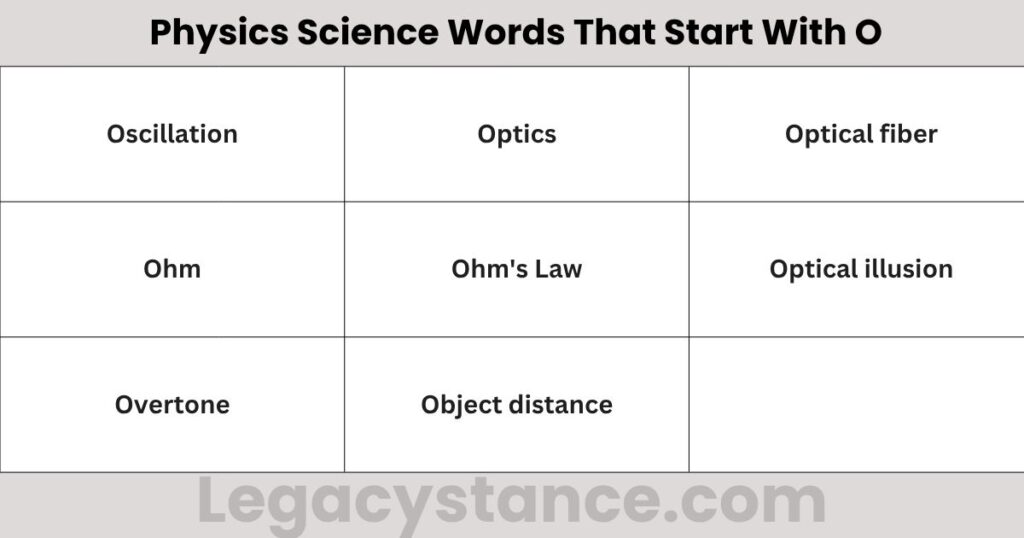
Oscillation A swing moving back and forth is oscillation — repeated motion around a fixed point. Pendulums, sound waves, and electrical circuits all oscillate.
Optics Studies how light bends, reflects, and travels. Every camera, telescope, and pair of glasses depends on optics.
Optical fiber A glass thread carrying light signals instead of electrical ones. Most high-speed internet runs through these.
Ohm The unit of electrical resistance. Higher resistance means lower current flow.
Ohm’s Law The core relationship between voltage, current, and resistance: V = IR.
Overtone A frequency layered over a main sound wave. It explains why a violin sounds different from a flute playing the same note.
Object distance In optics, how far an object sits from a lens or mirror — determines where the image forms.
Optical illusion An image misleading visual perception. A legitimate research topic in physics and neuroscience.
Chemistry Science Words That Start With O
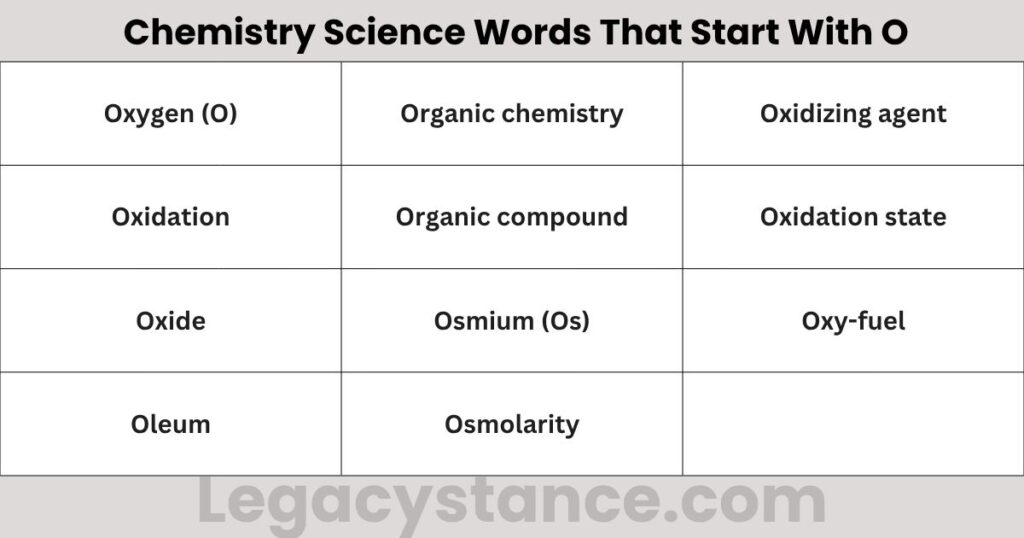
Oxygen (O) Atomic number 8. Most abundant element in Earth’s crust. Combustion and respiration both stop without it.
Oxidation A reaction where a substance loses electrons. Iron rusting and food spoiling in open air are everyday examples.
Oxide A compound formed when oxygen bonds with another element. Rust is iron oxide; carbon dioxide is a carbon oxide.
Organic chemistry Study of carbon-containing compounds. Nearly every medicine, plastic, and food molecule falls here.
Organic compound Any molecule with carbon atoms bonded to hydrogen — sugars, fats, proteins.
Osmium (Os) The densest naturally occurring element. Bluish-white, rare, and extremely hard.
Oxidizing agent Accepts electrons from another substance, triggering oxidation. Hydrogen peroxide works this way in wound care.
Oxidation state A number showing how many electrons an atom gained or lost in a compound. Critical for balancing equations.
Oxy-fuel Combustion using pure oxygen instead of air, producing higher temperatures. Used in industrial welding.
Oleum Fuming liquid made from sulfuric acid and sulfur trioxide. Highly corrosive; used in industrial manufacturing.
Osmolarity Concentration of dissolved particles in a solution. Measured in blood and urine for clinical diagnosis.
Biology Science Words That Start With O
Organism Anything alive — bacteria, fungi, trees, humans. All share growth, response, and reproduction.
Organ Different tissues working together for one job. Heart pumps blood. Lungs exchange gases.
Organelle A functional structure inside a single cell. Mitochondria produce energy; the nucleus holds DNA.
Osmosis Water moves from low solute concentration to high through a membrane. How plant roots absorb water from soil; how kidneys concentrate urine.
Offspring The biological result of reproduction — kittens from cats, seeds from plants.
Ovary In animals, produces eggs. In flowering plants, holds ovules that become seeds after fertilization.
Ovulation Release of a mature egg from the ovary — roughly monthly in humans.
Omnivore Eats both plants and animals. Bears, pigs, crows, and humans.
Osmotroph Absorbs dissolved nutrients from the environment rather than eating solid food. Most bacteria and fungi feed this way.
Operon A group of genes in bacteria switched on or off together. The lac operon in E. coli is the standard genetics example.
Organogenesis The embryo stage when organs begin forming — a critical window in early pregnancy.
Ovule The structure inside a plant’s ovary that becomes a seed after fertilization.
Osmotic pressure The pressure needed to stop osmosis. Cells use this to regulate water balance.
Oogonia Female reproductive stem cells that develop into eggs during fetal development.
Oocyte A cell that develops into a mature egg.
Ontogeny The complete development of an individual organism from embryo to adult.
Earth Science Words That Start With O
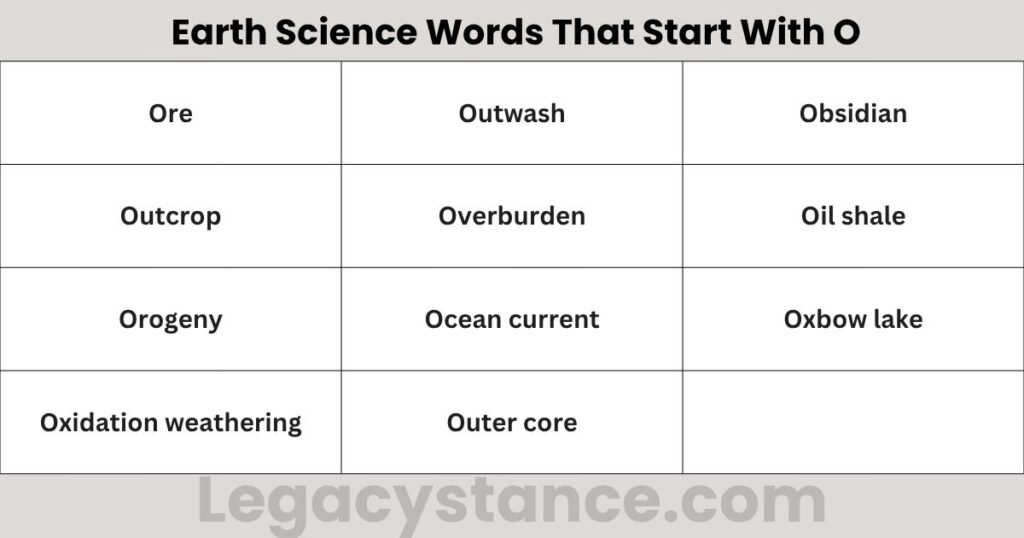
Ore Rock containing enough valuable mineral to justify mining — iron, copper, and gold ore are extracted globally.
Outcrop Rock that breaks through soil and becomes visible at the surface. Geologists read outcrops to understand underground layers.
Orogeny Mountain formation through tectonic forces. The Himalayas formed when the Indian plate collided with the Eurasian plate.
Outwash Sediment left behind by water flowing from melting glaciers — creates flat, sandy outwash plains.
Overburden Rock and soil sitting above a mineral deposit. Removed during mining to reach ore beneath.
Ocean current A continuous, directed movement of ocean water. The Gulf Stream moves heat around the planet and directly shapes climate.
Obsidian Volcanic glass formed when lava cools rapidly. Ancient peoples shaped it into cutting tools.
Oil shale Sedimentary rock containing organic matter called kerogen. Heating it releases oil.
Oxbow lake A curved lake formed when a river bend gets cut off from the main channel.
Oxidation weathering Rock breakdown caused by minerals reacting with oxygen and water. The red color of desert sandstone comes from iron oxidation.
Outer core The liquid iron-nickel layer inside Earth, responsible for generating the planet’s magnetic field.
Space & Astronomy Science Words That Start With O
Orbit The curved path a planet, moon, or satellite follows around another object due to gravity.
Orbital period Time to complete one full orbit. Mercury’s is about 88 Earth days.
Orbital velocity The speed required for a stable orbit. Too slow — gravity pulls you down. Too fast — you escape entirely.
Obliquity The tilt of a planet’s rotational axis. Earth’s 23.5° tilt creates the seasons.
Observatory A facility built to observe space. The Hubble Space Telescope is an orbital observatory.
Occultation When one space object passes in front of another, blocking its light. Used to study dim or distant objects.
Oort Cloud A distant spherical region surrounding the solar system containing billions of icy bodies. The likely source of long-period comets.
Open cluster A loosely bound group of young stars. The Pleiades is the most recognizable example visible without a telescope.
Opposition When a planet sits directly opposite the Sun from Earth. Mars at opposition appears large and bright.
Optical telescope Collects visible light to form images — standard equipment for backyard astronomers.
Orbital resonance When orbiting bodies exert regular gravitational influence on each other due to aligned orbital periods.
Medical & Health Science Words That Start With O
Oncology Branch of medicine focused on cancer — diagnosis, treatment, and research.
Organ transplant Surgical replacement of a failing organ with a healthy donor organ.
Obesity Excess body fat reaching levels that damage health. Defined clinically by a BMI above 30.
Orthopedics Medicine focused on bones, joints, and muscles. Handles fractures and sports injuries.
Osteoporosis Bones lose density and become fragile. More common in older adults, especially post-menopausal women.
Otitis Ear inflammation. Otitis media (middle ear) is one of the most common childhood infections.
Ophthalmology Eye health specialty. Covers cataracts, glaucoma, and vision correction.
Oximetry Measures blood oxygen levels using a clip-on device. Used constantly in clinical settings.
Overdose Taking more of a substance than the body can safely process.
Opioid Drugs binding to pain receptors in the brain — includes prescription painkillers and illegal substances.
Oxytocin Hormone involved in social bonding, childbirth, and breastfeeding.
Oxidative stress Cell damage caused by excess reactive oxygen species. Linked to aging and many chronic diseases.
Technology & Applied Science Words That Start With O
Output What a system produces after processing input — visual on a screen, audio from a speaker.
Operating system Software managing all hardware and programs. Windows, macOS, and Linux are examples.
Optical sensor Detects light and converts it to an electrical signal. Found in cameras, smoke detectors, touchscreens.
Oscilloscope Displays electrical signals as wave patterns. Engineers use it to test and diagnose circuits.
Open-source Software with publicly available code anyone can view, modify, or improve. Linux and Python are open-source.
Ohmmeter Measures electrical resistance in a circuit or component.
Optoelectronics Combines optics and electronics — covers LEDs, laser diodes, and solar cells.
Overclocking Running a processor above its rated speed for extra performance.
Open circuit An electrical circuit with a broken path — current cannot flow.
Advanced Science Words That Start With O
These appear in AP courses, university study, and research contexts.
| Term | Meaning |
| Osmotic potential | Tendency of water to move into a solution; measured in pressure units |
| Oligonucleotide | Short nucleotide chain used in genetics and diagnostics |
| Oxidative phosphorylation | ATP production using oxygen inside mitochondria |
| Optical isomers | Mirror-image molecules with identical formulas but different biological behavior |
| Osteoblast | Cell that builds new bone tissue |
| Osteoclast | Cell that breaks down old bone tissue |
| Organochlorine | Chlorine-containing organic compound; many are environmental pollutants |
| Oscillatory reaction | Chemical reaction where concentrations cycle up and down over time |
| Orbital hybridization | Mixing of atomic orbitals to form new bonding structures |
| Oxalosuccinate | Intermediate compound in the citric acid cycle |
| Oxidoreductase | Enzyme catalyzing oxidation-reduction reactions |
| Opsonin | Molecule that marks bacteria for destruction by the immune system |
| Osmoreceptor | Receptor detecting changes in osmotic pressure |
| Organotroph | Organism using organic compounds as its energy source |
| Oncogene | Gene with the potential to cause cancer when mutated |
Complete Reference List: 130+ Science Words That Start With O
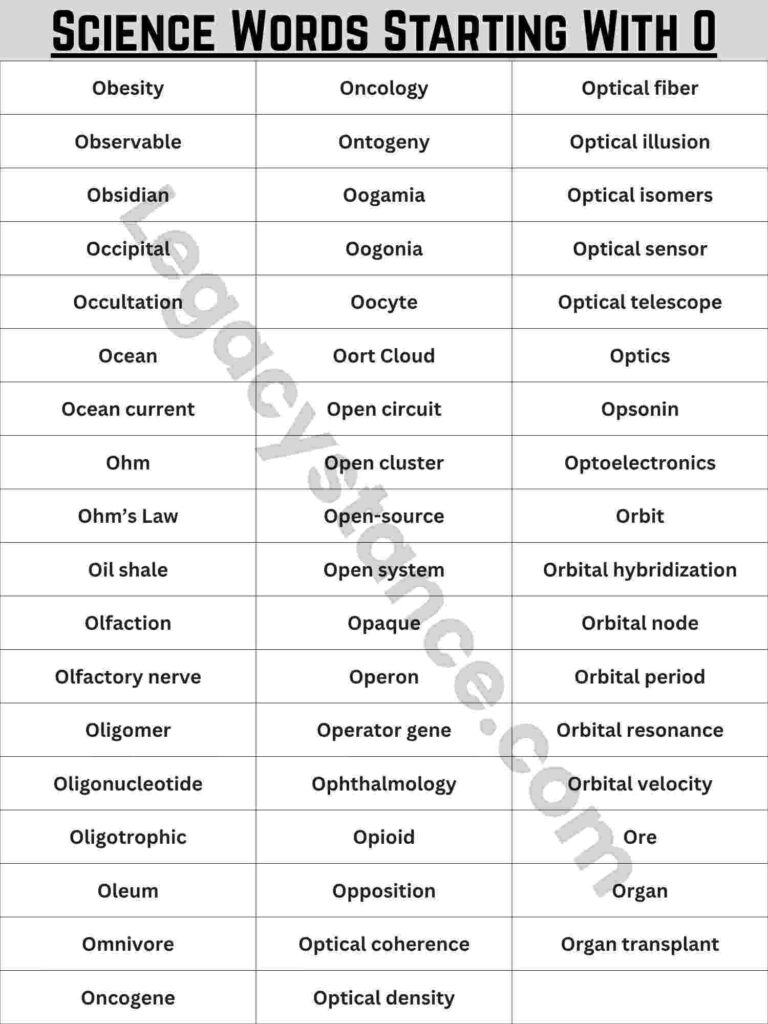
Obesity — Excess body fat damaging health
Observable — Measurable through direct senses
Obsidian — Volcanic glass from rapid lava cooling
Occipital — Back region of the skull
Occultation — One space object blocking another
Ocean — Large saltwater body on Earth
Ocean current — Directed continuous flow of ocean water
Ohm — Unit of electrical resistance
Ohm’s Law — V = IR
Oil shale — Sedimentary rock releasing oil when heated
Olfaction — The sense of smell
Olfactory nerve — Nerve carrying smell signals to the brain
Oligomer — Short chain of repeating molecular units
Oligonucleotide — Short nucleotide chain for genetic research
Oligotrophic — Water body low in nutrients
Oleum — Fuming industrial sulfuric acid mixture
Omnivore — Eats both plants and animals
Oncogene — Gene with cancer-causing potential
Oncology — Medical study of cancer
Ontogeny — Full development of an individual organism
Oogamia — Fertilization between large egg and small sperm
Oogonia — Female reproductive stem cells
Oocyte — Cell developing into an egg
Oort Cloud — Distant region of icy solar system bodies
Open circuit — Electrical circuit with broken path
Open cluster — Loosely bound group of young stars
Open-source — Publicly available software code
Open system — System exchanging both energy and matter
Opaque — Blocks all light
Operon — Co-regulated gene cluster in bacteria
Operator gene — Gene controlling nearby gene expression
Ophthalmology — Medical study of the eyes
Opioid — Drug binding to brain pain receptors
Opposition — Planet directly opposite the Sun from Earth
Optical coherence — Light wave phase alignment
Optical density — Measure of light absorption by a substance
Optical fiber — Glass thread carrying light signals
Optical illusion — Image misleading visual perception
Optical isomers — Mirror-image molecules, same formula
Optical sensor — Light-detecting device
Optical telescope — Telescope using visible light
Optics — Study of light behavior
Opsonin — Molecule marking bacteria for immune destruction
Optoelectronics — Field combining optics and electronics
Orbit — Curved path around another object
Orbital hybridization — Mixing of atomic orbitals
Orbital node — Point where orbit crosses a reference plane
Orbital period — Time to complete one orbit
Orbital resonance — Regular gravitational pull between orbiting bodies
Orbital velocity — Speed needed for stable orbit
Ore — Rock containing valuable minerals
Organ — Tissue group with a specific function
Organ transplant — Surgical replacement of a failing organ
Organelle — Functional structure inside a cell
Organic chemistry — Study of carbon-based compounds
Organic compound — Carbon-hydrogen containing molecule
Organochlorine — Chlorine-containing organic pollutant
Organogenesis — Organ formation during embryo development
Organism — Any living thing
Organotroph — Organism using organic compounds for energy
Organotropism — Growth response toward a stimulus
Orogeny — Mountain formation by tectonic activity
Orthopedics — Medicine for bones and joints
Oscillation — Repeated back-and-forth motion
Oscillator — Device producing oscillating signals
Oscilloscope — Instrument displaying electrical wave signals
Oscillatory reaction — Reaction with cycling concentrations
Osmium (Os) — Densest naturally occurring element
Osmolarity — Dissolved particle concentration in solution
Osmoreceptor — Receptor detecting osmotic pressure changes
Osmosis — Water movement through semi-permeable membrane
Osmotic potential — Tendency of water movement into a solution
Osmotic pressure — Pressure needed to stop osmotic flow
Osmotroph — Organism absorbing dissolved nutrients
Osteoblast — Cell building bone tissue
Osteoclast — Cell breaking down bone tissue
Osteocyte — Mature bone cell maintaining bone
Osteoporosis — Condition of fragile low-density bones
Otitis — Ear inflammation or infection
Otolith — Calcium structure in inner ear for balance
Otoscope — Instrument for examining the ear
Outcrop — Surface-exposed rock formation
Outer core — Liquid iron-nickel layer inside Earth
Output — Result produced by a system
Outwash — Sediment deposited by glacial meltwater
Overburden — Material sitting above a mineral deposit
Overclocking — Running processor above rated speed
Overdose — Dangerously excessive substance intake
Overexpression — Excessive gene or protein production in cells
Overstory — Uppermost forest canopy layer
Ovary — Reproductive organ producing eggs or seeds
Ovicell — Protective chamber for developing eggs
Oviparity — Reproduction by laying eggs
Ovogenesis — Process of egg cell development
Ovoviviparity — Eggs hatching inside the mother
Ovulation — Release of egg from ovary
Ovule — Plant structure becoming a seed
Oxalic acid — Organic acid found in plants like spinach
Oxalosuccinate — Intermediate in the citric acid cycle
Oxbow lake — Curved lake from cut-off river bend
Oxidation — Chemical process of losing electrons
Oxidation state — Electron gain/loss number in compounds
Oxidation weathering — Rock breakdown through oxygen reaction
Oxidative phosphorylation — ATP production using oxygen in mitochondria
Oxidative stress — Cell damage from excess reactive oxygen
Oxide — Oxygen compound with another element
Oxidize — To react chemically with oxygen
Oxidized mineral — Mineral altered by oxygen exposure
Oxidizing agent — Substance accepting electrons from another
Oxidoreductase — Enzyme for oxidation-reduction reactions
Oxy-fuel — Combustion using pure oxygen
Oxygen (O) — Element essential for life and combustion
Oxygenation — Adding oxygen to a substance or system
Oximetry — Measuring blood oxygen levels
Oxytocin — Hormone for bonding and childbirth
Oxytropism — Plant growth response toward oxygen
Ozone — Gas absorbing UV radiation
Ozone depletion — Reduction in stratospheric ozone
Ozone layer — Stratospheric ozone concentration region
Obliquity — Tilt of a planet’s rotational axis
Observatory — Facility for astronomical observation
Ohmmeter — Measures electrical resistance
Operating system — Software managing computer hardware
Where O Science Words Actually Appear
No separate descriptions needed — the real-world connection is direct:
| Setting | Key “O” Words in Use |
| Hospitals | Oximetry, oncology, oxytocin, organ transplant, osteoporosis |
| Environmental science | Ozone depletion, ocean current, oxidation weathering, oligotrophic lakes |
| Your devices | Optical sensor, open-source, output, operating system, overclocking |
| Agriculture & food | Osmosis, organic compounds, oxalic acid |
| Space programs | Orbital velocity, obliquity, Oort Cloud, occultation |
| Nature & geology | Obsidian, outcrops, oxbow lakes, outwash plains |
Common Confusions — Cleared Up
Osmosis vs. Diffusion Osmosis is only water moving through a membrane. Diffusion covers any particle spreading out in any medium. Osmosis is a specific type of diffusion.
Organ vs. Organelle Scale is the only difference. Organs exist inside whole bodies. Organelles exist inside single cells.
Oxidation vs. Combustion Combustion is fast, visible oxidation that produces heat and light. Rusting is slow oxidation with no flame. Same chemistry — completely different speeds.
Ovary: animal vs. plant In animals it produces eggs. In flowering plants it’s the base of the pistil, holding ovules that become seeds. Related function, different scale and structure.
Osteoblast vs. Osteoclast “Blast” builds bone. “Clast” breaks it down. Both work constantly together to maintain healthy bone density. Lose this balance and osteoporosis develops.
Opaque vs. Translucent vs. Transparent Opaque blocks all light — brick wall. Translucent scatters light — frosted glass. Transparent passes light clearly — window glass.
You may like:
150+ Science Words That Start With Q: Meanings & Easy Guide
140+ Science Words That Start With P | Full List with Meanings
FAQs about Science Words That Start With O
1. How can I quickly understand science words instead of memorizing them?
Start with the root word. For example, learn “osmosis” first, then “osmotic pressure” becomes easier. Focus on meaning, not just spelling.
2. Why do many science words sound similar but mean different things?
Many terms come from Greek and Latin roots. Small changes in endings or prefixes can completely change the meaning.
3. Which “O” words are most important for exams?
Common ones include oxygen, osmosis, organism, orbit, oxidation, and ozone. These appear across multiple subjects and grades.
4. How do I remember the difference between similar terms like organ and organelle?
Think about size. Organs are parts of the body. Organelles are tiny parts inside a cell. Linking words to size makes them easier to recall.
5. Are these words useful outside of school?
Yes. Words like oxygen, obesity, optical, and operating system are used in daily life, health, and technology.
What You’ve Learned Here
130+ science words starting with “O” — sorted by subject, scaled by difficulty, connected to where they actually appear in the world.
Science vocabulary compounds like interest. Learn osmosis and osmotic pressure costs you almost nothing extra. Learn orbit and orbital velocity, orbital period, and orbital resonance follow naturally. Start with the words you already half-know. The rest builds itself.