
Learning Science Words That Start With M can feel overwhelming at first, but it doesn’t have to be. This guide is built to make things simple, clear, and useful for real life—not just exams. Whether you’re a student preparing for a test, a parent helping with homework, or someone improving English, these words are explained in an easy way.
You’ll find terms from biology, chemistry, physics, and more, all organized so you can quickly understand and remember them without confusion or stress.
20 Most-Used Science Words Starting With M
Mass — Amount of matter in an object
Matter — Anything with mass that takes up space
Molecule — Two or more atoms bonded together
Magnet — Object that attracts iron and certain metals
Membrane — Thin layer surrounding cells or organs
Metamorphosis — Major body change during an animal’s life cycle
Mitosis — Cell division producing two identical cells
Microorganism — Living thing too small to see without a microscope
Mutation — Change in a DNA sequence
Mineral — Natural solid substance found in Earth
Momentum — Mass multiplied by velocity
Motion — Change in position of an object over time
Microscope — Instrument used to magnify tiny objects
Melting Point — Temperature at which a solid becomes liquid
Mixture — Two or more substances combined but not chemically bonded
Moon — Natural satellite orbiting a planet
Meteorite — Space rock that lands on Earth’s surface
Myelin — Protective coating around nerve fibers
Mutualism — Relationship where both species benefit
Mantle — Earth’s layer between the crust and core
Physics Science Words That Start With M
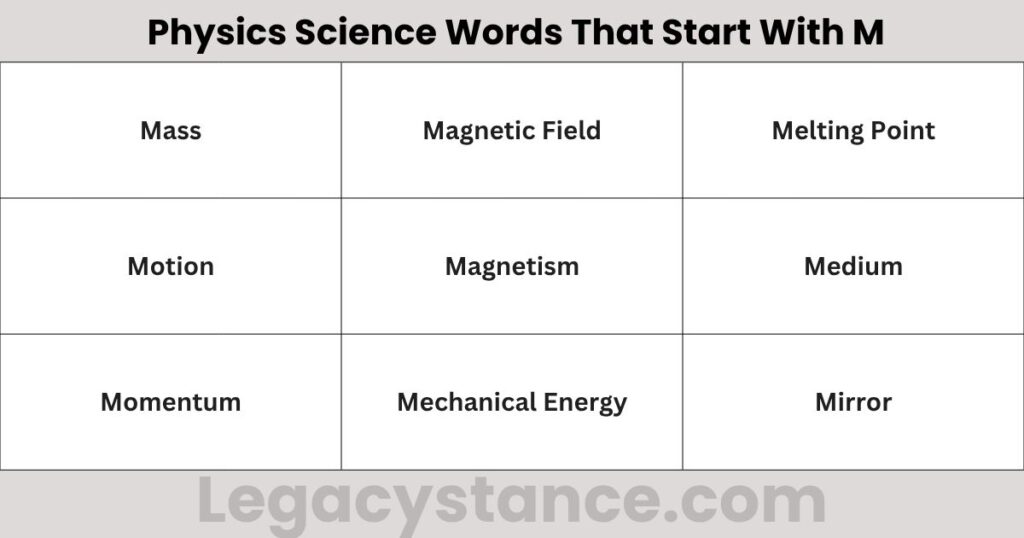
Physics explains how things move, interact, and exist. M words are central to this subject.
Mass — Measures how much matter is in an object. Not the same as weight. An astronaut on the Moon weighs less but has the same mass as on Earth — because mass doesn’t change with gravity.
Motion — Any change in position over time. Without it, physics barely has a subject.
Momentum — A bowling ball rolling toward pins carries high momentum. It equals mass × velocity. Stopping something with high momentum takes serious force.
Magnetic Field — The invisible area around a magnet where its force works. Earth has one — that’s why compasses point north.
Magnetism — The force magnets produce. Unlike gravity, it can both attract and repel.
Mechanical Energy — Energy from movement or stored position. A swinging pendulum has it. A stretched rubber band has it before it snaps.
Melting Point — The exact temperature where a solid turns liquid. Ice melts at 0°C. Iron melts at 1538°C. Every pure substance has its own specific value.
Medium — The material through which a wave travels. Sound needs a medium — that’s why space is silent. Light travels without one.
Mirror — A surface that reflects light to create images. Flat, concave, and convex mirrors each reflect differently.
Modulus — A measure of a material’s stiffness or elasticity. Engineers rely on this when designing bridges or buildings.
Chemistry Science Words That Start With M
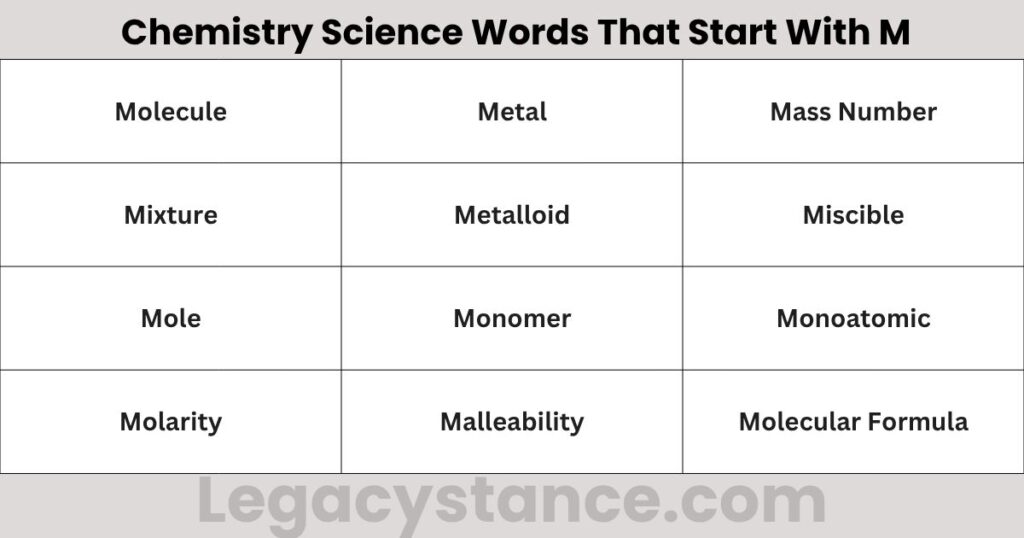
Molecule — Two or more atoms bonded together. Water is H₂O — two hydrogen, one oxygen. Simple but essential.
Mixture — Substances combined without a chemical bond. Salt stirred into water is a mixture — evaporate the water and the salt returns unchanged.
Mole — A unit for counting particles. One mole = 6.02 × 10²³ particles. Scientists use this because atoms are far too tiny to count individually.
Molarity — Concentration of a solution. Tells you how many moles of a substance sit in one liter of liquid.
Metal — Elements that are shiny, conduct electricity, and bend without breaking. Iron, copper, and gold are metals.
Metalloid — Elements behaving like both metals and non-metals. Silicon is one — it runs your computer chips.
Monomer — A single unit that joins with others to form a polymer. One bead; the full necklace is the polymer.
Malleability — Ability to be shaped by hammering without cracking. Gold is so malleable it can be beaten thinner than paper.
Mass Number — Total protons plus neutrons in an atom’s nucleus. Carbon-12 has a mass number of 12.
Miscible — Two liquids that fully mix. Water and alcohol are miscible. Water and oil are not.
Monoatomic — Existing as single atoms rather than molecules. Noble gases like helium exist this way.
Molecular Formula — Shows types and numbers of atoms in a molecule. C₆H₁₂O₆ is glucose.
Biology Science Words That Start With M
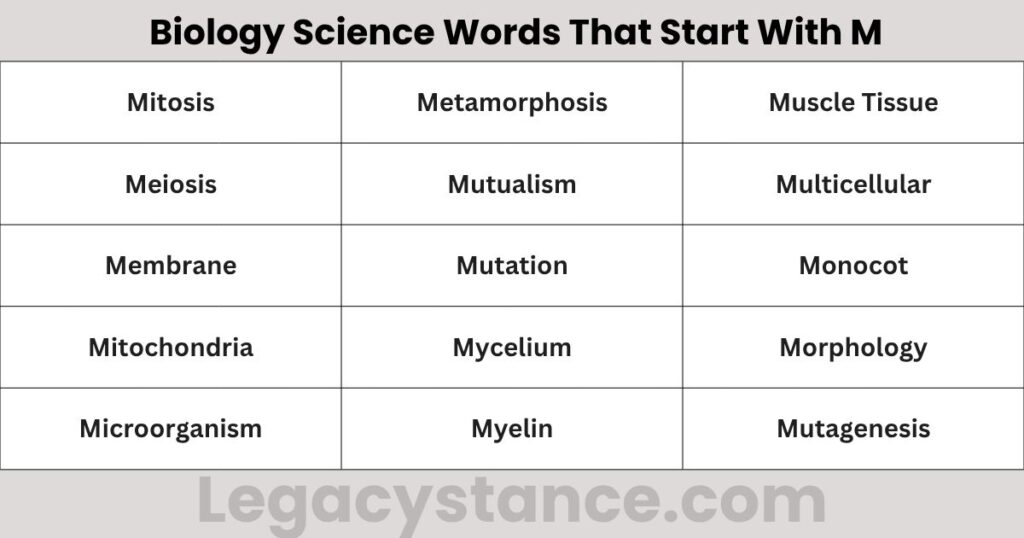
Mitosis — One cell divides into two identical copies. Your body does this constantly for growth and repair.
Meiosis — Creates reproductive cells with half the normal chromosomes. This is how sexual reproduction works — and it’s completely different from mitosis.
Membrane — A thin, flexible barrier. The cell membrane controls what enters and exits every cell in your body.
Mitochondria — Produces energy inside the cell. Animal and plant cells both have them. Yes, “powerhouse of the cell” is accurate.
Microorganism — Any living thing invisible without a microscope. Bacteria, viruses, some fungi. Some cause disease; many are helpful — like gut bacteria.
Metamorphosis — Dramatic body transformation during an animal’s life. A caterpillar becoming a butterfly is complete metamorphosis. A grasshopper changing gradually is incomplete.
Mutualism — Both species benefit. Bees get nectar; flowers get pollinated.
Mutation — A change in the DNA sequence. Some mutations cause problems. Others are neutral. A rare few lead to useful traits passed across generations.
Mycelium — The underground thread network of a fungus. The mushroom above ground is only the tip of it.
Myelin — Fatty coating around nerve fibers that speeds up electrical signals. When damaged — as in multiple sclerosis — nerve communication slows or breaks down.
Muscle Tissue — One of four main tissue types in animals. Three kinds: cardiac, smooth, and skeletal.
Multicellular — Made of more than one cell. Humans have roughly 37 trillion.
Monocot — Flowering plant with one seed leaf. Grass and corn are monocots.
Morphology — The study of form and structure in living things. What they look like, how they’re shaped.
Mutagenesis — The process of causing mutations — through chemicals, radiation, or other agents.
Earth Science Words That Start With M
Mantle — The thick, semi-solid rock layer between Earth’s crust and core. It flows — extremely slowly — over millions of years.
Mineral — Naturally occurring, solid, inorganic substance with a defined chemical composition. Rocks are made of minerals. Your body needs some too — calcium and iron, for example.
Magma — Molten rock underground. Once it erupts through a volcano, it becomes lava. Same material, different location.
Metamorphic Rock — Rock reshaped by heat and pressure without melting. Marble started as limestone. Slate started as shale.
Moraine — Rocks and debris left behind by a moving glacier. You can trace ancient glacier paths by following moraines.
Monsoon — Seasonal wind system bringing heavy rainfall. South Asia’s monsoon feeds agriculture — and can also trigger devastating floods.
Mesosphere — Atmospheric layer above the stratosphere. Most meteors burn up here before reaching the ground.
Meander — A wide, winding river curve. Rivers develop these naturally as water erodes outer banks and deposits sediment inside.
Mid-Ocean Ridge — Underwater volcanic mountain range where tectonic plates pull apart. New ocean floor forms here continuously.
Magnitude — Measures earthquake intensity. Each full number on the Richter scale represents ten times more ground shaking than the number below it.
Space & Astronomy Science Words That Start With M
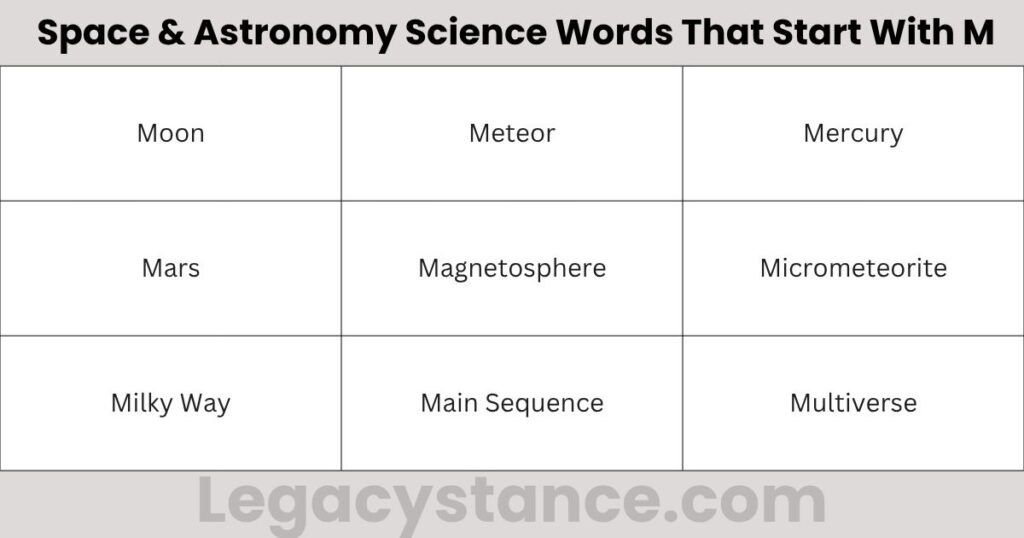
Moon — A natural satellite orbiting a planet. Earth has one. Jupiter has over 90.
Mars — Fourth planet from the Sun. Iron oxide on its surface creates the red color. A strong candidate for future human missions.
Milky Way — Our home galaxy. A barred spiral structure containing over 200 billion stars.
Meteor — A space rock burning up in Earth’s atmosphere — the streak of light you see. If it survives and hits the ground, it becomes a meteorite.
Magnetosphere — A planet’s magnetic shield. Earth’s deflects harmful solar wind — without it, life as we know it couldn’t survive on the surface.
Main Sequence — The stable phase in a star’s life, where hydrogen fuses into helium. The Sun is currently here.
Mercury — Smallest planet, closest to the Sun. One full orbit takes just 88 Earth days.
Micrometeorite — A microscopic meteorite. Thousands land on Earth daily without anyone noticing.
Multiverse — The theoretical idea that our universe is one of many. Unproven — but taken seriously in theoretical physics.
Medical & Health Science Words That Start With M
Metabolism — Every chemical reaction keeping you alive. Breathing, digesting, growing — all metabolism.
Malignant — Cancer cells that invade and spread. The opposite, benign, means contained and non-spreading.
Mucus — The body’s protective slippery fluid. Your nose, lungs, and gut all produce it constantly.
Myocardium — Heart muscle tissue. A heart attack damages it by cutting off blood supply.
Malaria — Disease caused by a parasite carried by mosquitoes. Still one of the world’s deadliest infectious diseases.
Meningitis — Inflammation of tissue surrounding the brain and spinal cord. Serious — requires fast treatment.
MRI — Magnetic Resonance Imaging. Creates detailed internal body images using magnetic fields and radio waves — no radiation like X-rays.
Macrophage — An immune cell that engulfs and destroys bacteria, debris, and dead cells. One of your body’s first-line defenders.
Malnourishment — The body lacking adequate nutrients. Affects brain development, immune response, and growth.
Motor Neuron — Carries signals from the brain to muscles, telling them when to move.
Technology & Applied Science Words That Start With M
Microprocessor — The central chip in electronic devices. Processes billions of instructions per second in modern hardware.
Module — A self-contained unit in engineering or software. Spacecraft are assembled in modules. Code is written in modules. Teams can work on separate pieces without breaking each other’s work.
Modulation — Altering a wave to carry information. AM and FM radio both use it — just different methods.
Machine Learning — Computers learning patterns from data rather than following rigid instructions. Behind most modern recommendations and predictions.
Mechanical Advantage — The force multiplication a simple machine provides. Levers, pulleys, and ramps all give you this — they let you move heavier loads with less effort.
Magnetic Resonance — The physical principle behind MRI. Hydrogen atoms in your body respond to magnetic fields, and that response creates the image.
Easy Science Words That Start With M — Beginners & Kids
These are great starting points if you’re new to science vocabulary.
| Word | Simple Meaning |
| Magnet | Attracts iron and steel objects |
| Matter | Anything that takes up space — air, water, you |
| Melt | Solid turning to liquid from heat |
| Moss | Small soft plant that grows in damp, shady spots |
| Mold | Fungus that grows on damp surfaces or old food |
| Migration | Animals traveling long distances with the seasons |
| Muscle | Body tissue that contracts to create movement |
| Moisture | Water or liquid present in air or on a surface |
| Mammal | Warm-blooded animal that feeds young with milk |
Advanced Science Words That Start With M
These go deeper — useful for high school and beyond.
Meiotic Division — The specific stages in meiosis producing four genetically unique cells, each with half the normal chromosome count.
Molecular Orbital Theory — Treats electrons in a molecule as spread across the entire molecule rather than belonging to individual atoms.
Magnetohydrodynamics — Studies how magnetic fields interact with electrically conducting fluids like plasma. Relevant to fusion energy research.
Morphogenesis — The biological process controlling the shapes and patterns cells develop during growth.
Mycorrhizae — Fungus-root partnerships where fungi help plants absorb water and nutrients; plants share sugars back.
Muon — A subatomic particle like an electron but 207 times heavier. Forms when cosmic rays strike the upper atmosphere.
Mesophyll — Inner leaf tissue where photosynthesis mainly occurs. Packed with chloroplasts.
Metallurgy — The science of extracting, purifying, and working with metals.
Mitochondrial DNA — Genetic material found only in mitochondria. Passed down exclusively through the mother. Used in ancestry testing and forensics.
Macroevolution — Evolutionary change at the species level and above — new species emerging over vast time spans.
Complete Reference List — 160+ Science Words That Start With M
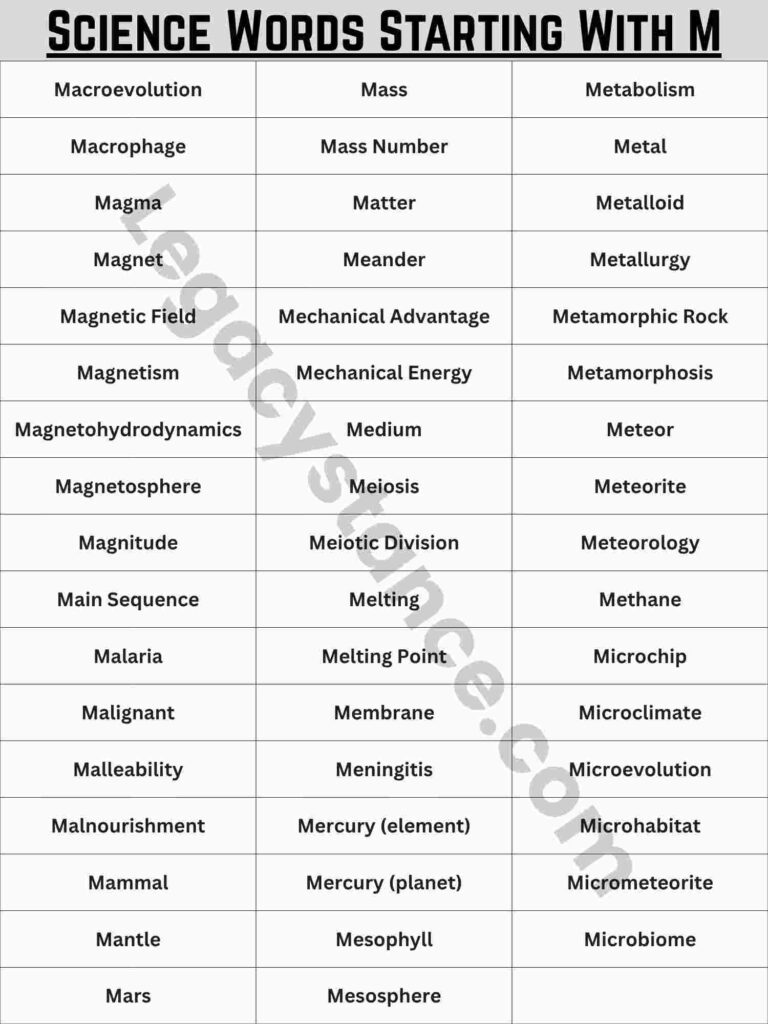
Macroevolution — Species-level evolutionary change
Macrophage — Immune cell destroying harmful particles
Magma — Underground molten rock
Magnet — Attracts iron and similar metals
Magnetic Field — Region where magnetic force acts
Magnetism — Force from moving electric charges
Magnetohydrodynamics — Magnetic effects on conducting fluids
Magnetosphere — Planetary magnetic shield
Magnitude — Scale of earthquake or star brightness
Main Sequence — Stable hydrogen-fusing phase of a star
Malaria — Mosquito-transmitted parasitic disease
Malignant — Spreading cancer
Malleability — Shapeable without cracking
Malnourishment — Insufficient nutrient intake
Mammal — Milk-feeding warm-blooded animal
Mantle — Earth’s layer below crust
Mars — Fourth planet from the Sun
Mass — Quantity of matter in an object
Mass Number — Protons + neutrons in a nucleus
Matter — Substance occupying space
Meander — Winding river curve
Mechanical Advantage — Force multiplication via simple machine
Mechanical Energy — Energy of motion or position
Medium — Wave-carrying material
Meiosis — Reproductive cell division
Meiotic Division — Stages producing four unique cells
Melting — Solid-to-liquid transition
Melting Point — Temperature triggering melting
Membrane — Thin cellular or biological barrier
Meningitis — Brain/spinal membrane inflammation
Mercury (element) — Liquid metal at room temperature
Mercury (planet) — Closest planet to Sun
Mesophyll — Leaf tissue for photosynthesis
Mesosphere — Atmospheric layer above stratosphere
Metabolism — All life-sustaining chemical reactions
Metal — Conductive, malleable element
Metalloid — Partial metal/non-metal element
Metallurgy — Science of metals
Metamorphic Rock — Heat/pressure-altered rock
Metamorphosis — Animal life-cycle transformation
Meteor — Burning space rock in atmosphere
Meteorite — Space rock reaching Earth’s surface
Meteorology — Study of weather
Methane — CH₄ greenhouse gas
Microchip — Miniature electronic circuit
Microclimate — Local small-area atmospheric conditions
Microevolution — Small-scale species-level genetic change
Microhabitat — Tiny environment within a larger one
Micrometeorite — Microscopic meteorite particle
Microbiome — Community of microorganisms in a habitat
Microgravity — Near-weightlessness in space
Micron — One millionth of a meter
Microorganism — Microscopic living thing
Microprocessor — Central computing chip
Microscope — Magnification instrument
Mid-Ocean Ridge — Underwater volcanic mountain range
Midbrain — Brainstem region
Migration — Seasonal animal movement
Milky Way — Our home galaxy
Millibar — Unit of atmospheric pressure
Mineral — Natural inorganic solid
Mineral Cycle — Movement of minerals through ecosystems
Mirror — Light-reflecting surface
Miscible — Fully mixing liquids
Mitochondria — Cell energy organelle
Mitochondrial DNA — Maternally inherited mitochondrial genes
Mitochondrial Matrix — Inner fluid compartment of mitochondria
Mitosis — Identical-cell division
Mixture — Unbonded combined substances
Mobile Phase — Moving component in chromatography
Modulation — Wave alteration carrying information
Module — Self-contained system component
Modulus — Material stiffness measure
Moist — Slightly wet
Molarity — Moles per liter of solution
Molar Mass — Mass of one mole of a substance
Mole — 6.02 × 10²³ particles unit
Molecular Formula — Atom-type notation for molecules
Molecular Orbital Theory — Electron spread model across molecules
Molecule — Bonded atoms
Mollusca — Phylum of snails, clams, octopuses
Molten — Heat-liquefied state
Momentum — Mass × velocity
Monoatomic — Single-atom element form
Monocot — One-seed-leaf flowering plant
Monocular — Single-lens or single-eye viewing
Monomer — Polymer-building single unit
Monsoon — Seasonal heavy rainfall system
Moon — Planetary natural satellite
Moon Phases — Lunar cycle visible shapes
Moraine — Glacier-deposited debris
Morbidity — Disease prevalence rate
Morphogenesis — Organism shape development
Morphology — Form and structure study
Mortality — Population death rate
Motility — Self-movement ability in cells
Motion — Position change over time
Motor Neuron — Brain-to-muscle signal carrier
MRI — Magnetic body imaging
MRSA — Antibiotic-resistant bacteria
Mucosa — Mucus-secreting body lining
Mucus — Protective body fluid
Muon — Heavy electron-like particle
Multicellular — Many-celled organism
Multiverse — Theoretical multiple-universe concept
Muscle Tissue — Contractile movement tissue
Mutagenesis — Mutation-causing process
Mutation — DNA sequence change
Mutualism — Mutually beneficial species relationship
Mycelium — Fungal underground thread network
Mycorrhizae — Fungus-plant root symbiosis
Myelin — Nerve-fiber protective coating
Myocardium — Heart muscle
Myofibril — Thin muscle fiber strand
Myopia — Nearsightedness
Myosin — Muscle contraction protein
Machine Learning — Data-driven AI learning
Macronutrient — Large-quantity needed nutrient
Magnetic Resonance — Proton response to magnetic fields
Mast Cell — Allergy-response immune cell
Matrix — Surrounding embedding substance
Mean — Mathematical average
Medulla — Organ or gland inner region
Melanin — Skin, hair, and eye pigment
Meniscus — Liquid curve in a container
Mesoderm — Middle embryonic cell layer
Metabolite — Metabolism byproduct
Magnetar — Neutron star with extreme magnetic field
Mangrove — Saltwater-adapted coastal tree
Marine Biology — Ocean life science
Mass Extinction — Widespread species loss event
Mechanoreceptor — Pressure-sensitive sensory receptor
Meridian — North-south imaginary Earth line
Mesocosm — Controlled outdoor experiment environment
Mesopelagic — Ocean zone 200–1000 meters deep
Mafic — Iron/magnesium-rich rock
Magnetic Declination — True vs. magnetic north angle
Micrometeorite — Sub-millimeter space particle
Mucilage — Thick sticky plant secretion
Common Confusions — M Words People Mix Up
Mitosis vs. Meiosis Both are cell division — completely different outcomes. Mitosis makes two identical cells. Meiosis makes four genetically unique cells with half the chromosomes. Memory trick: Meiosis = Making reproductive cells.
Magma vs. Lava Same molten rock — different location. Underground = magma. Erupted onto the surface = lava.
Mass vs. Weight Mass is how much matter is in you — constant anywhere in the universe. Weight is gravity’s pull on that mass — changes on the Moon, on Mars, in orbit.
Meteor vs. Meteoroid vs. Meteorite Meteoroid = space rock traveling through space. Meteor = that rock burning through Earth’s atmosphere (the visible streak). Meteorite = the piece that actually lands. Three stages, three names.
Mixture vs. Compound A mixture combines substances without bonding them — you can separate them again. A compound chemically bonds elements into something new. Saltwater = mixture. Water itself (H₂O) = compound.
Mutualism vs. Commensalism vs. Parasitism Three types of species relationships. Mutualism — both benefit. Commensalism — one benefits, the other is unaffected. Parasitism — one benefits, the other is harmed.
Where M Science Words Show Up in Real Life
At the doctor’s office — MRI, myocardium, mucus, malignant, metabolism, motor neuron, macrophage
In the kitchen — Melting point (butter, chocolate, ice), mixture (salad dressing, spice blends), mold (bread spoiling), microorganisms (active in yogurt and fermented foods)
Outside — Mineral (rocks underfoot), migration (birds flying overhead), moraine (glacial landscape), monsoon (if you live in South Asia or Southeast Asia)
In the news — Mutation (virus variants), magnetosphere (solar storm coverage), mass extinction (biodiversity reporting), meteorite (space news)
On your phone — Microprocessor (inside the device), machine learning (your recommendations), modulation (how calls transmit)
You may also like:
160+ Science Words That Start With L | Full List With Meanings
160+ Science Words That Start With K | Definitions with Examples
FAQs
1. What are the most important science words starting with M to learn first?
Start with common ones like mass, matter, molecule, mitosis, and mutation. These show up often in school and build a strong base.
2. How can I remember difficult science terms easily?
Break words into parts. For example, “micro” means small and “macro” means large. Understanding roots makes new words easier to learn.
3. Are these words useful outside of school?
Yes. Words like metabolism, mineral, and microorganism appear in daily life—health, food, news, and even product labels.
4. What’s the best way to study this list without memorizing everything?
Focus on the topic you’re learning right now. Don’t try to learn all at once—use the list as a reference when needed.
Bottom line
This guide organized 160+ science words starting with M across physics, chemistry, biology, earth science, space, medicine, and technology. Each word was placed once — in the section where it belongs — with full context. The complete reference table gives you quick lookups without repeating what’s already explained.
Science vocabulary builds on itself. Mitochondria connects to metabolism connects to metabolite. Magma connects to mantle connects to metamorphic. The more M words you understand, the faster the rest of each subject starts making sense.