Learning Science Words That Start With P doesn’t have to feel like memorizing a dictionary. This guide keeps things simple, clear, and useful for real life. Whether you’re a student preparing for exams, a parent helping with homework, or just curious, these words are explained in plain language you can actually understand.
Instead of long, confusing definitions, you’ll find short meanings and everyday examples that stick. By the end, you won’t just recognize these terms—you’ll know what they mean and how they show up in science around you.
20 Most-Used Science Words That Start With P
These appear constantly — in textbooks, exams, and labs. Start here.
Photosynthesis — Plants making food from sunlight, water, CO₂
Proton — Positively charged particle inside an atom’s nucleus
Pressure — Force applied over a surface area
Protein — Large molecule essential for body structure and function
Plasma — Fourth state of matter; also the liquid part of blood
Pendulum — Swinging weight used to study motion and time
Pollination — Transfer of pollen between flowers for fertilization
Predator — Animal that hunts other animals for food
Precipitation — Water falling from clouds — rain, snow, sleet, hail
Periodic Table — Chart organizing all known chemical elements
Pigment — Substance giving color to materials or living things
Parasite — Organism living on a host, drawing nutrients, causing harm
Phloem — Plant tissue moving sugars downward from leaves
Prism — Transparent shape splitting white light into color spectrum
Polymer — Large molecule made of repeating smaller units
Photon — Smallest packet of light energy
pH — Scale (0–14) measuring acidity or alkalinity
Pathogen — Microorganism that causes disease
Permafrost — Ground staying frozen for two or more consecutive years
Pulsar — Rapidly spinning neutron star emitting energy beams
Physics Science Words That Start With P
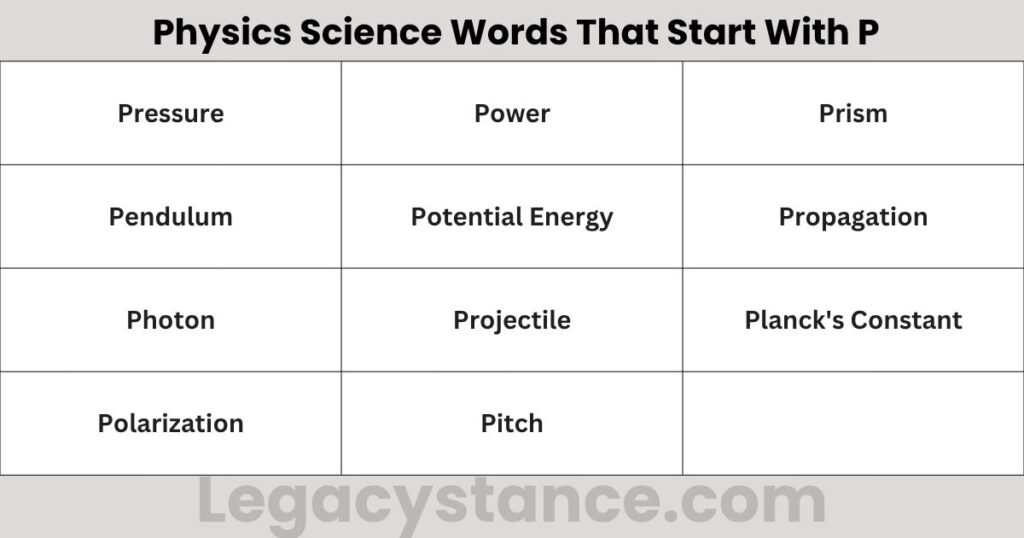
Pressure — Force divided by area. A needle pierces skin; a flat hand doesn’t. Same force, smaller area = more pressure.
Pendulum — A hanging weight that swings at a constant time interval regardless of arc width. Galileo’s observation here led directly to clock design.
Photon — Light travels as particles called photons. No mass, but pure energy. When one hits your retina, you see.
Polarization — Normally light vibrates in every direction. Polarization restricts it to one plane. Polarized sunglasses cut glare from flat water surfaces using this principle.
Power — Not about strength here. Power = energy used per unit of time. A powerful engine does more work faster, not harder.
Potential Energy — Stored energy based on position. A held ball has it. Drop the ball, potential becomes kinetic.
Projectile — Any object launched through air under gravity. Soccer ball, arrow, thrown stone — all follow curved paths for the same gravitational reason.
Pitch — The highness or lowness of sound. Fast vibrations = high pitch (whistle). Slow vibrations = low pitch (bass drum).
Prism — White light enters, full spectrum exits: red, orange, yellow, green, blue, indigo, violet. The glass doesn’t add color — it reveals what was already there.
Propagation — How waves (sound, light, water) travel through a medium. Understanding this shapes how speakers, telescopes, and medical ultrasound devices are designed.
Planck’s Constant — A fixed value (6.626 × 10⁻³⁴ J·s) connecting a photon’s energy to its light frequency. Central to quantum physics. Named after Max Planck.
Chemistry Science Words That Start With P
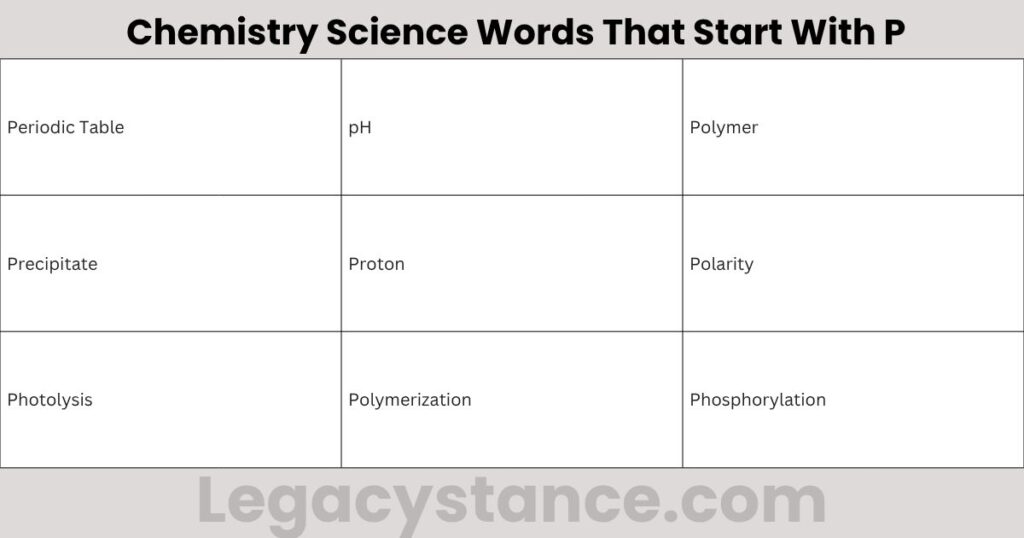
Periodic Table — Every discovered element organized by atomic number and grouped by shared properties. Chemists navigate it the way drivers use a road map.
pH — Runs from 0 (most acidic) to 14 (most alkaline), with 7 as neutral. Lemon juice ≈ 2. Pure water = 7. Baking soda ≈ 9. Matters in medicine, farming, and food science.
Polymer — A long chain molecule built from many repeating small units (monomers). Plastic, rubber, nylon, DNA, and hair are all polymers.
Precipitate — Mix two liquids, and sometimes a solid drops out. That solid is the precipitate. Used in water treatment to pull out dissolved impurities.
Proton — Sits inside the nucleus of every atom. Carries positive charge. The number of protons determines which element an atom is — change proton count, change the element entirely.
Polarity — Molecules with unequal charge distribution are polar. Water is polar, which is why it dissolves so many substances. The chemistry rule “like dissolves like” comes directly from polarity.
Photolysis — Using light energy to break apart a chemical compound. Plants do this during photosynthesis to split water molecules into hydrogen and oxygen.
Polymerization — The process of linking monomers into a polymer chain. Industrial plastic manufacturing runs on this reaction.
Pyrolysis — Heating material at high temperature without oxygen until it breaks down. Used to convert waste plastics into reusable fuel — a growing recycling method.
Phosphorylation — Adding a phosphate group to a molecule. ATP — your cell’s main energy currency — is produced through this process constantly inside your body.
Biology Science Words That Start With P
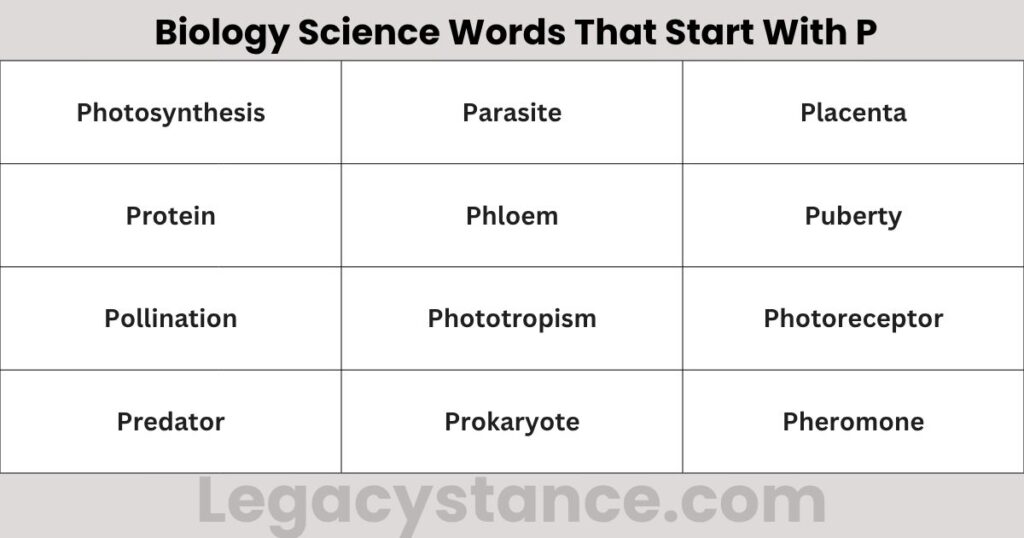
Photosynthesis — Sunlight + water + CO₂ → glucose + oxygen. Every food chain on Earth begins with this reaction. No photosynthesis, no food.
Protein — Built from chains of amino acids. Your muscles, enzymes, skin, and hair are proteins. Your body uses 20 amino acids to construct thousands of different protein types.
Pollination — Pollen moves from stamen to pistil, enabling seed formation. Bees, butterflies, wind, and water all carry pollen. Without it, most fruits and vegetables wouldn’t form.
Predator — Hunts and eats other animals. Lions, hawks, sharks. They keep prey populations controlled, which maintains ecosystem balance.
Prey — Animals hunted by predators. Most animals occupy both roles depending on what’s above and below them in the food chain.
Parasite — Lives on or inside a host long-term, extracting nutrients while causing harm. Tapeworms, lice, and the malaria-causing Plasmodium are classic examples. The host never benefits.
Phloem — Carries sugars downward from leaves to roots. (Xylem moves water upward — they’re a pair, not the same thing.)
Phototropism — Plants grow toward light sources. Leave a houseplant near a window for a week — the lean you see is phototropism in progress.
Prokaryote — A cell with no true nucleus. Bacteria are prokaryotes — the oldest and simplest life forms on Earth.
Phenotype — The physical traits you can observe: eye color, leaf shape, height. Produced by genes and environment working together.
Placenta — Organ forming during mammalian pregnancy. Connects mother to developing fetus, delivering nutrients and oxygen while removing waste.
Puberty — Hormone-driven biological transition from child to adult body. Triggers changes in height, body composition, and reproductive development.
Photoreceptor — Specialized cells in the eye. Rods detect light and dark. Cones detect color. Together they produce full visual experience.
Pheromone — A chemical signal released by one organism to influence the behavior of another of the same species. Ants use pheromone trails. Many insects use them to attract mates.
Phytoplankton — Microscopic aquatic plant-like organisms. They produce over half of Earth’s oxygen through photosynthesis and form the base of ocean food chains.
Pupa — The developmental stage between larva and adult in insects like butterflies. Inside the cocoon or chrysalis, the organism completely reorganizes its body structure.
Population — All individuals of the same species living in one area at one time. Population size shifts with birth rate, death rate, food supply, and predation pressure.
Earth Science Words That Start With P
Precipitation — Any water falling from the atmosphere: rain, snow, sleet, hail. Returns water from clouds to land as part of the continuous water cycle.
Permafrost — Ground frozen for at least two consecutive years. Found in Arctic and sub-Arctic regions. As temperatures rise, melting permafrost releases stored carbon — accelerating climate change.
Plate Tectonics — Earth’s outer crust is broken into large moving plates. Where they meet or separate: earthquakes, volcanoes, mountain ranges. Movement is slow — a few centimeters per year.
Paleontology — Study of ancient life using fossils. Paleontologists reconstruct extinct species, ancient climates, and evolutionary history from preserved remains in rock.
Petroleum — Liquid fossil fuel formed from ancient marine organisms over millions of years. Refined into gasoline, diesel, jet fuel, and plastics.
Peat — Partially decomposed plant material accumulating in waterlogged wetlands over thousands of years. Stores significant carbon. Used as fuel and in horticulture.
Peneplain — A nearly flat landmass produced by millions of years of erosion wearing down elevated terrain. Geologists use it to identify ancient, heavily eroded landscapes.
Pyroclast — Rock and lava fragments ejected during volcanic eruption. Ranges from fine ash to large boulders. Pyroclastic flows move at lethal speeds down volcano slopes.
Porosity — The proportion of empty pore space inside rock or soil. High porosity means water passes through easily. Critical for understanding groundwater movement and aquifer capacity.
Space & Astronomy Science Words That Start With P
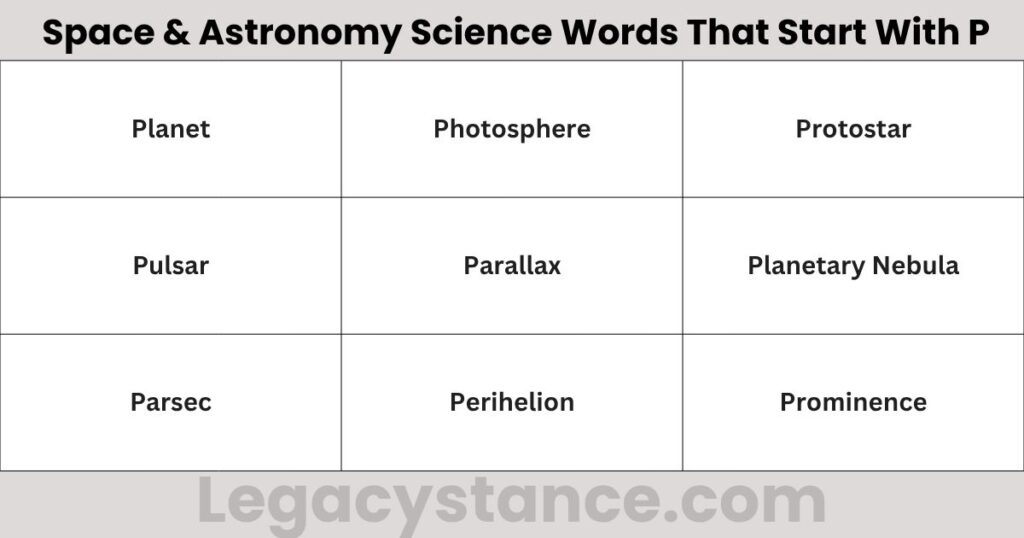
Planet — A body orbiting a star, spherical due to its own gravity, and dominant in clearing its orbital zone. Earth, Mars, Jupiter qualify. (Pluto doesn’t — it hasn’t cleared its zone.)
Pulsar — A neutron star spinning dozens to hundreds of times per second, emitting focused electromagnetic beams. From Earth, those beams appear as precise pulses — like a cosmic lighthouse.
Parsec — Astronomical distance unit. One parsec = approximately 3.26 light-years. Used because light-years get unwieldy at galactic scales.
Photosphere — The Sun’s visible surface. The light reaching Earth every day originates here, at roughly 5,500°C. Sunspots are cooler, darker patches on the photosphere.
Parallax — As Earth orbits the Sun, nearby stars appear to shift position against distant background stars. That apparent shift — parallax — lets astronomers calculate stellar distances geometrically.
Perihelion — The closest point in a planet’s orbit to the Sun. Earth hits perihelion in early January. (Aphelion = farthest point, reached in early July.)
Protostar — A forming star still pulling in surrounding gas and dust before nuclear fusion ignites. Can take millions of years before becoming a true star.
Planetary Nebula — Glowing shell of gas released when a medium-sized star dies. Early astronomers named it this because the glow resembled planets through early telescopes — the name stuck despite being misleading.
Prominence — A massive plasma loop arching from the Sun’s surface into its outer atmosphere. Can extend hundreds of thousands of kilometers and last for months.
Medical & Health Science Words That Start With P
Pathogen — Any organism or agent causing disease: bacteria, virus, fungus, or parasite. Identifying pathogens is the starting point of diagnosis and treatment.
Plasma (Blood) — The pale yellow liquid making up ~55% of blood volume. Carries red cells, white cells, platelets, hormones, nutrients, and waste products simultaneously.
Platelet — Tiny, irregularly shaped blood cell fragments. When injury occurs, platelets aggregate at the wound site and begin forming a clot to stop blood loss.
Pancreas — Gland sitting behind the stomach. Serves two roles: produces digestive enzymes (breaking down food) and secretes insulin (regulating blood sugar). Pancreatic failure leads to diabetes.
Pulmonary — Anything related to the lungs. Pulmonary artery carries oxygen-depleted blood from heart to lungs. Pulmonary disease affects lung function and breathing capacity.
Pathology — The medical discipline studying disease — its causes, mechanisms, and effects. Pathologists analyze tissue samples, blood, and biopsies to reach diagnoses.
Placebo — An inactive substance (sugar pill, saline injection) given to control groups in clinical trials. The placebo effect — measurable improvement from belief alone — is a documented and studied phenomenon.
Prognosis — A clinician’s evidence-based prediction of how a condition will develop. Favorable prognosis = likely recovery. Poor prognosis = serious or worsening outcome expected.
Pneumonia — Infection causing inflammation and fluid accumulation in lung air sacs. Breathing becomes painful and labored. Caused by bacteria, viruses, or fungi — treatment depends on the cause.
Peripheral — Describes structures at the outer edges of a system. Peripheral nervous system = all nerves outside the brain and spinal cord. Peripheral vision = the outer edges of your visual field.
Technology & Applied Science Words That Start With P
Pixel — The smallest single unit of a digital image. Screens contain millions of pixels. Resolution (sharpness) is measured in pixels per inch (PPI) — more pixels, finer detail.
Photovoltaic — Material or device that converts sunlight directly into electrical energy. Solar panels are photovoltaic. Photo = light; voltaic = relating to electrical voltage.
Processor — The central computing unit executing all instructions in a device. Speed is measured in GHz (gigahertz) — faster processors handle more operations per second.
Piezoelectric — The property of certain crystals to generate electrical charge when mechanically deformed. Used in microphones, pressure sensors, inkjet printers, and gas lighters (the click mechanism).
Protocol — A defined set of communication rules two systems must follow to exchange data. HTTP governs web pages. Bluetooth and Wi-Fi each operate on their own protocol standards.
Pneumatics — Engineering systems using compressed air to generate force or movement. Pneumatic drills, dental handpieces, and factory automation equipment commonly use pneumatic systems.
Photolithography — The technique of printing microscopic circuit patterns onto silicon chips using light. Modern chips contain billions of transistors printed this way at nanometer scale.
Easy Science Words That Start With P (Grades 3–6)
These work well for younger students or anyone beginning their science vocabulary journey.
| Word | Plain Meaning |
| Plant | Living thing that makes its own food from sunlight |
| Pond | Small freshwater body supporting plants and animals |
| Push | Force moving an object away from you |
| Pull | Force drawing an object toward you |
| Petal | Colorful flower part that attracts pollinators |
| Pore | Tiny opening in skin or a leaf allowing gas exchange |
| Pulse | Rhythmic beat in arteries caused by the heart pumping |
| Pod | Seed case of legume plants like peas and beans |
| Pebble | Small smooth stone shaped over time by water |
| Pinecone | Seed-bearing structure of pine trees |
| Plankton | Tiny organisms drifting through ocean and lake water |
| Producer | Organism (usually a plant) making its own food |
Advanced Science Words That Start With P
For high school, university, or deeper independent study.
Polymerase — Enzyme that builds new DNA or RNA strands by reading an existing template. Every time a cell divides, DNA polymerase copies the entire genome. Errors here cause mutations.
Phylogenetics — Study of evolutionary relationships among species using genetic and anatomical data. Results shown as branching “phylogenetic trees” mapping common ancestors and divergence points.
Psychrometer — Instrument measuring relative humidity using two thermometers — one dry-bulb, one wet-bulb. The temperature difference between them reveals moisture content of surrounding air.
Peristalsis — Coordinated, involuntary wave-like muscle contractions moving food through the digestive tract. Operates automatically from esophagus to large intestine without conscious control.
Photoemission — When light strikes a material with sufficient energy, it ejects electrons from the surface. Einstein’s explanation of this — the photoelectric effect — earned him the 1921 Nobel Prize in Physics.
Photochemistry — The branch of chemistry studying reactions initiated or driven by light energy. Photosynthesis, vitamin D synthesis in skin, and photography all involve photochemical reactions.
Pinocytosis — A cellular process where the cell membrane engulfs small droplets of fluid from its surroundings. One form of endocytosis — how cells “drink” their environment.
Parenchyma — The primary functional tissue of an organ or plant structure. In plant leaves, parenchyma cells conduct photosynthesis. In the liver, they metabolize nutrients and neutralize toxins.
Complete Reference List — 140+ Science Words That Start With P
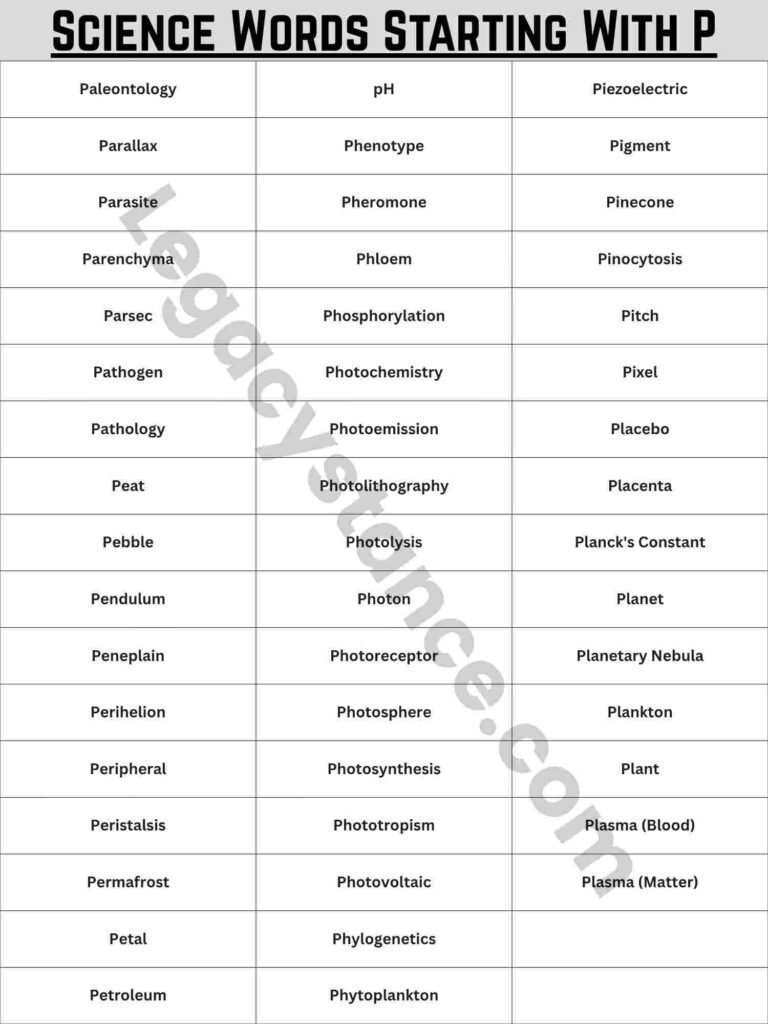
Full alphabetical list for studying, teaching, or quick lookup.
Paleontology — Study of ancient life through fossils
Parallax — Star position shift used to calculate distance
Parasite — Organism harming its host while drawing nutrition
Parenchyma — Functional tissue of organs or plants
Parsec — Astronomical distance unit (~3.26 light-years)
Pathogen — Disease-causing microorganism
Pathology — Medical study of disease causes and mechanisms
Peat — Partially decomposed wetland plant matter
Pebble — Small stone smoothed by water erosion
Pendulum — Swinging weight demonstrating time and motion
Peneplain — Flat landscape produced by long-term erosion
Perihelion — Orbit point closest to the Sun
Peripheral — Relating to outer areas away from a central system
Peristalsis — Muscle wave motion moving food through digestion
Permafrost — Ground frozen continuously for two or more years
Petal — Colorful flower structure attracting pollinators
Petroleum — Liquid fossil fuel refined into fuels and plastics
pH — Acidity/alkalinity scale from 0 to 14
Phenotype — Observable physical traits of an organism
Pheromone — Chemical signal influencing same-species behavior
Phloem — Plant tissue transporting sugars downward
Phosphorylation — Adding a phosphate group to a molecule
Photochemistry — Chemistry of light-driven reactions
Photoemission — Electron ejection from material by light
Photolithography — Light-based circuit printing on computer chips
Photolysis — Breaking compounds apart using light energy
Photon — Discrete packet of light energy
Photoreceptor — Eye cells detecting light or color
Photosphere — Sun’s visible outer surface layer
Photosynthesis — Plant food production using sunlight, water, CO₂
Phototropism — Plant growth directed toward light
Photovoltaic — Converting sunlight directly to electricity
Phylogenetics — Mapping evolutionary relationships among species
Phytoplankton — Microscopic aquatic photosynthetic organisms
Piezoelectric — Generating charge from mechanical pressure on crystals
Pigment — Color-producing substance in living or non-living matter
Pinecone — Pine tree’s seed-bearing cone structure
Pinocytosis — Cell engulfing fluid droplets from its surroundings
Pitch — Highness or lowness of a sound wave
Pixel — Smallest unit of a digital image
Placebo — Inactive treatment used in controlled medical trials
Placenta — Organ nourishing fetus during mammalian pregnancy
Planck’s Constant — Quantum physics value linking photon energy to frequency
Planet — Spherical body orbiting a star with cleared orbital zone
Planetary Nebula — Gas shell released by a dying mid-sized star
Plankton — Tiny organisms drifting in water bodies
Plant — Photosynthetic organism producing its own food
Plasma (Blood) — Liquid component of blood carrying cells and nutrients
Plasma (Matter) — Ionized superheated gas; fourth state of matter
Plate Tectonics — Theory of moving crustal plates shaping Earth’s surface
Platelet — Blood cell fragment triggering clot formation
Pneumatics — Compressed-air systems generating force or movement
Pneumonia — Lung infection causing fluid-filled air sacs
Pod — Legume seed casing (peas, beans)
Polarity — Unequal charge distribution within a molecule
Pollen — Fine powder carrying male plant sex cells
Pollination — Pollen transfer enabling plant fertilization
Polymer — Long molecule chain of repeating monomer units
Polymerase — Enzyme building DNA or RNA from a template
Polymerization — Chemical bonding of monomers into polymer chains
Pond — Small freshwater ecosystem
Population — All same-species individuals in one defined area
Pore — Tiny surface opening for gas or fluid exchange
Porosity — Proportion of pore space within rock or soil
Potential Energy — Stored energy based on position or state
Power — Rate of energy transfer or work done over time
Precipitate — Solid forming when two solutions are mixed
Precipitation — Atmospheric water falling as rain, snow, sleet, or hail
Predation — One organism hunting and consuming another
Predator — Animal that hunts other animals
Pressure — Force applied per unit of surface area
Prey — Animal hunted and consumed by a predator
Primary Consumer — Organism feeding directly on producers
Prism — Transparent object dispersing light into spectrum
Producer — Organism generating its own food through photosynthesis
Prognosis — Medical prediction of disease course and outcome
Projectile — Object moving through air under gravitational influence
Prokaryote — Single-celled organism lacking a membrane-bound nucleus
Prominence — Large plasma loop erupting from the Sun’s surface
Propagation — Wave movement through a medium
Protein — Amino acid chain performing structural or functional roles
Protocol — Standardized rules governing device communication
Protostar — Forming star before nuclear fusion ignition
Psychrometer — Dual-thermometer instrument measuring air humidity
Puberty — Hormone-driven biological maturation into adulthood
Pull — Force drawing an object toward its source
Pulmonary — Relating to the lungs and respiratory function
Pulsar — Rapidly rotating neutron star emitting periodic energy beams
Pulse — Arterial beat produced by cardiac contraction
Pupa — Insect life stage between larva and adult
Pure Substance — Matter composed entirely of one type of particle
Push — Force moving an object away from its source
Pyrolysis — Thermal decomposition of material without oxygen
Pyroclast — Volcanic rock and lava fragments ejected during eruption
Pancreas — Dual-function gland producing insulin and digestive enzymes
Common Confusions — P Words People Mix Up
Phloem vs. Xylem Both transport materials through plants — but in opposite directions. Xylem pulls water up from roots. Phloem pushes sugars down from leaves. Think: X goes up (like an elevator), Ph flows down (like a waterfall).
Prokaryote vs. Eukaryote One nucleus, one major difference. Prokaryotes (bacteria) have none. Eukaryotes (animals, plants, fungi) have a proper membrane-bound nucleus. All complex life is eukaryotic.
Predator vs. Parasite Both exploit other organisms for survival, but differently. Predators kill prey quickly and move on. Parasites maintain long-term relationships with living hosts — draining them slowly without an immediate kill.
Precipitate vs. Precipitation Chemistry uses “precipitate” for a solid forming during a reaction. Earth science uses “precipitation” for atmospheric water falling to the ground. Same Latin root (praecipitare = to fall headlong), two entirely separate meanings depending on subject context.
Plasma (Blood) vs. Plasma (Matter) Blood plasma = pale yellow liquid carrying blood cells through your circulatory system. Physical plasma = ionized gas at extreme temperatures found in stars and lightning. The word is shared; the science is completely unrelated.
Phenotype vs. Genotype Genotype = the genetic instructions stored in DNA (invisible). Phenotype = the physical outcome of those instructions (visible). Blue eyes are a phenotype. The gene variant causing them is the genotype.
Photosynthesis vs. Cellular Respiration They’re biochemical opposites. Photosynthesis consumes CO₂ and produces oxygen. Cellular respiration consumes oxygen and produces CO₂. Plants do both; animals only do the second.
Read more:
160+ Science Words That Start With L | Full List With Meanings
150+ Science Words That Start With Q: Meanings & Easy Guide
FAQs about Science Words That Start With P
1. Which P science words are most important for exams?
Focus on commonly tested terms like photosynthesis, pressure, precipitation, predator, prey, pH, and protein. These appear often in school exams because they connect to core concepts in biology, chemistry, and earth science.
2. How can I remember difficult science words easily?
Break words into roots. For example, photo means light, so photosynthesis and photon both relate to light. This makes learning faster and more logical instead of pure memorization.
3. What’s the difference between similar P words like predator and parasite?
A predator kills its prey quickly for food, while a parasite lives on a host over time and harms it slowly. Both depend on other organisms, but in very different ways.
4. Are these words useful outside school?
Yes. Words like pressure, protein, plasma, and pathogen are used in daily life, health discussions, weather reports, and even technology.
Bottom line
This article walked through 140+ science words starting with P — organized by field, explained with real-world context, and free of the redundancy that makes vocabulary lists hard to use.
The complete reference table in Section 11 works as a study tool or quick lookup. The categorized sections work best when you’re studying a specific subject. Return to Section 12 any time two similar-sounding terms are causing confusion.
Science vocabulary grows fastest when you understand the logic inside the words. Once photo, poly, para, pro, and pneumo start feeling familiar as roots — new P words stop being strangers.