

Science terms can feel confusing when they show up without context. You may recognize a word but still not fully understand it.
This guide on Science Words That Start With K is built to fix that. It breaks down important terms into simple meanings you can actually remember and use. Whether you are studying for a test, helping with homework, or building your vocabulary step by step, this page gives you clear explanations without extra noise. You will not just memorize these words—you will understand how they work in real life.
20 Most-Used Science Words That Start With K
- Kinetic energy — Energy an object has from moving
- Kelvin — Absolute temperature scale used in science
- Kidney — Organ filtering waste from blood
- Keratin — Protein forming hair, nails, outer skin
- Karyotype — Visual map of chromosomes in a cell
- Keystone species — Species whose removal collapses an ecosystem
- Kinase — Enzyme that activates other proteins
- Krebs cycle — Energy-releasing chemical loop inside mitochondria
- Krypton — Noble gas element, symbol Kr
- Kaolin — Soft white clay mineral
- Karst — Cave-riddled landscape from dissolved limestone
- Kelp — Large brown seaweed forming ocean forests
- Kinetics — Study of how fast chemical reactions occur
- Karyokinesis — Division of a cell’s nucleus
- Kerogen — Organic rock matter that becomes fossil fuel
- Kilohertz — Frequency unit — 1,000 cycles per second
- Kilopascal — Pressure unit — 1,000 pascals
- Ketone — Organic compound with a carbon-oxygen double bond
- Ketosis — Metabolic fat-burning state producing ketones
- Komatiite — Rare ancient volcanic rock from early Earth
Physics Words That Start With K
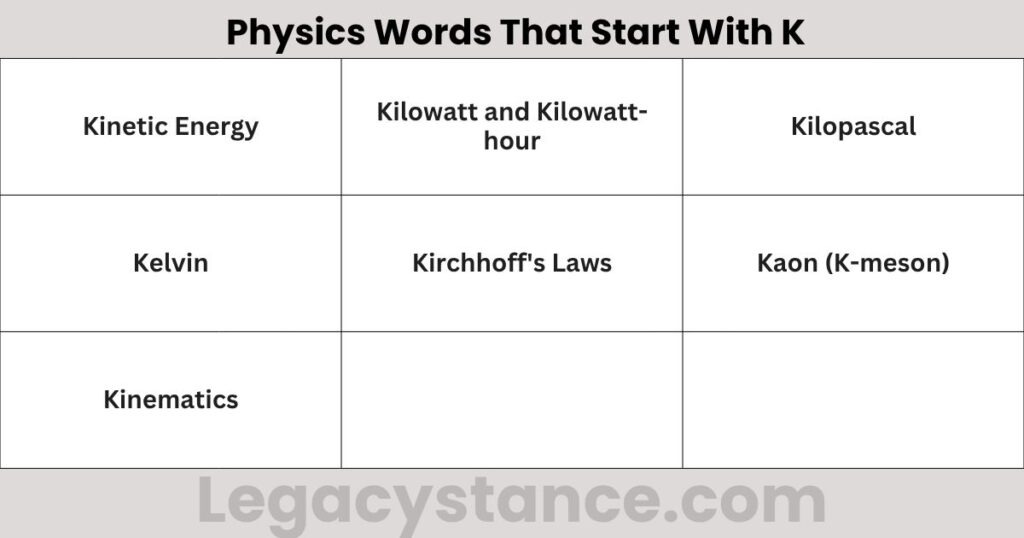
Kinetic Energy Moving objects carry energy because of their motion. The heavier the object and the faster it moves, the more kinetic energy it holds. A truck at highway speed carries far more than a bicycle at the same speed. One of the most tested physics concepts from grade 7 onward.
Kelvin The temperature scale science runs on. Unlike Celsius or Fahrenheit, Kelvin starts at absolute zero — the point where molecular motion theoretically stops completely, at −273.15°C. Gas laws, thermodynamics, and star temperature measurements all use Kelvin exclusively.
Kinematics Studies how things move — speed, direction, distance, acceleration — without asking what caused the motion. A ball thrown off a cliff is a kinematics problem.
Kilowatt and Kilowatt-hour A kilowatt (kW) measures power at a moment — 1,000 watts running right now. A kilowatt-hour (kWh) measures energy consumed over time — 1,000 watts running for one full hour. Appliances are rated in kilowatts. Electricity bills charge in kilowatt-hours.
Kirchhoff’s Laws Two circuit rules every electronics engineer uses. One tracks how current splits and rejoins at junctions. The other tracks how voltage distributes around a closed loop.
Kilopascal Pressure in units of 1,000 pascals. Tire pressure, weather systems, and chemistry experiments all report in kilopascals because raw pascal values become unwieldy fast.
Kaon (K-meson) A subatomic particle in the meson family. Belongs to university-level particle physics — not a classroom word, but worth knowing by name.
Chemistry Words That Start With K
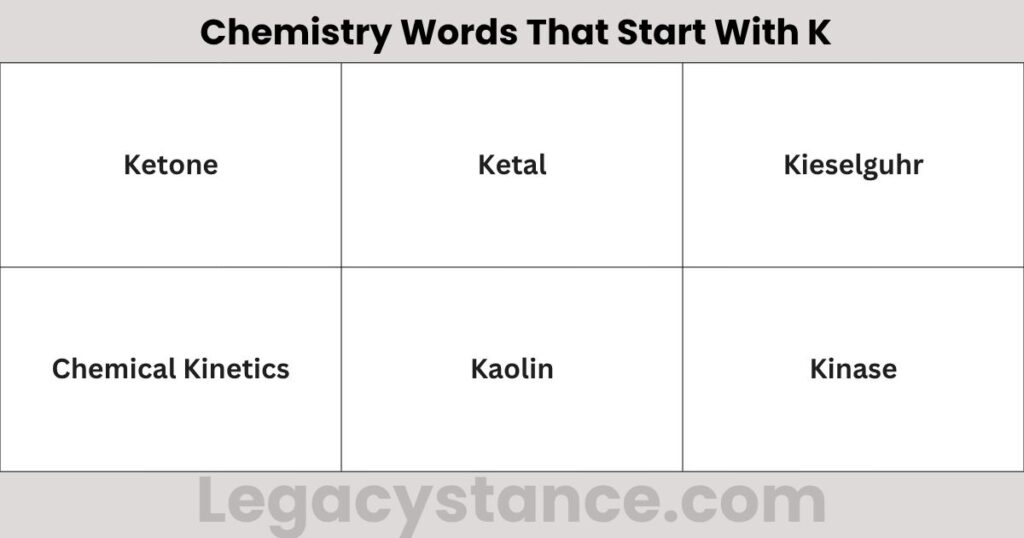
Ketone An organic molecule where a carbon-oxygen double bond sits flanked by two carbon atoms. Acetone — nail polish remover — is the most familiar ketone. The body also produces ketones when breaking down fat.
Chemical Kinetics Reaction speed science. Why does food spoil faster when warm? Why does a catalyst make a reaction quicker? Kinetics examines temperature, concentration, surface area, and catalysts to answer those questions.
Ketal Formed when a ketone reacts with two alcohol molecules. Organic chemists use ketals as protective shields — keeping one part of a molecule chemically safe while modifying another section.
Kaolin A soft white clay mineral forming when feldspar rock weathers over long periods. Used in paper manufacturing, ceramics, and some medicines. Also found as a geological deposit marking ancient weathering events — so it matters in both chemistry and earth science, but from different angles.
Kieselguhr A crumbly, porous rock built from fossilized microscopic algae called diatoms. Alfred Nobel used it to stabilize nitroglycerin, which led directly to the invention of dynamite.
Kinase An enzyme that transfers phosphate groups onto target molecules, switching them on or off like a biological light switch. Cell signaling depends on kinases. Many cancer treatments specifically block kinases driving tumor growth.
Biology Words That Start With K
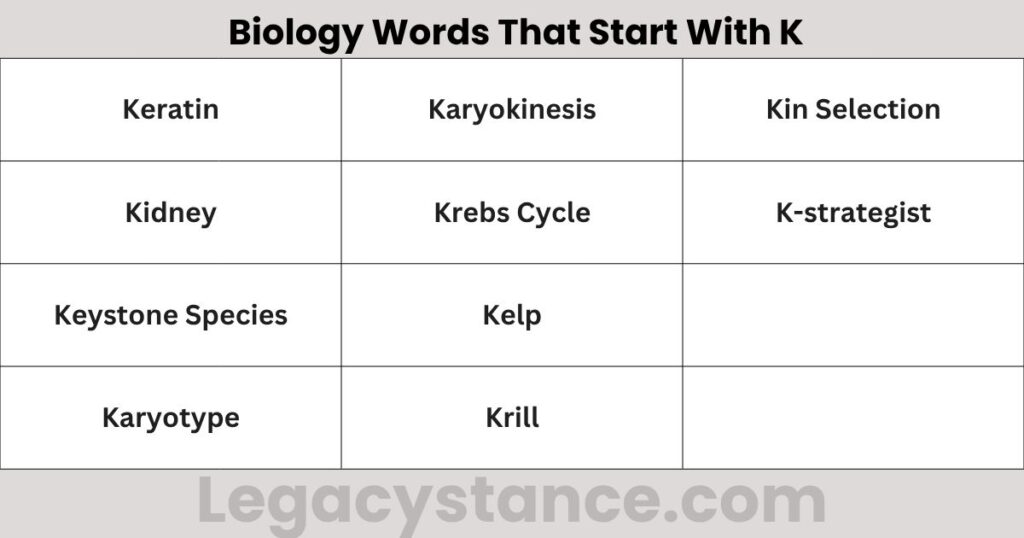
Keratin The structural protein behind hair, nails, feathers, hooves, claws, and outer skin. Tough, waterproof, chemically resistant. A rhinoceros horn is almost entirely keratin. So is a bird’s beak.
Kidney Two fist-sized organs just below the ribcage. They filter roughly 200 liters of blood daily, pulling out waste that exits as urine, while regulating blood pressure and fluid balance simultaneously.
Keystone Species One species that holds an entire ecosystem in structural balance. Sea otters eat sea urchins — without otters, urchins multiply unchecked and destroy kelp forests, collapsing habitat for hundreds of species. The keystone metaphor is literal: pull it out and the arch falls.
Karyotype A photograph of all chromosomes arranged by size and shape into matched pairs. Doctors order karyotypes to detect chromosomal conditions. A standard human karyotype shows 46 chromosomes in 23 pairs.
Karyokinesis The phase of cell division where the nucleus divides first, distributing chromosomes equally before the rest of the cell splits. Cytokinesis — the cell body splitting — follows after.
Krebs Cycle A loop of chemical reactions inside mitochondria extracting energy from nutrients. Output molecules carry that energy forward into the final stage of cellular respiration. Biochemists also call it the citric acid cycle — same process, different naming tradition.
Kelp Large brown algae growing in cold coastal waters, forming underwater forests that shelter fish, invertebrates, and marine mammals. Among the most productive marine ecosystems on Earth.
Krill Tiny shrimp-like crustaceans forming the foundation of polar ocean food webs. Whales, penguins, seals, and fish all depend on them. A krill population collapse ripples through the entire chain above it.
Kin Selection An evolutionary explanation for why animals help relatives at personal cost. Bees defending a hive, meerkats standing guard — the behavior benefits shared genes even when it costs the individual.
K-strategist A reproductive approach favoring few offspring raised with heavy investment. Elephants, whales, and humans follow this pattern. The opposite — thousands of offspring, no parental care — is r-strategy.
Earth Science Words That Start With K
Karst Rainwater carries weak carbonic acid. Over thousands of years, it dissolves limestone bedrock, carving caves, sinkholes, and underground rivers. Carlsbad Caverns and Slovenia’s cave networks are textbook karst landscapes.
Komatiite An extraordinarily rare volcanic rock only forming when Earth’s mantle ran far hotter than today — mostly in rocks over 2.5 billion years old. Scientists use it as a geological thermometer for early Earth conditions.
Kerogen Solid organic material locked inside sedimentary rock. Given millions of years of heat and pressure, it converts into oil and natural gas — the raw ingredient for fossil fuels.
Kettle Lake When a buried block of glacial ice melts, it leaves a bowl-shaped depression. Water fills it. Thousands of lakes across Minnesota, Canada, and Scandinavia formed this way.
K-Pg Boundary A thin rock layer found worldwide marking the extinction event 66 million years ago that killed non-avian dinosaurs. Abnormally high iridium concentrations in this layer point to a massive asteroid impact.
K-feldspar A potassium-rich feldspar mineral common in granite. When it weathers chemically, it produces kaolin clay — connecting igneous geology to sedimentary clay deposits.
Space and Astronomy Words That Start With K
Kuiper Belt A vast band of icy objects beyond Neptune, including dwarf planets like Pluto and short-period comets. These objects have changed very little since the solar system formed, making the Kuiper Belt a frozen record of early solar system chemistry.
Kepler’s Laws Three rules Johannes Kepler published between 1609 and 1619. Planets orbit in ellipses, not circles. Speed increases as a planet approaches the sun. Orbit size and travel time follow a precise mathematical relationship. These laws remain foundational to orbital mechanics.
Kepler Space Telescope Launched by NASA in 2009, retired in 2018. Confirmed over 2,600 exoplanets by detecting tiny starlight dips when planets crossed their host stars. It fundamentally changed how scientists think about planet frequency in the galaxy.
Kirkwood Gaps Empty orbital zones inside the asteroid belt between Mars and Jupiter. Jupiter’s gravity periodically clears asteroids from these positions. Astronomer Daniel Kirkwood identified them in 1866.
Medical and Health Words That Start With K
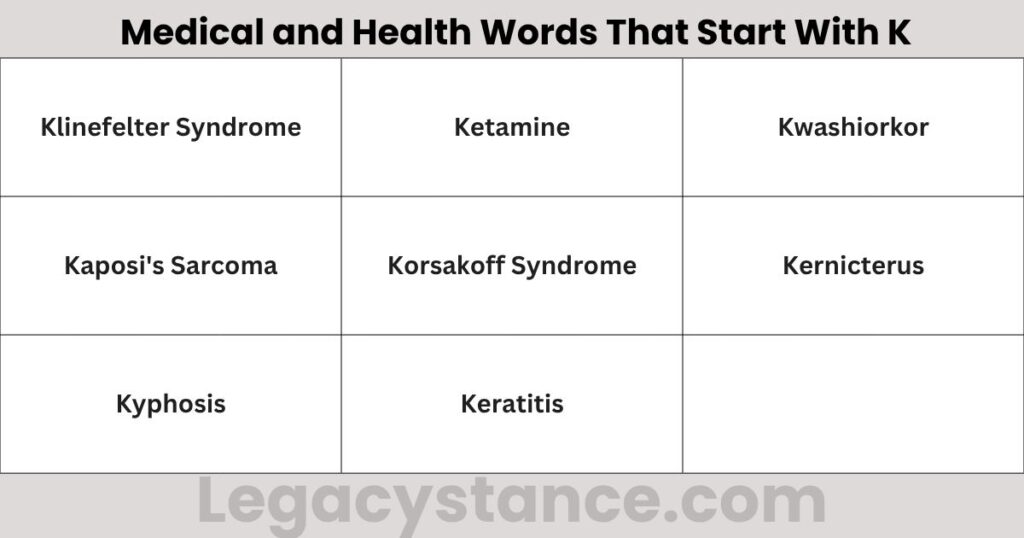
Klinefelter Syndrome Males born with XXY chromosomes instead of XY. Effects include reduced testosterone, infertility, and sometimes learning differences. Occurs in roughly 1 in 650 male births.
Kaposi’s Sarcoma Cancer producing lesions on skin and internal organs, driven by a herpesvirus. Became widely recognized during the HIV/AIDS epidemic because severely weakened immune systems cannot suppress it.
Kyphosis Outward rounding of the upper spine. Mild cases are common and postural. Severe cases can compress the spinal cord or limit lung expansion.
Ketamine Originally a surgical anesthetic. Now studied as a fast-acting depression treatment — producing measurable effects within hours in some patients, unlike standard antidepressants that take weeks.
Korsakoff Syndrome Brain disorder from chronic thiamine (vitamin B1) deficiency, most commonly caused by long-term alcohol misuse. Patients cannot form new memories and often cannot retrieve old ones.
Keratitis Inflammation of the cornea. Caused by infection, injury, or contact lens misuse. Left untreated, it risks permanent vision damage.
Kwashiorkor Severe protein malnutrition in young children. Causes swollen abdomen, skin changes, and stunted growth. Distinct from marasmus, which is total calorie starvation rather than specifically protein deficiency.
Kernicterus Brain damage in newborns from untreated severe jaundice. Excess bilirubin crosses into brain tissue, causing permanent neurological damage if not treated promptly.
Technology and Applied Science Words That Start With K
Kevlar Synthetic fiber developed by chemist Stephanie Kwolek in 1965. Weight for weight, five times stronger than steel. Bulletproof vests, helmets, fiber optic cables, and racing tires all use it.
Kernel The core of an operating system. Manages every interaction between software and hardware — memory, processes, device drivers. Loads first when a computer starts.
Kinesiology Scientific study of human body movement. Applied across physical therapy, sports performance, ergonomics, and rehabilitation engineering.
Kilohertz (kHz) 1,000 cycles per second. AM radio broadcasts in this range. Audio equipment and some medical devices also use kilohertz frequencies.
Kilobyte (KB) 1,024 bytes of digital data. The foundational unit of file size, now tiny by modern standards — a single photo runs thousands of kilobytes.
Science Words That Start With K — For Kids (Grades 3–6)
No jargon. Just clear connections to things already familiar.
| Word | Plain Meaning |
| Kelp | Underwater seaweed forest where fish live |
| Kidney | Two organs cleaning your blood all day |
| Kinetic energy | Energy you create when you run or throw |
| Keystone species | One animal keeping everything else in balance |
| Krill | Tiny ocean creatures whales depend on |
| Knot | Speed unit sailors use instead of mph |
| Kindling temperature | Minimum heat needed to make something burn |
Advanced Science Words That Start With K
For AP, IB, or university-level students.
Karyogamy — Fusion of two cell nuclei during sexual reproduction, combining genetic material from two parent cells.
Kinetic Molecular Theory — Model treating gas molecules as tiny particles in constant random motion, explaining pressure, temperature, and diffusion behavior.
Klystron — A vacuum tube amplifying microwave signals. Used in radar, particle accelerators, and satellite communication.
Knudsen Number — A dimensionless ratio in fluid dynamics comparing molecular mean free path to a physical scale length. When large, gases cannot be modeled as continuous fluids.
Kronecker Delta — A mathematical function returning 1 when two indices match and 0 when they differ. Appears constantly in quantum mechanics and linear algebra.
Kramers-Kronig Relations — Equations linking absorption and refractive index in optical materials. Essential in advanced optics and signal processing.
Kallmann Syndrome — A genetic condition disrupting puberty onset by affecting the brain’s hormone signaling pathway.
Complete Reference List — 160+ Science Words That Start With K
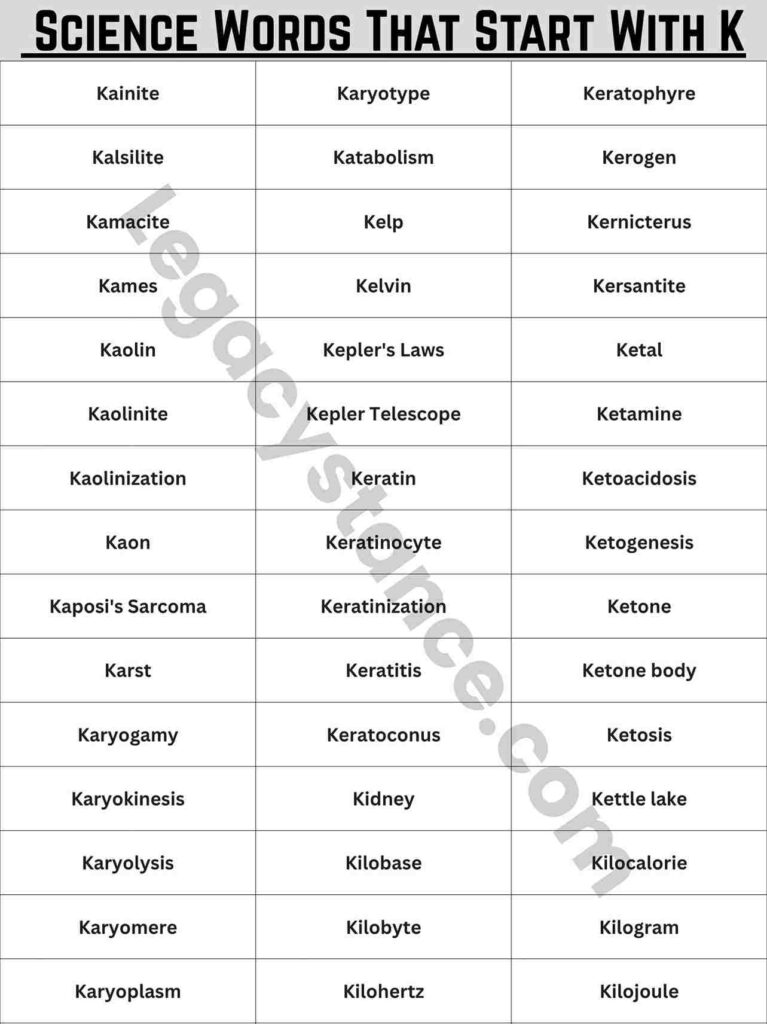
Kainite — Hydrated potassium magnesium sulfate mineral
Kalsilite — Potassium aluminum silicate mineral
Kamacite — Iron-nickel alloy found in meteorites
Kames — Sand mounds deposited by glacial meltwater
Kaolin — White clay mineral from weathered feldspar
Kaolinite — Mineral form of kaolin
Kaolinization — Rock converting to kaolin through weathering
Kaon — K-meson subatomic particle
Kaposi’s Sarcoma — Herpesvirus-driven skin and organ cancer
Karst — Dissolved-limestone cave landscape
Karyogamy — Fusion of two cell nuclei
Karyokinesis — Nuclear division in cell splitting
Karyolysis — Complete dissolution of cell nucleus
Karyomere — Nucleus fragment during division
Karyoplasm — Fluid filling the cell nucleus
Karyorrhexis — Nucleus fragmentation in dying cells
Karyotype — Chromosome arrangement map
Katabolism — Breaking molecules down for energy
Kelp — Large marine brown algae
Kelvin — Absolute temperature unit
Kepler’s Laws — Planetary orbit rules
Kepler Telescope — NASA exoplanet-hunting spacecraft
Keratin — Structural protein in hair and nails
Keratinocyte — Skin cell producing keratin
Keratinization — Cells filling with keratin
Keratitis — Corneal inflammation
Keratoconus — Cornea thinning into cone shape
Keratophyre — Sodium-rich volcanic rock
Kerogen — Fossil-fuel-forming organic rock matter
Kernicterus — Newborn brain damage from jaundice
Kersantite — Dark igneous rock type
Ketal — Ketone-alcohol organic compound
Ketamine — Anesthetic with antidepressant applications
Ketoacidosis — Dangerous blood acid buildup from excess ketones
Ketogenesis — Ketone body production
Ketone — Organic molecule with C=O group
Ketone body — Fat metabolism byproduct
Ketosis — Fat-burning metabolic state
Kettle lake — Lake formed from melted glacial ice
Kidney — Blood-filtering organ
Kilobase — 1,000 DNA base pairs
Kilobyte — 1,024 bytes of data
Kilocalorie — 1,000 calories
Kilogram — Base SI mass unit
Kilohertz — 1,000 cycles per second
Kilojoule — 1,000 joules
Kilonewton — 1,000 newtons of force
Kilopascal — 1,000 pascals of pressure
Kilowatt — 1,000 watts of power
Kilowatt-hour — Energy consumed over time
Kimberlite — Diamond-bearing volcanic rock
Kinematics — Motion study without force analysis
Kinematic viscosity — Fluid flow resistance ratio
Kinescope — Early television display tube
Kinesthesia — Sense of body position and movement
Kinetic energy — Energy from motion
Kinetic Molecular Theory — Gas behavior particle model
Kinetics — Reaction rate study
Kinase — Protein-activating enzyme
Kinesiology — Study of human movement
Kinesin — Motor protein transporting cell cargo
Kinetochore — Chromosome anchoring protein structure
Kinetosis — Motion sickness
Kin selection — Helping relatives for genetic benefit
Kirchhoff’s Laws — Electric circuit rules
Kirkwood Gaps — Empty orbital zones in asteroid belt
Klebsiella — Gram-negative bacteria causing infections
Kleptoparasitism — Stealing food from another species
Klinefelter Syndrome — XXY chromosome condition
Klippel-Feil Syndrome — Fused cervical vertebrae condition
Kluver-Bucy Syndrome — Temporal lobe damage behavior syndrome
Klystron — Microwave-amplifying vacuum tube
Knot — Nautical speed unit
Knudsen Number — Molecular fluid dynamics ratio
Koilonychia — Spoon-shaped nail deformity
Komatiite — Ancient rare volcanic rock
Koppen Classification — Global climate zone system
Koplik’s Spots — Early measles mouth indicators
Korsakoff Syndrome — Memory disorder from B1 deficiency
K-feldspar — Potassium feldspar mineral
K-Pg Boundary — Mass extinction rock layer
K-ras Gene — Commonly mutated cancer gene
K-strategist — Low-offspring, high-investment reproduction
Kramers-Kronig Relations — Complex optical equations
Krebs Cycle — Cellular energy reaction loop
Krill — Polar ocean crustacean, base of food web
Kronecker Delta — Binary index function in mathematics
Krypton — Noble gas, atomic number 36
Kuiper Belt — Icy zone beyond Neptune
Kunzite — Pink potassium mineral gemstone
Kuru — Fatal prion brain disease
Kutnahorite — Calcium manganese carbonate mineral
Kyanite — Blue aluminum silicate mineral
Kyanization — Wood preservation using mercuric chloride
Kymograph — Device recording biological motion
Kwashiorkor — Protein deficiency malnutrition
Kyphosis — Upper spine outward curvature
Kallmann Syndrome — Puberty-disrupting genetic condition
Common Confusions — K Terms People Mix Up
Kinetics vs. Kinematics Kinematics asks how something moves. Kinetics in physics asks why — what forces caused it. In chemistry, kinetics means reaction rates entirely. Same root word, three different scientific contexts.
Ketone vs. Ketosis vs. Ketoacidosis A ketone is a molecule. Ketosis is a normal fat-burning metabolic state. Ketoacidosis is a life-threatening crisis where ketones accumulate faster than the body can clear them. Confusing the second with the third carries genuine health consequences.
Karyokinesis vs. Cytokinesis Both occur during cell division. Karyokinesis is the nucleus splitting. Cytokinesis is the cell body splitting afterward. One step happens inside the other.
Keystone Species vs. Apex Predator An apex predator has no natural predators above it. A keystone species structurally holds its ecosystem together — its removal causes disproportionate collapse. A wolf can be both simultaneously, but the terms measure different things.
Krebs Cycle vs. Citric Acid Cycle Identical process. Hans Krebs discovered it — biology textbooks use his name. Biochemistry courses prefer citric acid cycle because citric acid is both consumed and regenerated within the loop.
Real-Life Connections
| Where | K Words in Action |
| Hospital | Keratitis, Kyphosis, Ketoacidosis, Kernicterus |
| Weather report | Kilopascal readings |
| Electricity bill | Kilowatt-hours |
| Ocean news | Kelp forests, Krill populations |
| Diet science | Ketosis, Ketone bodies |
| Space news | Kuiper Belt discoveries, Kepler data |
| Genetics lab | Karyotype, Kinase inhibitors, K-ras mutations |
| Computer science | Kernel updates, Kilobyte file sizes |
| Safety equipment | Kevlar vests and helmets |
| Field geology | Karst mapping, Kerogen analysis |
You may also like:
120+ Science Words That Start With V | Full List with Meanings
130+ Science Words That Start With H | Full List with Meanings
FAQs about Science Words That Start With K
1. How can I remember science words more easily?
Start with meaning, not memorization. Connect each word to a real example—like linking kinetic energy to a moving car. Small connections stick longer than long definitions.
2. Which K science words are most important for exams?
Focus on commonly tested terms like kinetic energy, Kelvin, kidney, and Krebs cycle. These appear often because they connect to bigger concepts in science.
3. What is the difference between similar K words like kinetics and kinematics?
Kinematics describes motion (how something moves). Kinetics explains the cause (why it moves). Same root word, but different focus—this is a common exam trap.
4. Are all “kilo-” words related?
Yes. The prefix “kilo” always means 1,000. Once you learn that, words like kilowatt, kilogram, and kilohertz become much easier to understand.
5. Should beginners learn all 160+ words at once?
No. Start with the basic ones used in your grade level. Once those feel easy, move to harder terms. Science vocabulary builds best in layers.
What You Now Have
This guide covered 160+ science terms starting with K across physics, chemistry, biology, earth science, space, medicine, and technology.
The categorized sections give field-specific depth. The complete table gives fast lookup. The confusions section untangles the pairs that trip people up most. The real-life table shows where these words actually land outside a textbook.
Science vocabulary builds in layers. The K words you learn at grade 6 make the harder ones at grade 10 easier to absorb. Start where this list meets your level, and work outward from there.