Learning Science Words That Start With R doesn’t have to feel overwhelming. Whether you’re studying for a test, helping your child, or improving your English, the right words explained simply can make a big difference.
This guide brings together useful, real-world science terms with meanings you can actually understand. Instead of long, confusing definitions, you’ll find clear explanations and examples that connect to everyday life.
From basic ideas like rain and roots to advanced concepts like red shift and ribosomes, this list is designed to help you learn faster and remember longer.
20 Most-Used Science Words That Start With R
Radiation — Energy released as waves or particles through space
Reaction — Change occurring when substances chemically interact
Refraction — Bending of light passing through a medium
Respiration — Process cells use to release energy from glucose
Reproduction — Biological process of producing new living organisms
Reflection — Light bouncing back off a surface
RNA — Molecule carrying genetic instructions for protein building
Radius — Distance from center to edge of a circle
Relativity — Einstein’s theory linking space, time, and gravity
Resonance — Object vibrating at its natural frequency
Rust — Iron oxide formed when iron meets water and oxygen
Receptor — Cell structure detecting and responding to signals
Retina — Light-sensitive layer at the back of the eye
Radioactivity — Unstable atoms spontaneously releasing energy
Recessive — Gene trait hidden when a dominant one is present
Resistance — Opposition to flow of electric current
Reflex — Automatic body response without conscious thought
Renewable — Energy source that naturally replenishes
Reptile — Cold-blooded vertebrate with scales and lungs
Root — Plant part absorbing water and anchoring in soil
Physics Science Words That Start With R
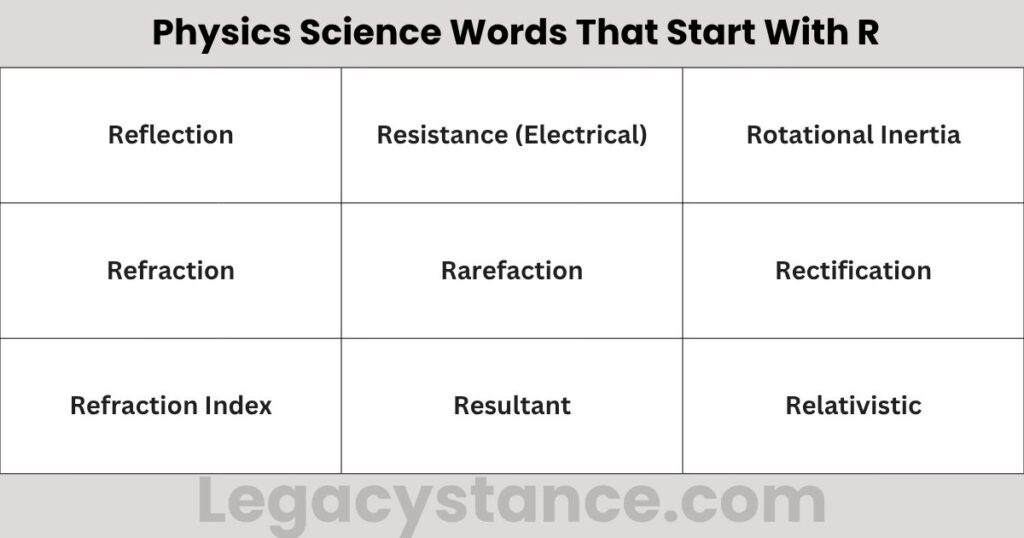
Reflection — Light hits a surface and bounces back. Mirrors and radar both run on this principle.
Refraction — Light bends when moving from one material into another. A straw looks broken inside a glass of water because of this.
Refraction Index — A number showing how much light slows inside a material. Water scores 1.33. Diamond is 2.42 — explaining why it sparkles so intensely.
Resonance — Every object has a natural frequency. When an outside force matches it, vibration builds dramatically. A wine glass shattering from sound is resonance in action.
Resistance (Electrical) — How much a material fights electric current. Higher resistance generates more heat, allows less current through.
Rarefaction — The stretched, low-pressure part of a sound wave where particles spread apart. Alternates with compression as sound travels.
Resultant — When two forces act on an object, the resultant is the single equivalent force replacing both.
Rotational Inertia — A spinning object resists changes to its spin. A figure skater pulling arms inward spins faster because this property is conserved.
Rectification — Converting alternating current (AC) into direct current (DC). Every phone charger does this.
Relativistic — Describing behavior only visible near the speed of light. At those speeds, time measurably slows and mass increases.
Chemistry Science Words That Start With R
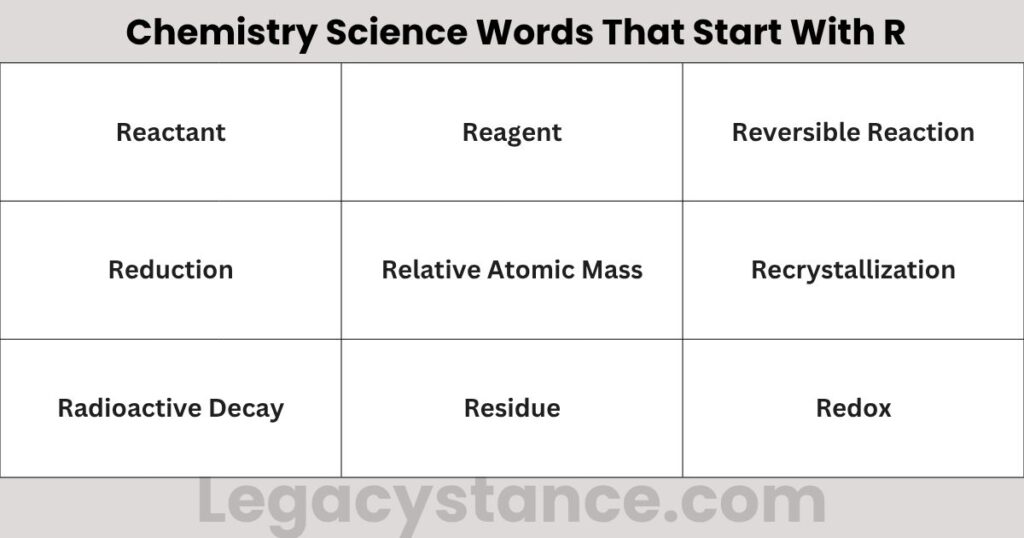
Reactant — The starting material consumed during a chemical reaction, becoming something new by the end.
Reduction — A substance gains electrons. Always paired with oxidation — they cannot occur separately.
Radioactive Decay — Unstable atomic nuclei break apart and release energy. Carbon-14 decay lets scientists date ancient organic material.
Reagent — Added to a system to trigger a reaction or test for another substance. Standard in labs and hospital diagnostics.
Relative Atomic Mass — Average mass of an element’s atom compared to carbon-12. Printed on every periodic table.
Residue — What physically remains after a reaction or filtration. Not every substance gets fully consumed.
Reversible Reaction — Proceeds both forward and backward. Water splitting into hydrogen and oxygen, then recombining, is a textbook example.
Recrystallization — A purification method where a solid dissolves in hot solvent, then slowly crystallizes as it cools, leaving impurities behind.
Redox — Short for reduction-oxidation. Electrons transfer between substances simultaneously. Batteries run entirely on redox chemistry.
Biology Science Words That Start With R
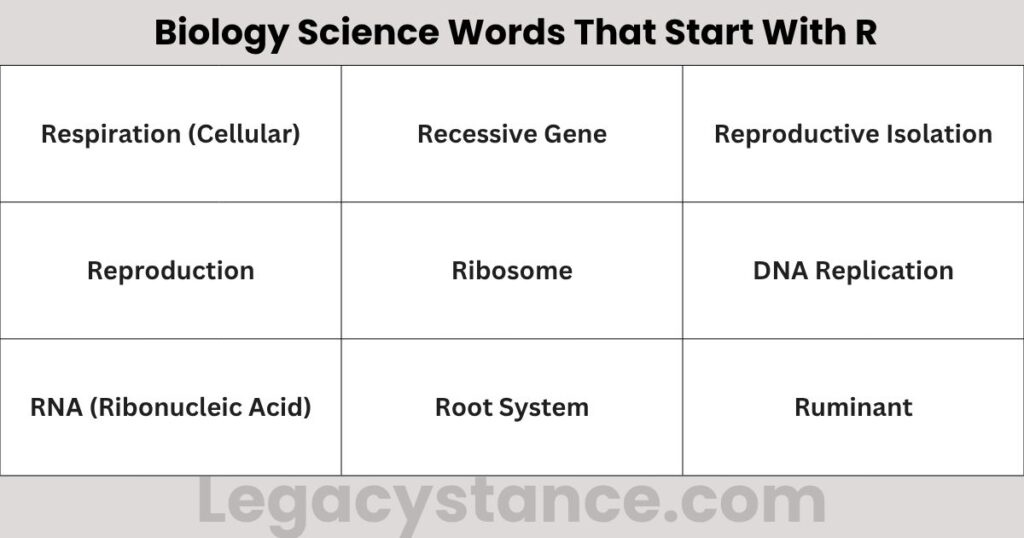
Respiration (Cellular) — Cells break down glucose to release usable energy. This is not the same as breathing. Breathing moves air. Cellular respiration is the chemical reaction happening inside each cell — even in organisms that never breathe at all.
Reproduction — Sexual reproduction needs two parents. Asexual needs only one. Both strategies carry survival advantages depending on the environment.
RNA (Ribonucleic Acid) — Carries instructions from DNA to the protein-building machinery. DNA is the blueprint locked in the nucleus. RNA is the worker delivering copies to where they’re needed.
Receptor — A protein on the cell surface detecting specific signals — hormones, drugs, viruses. Receptors explain why medicines work on some cells and not others.
Recessive Gene — Only shows its effect when both inherited copies match. One dominant allele completely overrides it.
Ribosome — Assembles proteins using RNA instructions. Every cell contains thousands working simultaneously.
Root System — Complete underground plant network. Absorbs water and minerals, anchors the plant, sometimes stores food. Carrots are roots.
Rhizome — An underground stem spreading horizontally. Ginger is one. Grass uses rhizomes — which is why it keeps creeping across your lawn.
Reproductive Isolation — When two populations can no longer interbreed, separate species eventually form. This drives biodiversity over evolutionary time.
DNA Replication — Before a cell divides, the entire DNA strand is copied so each daughter cell receives a complete set. Rare copying errors create mutations.
Ruminant — Animals like cows using a multi-chambered stomach to digest food in stages, extracting nutrients from grass most animals cannot process.
Earth Science Words That Start With R
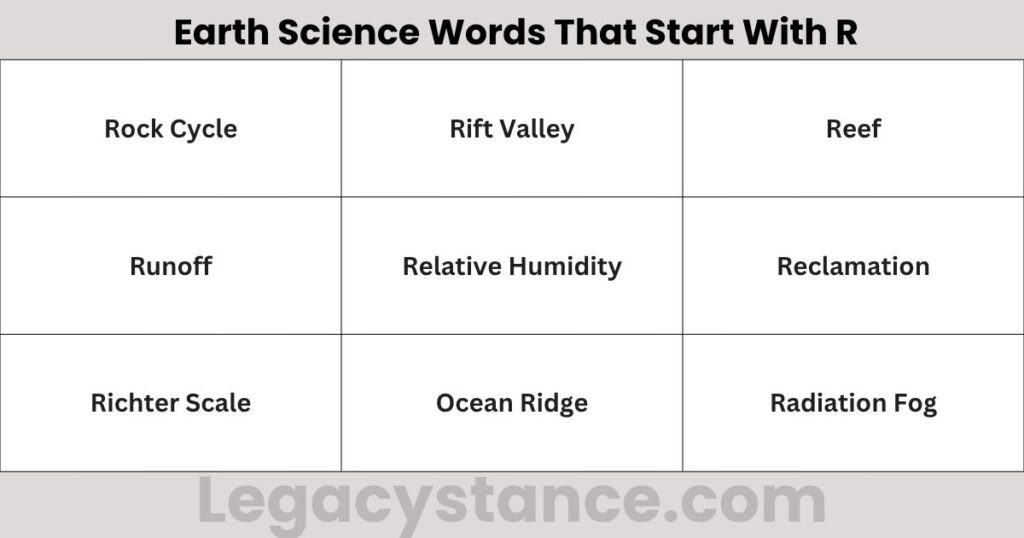
Rock Cycle — Rocks transform between igneous, sedimentary, and metamorphic types across millions of years. Nothing underground stays permanently fixed.
Runoff — Rain that doesn’t absorb into soil flows across the surface, carrying debris and chemicals into waterways. Heavy runoff triggers flooding and erosion.
Richter Scale — Measures earthquake energy logarithmically. Each full number up means 10 times more ground shaking and roughly 31 times more energy. A magnitude 7 is dramatically — not slightly — worse than a 6.
Regolith — Loose rock fragments and dust sitting above solid bedrock. The Moon has no organic soil — its entire surface is regolith.
Rift Valley — Forms where tectonic plates pull apart and land between them drops. East Africa’s Great Rift Valley is actively splitting the continent — just imperceptibly slowly.
Relative Humidity — Current moisture in the air as a percentage of the maximum it could hold at that temperature. At 100%, rain becomes likely.
Ocean Ridge — Underwater mountain chains where new ocean floor forms as plates separate. The Mid-Atlantic Ridge stretches the full length of the Atlantic.
Reef — Built by coral polyps over centuries. Reefs support roughly 25% of marine species while covering less than 1% of the ocean floor.
Reclamation — Restoring land damaged by mining or industrial activity back to a usable state.
Radiation Fog — Forms on calm, clear nights when the ground loses heat rapidly. Common in valleys during autumn mornings.
Space & Astronomy Science Words That Start With R
Red Giant — A dying star that expands enormously as hydrogen fuel depletes. Our Sun becomes one in roughly 5 billion years.
Red Shift — Light from a receding galaxy stretches toward the red end of the spectrum. Measuring this across the universe confirmed it is expanding in every direction.
Retrograde Motion — A planet appearing to move backward against background stars. Actually an optical illusion from Earth and the other planet moving at different orbital speeds.
Roche Limit — Minimum safe orbital distance for a moon. Inside this boundary, tidal forces tear it apart. Saturn’s rings exist because a moon crossed this limit long ago.
Rotation and Revolution — Rotation = spinning on an axis, creating day and night. Revolution = orbiting another body, creating a year. Earth does both simultaneously.
Radio Telescope — Detects radio waves from space instead of visible light, revealing things optical telescopes cannot see — including the Milky Way’s center.
Radiation Belt — Zones of charged particles trapped by Earth’s magnetic field. Satellites passing through these Van Allen Belts can sustain damage.
Rille — A narrow channel on the Moon’s surface, likely from ancient lava flows or collapsed underground tubes.
Rocket Propulsion — Built on Newton’s third law: gases pushed backward drive the rocket forward. Requires no surrounding air, which is why it works in vacuum.
Medical & Health Science Words That Start With R
Renal — Relating to kidneys. Renal failure means kidneys can no longer filter blood. Patients may need dialysis or transplant.
Remission — Disease signs decrease or disappear, sometimes temporarily. Cancer patients in remission still need ongoing monitoring.
Resuscitation — Restarting breathing or heartbeat after they stop. CPR is the most widely taught technique.
Rupture — An internal structure tears open. A ruptured appendix releases bacteria into the abdominal cavity — immediate emergency.
Retrovirus — Writes its genetic material directly into the host cell’s DNA. HIV operates this way, making complete elimination from the body extremely difficult.
Rhinitis — Inflammation of nasal passages. Allergic rhinitis affects millions seasonally. Chronic cases disrupt sleep and daily concentration.
Radiation Therapy — Targeted high-energy radiation destroying cancer cells while minimizing damage to surrounding healthy tissue.
Rickets — Bone disease from vitamin D deficiency. Most common in children. Causes bones to soften and bend under normal body weight.
Technology & Applied Science Words That Start With R
Resistor — Limits current flow through circuits, protecting sensitive components. Found in virtually every electronic device.
RAM (Random Access Memory) — Holds active programs temporarily. Clears completely when power is off. More RAM means smoother multitasking.
Robotics — Designing machines that perform tasks automatically or with remote guidance. Used in surgery, manufacturing, space missions, and deep-sea exploration.
Remote Sensing — Collecting Earth surface data from satellites without physical contact. Used for weather forecasting, deforestation tracking, and disaster monitoring.
Renewable Energy — Solar, wind, hydro, geothermal — sources that naturally restore themselves, unlike fossil fuels.
Radar — Uses radio waves to detect an object’s distance, speed, and direction. Standard now in weather forecasting, aviation safety, and traffic enforcement.
Router — Directs data packets across networks. Every webpage you load involves rapid routing decisions made multiple times per second.
Resolution (Imaging) — Level of fine detail in an image. Higher resolution = more pixels per area = sharper output.
Easy Science Words That Start With R (Grades 4–6)
Start here if you’re newer to science vocabulary. These are the words that appear most in early school years.
| Word | Simple Meaning |
| Rain | Water falling from clouds |
| Rainbow | Sunlight split into colors through water droplets |
| Rock | Hard natural material from Earth’s crust |
| Root | Underground part of a plant |
| Reptile | Scaly cold-blooded animal — snakes, lizards, turtles |
| Reflect | Light bouncing off a surface |
| Rotate | Spin around a central point |
| River | Large natural stream of flowing water |
| Rust | Red-brown coating on iron left in moist air |
| Reaction | Two substances mix and change into something new |
Advanced Science Words That Start With R (Grades 9–12 and Beyond)
These require background knowledge before they fully click. If a definition feels opaque, that’s normal — return to it after covering the basics.
Rayleigh Scattering — Short wavelengths (blue light) scatter more than long ones when hitting atmospheric molecules. This is why the sky appears blue and sunsets appear red.
Recombinant DNA — DNA artificially combined from two different organisms. Foundation of genetic engineering — used to produce insulin, vaccines, and modified crops.
Receptor Tyrosine Kinase — A surface protein that, when activated, triggers cell growth. Mutations here are linked to multiple cancer types.
Ribozyme — An RNA molecule that acts as an enzyme — cutting or joining other RNA. This challenged the assumption that only proteins could be enzymes.
Reynolds Number — A dimensionless value predicting whether fluid flow will be smooth (laminar) or chaotic (turbulent). Critical in designing pipes, aircraft wings, and blood vessels.
Renormalization — A quantum physics technique for handling infinite values that appear in certain calculations. Technically demanding — but essentially a rigorous mathematical cleanup method.
Reverse Transcriptase — Enzyme converting RNA back into DNA. Used by retroviruses like HIV. Also a key tool in genetic research and diagnostics.
Resting Potential — The electrical charge difference across a neuron membrane when it isn’t firing. Disrupting this charge is how nerve signals actually travel.
Complete Reference List: 170+ Science Words That Start With R
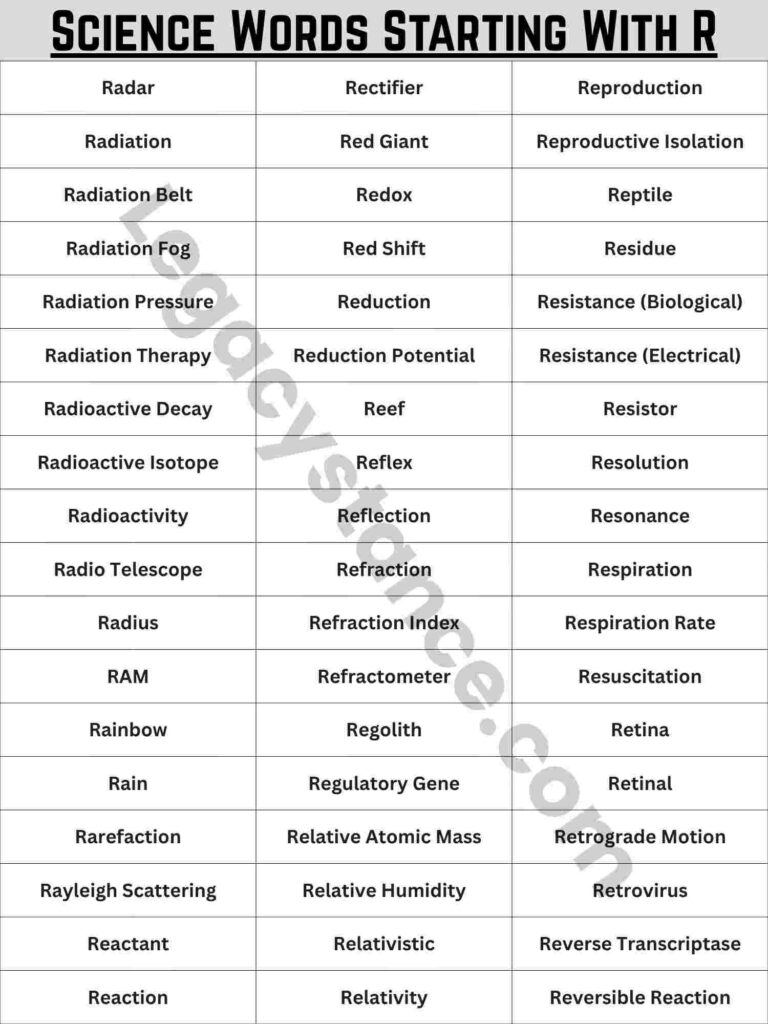
Radar — Radio wave system detecting object location and speed
Radiation — Energy moving through space as waves or particles
Radiation Belt — Charged particle zone trapped by Earth’s magnetic field
Radiation Fog — Fog forming when ground cools rapidly on calm nights
Radiation Pressure — Force exerted by electromagnetic radiation on matter
Radiation Therapy — Cancer treatment using targeted high-energy radiation
Radioactive Decay — Unstable nucleus breaking down and releasing energy
Radioactive Isotope — Unstable element version emitting radiation
Radioactivity — Spontaneous energy emission from unstable atomic nuclei
Radio Telescope — Instrument detecting radio waves from space
Radius — Half the diameter of a circle or sphere
RAM — Temporary computer memory cleared when power is off
Rainbow — Sunlight split into spectrum colors through water droplets
Rain — Water droplets falling from clouds
Rarefaction — Low-pressure region in a sound wave
Rayleigh Scattering — Light scattering by small particles; explains blue sky
Reactant — Substance present before a chemical reaction
Reaction — Substances interacting to form new substances
Reactive Metal — Metal readily losing electrons to form compounds
Receptor — Cell structure binding to specific chemical signals
Receptor Tyrosine Kinase — Surface protein triggering cell growth when activated
Recessive — Trait expressed only when two matching alleles present
Recessive Allele — Allele masked by a dominant allele when paired
Reclamation — Restoring degraded or industrially damaged land
Recrystallization — Purification via dissolving and controlled re-solidifying
Rectification — Converting AC to DC electrical current
Rectifier — Device performing AC-to-DC conversion in circuits
Red Giant — Expanded dying star with lower surface temperature
Redox — Simultaneous reduction and oxidation reaction
Red Shift — Light stretching toward red from a receding object
Reduction — Gain of electrons by a substance in a reaction
Reduction Potential — Tendency of a substance to gain electrons
Reef — Marine structure built primarily by coral organisms
Reflex — Rapid automatic response bypassing conscious thought
Reflection — Bouncing back of waves off a surface
Refraction — Bending of waves passing between different media
Refraction Index — Ratio measuring how much light slows in a material
Refractometer — Device measuring refractive index of a substance
Regolith — Loose surface layer of rock fragments above bedrock
Regulatory Gene — Gene controlling expression of other genes
Relative Atomic Mass — Average atomic mass compared to carbon-12
Relative Humidity — Current moisture as percentage of air’s maximum capacity
Relativistic — Effects significant only at near-light-speed
Relativity — Theories linking space, time, mass, and energy
Remission — Decrease or disappearance of disease signs
Remote Sensing — Earth data collection from satellites without contact
Renal — Relating to kidneys
Renal Cortex — Outer kidney region where blood filtration begins
Renal Tubule — Kidney tube where filtered fluid is processed
Renewable Energy — Energy from naturally replenishing sources
Renormalization — Quantum physics method resolving infinite values
Replication (DNA) — Complete DNA copying before cell division
Reproduction — Biological production of new organisms
Reproductive Isolation — Barrier preventing interbreeding
Reptile — Cold-blooded scaly vertebrate with lungs
Residue — Material remaining after a reaction
Resistance (Biological) — Ability to fight disease or drugs
Resistance (Electrical) — Opposition to electric current
Resistor — Component restricting current flow
Resolution — Level of detail in imaging or measurement
Resonance — Amplified vibration when frequencies match
Respiration — Energy release from glucose in cells
Respiration Rate — Number of breaths per minute
Resuscitation — Restoring breathing or heartbeat
Retina — Light-sensitive layer at the back of the eye
Retinal — Light-absorbing molecule in eye cells
Retrograde Motion — Apparent backward movement of a planet
Retrovirus — Virus inserting RNA into host DNA
Reverse Transcriptase — Enzyme converting RNA into DNA
Reversible Reaction — Reaction that works in both directions
Reynolds Number — Predicts smooth or turbulent fluid flow
Rhinitis — Inflammation of nasal passages
Rhizome — Underground horizontal stem
Ribonucleic Acid (RNA) — Carries instructions from DNA
Ribose — Sugar forming RNA structure
Ribosome — Cell structure making proteins
Ribozyme — RNA acting as an enzyme
Richter Scale — Logarithmic earthquake measurement scale
Rift — Crack in Earth’s crust
Rift Valley — Valley formed by separating tectonic plates
Rille — Channel on the Moon’s surface
Ring (Planetary) — Orbiting particles around a planet
RNA Polymerase — Enzyme making RNA from DNA
RNA Splicing — Removing non-coding RNA segments
Robotics — Design and use of automated machines
Roche Limit — Distance where a moon breaks apart
Rock — Natural solid mineral material
Rock Cycle — Transformation of rock types
Rock Salt — Natural form of sodium chloride
Rock Weathering — Breakdown of rocks over time
Root — Plant part absorbing water and anchoring
Root System — Entire underground root network
Rotation — Spinning on an axis
Revolution — Orbiting around another body
Router — Device directing network data
Ruminant — Animal with multi-part stomach
Runaway Greenhouse Effect — Extreme uncontrolled warming
Runoff — Water flowing over land into water bodies
Rupture — Sudden tearing of a structure
Rust — Iron oxide from reaction with oxygen and water
Rutherford Model — Atomic model with central nucleus
Resting Potential — Electrical charge in a resting neuron
Recombinant DNA — Combined DNA from different organisms
Receptor (Pharmacology) — Protein drugs bind to
Rain Shadow — Dry area behind mountains
Rapid Oxidation — Fast reaction with oxygen
Riparian — Related to riverbank areas
Rock Stratum — Layer of sedimentary rock
Radiolarian — Microscopic marine organism
Rheology — Study of material flow
Radiometry — Measurement of radiation
Radiocarbon Dating — Dating using carbon-14 decay
Common Confusions
Reflection vs. Refraction One word separates them cleanly. Reflection: light bounces back — never passes through. Refraction: light bends and passes through. Mirror = reflection. Water bending a straw’s appearance = refraction.
Respiration vs. Breathing Breathing moves air mechanically. Cellular respiration releases energy chemically inside cells — and works in organisms that never breathe. Confusing them is one of the most common biology mistakes at every grade level.
RNA vs. DNA DNA = double-stranded, permanent, stays in the nucleus. RNA = single-stranded, temporary, travels out to ribosomes. DNA stores. RNA delivers.
Recessive vs. Dominant Neither allele is biologically stronger. Recessive simply means the trait stays hidden when paired with a dominant allele. Pair two recessives together — it expresses fully.
Reduction vs. Oxidation Reduction = gaining electrons. Oxidation = losing electrons. Memory shortcut: OIL RIG — Oxidation Is Loss, Reduction Is Gain. They always happen together, never alone.
Richter Scale vs. Moment Magnitude Scale Scientists replaced Richter with the Moment Magnitude Scale (Mw) for greater accuracy — especially in large earthquakes. Media still says “Richter” from decades of habit. They measure differently.
Rotation vs. Revolution Rotation = spinning in place on an axis. Revolution = traveling around another object. Earth rotates daily. Earth revolves around the Sun yearly. Completely different motions sharing a similar root word.
Read more about:
130+ Science Words That Start With O | Definitions & Real Uses
100+ Science Words That Start With N: Simple Meanings for Students
FAQs about Science Words That Start With R
1. How can I remember science words easily?
Don’t try to memorize everything at once. Group words by topic like physics or biology. Then connect each word to a real example. For example, think of a mirror for reflection or a bent straw for refraction. This makes memory stronger.
2. What’s the difference between reflection and refraction?
Reflection is when light bounces back, like in a mirror. Refraction is when light bends as it passes through something like water or glass. One stays outside, the other goes through.
3. Are these words useful for school exams?
Yes. Many of these terms appear in middle and high school science. Words like respiration, reproduction, and resistance are commonly tested, so understanding them clearly helps in exams.
4. Should beginners learn advanced science words too?
Start with basic words first. Once you understand simple ideas, advanced terms become easier. Jumping ahead too quickly can make learning confusing.
Conclusion
Over 170 science words starting with R — sorted by subject, difficulty level, and actual use. No filler, no repeated definitions across sections.
R words carry serious scientific weight. They name processes keeping you alive, forces shaping the universe, tools running every device you own, and phenomena scientists are still actively studying.
Use this list the way it suits you best. Match it to your current unit. Scan for a quick definition. Use the confusion section before a test. The complete table is there for fast lookup anytime.
Having the right word for what’s happening — that’s what science vocabulary actually gives you.