Science vocabulary can feel heavy, but it doesn’t have to be confusing. This guide to Science Words That Start With T keeps things simple, clear, and useful. Whether you’re studying for a test, helping with homework, or just curious, these words are explained in a way that actually makes sense.
You won’t just memorize definitions—you’ll understand how each word connects to real life, from your body to the weather to space.
20 Most-Used Science Words That Start With T
Temperature — Measure of heat energy in a substance
Tissue — Group of similar cells working together
Tectonic — Related to movement of Earth’s crustal plates
Transpiration — Water vapor released through plant leaves
Toxin — Poisonous substance produced by living things
Thermal — Related to heat or temperature
Taxonomy — Science of classifying living organisms
Tendon — Tissue connecting muscle to bone
Trajectory — Path of a moving object through space
Transformer — Device that changes electrical voltage
Tide — Rise and fall of sea levels caused by gravity
Thorax — Middle body section of insects; chest in humans
Turbine — Machine converting fluid motion into energy
Troposphere — Lowest layer of Earth’s atmosphere
Trait — Inherited characteristic of an organism
Translucent — Allows partial light passage
Trachea — Airway tube connecting mouth to lungs
Tsunami — Large ocean wave caused by seismic activity
Thermostat — Device that regulates temperature automatically
Titration — Lab method measuring concentration of a solution
Physics Science Words That Start With T
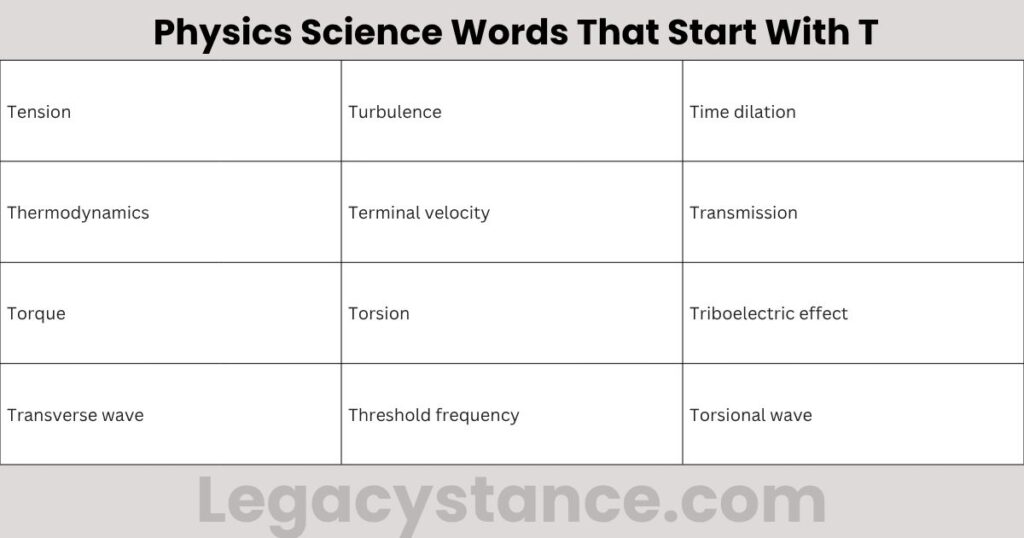
Physics covers matter, energy, and forces. These words appear whether you’re studying motion, sound, light, or electricity.
Tension — A pulling force stretching an object. Pull both ends of a rubber band and you feel it immediately.
Thermodynamics — The study of heat and energy transfer. Every engine ever built runs on these principles.
Torque — A twisting force causing rotation. Turning a doorknob or tightening a bolt both use it.
Transverse wave — A wave where particles move perpendicular to the direction of travel. Light behaves this way.
Turbulence — Chaotic, irregular fluid or air movement. Airplane passengers feel it during rough flights.
Terminal velocity — Maximum speed a falling object reaches when air resistance equals gravity. Skydivers hit this point during freefall.
Torsion — Twisting stress on a material. Engineers test it when designing car axles and bridges.
Threshold frequency — Minimum light frequency needed to release electrons from metal. Central to the photoelectric effect.
Time dilation — Time slowing at high speeds or in strong gravity. Einstein’s relativity describes this.
Transmission — Passing of waves or signals through a medium without full absorption.
Triboelectric effect — Static electricity generated by friction between two different materials. Rubbing a balloon on hair is the textbook example.
Torsional wave — A wave that travels through rotational oscillation rather than linear displacement.
Chemistry Science Words That Start With T
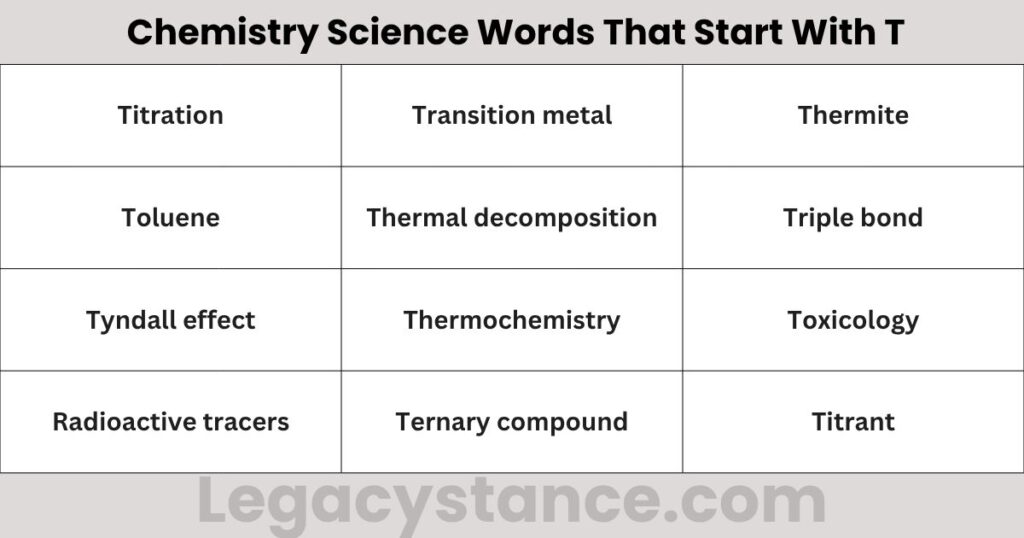
Titration is already defined above. Here’s what makes it useful: it appears in food testing, water quality labs, and pharmaceutical manufacturing — anywhere the exact concentration of a substance matters.
Transition metal — Elements in the periodic table’s middle block — iron, copper, nickel — known for variable oxidation states and colorful compounds.
Thermite — Aluminum powder mixed with iron oxide. Burns at extreme temperatures. Used in welding and controlled demolition.
Toluene — A clear hydrocarbon solvent from crude oil, found in paint thinners and adhesives.
Thermal decomposition — A compound breaking down from heat alone. Heating limestone produces calcium oxide this way.
Triple bond — Three shared electron pairs between two atoms. Nitrogen gas (N₂) contains one.
Tyndall effect — Light scattering by particles in a colloid. The reason a sunbeam through dusty air becomes visible.
Thermochemistry — Study of heat changes during chemical reactions.
Toxicology — How chemicals affect living organisms, and at what doses they become harmful.
Radioactive tracers — Radioactive atoms used to follow a substance through a reaction or biological system.
Ternary compound — A compound built from exactly three different elements. Sodium bicarbonate (NaHCO₃) is one.
Titrant — The solution of known concentration added during a titration experiment.
Biology Science Words That Start With T
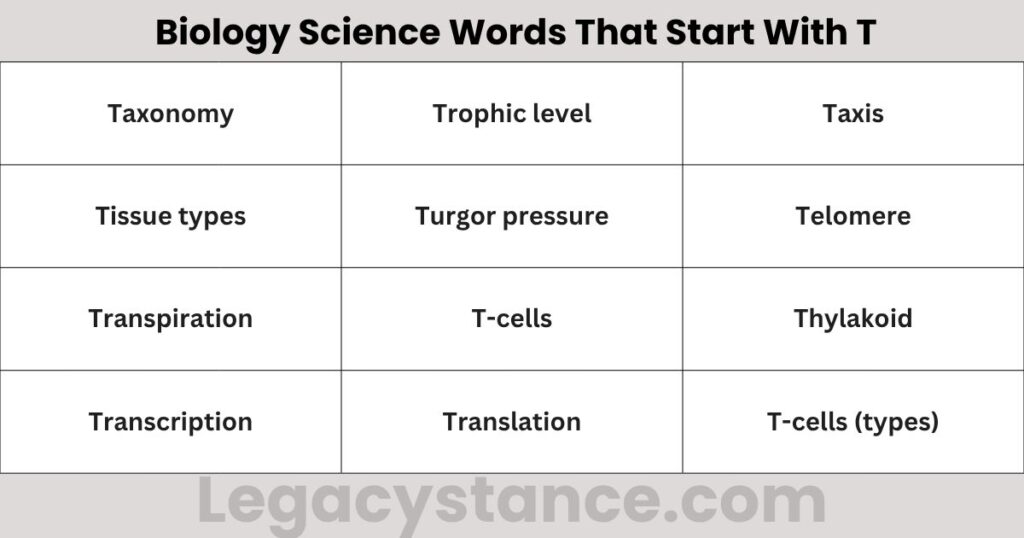
Biology’s “T” words span cells, organs, ecosystems, and genetics. The Quick Answer table covered basic definitions; this section adds the context that makes them stick.
Taxonomy groups life into a nested hierarchy: domain, kingdom, phylum, class, order, family, genus, species. Carl Linnaeus built this framework in the 1700s and scientists still use it today.
Tissue types in animals include muscle, nervous, epithelial, and connective. Plants have vascular, ground, and dermal tissue. Knowing which tissue does what is fundamental to both biology exams and medical understanding.
Transpiration does more than lose water — it drives a continuous upward pull through the plant. A single large tree can move 400 liters of water daily just through this process.
Trophic level — Position in a food chain. Producers at level one, herbivores at two, carnivores above that. Energy drops roughly 90% between each level.
Turgor pressure — Water pressure inside plant cells. It keeps stems upright. When plants lose it, they visibly wilt. This is why watering a drooping plant revives it within hours.
T-cells — White blood cells at the center of adaptive immunity. Some attack infected cells directly; others coordinate the broader immune response.
Taxis — Directed movement toward or away from a stimulus. Bacteria swimming toward a food source is chemotaxis. Moths flying toward light is phototaxis.
Telomere — Protective chromosome caps that shorten with each cell division. Scientists study telomere length as a biological clock for aging.
Thylakoid — Flat membrane sacs inside chloroplasts. The light-capturing reactions of photosynthesis happen across their surfaces.
Transcription — DNA copied into messenger RNA inside the nucleus. The first step in making any protein.
Translation — Ribosomes read mRNA and assemble proteins from it. Transcription writes the instruction; translation builds the product.
T-cells (types) — Cytotoxic T-cells kill; helper T-cells signal; memory T-cells remember past infections for faster future responses.
Earth Science Words That Start With T
Tectonic plates move a few centimeters per year — about the rate your fingernails grow. That slow movement builds mountain ranges, opens ocean basins, and triggers earthquakes along fault lines.
Tsunami waves are barely noticeable in deep ocean — sometimes only 30 cm tall. At the shore, the same wave can rise 30 meters. Speed and shallowing water cause the dramatic buildup.
Topography — Physical features of a land surface: elevation, slopes, valleys, ridges. Used in everything from hiking maps to military strategy.
Tropopause — The sharp boundary between the troposphere and stratosphere. Commercial aircraft cruise just below or at this boundary to avoid weather.
Tundra — Cold, treeless biome with permafrost beneath a thin active soil layer. Found in Arctic regions and at high mountain altitudes. Very low biodiversity but ecologically fragile.
Tephra — All solid material thrown by a volcano: ash, cinders, and larger rock fragments called bombs.
Turbidite — Sediment deposits from underwater avalanches. They reveal past seismic history on the ocean floor.
Thermocline — Layer where water temperature drops sharply with depth. Below the thermocline, temperature stays near-constant and cold regardless of surface conditions.
Talus — Rock debris piling up at a cliff’s base through weathering. Common in mountainous terrain.
Tornado — A rotating air column reaching the ground from a thunderstorm. Rated on the Enhanced Fujita (EF) scale from EF0 to EF5.
Terrace (geological) — Flat, step-like landform carved by river erosion or tectonic uplift over thousands of years.
Space & Astronomy Science Words That Start With T
Telescope — Collects light or other radiation from distant objects. The James Webb Space Telescope detects infrared light from galaxies formed a few hundred million years after the Big Bang.
Tidal locking — A moon rotating at the same rate it orbits, permanently showing one face. Earth’s Moon is tidally locked — the far side is never visible from Earth’s surface.
Transit (astronomy) — A smaller body crossing in front of a larger one. Astronomers detected most known exoplanets by measuring the tiny brightness dip during a stellar transit.
Terrestrial planet — Rocky, dense planet. Mercury, Venus, Earth, and Mars are the solar system’s four.
Tidal force — Gravitational difference across a body that stretches or compresses it. Jupiter’s tidal force heats its moon Io internally, driving its constant volcanic activity.
Total solar eclipse — The Moon fully covering the Sun’s disk, briefly revealing the faint outer corona not visible otherwise.
Thermosphere — Atmospheric layer from 80 to 600 km altitude. Temperatures here can exceed 2,000°C, though the air is so thin it transfers almost no heat. The ISS orbits in this layer.
Trojans — Asteroids sharing a planet’s orbit at stable gravitational points called Lagrange points. Jupiter hosts thousands.
T Tauri star — A young star still contracting, before it reaches stable hydrogen fusion. Our Sun passed through this phase roughly 4.5 billion years ago.
Transient lunar phenomenon — Brief, unexplained glows or flashes on the Moon’s surface. Observed since the 1700s, still not fully explained.
Medical & Health Science Words That Start With T
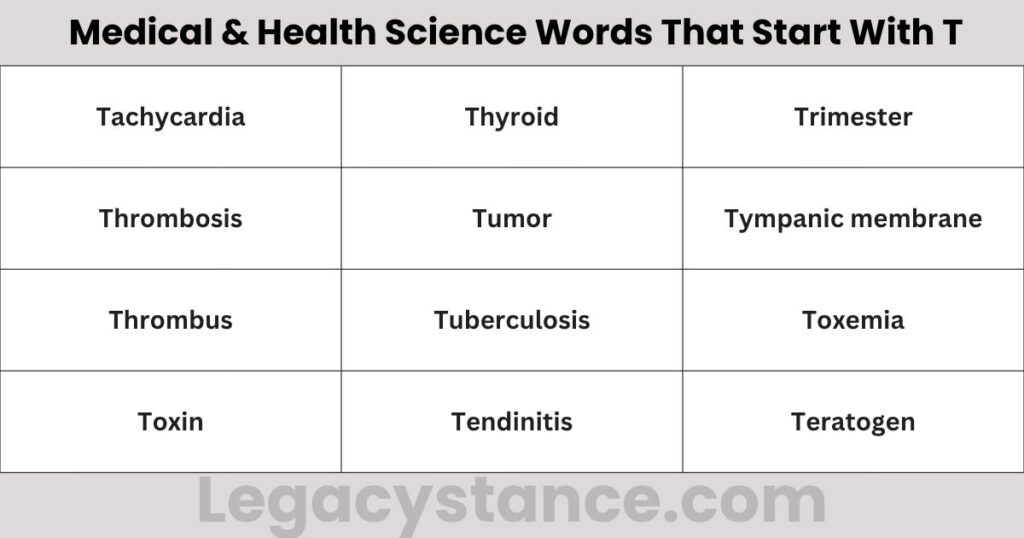
Tachycardia — Resting heart rate above 100 bpm. Causes range from caffeine and anxiety to underlying cardiac conditions.
Thrombosis — Blood clot forming inside a vessel and blocking circulation. Deep vein thrombosis (DVT) typically forms in the legs, with risk of breaking off and reaching the lungs.
Thrombus — The clot itself. Thrombosis is the condition; a thrombus is the physical object causing it.
Toxin — Poison from a living source. The tetanus toxin blocks nerve signals to muscles, causing the characteristic rigidity of the disease.
Trauma — Physical injury or severe psychological shock. Emergency medicine and mental health both use the term, but mean different things by it.
Thyroid — Butterfly-shaped gland in the neck. Produces thyroxine, which controls how fast the body uses energy.
Tumor — Abnormal cell mass. Benign ones stay put; malignant ones invade and spread. Size alone doesn’t determine which it is.
Tuberculosis — Bacterial lung infection from Mycobacterium tuberculosis. Spread through airborne droplets. Still kills over a million people annually worldwide.
Tendinitis — Tendon inflammation from repetitive overuse. Tennis elbow, patellar tendinitis, and rotator cuff issues are the most common forms.
Triage — Sorting patients by urgency when resources are limited. Developed in battlefield medicine; now the operational backbone of every emergency department.
Trimester — One of three 13-week pregnancy periods. First trimester: organ formation. Second: rapid growth. Third: maturation and preparation for birth.
Tympanic membrane — The eardrum. Vibrates in response to sound waves. A perforated tympanic membrane causes hearing loss and pain.
Toxemia — Toxins circulating in the bloodstream. In pregnancy, the term often refers to preeclampsia — dangerously high blood pressure.
Teratogen — Any substance causing developmental defects in a fetus. Alcohol, certain medications, and some infections are teratogens.
Technology & Applied Science Words That Start With T
Transistor — The electronic switch everything digital runs on. A modern smartphone chip packs more than 15 billion transistors into a fingernail-sized space.
Turbine — Converts moving fluid or gas into mechanical power. Wind turbines use air; hydroelectric turbines use water; jet engines use combustion gases.
Telemetry — Wireless, automated data collection from remote locations. Used in space probes, Formula 1 cars, medical implants, and weather stations.
Topology (network) — The layout of connections in a network. Ring, star, and mesh topologies each have different strengths for speed and fault tolerance.
Terabyte — 1,024 gigabytes. A single 4K movie takes about 100 GB; a terabyte holds roughly ten of them.
Thermal imaging — Creates images from heat radiation rather than light. Used in search and rescue, electrical fault detection, and building insulation surveys.
Tensile strength — Maximum pull stress a material withstands before fracturing. Steel cables on suspension bridges are designed around tensile strength calculations.
3D printing — Builds physical objects layer by layer from a digital file. Surgeons now use it to create custom implants matched to a patient’s exact anatomy.
Transducer — Converts one energy form to another. Every microphone, speaker, solar cell, and motor is a transducer.
Turing machine — Alan Turing’s theoretical model of computation from 1936. It defines the mathematical boundary of what any computer, anywhere, can ever solve.
Science Words That Start With T by Grade Level
This replaces separate “easy” and “kids” sections — organized by what students actually encounter at each level.
Grade 3–5
| Word | Plain Meaning |
| Thunder | Sound from air expanding after a lightning strike |
| Tadpole | Baby frog living in water before legs develop |
| Trunk (tree) | Main woody stem that supports all branches |
| Thorn | Sharp plant growth that deters animals |
| Tongue | Muscular organ for tasting and speech |
| Topsoil | Top soil layer; richest in nutrients |
| Tide pool | Rocky coastal pool exposed when tide goes out |
Grade 6–7
| Word | Plain Meaning |
| Trophic level | An organism’s position in a food chain |
| Turgor pressure | Water pressure keeping plant cells firm |
| Tyndall effect | Light scattering through a cloudy liquid or air |
| Tidal force | Gravitational pull that stretches a body unevenly |
| Tropism | Plant growth responding to light, gravity, or water |
| Thermoregulation | How an organism controls its own body temperature |
Grade 8 and Up
| Word | Plain Meaning |
| Transcription | DNA copied into mRNA in the nucleus |
| Translation | mRNA read by ribosomes to build proteins |
| Telomere | Chromosome tip linked to cellular aging |
| Transposon | “Jumping gene” that moves within the genome |
| Thermodynamic equilibrium | System state where no further energy change occurs |
| Titrant | Known solution used to measure an unknown one |
Advanced Science Words That Start With T
These appear in upper-grade science, AP courses, and first-year university reading.
Telomerase — Rebuilds telomeres after cell division. Cancer cells activate it abnormally, making them effectively immortal.
Transduction (biology) — A bacteriophage virus accidentally carries bacterial DNA from one bacterium to another. One mechanism behind antibiotic resistance spreading.
Tachyon — Hypothetical particle that would always travel faster than light. Mathematically consistent, never experimentally detected.
Topoisomerase — Untangles and relaxes DNA ahead of the replication fork. Without it, DNA would knot itself into an unreadable tangle during copying.
Thermistor — Resistor whose electrical resistance changes predictably with temperature. Found in thermostats, medical probes, and engine management systems.
Trophoblast — Outer cell layer of an early embryo that implants into the uterine wall and forms the placenta.
Turbidity — Liquid cloudiness from suspended particles. Ecologists measure it to assess water quality; brewers monitor it during fermentation.
Tritium — Radioactive hydrogen isotope with two neutrons. Used in nuclear fusion research and self-luminous watch dials.
Triple point — The precise temperature and pressure where a substance’s solid, liquid, and gas phases all coexist simultaneously. Water’s triple point is at 0.01°C and 611.7 pascals.
Transposon — DNA segment that relocates within the genome. Barbara McClintock discovered them in maize in the 1940s — and won a Nobel Prize for it decades later.
Thermoluminescence — Light emitted when certain materials are heated. Archaeologists use it to date ancient ceramics.
Complete Reference List: 200+ Science Words That Start With T
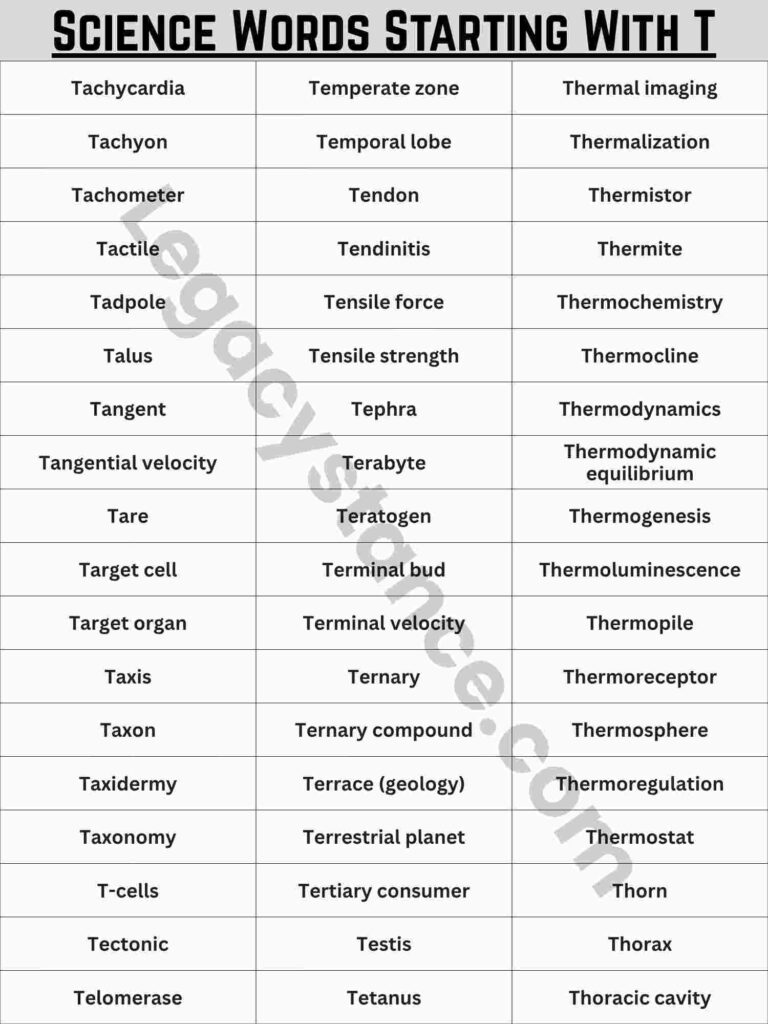
Tachycardia — Resting heart rate above 100 bpm
Tachyon — Hypothetical faster-than-light particle
Tachometer — Instrument measuring rotational speed
Tactile — Related to the sense of touch
Tadpole — Aquatic larval stage of a frog or toad
Talus — Rock debris at base of a cliff or slope
Tangent — Line touching a curve at exactly one point
Tangential velocity — Speed of an object along a curved path
Tare — Counterweight used to zero a weighing scale
Target cell — Cell that responds to a specific hormone
Target organ — Organ responding to a specific hormone
Taxis — Directed organism movement toward or away from stimulus
Taxon — Any named group in biological classification
Taxidermy — Science and art of preserving animal specimens
Taxonomy — System for naming and classifying living organisms
T-cells — Immune cells coordinating adaptive immune response
Tectonic — Related to Earth’s crustal plate movement
Telomerase — Enzyme that rebuilds chromosome end caps
Telomere — Protective cap at the end of a chromosome
Telemetry — Wireless remote data collection and transmission
Temperature — Degree of heat energy in a substance
Temperate zone — Climate zone between tropics and polar regions
Temporal lobe — Brain region for hearing and memory processing
Tendon — Fibrous tissue connecting muscle to bone
Tendinitis — Tendon inflammation from repetitive overuse
Tensile force — Stretching force applied along a material
Tensile strength — Maximum stress before material fractures under tension
Tephra — All solid volcanic ejecta: ash, cinders, and bombs
Terabyte — Digital storage unit equal to 1,024 gigabytes
Teratogen — Substance causing fetal developmental defects
Terminal bud — Growth tip at the end of a plant stem
Terminal velocity — Maximum falling speed when drag equals gravity
Ternary — System or compound with three components
Ternary compound — Chemical compound containing exactly three elements
Terrace (geology) — Step-like flat landform from erosion or uplift
Terrestrial planet — Rocky, dense planet (Mercury, Venus, Earth, Mars)
Tertiary consumer — Top predator in a food chain
Testis — Male reproductive organ producing sperm
Tetanus — Bacterial disease causing severe muscle rigidity
Tetrahedral — Four-faced geometric molecular structure
Thermal — Related to heat energy
Thermal decomposition — Compound breakdown by heat alone
Thermal imaging — Infrared heat-based imaging technology
Thermalization — Process of particles reaching thermal equilibrium
Thermistor — Temperature-sensitive electrical resistor
Thermite — Aluminum-iron oxide high-temperature reactive mixture
Thermochemistry — Study of heat changes in chemical reactions
Thermocline — Sharp water temperature drop with increasing depth
Thermodynamics — Physics of heat and energy transfer
Thermodynamic equilibrium — System state with no further energy change
Thermogenesis — Heat production within living organisms
Thermoluminescence — Light emitted from material when heated
Thermopile — Array converting heat differences into electrical voltage
Thermoreceptor — Sensory cell detecting temperature changes
Thermosphere — Atmospheric layer from 80 to 600 km altitude
Thermoregulation — Biological control of internal body temperature
Thermostat — Device that automatically regulates temperature
Thorn — Sharp protective growth on a plant stem
Thorax — Chest in humans; middle segment in insects
Thoracic cavity — Chest space containing the heart and lungs
Threshold — Minimum stimulus level triggering a response
Threshold frequency — Minimum light frequency for photoelectric emission
Thrombocyte — Platelet; blood cell fragment aiding clotting
Thrombosis — Blood clot forming and blocking a vessel
Thrombus — The stationary clot itself inside a vessel
Thylakoid — Chloroplast membrane where light reactions occur
Thymine — DNA base that pairs with adenine
Thymus — Gland where T-cells mature
Thyroid — Neck gland producing metabolic hormones
Thyroglobulin — Thyroid protein used to synthesize hormones
Thyroxine — Primary hormone produced by the thyroid
Tibia — Larger of the two lower leg bones
Tidal dissipation — Energy lost within a body through tidal forces
Tidal flat — Coastal zone exposed at low tide
Tidal force — Gravitational difference stretching a body
Tidal locking — Rotation matching orbital period
Tidal volume — Air moved in one normal breath
Tide — Sea level rise and fall from lunar gravity
Tide pool — Rocky coastal pool exposed at low tide
Timbre — Unique sound quality
Time dilation — Slowing of time at high speed or gravity
Tissue — Group of similar cells performing a function
Tissue engineering — Growing biological tissue for medical use
Titrant — Known solution used in titration
Titration — Method to measure solution concentration
Toluene — Hydrocarbon solvent
Topaz — Silicate mineral gemstone
Topography — Physical land surface features
Topoisomerase — Enzyme that untangles DNA
Topology — Arrangement of network connections
Topsoil — Upper nutrient-rich soil layer
Torpor — Reduced metabolic state
Tornado — Rotating column of air from storm
Torque — Rotational force
Torr — Unit of pressure
Torricelli’s theorem — Fluid speed relation
Torsion — Twisting stress
Torsional wave — Rotational wave motion
Total internal reflection — Light reflecting inside medium
Totipotency — Ability to form entire organism
Totipotent cell — Cell forming all types
Toxemia — Toxins in bloodstream
Toxicology — Study of harmful chemicals
Toxin — Poison from living organisms
Trace element — Needed in very small amounts
Trace fossil — Evidence of organism activity
Trace gas — Gas in tiny amounts
Tracer — Substance used to track movement
Trachea — Air tube to lungs
Tracheal system — Insect breathing tubes
Trait — Inherited characteristic
Trait heritability — Genetic transmission degree
Transcription — DNA copied into RNA
Transcriptome — All RNA in a cell
Transducer — Converts energy forms
Transduction — DNA transfer by virus
Transect — Sampling line in ecology
Transfer RNA — Delivers amino acids
Transfer efficiency — Energy transfer percentage
Transformation — Genetic change in cell
Transformer — Changes voltage
Transgenic — Organism with foreign genes
Transient — Short-lived event
Transient lunar phenomenon — Moon flashes
Transit — Celestial crossing event
Transition metal — Variable oxidation element
Translation — Protein building process
Translocation — Sugar movement in plants
Translucent — Partially lets light through
Transmissibility — Spread rate of disease
Transmission — Passing of signals
Transmutation — Element conversion
Transparent — Fully lets light through
Transpiration — Water loss from plants
Transpiration ratio — Water use efficiency
Transponder — Signal relay device
Transpulmonary pressure — Lung pressure difference
Transposon — Jumping DNA segment
Transverse colon — Middle large intestine
Transverse section — Cross cut
Transverse wave — Perpendicular wave motion
Trauma — Serious injury
Tree canopy — Top forest layer
Tree ring — Annual growth layer
Triboelectric effect — Static electricity
Tricarboxylic acid cycle — Krebs cycle
Triage — Patient priority system
Trigeminal nerve — Facial nerve
Trilobite — Extinct marine fossil
Trimester — Pregnancy stage
Triple bond — Three shared electrons
Triple point — Solid, liquid, gas coexist
Tritium — Radioactive hydrogen
Trochlea — Pulley-shaped structure
Tropic of Cancer — 23.5°N latitude
Tropic of Capricorn — 23.5°S latitude
Tropism — Plant response growth
Trophic cascade — Ecosystem chain reaction
Trophic efficiency — Energy transfer
Trophic level — Food chain position
Trophic pyramid — Energy diagram
Trophoblast — Embryo outer layer
Tropocollagen — Collagen unit
Troposphere — Lowest atmosphere layer
Tropopause — Atmosphere boundary
Trophozoite — Active parasite stage
Trypsin — Digestive enzyme
T Tauri star — Young star
Tuber — Underground storage stem
Tuberculosis — Lung infection
Tubule — Small tube
Tumor — Abnormal cell mass
Tumor marker — Cancer indicator
Tundra — Cold biome
Tungsten — High melting metal
Tungsten carbide — Hard industrial compound
Turbidite — Underwater sediment deposit
Turbidity — Liquid cloudiness
Turbine — Energy conversion machine
Turbofan — Jet engine type
Turbulence — Chaotic flow
Turbulent flow — Irregular fluid motion
Turgid — Swollen cell
Turgor movement — Plant motion from water
Turgor pressure — Cell water pressure
Turing machine — Computation model
Turnover — Species replacement rate
Two-photon absorption — Two photons absorbed
Two-stroke engine — Two-step engine cycle
Tymbal — Insect sound organ
Tympanic membrane — Eardrum
Tympanum — Hearing membrane
Tympanometry — Ear test
Type I error — False positive
Type II error — False negative
Type specimen — Reference sample
Typhoon — Pacific cyclone
Tyrosine — Amino acid
Tension — Pulling force
Thermodynamics — Heat and energy study
Trajectory — Path of motion
Transformer — Voltage-changing device
Turbine — Fluid energy machine
Twitch fiber — Fast muscle fiber
Tymbal — Sound-producing membrane
Common Confusions Cleared Up
Transpiration vs. Translocation Both happen in plants. Transpiration is water leaving as vapor through leaf pores — it’s loss. Translocation moves dissolved sugars through the phloem from leaves to roots and growing tips — it’s delivery. Opposite directions, opposite purposes.
Tendon vs. Ligament Tendons connect muscle to bone; ligaments connect bone to bone. Sprained ankle = torn ligament. Heavy lifting injury = torn tendon. Same body region, completely different structures.
Tissue vs. Organ Tissue is built from similar cells. An organ is built from multiple different tissues. The heart is an organ made of cardiac muscle tissue, connective tissue, and nervous tissue working together.
Transparent vs. Translucent Transparent: see through clearly — clean window glass. Translucent: light passes but image blurs — frosted glass, wax paper. Opaque: no light passes at all.
Tidal wave vs. Tsunami “Tidal wave” is a popular but wrong term. Tsunamis have no connection to tides — they come from seismic events. Tides come from the Moon’s gravity. The scientifically correct term is always tsunami.
Tumor vs. Cancer Benign tumors grow in one place and don’t spread. Malignant tumors (cancer) invade surrounding tissue and can travel through blood or lymph to other organs. Not all tumors are dangerous; not all cancers form visible tumors.
Transcription vs. Translation Transcription: inside the nucleus, DNA is copied into mRNA. Translation: at the ribosome, mRNA is read and a protein is built. Write the recipe (transcription), then cook the dish (translation).
Thrombosis vs. Thrombus A thrombus is the physical clot. Thrombosis is the process of it forming and blocking a vessel. Object vs. event.
Rea also about:
160+ Science Words That Start With M: Meanings & Simple Guide
100+ Science Words That Start With N: Simple Meanings for Students
FAQs
1. Which “T” science words should I learn first for exams?
Start with the basics that show up often: temperature, tissue, trachea, transpiration, tectonic, and troposphere. These appear across biology, physics, and earth science, so they give you a strong base without overload.
2. How can I remember difficult science words easily?
Don’t just read—connect the word to something real. For example, think of a plant drooping when learning “turgor pressure” or your breathing when learning “trachea.” Visual links stick better than plain definitions.
3. Are all science words important to memorize?
No. Focus on understanding key concepts first. Once you understand how systems work, many words become easier to recognize and remember without forced memorization.
4. Why are there so many science words starting with “T”?
Many come from Latin and Greek roots like “trans-” (across), “tri-” (three), and “thermo-” (heat). These roots are reused across different topics, which is why one letter can have so many terms.
Bottom line
From “tadpole” to “transposon.” From Grade 3 to graduate-level reading. Every section in this guide was written for a specific purpose — the grade table for test prep, the categorized sections for understanding context, the confusion pairs for the mistakes that cost marks, and the full reference table for fast lookup.
Science vocabulary isn’t about memorizing. It’s about building a mental map of how the natural world works — one precise word at a time.