If you’ve ever paused on words like “velocity” or “vacuole,” you’re not alone. Science terms can feel heavy, especially when they show up in tests or homework.
This guide on Science Words That Start With V keeps things clear and practical. Instead of long, confusing definitions, you’ll find simple meanings and real-life context. Whether you’re a student, parent, or just curious, this will help you understand and actually remember what these words mean.
20 Most-Used Science Words Starting With V
Velocity — Speed of an object in a specific direction
Vacuum — Space with no matter or air pressure
Vapor — Gas form of a substance normally found as liquid
Virus — Tiny infectious agent that replicates inside cells
Viscosity — A liquid’s resistance to flow
Volcano — Opening in Earth’s crust releasing lava and gases
Volume — Amount of space an object or substance occupies
Vacuole — Storage organelle found inside plant and animal cells
Variable — A factor that can change in an experiment
Vertebrate — Animal with a backbone or spinal column
Valence — Combining power of an element’s outer electrons
Ventricle — Heart chamber that pumps blood out
Vibration — Rapid back-and-forth movement of particles
Volt — Unit measuring electrical potential
Vesicle — Small fluid-filled sac inside a cell
Vascular — Relating to vessels that carry fluids in organisms
Vein — Blood vessel carrying blood toward the heart
Volatile — Substance that evaporates quickly at room temperature
Vector — Quantity with both magnitude and direction
Variation — Differences in traits among individuals of a species
Physics Science Words That Start With V
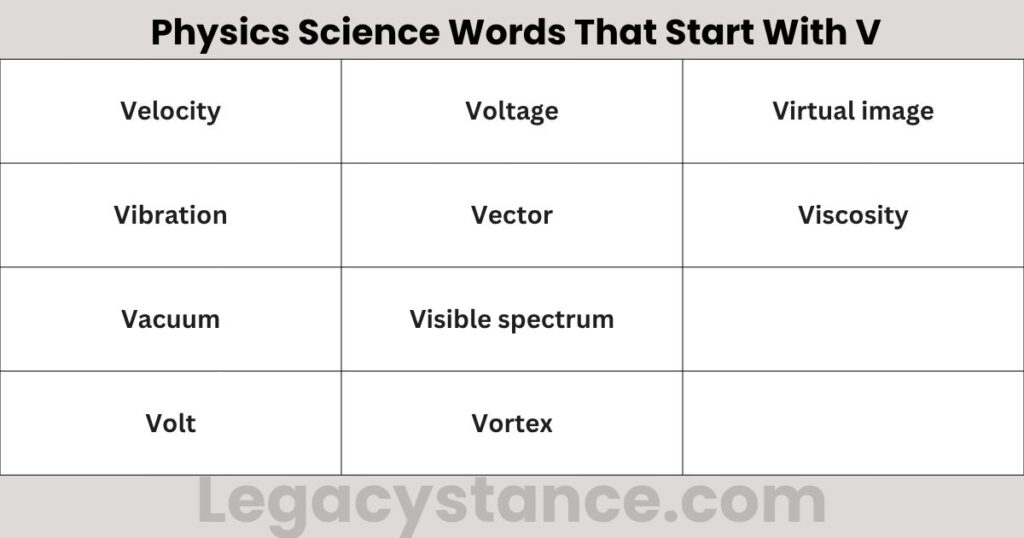
Physics V words mostly describe things you can observe — movement, force, energy, light.
Velocity — Not just speed. Velocity includes direction. A car at 60 mph north has a different velocity than one going 60 mph south. That difference matters in every physics calculation involving motion.
Vibration — Particles moving back and forth rapidly around a fixed point. Sound travels because of vibrations. Pluck a guitar string — you’re watching vibration create sound in real time.
Vacuum — A region with no matter, or almost none. Outer space is close to a perfect vacuum. No air means no medium for sound to travel through. That’s why space is silent.
Volt — The unit of electric potential difference. Named after Alessandro Volta. When you see “9V” on a battery, that’s nine volts of electrical push.
Voltage — The pressure driving electric current through a wire. Higher voltage = stronger push. Every USB charger, every wall socket runs on this principle.
Vector — A quantity with both size and direction. Velocity is a vector. Temperature is not.
Visible spectrum — The range of light wavelengths the human eye detects — violet through red. Rainbows display the entire visible spectrum at once.
Vortex — A rotating mass of fluid or air. Tornadoes, whirlpools, and the swirl of water down a drain are all vortexes.
Virtual image — An image that cannot be projected onto a screen because light rays only appear to meet. Mirrors create virtual images.
Viscosity — Honey flows slowly. Water flows fast. That difference is viscosity — a fluid’s resistance to movement. High viscosity means thick and slow.
Chemistry Science Words That Start With V
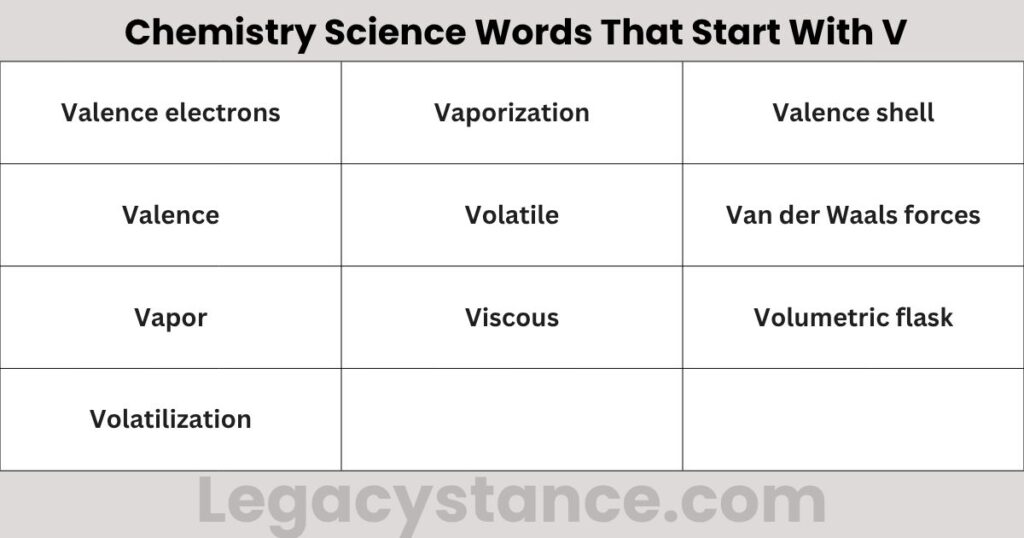
Valence electrons — Electrons in the outermost shell of an atom. These are the ones that form chemical bonds and decide how reactive an element is.
Valence — The combining power of an atom. Carbon has a valence of 4 — it bonds with four other atoms simultaneously. That’s why carbon is the backbone of all organic chemistry.
Vapor — When a liquid turns to gas below its boiling point. Perfume vapors at room temperature. That’s how you smell it across the room.
Vaporization — Converting liquid to vapor. Two forms: evaporation (slow, at the surface) and boiling (fast, throughout the liquid).
Volatile — A volatile substance evaporates easily. Acetone in nail polish remover is volatile — open the bottle and you smell it instantly.
Viscous — Thick fluid that resists flow. Molasses, tar, and syrup are viscous liquids.
Valence shell — The outermost energy level of an atom. How full this shell is determines chemical behavior.
Van der Waals forces — Weak attractions between molecules. Geckos stick to walls by exploiting Van der Waals forces through thousands of tiny toe hairs. Weak individually — powerful combined.
Volumetric flask — A lab container designed to hold one precise volume of liquid. Accuracy in chemistry starts here.
Volatilization — When a solid or liquid converts to gas due to heat or pressure change — without necessarily boiling first.
Biology Science Words That Start With V
Vacuole — A membrane-bound sac inside a cell. In plant cells, the central vacuole can occupy 90% of the cell’s space — storing water and keeping the plant structurally firm.
Vascular tissue — In plants, this includes xylem (carries water upward) and phloem (carries sugars downward). Without vascular tissue, plants couldn’t grow tall.
Vertebrate — An animal with a backbone. Humans, fish, birds, reptiles, amphibians — all vertebrates. Roughly 60,000 species total.
Virus — Smaller than any bacterium. Not technically alive by most definitions. Just genetic material wrapped in a protein coat that hijacks living cells to copy itself.
Vesicle — Tiny sacs inside cells that transport materials in, out, and around like microscopic delivery trucks.
Vein (plant) — In leaves, veins carry water and nutrients. The vein pattern (venation) is used to identify plant species.
Vein (animal) — Carries blood back to the heart. Arteries carry blood away. One exception: pulmonary veins carry oxygenated blood from lungs to the heart. Worth remembering for exams.
Ventricle (heart) — The lower heart chambers. The left ventricle pushes oxygenated blood to your entire body. It’s the hardest-working muscle in your body.
Ventricle (brain) — Fluid-filled cavities producing and circulating cerebrospinal fluid, which cushions and protects the brain.
Viviparous — Animals that give birth to live young, nourished inside the mother. Humans, dogs, and whales are viviparous.
Vestigial structure — A body part that lost its function through evolution. Human wisdom teeth. The tailbone. Whale leg remnants buried inside their bodies.
Villi — Tiny finger-like projections lining the small intestine. They massively expand the surface area available for absorbing nutrients.
Variation — Differences in traits among individuals of the same species. Variation is what natural selection acts on. Without it, evolution has nothing to work with.
Venom — A toxic substance injected into prey or threats through biting or stinging. Different from poison, which harms when touched or eaten — not injected.
Earth Science Words That Start With V
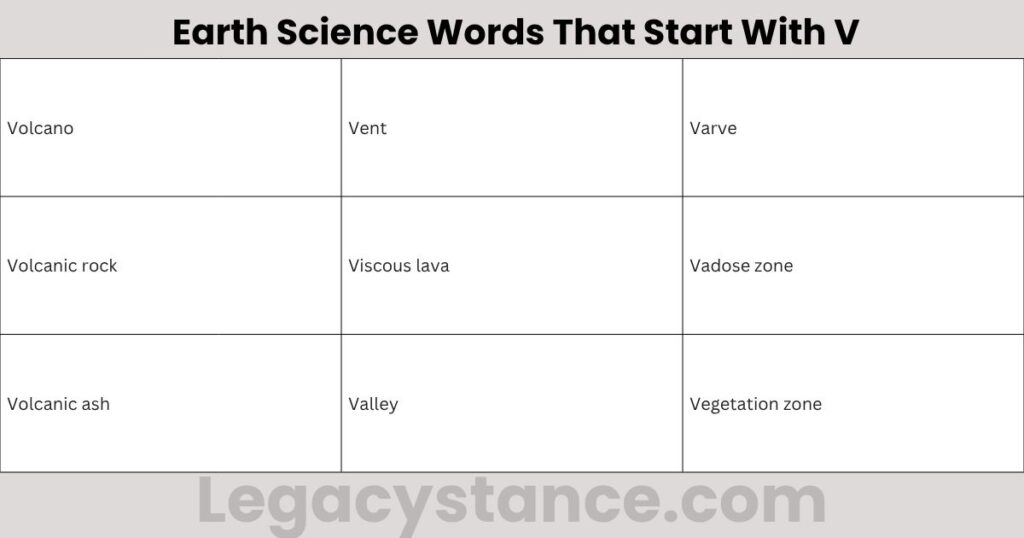
Volcano — A rupture in Earth’s crust where molten rock, ash, and gases escape. About 1,500 on Earth are considered potentially active.
Volcanic rock — Rock formed when lava cools. Obsidian forms when lava cools so rapidly that crystals never have time to grow.
Volcanic ash — Fine particles of rock and mineral glass blasted skyward during eruptions. Can travel thousands of miles and temporarily affect global climate.
Vent — The opening through which volcanic material escapes. A volcano may have one central vent or several side vents.
Viscous lava — Thick, slow-moving lava with high silica content. Because gas can’t escape easily, it builds pressure — causing explosive eruptions.
Valley — Low land between hills or mountains. Usually carved by rivers over thousands of years, or by glaciers during ice ages.
Varve — A pair of sediment layers deposited in a lake over one year. Scientists read varves like tree rings to study past climates.
Vadose zone — The soil and rock layer between Earth’s surface and the water table. Water here moves downward toward groundwater.
Vegetation zone — A region defined by plant types based on climate and soil. Scientists use these zones to map ecosystems worldwide.
Space & Astronomy Science Words That Start With V
Vacuum of space — Space isn’t completely empty, but close — roughly one atom per cubic meter on average. Sound cannot travel through it.
Velocity (orbital) — The speed needed to maintain orbit. Earth travels around the Sun at about 30 km per second.
Venus — Second planet from the Sun and the hottest in the solar system. Its thick CO₂ atmosphere traps heat so effectively that surface temperatures reach ~465°C — hotter than Mercury.
Void — A massive region of space containing very few galaxies. The Boötes Void stretches approximately 330 million light-years across.
Variable star — A star whose brightness changes over time. Some pulse rhythmically; others dim when a companion star passes in front.
Virgo Cluster — Over 1,300 galaxies clustered about 54 million light-years away. Our own Local Group of galaxies is slowly being pulled toward it.
Van Allen belts — Two zones of charged particles trapped by Earth’s magnetic field. They shield the planet from harmful solar radiation and were discovered in 1958.
Visible light — The narrow slice of the electromagnetic spectrum human eyes detect. Most of what exists in the universe is invisible to us without instruments.
Medical & Health Science Words That Start With V
Vaccine — A substance that trains your immune system to recognize a specific pathogen without causing the actual disease. Think of it as a wanted poster shown to your immune cells.
Vital signs — The four core body measurements: temperature, pulse, breathing rate, and blood pressure. The first things checked in any medical situation.
Varicose veins — Enlarged, twisted veins that appear most often in legs. Caused by weakened vein walls and valves. More common in people who stand for extended periods.
Vasodilation — Widening of blood vessels. When you’re overheated, vessels near your skin dilate to release heat. Your face reddens. That’s vasodilation doing its job.
Vasoconstriction — The opposite process — blood vessels narrowing. Happens when you’re cold, restricting blood flow to skin to conserve core body heat.
Vascular disease — Conditions affecting blood vessels, including heart disease, stroke, and peripheral artery disease.
Vitamins — Organic compounds the body needs in small amounts but mostly can’t manufacture. They come from food. Vitamin D is the exception — sunlight triggers its production in skin.
Visceral fat — Fat stored around internal organs rather than under the skin. Linked to higher health risks than subcutaneous fat.
Technology & Applied Science Words That Start With V
Vacuum tube — An early electronic component controlling electric current. Before transistors replaced them in the 1950s, every radio and early computer depended on vacuum tubes.
Viscosity index — An engineering rating describing how much a lubricant’s thickness changes with temperature. High-performance engine oils carry a high viscosity index.
Virtual reality (VR) — Technology creating a simulated environment using headsets and motion sensors. Used in gaming, surgical training, architectural design, and mental health therapy.
Voice recognition — Software converting spoken words into text or commands, built on pattern recognition and machine learning.
Voltmeter — An instrument measuring voltage between two points in a circuit. Standard in electrical engineering and repair work.
Vibration analysis — An engineering diagnostic method. When machinery starts vibrating differently than normal, it signals something wearing out before a breakdown occurs.
Vacuum pump — Removes air or gas from a sealed container. Used in food preservation, scientific labs, and industrial manufacturing.
Science Words That Start With V for Students (Grades 5–7)
These are the core vocabulary words for middle school science. Learn these first.
- Vapor — Steam rising from hot water. The cloud above your soup is vapor.
- Vacuole — The storage unit of a cell, especially large in plant cells.
- Vascular system — The network of tubes moving blood (in animals) or fluids (in plants).
- Variable — In an experiment, the thing you change to test your hypothesis.
- Velocity — Speed plus direction. Not the same as just speed.
- Vertebrate — Any animal with a spine. You are one.
- Vibration — How sound actually travels. Everything that produces sound is vibrating.
- Volcano — A mountain-like structure that can release lava, gas, and ash.
- Volume — How much space something occupies. Measured in liters or cubic meters.
- Vitamin — A nutrient your body needs from food to function properly.
Advanced Science Words That Start With V
These appear in high school, college, or specialized scientific fields.
Van der Waals forces — Weak intermolecular attractions explaining why noble gases condense into liquids at extremely low temperatures. Named after Dutch physicist Johannes Diderik van der Waals.
Vasopressin — A hormone produced by the hypothalamus regulating water retention in the kidneys. Also influences social bonding behavior in mammals.
Vectorial transport — Movement of ions or molecules in one specific direction across a cell membrane. Critical in kidney function and intestinal absorption.
Virial theorem — Relates average kinetic energy to potential energy across a physical system. Astrophysicists use it to estimate the mass of entire galaxy clusters.
Vorticity — A measure of rotation within a fluid. Meteorologists track vorticity when predicting tornado formation and storm intensity.
Valence band — In semiconductor physics, the highest energy band electrons occupy at absolute zero. The gap between valence band and conduction band determines whether a material conducts electricity.
Virion — The complete viral particle existing outside a host cell. This is the “active” form capable of infecting new cells.
Vesicular transport — How cells move materials packaged in vesicles from where they’re produced to where they’re needed.
Complete Reference List: 120+ Science Words Starting With V
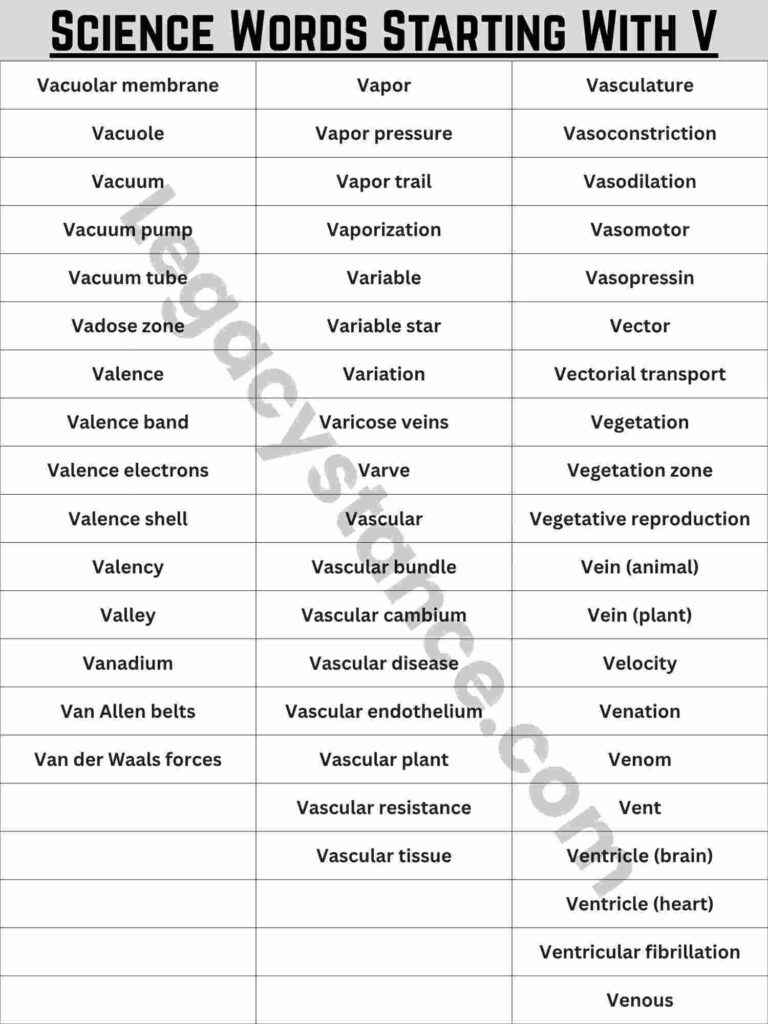
Vacuolar membrane — Membrane surrounding a cell vacuole
Vacuole — Cell organelle storing water, waste, or nutrients
Vacuum — Space devoid of matter
Vacuum pump — Device removing gas from a sealed space
Vacuum tube — Early electronic current-control component
Vadose zone — Soil layer above the water table
Valence — Combining power of an atom
Valence band — Highest occupied electron energy band in a solid
Valence electrons — Electrons in the outermost atomic shell
Valence shell — Outermost electron energy level of an atom
Valency — Alternate term for valence
Valley — Low land between hills or mountains
Vanadium — Transition metal, atomic number 23
Van Allen belts — Radiation zones surrounding Earth
Van der Waals forces — Weak intermolecular attractions
Vapor — Gas phase of a substance below boiling point
Vapor pressure — Pressure exerted by vapor above a liquid
Vapor trail — Condensation streak left by aircraft
Vaporization — Liquid-to-gas conversion process
Variable — Factor that changes in an experiment
Variable star — Star with changing brightness over time
Variation — Trait differences among individuals of a species
Varicose veins — Enlarged, swollen leg veins
Varve — Annual sediment layer pair in lake beds
Vascular — Related to fluid-carrying vessels
Vascular bundle — Strand of vascular tissue in plant stems
Vascular cambium — Plant tissue producing new vascular cells
Vascular disease — Disorder affecting blood vessels
Vascular endothelium — Inner lining of blood vessels
Vascular plant — Plant containing xylem and phloem tissue
Vascular resistance — Opposition to blood flow in vessels
Vascular tissue — Plant tissue moving water and nutrients
Vasculature — Complete blood vessel network in a body
Vasoconstriction — Blood vessel narrowing
Vasodilation — Blood vessel widening
Vasomotor — Relating to blood vessel diameter control
Vasopressin — Water-regulating hormone from hypothalamus
Vector — Quantity with magnitude and direction
Vectorial transport — Directional movement of molecules across membranes
Vegetation — Plant life in a specific area
Vegetation zone — Area defined by plant type and climate
Vegetative reproduction — Asexual reproduction in plants
Vein (animal) — Blood vessel carrying blood toward the heart
Vein (plant) — Leaf structure carrying water and nutrients
Velocity — Speed with a directional component
Venation — Pattern of veins in a leaf
Venom — Injected toxic substance from animals
Vent — Opening releasing volcanic material
Ventricle (brain) — Brain cavity containing cerebrospinal fluid
Ventricle (heart) — Lower heart chamber pumping blood
Ventricular fibrillation — Dangerous irregular heart rhythm
Venous — Relating to veins
Venus — Second planet; hottest in the solar system
Vertebra — Individual bone of the spinal column
Vertebral column — The complete spine or backbone
Vertebrate — Animal with a spinal column
Vertebrate embryo — Early developmental stage of backbone animals
Vesicle — Small membrane-bound sac inside a cell
Vesicle fusion — Process of vesicles merging with cell membrane
Vesicular transport — Cell material movement via vesicles
Vestigial structure — Non-functional evolutionary remnant
Viable — Capable of surviving and developing
Vibration — Rapid oscillation of particles
Vibration analysis — Engineering method detecting machinery faults
Vibrational energy — Energy stored in molecular vibration
Vibrational frequency — How often a particle vibrates per second
Vibrational mode — Pattern of molecular vibration
Vibrio — Comma-shaped genus of bacteria
Villi — Intestinal projections for nutrient absorption
Viral — Relating to viruses
Virgo Cluster — Galaxy cluster ~54 million light-years away
Virion — Complete viral particle outside a host cell
Virology — Scientific study of viruses
Virtual image — Image formed by apparent light ray convergence
Virtual reality — Simulated digital environment technology
Virial theorem — Energy relationship across physical systems
Virus — Infectious agent replicating inside host cells
Visceral — Relating to internal body organs
Visceral fat — Fat surrounding internal organs
Viscometer — Instrument measuring fluid viscosity
Viscosity — Fluid resistance to flow
Viscosity coefficient — Numerical value of a fluid’s flow resistance
Viscosity index — Lubricant performance rating across temperatures
Viscous — Thick, slow-flowing fluid
Viscous lava — Thick, explosive, slow-moving lava type
Visible light — Electromagnetic radiation detectable by human eyes
Visible spectrum — Range of wavelengths visible to humans
Visible universe — Observable portion of the entire universe
Visual acuity — Sharpness or clarity of vision
Visual cortex — Brain region processing visual information
Vital signs — Core measurements of body function
Vitamin — Essential organic nutrient from food
Vitamin C — Immune-supporting ascorbic acid
Vitamin D — Sun-triggered vitamin supporting bone health
Vitamin K — Fat-soluble vitamin supporting blood clotting
Vitriol — Historical term for sulfuric acid compounds
Viviparous — Giving birth to live young
Viviparous fish — Fish species giving birth to live young
Vocal cords — Tissue folds in larynx producing sound
Voice recognition — Speech-to-text software technology
Void — Vast near-empty region of space
Volatile — Substance that evaporates quickly
Volatilization — Solid or liquid converting to gas
Volcanic ash — Fine particles ejected during eruptions
Volcanic eruption — Release of lava, gas, and ash from a volcano
Volcanic island — Island formed entirely by volcanic activity
Volcanic rock — Rock formed from cooled lava
Volcano — Crustal opening releasing magma and gases
Volcanology — Scientific study of volcanoes
Volt — Unit of electrical potential difference
Volt-ampere — Unit of electrical power in AC circuits
Voltage — Electrical pressure in a circuit
Voltaic cell — Electrochemical cell producing current from reactions
Voltmeter — Instrument measuring voltage
Volume — Amount of space an object occupies
Volumetric analysis — Chemistry method using measured liquid volumes
Volumetric flask — Precise volume measurement lab container
Volumetric heat capacity — Heat energy stored per unit volume
Vomeronasal organ — Sensory organ detecting chemical signals
Vortex — Rotating mass of fluid or air
Vorticity — Measurement of rotation in fluid dynamics
Vulnerary — Substance that promotes wound healing
Vertical circulation — Up-and-down movement in ocean or atmosphere
Vestibular system — Inner ear system controlling balance
Vasomotor — Relating to blood vessel diameter control
Common Confusions With V Science Words
Velocity vs. Speed Speed is how fast. Velocity is how fast and in which direction. Identical numbers, completely different meanings in physics calculations.
Vein vs. Artery Arteries carry blood away from the heart. Veins carry it back. The pulmonary vein is the one exception — it carries oxygenated blood from lungs to heart, which trips up most students on exams.
Virus vs. Bacteria Bacteria are living single-celled organisms — antibiotics can kill them. Viruses aren’t truly alive — they’re genetic code inside a protein shell. Antibiotics have zero effect on viruses. That’s why doctors won’t prescribe them for a cold or flu.
Vacuole vs. Vesicle Both are sacs inside cells. Vacuoles are large storage structures, dominant in plant cells. Vesicles are small, temporary transport sacs moving materials around the cell. Storage room vs. delivery cart.
Venom vs. Poison Venom is injected — snakes, bees, jellyfish. Poison is harmful when touched or eaten. A snake is venomous. Some frogs are poisonous. Quick test: if you bite it and get sick, it’s poisonous. If it bites you and you get sick, it’s venomous.
Volatile vs. Viscous Nearly opposite behaviors. Volatile = evaporates fast, spreads into air quickly. Viscous = thick, flows slowly. Acetone is volatile. Honey is viscous.
Where These Words Actually Show Up
In a hospital — Vital signs, ventricle, vasodilation, vasoconstriction, vaccine, virus, visceral fat, vascular disease. Everyday clinical vocabulary.
In plant biology — Vascular tissue, vacuole, villi, venation, vegetative reproduction, vascular bundle. The operating system of a plant, essentially.
In a physics lab — Velocity, vector, voltage, volt, vibration, vacuum, viscosity, volumetric flask. Nearly every lab report uses several of these.
On a geology field trip — Volcano, volcanic rock, volcanic ash, vent, varve, valley, vadose zone.
In space reporting — Van Allen belts, Venus, void, variable star, visible universe, Virgo Cluster, orbital velocity.
Read also:
150+ Science Words That Start With D | Definitions & Real Use
115+ Science Words That Start With S | Full List With Meanings
FAQs
1. Why do I need to learn science words starting with V?
These words appear often in school exams, textbooks, and everyday science topics. Understanding them helps you follow lessons, answer questions correctly, and build confidence in subjects like biology, physics, and chemistry.
2. What’s the easiest way to remember these terms?
Don’t try to memorize everything at once. Learn a few words daily and connect them to real life. For example, think of “vibration” when you hear music or “volume” when filling a bottle.
3. Which V science words are most important for exams?
Focus on commonly used ones like velocity, volume, virus, vacuole, vector, and voltage. These show up often in middle school and early high school tests.
4. How are similar words like velocity and speed different?
Speed tells how fast something moves. Velocity includes direction too. So, speed is just a number, but velocity explains movement more clearly.
5. Are all V science words difficult to understand?
Not really. Many sound complex but are simple when broken down. Words like vapor, vein, and volcano are easy once you relate them to everyday examples.
Bottom line
This guide covered 125+ science words starting with V across eight fields — physics, chemistry, biology, earth science, space, medicine, technology, and student-focused vocabulary. Each section gave words real context, not just a definition floating in space.
The confusions section handled the pairs that cause the most exam mistakes. The real-life section connected words to places you already encounter. The full table gives you a searchable reference to return to whenever a word appears on a test or in a reading.
Science vocabulary builds on itself. Learn velocity — and vectors, acceleration, and momentum become easier. Understand vacuoles — and osmosis, turgor pressure, and cell biology click faster.
The letter V delivered.