

Learning Science Words That Start With H shouldn’t feel confusing or overwhelming. Whether you’re studying for a test, helping your child, or just trying to understand science better, clear explanations make all the difference.
This guide brings together useful H-words from biology, chemistry, physics, and more—written in simple language you can actually follow. Just practical meanings, everyday examples, and words you’ll likely see in school or real life. You can scan quickly, learn faster, and come back anytime you need a quick refresher.
20 Most-Used Science Words That Start With H
Habitat — Where an organism naturally lives
Heat — Energy moving between objects due to temperature difference
Heredity — Passing traits from parents to offspring through genes
Hypothesis — A testable prediction made before an experiment
Homeostasis — Body’s ability to keep internal conditions stable
Hormone — Chemical messenger produced by glands
Hydrogen — Lightest element; atomic number 1
Hibernation — Deep winter dormancy used to conserve energy
Host — Organism that carries a parasite
Humidity — Water vapor concentration in the air
Hertz — Unit of frequency; one cycle per second
Helix — A spiral or coil shape
Herbivore — Animal that eats only plants
Half-life — Time for half a radioactive substance to decay
Hardness — A material’s resistance to being scratched
Horizon — A distinct layer in soil or sky boundary
Hydrosphere — All water on or near Earth’s surface
Helium — Second lightest element; noble gas
Hemoglobin — Oxygen-carrying protein in red blood cells
Hydrocarbon — Compound built from only hydrogen and carbon
Physics Science Words That Start With H
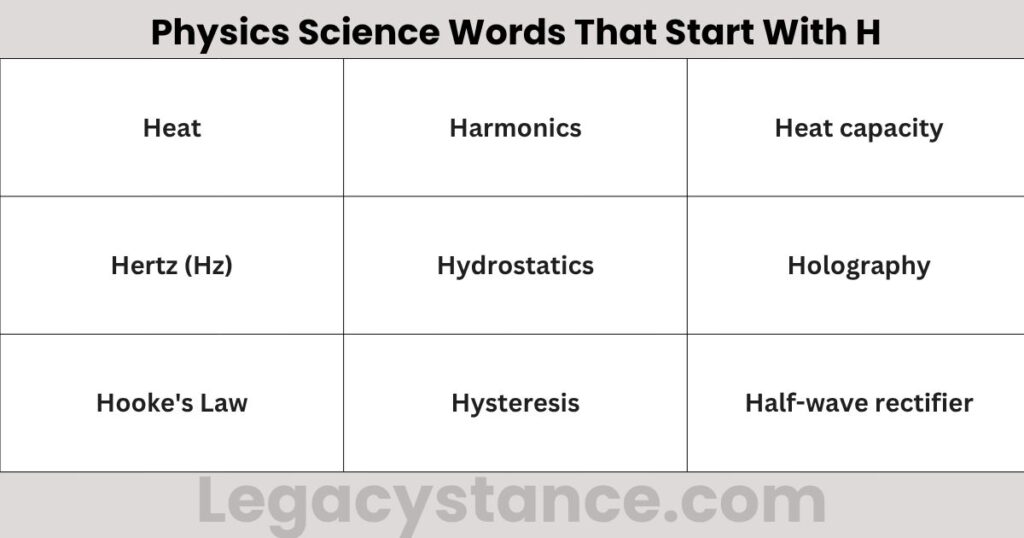
Heat — Thermal energy that flows from a warmer object to a cooler one. Touch a warm mug and heat crosses into your hand almost instantly. That transfer is what thermometers measure.
Hertz (Hz) — The unit of frequency. One hertz equals one complete wave cycle per second. Sound, light, and radio waves are all measured this way. Your home electricity runs at 50 or 60 Hz depending on where you live.
Hooke’s Law — A spring stretches in proportion to the force applied, as long as you don’t overstretch it. Robert Hooke discovered this in the 1600s. Engineers still use it today in everything from car suspension to precision scales.
Harmonics — Additional vibrations that ride alongside a main sound wave. They’re why a guitar and a piano playing the same note sound different. Same pitch, different harmonic content.
Hydrostatics — The physics of fluids that aren’t moving. It explains why water pressure builds the deeper you go, and why boats float. Submarine engineers calculate hydrostatic pressure before every design decision.
Hysteresis — A lag between cause and effect in a physical system. Stretch a rubber band and let go — it doesn’t return to exactly the same shape instantly. That delay is hysteresis.
Heat capacity — The amount of energy a substance needs to raise its temperature by one degree. Water’s heat capacity is unusually high, which is why coastal cities have milder climates than inland ones.
Holography — A method of recording 3D images using laser light. The result looks flat until light hits it at the right angle, then it appears three-dimensional.
Half-wave rectifier — A circuit that converts alternating current (AC) into direct current (DC) by allowing only half the wave through. Basic power adapters use this principle.
Chemistry Science Words That Start With H
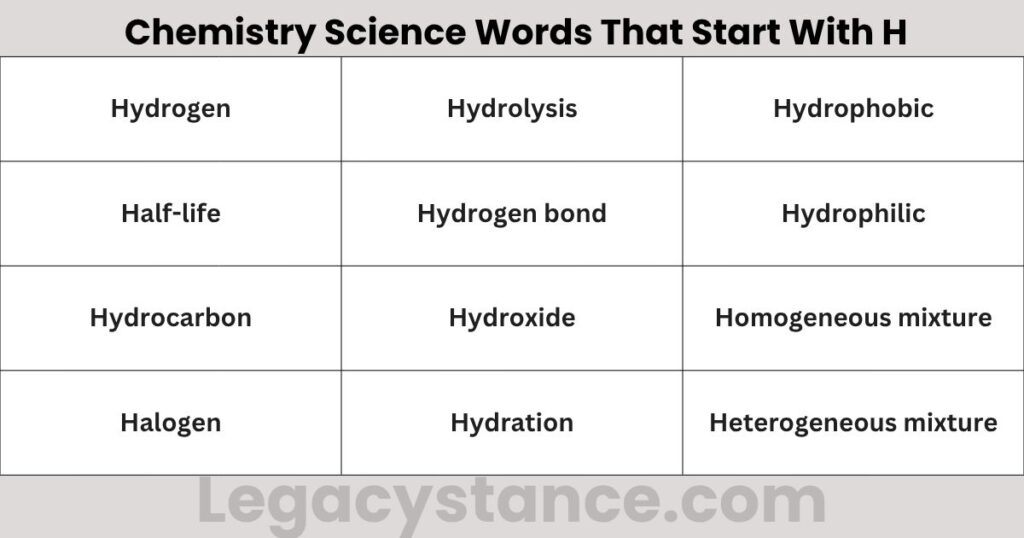
Hydrogen — The lightest and most abundant element in the universe. One proton, one electron. It powers stars, fuels experimental vehicles, and forms the backbone of organic chemistry.
Half-life — How long it takes for half of a radioactive element to break down into something else. Carbon-14 has a half-life of roughly 5,730 years. Scientists use that predictable decay rate to date ancient bones and artifacts.
Hydrocarbon — A molecule made entirely of hydrogen and carbon atoms. Gasoline, diesel, and natural gas are all hydrocarbon mixtures. They burn well, which is why fossil fuels dominated the last two centuries.
Halogen — A family of reactive nonmetals: fluorine, chlorine, bromine, iodine, and astatine. Chlorine sanitizes swimming pools. Fluorine strengthens tooth enamel in toothpaste. Both are halogens.
Hydrolysis — A reaction where water molecules break apart a larger molecule. Your stomach uses hydrolysis to split proteins into amino acids during digestion.
Hydrogen bond — A weak attraction between a hydrogen atom and a nearby electronegative atom like oxygen or nitrogen. These bonds let water climb through plant stems and give DNA its stable double-helix structure.
Hydroxide — A compound containing a bonded oxygen and hydrogen pair (OH⁻). Sodium hydroxide is used in drain cleaners. Calcium hydroxide is in cement. Both are strong bases.
Hydration — The process of water molecules surrounding and attaching to dissolved ions or molecules. Drop salt into water — every sodium and chloride ion gets a shell of water molecules. That’s hydration.
Hydrophobic — Physically repels water. Oil is hydrophobic, which is why it floats on water rather than mixing with it. Fat molecules are hydrophobic by nature.
Hydrophilic — Attracted to and mixes readily with water. Sugar dissolves quickly because it’s hydrophilic. Most proteins have both hydrophilic and hydrophobic sections, and that balance determines their shape.
Homogeneous mixture — A mixture that looks identical throughout. Saltwater is the standard example. No matter which part you sample, the composition is the same.
Heterogeneous mixture — A mixture where different parts are clearly visible. Soil, trail mix, and muddy river water are all heterogeneous.
Biology Science Words That Start With H
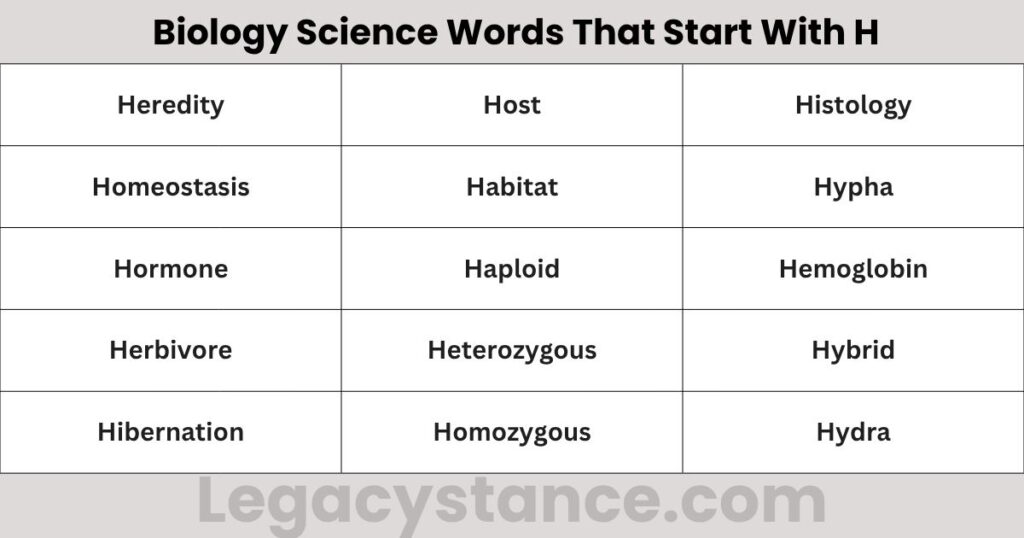
Heredity — The mechanism by which traits transfer from parents to their offspring through genes. It’s why children often share their parents’ eye color, height range, or blood type.
Homeostasis — The body’s continuous effort to keep its internal environment stable despite outside changes. Body temperature, blood pH, and blood sugar all stay within narrow ranges because of homeostasis.
Hormone — A chemical signal produced by a gland and released into the bloodstream to deliver instructions to distant organs. Adrenaline raises your heart rate under stress. Insulin directs cells to absorb glucose.
Herbivore — An animal whose diet consists entirely of plant material. Cows, elephants, and rabbits are all herbivores. Their digestive systems — particularly gut length and enzyme types — are built specifically for processing plant matter.
Hibernation — A prolonged state of minimal activity and reduced body temperature that some animals enter to survive winter. Heart rate and breathing drop dramatically. Bears, groundhogs, and certain bats are well-known hibernators.
Host — An organism that another organism lives on or inside, typically at the host’s expense. When a tapeworm lives in a mammal’s intestine, the mammal is the host.
Habitat — The specific environment where a species lives and meets all its basic needs — food, shelter, water, and space. Destroy the habitat, and the species has nowhere to survive.
Haploid — A cell carrying only one complete set of chromosomes rather than two. Human reproductive cells (sperm and egg) are haploid. When they fuse during fertilization, the result is a full two-set cell.
Heterozygous — A genetic condition where the two alleles for a given gene are different from each other — one from each parent.
Homozygous — A genetic condition where both alleles for a given gene are identical. Both chromosomes carry the same instruction.
Histology — The study of biological tissues at the microscopic level. It’s the science behind reading a biopsy — a trained histologist can identify cancer cells from tissue patterns.
Hypha (plural: Hyphae) — The thread-like structures that make up the body of a fungus. Under a microscope, a mushroom’s base is a dense network of hyphae. The fuzzy growth on old bread is the same thing.
Hemoglobin — An iron-containing protein packed into red blood cells. It binds oxygen in the lungs and releases it throughout the body. The iron gives blood its red color.
Hybrid — The offspring that results from crossing two genetically distinct species or varieties. A mule (horse × donkey) is a classic hybrid. Many crop plants are hybrids bred for disease resistance or yield.
Hydra — A small freshwater animal with a remarkable ability: cut it in half and both pieces regenerate into complete organisms. Biologists study it to understand the mechanics of cellular regeneration.
Earth Science Words That Start With H
Humidity — The amount of water vapor suspended in the air at a given time. On a humid day, sweat evaporates slowly because the air is already close to saturated — that’s why you feel so much hotter.
Hurricane — A massive tropical storm system with sustained winds above 74 mph (119 km/h), powered by warm ocean water. The same storm type is called a typhoon in the western Pacific and a cyclone in the Indian Ocean.
Hydrosphere — The collective term for all water on Earth — oceans, rivers, lakes, glaciers, groundwater, and atmospheric water vapor. It covers about 71% of Earth’s surface.
Horizon (soil) — A horizontal layer within a soil profile that has distinct physical and chemical properties. Geologists label them A (topsoil), B (subsoil), C (weathered rock), and O (organic matter on top).
Humus — The dark, nutrient-rich organic matter in soil formed from the slow decomposition of plant and animal material. High humus content is one of the most reliable indicators of fertile soil.
Hot spring — A naturally occurring pool fed by geothermally heated groundwater. The heat comes from magma or radioactive decay below Earth’s surface. Yellowstone has over 10,000 of them.
Hydrological cycle — The continuous circulation of water through evaporation from oceans, condensation into clouds, precipitation as rain or snow, and return through rivers and groundwater. No water is ever truly lost — just relocated.
Hardness (mineral) — A mineral’s resistance to being scratched by another material. The Mohs scale ranks this from 1 (talc, the softest mineral known) to 10 (diamond, the hardest natural substance).
Halite — The scientific name for rock salt, chemically sodium chloride (NaCl). It forms in thick underground layers where ancient seas evaporated over millions of years. Mined for road salt, food, and chemical manufacturing.
Highland — A region of elevated terrain that sits significantly above the surrounding land. Highlands tend to be cooler, windier, and wetter than adjacent lowlands — which shapes entirely different ecosystems.
Space & Astronomy Science Words That Start With H
Helium — The second most abundant element in the universe, produced in stellar cores through nuclear fusion. On Earth, helium is used to cool superconducting magnets in MRI machines and to pressurize rocket fuel tanks.
Hubble constant — A number representing the rate at which the universe is expanding. Astronomers have measured it two different ways and keep getting slightly different answers — this disagreement, called the Hubble tension, is one of the biggest unsolved problems in modern cosmology.
Heliosphere — A vast region of space dominated by the sun’s solar wind, extending well beyond Pluto’s orbit in every direction. It acts as a shield, deflecting most interstellar radiation before it reaches Earth.
Habitable zone — The range of orbital distances around a star where surface temperatures could allow liquid water to exist. Earth sits squarely in the sun’s habitable zone. Finding planets in other stars’ habitable zones is central to the search for extraterrestrial life.
Hypernova — A stellar explosion dramatically more energetic than a standard supernova, thought to occur when a massive, rapidly spinning star collapses. The resulting gamma-ray burst is detectable across billions of light-years.
Hydrogen fusion — The nuclear process at the heart of every active star. Four hydrogen nuclei combine under extreme pressure and temperature to form one helium nucleus, releasing energy as light and heat. The sun converts roughly 600 million tons of hydrogen per second.
Hubble Space Telescope — An optical telescope placed in Earth’s orbit in 1990 to avoid atmospheric interference. It gave astronomers their first truly sharp views of distant galaxies and helped nail down the age of the universe at approximately 13.8 billion years.
Galactic halo — A spherical region surrounding a galaxy that contains ancient stars, globular clusters, and a large amount of dark matter. It’s invisible to the eye but detectable through its gravitational effects.
Medical & Health Science Words That Start With H
Hypertension — A chronic condition where blood pushes against artery walls with too much force. It causes gradual damage to blood vessels, the heart, and kidneys — often with no symptoms until serious harm has occurred.
Hypotension — Abnormally low blood pressure. A common experience is standing up quickly and feeling lightheaded — the blood hasn’t reached the brain fast enough. That’s a mild, temporary form.
Hemophilia — A genetic disorder in which blood lacks sufficient clotting factors. Wounds that would close in minutes for most people can bleed for hours or days without treatment.
Histamine — A compound the immune system releases when it detects an allergen. It triggers inflammation, itching, and mucus production. Antihistamine drugs work by blocking the receptors histamine binds to.
Hyperglycemia — Elevated blood glucose levels that exceed the normal range. A common complication of poorly managed diabetes, it can damage nerves and blood vessels over time.
Hypoglycemia — Blood sugar that drops below the threshold the brain needs to function properly. Symptoms include shakiness, confusion, and rapid heartbeat. People with diabetes carry glucose tablets or juice for exactly this situation.
Hematology — The medical specialty focused on blood, bone marrow, and blood-forming organs. Hematologists diagnose and treat conditions like anemia, leukemia, and clotting disorders.
Hernia — A condition in which an internal organ or tissue protrudes through a weakened section of the surrounding muscle wall. Most commonly affects the abdominal wall or groin area.
Hormone therapy — A medical treatment that introduces, blocks, or modifies hormones to treat a condition. Used in breast and prostate cancers, thyroid disorders, and gender-affirming care.
Hypoxia — An insufficient supply of oxygen reaching body tissues. At high altitudes where air is thin, climbers develop hypoxia — causing headaches, poor judgment, and if severe, unconsciousness.
Technology & Applied Science Words That Start With H
Hardware — Every physical component in a computing or electronic system. Screens, processors, memory chips, keyboards — if you can touch it, it’s hardware. Software runs on top of it.
Hydraulics — Using pressurized liquid to transmit force and do mechanical work. Car braking systems, construction excavators, and commercial aircraft landing gear all rely on hydraulic pressure to function.
Hybrid (technology) — A system that draws on two fundamentally different power sources or technologies. A hybrid vehicle switches between an internal combustion engine and an electric motor, using whichever is more efficient for the current speed and load.
Hyperlink — A digital reference embedded in text or an image that connects to another resource when activated. The entire navigable structure of the internet depends on hyperlinks.
Heat sink — A passive cooling component that draws heat away from a processor or power circuit and dissipates it into the surrounding air. Without one, a modern CPU would overheat and fail within seconds of use.
Haptic feedback — Technology that communicates information through physical sensation — usually vibration. Your phone buzzes when you tap a button because of haptic actuators built into its body.
Hydroponics — A method of cultivating plants in water infused with dissolved nutrients, entirely bypassing soil. Used in commercial vertical farms, greenhouses in arid regions, and ongoing experiments aboard the International Space Station.
Easy Science Words That Start With H
For younger students or anyone just starting out — short definitions, no jargon.
Heat — Energy moving from something warm to something cooler.
Habitat — The natural home of an animal or plant.
Herbivore — An animal that eats only plants.
Hibernation — A long winter sleep to save energy.
Humidity — Water vapor in the air.
Hydrogen — The lightest element on the periodic table.
Helix — A spiral shape.
Host — An organism a parasite lives on or in.
Hatch — When a baby animal breaks free from an egg.
Hardness — How difficult it is to scratch a material.
Advanced Science Words That Start With H
For high school students, university-level readers, or anyone wanting to go beyond the basics.
Hamiltonian — A mathematical operator in quantum and classical mechanics that represents the total energy of a system. Writing the Hamiltonian is usually the first step in solving any quantum problem.
Haploinsufficiency — A situation where having just one functional copy of a gene, instead of the normal two, is not enough to maintain normal biological function. The result is often a developmental or metabolic disorder.
Heisenberg Uncertainty Principle — A fundamental limit in quantum physics: the more precisely you measure a particle’s position, the less precisely you can know its momentum, and vice versa. This is not a measurement problem — it’s a property of reality at that scale.
Hydrostatic equilibrium — The state inside a star where outward radiation pressure exactly balances inward gravitational pull. Stars spend most of their lives in this balance. When it fails, they collapse or explode.
Hydrodynamics — The branch of physics dealing with fluids in motion, including how they exert forces and how objects move through them. Used in designing ship hulls, modeling blood circulation, and optimizing aircraft shapes.
Hyperplasia — An abnormal but non-cancerous increase in the number of cells in a tissue or organ. Unlike cancer, hyperplastic cells are still well-organized. In some tissues, though, it increases cancer risk over time.
Histocompatibility — The degree to which a donor’s tissues are immunologically compatible with a recipient’s. The immune system uses surface proteins called HLA antigens to determine compatibility before accepting or rejecting a transplant.
Holomorphic function — In complex analysis, a function that is complex-differentiable at every point in its domain. This property imposes strict constraints that make these functions behave very differently from ordinary real functions.
Complete Reference List — 130+ Science Words That Start With H
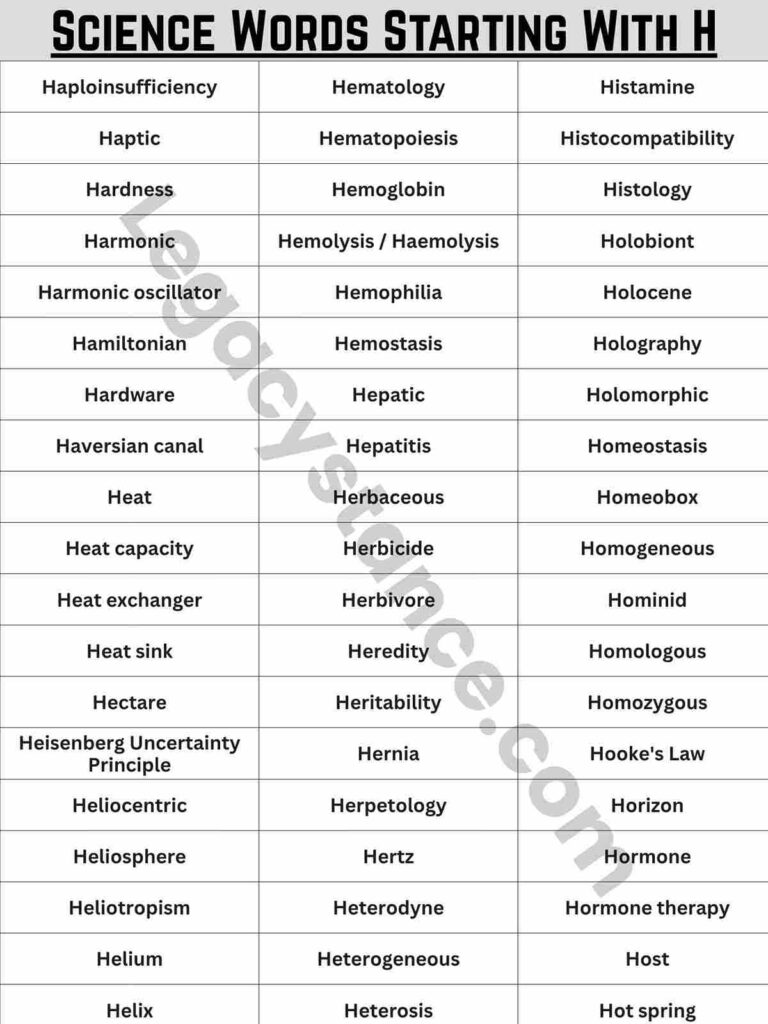
Habitat — Natural home of an organism
Half-life — Time for half a radioactive substance to decay
Halide — Salt compound formed from a halogen
Halite — Mineral form of rock salt (NaCl)
Halogen — Reactive nonmetal group: F, Cl, Br, I, At
Halocarbon — Carbon compound that includes halogen atoms
Halophyte — Plant adapted to grow in salty soil or water
Haploid — Cell with a single complete set of chromosomes
Haploinsufficiency — One gene copy insufficient for normal function
Haptic — Relating to the sense of touch
Hardness — Resistance to scratching
Harmonic — Frequency that is a whole-number multiple of the fundamental
Harmonic oscillator — System that vibrates at a natural, regular frequency
Hamiltonian — Quantum mechanical operator representing total system energy
Hardware — Physical components of a computing system
Haversian canal — Microscopic channel in bone carrying blood vessels and nerves
Heat — Thermal energy transferred between objects
Heat capacity — Energy required to raise a substance’s temperature by 1°C
Heat exchanger — Device that transfers heat between two separate fluids
Heat sink — Component that absorbs and disperses heat from electronics
Hectare — Area unit equal to 10,000 square meters
Heisenberg Uncertainty Principle — Simultaneous precision of position and momentum is impossible
Heliocentric — Describing a solar system model centered on the sun
Heliosphere — Region of space dominated by the sun’s solar wind
Heliotropism — Directional growth or movement of a plant toward light
Helium — Noble gas; atomic number 2
Helix — Spiral or coil-shaped structure
Hematology — Medical study of blood and blood disorders
Hematopoiesis — Production of blood cells in bone marrow
Hemoglobin — Iron-based protein in red blood cells carrying oxygen
Hemolysis / Haemolysis — Rupture and destruction of red blood cells
Hemophilia — Genetic disorder preventing normal blood clotting
Hemostasis — Physiological process that stops bleeding after injury
Hepatic — Relating to the liver
Hepatitis — Inflammation of the liver, often viral in origin
Herbaceous — Describing a plant with a soft, non-woody stem
Herbicide — Chemical compound designed to kill unwanted plants
Herbivore — Animal that feeds exclusively on plant material
Heredity — Genetic transmission of traits across generations
Heritability — Proportion of trait variation explained by genetic differences
Hernia — Organ pushing through a weakened muscle or tissue wall
Herpetology — Scientific study of reptiles and amphibians
Hertz — Unit of frequency; one complete cycle per second
Heterodyne — Signal processing technique combining two frequencies
Heterogeneous — Mixture with visibly distinct, non-uniform components
Heterosis — Hybrid vigor; offspring outperforming both parent lines
Heterotroph — Organism that acquires energy by consuming other organisms
Heterozygous — Gene pair carrying two different alleles
Highland — Elevated land region above surrounding terrain
High-energy bond — Chemical bond that stores significant potential energy
High-pressure system — Atmospheric system with dense, descending air and clear skies
Hindgut — Rear portion of the digestive tract
Histamine — Immune signaling molecule released during allergic reactions
Histocompatibility — Immunological compatibility between donor and recipient tissue
Histology — Microscopic study of tissue structure
Holobiont — A host organism together with all its associated microbes
Holocene — Current geological epoch, beginning roughly 11,700 years ago
Holography — Technique for producing three-dimensional images with laser light
Holomorphic — Complex function that is differentiable across its entire domain
Homeostasis — Biological maintenance of a stable internal environment
Homeobox — Gene regulatory sequence controlling body plan development
Homogeneous — Mixture uniform in composition throughout
Hominid — Taxonomic family including humans and great apes
Homologous — Chromosome pair sharing the same gene positions
Homozygous — Gene pair carrying two identical alleles
Hooke’s Law — Spring extension proportional to applied force
Horizon — Defined layer within soil or sky-earth boundary
Hormone — Blood-borne chemical messenger from a gland to target organs
Hormone therapy — Treatment involving hormones or hormone-modifying drugs
Host — Organism that supports a parasite
Hot spring — Geothermally heated natural water pool
Hubble constant — Measured expansion rate of the universe
Hubble Space Telescope — Orbital optical telescope launched in 1990
Humus — Decomposed organic matter forming part of fertile soil
Hurricane — Intense tropical storm with winds above 74 mph
Hyaline — Glassy or translucent in appearance
Hybrid — Offspring or system combining two distinct types
Hydra — Freshwater invertebrate capable of full body regeneration
Hydraulics — Mechanical force transmission using pressurized liquid
Hydrocarbon — Organic molecule composed solely of hydrogen and carbon
Hydration — Attachment of water molecules to dissolved ions
Hydrodynamics — Physics of fluids in motion
Hydrogen — Element 1; lightest and most abundant in the universe
Hydrogen bond — Weak attraction between hydrogen and an electronegative atom
Hydrogen fusion — Nuclear reaction powering stars; H nuclei forming helium
Hydrolysis — Chemical breakdown using water molecules
Hydrological cycle — Complete circulation of water through Earth’s environments
Hydronium — H₃O⁺ ion formed when an acid dissolves in water
Hydrophilic — Having affinity for water
Hydrophobic — Repelling or not mixing with water
Hydroponics — Growing plants in nutrient solution without soil
Hydrosphere — Total water present on, in, and above Earth
Hydrostatics — Study of fluids that are not in motion
Hydrostatic equilibrium — Balance of pressure and gravity inside a star
Hydroxide — Chemical species containing the OH⁻ ion
Hydroxyl group — Functional group –OH in organic chemistry
Hypha — Individual filament forming fungal body tissue
Hypernova — Catastrophic stellar explosion exceeding supernova energy
Hyperglycemia — Blood glucose level above the normal range
Hyperlink — Clickable digital connection between two documents or pages
Hyperopia — Farsightedness; difficulty seeing nearby objects clearly
Hyperplasia — Non-cancerous abnormal increase in cell count
Hypersonic — Speed exceeding Mach 5
Hypertension — Persistently elevated blood pressure
Hypertonic — Solution with a higher solute concentration than its surroundings
Hypnosis — Artificially induced state of focused, altered attention
Hypocenter — Underground point of origin of an earthquake
Hypodermis — Deepest skin layer; connects skin to underlying muscle
Hypoglycemia — Blood glucose level below functional range
Hypotension — Abnormally low blood pressure
Hypothermia — Dangerous drop in core body temperature
Hyperthermia — Dangerous rise in core body temperature
Hypothesis — Testable, specific prediction that precedes an experiment
Hypotonic — Solution with a lower solute concentration than its surroundings
Hypsometer — Instrument measuring altitude or the boiling point of liquids
Hysteresis — Lag in a system’s response relative to the applied input
Habitable zone — Orbital region where liquid water could exist on a planet
Galactic halo — Spherical region of old stars and dark matter surrounding a galaxy
Common Confusions — H Words People Mix Up
Hypothesis vs. Theory A hypothesis comes first — it’s a specific, testable prediction before evidence is gathered. A theory comes after — it’s an explanation supported by substantial, repeated evidence. Everyday speech uses “theory” to mean guess. In science, a theory is the opposite of a guess.
Homozygous vs. Heterozygous Homozygous means both gene copies are identical. Heterozygous means the two copies differ. The prefixes carry the full meaning: homo = same, hetero = different. Learn those two Latin roots and you’ll never mix them up again.
Hypertension vs. Hypotension Hyper = too much. Hypo = too little. One raises blood pressure dangerously. The other drops it. The prefix is the entire difference between these two diagnoses.
Humidity vs. Precipitation Humidity measures water vapor floating invisibly in the air. Precipitation is water that has condensed and actually fallen — rain, snow, sleet, hail. High humidity often precedes precipitation, but being humid is not the same as raining.
Habitat vs. Niche Habitat is the physical place where a species lives. Niche is the functional role it plays there — what it eats, when it’s active, what eats it. Two species can share a habitat and occupy completely different niches within it.
Haploid vs. Diploid Haploid cells have one chromosome set. Diploid cells have two. Reproductive cells are haploid so that when two fuse, the resulting cell has the correct diploid number — not double.
Herbivore vs. Omnivore Herbivores eat only plant material. Omnivores eat both plant and animal material. The difference matters in ecology because it determines where each animal sits in a food web.
Where These Words Show Up in Real Life
Knowing these terms outside a classroom changes how you read the world around you.
At home: When a humid day feels unbearable, that’s water vapor density affecting your body’s cooling ability. When a hybrid appliance switches power modes, that’s the same concept as a hybrid vehicle — two systems, one device.
In hospitals: Nearly every blood test ordered by a doctor involves at least three H-words: hemoglobin levels, hematology panels, and hormone markers. Histology reports decide cancer treatment plans.
In your food: The hydroponically grown basil at the grocery store never touched soil. The humus in farm soil directly affects the nutrient density of what gets harvested from it. Hydrolysis makes digestion physically possible.
In space science: Every planet-hunting mission run by NASA evaluates whether a planet sits in the habitable zone. Hydrogen fusion is the engine behind every star you’ve ever seen in the sky.
Read more:
115+ Science Words That Start With S | Full List With Meanings
120+ Science Words That Start With V | Full List with Meanings
FAQs
Q1: How can I remember science words more easily?
Try linking each word to a real-life example. For instance, think of “humidity” as how sticky the air feels on a hot day. Simple connections help memory stick better than memorizing definitions.
Q2: Which H science words should I focus on first?
Start with commonly used ones like hypothesis, habitat, heat, and homeostasis. These show up often in school lessons and basic science understanding.
Q3: Why do many science words sound similar?
Many come from Greek or Latin roots. Learning small parts like “hydro” (water) or “hyper” (too much) helps you understand many words at once instead of memorizing each one.
Q4: Are these words useful outside school?
Yes. You’ll hear them in health reports, weather updates, and even daily conversations. Words like hormone, humidity, and hybrid are used in real life all the time.
What This Guide Covers
Over 130 science words starting with H — organized by field so you can find what’s relevant to your subject, scaled from beginner to advanced so it works at different grade levels, and placed in real-world context so the definitions actually stick.
The reference table gives you a fast lookup. The field sections give you understanding. The confusions section saves you from the mistakes most students make. Use whichever part fits what you need right now.