Looking for science words that start with Z and coming up blank? Z is one of the least-used letters in English, so finding Z science terms can feel harder than expected.
This guide makes it easy.
Here, you’ll find a clear list of science words beginning with Z, along with simple meanings and real examples from biology, chemistry, physics, and more. Whether you’re studying for a test, completing homework, or building your vocabulary, this page helps you quickly understand and remember each word.
Just useful, easy-to-read explanations you can actually use.
20 Most-Used Science Words that Start With Z
- Zero — Baseline value; absence of quantity
- Zygote — First cell formed after fertilization
- Zinc — Essential metal, element number 30
- Zone — Region sharing defined characteristics
- Zenith — Point directly overhead in the sky
- Zoonosis — Disease transferable from animals to humans
- Zwitterion — Molecule carrying both positive and negative charges
- Zeolite — Porous mineral used in water filtration
- Zymase — Yeast enzyme that converts sugar to alcohol
- Zooplankton — Microscopic animals drifting in water
- Zero gravity — Apparent weightlessness during free fall
- Zodiac — Belt of 12 constellations along the Sun’s path
- Zonal flow — East-west dominant atmospheric wind pattern
- Zinc oxide — UV-absorbing compound used in sunscreen
- Zygomorphic — Flower symmetrical along one axis only
- Zoology — Scientific study of animals
- Zonation — Pattern of distinct ecological zones
- Zymogen — Inactive enzyme that activates when needed
- Z-boson — Particle that carries the weak nuclear force
🔬 Physics Science Words That Start With Z
Zero — Not just “nothing.” In physics, zero is a reference point. Zero Kelvin means all molecular motion stops. It anchors every measurement scale in science.
Zero gravity — Astronauts float not because gravity disappears, but because they’re in continuous free fall around Earth. Bones thin, muscles weaken, and fluids shift toward the head during extended exposure.
Zero-point energy — Even at absolute zero temperature, quantum particles still vibrate. That leftover energy has measurable consequences — including the Casimir effect, where two uncharged metal plates placed extremely close together experience an attractive force from quantum fluctuations alone.
Zeroth law of thermodynamics — If object A and object B are both in thermal equilibrium with object C, then A and B are in equilibrium with each other. Simple logic — but it’s why thermometers work.
Zeeman effect — A magnetic field causes an atom’s spectral lines to split into multiple lines. Scientists use this to measure magnetic field strengths inside stars millions of miles away.
Zone of silence — A region where sound from an explosion can’t be heard due to atmospheric bending. First studied during World War I when artillery sounds skipped over certain areas completely.
Zonal harmonics — Mathematical functions describing how gravitational or electromagnetic fields vary around a sphere. Used in satellite orbit calculations.
🧪 Chemistry Science Words That Start With Z
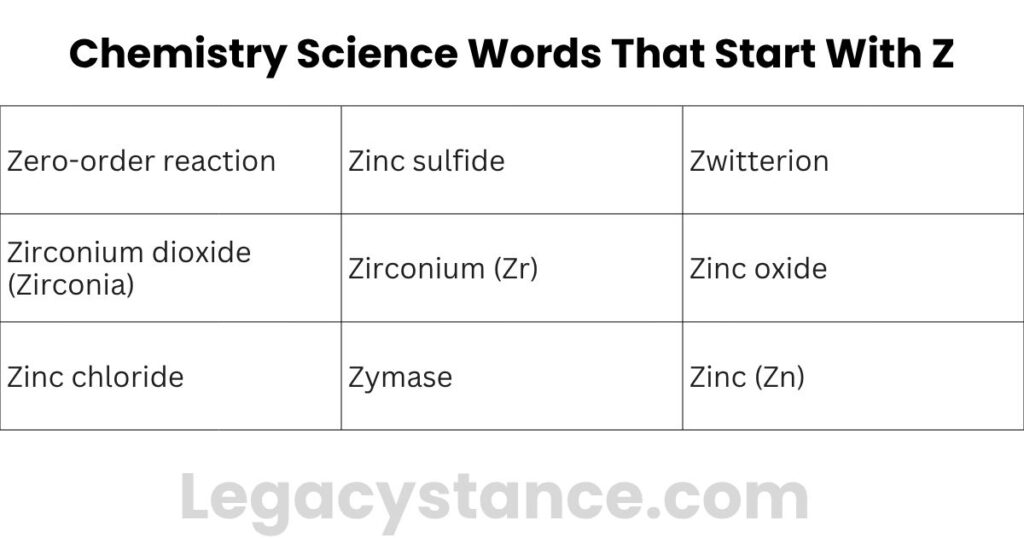
Zinc (Zn) — Element 30. It coats metal fences to prevent rust (galvanization), sits in brass doorknobs, and supports human immune function — which is why cold remedies often include it.
Zinc oxide — White powder with serious range: sunscreen, diaper cream, rubber manufacturing, solar cells. It absorbs ultraviolet radiation, which is why lifeguards apply it to their noses.
Zwitterion — Pronounced “ZWI-ter-eye-on.” A molecule carrying both a positive and negative charge simultaneously, with an overall neutral charge. Amino acids behave this way at body pH. Without zwitterions, proteins wouldn’t fold correctly.
Zeolite — A sponge-like mineral with tiny pores. Water treatment plants use zeolites to filter heavy metals. Laundry detergent often contains them to soften water by trapping calcium and magnesium ions.
Zymase — An enzyme complex in yeast that breaks glucose into ethanol and carbon dioxide. Every loaf of bread that rises, every fermented drink ever made — zymase is behind it.
Zirconium (Zr) — Element 40. Incredibly resistant to heat and corrosion. Nuclear reactors use zirconium alloys to encase uranium fuel rods because it barely absorbs neutrons under extreme heat.
Zinc sulfide — Glows when struck by radiation or electron beams. Used in early television screens and X-ray detection equipment.
Zinc chloride — Used in soldering flux, wood preservation, and some battery types.
Zirconium dioxide (Zirconia) — A very hard ceramic used in high-temperature crucibles, dental crowns, and jewelry (cubic zirconia).
Zero-order reaction — A chemical reaction whose rate stays constant regardless of how much reactant remains. Some enzyme-catalyzed reactions behave this way when the enzyme is fully saturated.
🧬 Biology Science Words That Start With Z
Zygote — The first cell of a new organism. One sperm plus one egg, carrying a complete DNA set, dividing billions of times into a full organism. Every person alive started as one.
Zoology — The branch of biology covering animal anatomy, behavior, genetics, evolution, and ecology. Wildlife biologists, veterinarians, and marine scientists all work within it.
Zooplankton — Microscopic animals drifting through oceans and freshwater. They eat phytoplankton and are eaten by fish, sitting near the base of nearly every aquatic food chain.
Zoonosis — A disease transferring from animals to humans. COVID-19, Ebola, rabies, and bird flu are all zoonotic. Understanding how this transfer happens is one of the most urgent areas in modern medicine and pandemic prevention.
Zymogen — An enzyme starting in inactive form. Pepsinogen, for example, is the inactive version of stomach enzyme pepsin. It only activates in stomach acid, which prevents your stomach from digesting itself before food arrives.
Zone of inhibition — In microbiology labs, a clear bacteria-free ring that forms around an antibiotic on a petri dish. A bigger ring means a more effective antibiotic.
Zygomorphic — A flower symmetrical along only one axis. Snapdragons and orchids are zygomorphic. Daisies, symmetrical in every direction, are actinomorphic.
Zona pellucida — A glycoprotein shell surrounding a mammalian egg. It protects the egg, helps sperm bind during fertilization, then hardens afterward to block additional sperm.
Zoospore — A reproductive spore that swims using flagella. Found in algae and some fungi — one of the earliest examples of motility in the microbial world.
Zymology — The science of fermentation, covering how yeasts and bacteria convert sugars into alcohol, acids, or gases. Relevant to food science, biotechnology, and medicine.
🌍 Earth Science Science Words That Start With Z
Zonation — The arrangement of ecosystems into distinct bands based on environmental conditions. On a mountain: grassland, then shrubs, then forest, then alpine meadow, then bare rock. Each transition is zonation.
Zonal flow — When upper atmosphere winds blow east-west in parallel bands. Strong zonal flow keeps cold Arctic air locked north. When it weakens, cold air spills south — what meteorologists call a polar vortex breakdown.
Zero meridian — The Prime Meridian at 0° longitude running through Greenwich, England. All longitude measurements on Earth are east or west of this line.
Zeuglodon — An extinct whale-like creature from about 40 million years ago. One of the key fossil links showing the evolutionary transition from land mammals to whales.
Zircon — A mineral in igneous rocks used to date ancient formations. Uranium inside zircon crystals decays at a known rate, making them natural clocks. The oldest known Earth material — a 4.4-billion-year-old zircon from Australia — was dated this way.
Zone of aeration — The soil layer above the water table where pores contain both air and water. Critical for agriculture and groundwater contamination studies.
Zone of saturation — The layer below the zone of aeration where all pore spaces are completely water-filled. This is where groundwater lives.
🚀 Space & Astronomy Science Words That Start With Z
Zenith — The point in the sky directly above the observer. Used in calculating star altitudes and positioning telescopes.
Zodiac — A band of sky 8 degrees on either side of the ecliptic. The 12 constellations within it are the zodiac constellations, used in mapping celestial positions.
Zodiacal light — A faint glow visible near the ecliptic at night, caused by sunlight scattering off comet and asteroid dust. Best seen from dark locations just after sunset or before sunrise.
Z-machine — A fusion energy research device at Sandia National Laboratories. It generates powerful magnetic fields to compress plasma, studying how matter behaves under conditions found inside stars.
Zonal winds — On gas giants like Jupiter and Saturn, winds blow in alternating east-west bands. These create Jupiter’s distinctive striped appearance.
Zero-point field — A theoretical background energy field pervading all of space, even in a perfect vacuum. Some physicists connect it to dark energy research.
💊 Medical & Health Science Words That Start With Z
Zinc deficiency — Affects over 2 billion people globally. Symptoms include poor wound healing, weakened immunity, stunted growth in children, and impaired taste and smell. Most common where diets rely heavily on grains.
Zanamivir — An antiviral for influenza, sold as Relenza. It blocks neuraminidase, the enzyme the flu virus uses to escape infected cells. Inhaled directly into the lungs.
Zidovudine (AZT) — Approved in 1987, one of the first antiretroviral drugs for HIV/AIDS. It blocks reverse transcriptase, the enzyme HIV uses to copy its genetic material — a turning point in the epidemic.
Zoonotic spillover — The specific moment a pathogen jumps from an animal host to a human. Habitat loss, wildlife trade, and factory farming all increase spillover risk. Central to pandemic prevention research.
Zygapophyseal joint — Small joints between adjacent vertebrae guiding spinal motion and preventing excessive twisting. Inflammation here causes facet joint syndrome, a specific type of back pain.
💻 Technology & Applied Science Words That Start With Z
Zero-day vulnerability — A software flaw unknown to developers, giving them “zero days” to fix it before exploitation. Major zero-days can affect millions of systems within hours.
Z-transform — A mathematical tool for digital signal processing. Every phone call and streamed song passes through systems built on Z-transforms.
Zinc-air battery — Uses atmospheric oxygen as a reactant, giving very high energy density. Already used in hearing aids; actively researched for electric vehicles.
Zero-emission vehicle — Any vehicle producing no direct exhaust. Electric and hydrogen fuel cell vehicles qualify. The classification drives environmental regulations globally.
Z-wave — A wireless protocol for smart home devices operating around 908 MHz in the U.S., reducing interference with Wi-Fi.
Zirconia ceramic — Used in dental implants and cutting tools. Hard, biocompatible, and largely replacing metal crowns in cosmetic dentistry.
🟢 Easy Science Words That Start With Z
Zoo — A facility for animal study and conservation, involved in breeding programs for endangered species.
Zero — The number representing nothing, and the reference point for temperature scales (0°C = water’s freezing point).
Zinc — A metal in vitamins, rust-resistant coatings, and cold remedies.
Zone — A defined region. Used across biology, geography, meteorology, and astronomy.
Zoology — The study of animals, from behavior to genetics.
Zygote — The first cell after fertilization. One cell that becomes a complete living organism.
Zodiac — The belt of constellations along the Sun’s yearly path through the sky.
🔴 Advanced Science Words that Start With Z
Zeeman effect — Splits atomic spectral lines under magnetic fields. Used to measure field strengths in distant stars and plasma research.
Zwitterion — A dipolar ion with simultaneous positive and negative charges. Central to protein chemistry and drug design; charge state shifts with pH.
Zero-point energy — Residual quantum energy at absolute zero. Produces measurable physical effects including the Casimir effect.
Zymogen activation — How inactive enzyme precursors become active. Disruptions are implicated in pancreatitis and certain cancers.
Z-boson — Carrier of the weak nuclear force. Discovered at CERN in 1983, it confirmed electroweak theory unifying two fundamental forces. About 91 times heavier than a proton.
Zonal index — Measures how strongly east-west flow dominates the atmosphere. Low zonal index = more extreme temperature events from north-south air mass exchanges.
📋 Complete Reference List: 85 Science Words that Starting With Z
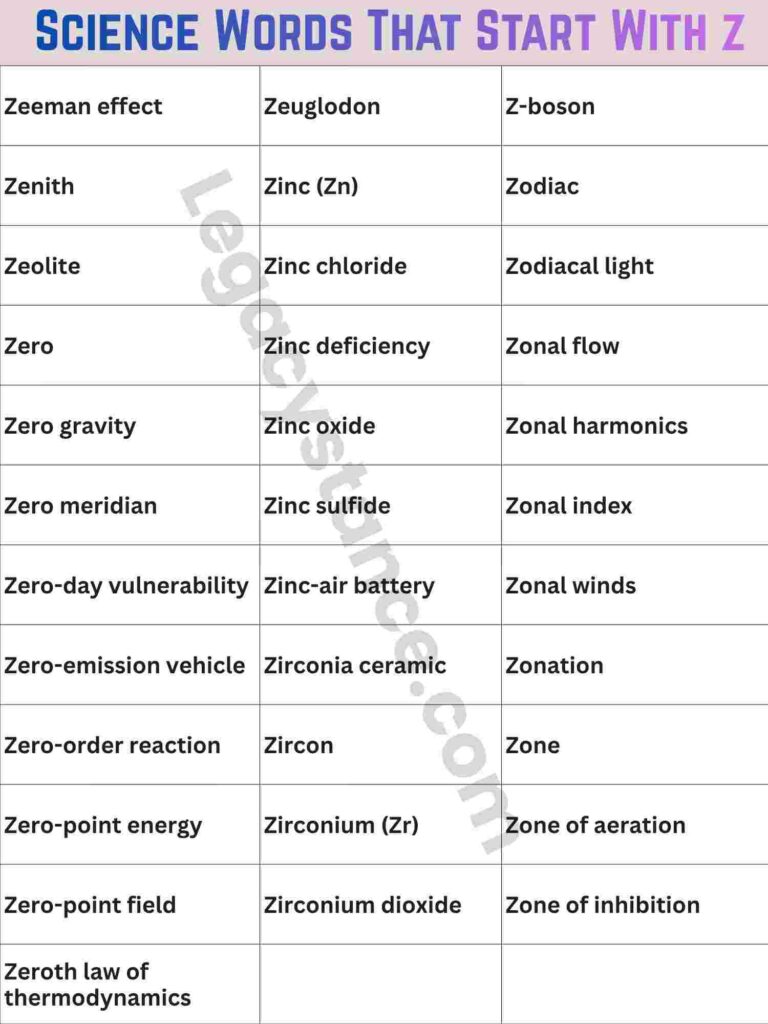
Zeeman effect — Spectral line splitting in magnetic fields
Zenith — Point directly overhead
Zeolite — Porous filtration mineral
Zero — Baseline; absence of quantity
Zero gravity — Apparent weightlessness in free fall
Zero meridian — Prime Meridian at 0° longitude
Zero-day vulnerability — Unpatched software security flaw
Zero-emission vehicle — Vehicle with no exhaust emissions
Zero-order reaction — Reaction rate unaffected by concentration
Zero-point energy — Lowest quantum energy state
Zero-point field — Background energy of space itself
Zeroth law of thermodynamics — Basis for temperature measurement
Zeuglodon — Extinct ancestral whale species
Zinc (Zn) — Essential metal, element 30
Zinc chloride — Compound used in soldering and batteries
Zinc deficiency — Condition from insufficient dietary zinc
Zinc oxide — UV-absorbing compound in sunscreen
Zinc sulfide — Luminescent compound in screens
Zinc-air battery — Battery using atmospheric oxygen
Zirconia ceramic — Hard ceramic for dental and cutting use
Zircon — Mineral used in radiometric dating
Zirconium (Zr) — Corrosion-resistant metal, element 40
Zirconium dioxide — Hard ceramic; cubic zirconia
Z-boson — Carrier of the weak nuclear force
Zodiac — Belt of 12 constellations along the ecliptic
Zodiacal light — Faint glow from interplanetary dust
Zonal flow — East-west dominant wind pattern
Zonal harmonics — Spherical functions for field calculations
Zonal index — Measure of east-west wind dominance
Zonal winds — Banded winds on gas giant planets
Zonation — Species distribution in distinct bands
Zone — Region with shared characteristics
Zone of aeration — Soil layer above the water table
Zone of inhibition — Bacteria-free ring around an antibiotic
Zone of saturation — Water-filled soil layer below water table
Zone of silence — Region where sound waves skip over
Zone therapy — Early pressure-point healing system
Zoo — Conservation and research facility for animals
Zoology — Scientific study of animals
Zoonosis — Animal-to-human disease transfer
Zoonotic — Relating to animal-origin diseases
Zoonotic spillover — Pathogen jumping from animals to humans
Zooplankton — Microscopic aquatic animals
Zoospore — Motile swimming reproductive spore
Z-transform — Tool for digital signal processing
Z-wave — Smart home wireless protocol
Zygapophyseal joint — Vertebral joint guiding spinal motion
Zygomorphic — Flower with single-axis symmetry
Zygote — First cell after fertilization
Zymase — Yeast enzyme complex for fermentation
Zymogen — Inactive enzyme precursor
Zymogen activation — Process activating an inactive enzyme
Zymology — Science of fermentation
Zanamivir — Influenza antiviral drug
Z-machine — High-power fusion research device
Zidovudine (AZT) — First HIV antiretroviral drug
Zona pellucida — Shell surrounding an egg cell
Zinc finger — Protein structure binding to DNA
Zinc flux — Zinc-containing soldering material
Zymotic disease — Historical term for infectious disease
Zoanthropy — Delusion of becoming an animal
Zoography — Study of animal characteristics
Zoogeography — Study of animal distribution
Zoochemistry — Chemistry of animal substances
Zoetrope — Device showing persistence of vision
Zugunruhe — Migratory restlessness in animals
Zeitgeber — Environmental cue for biological clocks
Zero tillage — Farming without plowing
Zymurgy — Chemistry of brewing and fermentation
Zooxanthellae — Algae living inside coral
Zonula occludens — Tight cell junctions
Z-DNA — Left-handed DNA structure
Zein — Protein found in corn
Zeatin — Plant growth hormone
Zoecium — Body wall of a bryozoan
Zymosterol — Cholesterol precursor in yeast
Zinc finger nuclease — Engineered gene-editing protein
Zearalenone — Toxin from molds
Z-line — Boundary in muscle fibers
Zonula adherens — Cell junction connecting cells
Zosteriform — Rash following a nerve pattern
Zygomatic bone — Cheekbone
Zymosan — Immune-activating yeast particle
Zeugite — Metamorphic rock type
Zoonome — Genetic material of animal-associated microbes
⚠️ Common Confusions about Science Words Starting With Z
Zygote vs. Embryo — A zygote is only the single cell immediately after fertilization. Once it begins dividing into a multicellular structure, it becomes an embryo. These are not interchangeable in scientific writing.
Zoonosis vs. Zoonotic — Zoonosis is the noun (the disease). Zoonotic is the adjective (describing something related to it). “Rabies is a zoonosis” and “rabies is a zoonotic disease” are both correct. “Rabies is a zoonotic” is not.
Zeolite vs. Zircon — Both are minerals but completely different. Zeolites are porous and used for filtration. Zircon is dense and crystalline, used for dating ancient rocks. Commonly mixed up on geology tests.
Zero gravity vs. Weightlessness — Gravity doesn’t disappear in space. Astronauts feel weightless because they’re continuously falling around Earth. It’s a perceived state, not an absence of gravitational force.
Zonation vs. Zone — A zone is a place. Zonation is the process by which zones form and the pattern they create. A mountain has zones; the study of how they develop is zonation.
Zymase vs. Zymogen — Zymase is an active enzyme complex. A zymogen is an inactive enzyme waiting to be triggered. Same biochemistry family, opposite functional states.
Read also: 83 Science Words That Start With J | Meanings & Examples
FAQ’s
What are some common science words that start with Z?
Common ones include zygote, zinc, zoology, zenith, and zoonosis. These appear often in school science topics.
Why are there so few science words starting with Z?
Because Z is rarely used in English and in Greek/Latin roots, which most scientific terms come from.
Are Z science words important for exams?
Yes. Words like zygote, zinc, and zoonosis often appear in biology and general science tests.
What is the easiest Z science word to remember?
“Zygote” is one of the easiest because it’s commonly taught in basic biology.
How can I learn Z science terms faster?
Group them by subject (biology, chemistry, physics). This makes them easier to remember than random lists.
What This Covers
Eighty-five science words, organized by field, explained at two difficulty levels, with confusions clarified and real contexts provided. Z sits at the end of the alphabet but spans quantum mechanics, ocean biology, pandemic medicine, and space science. The words here appear in actual textbooks, research papers, and standardized tests — not just word lists.
Pick the section that matches your subject. That’s where to start.

Hi, I’m the creator of Legacystance.com, dedicated to making English learning simple and enjoyable. I write clear, practical guides on adjectives, verbs, idioms, pronunciation, spelling, and more. Every article is carefully researched to give accurate, easy-to-understand information. My goal is to help readers improve their English skills confidently, one step at a time, with content that is trustworthy, useful, and beginner-friendly.