
Science words that start with “U” show up more often than expected—on exams, in textbooks, and during class discussions. This guide brings them together in one place, explained clearly with real-life connections so they actually make sense when you see them again. Whether you’re studying, teaching, or helping with homework, this is built to be easy to scan, quick to understand, and useful long after one test.
Quick Reference: 20 Most-Used Science Words Starting With U
- Ultraviolet — Light energy beyond visible violet; causes sunburn
- Uranium — Radioactive element used in nuclear energy
- Uterus — Organ where a fetus develops during pregnancy
- Umbilical cord — Connects fetus to placenta for nutrients and waste removal
- Universe — All existing matter, energy, space, and time
- Ultrasound — Sound waves above human hearing; used in medical imaging
- Urea — Nitrogen waste product filtered from blood by kidneys
- Uniform motion — Constant speed in a straight line, no change
- Unstable isotope — Atom that decays over time, releasing radiation
- Upthrust — Upward water force that keeps objects floating
- Ureter — Tube carrying urine from kidney to bladder
- Urine — Liquid waste removed by kidneys
- Umbra — Darkest shadow zone during an eclipse
- Uniformitarianism — Past geology shaped by same processes happening today
- Upper mantle — Earth’s layer directly below the crust
- Universal indicator — Color-change solution showing pH level
- Universal solvent — Water; dissolves more substances than any other liquid
- Unicellular — Organism made of only one cell
- Upwelling — Cold deep ocean water rising to the surface
- Universal gravitation — Every mass attracts every other mass
Physics Science Words That Start With U
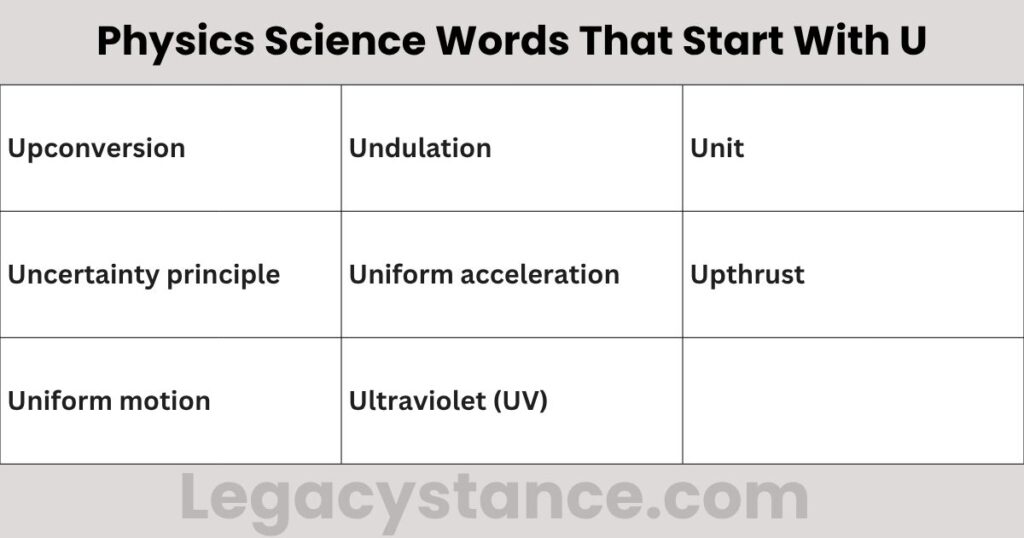
Ultraviolet (UV) — Electromagnetic radiation just beyond visible light. The sun emits it constantly. It sterilizes hospital surfaces and triggers sunburn — same energy, very different contexts.
Uniform motion — Movement at constant speed in one direction with no net force acting on the object. A train on a straight track at steady speed is the clearest example.
Upthrust — The upward force water pushes on any submerged or floating object. It’s why a rubber duck floats and why ships weighing hundreds of thousands of tons don’t sink. Archimedes explained this 2,000 years ago.
Uniform acceleration — Speed increases at a constant rate. A car gaining exactly 10 km/h every second has uniform acceleration. Don’t confuse this with uniform motion — one involves change, one doesn’t.
Uncertainty principle — You cannot know a particle’s exact position and momentum at the same time. Measuring one disturbs the other. This isn’t an equipment problem — it’s a fundamental property of matter at the quantum scale.
Unit — Every measurement needs one. Without units, “temperature is 37” is meaningless. With them — 37°C — it tells you someone has a mild fever.
Undulation — A smooth, wave-like motion. Used in physics to describe wave behavior in fluids and electromagnetic fields.
Upconversion — A process where low-energy photons are absorbed and re-emitted as higher-energy photons. Used in solar energy research and bioimaging technology.
Chemistry Science Words That Start With U
Universal indicator — A dye mixture that changes color across the full pH scale. Yellow means acidic, blue-green is neutral, purple is strongly alkaline. One solution covers the entire range.
Unsaturated compound — A molecule with at least one double bond between carbon atoms. Olive oil is unsaturated. Butter is saturated. That structural difference — one double bond — changes how the fat behaves in the body.
Uranium (U) — Element 92. Heavy, radioactive, naturally occurring. Inside nuclear reactors, U-235 atoms split in a controlled chain reaction, releasing heat that generates electricity.
Unstable isotope — An atom with an unbalanced nucleus that decays over time, releasing radiation. Carbon-14 is one — its known decay rate lets scientists date ancient organic materials.
Urea — Produced in the liver when proteins break down. Kidneys filter it into urine. Industrially, it’s manufactured as a fertilizer — the same molecule your liver makes ends up on farm fields.
Unified atomic mass unit — The standard unit for measuring atomic and molecular mass. One unit equals roughly the mass of a single proton or neutron.
Uronic acid — A sugar acid found in plant cell wall structures. Important in understanding plant biology and food chemistry.
Uranium glass — Glass colored with uranium oxide. Under UV light, it glows bright green. More historical curiosity than modern material, but still studied in materials science.
Biology Science Words That Start With U
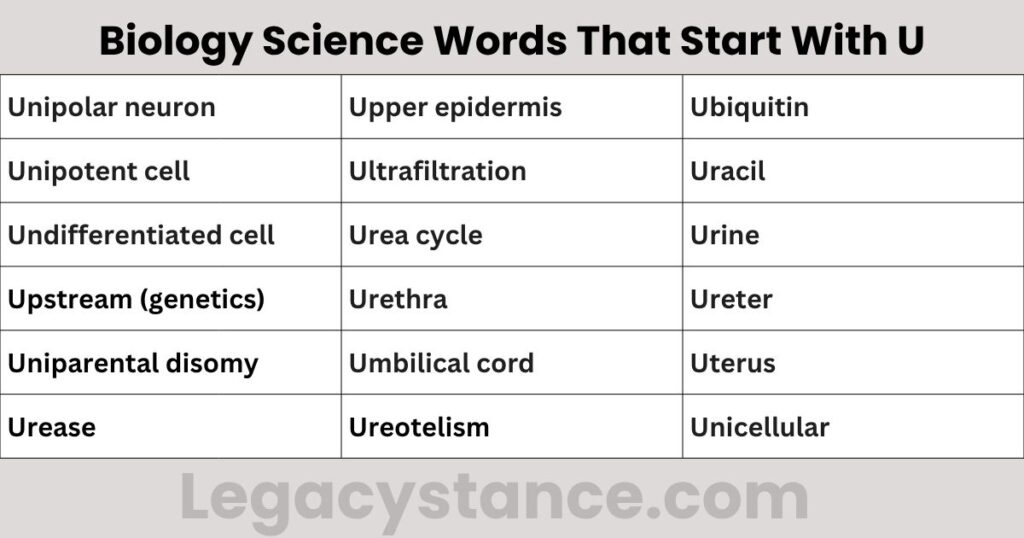
Unicellular — One cell, one organism, all jobs handled alone. Bacteria, amoeba, and yeast are all unicellular. No brain, no organs — just one cell eating, reproducing, and responding.
Uterus — Muscular, pear-shaped organ where a fertilized egg develops into a baby. Its lining thickens monthly. If no fertilization occurs, the lining sheds — that’s menstruation.
Umbilical cord — Connects the fetus to the placenta. Oxygen and nutrients flow in; waste flows out. After birth, it’s cut. The belly button is the mark it leaves.
Ureter — Thin tube, about 25 cm long, running from each kidney to the bladder. Kidney stones hurt so much partly because they get lodged in this narrow passage.
Urethra — Carries urine from the bladder out of the body. Shorter in females — one reason urinary tract infections occur more frequently in women.
Urine — Mostly water, plus urea, salts, and filtered waste. Color signals hydration: pale yellow means well-hydrated, dark yellow means drink more water, unusual colors signal a doctor visit.
Uracil — A nitrogen base found only in RNA, not DNA. It pairs with adenine. RNA uses uracil where DNA uses thymine.
Ubiquitin — A small protein that tags damaged or unneeded proteins inside a cell. The tagged proteins get sent to the cell’s disposal system and broken down. The body’s internal recycling label.
Urea cycle — The liver’s process for converting toxic ammonia (from protein breakdown) into urea, which kidneys can safely filter out. Without this cycle, ammonia would accumulate and become deadly.
Ultrafiltration — Filtration at a molecular level. In the kidneys, blood is filtered under pressure — water, urea, and small molecules pass through; large proteins stay in the blood.
Upper epidermis — The outermost cell layer on the top surface of a leaf. It protects internal tissue and is usually transparent to let sunlight through.
Undifferentiated cell — A cell that hasn’t taken on a specialized role yet. Stem cells are undifferentiated — they can still become many different cell types.
Unipotent cell — A stem cell that can only produce one specific cell type. More specialized than a pluripotent cell, which can become many types.
Unipolar neuron — A nerve cell with a single extension from its cell body. Common in invertebrates. In humans, sensory neurons use a modified version of this structure.
Urease — An enzyme that breaks urea down into ammonia and carbon dioxide. Some bacteria use it in digestion. In soil, it helps release nitrogen from organic material.
Upstream (genetics) — The region of a DNA strand located before a gene, in the direction opposite to transcription. Regulatory sequences that control gene activity often sit here.
Uniparental disomy — A genetic condition where both copies of a chromosome come from one parent rather than one from each. Can cause developmental problems depending on which chromosome is affected.
Unequal crossing over — An error during DNA recombination where misaligned chromosomes swap unequal sections. Can result in gene duplications or deletions — a source of genetic variation and sometimes disease.
Ureotelism — The biological strategy of excreting nitrogen waste mainly as urea. Mammals and most bony fish use this method. Birds and reptiles use uric acid instead — that’s uricotelism.
Urochordate — Marine animals belonging to the subphylum Urochordata, also called tunicates. They’re chordates — meaning they share evolutionary ancestry with vertebrates — but look nothing like fish or humans.
Utricle — Part of the inner ear’s vestibular system. Detects horizontal movement and head tilt. Works alongside the saccule to keep your sense of balance and spatial orientation functioning.
Uvula — The small, soft tissue hanging at the back of the throat. Plays a role in speech articulation and helps prevent food and liquid from entering the nasal cavity during swallowing.
Umbonate — Having a raised central bump, like the cap of certain mushroom species. Used in mycology and shell biology to describe surface structure.
Understory — The forest layer between the ground and the canopy above. Shade-tolerant plants, shrubs, and young trees live here. It’s an entire ecosystem within an ecosystem.
Earth Science Words That Start With U
Uniformitarianism — James Hutton’s foundational geological principle: the same slow processes happening today — erosion, sedimentation, volcanic activity — are the same ones that built Earth over millions of years. It replaced catastrophe-based explanations of Earth’s history.
Upper mantle — The layer of Earth directly below the crust. Mostly solid rock, but contains the asthenosphere — a partially molten zone. Tectonic plates slide over it. Without this movement, mountains wouldn’t form and earthquakes wouldn’t occur as they do.
Upwelling — Wind pushes warm surface water aside, and cold, deep water rises to replace it. These zones — like off Peru’s coast — carry nutrients from the deep. Some of Earth’s most productive fisheries exist because of upwelling.
Uplift — Tectonic forces pushing sections of Earth’s crust upward over millions of years. The Himalayas formed this way and are still rising — the Indian and Eurasian plates haven’t stopped colliding.
Unconformity — A gap in the geological record where rock layers are missing due to erosion or non-deposition. It tells geologists that time passed without leaving any rock behind.
Ultramafic rock — Rock with very high magnesium and iron content and very low silica. Found deep in Earth’s mantle. Peridotite is the most common example.
Ultrabasic — Describes igneous rocks with silica content below 45%. Often used interchangeably with ultramafic, though technically referring to chemical composition rather than mineral content.
Uraninite — A uranium-rich mineral ore, also called pitchblende. Marie Curie processed it to isolate radium and polonium. Still the primary ore mined for uranium today.
Space & Astronomy Science Words That Start With U
Universe — All matter, all energy, all space, all time. Estimated age: 13.8 billion years. Origin: the Big Bang. Current state: still expanding. Whether it has a boundary remains one of the open questions in physics.
Umbra — The darkest central zone of a shadow during an eclipse. Inside the umbra, the sun is completely blocked. Outside it sits the penumbra — partial shadow, partial sunlight.
Uranus — Seventh planet from the sun. Its axis tilts 98 degrees — it essentially rolls around the sun on its side. Pale blue-green color comes from methane in its atmosphere. It has 27 known moons.
Universal gravitation — Newton’s law: every object with mass pulls on every other object with mass. The force depends on both masses and the distance between them. It governs planetary orbits, tides, and why you don’t float off the floor.
Ultraviolet astronomy — Observing the universe in UV wavelengths that human eyes can’t detect. Hot young stars and active galaxies emit intense UV. Space-based UV telescopes reveal structures invisible to optical instruments.
Medical & Health Science Words That Start With U
Ulcer — An open sore on body tissue — stomach lining, mouth, or skin. Stomach ulcers often result from H. pylori bacterial infection or long-term anti-inflammatory drug use. Painful because stomach acid contacts raw tissue.
Urinalysis — A lab test examining urine for infections, kidney disease, diabetes markers, and other conditions. Color, clarity, chemical content, and cell count all carry diagnostic weight. Common in routine health checkups.
Urology — Medical specialty covering the urinary tract and male reproductive system. Urologists treat kidney stones, bladder conditions, and prostate disorders.
Umbilical hernia — Part of the intestine pushes through the abdominal wall near the navel. Common in newborns and usually resolves without treatment. Adults require surgical repair.
Urticaria — The medical term for hives. Raised, itchy welts caused by allergic reactions, stress, or infections. The immune system releases histamine, which triggers swelling and redness.
Upper respiratory tract — The airways from the nose and mouth down to the larynx. Colds, flu, and strep throat are all upper respiratory infections.
Uvea — The middle layer of the eye, comprising the iris, ciliary body, and choroid. Inflammation here is called uveitis — a serious condition that can affect vision.
Urobilin — The compound that gives urine its yellow color. Formed from the breakdown of bilirubin, which itself comes from the recycling of old red blood cells.
Urobilinogen — A colorless compound formed during bilirubin breakdown. Small amounts appear normally in urine. Elevated levels can signal liver disease or hemolytic anemia.
Technology & Applied Science Words That Start With U
UV sterilization — UV light damages bacterial and viral DNA, stopping reproduction. Used in hospital operating rooms, water treatment plants, and food packaging — no chemicals needed.
Uplink — Signal sent from Earth to a satellite. The satellite processes or amplifies it, then sends a downlink back. GPS, satellite TV, and space probe communication all depend on this.
USB (Universal Serial Bus) — Standardized connection system for data transfer and power between devices. The “universal” part means it works across different hardware without device-specific ports.
Uranium enrichment — Natural uranium is mostly U-238, which doesn’t split well. Enrichment increases the U-235 concentration. Power plant fuel is mildly enriched (3–5%). Weapons-grade uranium is highly enriched (90%+). The process is tightly regulated internationally.
Ultracentrifuge — A high-speed centrifuge that separates particles by density. Used in virology to isolate viruses, in biochemistry to separate proteins, and in uranium enrichment.
Easy Science Words That Start With U — Grades 5–7
| Word | Simple Meaning |
| Unicellular | Made of one cell — like bacteria |
| Ultraviolet | Invisible sun energy that causes sunburn |
| Upthrust | Water pushing up on floating things |
| Uterus | Where a baby grows before birth |
| Universe | Everything that exists |
| Urine | Liquid waste from kidneys |
| Umbilical cord | Baby’s connection to its mother before birth |
| Umbra | Darkest part of a shadow during eclipse |
| Upper mantle | Layer of Earth below the crust |
| Uranus | Seventh planet — spins sideways |
Advanced Science Words That Start With U
Uncertainty principle — Heisenberg’s quantum mechanics principle. Position and momentum of a subatomic particle cannot both be precisely known simultaneously. It’s not a measurement error — it’s the nature of quantum reality.
Uranium-235 fission — A neutron strikes U-235, splitting the nucleus into smaller elements and releasing energy plus more neutrons. Those trigger further splits. Controlled: powers cities. Uncontrolled: nuclear weapon.
Uniparental disomy — Both chromosome copies inherited from one parent. Can disrupt imprinted genes — genes that are only active when inherited from a specific parent — causing developmental disorders.
Unequal crossing over — DNA recombination error where chromosomes swap unequal segments. Results in duplications or deletions. A known mechanism behind some inherited conditions and evolutionary gene family expansions.
Ureotelism — Nitrogen excretion strategy specific to mammals and bony fish. Ammonia — toxic — gets converted to urea in the liver and safely excreted. Contrast with uricotelism in birds and reptiles.
Upwelling zones — Biologically among the richest ocean areas on Earth. Cold, nutrient-dense water rising from depth feeds phytoplankton blooms, which support entire marine food webs from fish to whales.
Complete Reference List: 95+ Science Words That Start With U
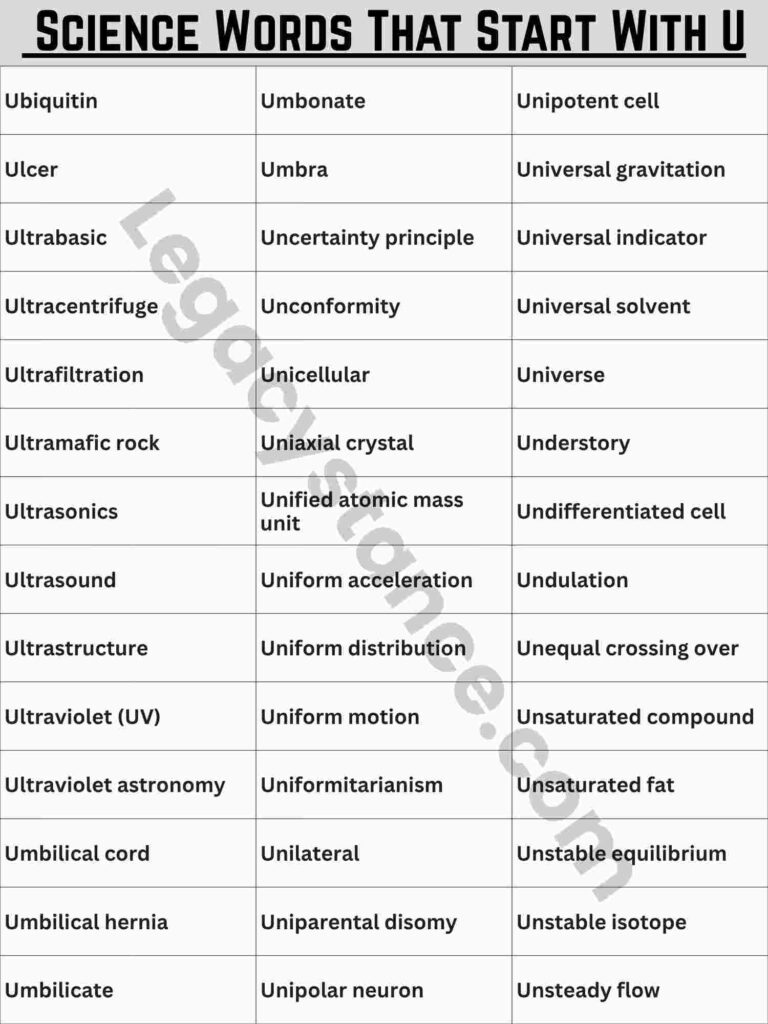
Here’s the Complete list with meanings:
Ubiquitin — Protein tag marking cells for disposal
Ulcer — Open tissue sore
Ultrabasic — Rock with below 45% silica
Ultracentrifuge — High-speed density-separation device
Ultrafiltration — Molecular-level filtration
Ultramafic rock — High magnesium, iron, low silica rock
Ultrasonics — Study of sound above 20,000 Hz
Ultrasound — High-frequency sound used in imaging
Ultrastructure — Cell detail visible only under electron microscope
Ultraviolet (UV) — Radiation beyond visible violet light
Ultraviolet astronomy — Observing space in UV wavelengths
Umbilical cord — Fetus-to-placenta connection
Umbilical hernia — Intestine bulge near navel
Umbilicate — Having a navel-like central pit
Umbonate — Having a central raised bump
Umbra — Total shadow zone in eclipse
Uncertainty principle — Position and momentum can’t both be precisely known
Unconformity — Gap in geological rock record
Unicellular — Single-celled organism
Uniaxial crystal — Crystal with one optical axis
Unified atomic mass unit — Standard unit for atomic mass
Uniform acceleration — Constant rate of velocity increase
Uniform distribution — Equal spread across an area
Uniform motion — Constant speed, constant direction
Uniformitarianism — Present processes explain past geology
Unilateral — Occurring on one body side only
Uniparental disomy — Both chromosomes from one parent
Unipolar neuron — Nerve cell with single process
Unipotent cell — Stem cell forming one cell type only
Universal gravitation — All masses attract each other
Universal indicator — pH color-change solution
Universal solvent — Water — broadest dissolving ability
Universe — All matter, energy, space, time
Understory — Forest layer below the canopy
Undifferentiated cell — Unspecialized cell, not yet committed
Undulation — Wave-like motion or form
Unequal crossing over — DNA recombination error — unequal swap
Unsaturated compound — Molecule with at least one double bond
Unsaturated fat — Fat with double-bonded carbon chain
Unstable equilibrium — Balance that collapses under disturbance
Unstable isotope — Atom that decays releasing radiation
Unsteady flow — Fluid changing speed or direction over time
Upper epidermis — Top leaf cell layer
Upper mantle — Earth layer below the crust
Upper respiratory tract — Airways from nose/mouth to larynx
Upconversion — Low-energy photons becoming high-energy
Uplink — Earth-to-satellite signal
Uplift — Tectonic upward crust movement
Upthrust — Upward force on submerged objects
Upstream (genetics) — DNA region before a gene
Upwelling — Deep ocean water rising to surface
Uracil — RNA nitrogen base, pairs with adenine
Uraninite — Uranium ore mineral
Uranium (U) — Radioactive element 92
Uranium enrichment — Increasing U-235 concentration
Uranium glass — Uranium-colored glass, glows under UV
Uranium-235 — Fissile isotope used in nuclear reactions
Uranus — Seventh planet, sideways-tilted axis
Urea — Nitrogen waste from protein metabolism
Urea cycle — Liver process converting ammonia to urea
Urease — Enzyme breaking urea into ammonia
Ureotelism — Nitrogen excretion as urea strategy
Ureter — Kidney-to-bladder tube
Urethra — Bladder-to-exterior tube
Uric acid — Waste from nucleotide metabolism
Urinalysis — Diagnostic urine lab test
Urine — Filtered kidney waste liquid
Urobilin — Compound giving urine yellow color
Urobilinogen — Bilirubin breakdown compound in urine
Urochordate — Tunicate — marine chordate animal
Uronic acid — Sugar acid in plant cell walls
Urology — Urinary tract and male reproduction specialty
Urothelium — Tissue lining the urinary tract
Urticaria — Hives — histamine-triggered skin reaction
USB — Universal device connection standard
Useful load — Weight capacity beyond own mass
Uteroplacental — Relating to uterus-placenta circulation
Uterus — Fetal development organ
Utricle — Inner ear horizontal movement detector
UV index — Scale measuring UV radiation intensity
UV radiation — Solar radiation causing DNA damage
UV sterilization — UV light used to destroy pathogens
Uvea — Middle eye layer — iris, ciliary body, choroid
Uvula — Soft tissue at back of throat
Common Confusions about these U Words
Ureter vs Urethra Ureter = kidney to bladder. Urethra = bladder to outside. Memory trick: urEtEr has two E’s — two tubes (one per kidney). UrEthrA ends with A — think Away, it exits the body.
Umbra vs Penumbra Umbra = total darkness, complete shadow. Penumbra = partial shadow at the edges. Only people standing in the umbra see a total solar eclipse.
Unicellular vs Multicellular One cell vs many cells. Bacteria: one cell handles everything. Humans: 37 trillion cells with specialized jobs.
Uniform motion vs Uniform acceleration Uniform motion = no change in speed. Uniform acceleration = speed changes, but the rate of change stays constant. Both use “uniform” — but one involves change and one doesn’t.
Urea vs Uric acid Both are nitrogen waste products. Urea comes from protein breakdown — excreted by mammals. Uric acid comes from nucleotide breakdown — excreted by birds and reptiles. Humans produce small amounts of uric acid too; excess levels cause gout.
Unstable isotope vs Radioactive element Radioactive elements always contain unstable isotopes. But unstable isotopes also appear in non-radioactive elements — carbon-14 is an unstable isotope of carbon, which isn’t classified as a radioactive element in everyday chemistry.
You may like to read:
75+ Science Words That Start With I — List with Meanings
85+ Science Words That Start With Z | Full List with Meanings
FAQs
1. Why are there so many “U” words in biology and medicine?
Many science terms come from Latin and Greek. Prefixes like “uni” (one) and “uro” (urine) are widely used in biology and medicine. That’s why topics like the human body and cells have more U-terms than physics or math.
2. How can I remember science words that start with U more easily?
Link each word to a real situation.
- Ultraviolet → sunlight and sunburn
- Ureter → urine moving from kidney to bladder
- Upthrust → why boats float
When a word connects to something you’ve seen, it sticks faster.
3. Are all U science words difficult to learn?
No. Some are advanced, but many are simple and used early in school. Words like universe, urine, uterus, and unicellular are taught in middle grades and form the base for harder topics later.
4. What’s the best way to use this list for studying?
Don’t try to memorize everything at once. Break it into groups—biology, physics, chemistry—and learn a few words daily. Focus on meaning + example, not just definitions.
What You’ve Learned
This guide worked through 95+ science words starting with U — by subject, by difficulty level, and with real context showing where each word actually matters.
Urea travels the urea cycle. Upwelling feeds fisheries. Ultraviolet starts in the sun and ends in a hospital sterilization lamp. These words connect to each other and to things that happen in the world every day.
The vocabulary is the same language scientists, doctors, and engineers use to describe exactly how things work.