Science words that start with J can feel limited—but they actually cover a wide range of topics, from physics and biology to space and technology.
If you’ve ever wondered what words like joule, jet stream, or juvenile really mean, this guide makes it easy to understand them without confusion.
Here, you’ll find 83 science words starting with J, explained in simple language with real examples you can relate to.
Whether you’re a student preparing for a test, a parent helping with homework, or just curious about science vocabulary, this list is designed to be clear, useful, and quick to scan.
Quick Answer: Science Words Starting With J
| Word | Field | Meaning |
| Joule | Physics | Unit of energy or work |
| Junction | Physics | Point where two things meet or connect |
| Jet stream | Earth Science | Fast wind current high in the atmosphere |
| Juvenile | Biology | Young stage of an organism |
| Joint | Biology | Where two bones connect in the body |
| Jupiter | Astronomy | Largest planet in our solar system |
| Java | Technology | A widely used programming language |
| Jawbone | Biology | The mandible — the lower jaw structure |
Physics Science Words That Start With J
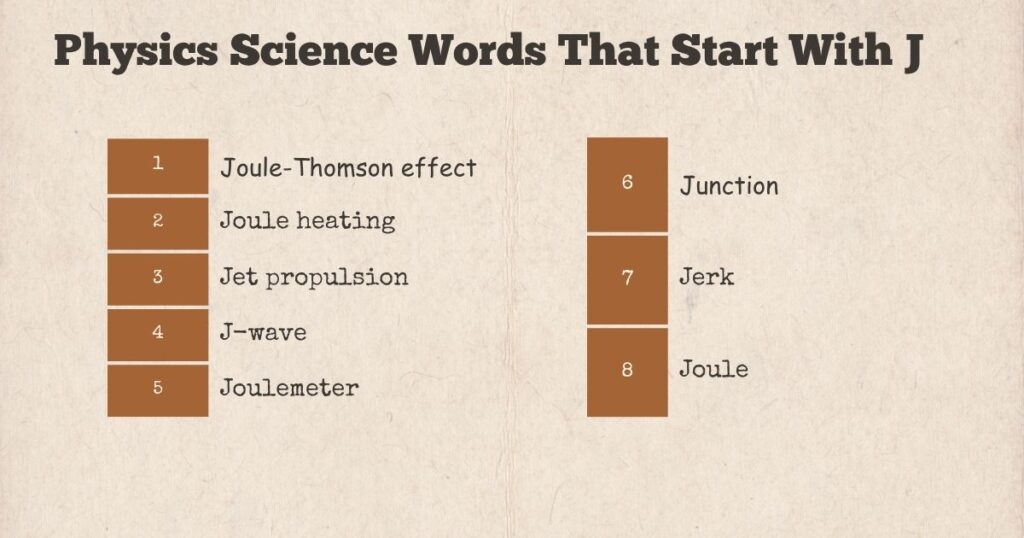
Joule — The standard unit for measuring energy, heat, and work. When you lift a book, charge a phone, or feel warmth from sunlight, the energy involved is counted in joules. Named after physicist James Prescott Joule.
Jerk — In physics, jerk is the rate at which acceleration changes over time. A car speeding up smoothly has constant acceleration. A car that lurches forward suddenly — that sudden change is jerk.
Junction — A point where two electrical components or conductors meet. In circuits, junctions are where current can split or combine paths.
Joulemeter — A device used in labs to measure how much electrical energy a circuit uses over time.
J-wave — An electrical signal sometimes visible on heart monitors. It appears under certain temperature and cardiac conditions, studied in both physics and medical science.
Jet propulsion — Movement caused by a fluid or gas shooting out in one direction. Rockets and jet aircraft both use this. It follows directly from Newton’s third law of motion.
Joule heating — When electric current passes through a conductor, heat is produced. That heat is Joule heating. It explains why your phone gets warm while charging.
Joule-Thomson effect — When compressed gas expands through a small opening, it cools. This is the principle behind refrigerators and air conditioners.
Chemistry Science Words That Start With J
Jade — A mineral compound, usually jadeite or nephrite, prized for centuries. Chemically, jadeite is sodium aluminum silicate.
Jadeite — A pyroxene mineral with the formula NaAlSi₂O₆. Found in metamorphic rocks, typically formed under high pressure deep in the Earth.
Jarosite — A yellowish mineral containing potassium, iron, and sulfate. Common in acidic soils on Earth and detected on Mars by NASA rovers.
Jet (mineral) — A dense black gemstone formed from compressed fossilized wood. Studied in mineralogy and used historically in jewelry.
Jelly (colloid) — In chemistry, a jelly is a semi-solid colloid — a substance caught between liquid and solid states. Gelatin is one example. Important in food science and pharmaceuticals.
Juglone — A natural chemical compound produced by walnut trees. It’s toxic to many surrounding plants and functions as a natural herbicide in the soil.
Japonilure — A synthetic chemical pheromone used in traps to attract and control Japanese beetles. A practical example of applied chemistry in pest management.
Jasper — An opaque, fine-grained variety of quartz (SiO₂). Its red, yellow, and brown colors come from iron oxide content. Found in both sedimentary and volcanic rock formations.
Biology Science Words That Start With J
Joint — The place where two or more bones meet. Some joints move freely (like the knee), some move slightly (like vertebrae), and some don’t move at all (like skull bones). The human body has over 300 joints.
Jugular vein — The large vein running down the side of the neck that carries blood from the head back to the heart.
Jejunum — The middle section of the small intestine, sitting between the duodenum and ileum. Most nutrient absorption from digested food happens here.
Juvenile — The life stage between infant and adult in many animals. A juvenile frog is called a froglet. A juvenile bird still has developing feathers.
Jawbone (Mandible) — The lower jaw and the only bone in the skull that moves. Essential for chewing and speaking.
J-shaped curve — A graph showing exponential population growth. When a species has unlimited food and no predators, its population grows in a steep J shape before eventually crashing or leveling off.
Juxtaposition (cellular) — When two cells sit directly next to each other and interact through contact. Cell juxtaposition plays a key role in signaling and development.
Jacobson’s organ — Also called the vomeronasal organ. Found in snakes, lizards, and some mammals, it detects chemical signals. This is how snakes “taste” the air with their tongues.
Junk DNA — An older and now mostly outdated term for DNA sequences that don’t code for proteins. Research has since shown that much of it serves regulatory functions, so scientists now prefer “non-coding DNA.”
Jugular foramen — An opening at the base of the skull through which several important nerves and blood vessels pass.
Juvenile hormone — A hormone in insects that controls development and prevents premature maturation. When disrupted by certain chemicals, insects fail to develop normally.
Earth Science Words That Start With J
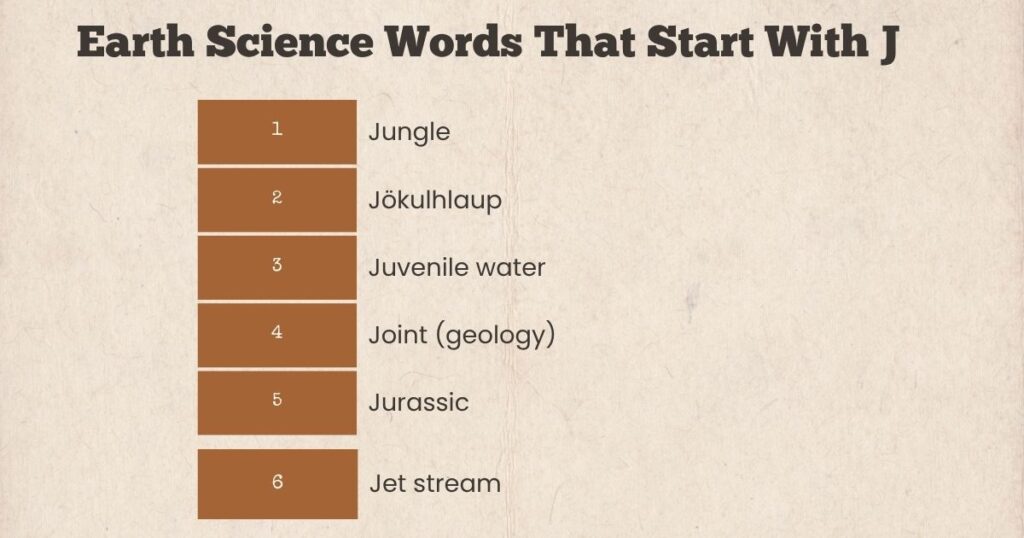
Jet stream — A narrow band of fast-moving wind flowing west to east roughly 6–9 miles above Earth’s surface. Pilots use it to save fuel on long flights. It also steers weather systems across continents, which is why meteorologists track it closely.
Jurassic — A period in Earth’s history lasting from about 201 to 145 million years ago. Dinosaurs like Brachiosaurus and Stegosaurus lived during this time. The name comes from the Jura Mountains in Europe.
Joint (geology) — A crack or fracture in rock where no movement has occurred along the break. Different from a fault. Joints form due to pressure changes, cooling, or tectonic stress.
Juvenile water — Water released from magma during volcanic activity that has never previously been part of the surface water cycle. It comes from inside the Earth itself.
Jökulhlaup — An Icelandic term used in geology for a sudden glacial flood. Happens when meltwater trapped beneath or within a glacier breaks free rapidly. Pronounced “YO-kul-hloyp.”
Jungle — In ecology, a dense tropical or subtropical forest with thick ground-level vegetation. Different from a rainforest, which has a closed canopy that blocks sunlight and keeps the forest floor relatively open.
Space and Astronomy Science Words That Start With J
Jupiter — The fifth planet from the Sun and the largest in the solar system. Its mass exceeds that of all other planets combined. The Great Red Spot is a storm on Jupiter that has lasted for hundreds of years.
James Webb Space Telescope — Launched in December 2021, this telescope observes infrared light from the earliest galaxies ever detected. It sees farther back in cosmic time than any instrument before it.
Jovian — Relating to Jupiter, or describing planets similar to Jupiter — large, gas-based, with no solid surface. Saturn, Uranus, and Neptune are also classified as Jovian planets.
Jet (astronomical) — A narrow stream of high-speed particles ejected from a star, black hole, or active galactic nucleus. Some jets extend for millions of light-years.
Juno spacecraft — NASA’s mission to study Jupiter up close. It entered Jupiter’s orbit in 2016 and has returned detailed data about the planet’s atmosphere, gravity, and magnetic field.
J-type asteroid — A rare class of asteroid with a spectral signature matching the deep interior layers of certain differentiated rocky bodies. Very few have been confirmed so far.
Julian date — A continuous count of days used by astronomers instead of months and years. Every day gets a unique number, making it much easier to calculate time between astronomical events.
Technology and Applied Science Words That Start With J
Java — One of the most widely used programming languages in the world. It runs on a “write once, run anywhere” principle, meaning Java code works on almost any device or operating system.
JavaScript — A scripting language that makes websites interactive. When a webpage responds to a click, updates without refreshing, or animates — that’s usually JavaScript.
JPEG — Stands for Joint Photographic Experts Group. A standard compression format for digital images. Most photos on your phone are stored as JPEGs.
JSON — JavaScript Object Notation. A lightweight format for storing and transferring data between computers. Widely used in apps and web services.
Joystick — An input device used to control movement in computers, games, and aircraft. Developed originally for aviation before gaming adopted it.
Junction transistor — A transistor made of semiconductor material with a p-n junction. The foundation of modern electronics. Billions of these exist inside every computer chip.
Just-in-time (JIT) compilation — A method where code is compiled right before it runs rather than beforehand. This makes programs faster because only the needed portions are processed in the moment.
Grade-Level Breakdown
Science Words That Start With J For Kids
- Jaw — the structure in your face that helps you chew
- Juice — liquid from fruits; studied in food science
- Jump — in physics, a movement using stored muscle energy
- Jupiter — the biggest planet in the solar system
- Joint — where two bones meet in the body
Grade 5 Science Words That Start With J
- Joule — unit of energy
- Juvenile — the young stage of an animal’s life
- Jet stream — a fast wind current high in the atmosphere
- Jurassic — a prehistoric period when dinosaurs lived
- Junction — a point where things connect
6th Grade Science Words That Start With J
- Jejunum — the middle section of the small intestine
- Jovian — describing Jupiter-type gas planets
- J-shaped curve — a graph of exponential population growth
- Juglone — a natural chemical from walnut trees toxic to nearby plants
- Juvenile hormone — the insect hormone that controls maturation
7th Grade Science Words That Start With J
- Jacobson’s organ — a chemical detection organ in snakes and some mammals
- Jarosite — an iron sulfate mineral found in acidic soils and on Mars
- Joule heating — heat generated when current flows through a conductor
- Junk DNA (non-coding DNA) — genetic sequences without protein-coding function
- Jökulhlaup — a sudden glacial flood event
Grade 8 Science Words That Start With J
- Joule-Thomson effect — gas cooling during rapid expansion
- Junction transistor — the semiconductor device at the core of electronics
- Julian date — a continuous day-count system used in astronomy
- Japonilure — a synthetic pheromone used in pest management
- Just-in-time compilation — a performance method in programming
Complete Reference List: 83 Science Words That Start With J
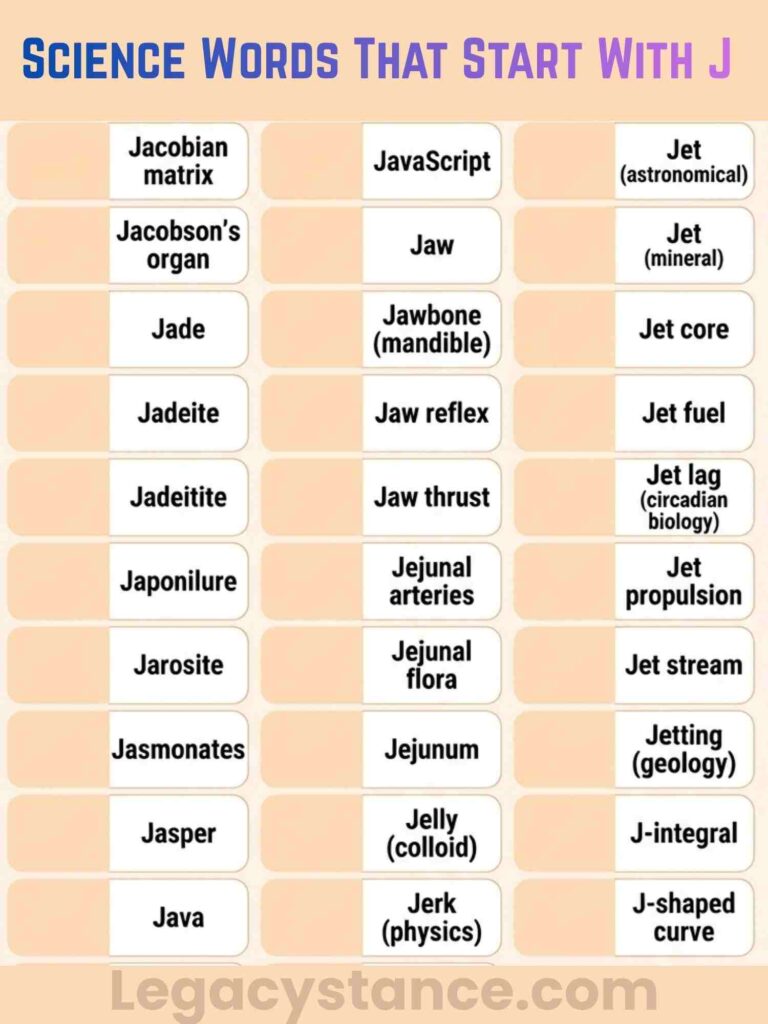
- Jacobian matrix
- Jacobson’s organ
- Jade
- Jadeite
- Jadeitite
- Japonilure
- Jarosite
- Jasmonates
- Jasper
- Java
- JavaScript
- Jaw
- Jawbone (mandible)
- Jaw reflex
- Jaw thrust
- Jejunal arteries
- Jejunal flora
- Jejunum
- Jelly (colloid)
- Jerk (physics)
- Jet (astronomical)
- Jet (mineral)
- Jet core
- Jet fuel
- Jet lag (circadian biology)
- Jet propulsion
- Jet stream
- Jetting (geology)
- J-integral
- J-shaped curve
- J-type asteroid
- J-wave
- Joint (anatomy)
- Joint capsule
- Joint (geology)
- Joint probability
- Joubert syndrome
- Joule
- Joule heating
- Joule per kilogram
- Joule-Thomson effect
- Joulemeter
- Jovian
- Jovian magnetosphere
- Jovian moon
- Jovian ring system
- JPEG
- JSON
- J-coupling (NMR)
- Jugular foramen
- Jugular vein
- Juglone
- Julian calendar
- Julian date
- Julian year
- Junction
- Junction transistor
- Jungle
- Juno spacecraft
- Jupiter
- Jurassic
- Justa-articular
- Just-in-time compilation
- Juvenile
- Juvenile hormone
- Juvenile onset
- Juvenile water
- Juxtamedullary nephron
- Juxtaglomerular apparatus
- Juxtaglomerular cells
- Juxtaposition (cellular)
- Jökulhlaup
- James Webb Space Telescope
- Jaundice
- Jasmine oil
- Jacamar
- Jacobi method
- Jar test
- Jasmonyl
- Joystick
- J-type star
- Juxtapyloric
- Jet lag
Where Science Words Show Up in Real Life
In hospitals: Jugular vein, jaw reflex, jaw thrust, jaundice, Joubert syndrome, and juvenile onset are part of everyday clinical vocabulary. Doctors use these terms in diagnosis and treatment.
In your own body right now: Your joints hold your skeleton together. Your jejunum is absorbing nutrients from your last meal. Your jugular vein is moving blood from your head to your heart as you read this.
In weather reports: The jet stream drives weather system movement across entire continents. Meteorologists mention it almost every time a major storm changes course unexpectedly.
In space missions: Jupiter, James Webb Space Telescope, Jovian moons, the Juno spacecraft, and Julian dates are central to current and ongoing space science.
On your phone and computer: Java powers Android apps. JavaScript runs most websites. Your photos are stored as JPEGs. JSON transfers data every time an app loads content.
In nature outside your window: Juglone from walnut tree roots silently kills competing plants. Juvenile hormone determines whether insects grow normally or stay in larval form when exposed to certain environmental chemicals.
Common Confusions about Science Words That Start With J
Joule vs. Watt — Students mix these constantly. A joule measures total energy. A watt measures the rate of energy use (power). A 60-watt bulb uses 60 joules every single second.
Jungle vs. Rainforest — Not the same place. A rainforest has a thick overhead canopy blocking sunlight, which keeps the ground level relatively sparse. A jungle has dense low-level growth because more light reaches the ground.
Joint (anatomy) vs. Joint (geology) — Same spelling, completely different meaning. One is where bones meet. The other is a crack in rock where no movement occurred.
Juvenile vs. Larval stage — Juvenile animals look like small adults of their species. Larvae look entirely different from the adult form. A juvenile deer looks like a deer. A caterpillar looks nothing like a butterfly.
Junk DNA vs. Non-coding DNA — “Junk DNA” reflected a misunderstanding. The ENCODE project found that most of it has real regulatory roles. “Non-coding DNA” is now the accurate term.
J-shaped curve vs. S-shaped curve — A J-curve shows unlimited exponential growth with no resource constraints. An S-curve (logistic growth) shows what happens when resources run out and the growth rate slows naturally.
Read also: 120 Adjectives That Start With C (With Meanings & Examples)
FAQ
Are science words starting with J harder than other letters?
Not harder — just fewer. Most scientific vocabulary comes from Latin and Greek roots, and J is a rare letter in both languages. That’s why building a list of 80+ J science words takes more effort than, say, C or P words.
Which J science words appear most on standardized tests?
Joule, joint, Jurassic, jet stream, and juvenile appear most often in middle school science assessments. Jovian and junction transistor appear more in high school physics and biology.
Why do so many anatomy terms start with J?
They come from Latin. Jugular comes from jugulum (throat). Jejunum comes from jejunus (empty — because this section of the intestine is usually found empty after death). Latin anatomists named structures based on what they observed.
Is “junk DNA” still scientifically accurate?
Not really. The ENCODE project showed that most so-called junk DNA influences how and when genes are expressed. Scientists now use specific terms like introns, transposons, or regulatory sequences instead of the catch-all “junk” label.
What You Now Have
You came here for science words starting with J. You’re leaving with 83 terms, real-world context across every major science field, a clean grade-level breakdown from elementary through 8th grade, a full reference list, and clear answers to the confusions that trip up most students.
These words connect to real things — your joints are working right now, the jet stream is moving weather systems somewhere on Earth right now, and Jupiter has orbited the Sun billions of times before any of us existed. That’s what makes vocabulary worth learning.