Learning math becomes much easier when you understand the language behind it. This collection of Math Words That Start With I brings together important terms used in arithmetic, algebra, geometry, statistics, calculus, and beyond. Whether you’re a student, parent, or teacher, these words can help make math concepts clearer and easier to apply.
From everyday terms like integer and inequality to advanced ideas such as integral and isomorphism, this guide explains each concept in a simple way. Use it as a quick reference, study aid, or vocabulary builder whenever you come across an unfamiliar math term.
Quick List: 100+ Math Words That Start With I
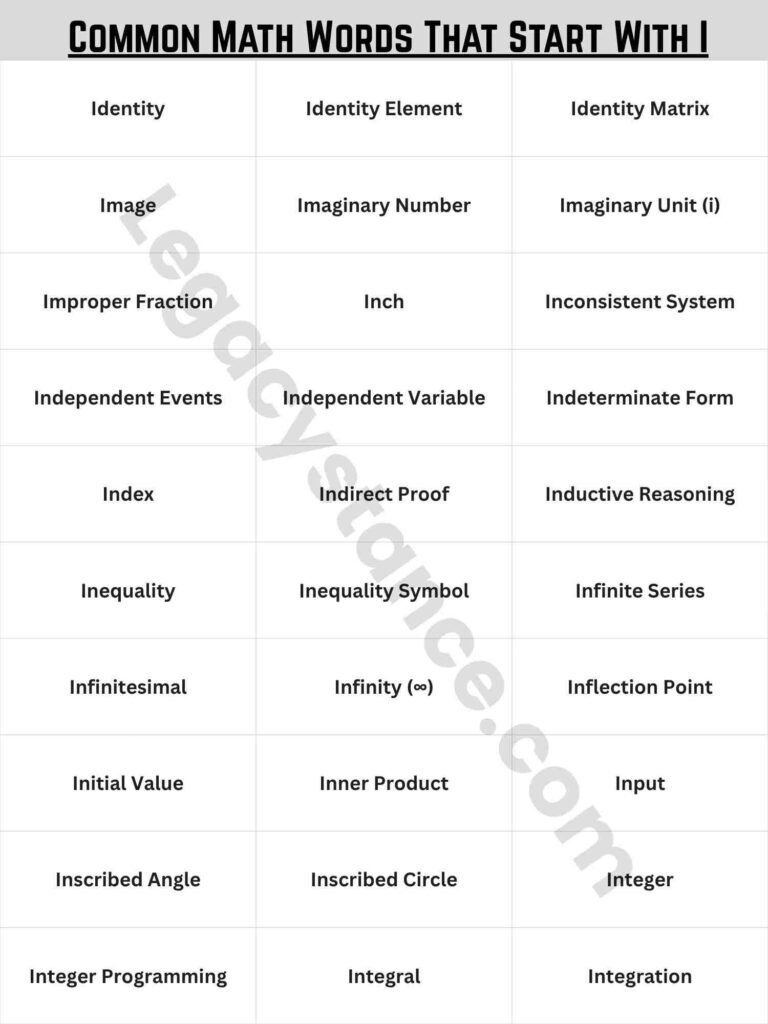
- Identity
- Identity Element
- Identity Matrix
- Image
- Imaginary Number
- Imaginary Unit (i)
- Improper Fraction
- Inch
- Inconsistent System
- Independent Events
- Independent Variable
- Indeterminate Form
- Index
- Indirect Proof
- Inductive Reasoning
- Inequality
- Inequality Symbol
- Infinite Series
- Infinitesimal
- Infinity (∞)
- Inflection Point
- Initial Value
- Inner Product
- Input
- Inscribed Angle
- Inscribed Circle
- Integer
- Integer Programming
- Integral
- Integration
- Intercept
- Intercept Form
- Interior
- Interior Angle
- Intermediate Value Theorem
- Interpolation
- Interquartile Range (IQR)
- Intersection
- Interval
- Invariant
- Inverse
- Inverse Function
- Inverse Matrix
- Inverse Operation
- Inverse Proportion
- Inverse Variation
- Irrational Number
- Isogonal Conjugate
- Isometry
- Isomorphism
- Isosceles Trapezoid
- Isosceles Triangle
- Iteration
- Icosahedron
- Ideal (Ring Theory)
- Idempotent
- Incenter
- Incidence Matrix
- Included Angle
- Included Side
- Increment
- Indefinite Integral
- Index Notation
- Indicator Variable
- Indirect Measurement
- Indirect Variation
- Infix Notation
- Injection (Injective Function)
- Input-Output Table
- Integer Factorization
- Integer Sequence
- Integrand
- Interest (Compound)
- Interest (Simple)
- Interior of a Circle
- Interval Notation
- Inverse Sine (arcsin)
- Inverse Cosine (arccos)
- Inverse Tangent (arctan)
- Iterated Function
- Iterated Integral
- Icosagon (20-sided polygon)
- Inradius
- Inscribed Polygon
- Integral Test
- Integrating Factor
- Interchange of Limits
- Interior Point
- Intermediate Value
- Inverse Proportion
- Inverse Square Law
- Isentropic (applied math)
- Isolated Point
- Isolated Solution
- Isosceles Right Triangle
- Iterative Method
- Integer Part (floor function)
- Improper Integral
- Independent System
Common Math Words That Start With I
Identity
Meaning: A statement that is always true regardless of the values used.
Example: 5 + 0 = 5 (additive identity). 7 × 1 = 7 (multiplicative identity).
Why It Matters: Identity properties are used to simplify expressions and solve equations at every level of algebra.
Identity Element
Meaning: The value that leaves another number unchanged when an operation is applied.
Example: 0 is the identity element for addition. 1 is the identity element for multiplication.
Why It Matters: This concept builds into group theory and abstract algebra.
Identity Matrix
Meaning: A square matrix with 1s on the diagonal and 0s everywhere else. Multiplying any matrix by it leaves the matrix unchanged.
Example: A 2×2 identity matrix looks like: [[1,0],[0,1]].
Why It Matters: It plays the same role as 1 does in regular multiplication, but for matrices.
Image
Meaning: The result of a shape or point after a geometric transformation.
Example: Reflect triangle ABC over the y-axis — triangle A’B’C’ is the image.
Why It Matters: Every transformation problem asks you to find, draw, or describe the image.
Improper Fraction
Meaning: A fraction where the numerator is larger than or equal to the denominator.
Example: 9/4 is improper. It equals the mixed number 2¼.
Why It Matters: Required for fraction multiplication, division, and algebraic expressions.
Inch
Meaning: A U.S. customary unit of length. 12 inches = 1 foot.
Example: A standard ruler is 12 inches.
Why It Matters: Measurement and geometry word problems regularly use inches.
Inconsistent System
Meaning: A system of equations with no solution — the lines are parallel and never meet.
Example: y = 2x + 1 and y = 2x + 5 are parallel; they never intersect.
Why It Matters: Identifying inconsistent systems prevents wasted effort trying to solve something unsolvable.
Independent Events
Meaning: Two events where the outcome of one does not affect the other.
Example: Flipping a coin and rolling a die are independent events.
Why It Matters: Calculating combined probabilities requires knowing whether events are independent.
Independent Variable
Meaning: The variable you control or choose. It drives changes in the dependent variable.
Example: In y = 3x + 1, x is independent because you pick its value.
Why It Matters: Correctly identifying variables is essential for setting up graphs, experiments, and equations.
Indirect Proof
Meaning: Proving a statement by assuming the opposite is true and showing that leads to a contradiction.
Example: Proving √2 is irrational uses indirect proof — assume it’s rational, then derive a contradiction.
Why It Matters: Many important mathematical proofs use this method, including classic ones in number theory and geometry.
Inductive Reasoning
Meaning: Drawing a general conclusion from observed patterns in specific cases.
Example: Noticing 2, 4, 6, 8 are all even and concluding all even numbers are divisible by 2.
Why It Matters: This is how mathematicians form conjectures before proving them formally.
Inequality
Meaning: A statement showing two values are not equal, using <, >, ≤, or ≥.
Example: x > 4 means x is any number greater than 4.
Why It Matters: Inequalities model real constraints — budgets, limits, ranges, and optimization problems.
Inequality Symbol
Meaning: The symbols used to compare values: < (less than), > (greater than), ≤ (less than or equal), ≥ (greater than or equal), ≠ (not equal).
Example: 7 ≠ 5 means 7 is not equal to 5.
Why It Matters: Misreading an inequality symbol reverses the entire answer.
Infinity (∞)
Meaning: A concept representing a value larger than any real number. Not a number itself — a concept of endlessness.
Example: The number line extends to infinity in both directions.
Why It Matters: Infinity appears in limits, series, integrals, and set theory throughout higher math.
Initial Value
Meaning: The starting value of a function or sequence, typically when x = 0 or at the beginning of a problem.
Example: In y = 3x + 7, the initial value is 7.
Why It Matters: Initial values anchor real-world models like population growth or compound interest.
Input
Meaning: The value fed into a function. Also called the domain value or independent variable.
Example: In f(x) = x² + 1, if input = 3, output = 10.
Why It Matters: Understanding input-output relationships is fundamental to all function work.
Input-Output Table
Meaning: A table listing inputs alongside their corresponding outputs for a function.
Example: Input 1 → Output 4, Input 2 → Output 7, Input 3 → Output 10 (rule: ×3 + 1).
Why It Matters: Helps students identify patterns and rules before writing formal function notation.
Inscribed Angle
Meaning: An angle formed inside a circle with its vertex on the circle and both sides as chords.
Example: If an arc measures 80°, the inscribed angle intercepting it is 40°.
Why It Matters: The Inscribed Angle Theorem is a key result in circle geometry.
Inscribed Circle
Meaning: A circle inside a polygon that touches every side exactly once. Also called the incircle.
Example: A triangle’s inscribed circle touches all three sides.
Why It Matters: Finding the incircle and inradius is common in geometry problems.
Integer
Meaning: Any whole number — positive, negative, or zero. No decimals or fractions.
Example: –5, 0, 3, 47 are integers. 2.5 is not.
Why It Matters: Integers are the foundation of number theory and appear in virtually every math topic.
Integer Factorization
Meaning: Breaking an integer into a product of smaller integers (its factors).
Example: 36 = 2 × 2 × 3 × 3.
Why It Matters: Used in simplifying fractions, finding GCF, and cryptography.
Intercept
Meaning: Where a line or curve crosses an axis. The x-intercept crosses the x-axis; y-intercept crosses the y-axis.
Example: In y = 2x + 6, the y-intercept is 6; the x-intercept is –3.
Why It Matters: Intercepts are the most direct way to read information off a graph.
Intercept Form
Meaning: The equation of a line written as x/a + y/b = 1, where a is the x-intercept and b is the y-intercept.
Example: x/3 + y/6 = 1 crosses the x-axis at 3 and the y-axis at 6.
Why It Matters: Useful when intercepts are given directly in word problems.
Interest — Simple
Meaning: Interest calculated only on the original principal.
Formula: I = P × R × T
Example: $1,000 at 5% for 3 years = $150 interest.
Why It Matters: Appears in real loan and savings problems.
Interest — Compound
Meaning: Interest calculated on the principal plus all previously earned interest.
Example: The same $1,000 grows faster with compound interest because each period’s interest earns more interest.
Why It Matters: Most real financial products use compound interest. Understanding it has direct money value.
Interior
Meaning: The inside region of a geometric figure.
Example: The interior of a triangle is the region enclosed by its three sides.
Why It Matters: Distinguishing interior from exterior matters in angle problems and area calculations.
Interior Angle
Meaning: An angle formed inside a polygon between two adjacent sides.
Example: Each interior angle of an equilateral triangle is 60°.
Why It Matters: Interior angle sum formulas (180° for triangles, 360° for quadrilaterals) are tested constantly.
Intermediate Value Theorem
Meaning: If a function is continuous on [a, b], it takes every value between f(a) and f(b) at least once.
Example: If f(1) = –2 and f(4) = 5, then f equals 0 somewhere between x = 1 and x = 4.
Why It Matters: Guarantees solutions exist even when you can’t find them directly.
Interpolation
Meaning: Estimating an unknown value between two known data points.
Example: Knowing temperature at 2 PM and 4 PM, estimate it at 3 PM.
Why It Matters: Widely used in data analysis, weather models, and scientific research.
Interquartile Range (IQR)
Meaning: The difference between the third quartile (Q3) and first quartile (Q1). Measures spread of the middle 50% of data.
Formula: IQR = Q3 − Q1
Example: Q1 = 10, Q3 = 22 → IQR = 12.
Why It Matters: More reliable than range because it ignores extreme outliers.
Intersection
Meaning: In sets, the elements two sets share. In geometry, where two shapes or lines meet.
Example (sets): A = {1,2,3}, B = {2,3,4} → A ∩ B = {2,3}.
Example (geometry): Two streets crossing form an intersection.
Why It Matters: Appears in probability, set theory, and coordinate geometry.
Interval
Meaning: All numbers between two endpoints on a number line.
Example: [3, 7] means all numbers from 3 to 7, endpoints included.
Why It Matters: Intervals describe solution sets for inequalities and domains for functions.
Interval Notation
Meaning: A shorthand way to write intervals using brackets and parentheses. Square brackets [ ] mean endpoints included; round brackets ( ) mean excluded.
Example: (2, 5] means greater than 2 and up to and including 5.
Why It Matters: Standard notation in algebra and calculus for expressing ranges.
Inverse
Meaning: The opposite or reverse of a mathematical object or operation.
Example: The additive inverse of 5 is –5. The multiplicative inverse of 4 is ¼.
Why It Matters: Inverses are used to solve equations by “undoing” operations.
Inverse Function
Meaning: A function that reverses another function’s mapping. If f maps x to y, then f⁻¹ maps y back to x.
Example: If f(x) = 2x, then f⁻¹(x) = x/2.
Why It Matters: Foundation for solving equations, working with logarithms, and understanding function behavior.
Inverse Operation
Meaning: The operation that undoes another.
Example: Subtraction undoes addition. Division undoes multiplication.
Why It Matters: Every equation-solving step relies on applying inverse operations.
Inverse Proportion
Meaning: As one quantity increases, the other decreases proportionally. Their product is constant.
Example: 4 workers finish in 6 days. 8 workers finish in 3 days. (4×6 = 8×3 = 24)
Why It Matters: Common in physics, work-rate problems, and applied math.
Inverse Variation
Meaning: A specific relationship y = k/x where k is a constant. As x grows, y shrinks.
Example: If k = 12, then when x = 3, y = 4; when x = 6, y = 2.
Why It Matters: Models many real situations: speed vs. travel time, pressure vs. volume.
Irrational Number
Meaning: A number that cannot be written as a fraction. Its decimal never ends and never repeats.
Example: √2 = 1.41421356… — it goes forever without repeating.
Why It Matters: Key concept in number theory and understanding exact vs. approximate values.
Isosceles Trapezoid
Meaning: A trapezoid with equal non-parallel sides (legs) and equal base angles.
Example: A trapezoid where both legs measure 5 cm and the base angles are equal.
Why It Matters: Appears in symmetry problems and coordinate geometry proofs.
Isosceles Triangle
Meaning: A triangle with exactly two equal sides and two equal base angles.
Example: Sides of 5, 5, and 8 cm form an isosceles triangle.
Why It Matters: Its properties appear in proofs, constructions, and standardized test problems.
Iteration
Meaning: Repeating a process using the previous result as the new starting point.
Example: Newton’s Method finds roots by iterating a formula until results stabilize.
Why It Matters: Iteration drives numerical methods and algorithms throughout applied math and computing.
Advanced Math Words That Start With I
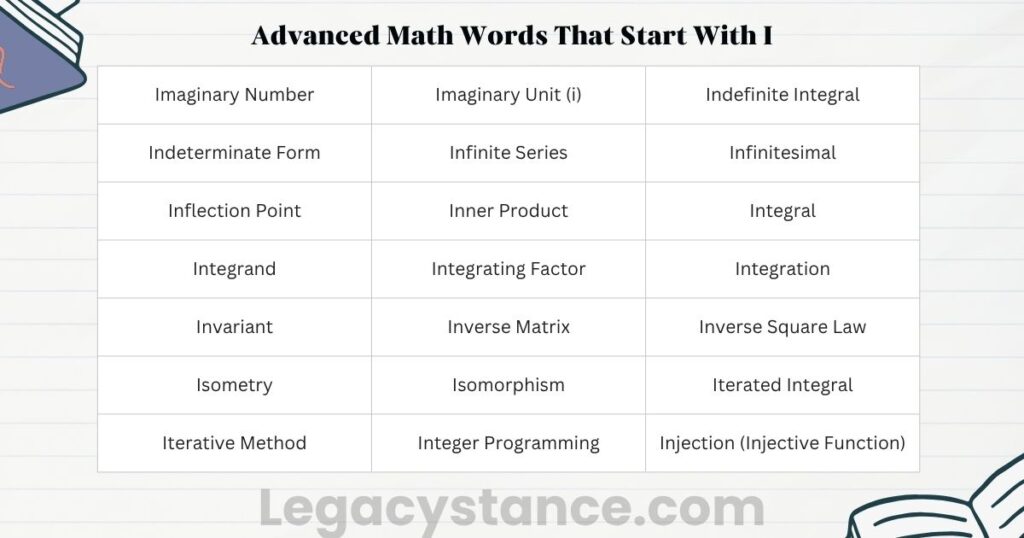
Imaginary Number
Meaning: A number involving √(–1), written using i where i² = –1.
Example: √(–9) = 3i.
Branch: Complex Numbers.
Real-World Use: Electrical engineering, signal processing, and quantum mechanics all depend on imaginary numbers.
Imaginary Unit (i)
Meaning: The fundamental unit defined as i = √(–1).
Example: i² = –1, i³ = –i, i⁴ = 1. The powers cycle in groups of four.
Branch: Complex Numbers.
Why It Matters: Without defining i, complex number math cannot exist.
Indefinite Integral
Meaning: The antiderivative of a function — integration without specific boundary values. Always includes + C (constant of integration).
Example: The indefinite integral of 3x² is x³ + C.
Branch: Calculus.
Why It Matters: Solving differential equations starts with finding indefinite integrals.
Indeterminate Form
Meaning: A limit expression that cannot be evaluated by direct substitution, such as 0/0 or ∞/∞.
Example: lim(x→0) sin(x)/x appears to be 0/0 but equals 1 using L’Hôpital’s Rule.
Branch: Calculus.
Why It Matters: Recognizing and resolving indeterminate forms is a core calculus skill.
Infinite Series
Meaning: The sum of infinitely many terms following a defined pattern.
Example: 1 + ½ + ¼ + ⅛ + … converges to 2.
Branch: Calculus / Analysis.
Real-World Use: Computing π, modeling waves, and powering numerical algorithms.
Infinitesimal
Meaning: A quantity greater than zero but smaller than any measurable positive number — approaching zero without reaching it.
Example: The change Δx in a derivative becomes infinitesimal as it approaches 0.
Branch: Calculus.
Why It Matters: The conceptual foundation of differentiation and integration.
Inflection Point
Meaning: A point on a curve where concavity changes — from curving upward to downward, or vice versa.
Example: For y = x³, the point (0, 0) is an inflection point.
Branch: Calculus.
Real-World Use: Shows where growth or decline shifts direction — used in economics and data modeling.
Inner Product
Meaning: An operation on two vectors producing a single number (scalar). Also called the dot product in standard space.
Example: [1, 2] · [3, 4] = (1×3) + (2×4) = 11.
Branch: Linear Algebra.
Real-World Use: Machine learning, physics projections, and computer graphics.
Integral
Meaning: The result of integration — measures the area under a curve between two points.
Example: The integral of f(x) = 2x from 0 to 3 equals 9.
Branch: Calculus.
Real-World Use: Calculates displacement, area, volume, work, and probability.
Integrand
Meaning: The function being integrated — the expression written between the integral symbol and dx.
Example: In ∫(3x²)dx, the integrand is 3x².
Branch: Calculus.
Why It Matters: Identifying the integrand is the first step in evaluating any integral.
Integrating Factor
Meaning: A function multiplied through a differential equation to make it easier to integrate.
Example: Used in solving first-order linear differential equations like dy/dx + P(x)y = Q(x).
Branch: Differential Equations.
Why It Matters: Transforms a difficult equation into a solvable one.
Integration
Meaning: The process of finding an integral — the reverse of differentiation.
Example: Integrating 3x² gives x³ + C.
Branch: Calculus.
Real-World Use: Calculates area, volume, work, and modeled quantities that accumulate over time.
Invariant
Meaning: A quantity or property that remains unchanged after a transformation or operation.
Example: The determinant of a matrix can be invariant under certain row operations.
Branch: Abstract Algebra / Geometry.
Why It Matters: Invariants simplify complex proofs by identifying what stays constant.
Inverse Matrix
Meaning: For matrix A, the inverse A⁻¹ is the matrix satisfying A × A⁻¹ = I (identity matrix).
Example: If A = [[2,0],[0,3]], then A⁻¹ = [[½,0],[0,⅓]].
Branch: Linear Algebra.
Real-World Use: Solves systems of linear equations in engineering and computing.
Inverse Square Law
Meaning: A relationship where a quantity decreases proportionally to the square of the distance from a source.
Example: Doubling your distance from a light source reduces its intensity to ¼ of the original.
Branch: Applied Mathematics / Physics.
Real-World Use: Gravity, light intensity, and sound all follow inverse square laws.
Isometry
Meaning: A transformation that preserves all distances — the shape and size stay identical.
Example: Reflections, rotations, and translations are all isometries.
Branch: Geometry / Group Theory.
Real-World Use: Computer animation, robotics, and geographic mapping.
Isomorphism
Meaning: A structure-preserving one-to-one mapping between two mathematical structures that behave identically.
Example: Integers under addition and even integers under addition are isomorphic.
Branch: Abstract Algebra.
Why It Matters: Reveals when two different-looking mathematical systems are fundamentally the same.
Iterated Integral
Meaning: A multiple integral evaluated one variable at a time, working from the inside out.
Example: ∫∫f(x,y)dy dx evaluates the inner integral first (with respect to y), then the outer.
Branch: Multivariable Calculus.
Real-World Use: Calculating volumes, surface areas, and double-variable probabilities.
Iterative Method
Meaning: A technique for solving problems by repeatedly improving an approximate answer.
Example: Newton’s Method refines guesses for roots of equations step by step.
Branch: Numerical Analysis.
Real-World Use: Used in engineering simulations, financial models, and scientific computing where exact solutions are impractical.
Integer Programming
Meaning: An optimization method where some or all variables must be integers.
Example: Scheduling shifts — you can’t assign half a worker.
Branch: Applied Mathematics / Operations Research.
Real-World Use: Airline scheduling, logistics, and supply chain management.
Injection (Injective Function)
Meaning: A function where every unique input maps to a unique output — no two inputs share an output. Also called one-to-one.
Example: f(x) = 2x is injective. f(x) = x² is not — both 3 and –3 map to 9.
Branch: Set Theory / Functions.
Why It Matters: Injectivity is required for a function to have an inverse.
Ideal (Ring Theory)
Meaning: A subset of a ring that absorbs multiplication from the ring. Closed under addition and under multiplication by any ring element.
Example: Even integers form an ideal within the integers.
Branch: Abstract Algebra.
Why It Matters: Ideals are used to construct quotient rings — central objects in modern algebra.
Idempotent
Meaning: An element where applying an operation twice gives the same result as applying it once.
Example: In Boolean algebra, 1 AND 1 = 1. Projecting a projected vector gives the same vector.
Branch: Abstract Algebra / Linear Algebra.
Why It Matters: Appears in matrix algebra, logic circuits, and functional programming.
Rare and Specialized Math Words That Start With I
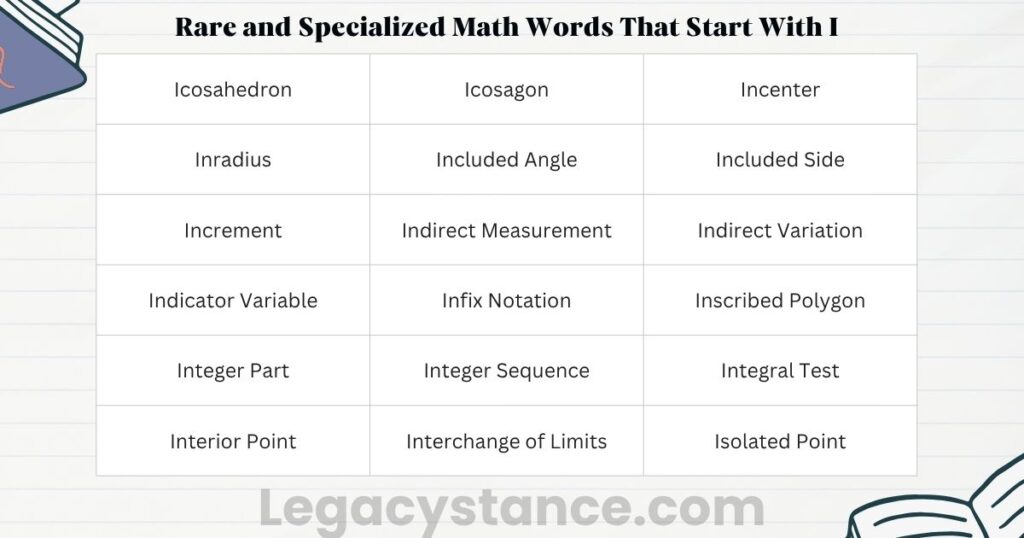
Icosahedron — A 3D solid with 20 equilateral triangular faces. One of the five Platonic solids.
Icosagon — A polygon with 20 sides. Interior angle sum = (20–2) × 180° = 3,240°.
Incenter — The point inside a triangle where all three angle bisectors meet. It is the center of the inscribed circle.
Inradius — The radius of the inscribed circle of a polygon, measured from the incenter to any side.
Included Angle — The angle formed between two given sides of a triangle. Used in SAS congruence.
Included Side — The side between two given angles of a triangle. Used in ASA congruence.
Increment — A small positive change in a variable, often written as Δx.
Indirect Measurement — Finding a measurement you cannot take directly using proportions or similar triangles.
Indirect Variation — Another name for inverse variation: y = k/x.
Indicator Variable — A variable that takes only the value 0 or 1 to represent the absence or presence of a category. Also called a dummy variable.
Infix Notation — Writing an operator between its operands: 3 + 4. Standard in everyday arithmetic.
Inscribed Polygon — A polygon with all vertices touching a circle.
Integer Part — The whole number part of a decimal, same as the floor function for positive numbers. Example: integer part of 3.7 is 3.
Integer Sequence — An ordered list of integers following a rule. Example: 1, 1, 2, 3, 5, 8 (Fibonacci sequence).
Integral Test — A test using integrals to determine whether an infinite series converges or diverges.
Interior Point — A point that lies strictly inside a region, not on its boundary.
Interchange of Limits — A technique in advanced calculus for swapping the order of limits in a double integral or iterated limit, valid under specific conditions.
Isolated Point — A point in a set that has no neighboring points from the same set immediately around it.
Isosceles Right Triangle — A right triangle where the two legs are equal. Its angles are 45°–45°–90°.
Isogonal Conjugate — In triangle geometry, the reflection of a cevian line over the angle bisector. Used in Olympiad-level geometry problems.
Math Words That Start With I Categories at a Glance
Geometry terms starting with I:
Identity Matrix, Image, Icosahedron, Icosagon, Incenter, Included Angle, Included Side, Inradius, Inscribed Angle, Inscribed Circle, Inscribed Polygon, Interior, Interior Angle, Interior Point, Isometry, Isosceles Right Triangle, Isosceles Trapezoid, Isosceles Triangle, Isogonal Conjugate
Algebra and functions terms starting with I:
Identity, Identity Element, Inconsistent System, Index, Index Notation, Indirect Variation, Inequality, Inequality Symbol, Initial Value, Input, Input-Output Table, Intercept, Intercept Form, Interval, Interval Notation, Inverse, Inverse Function, Inverse Operation, Inverse Proportion, Inverse Variation
Number theory terms starting with I:
Integer, Integer Factorization, Integer Part, Integer Sequence, Irrational Number
Statistics and probability terms starting with I:
Independent Events, Independent Variable, Indicator Variable, Interpolation, Interquartile Range (IQR)
Calculus and analysis terms starting with I:
Improper Integral, Indefinite Integral, Indeterminate Form, Infinite Series, Infinitesimal, Inflection Point, Integrand, Integrating Factor, Integration, Integral, Integral Test, Intermediate Value Theorem, Interchange of Limits, Iterated Integral, Iteration, Iterative Method
Linear and abstract algebra terms starting with I:
Ideal, Idempotent, Identity Matrix, Injection, Inner Product, Invariant, Inverse Matrix, Isomorphism
Applied math terms starting with I:
Indirect Measurement, Integer Programming, Inverse Square Law, Infix Notation
Finance math:
Interest (Simple), Interest (Compound)
Complex numbers:
Imaginary Number, Imaginary Unit (i), Infinity
Math Words That Start With I of Real-World Applications
Finance: Simple and compound interest directly affect loans, savings accounts, and mortgages. These are not abstract — they determine how much you pay or earn.
Data analysis: IQR appears in every box plot and data summary. Interpolation fills gaps in weather forecasting, medical monitoring, and economic models.
Technology: Imaginary numbers run electrical circuits and signal processors. Inner products power search engines and recommendation algorithms. Integer programming schedules airline crews, hospital staff, and delivery fleets.
Geometry and engineering: Isometries are used in robotics, animation, and GPS mapping. Inscribed circles appear in architectural design and engineering fit-tolerance calculations.
Science: Integrals calculate displacement, stored energy, and probability. Inflection points reveal where disease spread slows, where a market turns, or where a structural load peaks.
Tips for Remembering Math Words That Start With I
Use the “family” trick. Inverse operation, inverse function, inverse matrix, inverse proportion — all share one core idea: reversing. Learn the family, and each member makes more sense.
Connect words to actions. Don’t just read “iteration” — actually repeat a calculation five times by hand. The word will stick to the experience.
Spot roots and prefixes. “In–” often means not (irrational, inconsistent, indeterminate) or into/within (integral, interior, inscribed). Recognizing this helps you guess meanings when you encounter new terms.
Use the word in a real sentence. Writing “The IQR of this data set is 12, so the spread is moderate” is ten times more effective than copying a definition.
Commonly Confused I Math Terms
Integer vs. Whole Number
Integers include all negative whole numbers, zero, and positive whole numbers. Whole numbers typically start at 0 (sometimes 1) and go up only. So –4 is an integer but not a whole number.
Inverse Function vs. Inverse Operation
An inverse operation works at the arithmetic level — subtraction undoes addition. An inverse function works at the function level — f⁻¹ reverses f(x). Related idea, different level of math.
Intercept vs. Intersection
An intercept is specifically where a graph crosses an axis. An intersection is any point where two curves or lines meet — on or off an axis. Every intercept is a special type of intersection.
Irrational Number vs. Imaginary Numbe
Irrational numbers sit on the real number line — you can point to √2 between 1.4 and 1.5. Imaginary numbers don’t exist on the real number line at all. One is hard to write as a fraction; the other doesn’t exist in real space.
Interpolation vs. Extrapolation
Interpolation estimates within the range of your known data. Extrapolation estimates beyond that range. Interpolation is more reliable because you’re working inside what’s already measured.
Indefinite Integral vs. Definite Integral
A definite integral gives a specific number — the area between two boundary values. An indefinite integral gives a general function (plus C) — all possible antiderivatives. Same process, different purpose.
Read more:
60+ Math Words That Start With G
100+ Math Words That Start With F
80+ Math Words That Start With H
FAQs
Why is math vocabulary important for students?
Math vocabulary helps students understand instructions, solve problems correctly, and explain their thinking. Knowing the meaning of key terms often makes difficult questions much easier to tackle.
Which Math Words That Start With I are most useful to learn first?
Start with common terms such as integer, inequality, input, inverse, intercept, and improper fraction. These appear often in school math and provide a strong foundation for later topics.
How can I remember new math terms more easily?
Connect each word to an example, picture, or real-life situation. Using the term in a sentence or solving a problem with it helps the meaning stick much longer than memorizing definitions alone.
Are these math words used outside the classroom?
Yes. Terms like interest, interpolation, integral, and integer programming are used in finance, engineering, technology, data analysis, and many everyday applications.
What’s the difference between learning formulas and learning math vocabulary?
Formulas tell you what to calculate, while vocabulary helps you understand what the problem is asking. Strong math skills require both working together.
Conclusion
Math words beginning with I cover every level of the subject — from the integers and inches you meet in early grades to integrals and isomorphisms in university-level courses. Some of these words appear in every math class you’ll ever take. Others surface in specific branches like statistics, calculus, or abstract algebra.
All of them are real, useful, and worth knowing. Learn the ones at your level, keep the advanced ones as reference, and come back to this list whenever a term stops you mid-problem.