
Learning Science Words That Start With N can feel easier when they are clear, simple, and grouped in a way that makes sense. This guide is designed for students, parents, and anyone who wants quick understanding without confusion. Instead of long textbook explanations, you’ll find practical meanings you can actually remember and use in class or daily life.
From basic terms like nucleus and neuron to advanced ideas like nuclear energy and natural selection, this list helps you build real science vocabulary step by step without feeling overwhelmed.
20 Most-Used Science Words That Start With N
Nucleus — Control center of a cell; or dense core of an atom
Neutron — Neutral particle inside an atom’s nucleus
Nitrogen — Gas making up 78% of Earth’s air
Nerve — Fiber bundle that carries signals through your body
Nanometer — One billionth of a meter
Natural selection — Process where best-fit organisms survive and reproduce
Nebula — Cloud of gas and dust in space where stars form
Neuron — Cell that sends electrical signals in the nervous system
Noble gas — Unreactive gas like helium, neon, or argon
Nutrient — Substance living things need to grow
Niche — An organism’s specific role in its ecosystem
Nocturnal — Active at night
Neon — Noble gas that glows orange-red when electrified
Nephron — Tiny filtering unit inside the kidney
Nonrenewable — Resource that can’t be replaced on a human timescale
Nanotechnology — Engineering at atomic and molecular scale
Newton — Unit of force in physics
Nitrogen cycle — Movement of nitrogen through air, soil, and living things
Nucleotide — Building block of DNA and RNA
Nuclear energy — Energy released from an atom’s nucleus
Physics Science Words That Start With N
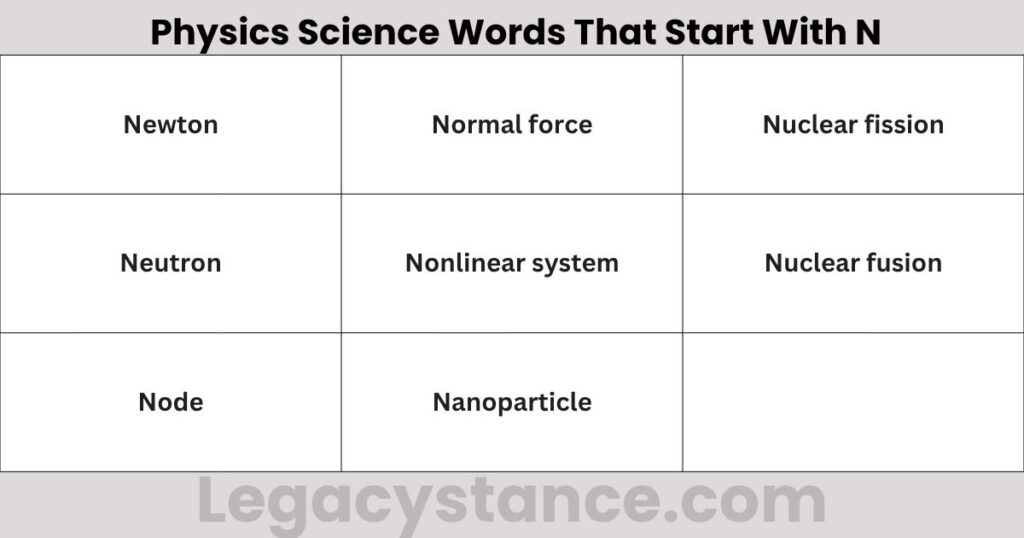
Newton — The unit for measuring force. Push a door open — you’re applying newtons. Comes directly from Newton’s Second Law: force = mass × acceleration.
Neutron — Found in every atomic nucleus except hydrogen’s. No electric charge, which is what makes it “neutral.” Adding or removing neutrons from an atom creates different isotopes of the same element.
Node — In wave physics, the point that stays completely still while the rest of the wave moves. On a vibrating guitar string, the ends that don’t move are nodes.
Normal force — The push a surface gives back when something rests on it. Stand on the floor — the floor pushes up on you with equal force. That’s normal force.
Nonlinear system — One where a small input can cause a wildly different output. Weather is nonlinear. A tiny pressure change today can become a storm next week.
Nanoparticle — A particle between 1 and 100 nanometers. At this scale, materials behave differently than their larger versions — same atoms, completely different properties.
Nuclear fission — Splitting a heavy atom’s nucleus, releasing large amounts of energy. This is what nuclear power plants use to generate electricity.
Nuclear fusion — The opposite of fission: combining two light nuclei into one, releasing even more energy. It powers the Sun. Scientists are still working to replicate it on Earth.
Chemistry Science Words That Start With N
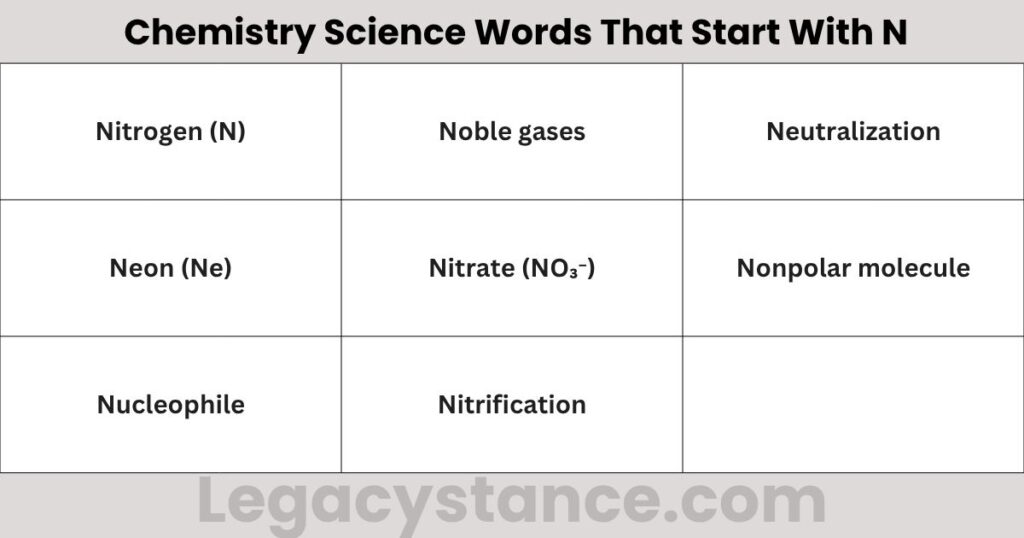
Nitrogen (N) — Element 7. About 78% of the air you breathe is nitrogen. Plants need it to build proteins, which is why fertilizers are packed with nitrogen compounds.
Noble gases — The far-right column of the periodic table. Their outer electron shells are already full, so they almost never react with anything. That stability makes them genuinely useful — argon protects welding, helium fills balloons, xenon powers certain spacecraft thrusters.
Neutralization — When an acid and base react and cancel each other out, producing water and a salt. Antacid tablets work this way — the base neutralizes excess stomach acid.
Neon (Ne) — Element 10. Glows bright orange-red when electricity runs through it. “Neon signs” became iconic because of this effect, though many colored signs use other gases entirely.
Nitrate (NO₃⁻) — A compound of nitrogen and oxygen. Found in fertilizers and preserved meats. High nitrate levels in drinking water are an ongoing environmental concern.
Nonpolar molecule — One where electrical charge is evenly spread. Oil is nonpolar. Water is polar. That difference is exactly why they don’t mix.
Nucleophile — A molecule attracted to positive charge that donates electrons to form bonds. The name literally means “nucleus lover” in Greek.
Nitrification — The process where bacteria convert ammonia in soil into nitrites, then nitrates. It’s a critical step in the nitrogen cycle and in wastewater treatment.
Biology Science Words That Start With N
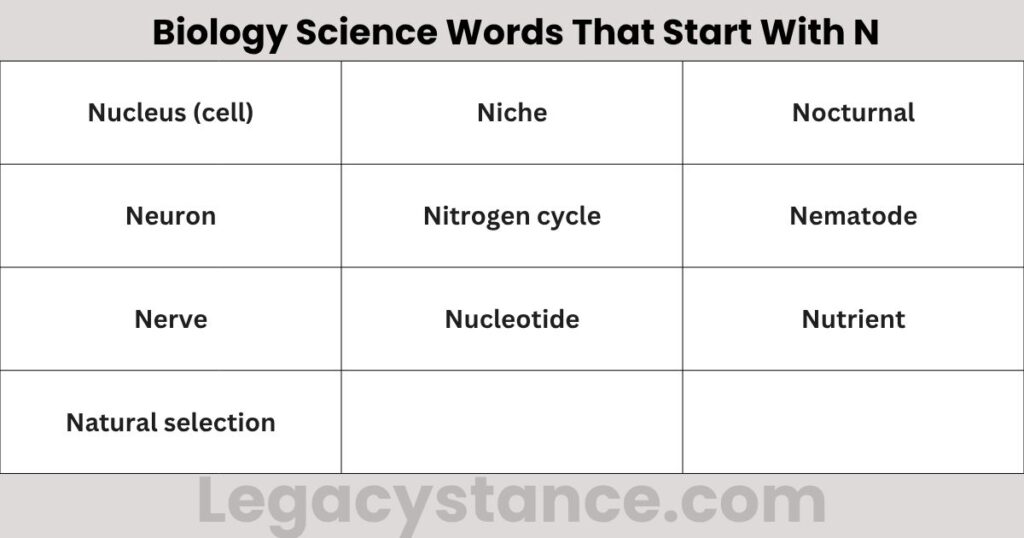
Nucleus (cell) — Every cell in your body except red blood cells has one. It holds your DNA and acts as the command center — deciding which proteins get made and when.
Neuron — The basic unit of your nervous system. Neurons send electrical signals at speeds up to 270 mph. Right now, neurons are firing so you can read this sentence.
Nerve — A bundle of neuron fibers grouped together like cables. The sciatic nerve, running from your lower back to your foot, is the longest nerve in the human body. Don’t confuse nerves with neurons — a nerve is the bundle, a neuron is a single cell inside it.
Natural selection — Darwin’s core observation: organisms with better-suited traits survive longer and reproduce more. Over generations, those traits spread. No plan involved — just survival and reproduction repeated across thousands of years.
Niche — Every organism fills a specific role. A bee pollinates flowers, makes honey, and is prey for certain birds. Two species can’t share the exact same niche in the same place — one will always outcompete the other.
Nitrogen cycle — Nitrogen moves from air → soil → plants → animals → back to air. Bacteria do the critical work, converting nitrogen gas into forms plants can absorb and back again.
Nucleotide — Each has three parts: a sugar, a phosphate group, and a base. The sequence of bases across billions of nucleotides is your genetic code.
Nocturnal — Owls, bats, raccoons. Their eyes and senses are adapted for low light. Nocturnal animals often have larger pupils and more light-sensitive cells in their eyes.
Nematode — Microscopic roundworms. More nematodes exist on Earth than any other animal. Most are harmless soil dwellers, but some are parasites.
Nutrient — For plants: nitrogen, phosphorus, potassium. For humans: carbohydrates, proteins, fats, vitamins, minerals, water. Without the right nutrients, growth stops and systems fail.
Earth Science Words That Start With N
Nonrenewable resource — Coal, oil, and natural gas take millions of years to form. Once burned, they’re gone on any human timescale. Contrasts directly with wind or solar energy, which replenish constantly.
Normal fault — A geological fault where one rock block slides downward relative to the other. Forms where Earth’s crust is being pulled apart — common along rift zones.
Nimbus — The cloud type linked to rain. Nimbostratus brings steady gray drizzle. Cumulonimbus builds into the towering thunderstorm clouds.
Nitrogen fixation — Certain bacteria convert atmospheric nitrogen (N₂) into ammonia (NH₃), which plants can actually use. Without this process, most plant life on Earth couldn’t exist.
Nappe — A large sheet of rock pushed horizontally over other rocks during mountain building. Visible in heavily folded ranges like the Alps.
Nunatak — A mountain peak or rocky summit poking up through a glacier or ice sheet. They look like small rocky islands in a frozen sea.
Natural disaster — Earthquakes, hurricanes, floods, volcanic eruptions. Earth’s geological and atmospheric systems release enormous energy — sometimes catastrophically.
Space & Astronomy Science Words That Start With N
Nebula — A cloud of gas and dust in space. Gravity slowly pulls the material together until nuclear fusion ignites and a star is born. The “Pillars of Creation” in the Eagle Nebula is one of the most photographed examples.
Neutron star — What remains after a massive star explodes in a supernova. Neutron stars are extraordinarily dense — a teaspoon of the material would weigh roughly a billion tons.
Near-Earth object (NEO) — An asteroid or comet whose orbit brings it close to Earth. Scientists track thousands of them. Most pose no threat, but tracking is ongoing.
Nova — A sudden explosion on a star’s surface that temporarily makes it thousands of times brighter. Unlike a supernova, the star survives and eventually fades back.
Nadir — The point in the sky directly below an observer — the opposite of zenith. In satellite imagery, nadir is the point on Earth directly below the spacecraft.
Nucleosynthesis — How elements form inside stars. Hydrogen and helium came from the Big Bang. Heavier elements like carbon, iron, and gold were forged inside stars through nucleosynthesis.
Medical & Health Science Words That Start With N
Nephron — About one million nephrons sit inside each kidney. Each filters blood, pulls out waste, and produces a tiny stream of urine. Together, they filter your entire blood supply roughly 50 times per day.
Neurotransmitter — A chemical that carries signals across the gap between two neurons. Dopamine affects motivation and reward. Serotonin affects mood. Norepinephrine triggers the stress response.
Neoplasm — Abnormal tissue growth. Can be benign (won’t spread) or malignant (cancerous). From Greek: neo = new, plasma = formation.
Neonatal — Relating to newborns in their first 28 days. Neonatal intensive care units monitor premature or critically ill infants.
Necrosis — Death of body tissue from injury, infection, or loss of blood supply. Severe frostbite and certain bacterial infections can cause it.
Norovirus — Extremely contagious. Causes vomiting, diarrhea, and stomach cramps. Spreads fast in closed environments — cruise ships, schools, care homes.
Nociceptor — A nerve receptor that detects potentially harmful stimuli: extreme heat, pressure, or chemical damage. Your pain signal starts here.
Nosocomial infection — An infection caught inside a hospital. Also called a healthcare-associated infection. A serious challenge in medical settings worldwide.
Technology & Applied Science Words That Start With N
Nanotechnology — Engineering at the scale of atoms and molecules. Used to build stronger materials, smarter drug delivery systems, and smaller computer components.
Nanometer — One billionth of a meter. A human hair is about 80,000 nanometers wide. Viruses range from 20 to 400 nanometers. Computer chip features are now measured in single-digit nanometers.
Neural network — A computing system that learns from data rather than following fixed rules, loosely modeled on how brain neurons connect. Powers facial recognition, voice assistants, and language AI.
N-type semiconductor — A semiconductor doped with extra electrons, giving it negative charge carriers. Works alongside P-type semiconductors in transistors and solar cells.
Numerical analysis — Developing algorithms to find approximate answers to equations too complex to solve by hand. Engineers and physicists use it constantly.
Noise (signal) — Unwanted interference that disrupts an electronic signal. Reducing noise is a core challenge in microphone design, radio transmission, and sensor engineering.
Network — Connected devices that share data. The internet is the world’s largest network. In biology, “network” also describes interconnected systems — neural networks in the brain, food webs in ecosystems.
Easy Science Words That Start With N (Great for Younger Students)
These show up in elementary and middle school science most often.
| Word | Simple Meaning |
| Nucleus | The “boss” at the center of a cell or atom |
| Neutron | Atom particle with no charge — neutral |
| Nitrogen | The main gas in the air we breathe |
| Nerve | The body’s message highway |
| Niche | An animal’s job in its environment |
| Nocturnal | Sleeps in day, active at night |
| Nutrient | What food gives your body to grow |
| Nebula | A star-making cloud in space |
| Nova | A star that suddenly shines much brighter |
| Node | A still point in a wave |
Advanced Science Words That Start With N (High School and Beyond)
Neutrino — A subatomic particle with almost no mass and no charge. Trillions pass through your body every second without touching anything. Detecting them requires massive underground tanks filled with purified water.
Nernst equation — Calculates the electrical potential of an electrochemical cell when conditions aren’t standard. Accounts for temperature and ion concentration. Central to advanced chemistry and battery science.
Nonequilibrium thermodynamics — Studies systems where energy and matter flow constantly rather than sitting in balance. Every living organism is a nonequilibrium system.
Nucleophilic substitution — A reaction where a nucleophile replaces a leaving group on a molecule. Comes in two types: SN1 and SN2. A core concept in organic chemistry.
Neuroplasticity — The brain’s ability to physically reorganize by forming new neural connections. Happens when you learn something new. Also happens after brain injuries, where the brain reroutes signals around damaged tissue.
Null hypothesis — The starting assumption in any experiment: that there is no effect, no relationship, no difference. Scientists try to disprove it with data. If they can’t, the null hypothesis stands.
Complete Reference List: 100+ Science Words That Start With N
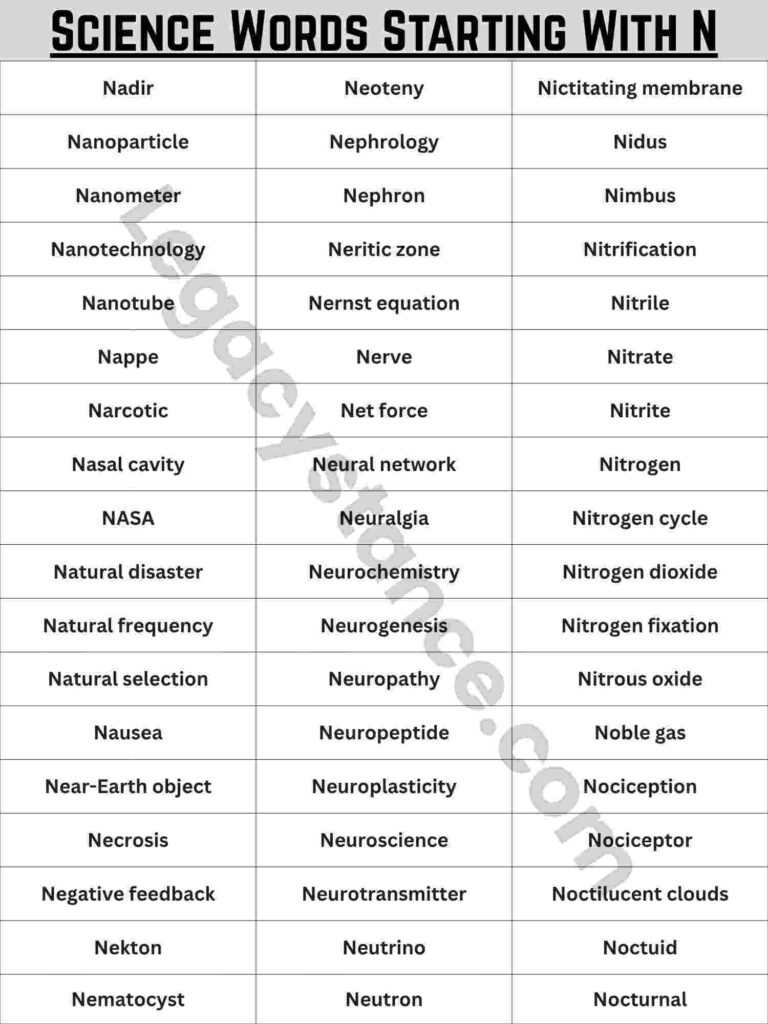
Nadir — Point directly below an observer
Nanoparticle — Particle 1–100 nm in size
Nanometer — One billionth of a meter
Nanotechnology — Engineering at atomic scale
Nanotube — Cylindrical carbon nanostructure with extreme strength
Nappe — Sheet of rock pushed over other rocks
Narcotic — Pain-dulling drug with addiction risk
Nasal cavity — Air passage inside the nose
NASA — U.S. National Aeronautics and Space Administration
Natural disaster — Severe natural event causing damage
Natural frequency — Frequency at which a system vibrates on its own
Natural selection — Survival and reproduction of best-adapted organisms
Nausea — Uncomfortable sensation before vomiting
Near-Earth object — Asteroid or comet with orbit close to Earth
Necrosis — Death of body tissue
Negative feedback — System response that reduces or reverses a change
Nekton — Organisms that swim freely in open water
Nematocyst — Stinging cell found in jellyfish
Nematode — Microscopic roundworm
Neon — Noble gas, glows orange-red when electrified
Neonatal — Relating to the first 28 days of life
Neoplasm — Abnormal tissue growth
Neoteny — Keeping juvenile traits into adulthood
Nephrology — Medical study of the kidneys
Nephron — Kidney’s filtering unit
Neritic zone — Shallow coastal ocean area
Nernst equation — Formula for electrochemical cell potential
Nerve — Bundle of neuron fibers
Net force — Total combined force acting on an object
Neural network — Data-learning computer system
Neuralgia — Sharp, stabbing nerve pain
Neurochemistry — Study of chemicals in the nervous system
Neurogenesis — Formation of new neurons
Neuropathy — Nerve damage causing pain or numbness
Neuropeptide — Short protein acting as a neural signal
Neuroplasticity — Brain’s ability to rewire itself
Neuroscience — Study of the nervous system
Neurotransmitter — Chemical signal between neurons
Neutrino — Nearly massless, chargeless subatomic particle
Neutron — Neutral particle in atomic nucleus
Neutron star — Ultra-dense collapsed stellar remnant
Neutrophil — White blood cell that attacks bacteria
Newton — Unit of force
Niche — Organism’s role in its ecosystem
Nictitating membrane — Third eyelid in some animals
Nidus — Site where infection or disease clusters
Nimbus — Rain-bearing cloud
Nitrification — Bacteria converting ammonia to nitrates
Nitrile — Organic compound containing a CN group
Nitrate — Nitrogen-oxygen compound (NO₃⁻)
Nitrite — Nitrogen-oxygen compound (NO₂⁻)
Nitrogen — Most abundant gas in Earth’s atmosphere
Nitrogen cycle — Movement of nitrogen through nature
Nitrogen dioxide — Reddish-brown air pollutant gas (NO₂)
Nitrogen fixation — Converting N₂ into plant-usable compounds
Nitrous oxide — Anesthetic gas; also a greenhouse gas
Noble gas — Unreactive gas with full electron shell
Nociception — Nervous system’s detection of harmful stimuli
Nociceptor — Nerve receptor sensing pain signals
Noctilucent clouds — Very high-altitude clouds that glow at night
Noctuid — Large family of night-flying moths
Nocturnal — Active during nighttime
Node — Still point in a wave; or junction in a network
Node of Ranvier — Gap in a nerve’s myelin sheath
Noise (signal) — Unwanted interference in electronic signals
Nonequilibrium — State of ongoing imbalance in a system
Nonlinear — System where small inputs cause large, unpredictable outputs
Nonpolar — Molecule with evenly distributed charge
Nonrenewable — Resource requiring millions of years to form
Nonspecific immunity — General body defense against pathogens
Nonvascular plant — Plant without water-transport vessels (e.g., moss)
Norepinephrine — Stress hormone and neurotransmitter
Normal fault — Fault where crust pulls apart and one block drops
Normal force — Perpendicular surface push on a resting object
Norovirus — Highly contagious stomach illness virus
Nosocomial — Infection acquired in a hospital
Notochord — Flexible rod in early vertebrate embryo development
Nova — Temporary stellar surface explosion
N-type semiconductor — Semiconductor with excess electrons
Nuclear energy — Energy from atomic nucleus reactions
Nuclear fission — Splitting of a heavy atomic nucleus
Nuclear fusion — Merging of light atomic nuclei
Nuclear membrane — Membrane surrounding the cell nucleus
Nucleic acid — DNA or RNA molecule
Nucleolus — Structure inside the nucleus that builds ribosomes
Nucleophile — Electron-donating molecule in a chemical reaction
Nucleophilic substitution — Reaction where a nucleophile replaces a leaving group
Nucleosynthesis — Formation of elements inside stars
Nucleotide — Building block of DNA and RNA
Nucleus (atom) — Dense center of an atom
Nucleus (cell) — DNA-containing control center of a cell
Null hypothesis — The “no effect” starting assumption in experiments
Numerical analysis — Math methods for approximate solutions
Nunatak — Rock peak protruding through a glacier
Nutrient — Growth-supporting substance for living things
Nutrition — Process of obtaining and using nutrients
Nutritional deficiency — Illness caused by lack of essential nutrients
Nymph — Immature stage of certain insects
Natrium — Latin name for sodium (Na)
Nebula — Gas and dust cloud in space
Network (biology) — Interconnected biological system
Network (tech) — Connected system for data sharing
Nail (biology) — Keratin structure protecting fingertips
Nekton — Free-swimming aquatic organisms
Neoteny — Retention of juvenile features in adulthood
Common Confusions
Nucleus (atom) vs. Nucleus (cell) Same word, different fields. The atomic nucleus holds protons and neutrons. The cell nucleus holds DNA. Both are dense control centers — that’s the shared logic behind the name.
Neutron vs. Neutrino Both are neutral, both are subatomic — but they’re not related. Neutrons have real mass and sit inside atoms. Neutrinos have almost no mass and pass through everything, including you, constantly.
Niche vs. Habitat Habitat = where an organism lives. Niche = what it does there. A pond is a habitat. Being the pond’s top algae-eater is a niche.
Nitrate vs. Nitrite Nitrate = NO₃⁻. Nitrite = NO₂⁻. Both appear on food labels. Nitrites are used in meat preservation and convert to nitrates in the body. Not interchangeable.
Nova vs. Supernova A nova is a surface explosion — the star survives and eventually dims. A supernova destroys the entire star. The scale difference is enormous.
Nonpolar vs. Neutral Neutral = no electric charge overall. Nonpolar = charge is evenly distributed throughout the molecule. Water is polar and neutral. Oil is nonpolar and neutral. Two different properties, easily mixed up.
Natural selection vs. Evolution Evolution is the broader change in species over time. Natural selection is one mechanism driving it — alongside mutation, genetic drift, and gene flow. Calling them the same thing is the most common biology mix-up at the middle school level.
Read also about:
140+ Science Words That Start With P | Full List with Meanings
130+ Science Words That Start With O | Definitions & Real Uses
FAQs about Science Words That Start With N
1. Which science words starting with N should I learn first?
Start with common ones like nucleus, neutron, nutrient, nerve, and natural selection. These appear often in school exams and build a strong base.
2. How can I remember science vocabulary easily?
Focus on understanding, not memorizing. Link each word to a real example—like nutrients from food or neurons in your brain sending signals.
3. Are these words useful outside school?
Yes. You’ll hear them in news, health topics, and technology discussions. Knowing them helps you understand real-world issues better.
4. What’s the difference between simple and advanced science terms?
Simple terms explain basic ideas (like nerve or nebula). Advanced terms (like null hypothesis) are used in deeper studies and research.
5. How many words should I learn at one time?
Keep it small—5 to 10 words at a time. Learn them well, use them in sentences, then move on to the next set.
Bottom line
This guide covered 100+ science words starting with N — sorted by subject, difficulty, and real-world use. From the most basic (nutrient, nerve, nucleus) to the genuinely advanced (null hypothesis, nucleophilic substitution, nonequilibrium thermodynamics).
Use it in sections, not all at once. Find the subject you’re studying, learn those words in context, and let the rest come naturally over time. The words connect — once you know what a nucleotide is, DNA clicks into place. Once neutrons make sense, nuclear energy follows. That’s how science vocabulary actually works.