If you’ve ever paused while reading a science book because a word didn’t click, you’re not alone. This guide to Science Words That Start With L is built to make things clearer, not harder. Whether you’re studying for a test, helping your child, or just curious, you’ll find easy explanations that stick.
Just real meanings in simple language. You can dive deeper depending on what you need. Think of this as your quick, reliable companion for understanding science without the stress.
20 Most-Used Science Words That Start With L
These words appear constantly across textbooks, exams, and labs. Definitions here are complete — these words don’t repeat in later sections.
Lava — Melted rock that reaches Earth’s surface through a volcano
Laser — Focused, amplified beam of light with a single wavelength
Lens — Curved transparent material that bends light rays
Liquid — State of matter with fixed volume but no fixed shape
Larva — Early worm-like insect stage after hatching from an egg
Lipid — Fat molecule that stores energy and builds cell membranes
Lymph — Fluid carrying white blood cells through the lymphatic system
Ligament — Tough tissue connecting bone to bone at a joint
Latitude — Imaginary lines measuring angular distance from the equator
Light-year — Distance light travels in one year (~9.46 trillion km)
Limestone — Sedimentary rock formed from ancient marine organism shells
Lichen — Symbiotic organism combining fungus and algae
Leukocyte — White blood cell that fights infection and disease
Lever — Simple machine using a rigid bar balanced on a pivot point
Lithosphere — Earth’s rigid outer shell of crust and upper mantle
Luminescence — Light produced by chemical or biological processes, not heat
Lumen — Interior space inside a hollow organ, vessel, or tube
Lung — Organ that exchanges oxygen and carbon dioxide in vertebrates
Longitudinal wave — Wave where particles move parallel to the direction of travel
Load — Force or weight applied to a structure or machine
Physics Science Words That Start With L
Light — Visible electromagnetic radiation. Travels at 300,000 km per second in a vacuum — the fastest speed in the universe. Everything you see exists because light bounces off it and reaches your eyes.
Latent heat — Energy absorbed or released when a substance changes state without changing temperature. Ice melting at exactly 0°C is latent heat at work — energy goes in, but the thermometer doesn’t move.
Liquefaction — During an earthquake, saturated soil suddenly behaves like a liquid. Buildings tilt and sink into the ground. A serious engineering hazard in coastal and riverside zones.
Lorentz force — The force acting on a charged particle moving through a magnetic field. It’s the principle behind every electric motor.
Lux — The unit measuring how much light actually falls on a surface. A candle produces about 1 lux at one meter. A surgery room runs at 10,000–100,000 lux.
Luminance — The measurable brightness of a surface as seen by an observer. Your phone screen’s brightness setting controls luminance directly.
Chemistry Science Words That Start With L
Liquid and lipid are defined in the top-20 table above.
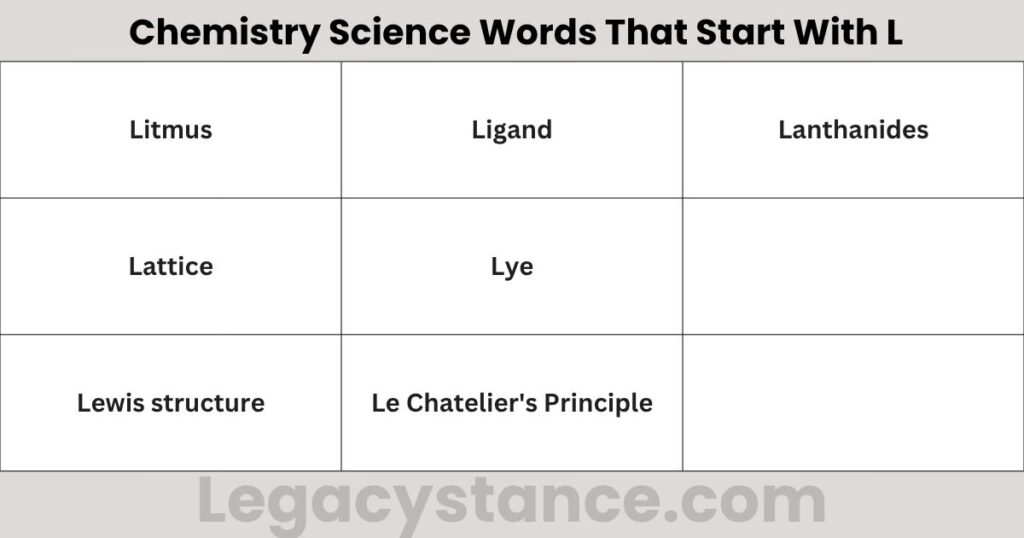
Litmus — A natural dye extracted from lichen, used to test whether a solution is acid or base. Red litmus turns blue in a base. Blue litmus turns red in an acid. A staple of every school chemistry lab.
Lattice — The repeating, orderly arrangement of atoms or ions in a crystalline solid. Table salt (NaCl) forms a cubic lattice. Diamond forms a tetrahedral one. The lattice structure determines hardness and melting point.
Lewis structure — A diagram using dots to show how atoms in a molecule are bonded and where electrons are located. Essential for predicting a molecule’s shape and reactivity.
Ligand — An atom or molecule that bonds to a central metal atom to form a complex. Critical in drug design — many medications work by acting as ligands that bind specific proteins.
Lye — The common name for sodium hydroxide (NaOH). A powerful base used in soap-making, drain cleaners, and food processing. Pretzels get their dark crust from a lye bath before baking.
Le Chatelier’s Principle — When a chemical system at equilibrium is disturbed, it shifts to counteract that disturbance. Industrial chemists use this to push reactions toward maximum product yield.
Lanthanides — A series of 15 metallic elements (atomic numbers 57–71) at the bottom of the periodic table. Essential in modern tech — wind turbine magnets, MRI contrast agents, and smartphone screens all use lanthanides.
Biology Science Words That Start With L
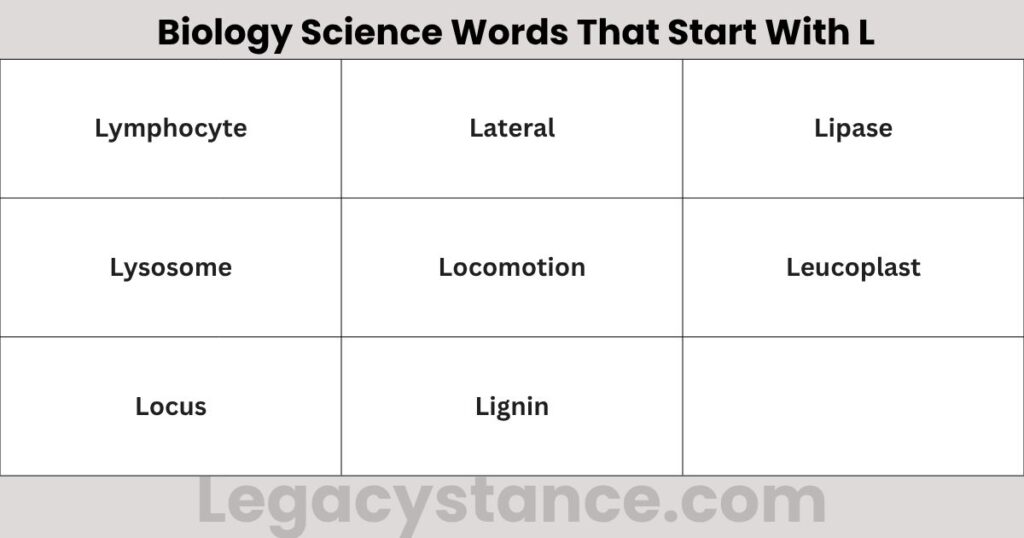
Lymphocyte — A specialized type of leukocyte. B-lymphocytes manufacture antibodies. T-lymphocytes hunt and destroy infected cells directly. These two cell types are your immune system’s strategic response team.
Lysosome — A small organelle inside cells packed with digestive enzymes. It breaks down waste, worn-out cell components, and invading bacteria. Think of it as the cell’s internal recycling and disposal unit.
Locus — The precise location of a gene on a chromosome. When scientists compare two organisms, they align matching loci to study genetic variation between them.
Lateral — Anatomical term meaning away from the body’s midline. Your shoulders are lateral to your chest. Your ears are lateral to your nose.
Locomotion — An organism’s ability to move itself from one location to another under its own power. Fish use fins. Earthworms contract muscles against soil. Humans use bipedal leg movement.
Lignin — The tough organic compound that gives wood its rigidity and strength. It’s what makes tree trunks hard. Lignin is also one of the most abundant natural polymers on Earth.
Lipase — An enzyme that breaks down dietary fats into smaller fatty acids. Produced by the pancreas. Without lipase, fat absorption from food becomes impossible.
Leucoplast — A colorless organelle in plant cells used to store starch, oils, or proteins. Potato cells are packed with leucoplasts storing starch — that’s why potatoes are so energy-dense.
Earth Science Words That Start With L
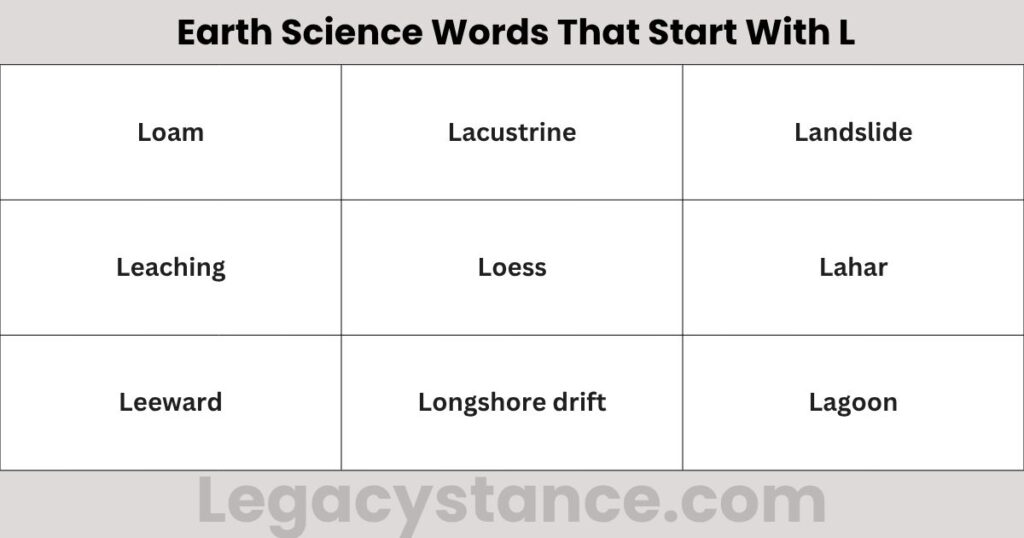
Loam — A balanced mixture of sand, silt, and clay. The preferred soil type for most agriculture because it drains without drying out and holds nutrients without waterlogging.
Leaching — Water moving through soil and dissolving away minerals and nutrients as it goes. Tropical rainforests receive so much rain that constant leaching strips soils of fertility fast.
Leeward — The side of a mountain or hill sheltered from the prevailing wind. The leeward side sits in a rain shadow — far drier than the windward face of the same mountain.
Lacustrine — Relating to lakes. Lacustrine sediments are layers of material deposited on lake floors over thousands of years. They’re valuable for studying past climates.
Loess — Fine, wind-blown silt that accumulates into thick, fertile deposits. China’s Loess Plateau — covering an area larger than France — formed this way over millions of years.
Longshore drift — The movement of sand and sediment along a coastline, driven by waves striking the shore at an angle. Over decades, it builds sand spits, bars, and reshapes entire beaches.
Landslide — Rapid downhill movement of rock, soil, or debris. Triggered by heavy rainfall, earthquakes, or undermined slopes. Can move faster than a person can run.
Lahar — A volcanic mudflow — a fast-moving mixture of water, ash, and rock debris flowing down a volcano’s slopes. More destructive than lava in many eruptions because it travels farther and faster.
Lagoon — A shallow body of coastal water separated from the open sea by a coral reef, sandbar, or barrier island. Highly productive ecosystems with unique marine life.
Space & Astronomy Science Words That Start With L
Lunar — Relating to the moon. Lunar eclipses occur when Earth passes between the sun and moon, casting its shadow across the lunar surface. The full lunar cycle takes 29.5 days.
Luminosity — The total energy a star radiates per second. The sun outputs 3.8 × 10²⁶ watts. Hypergiant stars can be five million times more luminous. Luminosity determines whether a star appears bright in our sky — but so does distance.
Libration — The slow, slight wobble of the moon as seen from Earth. It means we can observe about 59% of the lunar surface over time, not just the 50% that faces us at any given moment.
Lander — A spacecraft engineered to set down on a planetary or lunar surface. Apollo lunar modules were landers. The Mars Perseverance rover was delivered by a sky-crane lander system.
Local Group — The small cluster of about 54 galaxies that contains our Milky Way. The Andromeda Galaxy is the largest member. Gravity binds the whole group together.
Lagrange point — A location in space where the gravitational pull of two large bodies precisely balances, letting a smaller object stay in a stable position. The James Webb Space Telescope sits at Earth-Sun Lagrange point L2, 1.5 million km from Earth.
Low Earth orbit (LEO) — The orbital zone between 160 and 2,000 km altitude. The International Space Station circles Earth here at about 400 km, completing one orbit every 90 minutes.
Medical & Health Science Words That Start With L
Leukocyte, ligament, lumen, and lung are defined in the top-20 table above.
Lesion — Any area of tissue that is abnormal due to injury, disease, or damage. Doctors characterize lesions by size, shape, borders, and location to monitor disease progression.
Lumbar — The lower back region of the spine. Five large lumbar vertebrae carry most of the upper body’s weight. Lumbar strain is the most common cause of back pain worldwide.
Lymphoma — Cancer originating in lymphocytes. Hodgkin lymphoma involves a specific abnormal cell (Reed-Sternberg cell). Non-Hodgkin lymphoma covers a broader range of lymphatic cancers.
Laceration — A jagged cut or tear through skin and tissue, as opposed to a clean incision. Differs from an abrasion (surface scrape) and contusion (bruise without broken skin). Deep lacerations usually require stitches.
Lethargy — Abnormal physical and mental fatigue far beyond normal tiredness. In clinical settings, sudden or unexplained lethargy — especially in children — is treated as a warning sign requiring investigation.
Lipoma — A benign (non-cancerous) growth of fat cells just beneath the skin. Soft, movable, and usually painless. Very common in adults, rarely requiring treatment.
Lymphedema — Chronic swelling caused by lymph fluid accumulating in tissues when the lymphatic system is damaged, blocked, or surgically removed. Common after cancer treatment involving lymph node removal.
Laparoscopy — Minimally invasive surgery where a camera and instruments are inserted through small abdominal incisions. Patients recover in days rather than weeks compared to open surgery.
Technology & Applied Science Words That Start With L
LCD (Liquid Crystal Display) — Screen technology where liquid crystals control the passage of backlight to form images. Found in most monitors, TVs, and instrument panels.
Lithium-ion — The battery chemistry powering virtually every portable device currently made. High energy density, rechargeable hundreds of times, and light enough for electric vehicles and aircraft.
Lossless compression — A method of shrinking file size without discarding any data. Open a lossless file and you recover it exactly as it was. ZIP archives and PNG images both use lossless methods.
Latency — The time delay between sending a signal and receiving a response. In online gaming, high latency causes lag. In remote surgical systems, even 50 milliseconds of latency creates dangerous imprecision.
Load balancing — Distributing incoming tasks across multiple servers so no single machine becomes a bottleneck. Every major website you visit runs on load-balanced infrastructure.
LiDAR — Light Detection and Ranging. Fires rapid laser pulses and measures return time to build precise 3D maps. Self-driving cars use it to detect obstacles. Archaeologists use it to find buried structures under forest canopy.
Advanced Science Words That Start With L
These appear in AP courses, university-level study, and research literature.
Lipogenesis — The metabolic process converting excess carbohydrates into fat for long-term storage. Occurs mainly in liver and adipose tissue. Relevant to understanding obesity, diabetes, and metabolic disease.
Ligase — An enzyme that seals breaks in DNA strands by forming covalent bonds between nucleotides. Without ligase, cells couldn’t repair DNA damage or complete replication.
Lateral inhibition — A neurological process where an activated neuron suppresses the activity of its neighbors. Sharpens sensory boundaries — the reason you can feel exactly where something touches your skin.
Lyophilization — Freeze-drying. The material is frozen, then surrounding pressure is lowered so ice converts directly to vapor without passing through liquid. Preserves vaccines, blood plasma, and food without refrigeration.
Langmuir isotherm — A mathematical model describing how molecules adsorb onto a solid surface, assuming a fixed number of binding sites. Used in filter design, drug delivery, and wastewater treatment.
Leptoquark — A theoretical particle predicted by some physics models that interacts with both quarks and leptons simultaneously. Not yet observed. Active search ongoing at the Large Hadron Collider.
Lamarckism — Jean-Baptiste Lamarck’s pre-Darwin theory that traits acquired during an organism’s lifetime pass directly to offspring. Giraffes stretching necks to pass long necks to young. Thoroughly disproved by genetics.
Luminiferous aether — A 19th-century hypothesis that space was filled with an invisible medium through which light waves traveled. The 1887 Michelson-Morley experiment found no evidence for it. Einstein’s special relativity made the concept obsolete.
Lysogeny — A viral reproductive strategy where the virus inserts its DNA into the host cell’s genome and stays dormant rather than immediately destroying the cell. It activates later, sometimes triggered by stress.
Logistic growth — A population growth model where growth is fast at first, then slows as the population approaches the environment’s carrying capacity. Produces an S-shaped curve, unlike the J-shaped curve of unchecked exponential growth.
Complete Reference List — 160+ Science Words That Start With L
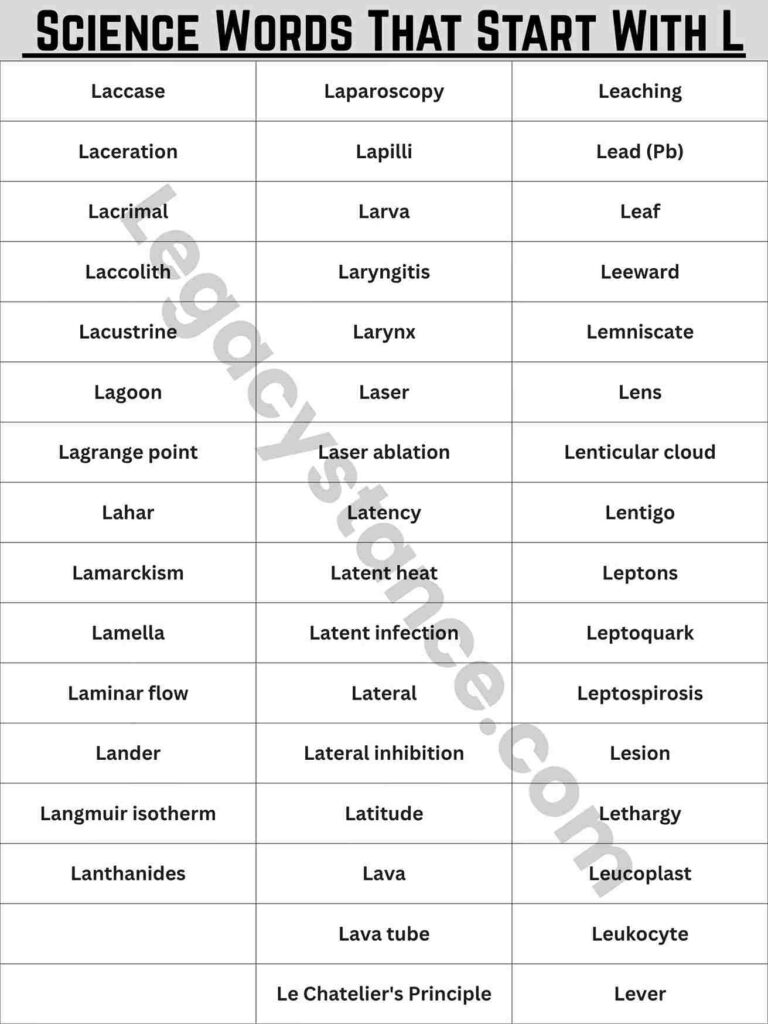
Laccase — Enzyme catalyzing oxidation reactions in fungi and plants
Laceration — Jagged cut or tear through skin and tissue
Lacrimal — Relating to the tear glands or tear ducts
Laccolith — Dome-shaped igneous intrusion that never reached the surface
Lacustrine — Relating to or formed in lakes
Lagoon — Shallow coastal water body separated from the sea
Lagrange point — Gravitational balance point between two large bodies in space
Lahar — Volcanic mudflow of water, ash, and rock debris
Lamarckism — Discredited theory claiming acquired traits pass to offspring
Lamella — Thin plate-like layer in biological tissue or rock
Laminar flow — Smooth, parallel-layered fluid movement without turbulence
Lander — Spacecraft designed to land on a planetary surface
Langmuir isotherm — Model of molecular surface adsorption
Lanthanides — Metallic elements 57–71 on the periodic table
Laparoscopy — Camera-assisted minimally invasive surgery
Lapilli — Small rock fragments ejected during a volcanic eruption
Larva — Early insect stage after hatching
Laryngitis — Inflammation of the larynx causing hoarseness
Larynx — Cartilaginous voice box in the throat
Laser — Focused amplified beam of coherent light
Laser ablation — Targeted material removal using a laser beam
Latency — Delay between signal transmission and response
Latent heat — Energy exchanged during phase change at constant temperature
Latent infection — Dormant infection not yet producing active symptoms
Lateral — Anatomically away from the body’s midline
Lateral inhibition — Suppression of neighboring neurons by an active one
Latitude — Angular distance north or south of the equator
Lava — Magma at Earth’s surface
Lava tube — Cave formed by a hardened outer shell around flowing lava
Le Chatelier’s Principle — Equilibrium shifts to oppose applied disturbance
Leaching — Nutrient or mineral loss from soil through water movement
Lead (Pb) — Dense heavy metal, atomic number 82, toxic in high doses
Leaf — Photosynthetic organ of a plant
Leeward — Downwind, sheltered side of a landform
Lemniscate — Figure-eight shaped mathematical curve (∞)
Lens — Curved refractive optical element
Lenticular cloud — Smooth lens-shaped cloud over elevated terrain
Lentigo — Pigmented skin spot from localized melanin concentration
Leptons — Elementary particles not subject to strong nuclear force
Leptoquark — Hypothetical particle coupling quarks and leptons
Leptospirosis — Bacterial zoonotic disease from infected animal urine
Lesion — Abnormal damaged or diseased tissue area
Lethargy — Clinical abnormal fatigue or reduced responsiveness
Leucoplast — Colorless plant storage organelle
Leukocyte — White blood cell
Lever — Bar-and-pivot simple machine
Levitation — Stable suspension without physical contact
Lewis structure — Electron dot diagram of atomic bonding
LiDAR — Laser-based 3D distance and mapping technology
Lichen — Fungus-algae symbiotic organism
Life cycle — Complete sequence of biological stages
Ligament — Connective tissue between bones
Ligand — Molecule binding to a metal center
Ligase — DNA strand-joining enzyme
Lignin — Rigid polymer giving wood strength
Light — Visible electromagnetic radiation
Light-year — Distance light travels in one year
Lightning — Atmospheric electrostatic discharge
Limnology — Study of freshwater ecosystems
Linear equation — Equation forming a straight line
Lipase — Fat-digesting enzyme
Lipid — Fat-based energy storage molecule
Lipogenesis — Conversion of carbohydrates into fat
Lipoma — Benign fatty growth
Lipopolysaccharide — Outer membrane of gram-negative bacteria
Liquid — Matter with fixed volume, no fixed shape
Liquid crystal — State between liquid and solid
Lithification — Sediment turning into rock
Lithium-ion — Rechargeable battery type
Lithosphere — Earth’s rigid outer layer
Lithotripsy — Kidney stone treatment using sound waves
Litmus — Acid-base indicator dye
Livor mortis — Post-death skin discoloration
Load — Applied force or weight
Load balancing — Distributing computing tasks
Loam — Fertile soil mix
Local Group — Galaxy cluster containing the Milky Way
Locomotion — Self-movement of an organism
Locus — Gene location on a chromosome
Loess — Wind-blown fertile silt
Logistic growth — S-shaped population growth
Longitudinal wave — Wave with parallel particle motion
Longshore drift — Coastal sediment movement by waves
Loop of Henle — Kidney structure concentrating urine
Lophophore — Feeding organ in marine animals
Lorenz attractor — Model of chaotic systems
Lossless compression — Data compression without loss
Lotic — Flowing freshwater ecosystem
Low Earth orbit — Orbit 160–2,000 km above Earth
Low pressure system — Weather system causing clouds/rain
Lubrication — Reducing friction between surfaces
Lumen — Inner space of a tube or organ
Lumbar — Lower back region
Luminance — Surface brightness
Luminescence — Light without heat
Luminiferous aether — Obsolete light medium theory
Luminosity — Total energy output of a star
Lunar — Relating to the moon
Lunar eclipse — Earth blocks sunlight from the moon
Lunar maria — Dark lava plains on the moon
Lung — Breathing organ
Lutetium — Rare earth element (71)
Lux — Unit of light intensity
Lye — Sodium hydroxide
Lymph — Fluid of lymphatic system
Lymphedema — Swelling from lymph blockage
Lymphocyte — Immune white blood cell
Lymphoma — Cancer of lymphatic system
Lyophilization — Freeze-drying process
Lysate — Cell contents after rupture
Lysogeny — Viral DNA integration into host
Lysosome — Cell waste-digesting organelle
Lysozyme — Antibacterial enzyme
Common Confusions — Words People Mix Up
Ligament vs. Tendon Both are connective tissue. Ligaments join bone to bone. Tendons join muscle to bone. A torn ACL is a ligament injury. A ruptured Achilles is a tendon injury.
Lava vs. Magma Same molten rock — location changes the name. Underground = magma. At the surface = lava.
Luminescence vs. Luminosity Luminescence is cold light from a biological or chemical process. Luminosity is a star’s total energy output. One term belongs to biology and chemistry; the other to astronomy.
Larva vs. Larvae One = larva. More than one = larvae. Plural trips students up on tests every time.
Lossless vs. Lossy Lossless compression recovers every bit of the original file. Lossy permanently discards some data for a smaller size. PNG = lossless. JPEG = lossy.
Latitude vs. Longitude Latitude lines run horizontally — north/south position. Longitude lines run vertically — east/west position. Memory trick: Latitude = Ladder (horizontal rungs). Longitude = Long vertical lines running Earth’s full length.
Read more:
130+ Science Words That Start With H | Full List with Meanings
160+ Science Words That Start With K | Definitions with Examples
FAQs about Science Words That Start With L
Q1: How do I actually remember science words instead of forgetting them after studying?
Focus on one word at a time and connect it to a real-life example. For example, link “lever” to a seesaw or “lung” to breathing. Small connections make memory stick better than memorizing long lists.
Q2: Are these words enough for school exams?
Yes, most common exam questions come from frequently used terms like liquid, lens, lava, and life cycle. If you understand these clearly, you’re already ahead of many students.
Q3: What’s the fastest way to revise before a test?
Read short definitions and quiz yourself. Cover the meaning and try to explain it in your own words. If you can teach it simply, you’ve learned it well.
Q4: Why do some science words feel so hard to understand?
Many come from Latin or Greek roots, which can sound unfamiliar. Once you learn the root meaning (like “luna” for moon or “lumen” for light), many words start to make sense quickly.
What You Now Have
Over 160 science words starting with L — organized by field, cleaned of repetition, and built for quick reference. Physics, chemistry, biology, earth science, space, medicine, and technology each got their own section. Common mix-ups are resolved. The full list gives you a one-stop lookup for any word you encounter.
These words appear in hospital charts, weather apps, phone specs, and space mission briefings. Knowing them doesn’t just help on a test — it makes the science around you readable.