If you’re trying to understand Science Words That Start With E, you’re in the right place. Maybe it’s for a test, homework help, or just building better vocabulary. Either way, this guide makes things easier.
Science terms can feel heavy, but they don’t have to be. Here, you’ll find clear meanings in simple words you can actually remember. From energy to ecosystem, these are the terms you’ll see again and again in school—and in real life.
10 Most Common Science Words Starting With E
Energy — Ability to do work or cause change
Ecosystem — Community of living things and their environment
Electron — Negatively charged particle inside an atom
Evolution — Change in species over many generations
Enzyme — Protein that speeds up chemical reactions
Erosion — Wearing away of land by water, wind, or ice
Evaporation — Liquid turning into gas below boiling point
Eclipse — One object blocking light from another in space
Element — Pure substance made of one type of atom
Embryo — Early developmental stage in an organism
These ten words alone appear in hundreds of science textbook chapters. Learn these first.
20 Most-Used Science Words That Start With E
Energy — Every machine, every living thing, every chemical reaction needs it. It comes in forms: heat, light, sound, kinetic, potential.
Ecosystem — A forest is one. So is a pond. So is your gut (yes, really). Any system where organisms interact with each other and with their physical environment.
Electron — Tiny, negatively charged, found orbiting the nucleus of every atom. Electrons are why electricity exists.
Evolution — Species change over long periods because some individuals survive and reproduce better than others. Darwin explained it. Science has confirmed it thousands of times since.
Enzyme — Your body runs on chemical reactions, and enzymes make those reactions fast enough to keep you alive. Without them, digestion alone would take years.
Erosion — Rivers carve canyons. Wind shapes deserts. Ice breaks apart mountains. The slow wearing away of Earth’s surface.
Evaporation — When a puddle disappears on a sunny day, the water hasn’t gone — it became vapor. Liquid turning to gas below boiling point.
Eclipse — When the Moon blocks the Sun (solar eclipse) or Earth’s shadow falls on the Moon (lunar eclipse).
Element — Gold, oxygen, carbon, iron — pure substances that can’t be broken into simpler chemical pieces. There are 118 confirmed elements.
Embryo — The early developmental stage after fertilization. In humans, this stage lasts through the first eight weeks of pregnancy.
Electromagnet — A magnet created by running electricity through a wire coil. Used in motors, speakers, MRI machines, and junkyard cranes.
Equilibrium — A balanced state. In chemistry: a reaction where forward and backward processes run at equal rates. In physics: forces cancel out.
Excretion — How living things remove waste products. Sweating, urinating, and exhaling CO₂ are all excretion.
Exothermic — A chemical reaction that releases heat. Burning wood, hand warmers, explosions.
Endothermic — A reaction that absorbs heat from surroundings. Ice packs work because of endothermic reactions.
Extinction — When the last individual of a species dies, that species is gone permanently. The dodo, the woolly mammoth, the dinosaurs.
Epidermis — The outermost layer of skin in animals, or the outer cell layer of plant leaves. First line of defense against the outside world.
Estrogen — A hormone present in all humans, but at higher levels in females. Regulates development, reproduction, and bone health.
Exosphere — Earth’s outermost atmospheric layer, where it fades into space. Satellites orbit here.
Epicenter — The point on Earth’s surface directly above the focus of an earthquake. The worst shaking happens at this point.
Physics Science Words That Start With E
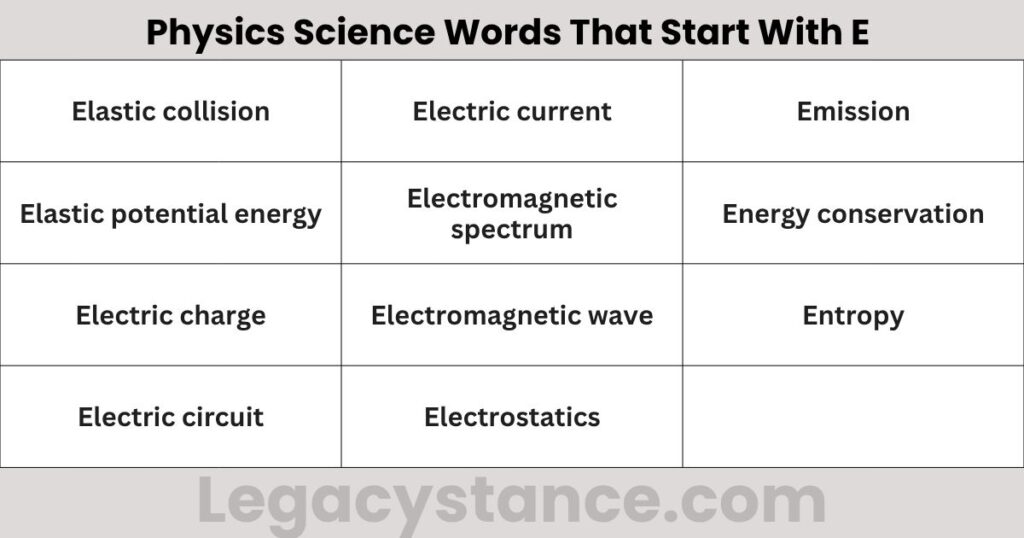
Physics explains how the universe moves, holds together, and transfers energy. These words are central to that story.
Elastic collision — A collision where both momentum and kinetic energy are conserved. Billiard balls come close. Almost nothing is perfectly elastic in real life.
Elastic potential energy — Stored energy in a stretched or compressed object. A pulled rubber band, a compressed spring.
Electric charge — A fundamental property of matter. Positive or negative. Like charges repel; opposites attract. Everything about electricity starts here.
Electric circuit — A closed path through which electric current flows. Your home’s wiring is one giant, branching circuit.
Electric current — The flow of electric charge through a conductor. Measured in amperes. This is what does the actual work in any electrical device.
Electromagnetic spectrum — The full range of electromagnetic radiation, from radio waves to gamma rays. Visible light is just a thin slice in the middle.
Electromagnetic wave — A wave of oscillating electric and magnetic fields. Light, X-rays, microwaves, and radio waves are all electromagnetic waves.
Electrostatics — The study of electric charges at rest. Rubbing a balloon on your hair and sticking it to a wall? Electrostatics.
Emission — When an atom releases energy as light or radiation. Each element emits specific colors — that’s how scientists identify what stars are made of.
Energy conservation — Energy cannot be created or destroyed, only changed in form. One of the most tested ideas in physics — and it holds up every time.
Entropy — A measure of disorder in a system. Ice melting, a room getting messy, sugar dissolving — entropy increases in all of them.
Chemistry Science Words That Start With E
Electrolysis — Using electricity to split a chemical compound. You can split water into hydrogen and oxygen this way. Industries use it to purify metals.
Electrolyte — A substance that conducts electricity when dissolved in water. Sports drinks have electrolytes. So does your blood. Without them, muscles stop working.
Electron configuration — The arrangement of electrons around an atom’s nucleus. This determines how an atom bonds with others.
Electronegativity — How strongly an atom pulls electrons toward itself in a bond. Fluorine has the highest electronegativity of all elements.
Endothermic reaction — Absorbs heat from surroundings. Baking soda and vinegar is a classroom example. The flask feels cold.
Exothermic reaction — Releases heat. Combustion is the classic example. The reaction inside a hand warmer is another.
Ester — An organic compound formed when an acid reacts with an alcohol. Esters give fruits their distinctive smells. Artificial fruit flavors are often synthetic esters.
Equilibrium constant — A number showing the ratio of products to reactants when a reaction reaches equilibrium. A large number means the reaction strongly favors products.
Empirical formula — The simplest whole-number ratio of atoms in a compound. Glucose (C₆H₁₂O₆) has the empirical formula CH₂O.
Effervescence — The bubbling you see when gas escapes from a liquid. Opening a soda can, dropping an antacid tablet in water.
Biology Science Words That Start With E
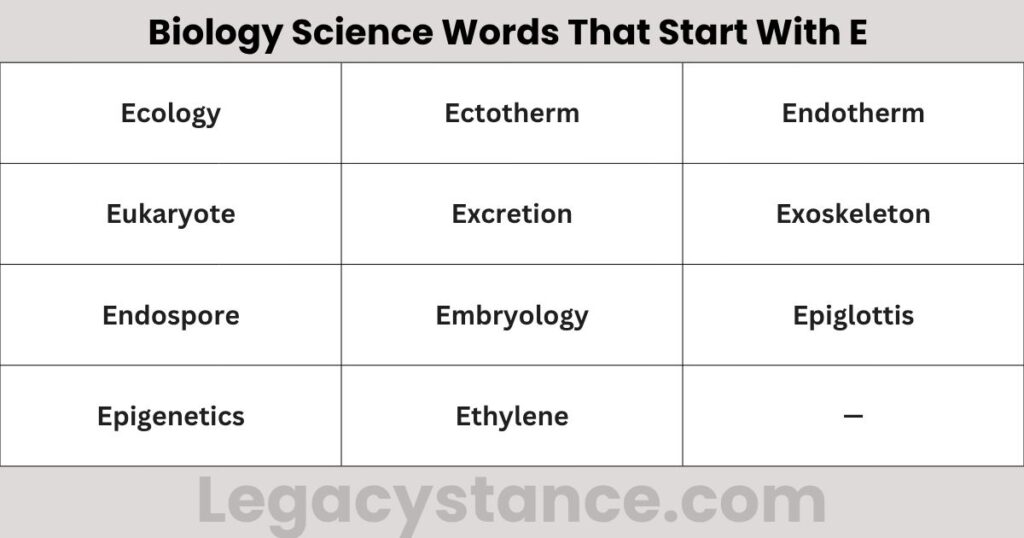
Ecology — The study of how living things interact with each other and with their environment. Food webs, climate change, and invasive species all fall under ecology.
Ectotherm — An animal that regulates body temperature using external heat. Reptiles, fish, insects. Often called “cold-blooded,” though that term isn’t quite accurate.
Endotherm — An animal that generates its own body heat internally. Mammals and birds. Your body burns calories partly just to stay warm.
Eukaryote — An organism whose cells have a nucleus enclosed by a membrane. You are a eukaryote. So are plants, fungi, and most things visible to the naked eye.
Excretion — Removing metabolic waste from the body. Kidneys, lungs, and skin all participate.
Exoskeleton — A hard outer structure supporting and protecting an animal’s body. Insects, crabs, and lobsters all have them.
Endospore — A tough, dormant structure formed by certain bacteria to survive extreme conditions. Some can survive for thousands of years.
Embryology — The study of how embryos develop from fertilization through birth. Fish embryos and human embryos look remarkably alike in early stages — a fact that surprised early scientists.
Epiglottis — The flap of cartilage in your throat that flips down when you swallow, preventing food from entering your airway. It’s why you can’t breathe and swallow simultaneously.
Epigenetics — Changes in how genes are expressed without changes to the actual DNA sequence. Diet, stress, and environment can all trigger epigenetic changes.
Ethylene — A plant hormone that triggers fruit ripening. Putting an unripe banana in a bag with a ripe one speeds ripening because the ripe fruit releases ethylene gas.
Earth Science Words That Start With E
Earthquake — Sudden shaking of Earth’s surface caused by tectonic plate movement. Measured on the Moment Magnitude scale.
Estuary — Where a river meets the ocean. The mixing of fresh and salt water creates one of Earth’s most biologically productive environments.
Evaporite — A rock or mineral deposit left when water evaporates. Salt flats are a famous example.
Extrusive rock — Igneous rock formed when lava cools quickly at Earth’s surface. Basalt is the most common. It makes up most of the ocean floor.
Exfoliation (geology) — When rock peels off in sheets due to pressure release. Granite domes like Half Dome in Yosemite formed partly this way.
El Niño — A periodic warming of the central Pacific Ocean that disrupts global weather. It causes droughts in some places, floods in others.
Eutrophication — When excess nutrients (usually from fertilizer runoff) cause explosive algae growth in a body of water. The algae depletes oxygen, killing fish.
Evapotranspiration — The combined water loss from soil evaporation and plant transpiration. Important in measuring water cycles and drought conditions.
Space & Astronomy Science Words That Start With E
Eclipse — When one space object moves into another’s shadow. Solar eclipses are dramatic. Lunar eclipses are subtle but striking.
Ellipse — The oval-shaped path planets follow orbiting the Sun. Not a perfect circle. Kepler confirmed this in the 1600s.
Elliptical galaxy — A smooth, oval-shaped galaxy containing mostly old stars and very little new star formation.
Escape velocity — The minimum speed needed to break free from a planet’s gravity without further propulsion. Earth’s is about 11.2 km/s (roughly 25,000 mph).
Exoplanet — A planet orbiting a star other than our Sun. Thousands have been confirmed. Some sit in the “habitable zone” where liquid water could exist.
Equinox — The two days each year when day and night are nearly equal length everywhere on Earth. Happens in March and September.
Emission nebula — A cloud of gas that glows because nearby hot stars are exciting it with radiation. The Orion Nebula is one of the most photographed examples.
Event horizon — The boundary around a black hole beyond which nothing — not even light — can escape.
Medical & Health Science Words That Start With E
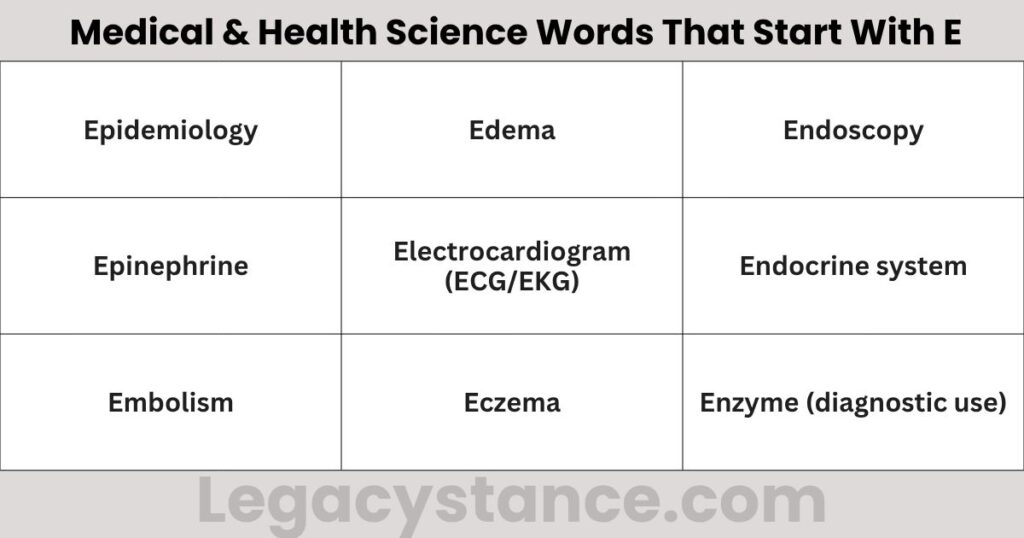
Epidemiology — The science of how diseases spread through populations. Epidemiologists tracked COVID-19, mapped its spread, and shaped public health responses.
Edema — Swelling caused by fluid buildup in tissues. Can signal heart, kidney, or liver problems.
Endoscopy — A thin camera inserted into the body to examine internal organs. No major surgery required.
Epinephrine — Also called adrenaline. Released during stress — speeds heart rate, opens airways, prepares muscles for action. EpiPens contain it for allergic emergencies.
Electrocardiogram (ECG/EKG) — A test recording the electrical activity of the heart. Those zigzag lines on hospital monitors.
Endocrine system — The network of glands producing hormones. Regulates growth, metabolism, mood, and reproduction.
Embolism — A blockage in a blood vessel from a clot or air bubble. A pulmonary embolism in the lungs can be life-threatening.
Eczema — A chronic inflammatory skin condition causing itching and redness. Affects millions worldwide.
Enzyme (diagnostic use) — Doctors measure enzyme levels in blood to detect problems. High liver enzymes may signal liver damage. Low digestive enzymes can cause malnutrition.
Technology & Applied Science Words That Start With E
Electrical resistance — The opposition a material offers to electric current. Measured in ohms. High resistance generates heat — useful in heaters and filament bulbs.
Electromagnetism — The unified force governing electricity and magnetism. Responsible for light, chemical bonding, and every electronic device ever made.
Encoder — A device or algorithm converting data into a coded format. Used in GPS systems, data compression, and digital communication.
Encryption — Converting data so only authorized parties can read it. Every secure website uses encryption.
Ergonomics — Designing tools and workplaces to fit human bodies. A chair that supports your spine is ergonomic. A keyboard designed to reduce wrist strain is ergonomic.
Extrusion — Forcing material through a shaped opening to produce a specific form. Pasta machines, plastic pipes, and 3D printers all use extrusion.
Electrolysis (industrial) — Used to coat metals (electroplating), produce aluminum, and generate hydrogen fuel. The same principle as the classroom water-splitting demo, scaled up enormously.
Easy Science Words That Start With E (Grades 4–6)
These are solid starting points for younger students or anyone new to science vocabulary.
- Ear — Hearing organ; converts sound waves into nerve signals
- Earth — Third planet from the Sun; the only known planet with life
- Egg — Reproductive cell or structure; contains nutrients for developing offspring
- Energy — The ability to do work; comes in many forms
- Environment — The surroundings in which an organism lives
- Experiment — A test designed to find something out or test a hypothesis
- Eye — The organ for vision; detects light and sends signals to the brain
- Echo — A reflected sound wave heard after a short delay
- Embryo — Early stage of growth after fertilization
- Erosion — Wearing away of land surfaces by natural forces
Advanced Science Words That Start With E (Grades 9–12 and Beyond)
Electrochemical gradient — The combined effect of electrical charge difference and concentration difference across a cell membrane. Drives ATP production in mitochondria.
Endosymbiotic theory — The idea that mitochondria and chloroplasts were once free-living bacteria absorbed by larger cells. Supported by strong molecular evidence.
Enthalpy — Total heat content in a thermodynamic system. Used to calculate heat released or absorbed during chemical reactions.
Epistasis — When one gene masks or modifies the expression of another. Makes genetics far more complex than simple dominant/recessive patterns.
Eukaryotic transcription — The process by which DNA is copied into RNA inside a cell’s nucleus. More complex than in bacteria, with multiple regulatory layers.
Eigenvalue — A special value associated with a linear transformation. Critical in quantum mechanics and structural engineering.
Electrophoresis — Separating molecules by size using an electric field. Used in DNA analysis, forensic science, and medical diagnostics.
Excited state — When an electron absorbs energy and jumps to a higher energy level. When it falls back, it releases that energy as light. This is how neon signs work.
Extracellular matrix — The protein network surrounding cells in body tissues. Provides structural support and influences how cells behave.
Endergonic reaction — A reaction that requires an energy input to proceed. The opposite of exergonic. Building proteins in your body is endergonic.
Complete Reference List — 123+ Science Words That Start With E
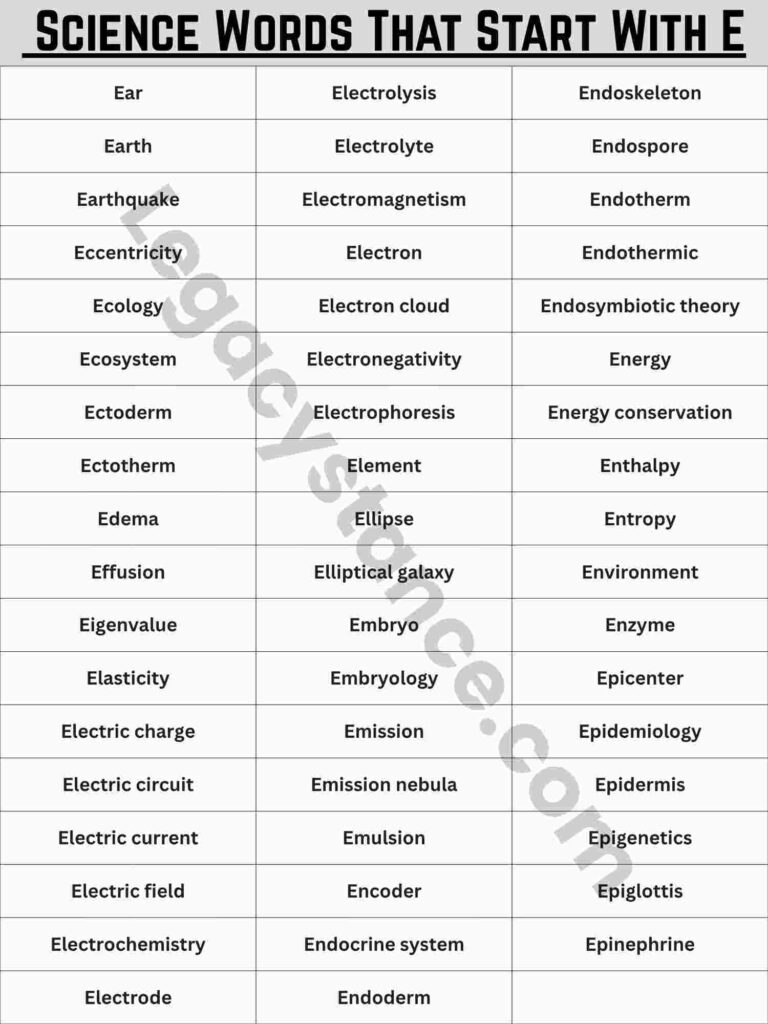
Ear — Hearing organ
Earth — Third planet from the Sun
Earthquake — Shaking from tectonic movement
Eccentricity — How stretched an elliptical orbit is
Ecology — Study of organisms and environments
Ecosystem — Organisms plus their physical environment
Ectoderm — Outer embryo cell layer
Ectotherm — Animal using external heat to regulate temperature
Edema — Tissue swelling from fluid buildup
Effusion — Gas escaping slowly through a small opening
Eigenvalue — Special value in linear transformation
Elasticity — Material returning to original shape after deformation
Electric charge — Positive or negative property of matter
Electric circuit — Closed path for current flow
Electric current — Flow of charge through conductor
Electric field — Region where electric force acts
Electrochemistry — Chemical reactions involving electricity
Electrode — Conductor for current entry or exit
Electrolysis — Splitting compounds using electricity
Electrolyte — Conducts electricity when dissolved
Electromagnetism — Unified electric and magnetic forces
Electron — Negatively charged atomic particle
Electron cloud — Region of probable electron location
Electronegativity — Atom’s pull on electrons in a bond
Electrophoresis — Molecule separation by electric field
Element — Pure substance made of one type of atom
Ellipse — Oval orbital path
Elliptical galaxy — Smooth, oval-shaped galaxy
Embryo — Early post-fertilization stage
Embryology — Study of embryo development
Emission — Energy released by an atom
Emission nebula — Glowing gas cloud near hot stars
Emulsion — Mixture of two unmixable liquids
Encoder — Converts data into coded format
Endocrine system — Hormone-producing gland network
Endoderm — Inner embryo layer forming digestive lining
Endoskeleton — Internal structural skeleton
Endospore — Tough bacterial survival structure
Endotherm — Animal generating its own body heat
Endothermic — Reaction absorbing heat
Endosymbiotic theory — Cells evolved by absorbing bacteria
Energy — Capacity to do work
Energy conservation — Energy cannot be created or destroyed
Enthalpy — Total heat content of a system
Entropy — Measure of disorder
Environment — Surroundings of an organism
Enzyme — Protein that speeds up reactions
Epicenter — Point above earthquake focus
Epidemiology — Study of disease spread
Epidermis — Outer skin or plant layer
Epigenetics — Gene expression changes without DNA change
Epiglottis — Flap blocking airway during swallowing
Epinephrine — Stress hormone (adrenaline)
Epistasis — One gene affecting another’s expression
Equator — Line dividing Earth into halves
Equilibrium — State of balance
Equinox — Equal day and night
Erosion — Movement of broken Earth material
Estrogen — Hormone regulating reproduction
Estuary — Where river meets ocean
Ether — Type of organic solvent
Ethanol — Alcohol compound
Ethylene — Plant hormone for ripening
Eukaryote — Cell with a nucleus
Eutrophication — Algae growth from excess nutrients
Evaporation — Liquid turning into gas
Evaporite — Mineral left after evaporation
Evapotranspiration — Water loss from soil and plants
Event horizon — Boundary of a black hole
Evolution — Change in species over time
Excited state — Electron at higher energy level
Excretion — Removal of waste
Exfoliation — Rock peeling in layers
Exoplanet — Planet outside our solar system
Exoskeleton — Hard outer body covering
Exosphere — Outer layer of atmosphere
Exothermic — Reaction releasing heat
Experiment — Scientific test
Extracellular matrix — Support structure around cells
Extrusive rock — Rock formed from lava
Extrusion — Shaping material by pushing through an opening
Eye — Organ for vision
Elastic collision — Collision conserving energy
Elastic potential energy — Stored energy in stretched objects
Electrical resistance — Opposition to current
Electrocardiogram — Heart activity recording
Electrostatics — Study of static charges
El Niño — Climate pattern warming oceans
Embolism — Blockage in blood vessel
Eczema — Skin inflammation condition
Ergonomics — Designing for human comfort
Endoscopy — Internal body examination
Encryption — Securing data by coding
Echo — Reflected sound
Egg — Reproductive cell
Effervescence — Bubbling of gas
Effluent — Waste liquid discharge
Electrodynamics — Study of moving charges
Electroplating — Coating metal using electricity
Embryonic stem cell — Early undifferentiated cell
Empirical formula — Simplest chemical ratio
Emulsification — Mixing fats into droplets
Endocytosis — Cell taking in material
Endoplasmic reticulum — Cell structure for protein/lipid production
Entomology — Study of insects
Epidural — Spinal anesthesia
Equilibrium constant — Ratio of products to reactants
Ester — Compound from acid and alcohol
Eugenics — Discredited genetic control practice
Eustachian tube — Ear-to-throat canal
Exergonic — Reaction releasing energy
Exocytosis — Cell releasing material
Exon — Coding part of a gene
Exponential growth — Rapid increasing growth
External fertilization — Fertilization outside body
Extinction — End of a species
Enantiomer — Mirror-image molecule
Endergonic — Reaction requiring energy
Effector — Organ responding to signals
Echinoderm — Marine animal like starfish
Electrochemical gradient — Charge and concentration difference
Eukaryotic transcription — DNA copied to RNA
Evapotranspiration — Combined water loss process
Exoergic — Energy-releasing nuclear reaction
Electromagnetic induction — Producing current via magnetic field movement
Common Confusions — “E” Words That Get Mixed Up
Evaporation vs. Boiling Both turn liquid into gas — but not the same process. Evaporation happens slowly at the surface at any temperature. Boiling happens throughout the liquid at one specific temperature.
Endothermic (chemistry) vs. Endotherm (biology) One letter difference, completely different fields. Endothermic = a reaction that absorbs heat. Endotherm = an animal that generates its own body heat internally. Don’t let the similar spelling trip you up.
Erosion vs. Weathering Weathering breaks rock down. Erosion moves the pieces. Rain chemically weathers rock. The river carries those fragments away — that’s erosion. Both happen, usually together.
Eukaryote vs. Prokaryote Eukaryotes have a membrane-bound nucleus. Prokaryotes don’t. Bacteria are prokaryotes. You are a eukaryote. This distinction represents one of the most fundamental splits in all of biology.
Exothermic vs. Exergonic Exothermic = heat released. Exergonic = free energy released. All exothermic reactions are exergonic, but not every exergonic reaction produces obvious heat output.
Emission vs. Absorption Atoms emit light when electrons fall to lower energy levels. They absorb light when electrons jump higher. Opposite processes — both essential for reading the spectra of stars.
Evaporation vs. Transpiration Evaporation comes from water surfaces like lakes and puddles. Transpiration is water vapor released by plants through tiny pores called stomata. Scientists combine them into one term: evapotranspiration.
You may also like:
100+ Science Words That Start With F (Meanings + Examples)
90+ Science Words That Start With G | Full List with Meanings
FAQs
1. What are the most important science words that start with E to learn first?
Start with everyday terms like energy, ecosystem, evaporation, and electron. These show up in many topics, so understanding them gives you a strong base.
2. How can I remember science vocabulary without cramming?
Focus on small groups of words and connect them to real life. For example, think of evaporation when you see wet clothes drying. Simple links help memory stick.
3. Are these words useful for exams?
Yes. Many of these terms appear in school tests from middle school to high school. Knowing the basics can help you answer both short and long questions.
4. What’s the easiest way to explain these words to a child?
Use examples they already know. For instance, explain energy as “what helps things move or work,” like how food gives the body power to play.
Bottom Line
Learning Science Words That Start With E isn’t just about memorizing definitions. It’s about understanding how the world works in small, clear steps. When you recognize these words, science becomes less confusing and more meaningful.
Take your time, revisit the words, and connect them to real-life examples. That’s how learning sticks—and how science starts to make sense.

Hi, I’m the creator of Legacystance.com, dedicated to making English learning simple and enjoyable. I write clear, practical guides on adjectives, verbs, idioms, pronunciation, spelling, and more. Every article is carefully researched to give accurate, easy-to-understand information. My goal is to help readers improve their English skills confidently, one step at a time, with content that is trustworthy, useful, and beginner-friendly.