Science Words That Start With G show up everywhere—tests, homework sheets, even everyday conversations. But memorizing long lists rarely helps if the meanings don’t stick. This guide keeps things simple. You’ll find clear explanations, real-life examples, and easy ways to connect each word to something you already understand.
Whether you’re studying for an exam, helping your child, or just brushing up your basics, this list of Science Words That Start With G is built to be useful—not overwhelming. Read it once, and you’ll remember more than you expect.
Quick Answer: 20 Most-Used Science Words That Start With G
Gene — A unit of DNA that carries hereditary information
Gravity — The force that pulls objects toward each other
Glucose — A simple sugar used by cells for energy
Galaxy — A huge system of stars, gas, and dust
Geology — The study of Earth’s structure and history
Germination — The process when a seed starts to grow
Genome — The complete set of DNA in an organism
Gas — A state of matter with no fixed shape or volume
Graviton — A theoretical particle that carries gravity
Gland — An organ that produces and releases substances
Glacier — A large, slow-moving mass of ice
Greenhouse Effect — The trapping of heat in Earth’s atmosphere
Gamete — A reproductive cell like sperm or egg
Geothermal — Heat energy from inside the Earth
Graphene — A one-atom-thick layer of carbon
Genotype — The genetic makeup of an organism
Groundwater — Water stored underground in soil and rock
Gymnosperms — Plants that produce seeds without fruit
Gravitational Wave — A ripple in space caused by massive objects
Glycogen — Stored form of glucose in the body
Physics Science Words That Start With G
Gravity Every time you drop something, gravity does the work. It pulls objects with mass toward each other. Earth pulls you down. You pull Earth up — just not enough to notice.
Graviton Scientists believe gravity might be carried by a tiny particle called the graviton. Not yet detected, but actively searched for — like the postman of gravitational force.
Gravitational Field The region around a massive object where its pull can be felt. Near a black hole, this field becomes extreme enough to trap light.
Gravitational Wave When two massive objects collide — say, two black holes — they send ripples through space itself. Einstein predicted these in 1916. Scientists confirmed them in 2015 using the LIGO detector.
Ground State The lowest energy level an electron can occupy inside an atom. When atoms absorb energy, electrons jump up. When they release it, electrons return here.
Gyroscope A spinning wheel that resists changes in direction. Used in aircraft navigation, smartphones, and the International Space Station for orientation control.
Gauge Pressure Pressure measured relative to atmospheric pressure. Your car tire’s pressure reading is gauge pressure, not absolute pressure.
Gravitational Constant (G) The fixed number that appears in Newton’s formula for gravitational force. Written as G = 6.674 × 10⁻¹¹. Small number, enormous consequences.
Chemistry Science Words That Start With G
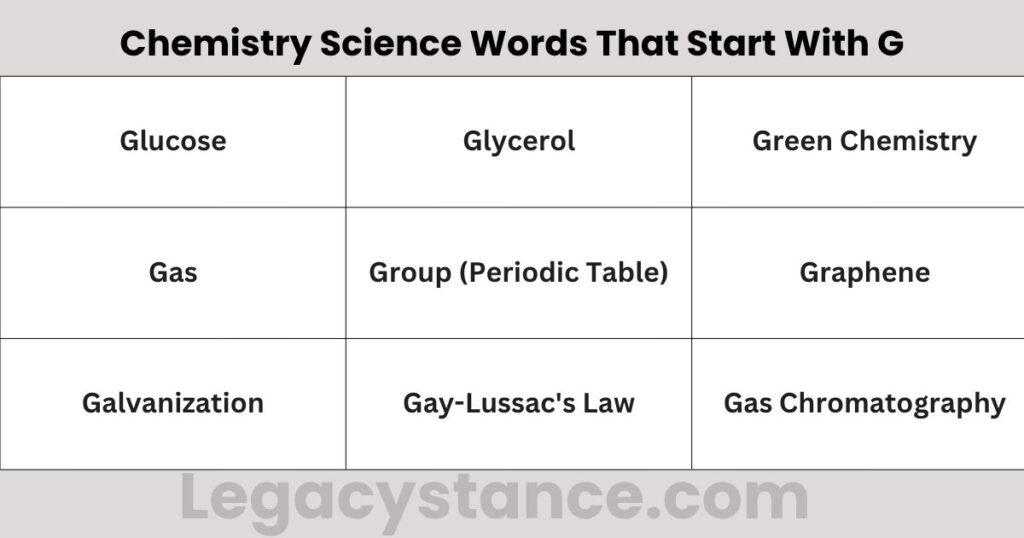
Glucose C₆H₁₂O₆ — the sugar your body runs on. Plants make it through photosynthesis. Your cells break it down to release energy. Without glucose, neither you nor a plant could function.
Gas One of the three main states of matter. Gas particles move freely, spread out to fill any container, and can be compressed. Air is a mixture of gases.
Galvanization Coating iron or steel with a thin layer of zinc to stop rusting. The metal pipes in older homes? That’s galvanization at work.
Glycerol A thick, colorless liquid found in fats and oils. Used in soaps, medicines, and food products. The “glycerin” on your soap label — that’s glycerol.
Group (Periodic Table) The vertical columns on the periodic table. Elements in the same group share chemical behavior. Group 1 metals all react violently with water, for instance.
Gay-Lussac’s Law When the volume of a gas stays constant and temperature rises, pressure increases. This explains why sealed aerosol cans can explode in fires.
Green Chemistry Designing chemical processes that reduce or eliminate harmful substances from the start — not as an afterthought.
Graphene A flat sheet of carbon just one atom thick, arranged in a honeycomb pattern. 200 times stronger than steel, nearly weightless. Now being explored for batteries, flexible electronics, and water filtration.
Gas Chromatography A lab method that separates mixtures of gases or vapors for identification. Used in food testing, environmental monitoring, and forensic science.
Biology Science Words That Start With G
Gene A specific DNA sequence holding instructions for making a protein or trait. Eye color, height, blood type — all shaped by genes. Humans carry roughly 20,000 of them.
Genome If genes are individual chapters, the genome is the entire book. The human genome contains about 3 billion base pairs. Sequencing it took 13 years and cost nearly $3 billion — now it takes a day.
Genotype The actual genetic code an organism carries — including hidden traits. Someone can carry a gene for a condition without ever showing it.
Gamete A sex cell. In humans, sperm or egg. Gametes carry half the normal chromosome count so that when two combine, the offspring gets the right total.
Germination What happens when a seed wakes up. Given water, warmth, and sometimes light, it breaks dormancy and starts forming roots and shoots. Every plant began this way.
Gland An organ that makes and releases specific substances. The thyroid regulates metabolism. Sweat glands cool you down. The pancreas releases insulin and digestive enzymes.
Glycolysis The first stage of cellular respiration. Cells split glucose into smaller molecules to extract energy. Happens in the cytoplasm. Requires no oxygen.
Genetics The branch of biology studying how traits pass from parents to offspring. Gregor Mendel launched this field in the 1860s using pea plants and careful observation.
Gymnosperms Plants that produce seeds not enclosed in fruit. Pine trees, cedars, and cycads are examples. Their seeds sit exposed on cone scales — open to the wind.
Gut Microbiome Trillions of bacteria, fungi, and microorganisms living in your digestive system. They affect digestion, immunity, and research increasingly links them to mood and mental health.
Gene Expression The process by which instructions in a gene get converted into a functional protein. Not all genes are expressed all the time — cells switch them on and off based on need.
Genetic Drift Random changes in gene frequency within a population over generations. Unlike natural selection, it has no direction. Small populations are most affected.
Earth Science Words That Start With G
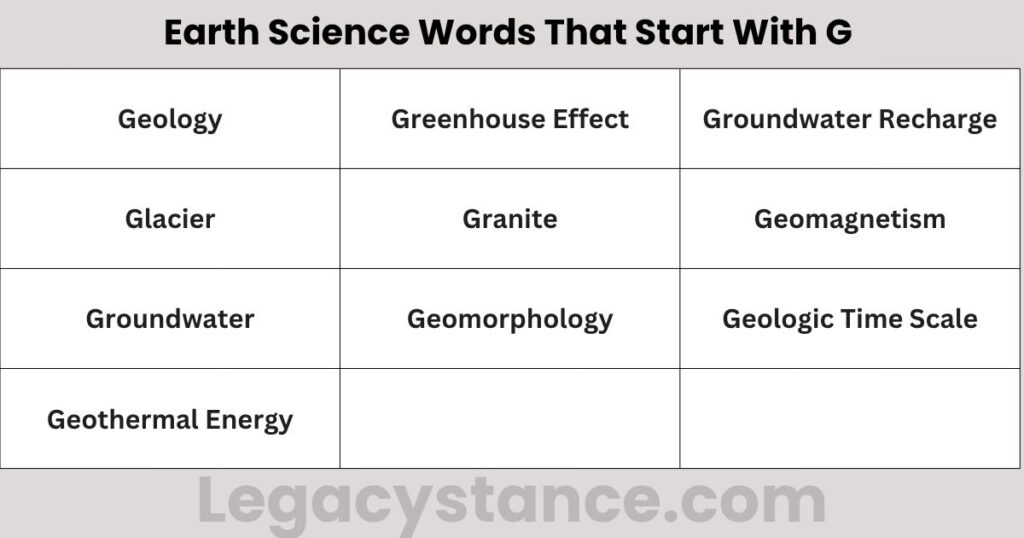
Geology The scientific study of Earth — its materials, structure, and processes over time. Rock layers read like chapters of planetary history.
Glacier A massive, slow-moving river of ice that forms where more snow falls than melts each year. Glaciers carve valleys, form lakes, and hold about 70% of Earth’s fresh water.
Groundwater Water that seeps into the ground and collects in underground layers called aquifers. Many cities and farms depend entirely on it for drinking and irrigation.
Geothermal Energy Heat from inside the Earth reaching the surface. Iceland uses it to heat homes and generate electricity — no fuel burned, no emissions produced.
Greenhouse Effect Gases like carbon dioxide and methane trap heat from the sun inside Earth’s atmosphere. Without any greenhouse effect, Earth would be frozen solid. Too much, and it overheats.
Granite A hard, coarse-grained igneous rock formed from slowly cooled magma deep underground. Found in mountain ranges, countertops, and monuments.
Geomorphology The study of Earth’s physical landforms — mountains, valleys, plains — and the forces that shape them: water, wind, ice, and tectonic movement.
Groundwater Recharge When rain or snowmelt seeps downward and refills underground aquifers. Deforestation and paved land surfaces reduce this process, causing water shortages over time.
Geomagnetism Earth’s magnetic field, generated by movement of molten iron in the outer core. It protects life from solar radiation and guides compass needles.
Geologic Time Scale A timeline dividing Earth’s 4.5-billion-year history into eons, eras, periods, and epochs. Gives scientists a shared language for discussing ancient events.
Space & Astronomy Science Words That Start With G
Galaxy A gravitationally bound system of stars, dust, gas, and dark matter. The Milky Way contains over 100 billion stars. The observable universe holds an estimated 2 trillion galaxies.
Gas Giant A planet made mostly of hydrogen and helium with no solid surface. Jupiter and Saturn are the solar system’s gas giants. There’s no ground to land on — you’d sink into layers of gas.
Geocentric Model The old idea that Earth sits at the center of the solar system with everything orbiting it. Believed for over a thousand years until Copernicus and later Galileo showed otherwise.
Gravitational Lensing When a massive object bends the path of light passing near it. This produces distorted or multiplied images of distant galaxies. Astronomers use it to detect dark matter.
Geosynchronous Orbit A satellite orbit where the satellite moves at exactly the same speed as Earth’s rotation — staying fixed above one spot on the ground. Television and weather satellites use this.
Grand Unified Theory A theoretical framework attempting to combine three of the four fundamental forces — electromagnetic, weak nuclear, and strong nuclear — into one model. Still a work in progress.
Medical & Health Science Words That Start With G
Ganglion A cluster of nerve cells outside the brain and spinal cord. Ganglia act as relay stations, passing signals between the central nervous system and the body.
Gastroenterology The branch of medicine focused on the digestive system — stomach, intestines, liver, gallbladder, and pancreas.
Genome Sequencing Reading a person’s entire DNA code. Now used clinically to identify cancer mutations, predict inherited disease risk, and personalize treatment plans.
Glucagon A hormone released by the pancreas that raises blood sugar. Works opposite to insulin. When blood sugar drops too low, glucagon signals the liver to release stored glucose.
Glaucoma A condition where increased pressure inside the eye damages the optic nerve, causing progressive vision loss. One of the leading causes of blindness worldwide.
Glycemia The level of glucose in the blood. Hyperglycemia means too high (as in diabetes). Hypoglycemia means dangerously low — a serious problem for brain function.
Gastric Acid Hydrochloric acid produced in the stomach to break down food and kill pathogens. Excess production causes heartburn and, over time, ulcers.
Gangrene The death of body tissue due to loss of blood supply or bacterial infection. A serious medical emergency requiring immediate treatment.
Gestation The period of development inside the womb before birth. In humans, roughly 40 weeks. In elephants, nearly 22 months.
Technology & Applied Science Words That Start With G
GPS (Global Positioning System) A network of satellites that sends precise timing signals to receivers — your phone uses them to calculate exact location using geometry. Accurate to within a few meters.
Gigabyte (GB) A unit of digital storage equal to roughly 1 billion bytes. One GB holds approximately 250 songs or 500 average-size photos.
Gigahertz (GHz) A unit measuring how many billion cycles per second a processor completes. Higher GHz generally means faster computation.
Geospatial Technology Tools that capture, store, and analyze location-based data. Used in disaster response, urban planning, farming, and environmental monitoring.
Gene Editing (CRISPR) A technology for cutting and modifying specific genes with precision. Active applications include cancer therapy, genetic disease correction, and drought-resistant crop development.
Easy Science Words That Start With G (For Beginners)
Perfect for younger students, ESL learners, or anyone just starting out.
- Gas — matter that spreads to fill any space, like air
- Germination — when a seed begins to grow
- Gravity — the force pulling you toward the ground
- Gills — organs fish use to pull oxygen from water
- Growth — getting bigger or more complex over time
- Granite — a very hard rock found in mountains
- Glacier — a giant, slow-moving mass of ice
- Glucose — the sugar that gives living cells energy
- Gland — a body part that releases useful substances
- Gut — the digestive tract from stomach to intestines
Advanced Science Words That Start With G
These appear in high school, university, or specialized fields.
Galvanic Cell An electrochemical cell that converts chemical energy into electrical energy through a spontaneous reaction. The operating principle behind batteries.
Geochemistry The study of Earth’s chemical composition and how it changes. Useful in mining, environmental science, and planetary research.
Gaussian Distribution A bell-shaped statistical curve where most values cluster near the average. Shows up in physics, biology, economics, and standardized testing alike.
Geodesic The shortest path between two points on a curved surface. On Earth, flight paths between cities follow geodesics — they look curved on flat maps but are actually the shortest routes.
Gibbs Free Energy A thermodynamic value describing how much energy is available to do useful chemical work. If it’s negative, a reaction happens spontaneously.
Gyromagnetic Ratio The ratio of a particle’s magnetic moment to its angular momentum. Directly relevant to how MRI machines create images of the human body.
Gluconeogenesis The liver’s process of making glucose from non-sugar sources like amino acids or fats. Critical during fasting or intense exercise.
Gluon The particle that carries the strong nuclear force — the force holding quarks together inside protons and neutrons.
Complete Reference List: 90+ Science Words That Start With G
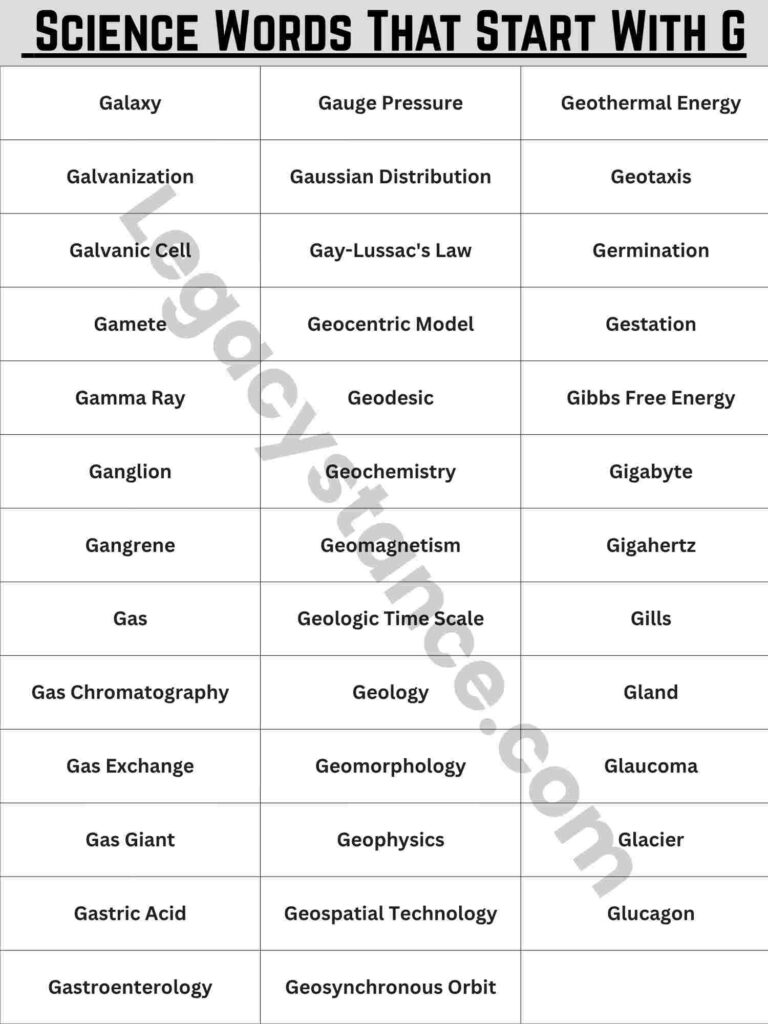
Galaxy — System of billions of stars bound by gravity
Galvanization — Zinc coating to prevent metal rust
Galvanic Cell — Device that converts chemical energy into electricity
Gamete — Reproductive cell (sperm or egg)
Gamma Ray — High-energy electromagnetic radiation
Ganglion — Cluster of nerve cells outside the central nervous system
Gangrene — Death of body tissue due to lack of blood supply
Gas — Matter with no fixed shape or volume
Gas Chromatography — Method to separate and analyze gas mixtures
Gas Exchange — Swap of oxygen and carbon dioxide in lungs or gills
Gas Giant — Large planet made mostly of gas
Gastric Acid — Acid in the stomach that helps digestion
Gastroenterology — Study of the digestive system
Gauge Pressure — Pressure measured compared to air pressure
Gaussian Distribution — Bell-shaped pattern of data
Gay-Lussac’s Law — Gas pressure increases with temperature at constant volume
Geocentric Model — Old idea that Earth is the center of the universe
Geodesic — Shortest path between two points on a curved surface
Geochemistry — Study of Earth’s chemical composition
Geomagnetism — Earth’s magnetic field
Geologic Time Scale — Timeline of Earth’s history
Geology — Study of Earth’s structure and materials
Geomorphology — Study of landforms and their formation
Geophysics — Study of Earth using physical principles
Geospatial Technology — Tools for mapping and location data
Geosynchronous Orbit — Orbit where a satellite stays above one spot on Earth
Geothermal Energy — Heat energy from inside the Earth
Geotaxis — Movement of organisms in response to gravity
Germination — Process of a seed starting to grow
Gestation — Development period before birth
Gibbs Free Energy — Energy available to do work in a system
Gigabyte — Unit of digital storage (~1 billion bytes)
Gigahertz — Measure of processor speed (billion cycles per second)
Gills — Organs fish use to breathe underwater
Gland — Organ that produces and releases substances
Glaucoma — Eye disease caused by pressure damage
Glacier — Large, slow-moving mass of ice
Glucagon — Hormone that raises blood sugar
Gluconeogenesis — Making glucose from non-sugar sources
Glucose — Sugar used by cells for energy
Glycemia — Level of sugar in the blood
Glycerol — Substance found in fats and oils
Glycogen — Stored form of glucose in the body
Glycolysis — First step in breaking down glucose for energy
GPS — Satellite system used for location tracking
Grand Unified Theory — Theory combining major forces of nature
Granite — Hard rock formed from cooled magma
Graphene — Single layer of carbon atoms
Gravitational Constant — Fixed value used in gravity calculations
Gravitational Field — Area where gravity affects objects
Gravitational Lensing — Bending of light by gravity
Gravitational Wave — Ripple in space caused by massive objects
Gravitation — Force that attracts objects with mass
Graviton — Hypothetical particle of gravity
Gravity — Force pulling objects toward each other
Gray (unit) — Unit measuring radiation dose
Green Chemistry — Designing safer chemical processes
Greenhouse Effect — Trapping of heat in Earth’s atmosphere
Greenhouse Gas — Gas that traps heat
Gross Anatomy — Study of body parts visible without a microscope
Gross Primary Production — Energy made by plants through photosynthesis
Ground State — Lowest energy level of an atom
Groundwater — Water found underground
Groundwater Recharge — Refilling of underground water
Group (Chemistry) — Column in the periodic table
Growth Hormone — Hormone that controls growth
Guanine — One of the four bases in DNA
Gut Microbiome — Microorganisms in the digestive system
Gymnosperms — Plants with seeds not enclosed in fruit
Gyromagnetic Ratio — Ratio related to magnetic and angular motion
Gyroscope — Device that maintains direction
Gametophyte — Stage in plant life cycle producing gametes
Gauge Boson — Particle that carries forces
Gene Editing — Changing DNA sequences
Gene Expression — Process of using DNA to make proteins
Gene Pool — Total genes in a population
Genetic Drift — Random changes in gene frequency
Genetic Mutation — Change in DNA sequence
Genetics — Study of heredity
Genome Sequencing — Reading the full DNA code
Genotype — Genetic makeup of an organism
Genotypic Frequency — How often a genotype appears
Geomagnetic Storm — Disturbance in Earth’s magnetic field
Geosphere — Solid part of Earth
Germ Cell — Cell that forms gametes
Gemmation — Reproduction by budding
Granum — Stack in chloroplast for photosynthesis
Gravitropism — Plant growth response to gravity
Group Velocity — Speed of a wave group
Gluon — Particle holding atomic nuclei together
Gammagraphy — Imaging using gamma rays
Genome — Complete set of DNA
Geochemical Cycle — Movement of chemicals through Earth
Gill Slit — Opening used for breathing in fish and embryos
Common Confusions: G Words People Mix Up
Genotype vs. Phenotype Genotype is the genetic code inside — what you carry. Phenotype is what shows on the outside — eye color, height, skin tone. The same genotype can produce different phenotypes depending on environment.
Glucose vs. Glycogen Glucose is ready-to-use fuel. Glycogen is the stored version, packed into the liver and muscles for later. Skip a meal and your body breaks glycogen back into glucose.
Germination vs. Growth Germination is the specific moment a seed breaks dormancy and begins developing. Growth is everything that follows. A seed germinates. A plant grows.
Gravity vs. Gravitation Gravity typically refers to the pull felt on Earth’s surface. Gravitation is the broader term for the attractive force between any two masses anywhere in the universe.
Glacier vs. Ice Sheet A glacier is a moving body of ice, usually in a mountain valley. An ice sheet is continental in scale — like Antarctica’s covering. All ice sheets are glaciers, but not all glaciers are ice sheets.
Galaxy vs. Solar System A solar system is one star plus everything orbiting it. A galaxy holds hundreds of billions of solar systems. The Milky Way contains our solar system and over 100 billion others.
You May also like:
120+ Science Words That Start With B | Full List with Meanings
140+ Science Words That Start With C (Meanings for Students & Beginners)
FAQs
1. What are the most important G science words to learn first?
Start with the ones you’ll see often: gravity, glucose, gene, germination, and glacier. These appear in school exams and daily life, so understanding them gives you a strong base quickly.
2. How can I remember science vocabulary more easily?
Don’t just read definitions—connect words to real life. For example, think of gravity when you drop something, or glucose as the sugar your body uses for energy. Simple links make words stick.
3. Are these words useful outside school?
Yes. Words like GPS, greenhouse effect, and genome come up in news, health topics, and technology. Knowing them helps you understand the world better, not just pass exams.
4. What’s the best way to study this list in less time?
Break it into small groups—5 to 10 words at a time. Review them, use them in a sentence, and come back later. Short, repeated study works better than long cramming sessions.
Bottom Line
Science vocabulary isn’t about memorizing definitions. It’s about understanding ideas well enough to use them — in class, in conversation, in real life.
The G words in this guide stretch across physics, chemistry, biology, earth science, space, medicine, and technology. Some were familiar. Some are new. A few might stick with you longer than you expect.
The best way to remember any of them: connect each word to something real. Gravity isn’t just a definition — it’s why your coffee stays in the cup. Germination isn’t just a term — it’s what happened to every seed ever planted.
Science vocabulary makes the world more legible. That’s the point.

Hi, I’m the creator of Legacystance.com, dedicated to making English learning simple and enjoyable. I write clear, practical guides on adjectives, verbs, idioms, pronunciation, spelling, and more. Every article is carefully researched to give accurate, easy-to-understand information. My goal is to help readers improve their English skills confidently, one step at a time, with content that is trustworthy, useful, and beginner-friendly.