Finding Math Words That Start With X can feel tricky because very few math terms begin with this letter. Still, X appears everywhere in mathematics, especially in graphs, algebra, statistics, logic, and advanced topics.
Learning these words helps students understand equations, coordinate planes, functions, and data more easily. This guide brings together useful X math vocabulary with simple meanings and clear examples that are easy to follow.
Quick List — Math Words That Start With X
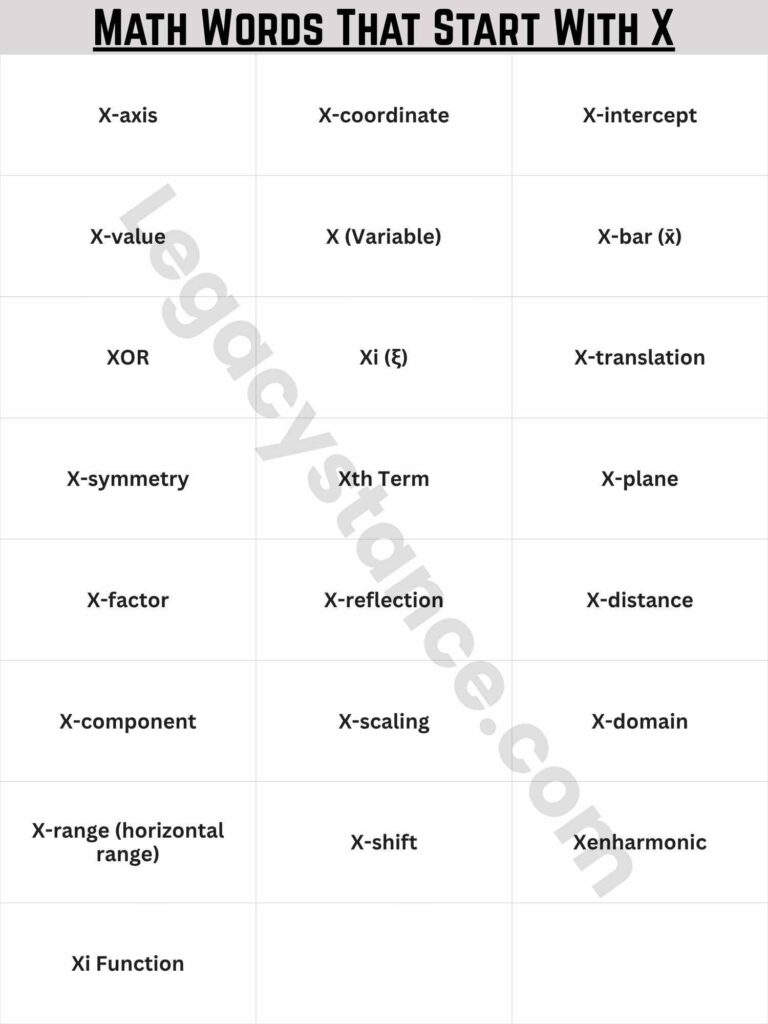
- X-axis
- X-coordinate
- X-intercept
- X-value
- X (Variable)
- X-bar (x̄)
- XOR
- Xi (ξ)
- X-translation
- X-symmetry
- Xth Term
- X-plane
- X-factor
- X-reflection
- X-distance
- X-component
- X-scaling
- X-domain
- X-range (horizontal range)
- X-shift
- Xenharmonic
- Xi Function
Common Math Words That Start With X
X-axis
The horizontal number line on a coordinate grid. Every standard graph has one. It runs left and right through the origin.
Example: The point (5, 0) lies on the x-axis.
X-coordinate
The first number in an ordered pair. It shows how far left or right a point sits from the origin.
Example: In (3, 7), the x-coordinate is 3.
X-intercept
The point where a line or curve crosses the x-axis. At this point, y always equals zero.
Example: The line y = 2x − 4 crosses the x-axis at (2, 0).
X-value
The input in a function or equation. Whatever number replaces x is the x-value.
Example: In f(x) = x + 5, if the x-value is 3, the output is 8.
X (Variable)
A symbol standing for an unknown number. The most widely used variable in algebra.
Example: Solve 4x = 20. Here x = 5.
Intermediate Math Words That Start With X
X-bar (x̄)
The symbol for the mean (average) of a data set in statistics. Written as x with a bar over it.
Example: Data: 2, 4, 6, 8 → x̄ = 5
X-translation
A horizontal shift of a graph or shape along the x-axis. The shape does not change — only its position moves left or right.
Example: y = (x − 3)² is y = x² shifted 3 units right. That shift is an x-translation.
X-symmetry
When a graph or shape is symmetric about the x-axis. The top half mirrors the bottom half exactly.
Example: The graph of x = y² has x-symmetry.
Xth Term
The general term of a sequence at position x. Lets you find any term without listing every term before it.
Example: In 3, 6, 9, 12… the xth term = 3x. At x = 10, the term is 30.
X-reflection
A flip of a shape or graph over the x-axis. Every point (x, y) becomes (x, −y).
Example: Reflecting the point (2, 5) over the x-axis gives (2, −5).
X-component
In vectors, the horizontal part of a vector. It tells how much the vector moves in the x-direction.
Example: A vector (4, 3) has an x-component of 4.
X-scaling
Stretching or compressing a graph horizontally. Multiplying x by a number inside the function changes the horizontal width.
Example: y = f(2x) compresses the graph of f horizontally — that is x-scaling.
X-domain
The set of all valid x-values (inputs) for a function. Same as the domain, but specifically referring to the x-variable.
Example: For y = √x, the x-domain is x ≥ 0.
X-distance
The horizontal distance between two points on a coordinate plane. Calculated by subtracting x-coordinates.
Example: Distance between (1, 4) and (6, 4) = |6 − 1| = 5 units horizontally.
X-shift
Another way to describe a horizontal translation of a graph. Used often in function notation.
Example: y = sin(x + 2) shows a left x-shift of 2 units.
X-range (Horizontal Range)
In projectile motion math, the horizontal distance a projectile travels. Also used to describe how far a graph extends horizontally.
Example: A ball launched at an angle covers a horizontal x-range of 40 meters.
X-factor (Algebraic)
In factoring, refers to x itself as a common factor pulled out of an expression.
Example: 3x² + 5x = x(3x + 5). Here x is the x-factor pulled out.
XOR (Exclusive OR)
A logic operation that returns true only when exactly one input is true — not both, not neither.
Example: 1 XOR 0 = 1. But 1 XOR 1 = 0.
Advanced Math Words That Start With X
Xi (ξ)
The 14th letter of the Greek alphabet. Used as a variable in higher mathematics, complex analysis, and physics equations.
Example: ξ appears in certain differential equations and probability density functions.
X-plane
In complex analysis, the real-number horizontal axis in the complex plane. Represents the real part of complex numbers.
Example: The complex number 3 + 2i has a real part of 3, plotted on the x-plane.
Xi Function (ξ-function)
A function in number theory, defined by Riemann in 1859. It is connected to the famous unsolved Riemann Hypothesis — one of the biggest open problems in mathematics.
Used in: advanced number theory and complex analysis.
Xenharmonic
Describes tuning systems outside the standard Western 12-note scale. Mathematically involves frequency ratios, logarithms, and divisions of the octave.
Example: Dividing an octave into 19 equal steps instead of 12 is a xenharmonic system.
Math Words That Start With X Subject-Specific Categories
Geometry and Coordinate Math
- X-axis
- X-coordinate
- X-intercept
- X-distance
- X-symmetry
- X-reflection
Algebra and Functions
- X (Variable)
- X-value
- X-intercept
- Xth Term
- X-factor
- X-domain
Transformations
- X-translation
- X-reflection
- X-scaling
- X-shift
Statistics
- X-bar (x̄)
Vectors
- X-component
Discrete Math / Logic
- XOR
Advanced / Higher Mathematics
- Xi (ξ)
- X-plane
- Xi Function
- Xenharmonic
Real-World Uses of Math Words That Start With X
- X-axis, X-coordinate, X-intercept — used in every graph in science, economics, and engineering
- X-bar — used in manufacturing quality control and medical research
- XOR — built into encryption, computer processors, and error-checking systems
- X-component — used in physics to break force and motion into directions
- X-scaling / X-shift — used in animation and game design to move and resize objects
- Xi Function — used in advanced number theory research
- Xenharmonic — used in music theory math and acoustic engineering
Commonly Confused X Math Terms
X-intercept vs. Root
Same point, different language. Root = algebraic term (x makes equation zero). X-intercept = graphing term (where the line hits the x-axis). Both describe the same location.
X-translation vs. X-shift
These mean the same thing. X-translation is the geometric term. X-shift is used more in function graphing. They describe horizontal movement only.
X-symmetry vs. Y-symmetry
X-symmetry = mirror across the x-axis (top/bottom match). Y-symmetry = mirror across the y-axis (left/right match). Even functions show y-symmetry. X-symmetry is rare in standard functions.
X-domain vs. Domain
X-domain is just the domain when the variable is specifically called x. They refer to the same thing — the set of valid inputs.
Read more:
50+ Math Words That Start With V – With Meanings and Examples
48+ Math Words That Start With W | With Meanings and Examples
FAQs about Math Words That Start With X
Q: Why does algebra use X for the unknown?
It traces back to 17th century Europe. René Descartes helped standardize it, partly because printers had extra X type blocks available. Before that, Arabic algebra used a word meaning “thing” for the unknown. X stuck and became the universal standard.
Q: Is x-bar written as x̄ or x-bar in problems?
Both. In handwritten work and printed textbooks, x̄ (x with a line on top) is standard. In typed work or when the symbol is unavailable, “x-bar” is the accepted written form. Both mean exactly the same thing: the sample mean.
Q: Can one graph have both x-symmetry and y-symmetry?
Yes. A circle centered at the origin has both. It mirrors perfectly across the x-axis and the y-axis. A shape with both types of symmetry also has origin symmetry (180° rotational symmetry).
Q: Is XOR a math concept or just a computer science term?
Both. XOR is rooted in Boolean algebra — a branch of mathematics. Computer science uses it practically, but it is taught in discrete mathematics courses and appears in mathematical logic, set theory (symmetric difference), and binary arithmetic.
Conclusion
X may not have as many math words as A or C, but the ones it has cover a wide range — from coordinate geometry basics to statistical notation, vector components, logical operations, and number theory.
The 20+ terms in this guide are all real, curriculum-relevant, and used across multiple levels of math. Start with the easy terms, get comfortable with the intermediate ones, and the advanced vocabulary will feel natural when you reach those levels.