Learning Math Words That Start With S can make math easier to understand and use in everyday life. From simple terms like sum and square to advanced ideas like standard deviation and sigma notation, these words appear across many areas of math. This guide explains them in clear, simple language so students, parents, and teachers can quickly build vocabulary and confidence without feeling overwhelmed.
Quick List: Math Words That Start With S
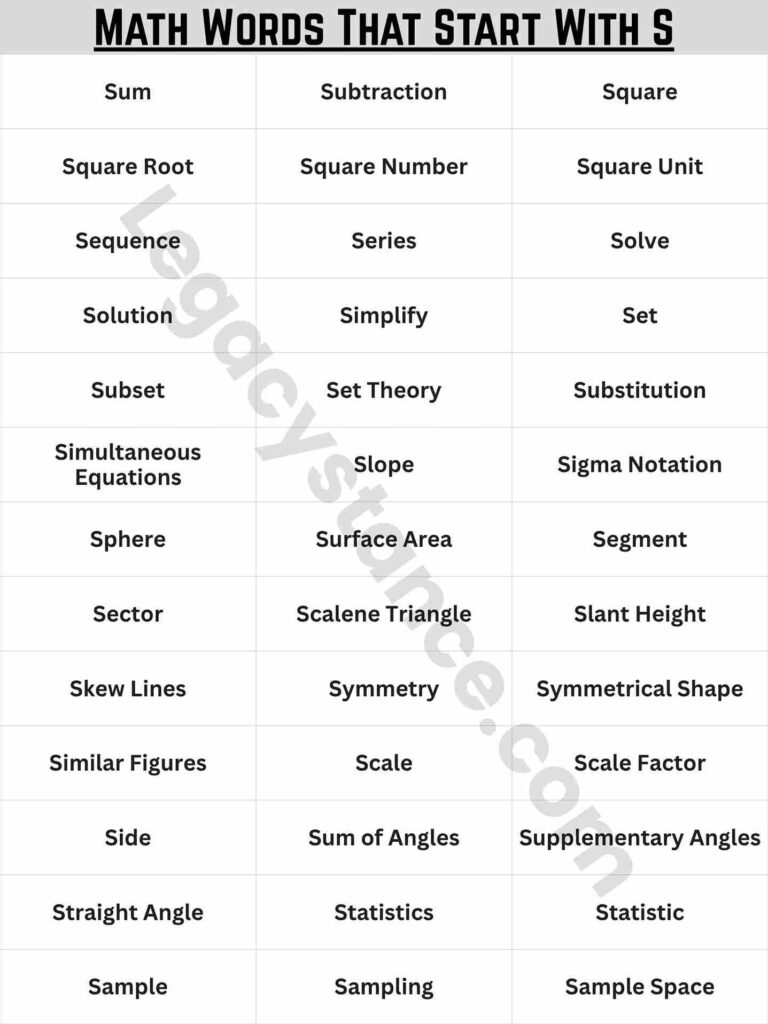
- Sum
- Subtraction
- Square
- Square Root
- Square Number
- Square Unit
- Sequence
- Series
- Solve
- Solution
- Simplify
- Set
- Subset
- Set Theory
- Substitution
- Simultaneous Equations
- Slope
- Sigma Notation
- Sphere
- Surface Area
- Segment
- Sector
- Scalene Triangle
- Slant Height
- Skew Lines
- Symmetry
- Symmetrical Shape
- Similar Figures
- Scale
- Scale Factor
- Side
- Sum of Angles
- Supplementary Angles
- Straight Angle
- Statistics
- Statistic
- Sample
- Sampling
- Sample Space
- Standard Deviation
- Spread
- Skewness
- Stem-and-Leaf Plot
- Sine
- Secant
- Speed
- Significant Figures
- Scientific Notation
- Step Function
- Subtrahend
- Spatial Reasoning
- Sum (statistics term, total of data values)
- Scalar
- Set Builder Notation
Vocabulary Table
| Word | Subject Area | Difficulty |
| Sum | Arithmetic | Easy |
| Square | Geometry/Algebra | Easy |
| Slope | Algebra | Medium |
| Symmetry | Geometry | Easy |
| Sample Space | Probability | Medium |
| Standard Deviation | Statistics | Advanced |
| Sphere | Geometry | Easy |
| Sine | Trigonometry | Advanced |
| Sigma Notation | Higher Math | Advanced |
| Skew Lines | Geometry | Medium |
| Scalar | Algebra | Medium |
| Set Builder Notation | Set Theory | Advanced |
Everyday Math Words That Start With S
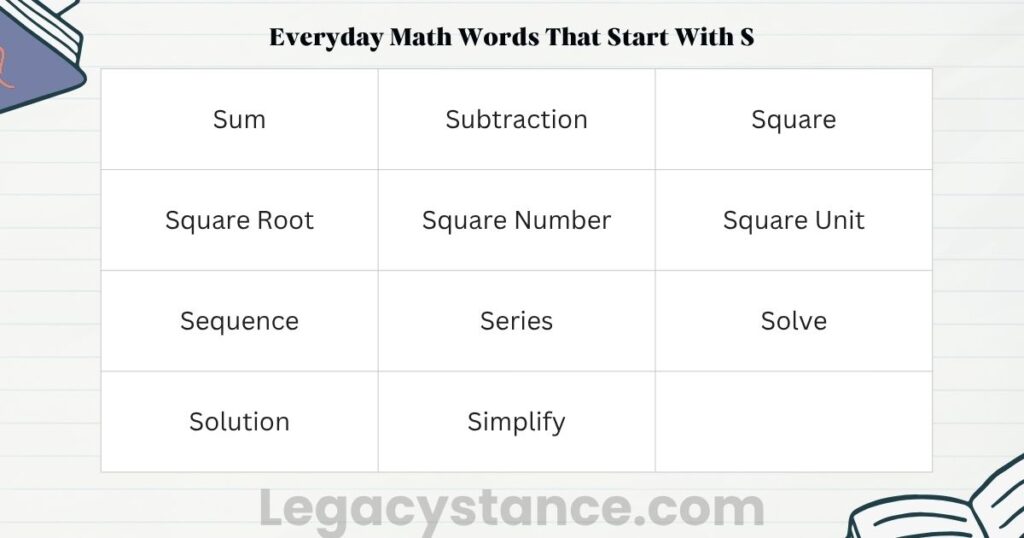
Sum – The answer when numbers are added. Example: the sum of 4 and 7 is 11.
Subtraction – Taking one number away from another. Example: 10 minus 3 equals 7.
Square – A shape with four equal sides and right angles, or a number multiplied by itself. Example: 5 squared equals 25.
Square Root – A number that, multiplied by itself, gives the original number. Example: the square root of 16 is 4.
Square Number – A number created by multiplying an integer by itself. Example: 9 is a square number (3 × 3).
Square Unit – A unit for measuring area. Example: a 10×10 foot room has 100 square feet.
Sequence – A list of numbers following a rule. Example: 2, 4, 6, 8.
Series – The sum of the terms in a sequence. Example: 2 + 4 + 6 + 8 = 20.
Solve – Finding the value of an unknown. Example: solving x + 5 = 12 gives x = 7.
Solution – The answer that makes an equation true. Example: the solution to 2x = 10 is x = 5.
Simplify – Writing an expression in its simplest form. Example: 6/8 simplifies to 3/4.
Set Theory and Algebra Math Words That Start With S
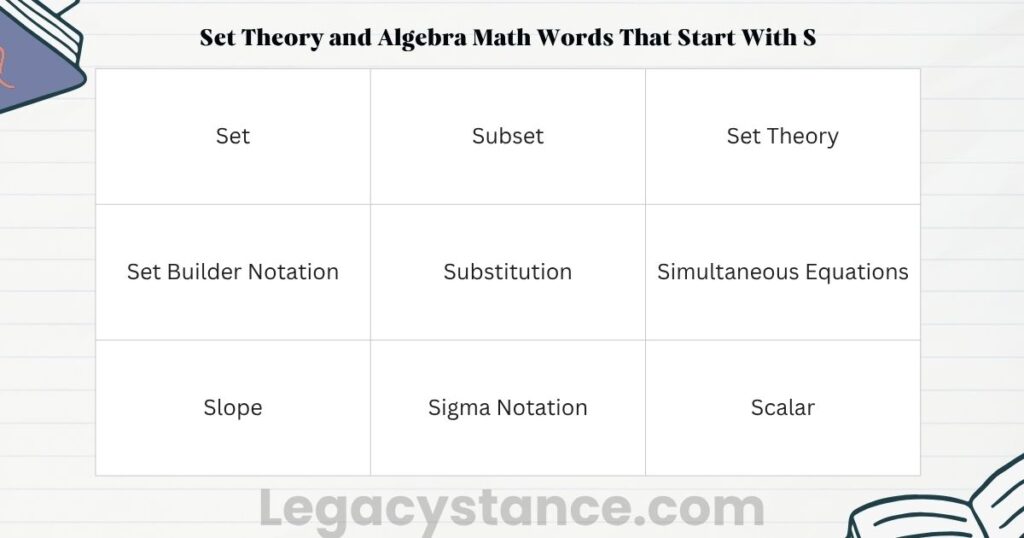
Set – A collection of distinct objects. Example: the set of even numbers includes 2, 4, 6, 8.
Subset – A set whose members all belong to a larger set. Example: even numbers from 1 to 10 are a subset of all numbers from 1 to 10.
Set Theory – The branch of math studying sets and their relationships. Example: it explains how groups overlap, as shown in Venn diagrams.
Set Builder Notation – A way to describe a set by stating the rule its members follow, instead of listing them. Example: {x | x > 0} means “all numbers greater than zero.”
Substitution – Replacing a variable with a known value. Example: if x = 3, then “x + 2” becomes “3 + 2.”
Simultaneous Equations – Two or more equations solved together. Example: x + y = 10 and x – y = 2.
Slope – How steep a line is, calculated as rise over run. Example: a slope of 2 rises 2 units for every 1 unit across.
Sigma Notation – Shorthand using the symbol Σ to represent a sum of terms. Example: it can mean “add up all numbers from 1 to 10” in one symbol.
Scalar – A single number used to multiply or scale a quantity, as opposed to a vector (which has direction). Example: multiplying a vector by the scalar 2 doubles its length.
Geometry Math Words That Start With S
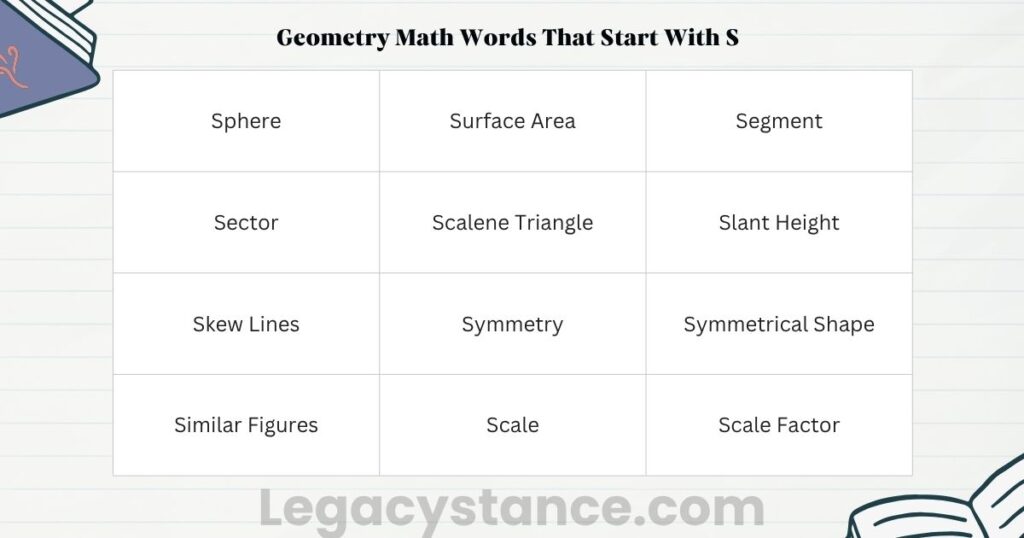
Sphere – A perfectly round 3D shape. Example: a basketball.
Surface Area – The total area covering a 3D shape’s outside. Example: needed to know how much paint covers a box.
Segment – Part of a line with two endpoints. Example: the line segment from point A to point B.
Sector – A slice of a circle bordered by two radii and an arc. Example: a pizza slice.
Scalene Triangle – A triangle with three different side lengths. Example: sides of 3, 5, and 7 units.
Slant Height – The distance from base to top measured along a slanted surface. Example: used for cones and pyramids, different from vertical height.
Skew Lines – Lines that don’t intersect and aren’t parallel, existing in different planes. Example: two roads on different levels of an overpass.
Symmetry – When one half of a shape mirrors the other. Example: a butterfly’s wings.
Symmetrical Shape – Any shape with at least one line of symmetry. Example: a square has four.
Similar Figures – Shapes with the same form but possibly different sizes. Example: two triangles with matching angles but different side lengths.
Scale – A ratio comparing a model’s size to the real object. Example: 1 inch on a map equals 10 miles.
Scale Factor – The number used to enlarge or shrink a shape’s dimensions. Example: a scale factor of 2 doubles every measurement.
Side – A line segment forming part of a shape. Example: a square has four equal sides.
Angles Math Words That Start With S
Sum of Angles – The total of all angles in a shape. Example: a triangle’s angles always add to 180 degrees.
Supplementary Angles – Two angles that add up to 180 degrees. Example: 110 degrees and 70 degrees.
Straight Angle – An angle measuring exactly 180 degrees. Example: looks like a flat line.
Statistics and Probability Math Words That Start With S
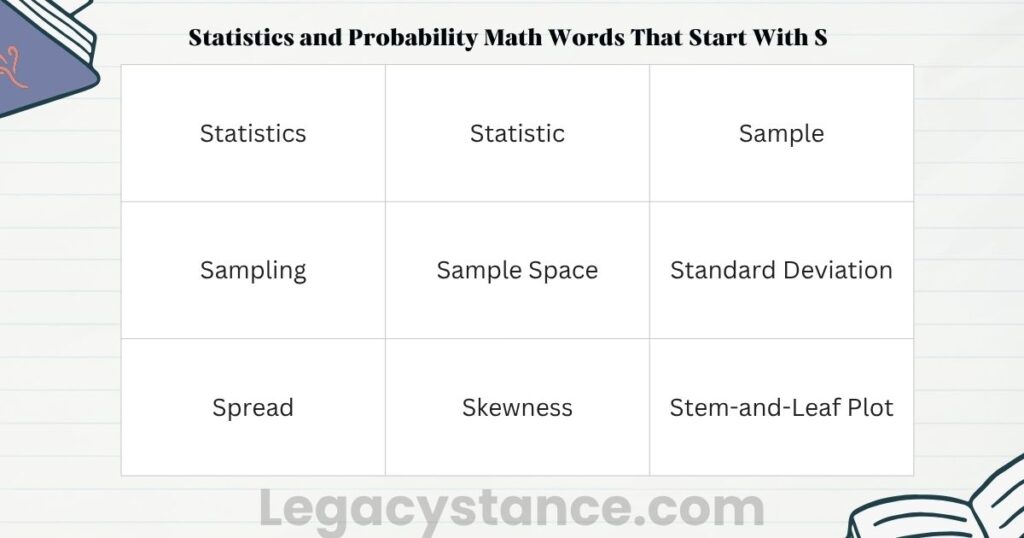
Statistics – The branch of math focused on collecting and interpreting data. Example: a survey about favorite foods.
Statistic – A single piece of information from data. Example: “60% of students prefer pizza.”
Sample – A smaller group representing a larger population. Example: surveying 50 out of 1,000 students.
Sampling – The process of choosing a sample. Example: random sampling gives everyone an equal chance.
Sample Space – All possible outcomes in a probability experiment. Example: rolling a die has the sample space {1, 2, 3, 4, 5, 6}.
Standard Deviation – A measure of how spread out data is from the average. Example: a small standard deviation means values cluster near the mean.
Spread – How distributed data values are, from lowest to highest. Example: a wide spread means high variation.
Skewness – How lopsided a data distribution is. Example: a few very high values among mostly low ones create skew.
Stem-and-Leaf Plot – A chart organizing numerical data by tens and ones digits. Example: test scores grouped by tens (stem) and ones (leaf).
Trigonometry Math Words That Start With S
Sine – A ratio comparing the side opposite an angle to the hypotenuse in a right triangle. Example: used to find unknown sides or angles.
Secant – The reciprocal of cosine. Example: less common than sine but part of the six trig ratios.
Measurement and Real-World Math
Speed – Distance divided by time. Example: 60 miles in one hour equals 60 mph.
Significant Figures – Digits that show a measurement’s precision. Example: 0.0420 has three significant figures.
Scientific Notation – Writing very large or small numbers using powers of ten. Example: 5,000,000 equals 5 × 10⁶.
Rare and Specialized Math Words That Start With S
Step Function – A function that jumps suddenly between values on a graph. Example: postage rates that jump at certain weight limits.
Subtrahend – In subtraction, the number being subtracted. Example: in 10 – 4 = 6, the subtrahend is 4.
Spatial Reasoning – The ability to mentally manipulate shapes and spaces. Example: solving a jigsaw puzzle.
Real-Life Connections
- Cooking and shopping – scale factors for recipes, square units for flooring
- Sports – statistics, sample, and standard deviation in sports analysis
- Technology – sets and subsets in programming and databases
- Travel – speed, scale on maps, sine in GPS calculations
- Science – significant figures and scientific notation for accurate measurements
Tips for Remembering S Math Words
- Group words by topic (algebra, geometry, statistics) rather than just by letter
- Use real objects, like holding a ball while learning “sphere”
- Write your own example sentences for each word
- Quiz yourself with a mix of terms from different topics
Commonly Confused S Math Terms
Solve vs. Simplify – Solving finds a variable’s value; simplifying shortens an expression without solving for anything.
Sequence vs. Series – A sequence is a list of numbers; a series is the sum of that list.
Sample vs. Sample Space – A sample is a group studied in statistics; a sample space is the list of outcomes in probability.
Slant Height vs. Height – Slant height runs along an angled surface; height is the straight vertical distance.
Read more:
45+ Math Words That Start With Q
45+ Math Words That Start With J
FAQs about Math Words That Start With S
Why do so many statistics words start with S?
It’s mostly coincidence, but sample, statistic, standard deviation, and skewness all happen to start with S, making this letter especially useful for data and probability topics.
Is slope the same as gradient?
Yes. Both describe how steep a line is and are calculated the same way; “gradient” is more common in some countries’ textbooks.
Do I need to learn secant in basic math?
Sine appears earlier in geometry and basic trigonometry. Secant usually shows up later in pre-calculus, so it’s less urgent for younger students.
How do I tell scalene, isosceles, and equilateral triangles apart?
Look at the sides: scalene has three different lengths, isosceles has two equal sides, and equilateral has all three equal.
Final Thoughts
S covers practical everyday words like sum and square, geometry terms like sphere and symmetry, and specialized vocabulary like skewness and sigma notation. Learning these by topic, rather than as a random list, makes them easier to remember and use in real math problems.