Learning Math Words That Start With V can make math easier to understand and less confusing. From simple terms like variable and volume to advanced ideas like vector space and variance, these words appear in many areas of mathematics.
This guide brings together useful V math vocabulary with clear meanings and examples. Whether you’re a student, parent, or teacher, you’ll find practical terms that help build stronger math skills and confidence.
Quick List — Math Words That Start With V
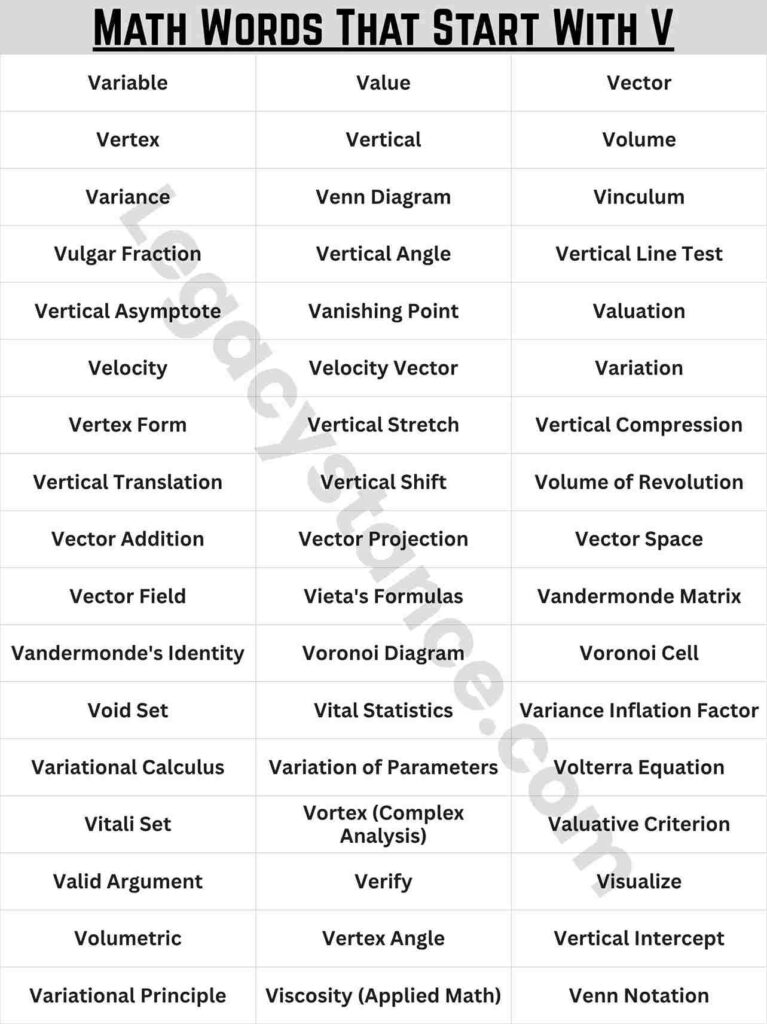
- Variable
- Value
- Vector
- Vertex
- Vertical
- Volume
- Variance
- Venn Diagram
- Vinculum
- Vulgar Fraction
- Vertical Angle
- Vertical Line Test
- Vertical Asymptote
- Vanishing Point
- Valuation
- Velocity
- Velocity Vector
- Variation
- Vertex Form
- Vertical Stretch
- Vertical Compression
- Vertical Translation
- Vertical Shift
- Volume of Revolution
- Vector Addition
- Vector Projection
- Vector Space
- Vector Field
- Vieta’s Formulas
- Vandermonde Matrix
- Vandermonde’s Identity
- Voronoi Diagram
- Voronoi Cell
- Void Set
- Vital Statistics
- Variance Inflation Factor
- Variational Calculus
- Variation of Parameters
- Volterra Equation
- Vitali Set
- Vortex (Complex Analysis)
- Valuative Criterion
- Valid Argument
- Verify
- Visualize
- Volumetric
- Vertex Angle
- Vertical Intercept
- Variational Principle
- Viscosity (Applied Math)
- Venn Notation
Common Math Words That Start With V
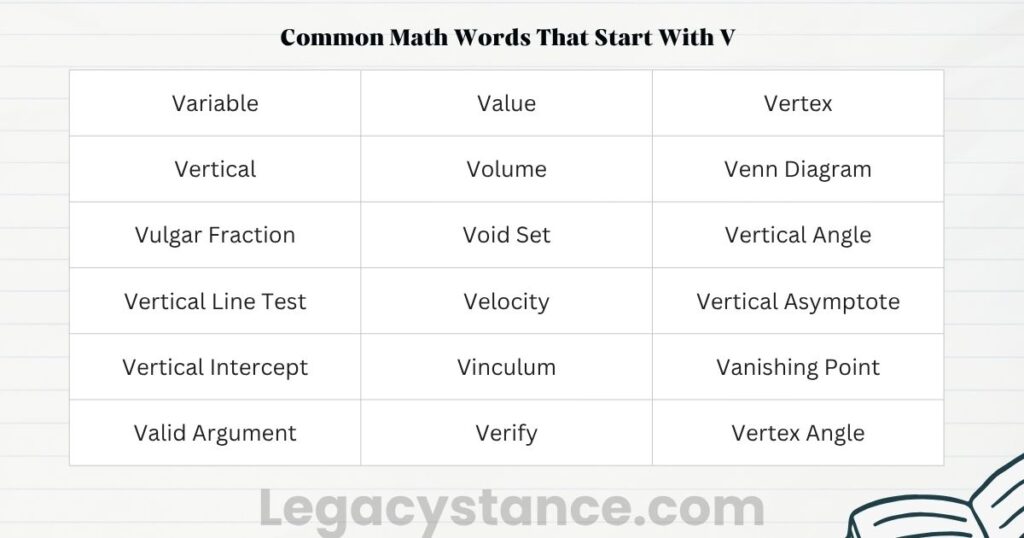
Variable
Meaning: A letter or symbol that stands in for an unknown or changing number.
Example: In 3x + 5 = 11, the letter x is the variable.
Why it matters: Variables make it possible to write general rules and solve equations. Every formula in mathematics uses them.
Value
Meaning: The specific number an expression equals after substitution or calculation.
Example: In y = 2x + 1, when x = 4, the value of y is 9.
Why it matters: Finding the value of an expression is what “evaluating” means in math.
Vertex
Meaning: The point where two or more lines or edges meet. In a parabola, it is the turning point — the highest or lowest point on the curve.
Example: A triangle has three vertices. The parabola y = x² has its vertex at (0, 0).
Why it matters: Vertex is used across geometry, algebra, and graph theory. You cannot describe a polygon or a parabola without it.
Vertical
Meaning: A straight up-and-down direction, perpendicular to the horizontal.
Example: The y-axis on a coordinate plane is a vertical line.
Why it matters: Students use this term when describing lines, planes, angles, and graph axes.
Volume
Meaning: The amount of three-dimensional space a solid object takes up, measured in cubic units.
Example: A cube with a side length of 4 cm has a volume of 64 cm³.
Why it matters: Volume problems appear in nearly every math and science course and have direct real-world uses from cooking to construction.
Venn Diagram
Meaning: A diagram using overlapping circles to show how sets relate — what they share and what they do not.
Example: Circle A contains even numbers. Circle B contains multiples of 3. The overlap holds numbers like 6, 12, 18.
Why it matters: Venn diagrams appear in set theory, probability, and logical reasoning. They make abstract relationships visible.
Vulgar Fraction
Meaning: A fraction written as one integer over another — numerator on top, denominator on bottom. Also called a common fraction.
Example: 3/4, 7/2, and 11/5 are vulgar fractions.
Why it matters: Older textbooks and standardized exams use this term. “Vulgar” here simply means “common” — there is nothing negative about it.
Void Set
Meaning: A set that contains no elements. Also called the empty set and written as {} or ∅.
Example: The set of whole numbers between 1 and 2 is the void set.
Why it matters: The void set is a fundamental concept in set theory. Every set contains it as a subset.
Vertical Angle
Meaning: When two lines intersect, the pairs of opposite angles formed are called vertical angles. They are always equal in measure.
Example: Two intersecting lines create angles of 70°, 110°, 70°, 110°. The two 70° angles are vertical angles, and so are the two 110° angles.
Why it matters: The vertical angle theorem is used in almost every angle-proof in geometry.
Vertical Line Test
Meaning: A visual method to determine if a graph represents a function. If any vertical line crosses the graph at more than one point, the graph is not a function.
Example: A circle fails this test. A parabola opening upward passes it.
Why it matters: This is the fastest way to identify a function from a graph without checking every input-output pair.
Velocity
Meaning: The rate at which an object changes its position in a specific direction. Unlike speed, velocity includes direction.
Example: A car moving at 60 km/h due north has a velocity of 60 km/h north.
Why it matters: Velocity is one of the primary concepts in applied mathematics and physics. Calculus defines it as the derivative of position with respect to time.
Vertical Asymptote
Meaning: A vertical line that a function’s graph approaches but never crosses or touches — usually at a point where the function is undefined.
Example: The function f(x) = 1/(x − 2) has a vertical asymptote at x = 2.
Why it matters: Understanding asymptotes is essential for graphing rational functions and analyzing function behavior near restricted values.
Vertical Intercept
Meaning: The point where a graph crosses the vertical (y) axis. Also called the y-intercept.
Example: The line y = 3x + 5 has a vertical intercept at (0, 5).
Why it matters: The vertical intercept gives the starting value of a linear function and is used in real-world models such as cost equations and population projections.
Vinculum
Meaning: The horizontal bar used in fractions, under radicals, or over repeating decimals to group terms.
Example: In the fraction 5/8, the bar between 5 and 8 is the vinculum. In √(x+4), the bar over x+4 performs the same grouping function.
Why it matters: Students who do not recognize the vinculum misread radical and fraction expressions, which causes calculation errors.
Vanishing Point
Meaning: In perspective geometry, the point on the horizon line where parallel lines appear to converge.
Example: Looking down a straight road, the two edges of the road appear to meet at a vanishing point on the horizon.
Why it matters: Vanishing points are used in projective geometry, computer graphics, and architectural drawing.
Valid Argument
Meaning: In logic, an argument is valid when the conclusion follows necessarily from the premises — if the premises are true, the conclusion must be true.
Example: “All squares are rectangles. This shape is a square. So this shape is a rectangle.” This is a valid argument.
Why it matters: Validity is the foundation of mathematical proof. Every theorem proof must be logically valid.
Verify
Meaning: To check whether a solution or statement is correct by substituting values or working through the logic.
Example: To verify x = 3 is a solution to 2x + 1 = 7, substitute: 2(3) + 1 = 7 ✓
Why it matters: Verification is the final step of problem-solving. It is how students catch errors before submitting answers.
Vertex Angle
Meaning: In an isosceles triangle, the vertex angle is the angle formed between the two equal sides.
Example: If the two equal sides of an isosceles triangle meet at a 40° angle, that 40° is the vertex angle.
Why it matters: This term appears in triangle classification and proofs involving isosceles triangles.
Variation
Meaning: A relationship between two quantities. Direct variation means one increases as the other increases. Inverse variation means one increases as the other decreases.
Example: Direct: y = 3x. Inverse: y = 12/x.
Why it matters: Variation describes proportional relationships. It shows up in science formulas, unit conversion, and algebraic modeling.
Advanced Math Words That Start With V
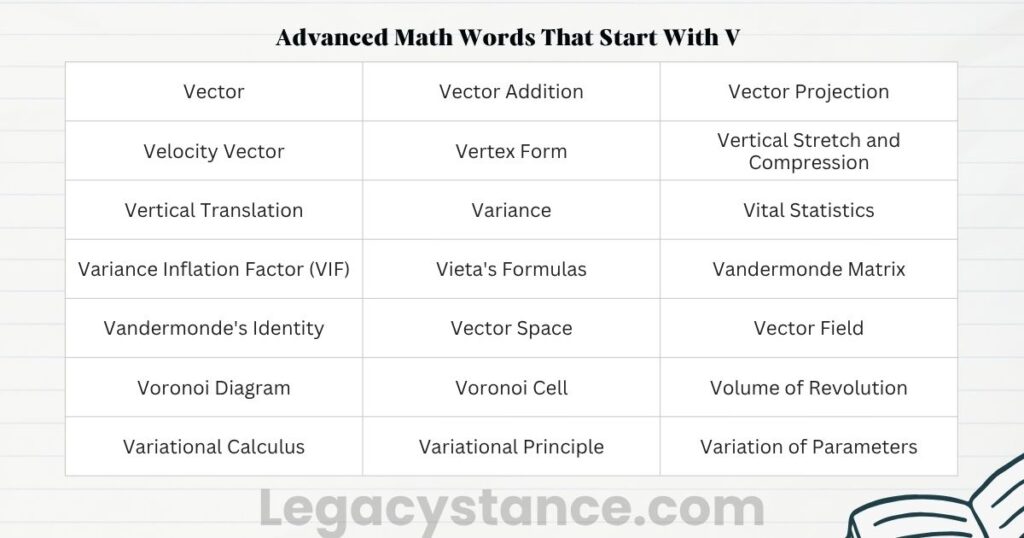
Vector
Meaning: A mathematical object with both magnitude and direction, represented as an arrow or a set of coordinates.
Example: The vector (3, 4) points right 3 units and up 4 units. Its magnitude is 5 (by the Pythagorean theorem).
Math Branch: Linear Algebra, Physics Math
Real-World Use: Vectors describe forces, motion, and direction in physics, robotics, and computer graphics. Every pixel movement in a video game uses vector math.
Vector Addition
Meaning: Combining two or more vectors by adding their corresponding components.
Example: (2, 3) + (1, −1) = (3, 2).
Math Branch: Linear Algebra
Real-World Use: Used to find the total force on an object when multiple forces act on it simultaneously.
Vector Projection
Meaning: The component of one vector that lies in the direction of another vector.
Example: Projecting vector a onto vector b gives the “shadow” of a in the direction of b.
Math Branch: Linear Algebra
Real-World Use: Used in physics to find how much of a force acts along a particular direction, and in machine learning for dimensionality reduction.
Velocity Vector
Meaning: A vector that represents the speed and direction of a moving object.
Example: An aircraft moving at 800 km/h heading northeast has a velocity vector pointing northeast with a magnitude of 800.
Math Branch: Physics Math, Calculus
Real-World Use: Navigation systems, flight control, and physics simulations all rely on velocity vectors.
Vertex Form
Meaning: A way of writing a quadratic function that immediately shows the vertex: f(x) = a(x − h)² + k, where (h, k) is the vertex.
Example: f(x) = 3(x − 2)² + 5 has its vertex at (2, 5).
Math Branch: Algebra
Real-World Use: Used to find maximum or minimum values instantly — such as the peak height of a thrown object.
Vertical Stretch and Compression
Meaning: Transformations that scale a graph vertically. A stretch multiplies all y-values by a factor greater than 1. A compression multiplies by a factor between 0 and 1.
Example:
- y = 4sin(x) is a vertical stretch of y = sin(x)
- y = 0.25sin(x) is a vertical compression
Math Branch: Algebra, Pre-Calculus
Why it matters: These transformations change a graph’s shape — taller or flatter — without shifting its position.
Vertical Translation
Meaning: Shifting an entire graph up or down without changing its shape. Also called a vertical shift.
Example: y = x² + 3 is the parabola y = x² moved up 3 units.
Math Branch: Algebra
Why it matters: Vertical translations change where a graph sits on the coordinate plane while preserving every other feature.
Variance
Meaning: A statistical measure of how spread out data points are from the mean. Calculated by averaging the squared differences from the mean.
Example: For the data set {2, 4, 6}, mean = 4. Variance = [(2−4)² + (4−4)² + (6−4)²] / 3 = 8/3 ≈ 2.67.
Math Branch: Statistics
Real-World Use: Analysts use variance to measure consistency and risk in finance, medical research, and quality control.
Vital Statistics
Meaning: Numerical data about a population — births, deaths, marriages, and disease rates — collected and analyzed statistically.
Example: A country’s birth rate and infant mortality rate are vital statistics.
Math Branch: Statistics, Applied Mathematics
Real-World Use: Governments and public health organizations use vital statistics to plan policy, allocate resources, and track population trends.
Variance Inflation Factor (VIF)
Meaning: A number used in regression analysis to detect multicollinearity — when two or more predictor variables are closely correlated with each other.
Example: A VIF of 1 means no correlation between predictors. A VIF above 10 signals a serious collinearity problem.
Math Branch: Statistics
Real-World Use: Data scientists and researchers use VIF to check whether their regression models are reliable before drawing conclusions.
Vieta’s Formulas
Meaning: Relationships between the roots of a polynomial and its coefficients. For ax² + bx + c = 0 with roots r and s:
- r + s = −b/a
- r × s = c/a
Example: For x² − 7x + 10 = 0, roots are 2 and 5. Sum = 7 = −(−7)/1. Product = 10 = 10/1.
Math Branch: Advanced Algebra, Number Theory
Real-World Use: Competition mathematicians use Vieta’s formulas to reason about roots without solving equations directly.
Vandermonde Matrix
Meaning: A matrix where each row is a geometric progression. Given values x₁, x₂, …, xₙ, each row takes the form (1, xᵢ, xᵢ², xᵢ³, …).
Example: For x₁ = 1, x₂ = 2, x₃ = 3:
| 1 | 1 | 1 |
| 1 | 2 | 4 |
| 1 | 3 | 9 |
Math Branch: Linear Algebra
Real-World Use: Used in polynomial interpolation, error-correcting codes, and signal processing.
Vandermonde’s Identity
Meaning: A combinatorial identity stating: C(m+n, r) = Σ C(m, k) · C(n, r−k).
Example: Choosing 3 people from a group of 5 men and 4 women can be broken down using this identity.
Math Branch: Combinatorics
Real-World Use: Used to simplify counting problems and prove results in combinatorics and probability.
Vector Space
Meaning: A set of objects (vectors) that can be added together and scaled by numbers, following eight specific axioms.
Example: All pairs (x, y) of real numbers form a 2D vector space. All polynomials of degree ≤ 2 form another.
Math Branch: Linear Algebra
Real-World Use: Machine learning, quantum mechanics, and computer graphics all operate within vector spaces. A neural network’s hidden layers are vector space transformations.
Vector Field
Meaning: A function that assigns a vector to every point in a region of space — giving each location a direction and magnitude.
Example: Wind speed and direction across a weather map form a vector field. Each city has its own arrow.
Math Branch: Multivariable Calculus
Real-World Use: Used in electromagnetism (Maxwell’s equations), fluid dynamics, and atmospheric modeling.
Voronoi Diagram
Meaning: A partition of a plane into regions based on which of a set of seed points is closest. Each region contains all points nearest to one particular seed.
Example: Place five hospitals on a city map. A Voronoi diagram shows which neighborhood is closest to which hospital.
Math Branch: Computational Geometry
Real-World Use: Cell tower coverage, GPS routing, airport planning, and epidemiology all use Voronoi methods.
Voronoi Cell
Meaning: A single region in a Voronoi diagram — the set of all points closer to one specific seed point than to any other.
Example: In a city with three post offices, each Voronoi cell contains the addresses served by one post office.
Math Branch: Computational Geometry
Why it matters: Understanding cells is essential for analyzing Voronoi diagrams in applications from logistics to crystallography.
Volume of Revolution
Meaning: The volume of a solid formed by rotating a 2D region around an axis. Calculated using the disk method, washer method, or shell method.
Example: Rotating the area under y = √x from x = 0 to x = 4 around the x-axis creates a solid whose volume is found by integration.
Math Branch: Calculus
Real-World Use: Used in engineering to design axially symmetric objects — bottles, turbine blades, pistons, and medical implants.
Variational Calculus
Meaning: A branch of mathematics that finds functions which minimize or maximize a quantity expressed as an integral — called a functional.
Example: The brachistochrone problem — finding the fastest sliding path between two points — is solved using variational calculus.
Math Branch: Advanced Calculus
Real-World Use: Lagrangian mechanics, optics (Fermat’s principle), and optimal control theory in engineering all depend on variational calculus.
Variational Principle
Meaning: A principle stating that the correct solution to a physical or mathematical problem is the one that makes some quantity — energy, action, or time — stationary (minimum or maximum).
Example: Hamilton’s Principle in physics states that a particle follows the path that minimizes the action integral.
Math Branch: Mathematical Physics, Applied Mathematics
Real-World Use: Fundamental to quantum mechanics, general relativity, and structural engineering.
Variation of Parameters
Meaning: A technique for solving non-homogeneous linear differential equations by treating the constants in the homogeneous solution as variable functions to be determined.
Example: Used to solve y” + y = cos(x) when undetermined coefficients are difficult to apply.
Math Branch: Differential Equations
Real-World Use: Models systems with external, time-varying inputs — such as a mechanical oscillator driven by a changing force.
Volterra Equation
Meaning: An integral equation where the unknown function appears under an integral sign with a variable upper limit. Named after mathematician Vito Volterra.
Example: f(x) = g(x) + ∫₀ˣ K(x, t) f(t) dt is a Volterra equation of the second kind.
Math Branch: Integral Equations, Advanced Calculus
Real-World Use: Used to model predator-prey dynamics, viscoelastic materials, and population growth with memory effects.
Vitali Set
Meaning: A specific subset of real numbers, constructed using the Axiom of Choice, that cannot be assigned a consistent measure (length). It is the first known non-measurable set.
Example: Vitali’s construction groups real numbers in [0, 1] into equivalence classes differing by rational numbers, then selects one representative from each. The result has no valid Lebesgue measure.
Math Branch: Real Analysis, Measure Theory
Why it matters: The Vitali set shows that not every set of numbers can be measured — which forced mathematicians to develop rigorous measure theory.
Valuation
Meaning: In number theory, a function that measures how divisible a number is by a given prime. The p-adic valuation vₚ(n) returns the highest power of prime p dividing n.
Example: v₂(24) = 3, because 24 = 2³ × 3, so 2 divides 24 exactly three times.
Math Branch: Number Theory
Real-World Use: p-adic valuations appear in cryptography, algebraic number theory, and the study of Diophantine equations.
Vortex (Complex Analysis)
Meaning: A type of fluid flow pattern in complex analysis where the flow circulates around a central point. Modeled using complex potential functions.
Example: A point vortex has a complex potential w(z) = (iΓ/2π) ln(z), where Γ is the circulation strength.
Math Branch: Complex Analysis, Fluid Mechanics
Real-World Use: Used in aerodynamics to model airflow around wings and in meteorology to model cyclones and tornadoes.
Valuative Criterion
Meaning: A theorem in algebraic geometry that characterizes proper morphisms between schemes using discrete valuation rings.
Example: A morphism of schemes is proper if and only if it satisfies the valuative criterion with respect to all valuation rings.
Math Branch: Algebraic Geometry
Why it matters: The valuative criterion is a foundational tool for working with compactness in algebraic geometry, where topological notions do not directly apply.
Viscosity (Applied Math)
Meaning: A measure of a fluid’s resistance to flow. In applied mathematics, it appears as a coefficient in the Navier-Stokes equations governing fluid motion.
Example: Honey has higher viscosity than water. In the Navier-Stokes equations, the viscosity coefficient μ controls how much internal friction resists the fluid’s motion.
Math Branch: Applied Mathematics, Fluid Dynamics
Real-World Use: Viscosity calculations appear in pipeline engineering, aerodynamics, blood flow modeling, and industrial manufacturing.
Real-World Applications of Math Words That Start With V
Measurement and Engineering
- Volume used in construction, packaging, and manufacturing
- Vertical measurements in architecture and surveying
- Viscosity in pipeline and fluid systems
Data and Statistics
- Variance and VIF in research, finance, and clinical trials
- Vital statistics in public health and government planning
Computer Science and AI
- Vector spaces in machine learning and language models
- Voronoi diagrams in GPS routing and spatial databases
- Vector fields in physics simulations and game engines
Physics and Engineering
- Velocity vectors and variational principles in mechanics
- Volterra equations in material science and population modeling
- Vortex models in aerodynamics and meteorology
Tips for Remembering V Math Words
- Group by branch. File each word under geometry, algebra, statistics, or calculus in your notes. “Variance” and “VIF” belong together. “Vertex,” “vertical angle,” and “voronoi” belong together.
- One word, one image. Attach a mental picture — vertex = tip of a mountain, vector = game controller arrow, vortex = a tornado.
- Use vocabulary cards. Write the word on one side, your own definition and one example on the other. The act of writing it yourself matters more than re-reading.
- Find the word in a real problem. Each time a textbook says “find the vertex” or “calculate the variance,” your brain links the word to an action, not just a definition.
- Connect to everyday objects. Volume = water in a bottle. Vertical = edge of a door frame. Vinculum = the bar in a fraction you write every day.
Commonly Confused V Math Terms
Variable vs. Value
A variable is the letter (x, y, n). A value is the specific number it represents. In x = 9, x is the variable and 9 is the value.
Vector vs. Scalar
A scalar has magnitude only — temperature, speed, mass. A vector has magnitude and direction — velocity, force, displacement. Speed is a scalar. Velocity is a vector.
Vertical Asymptote vs. Horizontal Asymptote
A vertical asymptote is where a function becomes undefined (a vertical wall the graph cannot cross). A horizontal asymptote is the value the function approaches as x grows infinitely large or small. They describe completely different graph behaviors.
Variance vs. Standard Deviation
Variance is the average of squared differences from the mean. Standard deviation is the square root of variance. Standard deviation stays in the original units of the data — which makes it easier to interpret — while variance is in squared units.
Vertical Stretch vs. Vertical Translation
A stretch changes the graph’s shape — taller or flatter. A translation moves the graph up or down without touching its shape. These are two different operations.
Vulgar Fraction vs. Decimal Fraction
Both are fractions. 3/4 is a vulgar fraction. 0.75 is the same value written as a decimal fraction. “Vulgar” means common — not negative.
Read more:
53+ Math Words That Start With T | With Meanings and Examples
57+ Math Words That Start With U: Meanings, Examples, and Uses
FAQs about V Math Words
Why should students learn math vocabulary instead of only solving problems?
Math vocabulary helps students understand instructions, concepts, and formulas correctly. When you know what words like variable, vertex, or variance mean, solving problems becomes much easier because you understand what the question is asking.
Which Math Words That Start With V are most important for beginners?
Beginners should focus on words they see often in schoolwork, including variable, value, vertex, vertical, volume, velocity, and Venn diagram. These terms appear regularly in elementary, middle school, and early high school math.
What is the easiest way to remember math terms that start with V?
Try connecting each word to a picture or real-life object. For example, think of a water bottle for volume, a road sign arrow for vector, and the corner of a triangle for vertex. Visual connections help memory last longer.
Are all V math words used in everyday life?
No. Some terms, such as volume, velocity, and variance, are used in practical situations like construction, travel, and data analysis. Others, such as Vitali set or valuative criterion, are mostly used in advanced university-level mathematics.
Conclusion
These 50+ math words starting with V cover the full range — from classroom basics like variable, vertex, and volume to university-level tools like vector spaces, Volterra equations, and variational calculus. Learning them in order of difficulty, with clear examples and honest context about where they appear, is far more useful than memorizing a list. Start with the common terms. As your coursework advances, the advanced vocabulary will slot naturally into place.