Learning Math Words That Start With J can help students build stronger math vocabulary and understand concepts across algebra, calculus, geometry, and statistics. While the letter J is not packed with common math terms, it includes some important ideas used in classrooms, exams, engineering, computer science, and advanced mathematics.
This guide brings together J Math Words with simple meanings, practical examples, and clear explanations. Whether you’re a student, teacher, parent, or curious learner, you’ll find useful terms ranging from basic probability concepts to higher-level mathematical theories.
Quick List: Math Words That Start With J
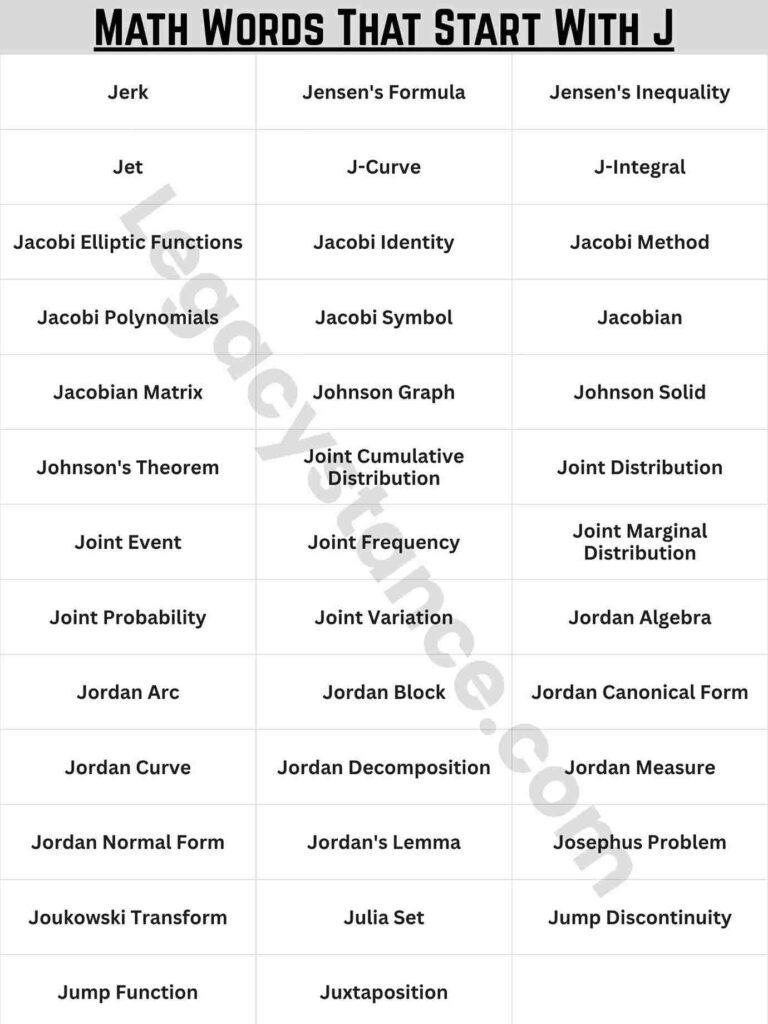
- Jerk
- Jensen’s Formula
- Jensen’s Inequality
- Jet
- J-Curve
- J-Integral
- Jacobi Elliptic Functions
- Jacobi Identity
- Jacobi Method
- Jacobi Polynomials
- Jacobi Symbol
- Jacobian
- Jacobian Matrix
- Johnson Graph
- Johnson Solid
- Johnson’s Theorem
- Joint Cumulative Distribution
- Joint Distribution
- Joint Event
- Joint Frequency
- Joint Marginal Distribution
- Joint Probability
- Joint Variation
- Jordan Algebra
- Jordan Arc
- Jordan Block
- Jordan Canonical Form
- Jordan Curve
- Jordan Decomposition
- Jordan Measure
- Jordan Normal Form
- Jordan’s Lemma
- Josephus Problem
- Joukowski Transform
- Julia Set
- Jump Discontinuity
- Jump Function
- Juxtaposition
Common Math Words That Start With J
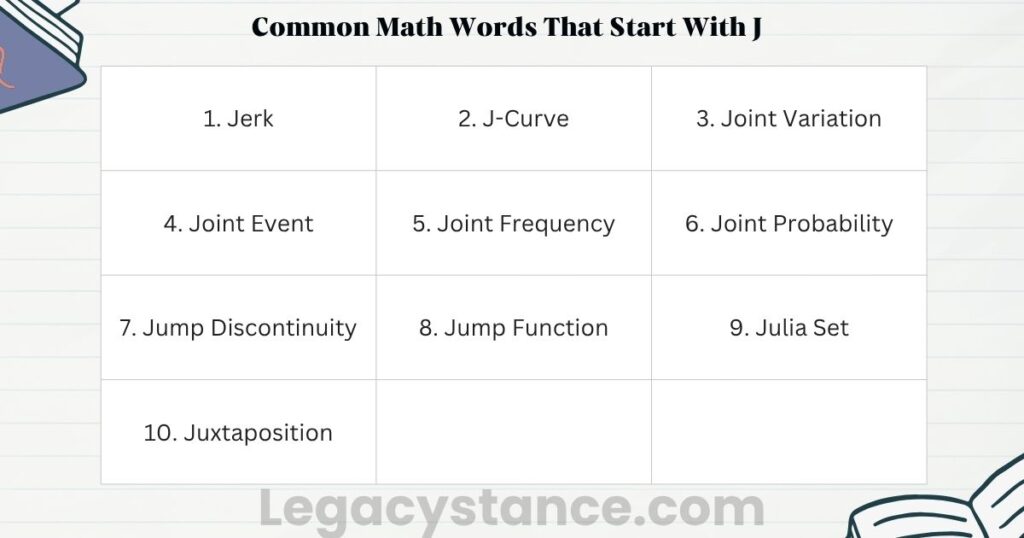
1. Jerk
Meaning: The rate of change of acceleration over time. It is the third derivative of position with respect to time.
Example: A car braking suddenly produces high jerk — mathematically written as da/dt or d³x/dt³.
Why it matters: Students studying higher-order derivatives in calculus meet jerk as a direct real-world application.
2. J-Curve
Meaning: A graph shaped like the letter J — values dip slightly before rising sharply over time.
Example: A population graph after a recovery event often shows a J-curve pattern.
Why it matters: Helps students interpret non-linear graph behavior and exponential-style growth.
3. Joint Variation
Meaning: A relationship where one variable changes proportionally with two or more other variables simultaneously.
Example: If z = kxy, then z varies jointly with x and y. If x = 2, y = 3, and k = 4, then z = 24.
Why it matters: Appears regularly in algebra word problems and forms the basis of many scientific formulas.
4. Joint Event
Meaning: An event that requires two or more conditions to be true at the same time.
Example: Drawing a card that is both red and a king is a joint event.
Why it matters: Students need to understand joint events before correctly applying multiplication or addition rules in probability.
5. Joint Frequency
Meaning: In a two-way table, the raw count of data points that share two specific characteristics.
Example: In a student survey table, the number of 8th-grade students who prefer math is a joint frequency.
Why it matters: A core concept in data analysis units and standardized test problems.
6. Joint Probability
Meaning: The likelihood that two events both occur — written as P(A and B) or P(A ∩ B).
Example: P(rolling a 4 and flipping tails) = 1/6 × 1/2 = 1/12.
Why it matters: Foundation for all multivariate probability and statistical modeling.
7. Jump Discontinuity
Meaning: A point where a function has two different finite one-sided limits that do not equal each other, causing a visible “jump” in the graph.
Example: f(x) = 1 for x < 0 and f(x) = 4 for x ≥ 0 has a jump discontinuity at x = 0.
Why it matters: Students must identify types of discontinuities in calculus to work with limits correctly.
8. Jump Function
Meaning: A function that is constant between points but jumps abruptly at specific values — also called a step function or saltus function.
Example: A tax bracket calculation behaves like a jump function.
Why it matters: Used in real analysis and economics-based math to model sudden changes.
9. Julia Set
Meaning: A fractal boundary generated by iterating a complex function — points near the boundary produce chaotic, infinitely detailed patterns.
Example: The swirling, endlessly complex fractal images generated from the formula f(z) = z² + c for fixed c are Julia Sets.
Why it matters: Connects complex numbers, iterative functions, and visual mathematics in a striking way.
10. Juxtaposition
Meaning: Placing two mathematical symbols side by side to indicate multiplication, without using a multiplication sign.
Example: Writing 3x means 3 multiplied by x. Writing ab means a multiplied by b.
Why it matters: Every algebra student uses juxtaposition daily, often without knowing the formal name for it.
Advanced Math Words That Start With J

11. Jacobian
Meaning: The determinant of the Jacobian Matrix. It measures how much a transformation stretches, shrinks, or rotates space at a given point.
Example: When converting integrals from Cartesian to polar coordinates, the factor r that appears is the Jacobian determinant.
Why it matters: Essential for change-of-variables in multivariable integrals and coordinate transformations.
12. Jacobian Matrix
Meaning: A matrix containing all first-order partial derivatives of a vector-valued function. Each row corresponds to one output function; each column to one input variable.
Example: For f(x, y) = (x² + y, xy), the Jacobian Matrix contains four partial derivatives arranged in a 2×2 grid.
Why it matters: Used in multivariable calculus, robotics, neural networks, and numerical solving methods.
13. Jacobi Method
Meaning: An iterative numerical algorithm for solving large systems of linear equations by repeatedly updating estimates using diagonal dominance.
Example: To solve 4x + y = 15 and x + 3y = 10, the Jacobi Method starts with guesses and refines them through cycles until the values stabilize.
Why it matters: Computers use this method to solve equation systems too large for direct algebraic approaches.
14. Jacobi Identity
Meaning: In a Lie algebra, for any three elements x, y, z: [x,[y,z]] + [y,[z,x]] + [z,[x,y]] = 0, where brackets denote the Lie bracket operation.
Why it matters: This identity defines the structure of Lie algebras, which model symmetry in physics and mathematics.
15. Jacobi Symbol
Meaning: A number-theoretic function written as (a/n), generalizing the Legendre symbol to composite denominators using prime factorization.
Why it matters: Used in advanced primality tests and integer factorization algorithms in cryptography.
16. Jacobi Polynomials
Meaning: A family of orthogonal polynomials on the interval [−1, 1], parameterized by α and β, that generalize Legendre, Chebyshev, and other classical polynomials.
Why it matters: Used in Gaussian quadrature for numerical integration and in solving physics equations with boundary conditions.
17. Jacobi Elliptic Functions
Meaning: Three doubly periodic functions — sn(u,k), cn(u,k), and dn(u,k) — that generalize sine and cosine to elliptic curves.
Why it matters: Appear in pendulum motion, signal processing, and elliptic curve cryptography.
18. Jacobi Triple Product
Meaning: An identity in number theory and combinatorics: ∏(1−x²ⁿ)(1+x²ⁿ⁻¹z²)(1+x²ⁿ⁻¹z⁻²) = Σ xⁿ²z²ⁿ.
Why it matters: Connects infinite products to infinite series and plays a role in the theory of partitions and modular forms.
19. Jensen’s Inequality
Meaning: For any convex function f and random variable X: f(E[X]) ≤ E[f(X)]. The function of the average is less than or equal to the average of the function.
Why it matters: Appears throughout probability theory, information theory, machine learning, and optimization.
20. Jensen’s Formula
Meaning: A complex analysis result relating the zeros of an analytic function inside a disk to its boundary values via a logarithmic integral.
Why it matters: Foundational for studying entire functions and the distribution of their zeros in complex analysis.
21. Jet (Differential Geometry)
Meaning: An equivalence class of functions that share the same value and the same derivatives up to order k at a point. A k-jet captures local behavior completely up to that order.
Why it matters: Formalizes local approximation of functions and is central to modern differential geometry and mathematical physics.
22. J-Integral
Meaning: A path-independent contour integral in fracture mechanics that quantifies the energy available to drive crack propagation in a material.
Why it matters: Bridges applied mathematics and structural engineering — used to predict exactly when and how materials will fracture.
23. Johnson Solid
Meaning: Any strictly convex polyhedron with all faces being regular polygons, excluding Platonic solids, Archimedean solids, prisms, and antiprisms. There are exactly 92 of them.
Example: A square pyramid with equilateral triangular faces is Johnson Solid J1.
Why it matters: Johnson Solids represent a complete classification in 3D geometry — a rare and satisfying result.
24. Johnson’s Theorem (Geometry)
Meaning: If three congruent circles each pass through a single common point, then the circle through their three other pairwise intersection points is congruent to each of the original three.
Why it matters: An elegant, non-obvious result in classical circle geometry — beautifully clean and surprising.
25. Johnson Graph
Meaning: A graph J(n, k) where each vertex represents a k-element subset of an n-element set, and two vertices connect if their subsets differ by exactly one element.
Why it matters: Important in coding theory and combinatorics, especially in the design of error-correcting codes.
26. Johnson Bound
Meaning: An upper bound in coding theory on the number of codewords in a binary code with given length and minimum distance.
Why it matters: Helps researchers understand the theoretical limits of how much information can be encoded with guaranteed error correction.
27. Jordan Curve
Meaning: A simple closed curve in the plane — a continuous loop that never crosses itself. The Jordan Curve Theorem guarantees it divides the plane into exactly two regions.
Example: Any closed, non-self-intersecting loop you draw on paper is a Jordan curve.
Why it matters: The theorem seems obvious but is remarkably difficult to prove rigorously — a landmark result in topology.
28. Jordan Arc
Meaning: A simple (non-self-intersecting) curve that does not close — it has two distinct endpoints.
Why it matters: The distinction between a Jordan arc and a Jordan curve matters in topology and complex analysis.
29. Jordan Block
Meaning: A square matrix with a single eigenvalue λ along the main diagonal and 1s on the superdiagonal, with zeros everywhere else.
Example: A 3×3 Jordan Block for λ = 2 looks like: diagonal entries all 2, with 1s above the diagonal.
Why it matters: Jordan Blocks are the building units of the Jordan Normal Form.
30. Jordan Matrix
Meaning: A block diagonal matrix where each block along the diagonal is a Jordan Block.
Why it matters: Represents the intermediate structure when decomposing a matrix into Jordan Normal Form.
31. Jordan Normal Form
Meaning: The most simplified form a square matrix can be written in (over an algebraically closed field), expressed as a Jordan Matrix.
Why it matters: Solves the problem of diagonalizing matrices that cannot be fully diagonalized — essential in differential equations and linear algebra.
32. Jordan Canonical Form
Meaning: The same concept as Jordan Normal Form. Different textbooks use both names interchangeably.
Why it matters: Knowing both names prevents confusion across different courses and textbooks.
33. Jordan Algebra
Meaning: A non-associative algebraic structure where multiplication satisfies commutativity and the Jordan identity: (xy)(x²) = x(y(x²)).
Why it matters: Models the algebra of quantum observables and appears in mathematical physics.
34. Jordan Decomposition
Meaning: Writing a matrix as the sum of a diagonalizable (semisimple) part and a nilpotent part, where the two parts commute.
Why it matters: Reveals the hidden structure of matrices and is used across representation theory and analysis.
35. Jordan Measure
Meaning: A method of measuring the size of sets using inner and outer rectangular approximations. A set is Jordan measurable when these two approximations agree.
Why it matters: Understanding Jordan Measure shows students why the more powerful Lebesgue measure was needed — Jordan Measure fails for some sets that Lebesgue handles cleanly.
36. Jordan’s Lemma
Meaning: A theorem in complex analysis stating that, under certain conditions, the integral of a function over a large semicircular arc tends to zero as the radius increases.
Why it matters: A necessary tool when evaluating real integrals using contour integration and residue theory.
37. Josephus Problem
Meaning: A combinatorics problem where n people stand in a circle and every k-th person is eliminated; the goal is to find who survives.
Example: With 7 people and every 2nd eliminated, a recursive formula f(n) = (f(n−1) + 2) mod n gives the survivor’s position.
Why it matters: Teaches recursive thinking, modular arithmetic, and dynamic programming — all in one elegant problem.
38. Joukowski Transform
Meaning: A conformal mapping in complex analysis that transforms a circle into an airfoil (wing) shape using the function w = z + 1/z.
Why it matters: Directly used in aerodynamics to model airflow over aircraft wings — applied complex analysis at its most concrete.
39. Joint Distribution
Meaning: A probability distribution that describes the simultaneous behavior of two or more random variables.
Why it matters: The backbone of multivariate statistics — used in machine learning, medical trials, and econometrics.
40. Joint Density Function
Meaning: For continuous random variables, a function f(x, y) such that the probability of the variables falling in a region equals the double integral of f over that region.
Why it matters: Required for working with continuous joint probability in statistics and engineering.
41. Joint Probability Mass Function
Meaning: For discrete random variables X and Y, a function P(X = x, Y = y) giving the probability of each combination of values.
Why it matters: The discrete counterpart of the joint density function — used in combinatorics and discrete probability.
42. Joint Cumulative Distribution
Meaning: A function F(x, y) = P(X ≤ x and Y ≤ y) giving the probability that two variables both fall below given thresholds.
Why it matters: Used in statistics to understand the combined behavior of two variables across their entire range.
43. Joint Marginal Distribution
Meaning: The probability distribution of one variable from a joint distribution, obtained by summing or integrating over all values of the other variable.
Why it matters: Allows statisticians to isolate and study one variable while accounting for its relationship to another.
44. Joint Sample Space
Meaning: The set of all possible outcome pairs when two random experiments are performed together.
Example: Rolling a die and flipping a coin gives a joint sample space of 12 outcomes: {(1,H), (1,T), (2,H)…}.
Why it matters: Defines the universe of possibilities before any probability calculation begins.
Subject-Specific Categories of Math Words That Start With J
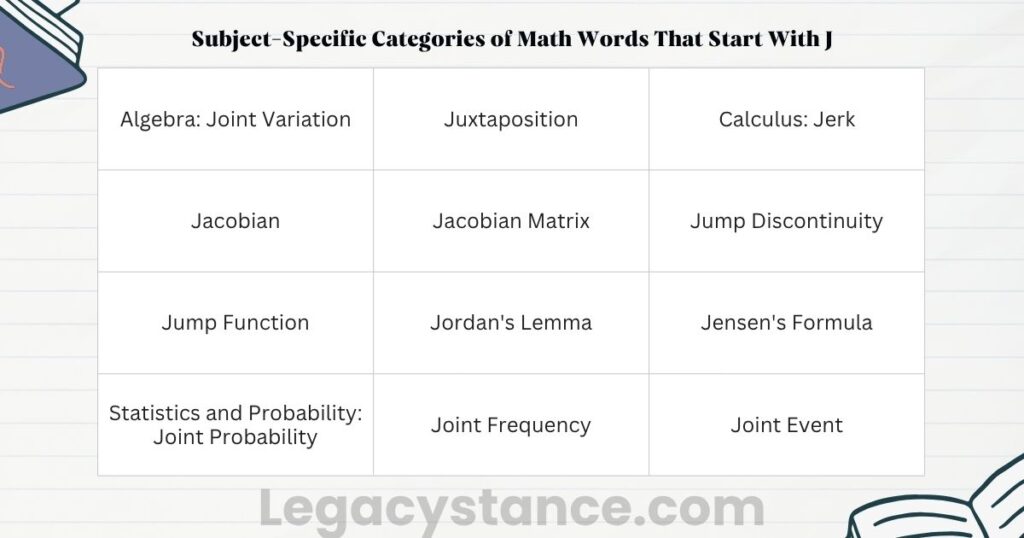
Algebra: Joint Variation, Juxtaposition
Calculus: Jerk, Jacobian, Jacobian Matrix, Jump Discontinuity, Jump Function, Jordan’s Lemma, Jensen’s Formula
Statistics and Probability: Joint Probability, Joint Frequency, Joint Event, Joint Distribution, Joint Density Function, Joint Probability Mass Function, Joint Cumulative Distribution, Joint Marginal Distribution, Joint Sample Space
Linear Algebra: Jordan Block, Jordan Matrix, Jordan Normal Form, Jordan Canonical Form, Jordan Decomposition
Geometry and Topology: Jordan Curve, Jordan Arc, Johnson Solid, Johnson’s Theorem, J-Curve
Abstract and Higher Math: Jensen’s Inequality, Jordan Algebra, Jordan Measure, Jacobi Identity, Jacobi Symbol, Jacobi Polynomials, Jacobi Elliptic Functions, Jacobi Triple Product, Jet, Julia Set
Applied and Computational Math: Jacobi Method, Josephus Problem, Joukowski Transform, J-Integral, Johnson Graph, Johnson Bound
Real-World Applications of Math Words That Start With J
Engineering: Jerk is minimized when designing elevator systems and roller coasters. The J-Integral tells structural engineers when a cracked metal component will fail.
Aerodynamics: The Joukowski Transform is the mathematical tool that first allowed engineers to model lift over a wing using complex numbers.
Computer Science: The Jacobi Method powers iterative solvers in graphics engines. The Josephus Problem is a classic recursive algorithm challenge taught in computer science courses.
Cryptography: The Jacobi Symbol and Jacobi Elliptic Functions appear in modern encryption and primality-testing algorithms.
Data Science and Machine Learning: Joint distributions and Jensen’s Inequality are foundational — almost every probabilistic model relies on them.
Pure Mathematics: Julia Sets, Jordan’s Lemma, and Jensen’s Formula are not just theoretical curiosities — they actively drive research in dynamical systems and complex analysis.
Commonly Confused J Math Words
Jordan Normal Form vs. Jordan Canonical Form
These are the same thing. Different textbooks use different names. They describe the same matrix structure.
Jacobian vs. Jacobian Matrix
The Jacobian Matrix is the full array of partial derivatives. The Jacobian (or Jacobian determinant) is just the determinant of that matrix. One is a matrix; the other is a single number.
Jordan Arc vs. Jordan Curve
Both are simple, non-self-intersecting curves. A Jordan arc has two open endpoints. A Jordan curve closes on itself to form a loop.
Joint Frequency vs. Joint Probability
Joint frequency is a raw count from a data table. Joint probability is that count divided by the total — a proportion between 0 and 1, not a raw number.
Joint Distribution vs. Joint Density Function vs. Joint Probability Mass Function
Joint distribution is the general concept. Joint density function applies specifically to continuous variables. Joint probability mass function applies specifically to discrete variables.
Julia Set vs. Mandelbrot Set
The Mandelbrot Set varies the parameter c and asks which values keep the orbit bounded. A Julia Set fixes c and varies the starting point. They come from the same formula but ask different questions.
Read also:
100+ Math Words That Start With L
45+ Math Words That Start With Q
FAQs about Math Words That Start With J
1. Which math words that start with J are most useful for students?
For most students, the most practical terms are Joint Probability, Joint Event, Joint Frequency, Joint Variation, and Jump Discontinuity. These appear more often in school math courses and standardized exams than advanced terms like Jacobian or Jordan Algebra.
2. Why are so many math terms named after people?
Many mathematical discoveries are named after the mathematicians who developed them. Terms such as Jacobian, Jacobi Method, Jordan Curve, and Jensen’s Inequality honor researchers whose work made lasting contributions to mathematics and science.
3. Are these J math words used outside the classroom?
Yes. Many of them have real-world applications. Engineers use Jerk and the J-Integral, data scientists work with Joint Distributions, cryptographers use the Jacobi Symbol, and aerospace engineers apply the Joukowski Transform when studying airflow around wings.
4. What is the difference between a Jacobian and a Jacobian Matrix?
A Jacobian Matrix contains first-order partial derivatives of a function. The Jacobian usually refers to the determinant of that matrix. In simple terms, one is a matrix of values, while the other is a single number calculated from that matrix.
Conclusion
From jerk and joint probability in middle and high school to the Jacobian, Julia Sets, and Jordan Normal Form in university courses, math words that start with J span an impressive range. This list covers 45+ verified terms across algebra, calculus, geometry, statistics, linear algebra, and advanced mathematics — each one genuinely belonging in the subject.
Use this as a reference, a study tool, or a starting point for deeper exploration. Every definition here is accurate, every term is real, and every example is original.