Learning Math Words That Start With W can help students understand math lessons, homework, and everyday problem-solving more easily. From basic terms like width and whole number to advanced ideas such as Wronskian and Wiener Process, these words appear across many areas of mathematics.
This guide brings together important W math vocabulary in one place. Each term includes a simple meaning, an example, and practical context so learners, parents, and teachers can quickly find clear explanations without getting lost in complicated definitions.
Quick List: Math Words That Start With W
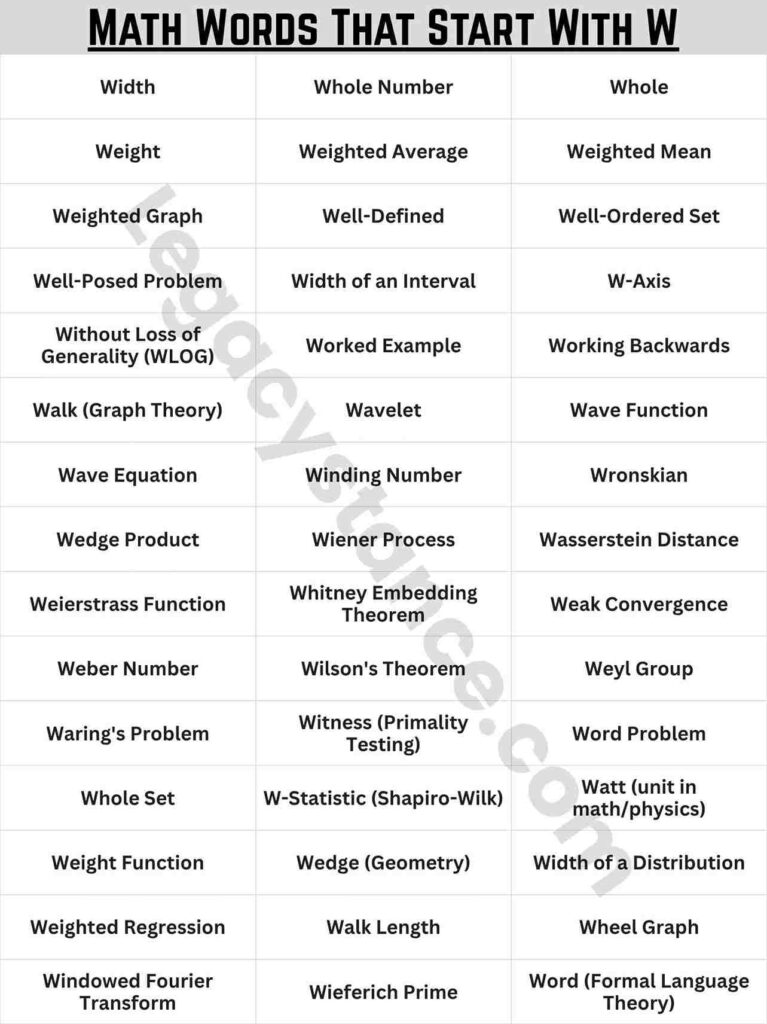
- Width
- Whole Number
- Whole
- Weight
- Weighted Average
- Weighted Mean
- Weighted Graph
- Well-Defined
- Well-Ordered Set
- Well-Posed Problem
- Width of an Interval
- W-Axis
- Without Loss of Generality (WLOG)
- Worked Example
- Working Backwards
- Walk (Graph Theory)
- Wavelet
- Wave Function
- Wave Equation
- Winding Number
- Wronskian
- Wedge Product
- Wiener Process
- Wasserstein Distance
- Weierstrass Function
- Whitney Embedding Theorem
- Weak Convergence
- Weber Number
- Wilson’s Theorem
- Weyl Group
- Waring’s Problem
- Witness (Primality Testing)
- Word Problem
- Whole Set
- W-Statistic (Shapiro-Wilk)
- Watt (unit in math/physics)
- Weight Function
- Wedge (Geometry)
- Width of a Distribution
- Weighted Regression
- Walk Length
- Wheel Graph
- Windowed Fourier Transform
- Wieferich Prime
- Word (Formal Language Theory)
- Wythoff’s Game
- Weil Conjecture
- Waterman Polyhedron
- Witch of Agnesi
- Weakly Increasing Sequence
Common Math Words That Start With W
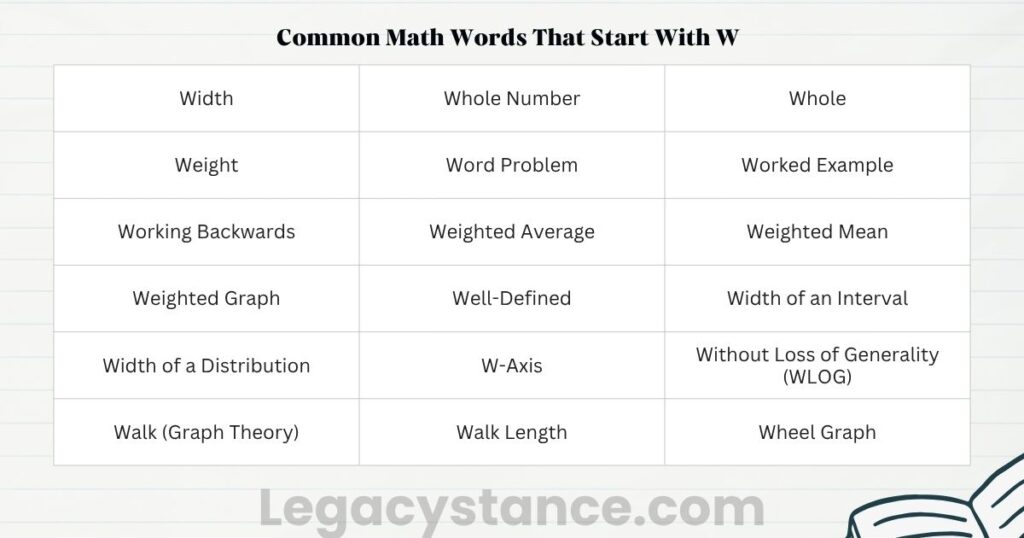
1. Width
Meaning: The measurement of a shape from side to side — its horizontal span.
Example: A rectangle is 9 cm long and 4 cm wide. Width = 4 cm.
Use: Appears in area (length × width), perimeter, and volume formulas.
2. Whole Number
Meaning: Any non-negative integer — 0, 1, 2, 3, 4 … — with no decimal or fractional part.
Example: 6, 0, and 25 are whole numbers. The number 4.5 is not.
Use: Foundation of counting, arithmetic, and number classification.
3. Whole
Meaning: The complete unit. In fractions, “the whole” = 1 — the full amount before any part is taken.
Example: A pie cut into 6 slices — all 6 slices together make the whole.
Use: Essential for understanding fractions, ratios, and percentages.
4. Weight
Meaning: Two uses in math:
- In measurement: how heavy an object is (grams, kg, pounds).
- In statistics: a value assigned to reflect how much a data point matters.
Example (measurement): The bag weighs 3 kilograms.
Example (statistics): The final exam is weighted at 70% of the grade.
Use: Measurement problems, weighted averages, probability.
5. Word Problem
Meaning: A math problem written in plain language that requires identifying the operation and solving it.
Example: “A train travels 60 km/h for 3 hours. How far does it go?” Answer: 60 × 3 = 180 km.
Use: Tests ability to translate real situations into math expressions.
6. Worked Example
Meaning: A fully solved problem shown step-by-step to model a method.
Example: Solving 3x − 6 = 9: Add 6 → 3x = 15. Divide by 3 → x = 5.
Use: Teaching tool; helps students understand strategy before attempting new problems.
7. Working Backwards
Meaning: A problem-solving strategy where you start from the answer and reverse the steps to find the unknown.
Example: After spending $12 and $9, Maya has $24 left. Working backwards: $24 + $9 + $12 = $45. She started with $45.
Use: Algebra, logic puzzles, algorithms, and inverse problems.
8. Weighted Average
Meaning: An average where each value is multiplied by its assigned weight before summing. Values with higher weights pull the average more.
Formula: Σ(value × weight) ÷ Σ(weights)
Example: Score of 80 (30%) and 90 (70%) → (80 × 0.3) + (90 × 0.7) = 24 + 63 = 87.
Use: Grade calculation, stock indices, polling, economics.
9. Weighted Mean
Meaning: The formal statistical term for weighted average. Computed identically — multiply each value by its weight, sum those products, divide by total weights.
Example: Items priced $5, $10, $20 with quantities 10, 4, 2 → Weighted Mean = (50 + 40 + 40) ÷ 16 = $8.13.
Use: Data analysis, cost accounting, survey results.
10. Weighted Graph
Meaning: A graph where each edge carries a numerical value (weight) representing cost, distance, or time between nodes.
Example: A map of cities where the edge between City A and City B shows 250 km.
Use: Shortest-path algorithms (Dijkstra’s), network routing, GPS navigation.
11. Well-Defined
Meaning: A math operation or object is well-defined when it gives the same result regardless of how the input is expressed.
Example: Adding fractions is well-defined: 1/2 + 1/3 = 2/4 + 2/6 — both give 5/6.
Use: Proof writing, set theory, abstract algebra.
12. Width of an Interval
Meaning: The length of an interval on the number line: right endpoint minus left endpoint.
Example: Interval [4, 13] has width = 13 − 4 = 9.
Use: Riemann sums in calculus, class width in frequency tables, real analysis.
13. Width of a Distribution
Meaning: A measure of how spread out data values are — often described by range, interquartile range, or standard deviation.
Example: Dataset {2, 4, 4, 6, 8}: range = 8 − 2 = 6. The distribution has a width of 6.
Use: Descriptive statistics, comparing datasets, understanding variability.
14. W-Axis
Meaning: The fourth coordinate axis in a four-dimensional space, used alongside X, Y, and Z.
Example: A 4D point: (x, y, z, w) = (1, 2, 3, 4).
Use: Theoretical mathematics, spacetime in physics, computer graphics (homogeneous coordinates).
15. Without Loss of Generality (WLOG)
Meaning: A phrase in proofs meaning: by choosing one convenient case, the argument covers all similar cases without repeating the proof for each.
Example: WLOG assume a ≤ b. The proof works the same if a and b are swapped.
Use: Formal proofs, logic, combinatorics.
16. Walk (Graph Theory)
Meaning: A sequence of vertices connected by edges where both vertices and edges may be repeated.
Example: A → B → C → B → D is a valid walk (vertex B is visited twice).
Use: Network analysis, algorithms, connectivity problems.
17. Walk Length
Meaning: The number of edges in a walk in a graph.
Example: The walk A → B → C → D has length 3 (three edges).
Use: Graph theory, algorithm complexity, network distances.
18. Wheel Graph
Meaning: A graph formed by connecting a single central vertex to all vertices of a cycle. Denoted Wₙ.
Example: W₄ has a central hub connected to a square (4 outer vertices), giving 8 edges.
Use: Graph theory, topology, combinatorics.
19. Wedge (Geometry)
Meaning: A solid with a rectangular base and a triangular cross-section — shaped like a door stopper.
Example: A wedge with base 6 cm, height 4 cm, and length 10 cm.
Use: Volume problems, engineering, 3D geometry.
20. Watt
Meaning: A unit of power equal to one joule per second. In applied mathematics and physics, watts appear in energy equations and engineering calculations.
Example: A 60-watt bulb consumes 60 joules of energy per second.
Use: Physics-based math problems, unit conversion, energy calculations.
21. Weber Number
Meaning: A dimensionless number in fluid dynamics comparing inertial force to surface tension force.
Formula: We = ρv²L ÷ σ
Use: Applied mathematics, engineering, fluid mechanics problems.
22. Weight Function
Meaning: A function w(x) that assigns different importance to different values of x in an integral or sum.
Example: In weighted integration: ∫ w(x) f(x) dx — the function w(x) scales the contribution of f(x) at each x.
Use: Numerical analysis, Gaussian quadrature, approximation theory.
23. Weighted Regression
Meaning: A version of linear regression where each data point is assigned a weight, giving some observations more influence over the fitted line.
Example: Recent sales data might be given higher weight than older data when fitting a trend line.
Use: Statistics, data science, econometrics.
24. W-Statistic (Shapiro-Wilk)
Meaning: A test statistic used in the Shapiro-Wilk test to assess whether a dataset comes from a normal distribution. Values close to 1 suggest normality.
Example: W = 0.97 for a dataset suggests it is approximately normally distributed.
Use: Statistical testing, data analysis, research.
Advanced Math Words That Start With W
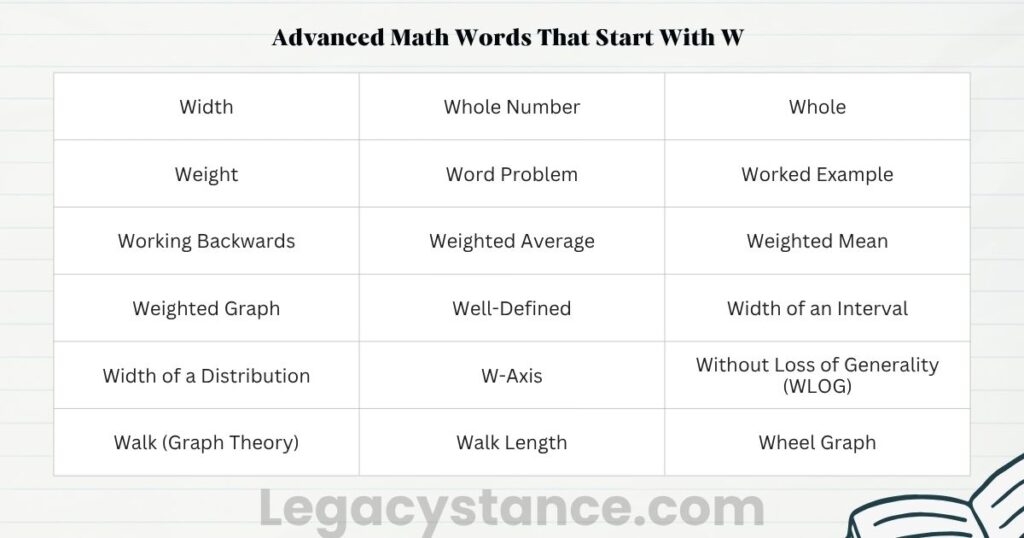
25. Winding Number
Meaning: Counts how many times a closed curve winds around a given point in the complex plane. Counterclockwise = positive, clockwise = negative.
Branch: Complex analysis, topology
Use: Complex integration, residue theorem, polygon point-in-polygon tests.
26. Wronskian
Meaning: A determinant used to test whether a set of functions is linearly independent. For two functions f and g: W = f·g′ − f′·g. If W ≠ 0, the functions are independent.
Branch: Differential equations, linear algebra
Use: Solving systems of differential equations.
27. Wave Function
Meaning: A mathematical function describing the quantum state of a particle. Its squared magnitude gives the probability of finding the particle at a location.
Branch: Mathematical physics, differential equations
Use: Quantum mechanics, semiconductor design, atomic modeling.
28. Wave Equation
Meaning: A partial differential equation describing how waves (sound, light, seismic) travel through space over time.
Form: ∂²u/∂t² = c² ∂²u/∂x²
Branch: PDEs, mathematical physics
Use: Acoustics, seismology, electromagnetic wave design.
29. Wavelet
Meaning: A small oscillating function localized in both time and frequency, used to analyze signals at multiple scales simultaneously.
Branch: Signal processing, applied mathematics
Use: Image compression (JPEG 2000), medical imaging, audio processing.
30. Wedge Product
Meaning: An anti-commutative operation combining vectors: u ∧ v = −(v ∧ u). Produces a bivector representing an oriented area.
Branch: Exterior algebra, differential geometry
Use: Differential forms, multivariable calculus, modern physics.
31. Wiener Process
Meaning: A continuous-time random process modeling unpredictable motion where increments are statistically independent and normally distributed. Also called Brownian motion mathematically.
Branch: Probability theory, stochastic calculus
Use: Stock price modeling, diffusion in physics, financial mathematics (Black-Scholes).
32. Wasserstein Distance
Meaning: Measures how different two probability distributions are by calculating the minimum “cost” to transform one into the other. Also called Earth Mover’s Distance.
Branch: Probability, optimization
Use: Machine learning (generative models), statistics, optimal transport.
33. Weierstrass Function
Meaning: A function that is continuous everywhere but differentiable nowhere — infinitely jagged at every scale. Disproved the assumption that continuity implies some smoothness.
Branch: Real analysis
Use: Counterexample in analysis, foundation of rigorous calculus.
34. Weak Convergence
Meaning: A sequence of functions converges weakly if, when multiplied by any test function and integrated, the result converges — even if the functions don’t converge pointwise.
Branch: Functional analysis, measure theory
Use: Quantum mechanics, PDEs, modern probability.
35. Well-Ordered Set
Meaning: A set with a total ordering where every non-empty subset has a least (smallest) element. Natural numbers are well-ordered; integers are not (negative integers have no minimum).
Branch: Set theory, logic
Use: Mathematical induction, Axiom of Choice, ordinal arithmetic.
36. Well-Posed Problem
Meaning: A problem that has a solution, the solution is unique, and the solution changes continuously with the initial data. Introduced by Hadamard.
Branch: Analysis, PDEs
Use: Checking validity of differential equation problems, numerical analysis.
37. Whitney Embedding Theorem
Meaning: Every smooth n-dimensional manifold can be smoothly embedded into Euclidean space of dimension 2n.
Branch: Differential topology
Use: Theoretical mathematics, geometric modeling, manifold theory.
38. Weyl Group
Meaning: A group of symmetries associated with a root system in a Lie algebra, generated by reflections.
Branch: Abstract algebra, Lie theory
Use: Representation theory, particle physics, algebraic geometry.
39. Wilson’s Theorem
Meaning: A prime number p satisfies (p−1)! ≡ −1 (mod p). This is true if and only if p is prime.
Branch: Number theory
Use: Primality testing, number theory proofs.
40. Waring’s Problem
Meaning: Asks: for each positive integer k, what is the smallest number g(k) such that every positive integer can be written as a sum of at most g(k) perfect k-th powers?
Example: Every positive integer is the sum of at most 4 perfect squares (g(2) = 4).
Branch: Number theory
Use: Additive number theory, pure mathematics research.
41. Witness (Primality Testing)
Meaning: In the Miller-Rabin primality test, a witness is a number that proves a given number is composite. If no witness is found up to a limit, the number is probably prime.
Branch: Computational mathematics, number theory
Use: Cryptography, generating large primes for encryption.
42. Windowed Fourier Transform
Meaning: A version of the Fourier transform that analyzes a signal in short, overlapping time windows — allowing both frequency and time information to be captured simultaneously.
Branch: Signal processing, applied mathematics
Use: Audio analysis, speech recognition, radar processing.
43. Wieferich Prime
Meaning: A prime p where 2^(p−1) ≡ 1 (mod p²). Only two are known: 1093 and 3511.
Branch: Number theory
Use: Fermat’s Last Theorem research, number theory.
44. Word (Formal Language Theory)
Meaning: A finite sequence of symbols from an alphabet. The empty word (no symbols) is denoted ε.
Example: Over alphabet {a, b}: “abba” is a word of length 4.
Branch: Discrete mathematics, theoretical computer science
Use: Automata theory, compiler design, formal grammars.
45. Wythoff’s Game
Meaning: A two-player mathematical game involving two piles of objects. Players take any amount from one pile, or equal amounts from both. The player who takes the last object wins.
Branch: Combinatorics, game theory
Use: Combinatorial game theory, recreational mathematics.
46. Weil Conjecture
Meaning: A set of conjectures (proved by Deligne in 1974) about the number of solutions to polynomial equations over finite fields, connecting algebraic geometry and number theory.
Branch: Algebraic geometry, number theory
Use: Pure mathematics, structure of algebraic varieties.
47. Waterman Polyhedron
Meaning: A family of polyhedra generated from sphere packings, discovered by Steve Waterman. They have irregular but highly symmetric structures.
Branch: Geometry, combinatorics
Use: Geometric modeling, architectural design, mathematical art.
48. Witch of Agnesi
Meaning: A bell-shaped cubic curve with equation y = 8a³ ÷ (x² + 4a²). Named after Maria Agnesi — though “witch” is a mistranslation of the Italian word versiera (turning curve).
Branch: Calculus, analytic geometry
Use: Calculus integration practice, historical mathematics, curve analysis.
49. Weakly Increasing Sequence
Meaning: A sequence where each term is greater than or equal to the previous term. Allows equal consecutive values, unlike a strictly increasing sequence.
Example: 2, 3, 3, 5, 7 is weakly increasing. 2, 3, 2, 5 is not.
Branch: Analysis, combinatorics
Use: Monotone sequence theorems, sorting algorithms, real analysis proofs.
50. W-Curve (Watt’s Curve)
Meaning: A curve traced by a point on a linkage mechanism designed by James Watt. It produces a figure-eight-like shape used in mechanical engineering.
Branch: Geometry, mechanical mathematics
Use: Engineering kinematics, mechanical linkage design.
Real-World Applications of Math Words That Start With W
Measurement and everyday math:
- Width, weight, whole number, and watt appear in construction, cooking, science labs, and daily calculation.
Statistics and data science:
- Weighted average, weighted mean, weighted regression, width of a distribution, and W-statistic are standard tools in data analysis, research, and machine learning.
Finance and probability:
- Wiener Process drives the Black-Scholes options pricing model. Wasserstein Distance is central to training AI image generators.
Engineering and physics:
- Wave equation, wavelet, windowed Fourier transform, and Weber number are used in acoustics, image compression, fluid mechanics, and signal design.
Computer science and cryptography:
- Walk, weighted graph, witness (primality), word (formal language), and wheel graph appear in algorithms, network design, and encryption systems.
Pure mathematics:
- Wronskian, Weil Conjecture, Weierstrass Function, Wilson’s Theorem, and Waring’s Problem are landmarks in analysis, number theory, and algebraic geometry.
Commonly Confused W Math Terms
Whole Number vs. Natural Number
Natural numbers usually start at 1. Whole numbers start at 0. The difference matters in formal proofs and set theory, even if textbooks sometimes treat them the same.
Weighted Average vs. Weighted Mean
These are the same calculation — just different names used in different contexts. “Weighted average” is common in everyday language and education; “weighted mean” is the formal statistical term.
Walk vs. Path (Graph Theory)
A walk allows repeated vertices and edges. A path does not allow repetition. Every path is a walk, but not every walk is a path.
Wavelet vs. Wave Function
A wavelet is a signal analysis tool from applied mathematics. A wave function is a quantum mechanical concept from physics. They share the word “wave” but have no direct connection.
Well-Defined vs. Well-Ordered
Well-defined = a math object gives consistent results regardless of representation. Well-ordered = every non-empty subset of a set has a minimum element. Two unrelated concepts.
Witch of Agnesi vs. a literal witch
The name is a mistranslation. The curve is called versiera in Italian (meaning “turning”), which was mistranslated as avversiera (witch). It is a smooth bell-shaped curve — nothing mysterious about it mathematically.
Read more:
57+ Math Words That Start With U: Meanings, Examples, and Uses
50+ Math Words That Start With V – With Meanings and Examples
FAQs about Math Words That Start With W
What are the most important Math Words That Start With W for students?
For most students, the key terms are width, whole number, weight, weighted average, word problem, and worked example. These appear often in school math and build a strong foundation for learning more advanced topics later.
Why should I learn math vocabulary words?
Math vocabulary helps you understand instructions, solve problems faster, and explain your answers clearly. Knowing the correct terms can also make new concepts easier to learn because you already understand the language used in math.
What is the difference between a weighted average and a regular average?
A regular average treats all values equally. A weighted average gives some values more importance than others. For example, a final exam may count more toward a grade than a homework assignment.
Are advanced W math words useful outside school?
Yes. Terms such as weighted regression, wavelet, Wiener Process, and Wasserstein Distance are used in data science, engineering, finance, artificial intelligence, and scientific research.
Which W math word is easiest for young learners?
Width is usually one of the easiest. Children encounter it early when measuring objects, drawing shapes, and learning basic geometry concepts.
Conclusion
This guide covers 50 math words starting with W — from width and whole number at the beginner level, through weighted average and walk at intermediate level, all the way to Wronskian, Wiener Process, and Weierstrass Function at the advanced level. Each word belongs to a specific branch of mathematics and serves a real purpose, whether in a classroom, a research paper, or a real-world application. Build your vocabulary layer by layer — the foundational words first, the advanced terms as your math deepens.