OTG most commonly means “On the Go” in texting and online chat. It tells the other person you’re physically busy or in motion but still active online. In specific situations, it can also mean “On the Game,” “Off the Grid,” or “On the Grind.”
The meaning can shift depending on context — so knowing the full picture helps whether you’re reading it or sending it.
What OTG Means in Everyday Texting
When someone sends “OTG rn, ttyl,” they’re telling you they’re in motion — maybe heading somewhere, running errands, or caught between tasks. It’s a status update in three letters.
The reason it works so well is that it sets expectations without being rude. Instead of leaving someone on read, you’re saying: I see your message, I’m just busy right now.
Real examples:
- “Can’t talk, OTG to the airport.”
- “OTG — I’ll call you when I’m free.”
- “Just woke up and already OTG lol.”
It replaced longer phrases like “I’m kind of busy right now” because texting rewards speed and brevity.
What OTG Means on Snapchat, TikTok, and Instagram
On Snapchat, OTG shows up in stories and quick replies. Someone filming from a car, rushing to class, or moving through a crowd will caption it “OTG” to explain the vibe without a paragraph.
It also manages expectations. If your contact says “OTG all day,” they’re telling you replies will be slow — not that they’re ignoring you.
On TikTok and Instagram, creators use it the same way. A quick “OTG to the venue” or “posting OTG” signals the content is raw and real — shot while busy, not staged at home.
All the Other Meanings of OTG
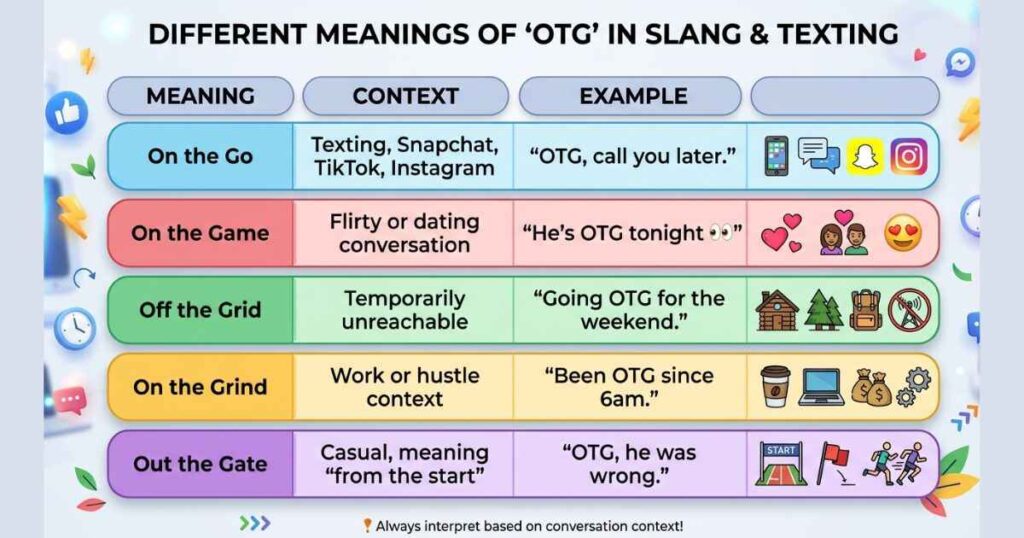
“On the Go” covers the vast majority of uses, but OTG does carry different meanings in specific contexts:
| Meaning | Context | Example |
| On the Go | Texting, Snapchat, TikTok, Instagram | “OTG, call you later.” |
| On the Game | Flirty or dating conversation | “He’s OTG tonight 👀” |
| Off the Grid | Temporarily unreachable | “Going OTG for the weekend.” |
| On the Grind | Work or hustle context | “Been OTG since 6am.” |
| Out the Gate | Casual, meaning “from the start” | “OTG, he was wrong.” |
Reading the surrounding conversation tells you which meaning fits. “On the Game” comes with obvious flirty energy. “Off the Grid” usually comes with a warning that someone won’t be reachable. In a normal text from a friend, it’s almost always just “On the Go.”
How OTG Compares to AFK, BRB, and Similar Terms
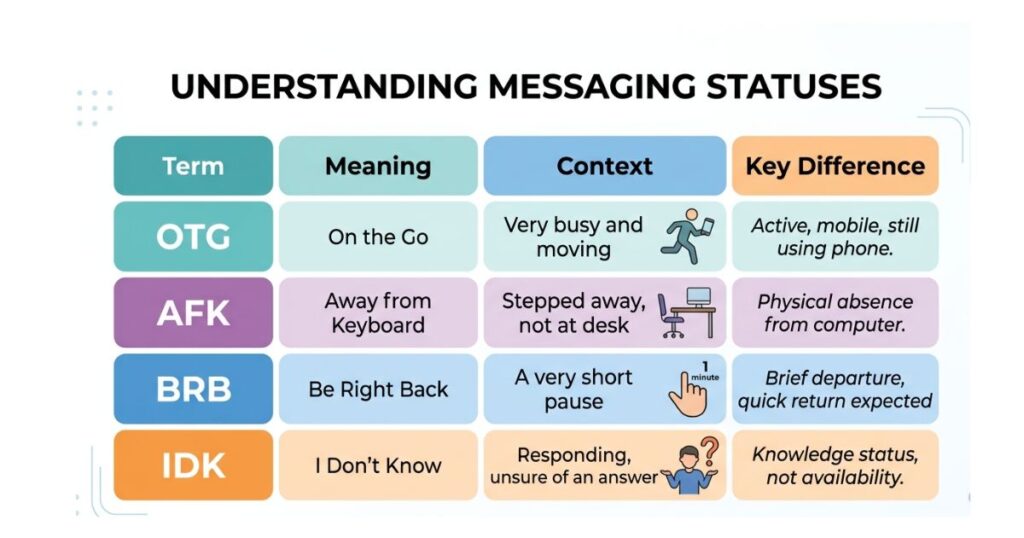
OTG gets searched alongside other availability abbreviations a lot. Here’s exactly where they differ:
| Term | Meaning | What Makes It Different |
| OTG | On the Go — busy and moving | Active, just out and about |
| AFK | Away from Keyboard | Stepped away, not responding |
| BRB | Be Right Back | Short pause, back soon |
| IDK | I Don’t Know | Not about availability at all |
OTG sits in a unique spot. It’s not being gone like AFK, and it’s not a short break like BRB. It describes a sustained busy state — where you’re still on your phone, just not sitting still.
OTG in Gaming
OTG isn’t a core gaming term. In Discord servers and game lobbies, players say AFK, BRB, or “in queue” for availability. If someone in a gaming space uses OTG, they’ve borrowed it from regular texting.
One nuance: in chats that mix gaming with social talk, OTG occasionally means “On the Game” — as in, actively playing and available to link up. Still rare, still context-dependent.
OTG in Tech — A Completely Different Meaning
If you searched OTG and landed on phone or USB results, that’s a separate meaning entirely. In mobile technology, OTG stands for On-The-Go USB — a standard that lets a phone act like a computer by connecting USB devices like keyboards or flash drives directly to it.
This has nothing to do with texting. In a tech forum or product review, OTG almost certainly refers to the USB standard, not a chat abbreviation.
OTG in Medical Contexts
OTG is not a standard medical acronym. In clinical settings or formal documents, you might occasionally see it used as institution-specific shorthand — but it carries no universal medical definition the way terms like ECG or BMI do.
If OTG appears in a medical document, check that document’s own glossary. Don’t assume it means anything from texting slang.
Common Misunderstandings
Thinking it means they’re offline. OTG people are still on their phones — they’re just moving around while they reply. It doesn’t mean unreachable.
Mixing up “On the Game” and “On the Go.” This happens when someone sends OTG with no context. Flirty conversation? “On the Game” is a fair read. Normal text from a friend? It’s “On the Go.”
Confusing it with tech. Totally understandable — OTG is a real term in phone settings. But in a personal text, it’s almost never about USB.
Read more:
OTS Meaning: What It Stands For in Texting, House Plans, and More
IRT Meaning: What It Stands For in Texts, Emails, and Official Documents
FAQs
Q: Someone texted me “OTG” — what does it mean for our conversation?
It means they’re busy and moving around but still around. You can keep the conversation going — they’ll reply when they have a moment. No need to overthink it.
Q: Is OTG a generational thing?
Mostly yes. It’s most natural among teens and people in their 20s who grew up texting in shorthand. If you’re messaging someone older who might not recognize it, adding a little context — like “OTG to work” — removes any guesswork.
Q: What’s the difference between OTG and just saying “on the move”?
They mean the same thing. “On the move” sounds slightly more formal and works better in speech. OTG is native to chat and fits the pace of texting naturally.
Q: Can OTG ever come across as dismissive?
In rare cases, if someone repeatedly replies with just “OTG” and nothing else, it can feel like a brush-off. Pairing it with a short extra line — “OTG, talk tonight” — keeps the tone warm and clear.
The Short Version
OTG almost always means “On the Go” — busy, out and about, but still reachable. The alternative meanings like “On the Game” or “Off the Grid” only surface when the context clearly points that way.
When you’re unsure, read the conversation around it. That’s the most reliable way to decode exactly what someone means.