Alr means “alright” — a fast, casual way to say okay or I agree without typing the full word. In some sentences, it also means “already.” Context decides which one fits.
That’s the quick answer. Now let’s make sure you actually understand how it works in real conversations, because the same three letters can mean something slightly different depending on what’s around them.
You Probably Saw ALR in a Message Like This
Someone asks: “You coming tonight?”
The reply: “alr”
No explanation. No punctuation. Just that.
For anyone not deep into texting culture, that reply feels oddly short. Is it a yes? Are they annoyed? Here’s the honest answer — it’s just a nod. A low-effort confirmation. The person typing it wasn’t being rude or cold. They just wanted to say “yeah, fine, sounds good” without making a whole thing out of it.
That’s exactly how “alr” functions. It keeps conversations moving without adding unnecessary words.
The Second ALR Meaning Most People Don’t Catch
Here’s where it gets worth paying attention to.
“Alr” doesn’t lock into one meaning. Swap the context and it shifts to “already.”
- “I’m alr outside” → already outside
- “I alr told him” → already told him
- “She alr knows” → already knows
The pattern is straightforward once you see it. When the sentence is about something completed or a situation currently in place, alr is almost always “already.” When someone’s responding to a plan or question, it’s “alright.”
If you try reading both meanings and one sounds off, the other one fits. That’s the whole trick.
ALR in Real Examples
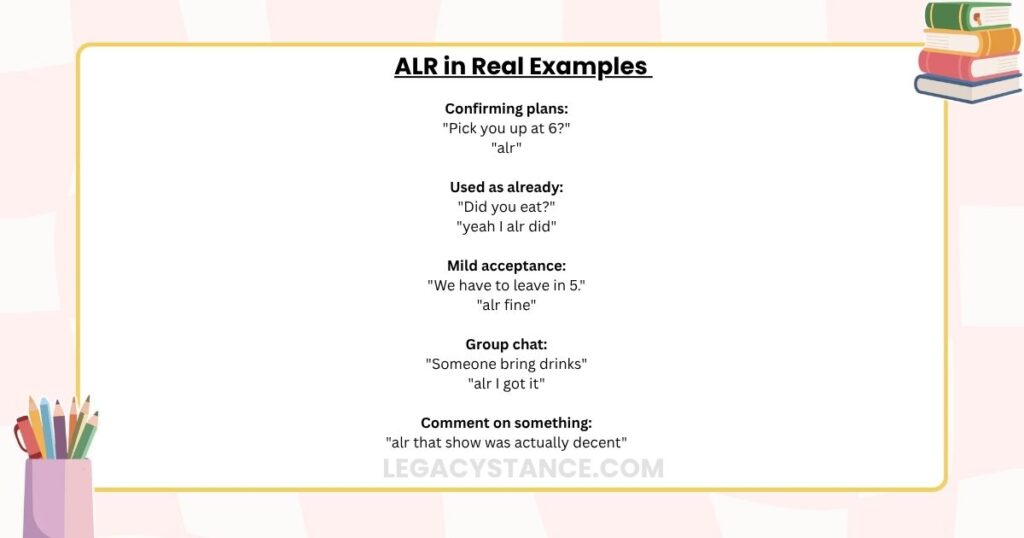
Different situations, different tones — this is how it actually shows up:
Confirming plans:
“Pick you up at 6?”
“alr”
Used as already:
“Did you eat?”
“yeah I alr did”
Mild acceptance:
“We have to leave in 5.”
“alr fine”
Group chat:
“Someone bring drinks”
“alr I got it”
Comment on something:
“alr that show was actually decent”
None of these carry strong emotion. That’s intentional. “Alr” is a low-temperature word — it doesn’t signal excitement or frustration on its own. The rest of the message carries the mood.
Does ALR Come Across as Rude?
Depends on who’s reading it.
Among people who text casually all day, “alr” reads as completely normal. Nobody blinks at it. But someone who isn’t used to internet shorthand might find a single-word reply cold or dismissive — even when the sender meant nothing by it.
The sender almost never thinks about this. It comes out automatically, like typing “lol” without actually laughing. If you’re unsure whether the person you’re texting will take it well, just write “alright.” Same meaning, less chance of misreading.
The Combos That Change the Vibe Slightly
Once you start noticing “alr,” you’ll see it paired with other words:
- “alr bet” — strong agreement. “Bet” already means “for sure,” so together they’re doubling down.
- “alr alr” — slightly more enthusiastic than one “alr” alone. Like “okay okay, got it.”
- “alr then” — has a faint edge of resignation. Not always, but sometimes.
Plain “alr” is neutral. The word it gets paired with shifts the tone, even if just a little.
Where ALR Means Something Completely Different
If you searched this because you saw ALR in a document, legal paper, or clinical setting — that’s a different thing entirely.
In law, ALR stands for American Law Reports, a resource legal professionals use for case analysis. In certain medical and technical fields, it’s also used as a clinical abbreviation. Neither of these has anything to do with texting.
Same letters, completely separate worlds. The context of where you saw it will make it obvious which one applies.
ALR in Business Messages
There’s no established business meaning for alr. If a coworker used it in a Slack message or casual work text, they’re just using regular slang — not some professional term. It hasn’t crossed into formal workplace language in any real way. If you see it in a work context, treat it the same as you would in any casual message.
Read more:
IGU Meaning in Text — What Those Three Letters Actually Mean
What Does BTA Mean? (And Why the Same Letters Confuse So Many People)
FTM Meaning: What It Means in Texts and Everyday Conversations
FAQ’s
Can “alr” mean both alright and already with the same person in one conversation?
Yes — and it happens constantly. Someone might text “alr, see you soon” and then “I alr got the tickets” in the same thread. The meaning shifts based on the sentence, not the person or the platform.
Is it the same as “ok” or “k”?
Close, but not identical. “K” reads the coldest of the three — many people find it passive-aggressive in certain contexts. “Ok” is neutral. “Alr” sits between them, a little warmer than “k” but still minimal. The difference is subtle, but most regular texters feel it.
Should I use it with someone older or in a professional setting?
Generally no. Unless you know the person is comfortable with casual internet language, shorthand like this can come across as lazy or unclear. With friends your own age, it’s completely natural. With a manager, professor, or anyone you’re trying to impress — write the full word.
Is “alr” mainly a Snapchat thing?
It’s common on Snapchat because short replies fit the format, but it’s everywhere — iMessage, WhatsApp, TikTok comments, Instagram DMs, X. The platform doesn’t define the word. The casual tone of the conversation does.
The Part That Actually Matters
Understanding “alr” isn’t just about knowing the definition. It’s about reading the message correctly so you don’t assume someone’s being short with you when they’re just being efficient.
A one-word reply isn’t always a bad sign. Sometimes it’s just how people text when they’re comfortable enough not to perform enthusiasm they don’t feel.
Alr = alright when someone’s agreeing or confirming something.
Alr = already when the sentence is about something done or in progress.
ALR in formal contexts is a professional abbreviation with no connection to slang.
That’s the whole picture — no missing pieces.