TMO means “Take Me Out” in texts and social media. In rugby, it’s Television Match Official. In road or council documents, it’s Traffic Management Order. Same letters, three completely different contexts.
You’re staring at a message that just says “TMO tonight?” and you have no idea if that’s an invitation, a sports reference, or something else entirely. That gap between seeing a term and actually getting it is exactly what this article closes.
The TMO Slang Meaning — What Most People Are Here For
In everyday texting and DMs, TMO = Take Me Out.
It’s casual, usually warm, sometimes flirty. Someone sends it when they want to be taken somewhere — a date, dinner, a drive, anything that gets them out of the house. The energy behind it is almost always light. You wouldn’t use TMO in a serious conversation or a formal message.
Real examples, different formats:
“TMO, I can’t sit inside one more day 😭”
Her: Three weekends straight at home.
You: So?
Her: TMO or I’m finding better friends lol
Comment under a restaurant post: “TMO next time pls 😩”
Notice the pattern — there’s always a little feeling behind it. TMO isn’t neutral slang like “btw” or “lmk.” It carries a want with it.
There’s a second slang meaning people skip: TMO can also mean Tomorrow in fast, casual chat. “Let’s sort it TMO” = let’s sort it tomorrow. Less common, but real. The sentence around it usually makes it obvious which one applies — just read past the abbreviation itself.
When a Girl Sends You TMO
Searches for this come up constantly, so let’s be direct.
When a girl texts you TMO, she’s almost always hinting at wanting you to make plans or ask her out. It’s rarely a demand — more like a nudge, sometimes a test to see what you do next. Ignoring it or pretending you missed it is the wrong move. Actually making a plan is the right one.
TMO on TikTok and Instagram
On TikTok, TMO shows up in captions and comments with the “Take Me Out” meaning almost every time. Someone posts a night-out video captioned “TMO energy only 🥂” — they’re not referencing rugby rules.
Instagram works the same way. Friends tag each other, caption stories with it, drop it in comment sections when they want to be included in plans. The slang meaning is fully at home on both platforms and has stayed consistent for a while now — though social media slang always shifts, so reading the full caption first never hurts.
TMO in Rugby — Completely Different Territory
Switch to a sports article or a live match broadcast and TMO means Television Match Official.
This is a trained official — not a player, not the main referee — who watches video replays from multiple camera angles to help the referee make the correct call on difficult decisions. The referee on the field can refer a moment to the TMO when they’re unsure about something they couldn’t see clearly in real time.
The TMO gets involved most often when:
- A player dives for the try line and ball-grounding isn’t clear
- There’s a possible forward pass before a try was scored
- Foul play happened away from the main action and was missed live
Rugby fans have mixed feelings about the TMO process. It slows the game down. But it also catches things that would otherwise be decided incorrectly. That’s the permanent trade-off in using it.
TMO in Traffic and Road Documents
Find TMO in a council letter, parking notice, or road announcement — that’s Traffic Management Order.
It’s a legal document local authorities use to create enforceable rules around parking, road layouts, speed restrictions, and similar things. Completely separate from slang or sport. If you’re reading one, the rest of the document makes the context obvious.
Most people only encounter this meaning if they’re dealing with parking appeals, planning paperwork, or local government correspondence.
TMO in a Hospital or Medical Setting
No single fixed meaning exists here. Different hospitals and departments use TMO differently — some expand it as “Treating Medical Officer,” others use it for something else entirely.
If TMO appeared in a patient file, prescription, or hospital document: don’t guess. Ask the staff directly or check the document’s own glossary. Medical abbreviations are the one place where assuming the wrong meaning actually matters.
Which TMO Meaning Fits — Fast Reference
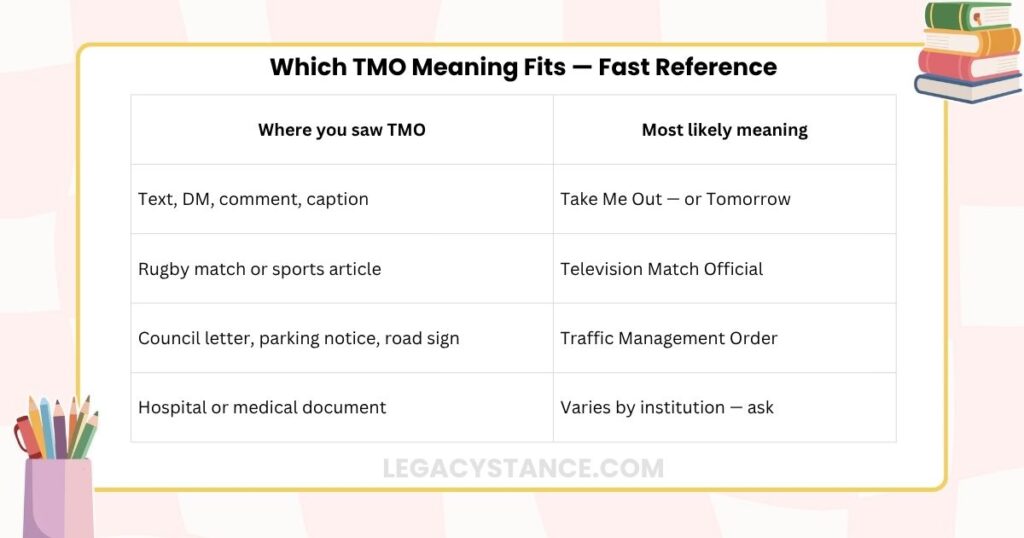
| Where you saw TMO | Most likely meaning |
| Text, DM, comment, caption | Take Me Out — or Tomorrow |
| Rugby match or sports article | Television Match Official |
| Council letter, parking notice, road sign | Traffic Management Order |
| Hospital or medical document | Varies by institution — ask |
The Two Mistakes People Keep Making
Mistake one: Assuming TMO has only one meaning and applying it everywhere. Someone reads it in a sports article and thinks it’s slang. Someone else sees it in a text and starts looking up rugby. The letters are identical — what they stand for isn’t.
Mistake two: Forgetting that “Tomorrow” is a real slang meaning too. In faster, shorthand-heavy conversations, people shorten “tomorrow” to TMO just to save keystrokes. If someone says “let’s talk TMO” and you reply asking where you’re going — that’s the mix-up in action.
The Thing Most Explanations Don’t Mention
From what shows up consistently in real online conversations, TMO almost always carries emotion with it in the slang context. Nobody sends it flatly. There’s longing behind it, or humor, or a quiet hope that someone will actually follow through. That’s what separates it from purely functional abbreviations.
When someone sends you TMO, they’re not passing along information. They’re asking for something.
Read also:
SMFH Meaning: What Those 4 Letters Are Really Saying
FWM Meaning: What It Really Means in Texts, DMs, and Online
WGFT Meaning — What It Really Means in Texts, Chats, and Online
FAQs about TMO
Can TMO mean “Take Me Out” and “Tomorrow” in the same conversation without it being confusing?
It can, but it rarely happens cleanly. Most conversations settle into one meaning based on the topic. If someone uses TMO for “tomorrow” early on and then says “TMO tonight?” — that’s a genuine contradiction, and they probably just switched meanings mid-chat. The surrounding sentences almost always clarify which one they intended.
Is TMO used more by a specific age group?
In practice, it shows up most among teenagers and people in their early-to-mid twenties. Older adults tend to write “tomorrow” or “take me out” in full. But slang doesn’t enforce age limits — anyone who texts casually can pick it up.
Why does one short abbreviation carry so many different meanings?
Because abbreviations grow independently in separate communities — sports organizations, texting culture, government offices — without any coordination between them. Rugby TMO existed before it became texting slang. Traffic Management Orders developed in completely separate professional spaces. Nobody coordinates these things. They just happen in parallel.
If I respond to TMO with the wrong meaning, is it a big deal?
Not really. Slang mix-ups happen all the time. A quick “wait, did you mean take me out or tomorrow?” fixes it immediately. The only place where getting TMO wrong actually matters is in a medical or legal document — in those cases, always confirm the meaning from the source rather than guessing.